Nalindren Naicker
1and Manoj S. Maharaj
21ICT and Society Research Group, Durban University of Technology, Durban, South Africa 2University of Kwa-Zulu Natal, Durban, South Africa
Investigating Agile Requirements
Engineering Practices in the South
African Software Development Market
The aim of this research study was to assess Agile RE practices in the South African software development industry and investigate secure Agile RE initiatives towards developing secure products. This qualita-tive research study was contextualized in seventeen South African software development companies. The researchers used structured interviews and document reviews as the primary data collection instruments. Qualitative data was analyzed inductively using con-tent analysis. Emanating from the research were rec-ommendations to guide a regular software developer on good Agile RE practices. The study concluded that although Agile Software Development is practiced in the South African software industry, there needs to be stricter adherences to the Agile Manifesto and Agile Security Manifesto in requirements engineering.
ACM CCS (2012) Classification: Software and its en-gineering → Software creation and management → Designing software → Requirements analysis
Software and its engineering → Software creation and management → Software development process man-agement → Software development methods → Agile software development
Keywords: agile software development, customer col-laboration, requirements, engineering, requirements prioritization, security requirements
1. Introduction
In requirements engineering (RE), information regarding the features of the system is collect-ed from the customer. These features are in the form of functional and non-functional require-ments. In traditional software development
practice, RE takes place at the beginning of the software development process and is a once off process [1]. In order to meet the rapid demands for web and mobile applications, many soft-ware development practitioners are implement-ing Agile Software Development (ASD) [2]. Requirements engineering (RE), the earliest stage of software engineering, is the focus of this research study. Rigorous processes during this stage can ensure the development of high quality products that are safe to use in the soft-ware applications market.
In ASD, Agile RE is an iterative process, as this development methodology builds the system incrementally within a rapidly changing busi-ness environment [3]. Therefore, in Agile RE, requirements cannot be frozen [4]. Changes in requirements are created as a result of compet-itive threats on the market, stakeholders chang-ing their preferences, changes in the develop-ment technology and short time required for the product to get to the market [5]. Agile RE is therefore dynamic and complicated.
Agile RE is also constrained by a number of factors. A combination of project factors such as schedule, risk, costs and human resources are constraining RE processes. In addition, the nature of the requirements is another constrain-ing factor, as requirements have complexity, dependencies, importance, business value and volatility [4].
takes place in practice may not necessarily cor-respond with what is recommended in the Agile Manifesto [11]. It is difficult to reach consen-sus when there are multiple stakeholders and multiple decision making criteria [4]. Clearly, both developers and clients have a role in the decision making and their input on the value of the requirement in real world practice is signif-icant.
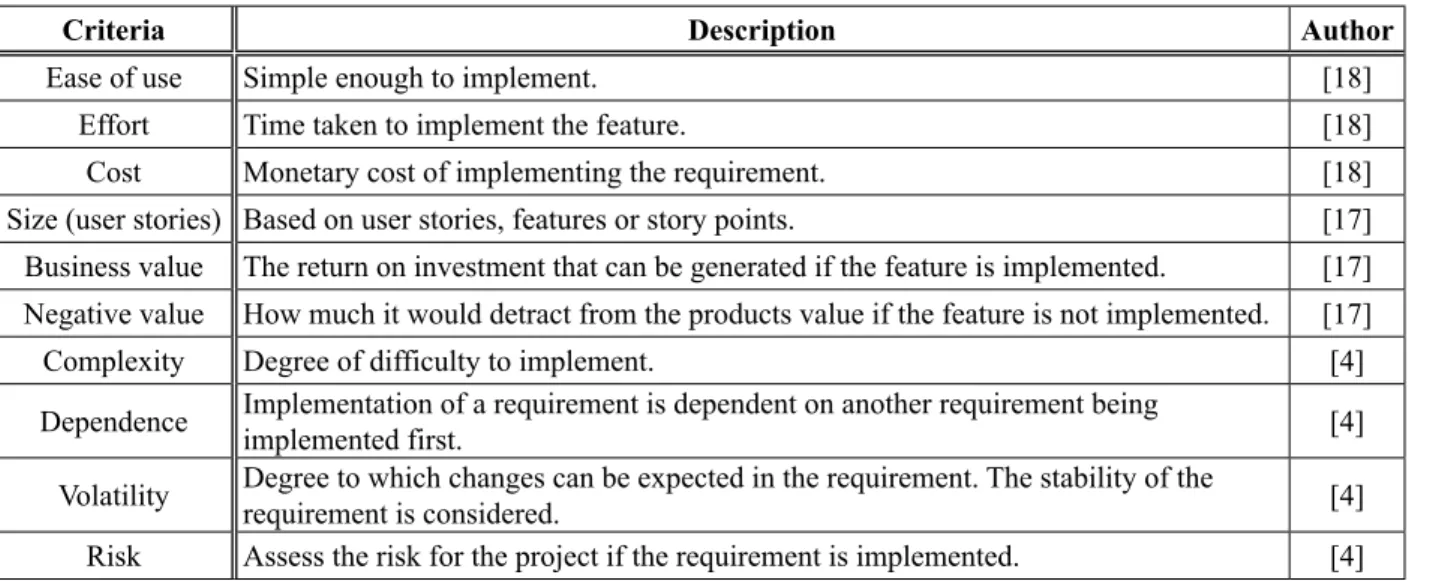
There are various criteria identified in literature for requirements prioritization. A pertinent ex-ample is a criterion called 'negative value' intro-duced by Racheva in [17]. Table 1, synthesized from ASD literature, provides typical prioriti-zation criteria that can be applied using an ap-propriate prioritization technique.
Appropriate prioritization technique is import-ant as erroneous prioritization may increase the cost of development and lead to system and project failure [4]. Therefore, a proper require-ments prioritization technique is critical to en-sure that the requirements engineering process is efficient [19].
Sebega and Mnkandla in [10] state that there is a lack of focus from practitioners in handling non-functional requirements such as security and this constitutes a major problem in Agile RE. Security literature abounds with Security Requirements Engineering (SRE) frameworks or methodologies that guide secure software development activities for requirement engi-neering. It is a systematic way to elicit security this stage are resolved through meetings with
stakeholders, modeling and prioritization [3]. The industry standard for Agile RE for analysis of requirements are JAD sessions [10]. Con-flicts are resolved through workshop sessions where all stakeholders get involved to negotiate and resolve conflicts. A communication gap be-tween IT specialists and customers leads to in-complete or incorrect requirements. Sebega and Mnkandla in [10] state that requirements nego-tiation, requirements prioritization and scalabil-ity problems are some of the issues that impair the analysis of requirements. Once the conflicts are resolved, the lists of requirements are ready to be prioritized.
In ASD requirements, prioritization occurs during the initial planning stage and then at the time of inter-iteration. Prioritization and repri-oritization are based on business value. Contin-uous requirements prioritization is thus a core activity of Agile RE [4]. This ensures that the highly ranked requirements important for the project get developed first. This will bring the highest business value to the customer and low-er the project risk by ensuring delivlow-erables to the customer [17].
However, practitioners are confronted with difficulties in making decisions about which requirements should be considered at the in-ter-iteration time. Although developers are very skilled and are the most influential stakehold-ers, it is the client who should make the final decision on the priority of a requirement. What
Table 1. Criteria for requirements prioritization.
Criteria Description Author
Ease of use Simple enough to implement. [18]
Effort Time taken to implement the feature. [18]
Cost Monetary cost of implementing the requirement. [18] Size (user stories) Based on user stories, features or story points. [17] Business value The return on investment that can be generated if the feature is implemented. [17] Negative value How much it would detract from the products value if the feature is not implemented. [17]
Complexity Degree of difficulty to implement. [4]
Dependence Implementation of a requirement is dependent on another requirement being implemented first. [4]
Volatility Degree to which changes can be expected in the requirement. The stability of the requirement is considered. [4] Risk Assess the risk for the project if the requirement is implemented. [4] development environment described above,
developers tend to focus less on RE activities that take time, for example the identification of security requirements or elicitation by pro-totyping, which is important for quality system development [6, 7]. It was, therefore, important to assess secure Agile RE practices.
The aim of this study was to assess Agile RE practices, including security, in order to con-tribute to the good professional practice of reg-ular software developer in Agile RE. Therefore, the study will attempt to answer the following question: What are the requirements engineer-ing practices in Agile RE in the South African software development landscape?
Researchers agree that there is a lack of empir-ical studies on how companies are conducting RE in Agile Software Development and much more research is required in this critical area [4, 8, 9, 10]. In order to close the research gap, there is a need to conduct an in-depth analysis of Agile RE practices to assess their impact on the development of high quality software apps that are safe to use.
2. Literature Review
To assess RE processes, in line with the re-search question, we review the extent of litera-ture from the existing body of knowledge. The four main values that underpin ASD out-lined in the ASD Manifesto [11] to promote quality products are, as follows.
1. Individuals and interactions over process-es and tools.
2. Working software over comprehensive documentation.
3. Customer collaboration over contract ne-gotiation.
4. Responding to change over following a plan.
Software developers transitioning to ASD must make a switch from traditional RE to Agile RE, with cumbersome traditional processes being permitted greater flexibility. Agile RE differs from traditional RE because it is ongoing or it-erative [12]. Inayat and Salim in [13] proposed the term Agile RE to describe a process derived
from flexibility in approaching traditional RE activities. Regardless of the RE approach, re-searchers are in agreement that RE plays an im-portant role in ASD.
Unlike traditional RE, Agile RE allows for changes in user requirements. By accommo-dating changes in user requirements, ASD en-sures that the outcome of the process are high quality requirements and customer satisfaction [1]. Therefore, ASD literature emphasizes that in gathering requirements, it is important to fo-cus on some key aspects. In this regard, Inayat and Salim in [13] advise that, owing to the high volatility of requirements, constant collabora-tion among stakeholders is important. They cit-ed communication and awareness as the most relevant socio-technical aspects of such col-laboration. Wurfel et al. in [14] also suggested that requirements engineers must be mindful of the vagueness in customers' requirements, and must remain open. Openness ensures that re-quirements engineers are not influenced by ex-isting software applications that they may have developed for another customer.
According to Schön in [2] in Agile, RE pro-cesses such as inception stage, elicitation stage, elaboration stage, negotiation stage, specifica-tion stage and validaspecifica-tion stage are not clear-ly separated. Kassab in [15] and Sebega and Mnkandla in [10] were in agreement with this finding. Classical activities are merged and conducted iteratively in the South African Ag-ile RE practice [10]. In AgAg-ile, RE is conducted just-in-time with little design upfront. Only the most important RE activities are elaborated. Requirements elicitation, the first stage, com-prises of problem solving, negotiation and specification [10]. Requirements are elicited through focus group sessions, interviews, brain-storming, questionnaires, discourse analysis and ethnography. Prototyping is another well-known strategy used to identify and determine the requirements from the customer perspec-tive. Requirements consistency, variability, list size and complexity derived from the elicitation stage can hinder Agile RE [10].
takes place in practice may not necessarily cor-respond with what is recommended in the Agile Manifesto [11]. It is difficult to reach consen-sus when there are multiple stakeholders and multiple decision making criteria [4]. Clearly, both developers and clients have a role in the decision making and their input on the value of the requirement in real world practice is signif-icant.
There are various criteria identified in literature for requirements prioritization. A pertinent ex-ample is a criterion called 'negative value' intro-duced by Racheva in [17]. Table 1, synthesized from ASD literature, provides typical prioriti-zation criteria that can be applied using an ap-propriate prioritization technique.
Appropriate prioritization technique is import-ant as erroneous prioritization may increase the cost of development and lead to system and project failure [4]. Therefore, a proper require-ments prioritization technique is critical to en-sure that the requirements engineering process is efficient [19].
Sebega and Mnkandla in [10] state that there is a lack of focus from practitioners in handling non-functional requirements such as security and this constitutes a major problem in Agile RE. Security literature abounds with Security Requirements Engineering (SRE) frameworks or methodologies that guide secure software development activities for requirement engi-neering. It is a systematic way to elicit security this stage are resolved through meetings with
stakeholders, modeling and prioritization [3]. The industry standard for Agile RE for analysis of requirements are JAD sessions [10]. Con-flicts are resolved through workshop sessions where all stakeholders get involved to negotiate and resolve conflicts. A communication gap be-tween IT specialists and customers leads to in-complete or incorrect requirements. Sebega and Mnkandla in [10] state that requirements nego-tiation, requirements prioritization and scalabil-ity problems are some of the issues that impair the analysis of requirements. Once the conflicts are resolved, the lists of requirements are ready to be prioritized.
In ASD requirements, prioritization occurs during the initial planning stage and then at the time of inter-iteration. Prioritization and repri-oritization are based on business value. Contin-uous requirements prioritization is thus a core activity of Agile RE [4]. This ensures that the highly ranked requirements important for the project get developed first. This will bring the highest business value to the customer and low-er the project risk by ensuring delivlow-erables to the customer [17].
However, practitioners are confronted with difficulties in making decisions about which requirements should be considered at the in-ter-iteration time. Although developers are very skilled and are the most influential stakehold-ers, it is the client who should make the final decision on the priority of a requirement. What
Table 1. Criteria for requirements prioritization.
Criteria Description Author
Ease of use Simple enough to implement. [18]
Effort Time taken to implement the feature. [18]
Cost Monetary cost of implementing the requirement. [18] Size (user stories) Based on user stories, features or story points. [17] Business value The return on investment that can be generated if the feature is implemented. [17] Negative value How much it would detract from the products value if the feature is not implemented. [17]
Complexity Degree of difficulty to implement. [4]
Dependence Implementation of a requirement is dependent on another requirement being implemented first. [4]
Volatility Degree to which changes can be expected in the requirement. The stability of the requirement is considered. [4] Risk Assess the risk for the project if the requirement is implemented. [4] development environment described above,
developers tend to focus less on RE activities that take time, for example the identification of security requirements or elicitation by pro-totyping, which is important for quality system development [6, 7]. It was, therefore, important to assess secure Agile RE practices.
The aim of this study was to assess Agile RE practices, including security, in order to con-tribute to the good professional practice of reg-ular software developer in Agile RE. Therefore, the study will attempt to answer the following question: What are the requirements engineer-ing practices in Agile RE in the South African software development landscape?
Researchers agree that there is a lack of empir-ical studies on how companies are conducting RE in Agile Software Development and much more research is required in this critical area [4, 8, 9, 10]. In order to close the research gap, there is a need to conduct an in-depth analysis of Agile RE practices to assess their impact on the development of high quality software apps that are safe to use.
2. Literature Review
To assess RE processes, in line with the re-search question, we review the extent of litera-ture from the existing body of knowledge. The four main values that underpin ASD out-lined in the ASD Manifesto [11] to promote quality products are, as follows.
1. Individuals and interactions over process-es and tools.
2. Working software over comprehensive documentation.
3. Customer collaboration over contract ne-gotiation.
4. Responding to change over following a plan.
Software developers transitioning to ASD must make a switch from traditional RE to Agile RE, with cumbersome traditional processes being permitted greater flexibility. Agile RE differs from traditional RE because it is ongoing or it-erative [12]. Inayat and Salim in [13] proposed the term Agile RE to describe a process derived
from flexibility in approaching traditional RE activities. Regardless of the RE approach, re-searchers are in agreement that RE plays an im-portant role in ASD.
Unlike traditional RE, Agile RE allows for changes in user requirements. By accommo-dating changes in user requirements, ASD en-sures that the outcome of the process are high quality requirements and customer satisfaction [1]. Therefore, ASD literature emphasizes that in gathering requirements, it is important to fo-cus on some key aspects. In this regard, Inayat and Salim in [13] advise that, owing to the high volatility of requirements, constant collabora-tion among stakeholders is important. They cit-ed communication and awareness as the most relevant socio-technical aspects of such col-laboration. Wurfel et al. in [14] also suggested that requirements engineers must be mindful of the vagueness in customers' requirements, and must remain open. Openness ensures that re-quirements engineers are not influenced by ex-isting software applications that they may have developed for another customer.
According to Schön in [2] in Agile, RE pro-cesses such as inception stage, elicitation stage, elaboration stage, negotiation stage, specifica-tion stage and validaspecifica-tion stage are not clear-ly separated. Kassab in [15] and Sebega and Mnkandla in [10] were in agreement with this finding. Classical activities are merged and conducted iteratively in the South African Ag-ile RE practice [10]. In AgAg-ile, RE is conducted just-in-time with little design upfront. Only the most important RE activities are elaborated. Requirements elicitation, the first stage, com-prises of problem solving, negotiation and specification [10]. Requirements are elicited through focus group sessions, interviews, brain-storming, questionnaires, discourse analysis and ethnography. Prototyping is another well-known strategy used to identify and determine the requirements from the customer perspec-tive. Requirements consistency, variability, list size and complexity derived from the elicitation stage can hinder Agile RE [10].
In summary, the ASD literature suggests that practitioners of software development do not clearly agree on standardized Agile RE prac-tices. The lack of coherent and consolidated views on Agile RE makes this a valuable re-search area [13]. The literature has highlight-ed requirements elicitation, security, customer involvement, analysis and prioritization of re-quirements as the focal points.
A review was conducted on prior work to gauge the methodologies used to analyze software de-velopment markets. The literature revealed the lack of studies conducted in the software devel-opment market on Agile methodology in South Africa. Sebega and Mnkandla in [10] conduct-ed a quantitative study in order to understand 'Agile processes' in the software development market in South Africa. Selecting a sampling frame was a challenge in this study, since there was only a vague idea of the target population. A list of all Agile companies in South Africa is non-existent. Researchers relied on a published list of the Top500, that is, a repository of the best managed companies in South Africa. A non-probabilistic sampling technique was used and more than 220 participants were contact-ed. A survey questionnaire was distributed to around 110 participants in the software devel-opment market. Only 25 participants responded to the survey. Issues in elicitation, analysis, doc-umentation, validation, and management were analyzed broadly through Likert-type ques-tions. This study revealed a strong penchant for principles of the Agile Manifesto. This research study follows on the Sebega and Mnkandla study in [10] with a more in-depth analysis of the South African software development mar-ket through a qualitative lens. Therefore, the qualitative methodology chosen is appropriate. An overview of international studies revealed numerous types of studies conducted on specif-ic industries in software development. Wagner
et al. in [25] conducted an international study of Agile requirements engineering in practice focusing on the status quo and critical problems in the industry. A non-probabilistic sampling technique was used. The study was based on the responses from 92 organisations in Austria, Germany, Ireland, Canada, USA, Estonia, Fin-land, Norway, Sweden and Brazil. The data was collected from 228 responses from the compa-nies classified as small, medium and large. The
survey results showed that RE concentrates on free-text documentation of requirements elicit-ed with a variety of techniques. The backlog is used to deal with changing requirements. There were several qualitative studies conduct-ed as well. Researchers in Ireland, namely, Noll
et al. in [26], conducted a qualitative study of an application in the Open Source Software De-velopment market. This study examined discus-sion forums of an open source project, namely OpenEMR, an open source medical practice management application. Through a qualitative analysis of 16 core developers they found out that end users play an important role in the de-velopment of open source software. In a quali-tative study on Agile RE with 16 organisations, Cao and Ramesh in [27] sought to answer two questions: What RE practices do Agile devel-opers follow? What benefits and challenges do these practices present? A multi-sited case study approach was used as a sampling tech-nique and grounded theory was used to analyze the data. The study identified seven Agile RE practices in the organizations.
The literature on the methodologies used to ana-lyze a software development market shows that both qualitative and quantitative studies were conducted. Quantitative studies focused on the surveys that involved a large number of partici-pants for general and broad findings on the Ag-ile software development market whilst quali-tative studies through interviews, focus groups and discussion forums with a smaller number of informants sort an inquiry with greater depth. This study conducted an analysis of Agile RE activities in the South African industry to gain more insight and provide critical review of the approaches used. The impact of the approaches used on the decisions taken to elicit and imple-ment non-functional requireimple-ments, such as the security of the system, was also of interest in this research study.
3. Setting and Methodology
In this qualitative study, the researchers sought to understand requirements engineering tices in Agile RE from the viewpoints of prac-titioners in the real life South African software development context. The following practices discussed in Agile RE literature were covered requirements to protect the system from
poten-tial attacks [8]. These frameworks vary in how security requirements are derived. For example, the misuse case and abuse case frameworks deal with security from the viewpoint that users mis-use the functionality of the system [20], while
risk-based frameworks extract security require-ments to mitigate the risks [21]. Haley et al. in [22] proposed a SRE framework which com-prised the following stages: functional require-ments identification, identification of security goals, identification of security requirements and finally the construction of satisfaction re-quirements.
In Agile RE, it is not quite clear how SRE takes place in a rapid release software development approach. The Agile Manifesto created in 2001 provided firm guidelines for software devel-opers in order to improve traditional practices [11]. Fifteen years later, in 2016, the Agile Se-curity Manifesto was launched to combat secu-rity problems that plagued software developers. The four principles of the Agile Security Mani-festo are, as follows [23].
1. Rely on developers and testers more than on security specialists.
2. Secure while we work more than after we're done.
3. Implement features securely more than adding on security features.
4. Mitigate risks more than fix bugs.
Principle 1 states that it is not possible for all companies to have security teams or spe-cialists. The process is rapid and lightweight, therefore security of the system depends on the ASD team that owns the security. This means that they must be trained and aware of security. According to principle 2, security must be in-corporated into ASD practices and should not be added as an afterthought. Principle 3 encour-ages the use of tried and tested security mea-sures, for example security frameworks such as authentication and password storage, to prevent developers from being detracted from focusing on the business value. Finally, principle 4 pro-motes security risks assessments over an ad hoc approach to security [23].
The SRE frameworks and approaches provid-ed by security researchers and practitioners in literature are complex and not customised
for lightweight Agile RE practices. The Agile Security Manifesto states that they must be blended naturally into Agile RE activities by requirements engineers who must be trained and be knowledgeable about application securi-ty issues. Requirements engineers must have an understanding of what type of security require-ments must be included in the system.
Haley et al. in [22] proposed how security can be factored into Agile XP requirements engi-neering practices. The approach focused on abuser stories. This means that it takes into consideration the actions of a hacker who in-tends to abuse the system and mitigates against these actions. The following Agile RE stages were suggested: identification of critical assets of the system; formulation of abuser stories; assessment of the abuser story to determine risk; negotiation between abuser and user sto-ries; identify security user stosto-ries; definition of security-related coding standards and, lastly, cross-checking abuser stories and countermea-sures against system abuse.
In summary, the ASD literature suggests that practitioners of software development do not clearly agree on standardized Agile RE prac-tices. The lack of coherent and consolidated views on Agile RE makes this a valuable re-search area [13]. The literature has highlight-ed requirements elicitation, security, customer involvement, analysis and prioritization of re-quirements as the focal points.
A review was conducted on prior work to gauge the methodologies used to analyze software de-velopment markets. The literature revealed the lack of studies conducted in the software devel-opment market on Agile methodology in South Africa. Sebega and Mnkandla in [10] conduct-ed a quantitative study in order to understand 'Agile processes' in the software development market in South Africa. Selecting a sampling frame was a challenge in this study, since there was only a vague idea of the target population. A list of all Agile companies in South Africa is non-existent. Researchers relied on a published list of the Top500, that is, a repository of the best managed companies in South Africa. A non-probabilistic sampling technique was used and more than 220 participants were contact-ed. A survey questionnaire was distributed to around 110 participants in the software devel-opment market. Only 25 participants responded to the survey. Issues in elicitation, analysis, doc-umentation, validation, and management were analyzed broadly through Likert-type ques-tions. This study revealed a strong penchant for principles of the Agile Manifesto. This research study follows on the Sebega and Mnkandla study in [10] with a more in-depth analysis of the South African software development mar-ket through a qualitative lens. Therefore, the qualitative methodology chosen is appropriate. An overview of international studies revealed numerous types of studies conducted on specif-ic industries in software development. Wagner
et al. in [25] conducted an international study of Agile requirements engineering in practice focusing on the status quo and critical problems in the industry. A non-probabilistic sampling technique was used. The study was based on the responses from 92 organisations in Austria, Germany, Ireland, Canada, USA, Estonia, Fin-land, Norway, Sweden and Brazil. The data was collected from 228 responses from the compa-nies classified as small, medium and large. The
survey results showed that RE concentrates on free-text documentation of requirements elicit-ed with a variety of techniques. The backlog is used to deal with changing requirements. There were several qualitative studies conduct-ed as well. Researchers in Ireland, namely, Noll
et al. in [26], conducted a qualitative study of an application in the Open Source Software De-velopment market. This study examined discus-sion forums of an open source project, namely OpenEMR, an open source medical practice management application. Through a qualitative analysis of 16 core developers they found out that end users play an important role in the de-velopment of open source software. In a quali-tative study on Agile RE with 16 organisations, Cao and Ramesh in [27] sought to answer two questions: What RE practices do Agile devel-opers follow? What benefits and challenges do these practices present? A multi-sited case study approach was used as a sampling tech-nique and grounded theory was used to analyze the data. The study identified seven Agile RE practices in the organizations.
The literature on the methodologies used to ana-lyze a software development market shows that both qualitative and quantitative studies were conducted. Quantitative studies focused on the surveys that involved a large number of partici-pants for general and broad findings on the Ag-ile software development market whilst quali-tative studies through interviews, focus groups and discussion forums with a smaller number of informants sort an inquiry with greater depth. This study conducted an analysis of Agile RE activities in the South African industry to gain more insight and provide critical review of the approaches used. The impact of the approaches used on the decisions taken to elicit and imple-ment non-functional requireimple-ments, such as the security of the system, was also of interest in this research study.
3. Setting and Methodology
In this qualitative study, the researchers sought to understand requirements engineering tices in Agile RE from the viewpoints of prac-titioners in the real life South African software development context. The following practices discussed in Agile RE literature were covered requirements to protect the system from
poten-tial attacks [8]. These frameworks vary in how security requirements are derived. For example, the misuse case and abuse case frameworks deal with security from the viewpoint that users mis-use the functionality of the system [20], while
risk-based frameworks extract security require-ments to mitigate the risks [21]. Haley et al. in [22] proposed a SRE framework which com-prised the following stages: functional require-ments identification, identification of security goals, identification of security requirements and finally the construction of satisfaction re-quirements.
In Agile RE, it is not quite clear how SRE takes place in a rapid release software development approach. The Agile Manifesto created in 2001 provided firm guidelines for software devel-opers in order to improve traditional practices [11]. Fifteen years later, in 2016, the Agile Se-curity Manifesto was launched to combat secu-rity problems that plagued software developers. The four principles of the Agile Security Mani-festo are, as follows [23].
1. Rely on developers and testers more
than on security specialists.
2. Secure while we work more than after we're done.
3. Implement features securely more than adding on security features.
4. Mitigate risks more than fix bugs.
Principle 1 states that it is not possible for all companies to have security teams or spe-cialists. The process is rapid and lightweight, therefore security of the system depends on the ASD team that owns the security. This means that they must be trained and aware of security. According to principle 2, security must be in-corporated into ASD practices and should not be added as an afterthought. Principle 3 encour-ages the use of tried and tested security mea-sures, for example security frameworks such as authentication and password storage, to prevent developers from being detracted from focusing on the business value. Finally, principle 4 pro-motes security risks assessments over an ad hoc approach to security [23].
The SRE frameworks and approaches provid-ed by security researchers and practitioners in literature are complex and not customised
for lightweight Agile RE practices. The Agile Security Manifesto states that they must be blended naturally into Agile RE activities by requirements engineers who must be trained and be knowledgeable about application securi-ty issues. Requirements engineers must have an understanding of what type of security require-ments must be included in the system.
Haley et al. in [22] proposed how security can be factored into Agile XP requirements engi-neering practices. The approach focused on abuser stories. This means that it takes into consideration the actions of a hacker who in-tends to abuse the system and mitigates against these actions. The following Agile RE stages were suggested: identification of critical assets of the system; formulation of abuser stories; assessment of the abuser story to determine risk; negotiation between abuser and user sto-ries; identify security user stosto-ries; definition of security-related coding standards and, lastly, cross-checking abuser stories and countermea-sures against system abuse.
and analyzed using content analysis. Appendix 3 contains a sample of the interview data and shows the kind of responses received to each question. Qualitative data was analyzed using content analysis through the thematic analysis approach with the assistance of a computer program called Nvivo Pro [7, 20]. In order to arrive at themes, codes were used. The study employed a coding scheme that was repeatable, transparent and led to objective findings. See appendix 3, appendix 4 and appendix 5.
Coding began by choosing a small number of well-defined labels (codes) for the transcript responses. Appendix 5 contains coding defi-nitions. This ensured that coding was straight-forward and could be completed quickly and easily. The codes that were assigned were all-in-clusive and mutually exall-in-clusive [31]. To explain using a concrete example from the study as a sample of how coding was processed, consider the question on ''Provide a detailed explanation of how the requirements were elicited for this project?''. The codes chosen for this question were 'Elicitation techniques'; 'Tools'; 'Specific teams'; 'Customer Involvement'; 'Role of Busi-ness Analyst'; 'Core RE activities'; 'Communi-cation'; 'Text Documents'. The code dimensions chosen were clear enough so that respondents' responses in the interview transcript could not fall into two codes at the same time. The next step was to codify the labels. This meant arrang-ing tharrang-ings in a systematic order by aggregatarrang-ing them into categories. The data was segregated or grouped or linked in order to consolidate meaning and explanation [31]. In the search for patterns in the data, similarly coded data was grouped into a single category. Intuition and tac-it knowledge were the skills required in coding and categorizing [31]. Taking an example, three categories, namely: 'Elicitation of Require-ments', 'Customer Involvement' and 'Output Documentation' emerged from the codes using the question in the above example. Overall, 21 categories were created in this study, as shown in appendix 4. A theme is an extended phrase or sentence that identifies a unit of the data. The theme chosen is the outcome of the coding and analytical reflection of the interviews and liter-ature review [31]. Taking the example forward, the three categories chosen, namely: 'Elicitation of Requirements', 'Customer Involvement' and 'Output Documentation' were clustered into the
theme 'Requirements Elicitation'. Appendix 4 contains the entire coding scheme for all inter-view questions.
Codes are used to give collected data meaning [32]. Coding was a way of indexing or catego-rizing the text in order to establish a framework of thematic ideas about it. Codes formed a fo-cus for thinking about the text and its interpre-tation. The codes used for this research project [33] were descriptive codes such as 'elicitation techniques', categorical codes such as 'security information sources' and analytical codes such as 'Core RE activities'. A computer program Nvivo Pro was used for filing and retrieving coded information. An inductive approach was used to arrive at the final thematic areas. Reliability and reproducibility of the data anal-ysis were enhanced by asking an external per-son to redo the analysis using the same coding definitions. Notes were compared with the ex-ternal source to validate the data analysis. The results showed strong correlation between the researcher and the external person. Further-more, more than one type of qualitative data, namely interviews and document analysis were used in the analysis. This allowed for triangu-lation of the results. The researcher ensured sampling adequacy through saturation and rep-lication [34]. Despite a small number of respon-dents in each company, the researcher was able to gauge saturation when no new insights were given by additional sources of data.
Based on the results of the content analysis and overriding themes, several findings were made.
4. Findings
Key themes within Agile RE emerged preced-ing the extensive literature review and the find-ings from the qualitative data analysis. Table 3 shows the clustering of related categories into themes.
Appendix 4 and Table 3 are the sources of the assessment of the RE practices in the South African software development market. The themes emanated corresponding to the research question were as follows: Theme 1: ments Elicitation; Theme 2: Security Require-ments Elicitation; Theme 3: Security approach; Theme 4: Security training; Theme 5: Custom-in the data collection: requirements elicitation,
requirements analysis, requirements prioritiza-tion, the security issue, customer involvement and a general idea about Agile RE satisfaction. A literature review on methodologies of pri-or wpri-ork in the software development revealed that both qualitative and quantitative studies were conducted with many studies opting for non-probabilistic sampling techniques.
In South Africa, the population of software de-velopment companies is unknown. In order to obtain a statistical figure, a LinkedIn search was conducted. The results of the search showed 165 software development companies. Using simple random sampling, one hundred software development companies were chosen for this research study. Simple random sampling is a technique where each member of the popula-tion has an equal chance of getting selected in the sample [28], thus making the results more applicable to general population.
Seventeen software companies responded to the researchers' invitation to participate in the research. The composition of the companies in terms of their fields was as follows: Gaming (5), Medical (3), Transport (1), Finance (2), Educa-tion (2) and Non-Specific (4). This cross-sec-tor analysis ensured that the results of Agile RE practices were not biased towards a single sector. The composition in terms of size was as follows: 'Less than 25 staff' (10); 'Between 25 and 50 staff' (5) and '50 and more staff' (2). A non-probability, purposive sampling approach called quota sampling was used to select infor-mants from the sample population, ensuring the inclusion and representation of all five stake-holder categories from the sample, namely: business analyst, product owner, customer/cli-ent proxy, project manager and developer [28].
Thus, while the companies were chosen ran-domly from the population, stakeholder catego-ries were chosen purposively from the sample. Table 2 shows involvement of the stakeholders from different companies.
Appendix 2 provides further details on the pro-file of the companies chosen for the research. The data was collected through structured in-terviews and document analyses. Documents analyzed were the Business Requirements Documents and use case diagrams. According to Silverman in [29], an interview helps us to generate the data which gives authentic insight into people's experiences. Interviews permit informants to give detailed information that cannot be obtained by a survey [30]. Seventeen face-to-face interviews were conducted with open ended questions for an average duration of one hour per interview.
The interview schedule was created according to important aspects of Agile RE, such as elic-itation, analysis, analysis and prioritization of requirements, documentation and security dis-cussed in the literature review. The questions were carefully crafted to explore Agile RE practices and developed in accordance with the study aim. The issues chosen for the interviews were outlined in the literature review in studies such as [3, 4, 8, 10, 15, 18, 20, 27].
Face-to-face interviews sought detailed expe-riences, motives, and opinions from the per-spective of experts in the field. Interviews were audio recorded. Questions on the interview schedule were enumerated, which made them easy to reference during the analysis. The re-searchers ensured that the recording was audi-ble for the transcriber and sufficient time was allocated for transcribing. Transcripts were produced from audio recordings of interviews
Table 2. Involvement of stakeholders.
Stakeholder Company Number Interviewed Business Analyst Gaming (1) and Finance (2) 3
Product Owner Gaming (2) and Medical (2) 4
Customer Transport (1) and Gaming (2) 3
Project Manager Education (2) 2
and analyzed using content analysis. Appendix 3 contains a sample of the interview data and shows the kind of responses received to each question. Qualitative data was analyzed using content analysis through the thematic analysis approach with the assistance of a computer program called Nvivo Pro [7, 20]. In order to arrive at themes, codes were used. The study employed a coding scheme that was repeatable, transparent and led to objective findings. See appendix 3, appendix 4 and appendix 5.
Coding began by choosing a small number of well-defined labels (codes) for the transcript responses. Appendix 5 contains coding defi-nitions. This ensured that coding was straight-forward and could be completed quickly and easily. The codes that were assigned were all-in-clusive and mutually exall-in-clusive [31]. To explain using a concrete example from the study as a sample of how coding was processed, consider the question on ''Provide a detailed explanation of how the requirements were elicited for this project?''. The codes chosen for this question were 'Elicitation techniques'; 'Tools'; 'Specific teams'; 'Customer Involvement'; 'Role of Busi-ness Analyst'; 'Core RE activities'; 'Communi-cation'; 'Text Documents'. The code dimensions chosen were clear enough so that respondents' responses in the interview transcript could not fall into two codes at the same time. The next step was to codify the labels. This meant arrang-ing tharrang-ings in a systematic order by aggregatarrang-ing them into categories. The data was segregated or grouped or linked in order to consolidate meaning and explanation [31]. In the search for patterns in the data, similarly coded data was grouped into a single category. Intuition and tac-it knowledge were the skills required in coding and categorizing [31]. Taking an example, three categories, namely: 'Elicitation of Require-ments', 'Customer Involvement' and 'Output Documentation' emerged from the codes using the question in the above example. Overall, 21 categories were created in this study, as shown in appendix 4. A theme is an extended phrase or sentence that identifies a unit of the data. The theme chosen is the outcome of the coding and analytical reflection of the interviews and liter-ature review [31]. Taking the example forward, the three categories chosen, namely: 'Elicitation of Requirements', 'Customer Involvement' and 'Output Documentation' were clustered into the
theme 'Requirements Elicitation'. Appendix 4 contains the entire coding scheme for all inter-view questions.
Codes are used to give collected data meaning [32]. Coding was a way of indexing or catego-rizing the text in order to establish a framework of thematic ideas about it. Codes formed a fo-cus for thinking about the text and its interpre-tation. The codes used for this research project [33] were descriptive codes such as 'elicitation techniques', categorical codes such as 'security information sources' and analytical codes such as 'Core RE activities'. A computer program Nvivo Pro was used for filing and retrieving coded information. An inductive approach was used to arrive at the final thematic areas. Reliability and reproducibility of the data anal-ysis were enhanced by asking an external per-son to redo the analysis using the same coding definitions. Notes were compared with the ex-ternal source to validate the data analysis. The results showed strong correlation between the researcher and the external person. Further-more, more than one type of qualitative data, namely interviews and document analysis were used in the analysis. This allowed for triangu-lation of the results. The researcher ensured sampling adequacy through saturation and rep-lication [34]. Despite a small number of respon-dents in each company, the researcher was able to gauge saturation when no new insights were given by additional sources of data.
Based on the results of the content analysis and overriding themes, several findings were made.
4. Findings
Key themes within Agile RE emerged preced-ing the extensive literature review and the find-ings from the qualitative data analysis. Table 3 shows the clustering of related categories into themes.
Appendix 4 and Table 3 are the sources of the assessment of the RE practices in the South African software development market. The themes emanated corresponding to the research question were as follows: Theme 1: ments Elicitation; Theme 2: Security Require-ments Elicitation; Theme 3: Security approach; Theme 4: Security training; Theme 5: Custom-in the data collection: requirements elicitation,
requirements analysis, requirements prioritiza-tion, the security issue, customer involvement and a general idea about Agile RE satisfaction. A literature review on methodologies of pri-or wpri-ork in the software development revealed that both qualitative and quantitative studies were conducted with many studies opting for non-probabilistic sampling techniques.
In South Africa, the population of software de-velopment companies is unknown. In order to obtain a statistical figure, a LinkedIn search was conducted. The results of the search showed 165 software development companies. Using simple random sampling, one hundred software development companies were chosen for this research study. Simple random sampling is a technique where each member of the popula-tion has an equal chance of getting selected in the sample [28], thus making the results more applicable to general population.
Seventeen software companies responded to the researchers' invitation to participate in the research. The composition of the companies in terms of their fields was as follows: Gaming (5), Medical (3), Transport (1), Finance (2), Educa-tion (2) and Non-Specific (4). This cross-sec-tor analysis ensured that the results of Agile RE practices were not biased towards a single sector. The composition in terms of size was as follows: 'Less than 25 staff' (10); 'Between 25 and 50 staff' (5) and '50 and more staff' (2). A non-probability, purposive sampling approach called quota sampling was used to select infor-mants from the sample population, ensuring the inclusion and representation of all five stake-holder categories from the sample, namely: business analyst, product owner, customer/cli-ent proxy, project manager and developer [28].
Thus, while the companies were chosen ran-domly from the population, stakeholder catego-ries were chosen purposively from the sample. Table 2 shows involvement of the stakeholders from different companies.
Appendix 2 provides further details on the pro-file of the companies chosen for the research. The data was collected through structured in-terviews and document analyses. Documents analyzed were the Business Requirements Documents and use case diagrams. According to Silverman in [29], an interview helps us to generate the data which gives authentic insight into people's experiences. Interviews permit informants to give detailed information that cannot be obtained by a survey [30]. Seventeen face-to-face interviews were conducted with open ended questions for an average duration of one hour per interview.
The interview schedule was created according to important aspects of Agile RE, such as elic-itation, analysis, analysis and prioritization of requirements, documentation and security dis-cussed in the literature review. The questions were carefully crafted to explore Agile RE practices and developed in accordance with the study aim. The issues chosen for the interviews were outlined in the literature review in studies such as [3, 4, 8, 10, 15, 18, 20, 27].
Face-to-face interviews sought detailed expe-riences, motives, and opinions from the per-spective of experts in the field. Interviews were audio recorded. Questions on the interview schedule were enumerated, which made them easy to reference during the analysis. The re-searchers ensured that the recording was audi-ble for the transcriber and sufficient time was allocated for transcribing. Transcripts were produced from audio recordings of interviews
Table 2. Involvement of stakeholders.
Stakeholder Company Number Interviewed Business Analyst Gaming (1) and Finance (2) 3
Product Owner Gaming (2) and Medical (2) 4
Customer Transport (1) and Gaming (2) 3
Project Manager Education (2) 2
also revealed socio-technical tension between requirements engineers and developers.
Table 4 below shows the summary of findings for theme 1.
Table 4. Summary of findings for requirements elicitation.
Noticed Agile RE practices In 14 out of 17 companies the business analyst elicited all requirements. Team not involved.
Prototyping was used in 4 out of 17 companies as an elicitation technique.
Business Requirements Document generated by the business analyst in 14 out of 17 companies.
5 companies had a business analyst on their staff. Business analyst works independently of the ASD team in 16 out of 17 companies.
Customers need to play a more active role in the elicitation of requirements in 16 out of 17 companies. Business analyst establishes viewpoints in 14 out of 17 companies.
Viewpoints captured in Business Requirements Document in all companies.
Business analyst clarifies users' viewpoints when necessary in 15 out of 17 companies.
Theme 2: Security requirements identifica-tion. Security requirements focus on protect-ing assets of the system and prevent unautho-rised access and violation of system assets. Common practices in Agile RE are that large companies have dedicated security teams who have established processes to ensure that secu-rity requirements are identified. Small to me-dium companies rely on the discretion of the software development team, such as business analyst or team leader, for identification of se-curity requirements during requirements engi-neering. Generally, in these companies, securi-ty requirements are limited in number and are generic. Security requirements are identified as system enhancements when there is a violation, or when the customer specifically requests it. Sebega & Mnkandla in [10] concur with this finding as they suggest a lack of integration in Agile RE of non-functional requirements such as security.
Table 5 below shows the summary of findings for theme 2.
Table 5. Summary of findings for security requirements identification.
Noticed Agile RE practices
Security requirements identified by the business ana-lyst in 11 out of 17 companies
Insufficient security requirements identified in 14 out of 17 companies.
Security requirements identified at coding when there is a glaring issue in 10 out of 17 companies.
Security requirements identified are generic (not customised) in 10 out of 17 companies.
Customer requirements are only specified when the company experienced a security violation in another project and wanted to mitigate upfront in the new project. This was the case in 7 out of 17 companies. Security requirements were identified after a system violation in 11 out of 17 companies.
Theme 3: Security approach. A security ap-proach in requirements engineering is to deploy a systematic method to unravel and identify security requirements. In software engineering literature, this RE process is known as securi-ty requirements engineering. Interviews, Busi-ness Requirements Documents and informal discussions with developers have showed that small to medium companies have not adopted any known approaches to security. It was the duty of the business analyst (a subject matter and domain expert) through consultation with the client to specify security requirements at the requirements engineering phase. Owing to the business analyst's limited knowledge on secu-rity, very few to no security requirements were elicited. Security approaches in general may be factored into the design and development under the following circumstances:
1. developer requests for security approaches during coding;
2. customer requests security during require-ments engineering;
3. business analyst includes security through consultation with the client and client se-curity policies during requirements engi-neering.
er Involvement; Theme 6: Prioritisation of Re-quirements and Theme 7: ASD RE Satisfaction. The study findings are discussed below, in terms of the themes that emanated following the coding.
4.1. Discussion under Themes
Theme 1: Requirements elicitation. Require-ments elicitation in RE focuses on ensuring that high quality requirements are extracted from the user. The document review in this study re-vealed that requirements generated for the proj-ects are highly refined, lacking complexity and ambiguity. It is important to note that across all companies, the entire software development team was not involved in the Agile RE practice of requirements elicitation. The business ana-lyst emerged as the most important stakehold-er involved in meetings with the customstakehold-ers, to elicit requirements. A product owner explained that the user requirements were derived by the business analysts who visited the client and
ob-tained the specifications for the system. They brought the requirements back, did further brainstorming with the project manager and proposed the cost and estimates. Business an-alysts generated a Business Requirement Doc-ument with the inputs from project managers. Customers do not play an active role. When this document of requirements is completed, it gets signed by the client. Thereafter, project manag-ers take responsibility for constructing the sys-tem in several releases. One company reported that 5 of their clients had a business analyst on their staff. These clients make the process of re-quirements elicitation very easy for the software developer, as the client's business analyst cap-tures the critical customer requirements on the client side. This reduces the overall RE process time for the business analyst, since the client's business analyst submits a completed Business Requirements Document to the software devel-opment business analyst. Prototyping to elicit requirements was not widely used by compa-nies. One developer said that, ''we don't have time to build a prototype''. The data analysis
Table 3. Outcome of the coding process.
CLUSTERING THEMES RESEARCH QUESTION
Elicitation of Requirements Customer Involvement
Output Documentation Requirements Elicitation
What are the requirements engineering practices in Agile RE in the South African
software development landscape? Elicitation of Security Requirements
Security Teams Security Risk Assessment
Identification Time
Security requirements identification
Known Security approach Customer Involvement
Security Policy Benefits of security
Role of ASD Team
Security approach
Security Policy Security Training
Security Awareness Security training Customer Involvement
Roles in prioritisation of requirements
In-house Business Analyst Customer Involvement Prioritisation techniques
Roles in prioritisation of requirements Important criteria
Prioritisation of requirements
Non-functional requirements Team Dynamics
also revealed socio-technical tension between requirements engineers and developers.
Table 4 below shows the summary of findings for theme 1.
Table 4. Summary of findings for requirements elicitation.
Noticed Agile RE practices In 14 out of 17 companies the business analyst elicited all requirements. Team not involved.
Prototyping was used in 4 out of 17 companies as an elicitation technique.
Business Requirements Document generated by the business analyst in 14 out of 17 companies.
5 companies had a business analyst on their staff. Business analyst works independently of the ASD team in 16 out of 17 companies.
Customers need to play a more active role in the elicitation of requirements in 16 out of 17 companies. Business analyst establishes viewpoints in 14 out of 17 companies.
Viewpoints captured in Business Requirements Document in all companies.
Business analyst clarifies users' viewpoints when necessary in 15 out of 17 companies.
Theme 2: Security requirements identifica-tion. Security requirements focus on protect-ing assets of the system and prevent unautho-rised access and violation of system assets. Common practices in Agile RE are that large companies have dedicated security teams who have established processes to ensure that secu-rity requirements are identified. Small to me-dium companies rely on the discretion of the software development team, such as business analyst or team leader, for identification of se-curity requirements during requirements engi-neering. Generally, in these companies, securi-ty requirements are limited in number and are generic. Security requirements are identified as system enhancements when there is a violation, or when the customer specifically requests it. Sebega & Mnkandla in [10] concur with this finding as they suggest a lack of integration in Agile RE of non-functional requirements such as security.
Table 5 below shows the summary of findings for theme 2.
Table 5. Summary of findings for security requirements identification.
Noticed Agile RE practices
Security requirements identified by the business ana-lyst in 11 out of 17 companies
Insufficient security requirements identified in 14 out of 17 companies.
Security requirements identified at coding when there is a glaring issue in 10 out of 17 companies.
Security requirements identified are generic (not customised) in 10 out of 17 companies.
Customer requirements are only specified when the company experienced a security violation in another project and wanted to mitigate upfront in the new project. This was the case in 7 out of 17 companies. Security requirements were identified after a system violation in 11 out of 17 companies.
Theme 3: Security approach. A security ap-proach in requirements engineering is to deploy a systematic method to unravel and identify security requirements. In software engineering literature, this RE process is known as securi-ty requirements engineering. Interviews, Busi-ness Requirements Documents and informal discussions with developers have showed that small to medium companies have not adopted any known approaches to security. It was the duty of the business analyst (a subject matter and domain expert) through consultation with the client to specify security requirements at the requirements engineering phase. Owing to the business analyst's limited knowledge on secu-rity, very few to no security requirements were elicited. Security approaches in general may be factored into the design and development under the following circumstances:
1. developer requests for security approaches during coding;
2. customer requests security during require-ments engineering;
3. business analyst includes security through consultation with the client and client se-curity policies during requirements engi-neering.
er Involvement; Theme 6: Prioritisation of Re-quirements and Theme 7: ASD RE Satisfaction. The study findings are discussed below, in terms of the themes that emanated following the coding.
4.1. Discussion under Themes
Theme 1: Requirements elicitation. Require-ments elicitation in RE focuses on ensuring that high quality requirements are extracted from the user. The document review in this study re-vealed that requirements generated for the proj-ects are highly refined, lacking complexity and ambiguity. It is important to note that across all companies, the entire software development team was not involved in the Agile RE practice of requirements elicitation. The business ana-lyst emerged as the most important stakehold-er involved in meetings with the customstakehold-ers, to elicit requirements. A product owner explained that the user requirements were derived by the business analysts who visited the client and
ob-tained the specifications for the system. They brought the requirements back, did further brainstorming with the project manager and proposed the cost and estimates. Business an-alysts generated a Business Requirement Doc-ument with the inputs from project managers. Customers do not play an active role. When this document of requirements is completed, it gets signed by the client. Thereafter, project manag-ers take responsibility for constructing the sys-tem in several releases. One company reported that 5 of their clients had a business analyst on their staff. These clients make the process of re-quirements elicitation very easy for the software developer, as the client's business analyst cap-tures the critical customer requirements on the client side. This reduces the overall RE process time for the business analyst, since the client's business analyst submits a completed Business Requirements Document to the software devel-opment business analyst. Prototyping to elicit requirements was not widely used by compa-nies. One developer said that, ''we don't have time to build a prototype''. The data analysis
Table 3. Outcome of the coding process.
CLUSTERING THEMES RESEARCH QUESTION
Elicitation of Requirements Customer Involvement
Output Documentation Requirements Elicitation
What are the requirements engineering practices in Agile RE in the South African
software development landscape? Elicitation of Security Requirements
Security Teams Security Risk Assessment
Identification Time
Security requirements identification
Known Security approach Customer Involvement
Security Policy Benefits of security
Role of ASD Team
Security approach
Security Policy Security Training
Security Awareness Security training Customer Involvement
Roles in prioritisation of requirements
In-house Business Analyst Customer Involvement Prioritisation techniques
Roles in prioritisation of requirements Important criteria
Prioritisation of requirements
Non-functional requirements Team Dynamics
ment prioritization technique and no software application was used to assist in the prioritiza-tion of requirements.
The project manager completed the ranking process on behalf of the customer. He ranked the customer's preference first, followed by ranking according to various other criteria. This meant that the customer was not directly in-volved in the process.
General ranking process at an established in-ternational software development company was summarized by a business analyst. All functional requirements were ranked. If the customer has 10 requirements, they inform the project manager what features they want first. Customers normally advise on the basis of core requirements. According to a senior developer in a company, ranking is done according to the following approach. Developers analyze the requirements, for example if feature XX is re-leased and the development time is 4 months and if feature YY is released and the develop-ment time is 2 months. When feature XX is live, the turnover (revenue) for the customer in one month is larger than feature YY in one month. XX has higher revenue for the customer and is selected for implementation. Developers con-sider the development time and revenue to the customer. This is known as an opportunity cost. As a rule, developers prioritize where they can generate more profits for the customer.
Sometimes the feature is simple and the de-velopment time is long. In this case the proj-ect manager informs the customer of the time taken to release the feature. If the release of the feature has a huge impact on the turnover, this will be communicated by the customer. De-spite a lengthy development time, it is chosen for implementation. Also, there can be interde-pendence of requirements, for example features 1 and 2 must be done before feature 5. In this case, there is no negotiation with the custom-er. Features 1 and 2 are both selected together for implementation. Other important criteria that developers consider are business value and weight of the customer in a multi project envi-ronment.
Non-functional requirements were not prior-itized at 10 companies. There were standard ways of doing things and non-functional re-quirements were brought in from past projects.
Developers did not rank non-functional re-quirements. Once the frameworks were in place for non-functional requirements, it was easy for the development team to implement at coding stage. For example, if they wanted to create a login screen, the encryption mechanism was taken from the security framework. It was con-sidered beneficial for a security framework and a scalability framework to be added to the new project. The need to code complex repetitive functions was removed. Existing projects were often used as a source of information and this saved time, resources and money.
Table 9 below shows the summary of findings for theme 6.
Table 9. Summary of findings for analysis and prioritization of requirements.
Noticed Agile RE practices
No team involvement in requirements prioritization (project manager and/or business analyst in 15 out of 17 companies.
No proper prioritization techniques used in 16 out of 17 companies.
Lack of direct involvement of customer in 16 out of 17 companies.
No specific prioritization technique in 15 out of 17 companies.
Prioritization generally takes place through consensus in 14 out of 17 companies.
Important criteria: opportunity cost, business value and dependence in 14 out of 17 companies.
Theme 7: Agile RE satisfaction. The research-er explored team membresearch-ers' satisfaction with Agile RE practices. Agile RE practices in this research were used to assess the extent to which traditional RE processes were applied to Agile RE. The data analysis indicated that all team members did not explicitly express their dis-satisfaction with Agile RE practices, but rather raised a number of concerns for improvement. Common practice in Agile RE in the South Af-rican industry suggested that developers were not inclusive of customers in RE processes, as in the case of elicitation of non-functional requirements such as security. Developers did not use any form of communication with the customer to obtain input from the customer on security issues.
However, with regard to point (3) above, the re-searcher noted, after viewing the requirements document, that only a few critical security re-quirements such as authentication and access control were factored in.
Table 6 below shows the summary of findings for theme 3.
Table 6. Summary of findings for security approach.
Noticed Agile RE practices No formal security methodologies used in all 17 companies.
No security experts used in 15 out of 17 companies. Ad hoc approaches on security in 15 out of 17 companies.
Developers request security approach during coding in 11 out of 17 companies.
Business analyst to ensure security requirements are elicited through consultation with the client and client security. These are restricted to authentication and access control in 10 out of 17 companies.
Customer can request security during requirements engineering. This happened in 2 out of 17 companies.
Theme 4: Security training. Security training in application development assists developers to combat known vulnerabilities.
Two distinguished practices for application se-curity training emerged. In large companies, security training is provided for the affected employees, whilst in smaller companies secu-rity training is not prioritised. Furthermore, it was apparent that stakeholders were unaware that the latest trends in terms of application se-curity can be sourced from sese-curity knowledge sources such as Open Web Application Secu-rity Project (OWASP) and Common Weakness Enumeration (CWE).
Table 7 below shows the summary of findings for theme 4.
Table 7. Summary of findings for security training.
Noticed Agile RE practices
Application of security training not prioritised in 16 out of 17 companies.
Poor awareness of security knowledge sources in 15 out of 17 companies.
Theme 5: Customer involvement. Customer involvement in ASD projects is an important ASD principle and in order to reap the bene-fits of ASD, the customer must be involved in the software development. The content analy-sis showed that customer involvement in ASD was poor across all organisations. The customer came to meetings at the beginning of the ASD project. They were not working with the de-velopment team on-site and were requested to attend meetings only. If they were unable to at-tend, the meeting was re-scheduled. They were only involved in very crucial meetings. Some customers had their own in-house team of busi-ness analysts whereby they elicited all the re-quirements, including security.
Table 8 below shows the summary of findings for theme 5.
Table 8. Summary of findings for customer involvement.
Noticed Agile RE practices
Poor customer involvement in 16 out of 17 companies. 5 companies out of 17 had their own teams of business analysts to elicit requirements on their behalf.
Theme 6: Prioritization of requirements.
Requirements prioritization is a very import-ant process in Agile RE. Requirements of high priority are implemented first, to add business value to the customer. Incorrect prioritization can lead to a loss of value, eventually resulting in project failure. When security requirements are lowly ranked, they don't get implemented. Prioritization is an important component of re-quirements analysis.