118
Changes of Intestine Dimensions Determined by Barley and
Wheat-Based Non Starch Polysaccharides (NSP) in Broilers
Lavinia Stef , Dan Drinceanu,
Gabi Dumitrescu, Călin Julean, Ducu Stef,
Cosmin Pandur
Banat's University of Agricultural Sciences and Veterinary Medicine, 300645 Timişoara, Calea Aradului, 119, România
Abstract
The objective of this experiment was to determine the main intestine dimension changes generated by the NSP content of the combined forage and by beta glucanase utilization in concordance with barley and wheat proportion in the structure of the combined forage for broilers. In this viewpoint, we carried out an experiment consisted of 5 experimental variants, as follows: EG1 - fed with a combined forage without barley, EG2 - fed with a combined forage including 60% barley in its structure in the first and second growth periods as well, EG3 - fed with a combined forage similar with the one offered in EG2, but with addition of beta glucanase 75 ppm, EG4 – with the enzyme in a quantity of 100 ppm and EG5 - 50 % of the barley amount was replaced with wheat and we also added beta glucanase 75 ppm. At the end of the experiment, successive to chicken killing, we determined the main changes at intestine dimension level and muscle stomach. By incorporating barley in proportion of 60 % in the combined forage structure, the intestinal dimensions (length, diameter) get changed, and also the width of the muscle stomach. The incorporation of enzymes in the combined forage structure reduces the differences available between the intestinal dimensions in the group fed with enzyme and the one that was not fed with enzyme: there are significant differences (p<0.05) between the length of duodenum, cecum and ileonum of the chickens fed with forage including beta glucanase 75 ppm and the chickens fed with forage including barley without beta glucanase, of up to 20 %. There are also significant differences in the case of the muscle stomach diameter, of up to 25 %.
Keywords: barley, broiler, intestine dimensions, non starch polysaccharides, wheat
1. Introduction
The use of enzymes in poultry diets in Europe is now almost universal. The reasons why they are used are manifold and include: to reduce the variation in nutrient quality of ingredients. The response to the use of enzymes is greatest on the poorest quality raw materials [1-4]; to reduce the incidence of wet litter. Feeding diets rich in barley, rye, oats, triticale and to a lesser extent wheat, often results in the production of viscous, wet manure [5-10]. The chemical nature of NSP differs from one ingredient to the other but most
*Corresponding author: Stef Lavinia, Tel
0722351672, Fax: 0256277110, Email: [email protected]
119
2. Materials and methods
In order to complete the objective of this work, we organized an experiment consisted of 5 experimental groups, as follows: EG1 fed combined forage without barley, EG2 fed combined forage with 60 % barley in its structure during the first growth period and the second growth period as well, EG3 fed combined forage that was similar with the one in EG2, but with addition of beta glucanase in quantity of 75 ppm, EG4 where the enzyme quantity increased to 100 ppm and EG5 where 50 % of the barley quantity was replaced by wheat, with supplementation of beta glucanase in quantity of 75 ppm. These amounts are available for the period 0-3 weeks and for 3-6 weeks as well. At the age of 6 weeks old, we killed 5 chickens from each experimental variant and determined the intestine dimensions: length, diameter of duodenum, jejunum, ileonum, cecum, muscle stomach length, width, stomach wall width. Analyses of combined forages’ nutritive content . To determine the nutritive value of the combines forages offered to broiler chickens in our experiments, we applied the standard methods according to WEENDE scheme, respectively:
- DM (%) – stove-drying at 105 0 C - CP ( % ) – Kjeldahl method - CF ( % ) – Soxhlet method - CC (%) – Van Soest method.
Determination of intestine dimensions in broiler chickens
- Length, diameter of duodenum, jejunum, ileonum, cecum
- Muscle stomach length, width, stomach wall width.
Biological material used in experiment
The hybrids used for meat production in intensive system are tetra-linear biracial, obtained through the simple hybridation of two White Cornish lines (paternal genotype) and two White Plymouth Rock lines (maternal genotype). Actually, the cross-breeding occurs between hybrid Cornish cocks and hybrids Plymouth Rock hens. The experiments were carried out on meat chickens, the hybrid Ross 308, at the Department of Animal Nutrition and Alimentation, from the Didactic Station of Banat’s University of Agricultural Sciences and Veterinary Medicine Timişoara.
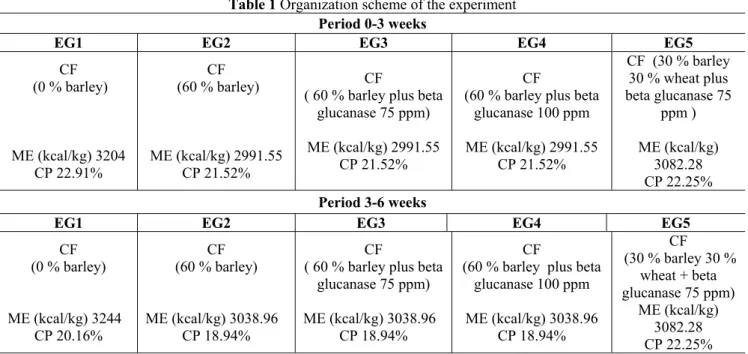
The organization scheme of the experiment is
presented in table 1.
Table 1 Organization scheme of the experiment Period 0-3 weeks
EG1 EG2 EG3 EG4 EG5 CF
(0 % barley)
ME (kcal/kg) 3204 CP 22.91%
CF (60 % barley)
ME (kcal/kg) 2991.55 CP 21.52%
CF
( 60 % barley plus beta glucanase 75 ppm)
ME (kcal/kg) 2991.55 CP 21.52%
CF
(60 % barley plus beta glucanase 100 ppm
ME (kcal/kg) 2991.55 CP 21.52%
CF (30 % barley 30 % wheat plus beta glucanase 75
ppm )
ME (kcal/kg) 3082.28 CP 22.25% Period 3-6 weeks
EG1 EG2 EG3 EG4 EG5 CF
(0 % barley)
ME (kcal/kg) 3244 CP 20.16%
CF (60 % barley)
ME (kcal/kg) 3038.96 CP 18.94%
CF
( 60 % barley plus beta glucanase 75 ppm)
ME (kcal/kg) 3038.96 CP 18.94%
CF
(60 % barley plus beta glucanase 100 ppm
ME (kcal/kg) 3038.96 CP 18.94%
CF (30 % barley 30 %
wheat + beta glucanase 75 ppm)
ME (kcal/kg) 3082.28 CP 22.25%
120
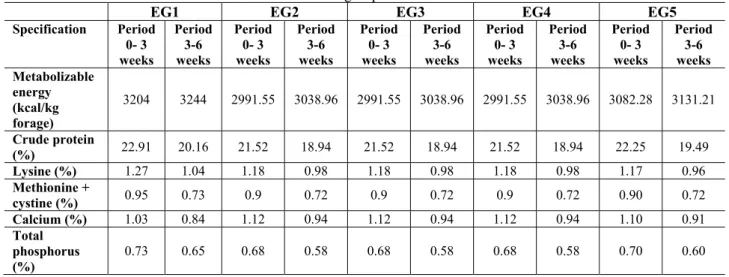
Table 2. Combined forages nutritive characteristics used for feeding broiler chicken from all five experimental groups
EG1 EG2 EG3 EG4 EG5
Specification Period 0- 3 weeks
Period 3-6 weeks
Period 0- 3 weeks
Period 3-6 weeks
Period 0- 3 weeks
Period 3-6 weeks
Period 0- 3 weeks
Period 3-6 weeks
Period 0- 3 weeks
Period 3-6 weeks Metabolizable
energy (kcal/kg forage)
3204 3244 2991.55 3038.96 2991.55 3038.96 2991.55 3038.96 3082.28 3131.21
Crude protein
(%) 22.91 20.16 21.52 18.94 21.52 18.94 21.52 18.94 22.25 19.49
Lysine (%) 1.27 1.04 1.18 0.98 1.18 0.98 1.18 0.98 1.17 0.96
Methionine +
cystine (%) 0.95 0.73 0.9 0.72 0.9 0.72 0.9 0.72 0.90 0.72
Calcium (%) 1.03 0.84 1.12 0.94 1.12 0.94 1.12 0.94 1.10 0.91
Total phosphorus (%)
0.73 0.65 0.68 0.58 0.68 0.58 0.68 0.58 0.70 0.60
According to the data presented in the table above, we may notice that during the first growth period, from 0 to 3 weeks, the energetic level of the combined forage was 2991.55-3204 kcal metabolisable energy, and the protein level was between 21.52%-22.91%.
During the second growth period, respectively from 3 to 6 weeks, the energetic level of the combined forage was comprised between 3038.96-3244 kcal metabolisable energy, and the protein level was 18.94%-20.16%.
The lysine, methionine + cystine, calcium and phosphorus were provided according the meat chicken requirements [20].
3. Results and discussion
According to tabular data and to the determinations performed in the laboratory from Dublin University, we obtained the soluble, insoluble and total NSP content of the combined forage; these values are presented in table 3. Cereals contain variable amounts of non-starch polysaccharides. Some of them, like wheat, contain big amounts of arabinoxylans (8.1 %), and others, like barley, contain big amounts of beta glucans (4.3 %) [21].Cereals’ content in NSP increases with cereals’ proportion of participation in the structure of combined forage. So, we may observe that during the growth period 0 - 3 weeks, compared with the forage from LE1 which did not contain barley, the LE2 with 60 % barley presented a bigger NSPs content with 1.914 percentage points, the NSPi with 1.974 and the
NSPt with 3.888 percentage points. The replacement of barley with wheat, in proportion of 50% (namely with a participation of 30 % barley and 30 % wheat), determines a NSPs content increase with only 0.522 percentage points. Compared with LE2, whose feed included barley in proportion of 60 %, the NSPi content is smaller with 0.894 percentage points, and the NSPt with 0.938 percentage points. During the period 3 - 6 weeks, LE2 presented a NSPs content that was bigger with 2.501 percentage points compared with LE1, whose forage was not supplemented with barley. The NSPi content was bigger with 1.97 percentage points, and the NSPt with 4.47 percentage points. By substituting barley with wheat, the NSPs amount decreases with 0.631 percentage points, the NSPi with 1.36 percentage points and the NSPt with 1.991 percentage points.
Anatomical intestine assessment of the broiler chickens used for the experimental groups
121
Table 3. Combined forages content on the non-starch polysaccharides (NSP) Growth
period Specification NSPs 1
(%) Percentage differences NSPi 2
(%) Percentage differences NSPt 3
(%) Percentage differences
Period
0-3 weeks 60 0% barley % barley 2.764 1.914 11.274 1.974 14.038 3.888 0.85 - 9.3 - 10.15 - 30 % wheat
30 % barley 3.286 0.522 10.38 - 0.894 13.1 -0.938 Period
3-6 weeks 0 % barley 0.79 - 9.35 - 10.14 -
60 % barley 3.291 2.501 11.32 1.97 14.611 4.47 30 % wheat
30 % barley 2.66 -0.631 9.96 - 1.36 12.62 -1.991 1 soluble non-starch polysaccharides
2 insoluble non-starch polysaccharides 3 total non-starch polysaccharides
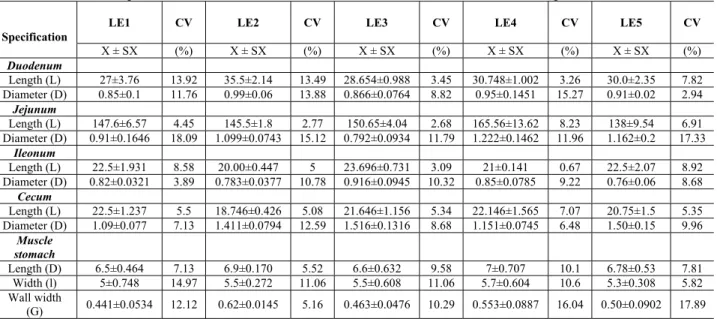
Table 4. Main parameters of intestine evolution in the broiler chickens used for the experimental variants
Specification
LE1 CV LE2 CV LE3 CV LE4 CV LE5 CV
X ± SX (%) X ± SX (%) X ± SX (%) X ± SX (%) X ± SX (%)
Duodenum
Length (L) 27±3.76 13.92 35.5±2.14 13.49 28.654±0.988 3.45 30.748±1.002 3.26 30.0±2.35 7.82 Diameter (D) 0.85±0.1 11.76 0.99±0.06 13.88 0.866±0.0764 8.82 0.95±0.1451 15.27 0.91±0.02 2.94
Jejunum
Length (L) 147.6±6.57 4.45 145.5±1.8 2.77 150.65±4.04 2.68 165.56±13.62 8.23 138±9.54 6.91 Diameter (D) 0.91±0.1646 18.09 1.099±0.0743 15.12 0.792±0.0934 11.79 1.222±0.1462 11.96 1.162±0.2 17.33
Ileonum
Length (L) 22.5±1.931 8.58 20.00±0.447 5 23.696±0.731 3.09 21±0.141 0.67 22.5±2.07 8.92 Diameter (D) 0.82±0.0321 3.89 0.783±0.0377 10.78 0.916±0.0945 10.32 0.85±0.0785 9.22 0.76±0.06 8.68
Cecum
Length (L) 22.5±1.237 5.5 18.746±0.426 5.08 21.646±1.156 5.34 22.146±1.565 7.07 20.75±1.5 5.35 Diameter (D) 1.09±0.077 7.13 1.411±0.0794 12.59 1.516±0.1316 8.68 1.151±0.0745 6.48 1.50±0.15 9.96
Muscle stomach
Length (D) 6.5±0.464 7.13 6.9±0.170 5.52 6.6±0.632 9.58 7±0.707 10.1 6.78±0.53 7.81 Width (l) 5±0.748 14.97 5.5±0.272 11.06 5.5±0.608 11.06 5.7±0.604 10.6 5.3±0.308 5.82 Wall width
(G) 0.441±0.0534 12.12 0.62±0.0145 5.16 0.463±0.0476 10.29 0.553±0.0887 16.04 0.50±0.0902 17.89
According to this table, we may draw the conclusion that, regarding duodenum length, this is bigger in the group fed barley with 8.5 cm. These differences get smaller in the case of utilization of beta glucanase in quantity of 75, respectively 100 ppm.
In the case of jejunum, barley incorporation in the combined forage structure in proportion of 60 % does not change the dimension, while the addition of enzymes determines an increase of jejunum dimension with 20 cm. Ileonum and cecum
dimensions do not present any changes generated by the introduction of barley or enzymes in the combined forage structure. The introduction of beta glucanase in combined forage structure determined a reduction of muscle wall width with 0.157 cm.
122
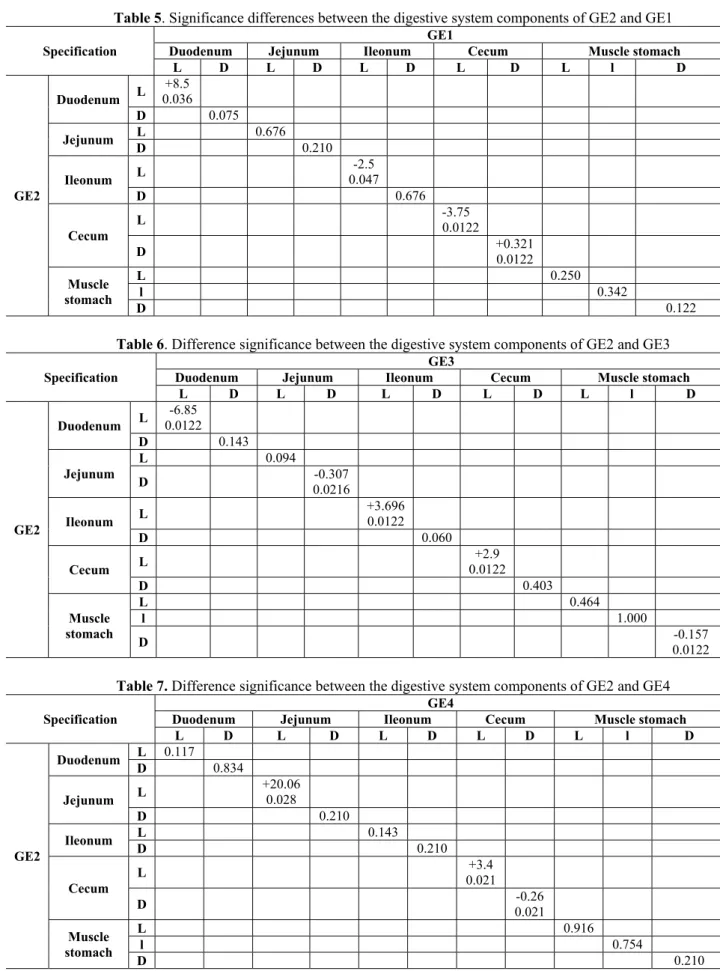
Table 5. Significance differences between the digestive system components of GE2 and GE1
Specification
GE1
Duodenum Jejunum Ileonum Cecum Muscle stomach
L D L D L D L D L l D
GE2
Duodenum L
+8.5 0.036
D 0.075
Jejunum L D 0.676 0.210
Ileonum L
-2.5 0.047
D 0.676
Cecum
L -3.75 0.0122
D +0.321 0.0122
Muscle stomach
L 0.250
l 0.342
D 0.122
Table 6. Difference significance between the digestive system components of GE2 and GE3
Specification
GE3
Duodenum Jejunum Ileonum Cecum Muscle stomach
L D L D L D L D L l D
GE2
Duodenum L
-6.85 0.0122
D 0.143
Jejunum
L 0.094
D 0.0216 -0.307
Ileonum L
+3.696 0.0122
D 0.060
Cecum L
+2.9 0.0122
D 0.403
Muscle stomach
L 0.464
l 1.000
D 0.0122 -0.157
Table 7. Difference significance between the digestive system components of GE2 and GE4
Specification
GE4
Duodenum Jejunum Ileonum Cecum Muscle stomach
L D L D L D L D L l D
GE2
Duodenum L 0.117
D 0.834
Jejunum L
+20.06 0.028
D 0.210
Ileonum L D 0.143 0.210
Cecum
L 0.021 +3.4
D -0.26 0.021
Muscle stomach
L 0.916
l 0.754
123
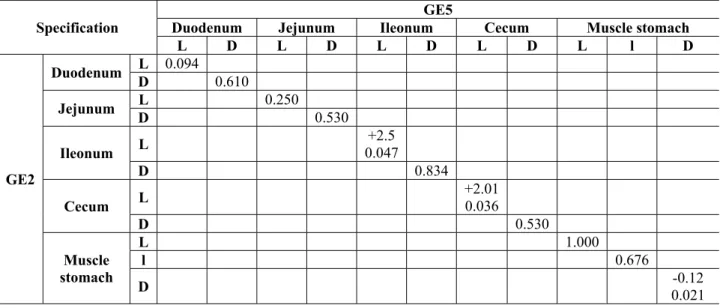
Table 8. Difference significance between the digestive system components of GE2 and GE5
Specification
GE5
Duodenum Jejunum Ileonum Cecum Muscle stomach L D L D L D L D L l D
GE2
Duodenum L D 0.094 0.610
Jejunum L D 0.250 0.530
Ileonum L
+2.5 0.047
D 0.834
Cecum L
+2.01 0.036
D 0.530
Muscle stomach
L 1.000
l 0.676
D 0.021 -0.12
Barley incorporation in proportion of 60 % in the combined forage destined for the chickens in GE2 also determines some intestinal changes. So, there are significant differences between the duodenum length of the chickens fed barley and those that did not consume barley in the combined forage (p<0.05). The same differences are available between the length of the ileonum, cecum and the cecum diameter (p<0.05). The differences between the other dimensions are insignificant from a statistical point of view. The addition of beta glucanase in the combined forage structure determines changes of the intestinal dimensions. In this viewpoint, there are significant differences (p<0.05) between the length of the duodenum, cecum and ileonum in the chickens that consumed forage with beta glucanase in quantity of 75 ppm and those that consumed forage with barley, without beta glucanase. Also significant differences are between the diameter of jejunum and the diameter of the muscle stomach. The addition of bet glucanase in quantity of 100 ppm reduces the differences between the dimensions of intestines, so that there are significant differences (p<0.05) between the lengths of the cecum and jejunum of the two groups. Also, there are differences between the diameters of the cecum of the two experimental groups (p<0.05).The substitution of barley with wheat in proportion of 50 % and the addition of beta glucanase in dose of 75 ppm determines some changes of intestinal dimensions, so that the jejunum length and the cecum length differ, with statistically significant differences (p<0.05). Also, there are differences
between the diameters of the muscle stomach in the case of the two groups (LE2 and LE5). The viscous NSP increased the weight of the small intestine but not the weight of the gizzard + proventriculum or liver. Changes in the empty weight of visceral organs are generally due to variation in rate of cell proliferation, cell size or proien synthesis [22]. [19].had observed an increase in the intestinal length of rats when fed diets that were supplemented with guar gum and traced this to an increase in mitotic activity within the mucosa. Enzyme supplementation of diets based on rye, wheat, barley or oats can reduce the mentioned adverse effects [23,10]. Enzymes decrease the viscosity of gut contents, resulting in improvements in nutrient digestibility and performance when added to poultry diets [24,25, 26].
4. Conclusions
- by incorporating barley in proportion of 60 % in the combined forage structure, we obtain changes of intestinal dimensions (the length of duodenum, cecum and ileonum) or of width in the case of the muscle stomach (diameter);
124
Acknowledgements
This research was funded by the Romanian Ministry of Education and Research / IDEI grant nr. 1115/2009, cod CNCSIS 895.
References
1. Classen, H. L., Scott, T. A., Irish, G. G., Huck, P., Swift, M., Bedford, M. R., The relationship of chemical and physical measurements to the apparent metabolisable energy (AME) of wheat when fed to broiler chickens with and without a wheat enzyme source. In: Proceedings of the Second European Symposium on Feed Enzymes, 1995, pp. 65-69
2. Scott, T. A., Classen, H. L., Swift, M., Bedford, M.R.,. Variability in AME (Kcal/Kg diet) of wheat-based diets fed to broilers. Anon. 1995
3. Scott, T. A., Silversides, F. G., Classen, H. L., Swift, M. L., Bedford, M. R., Hall, J. W., A broiler chick bioassay for measuring the feeding value of wheat and barley in complete diets. Poult. Sci. 1998a, 77, 449-455 4. Bedford, M. R., Scott, T. A., Silversides, F. G., Classen, H.L., Swift, M.L., Pack, M., The effect of wheat cultivar, growing environment and enzyme supplementation on digestibility of amino acids by broilers. Can. J. Anim. Sci. 78, 1998.335-342.
5. Classen, H. L., Campbell, G. L., Rassnagel, B. G., Bhatty, R.S., Reichert, R.D.,. Studies on the use of hulless barley in chick diets: deleterious effects and methods of alleviation. Can. J. Anim. Sci. 65, 1985725-733.
6. Elwinger, K., Teglof, B., Performance of broiler chickens as influenced by a dietary enzyme complex and without antibiotic supplementation. Arch. Ge¯ugelk1991, 55, 69-73
7. Newman, C. W., Newman, R. K., Danielson, A. D.,. Effect of supplemental enzymes on the performance of young pigs and broiler chicks. In: Proceedings of the 43rd Montana Livestock Nutrition Conference, 1992 8. Carre, B., Gomez, J., Melcion, J. P., Giboulot, B.,. La viscosite des aliments destines a l'aviculture utilisation pour predire la consommation et l'excretion d'eau. INRA Prod. Anim. 1994, 7, 369-379 (in French). 9. Bedford, M. R., Morgan, A. J., The use of enzymes in poultry diets. World Poult. Sci. J. 1996, 52, 61-68 10. Bedford M. R, Exogenous enzymes in monogastric nutrition- their current value and future benefits. Animal Feed Science and Technology, 2000, 86, 1-13 11. Evans, A.J., Cheung, P.C.K., Cheetham, W.H.,. The carbohydrate composition of cotyledons and hulls of cultivars of Lupinus angustifolius from Western Australia. J. Sci. Food Agric, 1993, 61, 189-194
12. Smits, C. H. M., Annison, G., Non-starch polysaccharides in broiler nutrition Ð towards a physiologically valid approach to their determination. Wld. Poultry Sci. J., 1996, 52, 203-221
13. Johnson, I. T., Gee, J. M., Gastrointestinal adaptation in response to soluble non-available polysaccharides in the rat. Br. J. Nutr., 1986, 55, 497-505
14. Brunsgaard, G., Eggum, B. O.,. Small intestinal tissue structure and proliferation as in¯uenced by adaptation period and indigestible polysaccharides. Comp. Biochem. Physiol. 1995, 112A, 365-377
15. Fengler, A. I., Marquardt, R. R.,. Water-soluble pentosans from rye. II. Effects on rate of dialysis and on the rate of retention of nutrients by the chick. Cereal Chem., 1988, 65, 298-302
16. Choct, M., Annison, G.,. Anti-nutritive effect of wheat pentosans in broiler chickens: roles of viscosity and gut microflora. Br. Poultry Sci., 1992, 33, 821-834 17. Annison, G., The role of wheat non-starch polysaccharides in broiler nutrition. Aust. J. Agric. Res., 1993, 44,.405±422
18. Van der Klis, J. D., Verstegen, M. W. A., Van Voorst, A.,. Effect of a soluble polysaccharide (carboxymethylcellulose) on the absorption of minerals from the gastrointestinal tract of broilers. Br. Poultry Sci., 1993,34, 985-997
19. Johnson, I. T., Gee J. M., Mahoney, R. R., Effect of dietary supplements of guar gum and cellulose on intestinal cell proliferation, enzymes levels and sugar transport in the rat. Br. J. Nutr., 1984, 52, 477-487 20. NRC (1994) Nutrient Requirements of Poultry, 9th edn. National Academy of Sciences, Washington, DC 21. Englyst, H.,. Classification and measurement of plant polysaccharides. Anim. Feed Sci. Technol., 1989, 23, 27-42
22. Iji, P. A., Saki, A. A., Tivey, D. R., , Intestinal development and body growth of broiler chicks on diets supplemented with non starch polysaccharides, Animal Feed Science and Technology, 2001,89, 175-188 23. Bedford, M. R., Classen, H. L., Reduction of intestinal viscosity through manipulation of dietary rye and pentosanase concentration is effected through changes in the carbohydrate composition of the intestinal aqueous phase and results in improved growth rate and food conversion efficiency of broiler chicks. J. Nutr., 1992., 122, 560–569
24. Campbell, G.L., Bedford, M. R.,. Enzyme application for monogastric feeds: a review. Can. J. Anim. Sci., 1992, 72, 449–466
25. Marquardt, R.R., Boros, D., Guenter, W., Crow, G.,. The nutritive value of barley, rye, wheat and corn for young chicks as affected by use of a Trichoderma reevei enzyme preparation. Anim. Feed Sci. Technol., 1994, 45, 363–378