International Journal of Research in Engineering & Applied Sciences 38 http://www.euroasiapub.org
SDML BASED REUSABLE WEB PAGE FRAMEWORK FOR
SEMANTIC WEB
Harish Kumar*
Sanjeev Kumar**
ABSTRACT
This paper purposes unique framework for designing reusable web page for Semantic Web. The symbolic web page’s design will be stored in unique format of keyword text with the name SBML tag based design. The inference mechanism is facilitated with the help of an inference engine which will search for specific keywords from the design repository. This framework will minimize the overall development effort of designing and developing web pages for semantic web.
Keywords: Agent, Semantic Web, Tag Based Design, Design Repository, Development Efforts
International Journal of Research in Engineering & Applied Sciences 39 http://www.euroasiapub.org
1 INTRODUCTION
This paper addresses the methodology for achieving the web page design reusability of a qualitative web based system and effort minimization by applying the inference on the stored design documents. The pictorial design documents of web pages are stored in a special format in the form of keyword text [SDML tag based design]. The design document storage mechanism will expose the keywords as per design stored. This methodology is having an inference engine. Inference engine search for the keywords and find the match for them in the available design repository. A successful match will help in achieving reusability after checking the quality parameters of the found design module in the result set. SDML notations produce qualitative designs which help in minimizing the efforts of web based system.
Web based development demands not only quick and reliable web page designing but also designing must be reusable. Generally, lot of developer time and efforts are used in developing solutions for difficult, time consuming and complex web based systems. One of the solutions is the web based designs document [2] [3]. Design process takes maximum time and efforts and is never reused in the future. Reusability is achieved up to some level in coding practices like OOPs, Component based developments, Active-X, technology, where a piece of written code is reused after passing through few checks for non discloser of the blueprints of the solution [5].
Design phase is considered to be the most important phase to achieve reusability in web based projects, as it bridges the gap between requirement phase and the development phase. This includes functional and user interaction design. [4] [6]. If a web based design is made reusable, the reusability in the development phases can be achieved because the coding phase is very much driven from the software design. This paper proposes a new approach in the context of the web based design reusability. Reusable web based design methodology is of special concern with the effort minimization, which could be achieved by following this approach. This paper also discusses the notation of the design document storage for reusability. This approach will provide good domain solution in minimum efforts. A good review mechanism can also be imposed on the stored reusable web based design for assigning quality attributes [7][8][9].
International Journal of Research in Engineering & Applied Sciences 40 http://www.euroasiapub.org
outcome of the result having the attribute tag of quality benchmark, like number of times the design is reused. The research also includes one tool, which helps in maintaining the central repository of the different design documents and inference mechanism on the stored design repository.
2 SDML BASED WEB PAGE DESIGN REPRESENTATION FOR
SEMANTIC WEB
The reusability of web page design for a software system could be achieved by storing the graphical design documents in the form of text. The graphics-symbols of the design document can be represented in the form of text. Tools are available which allow the user to draw the web page with diagrams. These tools however lack one aspect to store the design elements in the form of structured text as backend.
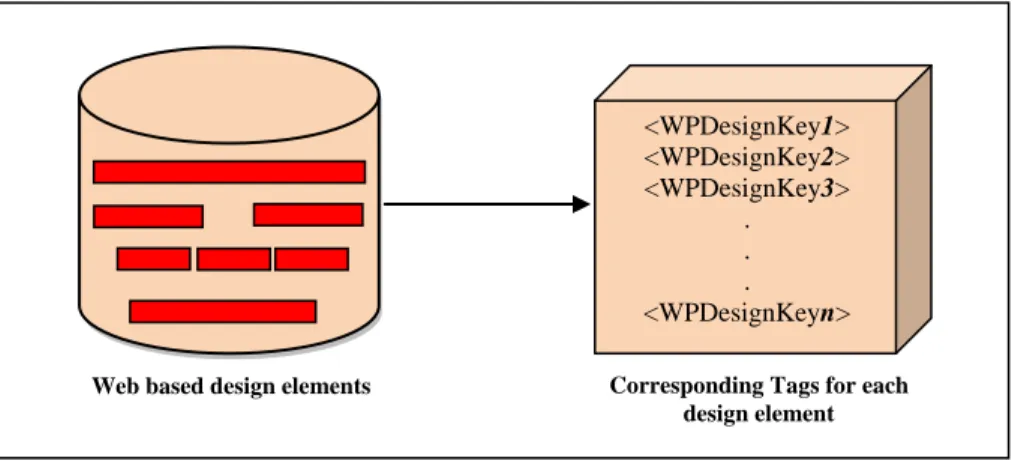
Our approach is to device some mechanism using which design diagrams for web page can be created and represented in the text format. So that when user creates one web page design and save it, it generates one text file. The approach chosen is to represent the text per design element is as a XML tag. So every design element will have a unique tag as shown in Figure 1.
Figure 1: Every web page design element is having web page design element tag associated with it.
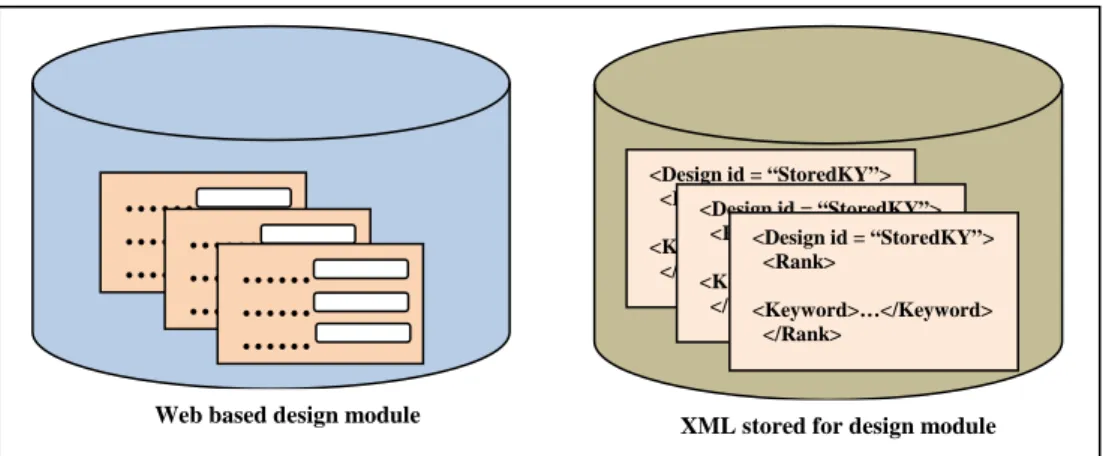
Initially the process start with making a new web page design document, which is XML, based. The system to create the web page design is having the collection of web page elements. All finite design elements have assigned names. User has to select and place these design elements while creating design document. When one web page design gets completed, there will be one complete XML document associated with it. These web page design repository will be a collection of associated XML document per design as shown in Figure 2.
<WPDesignKey1> <WPDesignKey2> <WPDesignKey3>
. . . <WPDesignKeyn>
International Journal of Research in Engineering & Applied Sciences 41 http://www.euroasiapub.org
Figure 2: Each design module is having associated SDML document
There will be a repository of designs after following this approach and every design is well defined in terms of XML tags. The text format of storing the design is having the predefined tags. Text format will be stored in XML notations. This is termed as Semantic Design Markup Language and is having the tags for all knows design elements. When user picks one design element, its respective tag will be placed in its corresponding text file. When web page design complete for some scenario by following this approach, system will be having a complete representation in textual format in the form of tags.
The XML text file having the details of design figures is the basis of our research. The approach has many benefits. When pictorial representations are saved in text form, lots of possibilities are there which increase the efficiency of overall development process [12] [13]. Reusability of design search within the available web page design, automatic generation of design skeleton on the basis of requirement document and available design text keywords, auto generation of test case scenarios.
Along with the design element tags, the XML-SDML file is having the information with the help of special tags (like <keywords>), which is important and is a key for further reusability criteria implementation and page rank number, which is used by Personal Agent and Service Agent for agent based web page semantic search [1]. This additional information is the list of keywords that designer wants to assign to his design. Each web page design is having one name, keywords and some attributes.
Name identifies the design module, keywords are the handles for reusability, and attributes are factors, which design document gain after reusability. Agents review the web page design
Web based design module XML stored for design module
…… …… …… …… ……
…… …… …… ……
<Design id = “StoredKY”> <Rank>
<Keyword>…</Keyword> </Rank>
<Design id = “StoredKY”> <Rank>
<Keyword>…</Keyword> </Rank>
<Design id = “StoredKY”> <Rank>
<Keyword>…</Keyword> </Rank>
International Journal of Research in Engineering & Applied Sciences 42 http://www.euroasiapub.org
and assign ranks to each keyword in a web page. A high rank number by agent make web page design a good candidate for reusability for particular type of user.
When some user wants to search the new web page based upon some keyword, he has to submit the keywords to be search to the Personal Agent. The keywords are analyzed and some keywords are evaluated by Personal Agent in terms of ranking. Next step is that agent looks into the available keywords of design module repository for the specific keyword. The design repository will be stored for each design element in a centralized database of the Personal Agent. The design stored is of the atomic nature by representation of text format. Each elementary design element will be having one name and some associated keywords. These keywords will be reflected in the centralized repository.
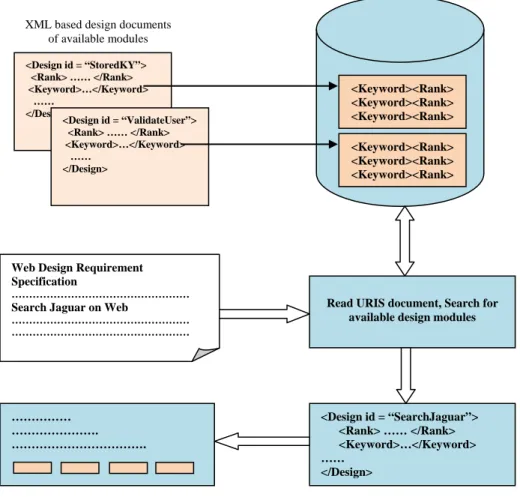
Figure 3: Mechanism for web page design reusability
<Keyword><Rank> <Keyword><Rank> <Keyword><Rank>
<Keyword><Rank> <Keyword><Rank> <Keyword><Rank> <Design id = “StoredKY”>
<Rank> …… </Rank> <Keyword>…</Keyword> ……
</Design>
<Design id = “ValidateUser”> <Rank> …… </Rank> <Keyword>…</Keyword> ……
</Design>
XML based design documents of available modules
Read URIS document, Search for available design modules
<Design id = “SearchJaguar”> <Rank> …… </Rank> <Keyword>…</Keyword> ……
</Design> ………
………. ………. Web Design Requirement Specification
……… Search Jaguar on Web
……… ………
Initial web based design created from
International Journal of Research in Engineering & Applied Sciences 43 http://www.euroasiapub.org
In software development life cycle, when analysis phase is completed and the requirements are defined, next stage is to move to design process. The existing design repository will help out in reusing the design elements. Above figure shows the mechanism for web page design reusability. After following the approach for creating XML based web page design documents (SDML), there will be a database of XML sheets for each design module. Each design module is having the name and keywords associated with it.
< !ELEMENT name *> < !ELEMENT keywords *>
Inference will be preformed on the centralized design repository against the keywords from the Personal Agent. This will be a type of look-in search process in the design repository keywords of elementary design. When search gets completed, it will generate a minimum web page design document having the maximum reusability of existing modules. This SDML document is arranged in order to get the maximum requirement fulfillment for required web page design.
Also, the result of the inference on stored design repository will be having the elementary design modules having attributes also. These attributes specify the design reusability factor for a module (DRF). More the reusability factor of a module indicates that module is strong candidate for reusability in new design. Reusing a web page design module will increase the reusability count factor by one.
Design storage and retrieval
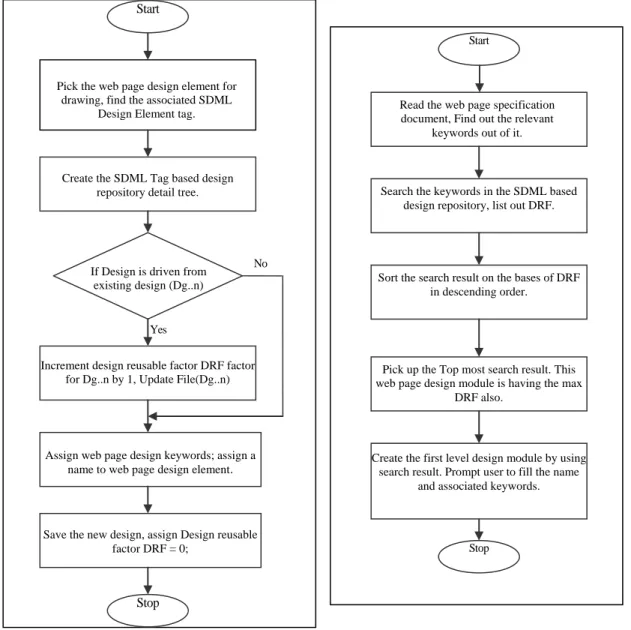
A.) Create SDML based web page design and generate design repository per design module. Figure4 is the logical representation while creation of new design. If user creates the new design and it is driven from some existing design element Dg..n, it will increment the design reusable factor DRF for Dg..n by one. This increment in DRF make makes design Dg..n a stronger candidate for further reusability
International Journal of Research in Engineering & Applied Sciences 44 http://www.euroasiapub.org
3 EXPERIMENT SETUP
For the experimental validation of the proposed approach of web page design reusability and effort minimization, five keywords have been considered. These keywords are having maximum of six different sub keywords. Web page design requirement for these modules have been studied and one end user is considered for the experiment to which the finished design will be given for review. From requirement discussion to first draft, we record the time spend for each keyword. We also record the time consumed by the web page design architect. When this gets finished, we need to discuss it with the end user. Time record for the end user involvement was also recorded. We include the end user in the design phase for layout, look and feel type observation. We consider this as design prototype.
4 RESULT AND OBSERVATIONS
International Journal of Research in Engineering & Applied Sciences 45 http://www.euroasiapub.org
Figure 4: Create SDML based web page design Figure 5: Retrieve SDML based design
repository for web page design reusability
Efforts in Hrs
Keywords Conventional web page Design efforts End User involvement
K1 14 7
K2 28 9
K3 16 6
K4 9 5
K5 18 6
K6 21 6
Table 1: Efforts (in Hrs) in web page design using conventional design methods
Start
Pick the web page design element for drawing, find the associated SDML
Design Element tag.
Create the SDML Tag based design repository detail tree.
If Design is driven from existing design (Dg..n)
Increment design reusable factor DRF factor for Dg..n by 1, Update File(Dg..n)
Save the new design, assign Design reusable factor DRF = 0;
Assign web page design keywords; assign a name to web page design element.
Stop
No
Yes
Start
Read the web page specification document, Find out the relevant
keywords out of it.
Search the keywords in the SDML based design repository, list out DRF.
Sort the search result on the bases of DRF in descending order.
Pick up the Top most search result. This web page design module is having the max
DRF also.
Create the first level design module by using search result. Prompt user to fill the name
and associated keywords.
International Journal of Research in Engineering & Applied Sciences 46 http://www.euroasiapub.org
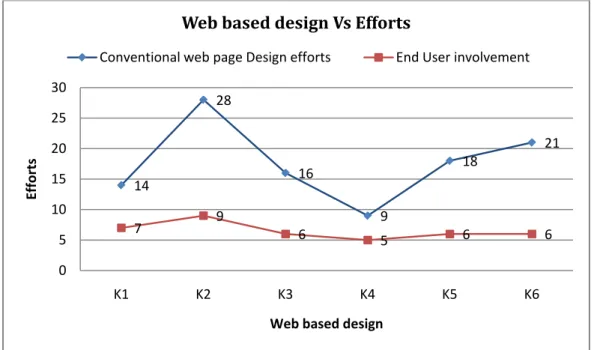
Figure 6: Efforts (in Hrs) in web page design using conventional design methods
(Source: Table 1)
The graph (Figure 6) represents that for a project of 4 modules, minimum time for design is 13 hrs where as maximum could be 29 hrs for a project of 4 modules. This variation shows that module count is immaterial but the important is nature of project. This observation when compared with the SDML based approach will shows very interesting results.
For our experiment with SDML based web page design, we are having 10 designs in the SDML storage and these are having 50% resemblance with the domain of the requirement. These design documents are having the keywords, which could be used during the search process. The SDML based design experiment for the reusability of existing design requires the framing of the requirement specification in some special format. So, we have made the requirement specification document. This is having the keyword-based text instead of the plain English based scenario discussions. Same projects with special formatting of the requirement specification are submitted to SDML inference engine.
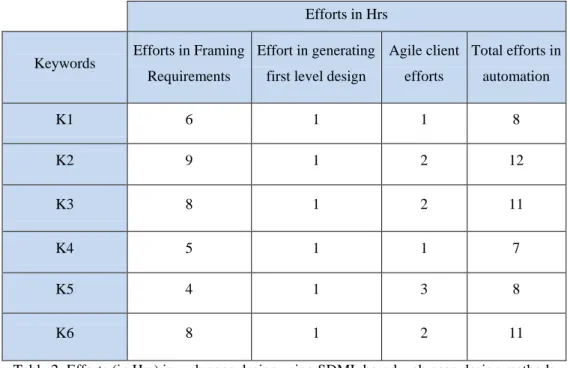
This takes very less time in identifying the candidate from available stored design and displays the results. The time taken in framing the requirement and getting the first level design from existing designs is shown in the following table (Table 2). Its approximately 1hr because this is not simply selection process, user have to spend some time (in few min) to identify which one is appropriate on the bases of some ranks, like reusability factor. Observations in Table 2 are showing the improvement in the efforts consumed. The only efforts consumed are in the framing of the requirement in the special format. The agile client
14
28
16
9
18
21
7 9 6
5 6 6
0 5 10 15 20 25 30
K1 K2 K3 K4 K5 K6
Effor
ts
Web based design
Web based design Vs Efforts
International Journal of Research in Engineering & Applied Sciences 47 http://www.euroasiapub.org
efforts, which can be a part of team also need to spend small time as compared to time spend in Table1 by the user [14][ 15]. We propose the involvement of the user in the design process with our mechanism. User interactions could be of the type of selecting one design layout out of available design layout produced by the system.
Efforts in Hrs
Keywords Efforts in Framing Requirements
Effort in generating
first level design
Agile client
efforts
Total efforts in
automation
K1 6 1 1 8
K2 9 1 2 12
K3 8 1 2 11
K4 5 1 1 7
K5 4 1 3 8
K6 8 1 2 11
Table 2: Efforts (in Hrs) in web page design using SDML based web page design methods
Figure 7: Efforts (in Hrs) in web page design using conventional design methods
(Source: Table2) 6
9
8
5
4
8
1 1 1 1 1 1
1 2 2 1
3
2 8
12
11
7 8
11
0 2 4 6 8 10 12 14
K1 K2 K3 K4 K5 K6
Effor
ts
Web based design
Web based design Vs Efforts
Efforts in Framing Requirements Effort in generating first level design
International Journal of Research in Engineering & Applied Sciences 48 http://www.euroasiapub.org
The total time consumed in the finalization which is summation of time consumed in framing requirement, design generation by system and client time to select. We represent this as TED, i.e. total effort required for SDML based design.
ACEi
DGi
RFi
TED
SP
i
⊕
⊕
=
∑
∈RF is the efforts required for requirement framing for software project SP, DG is efforts in design generation and ACE is the agile client efforts. Figure 6 shows the graphical representation for the same.
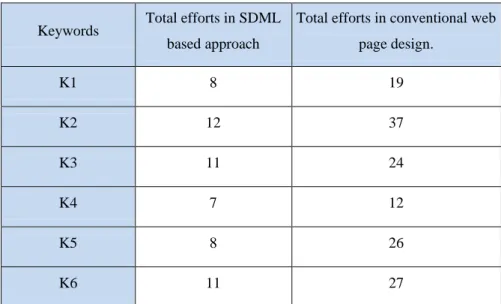
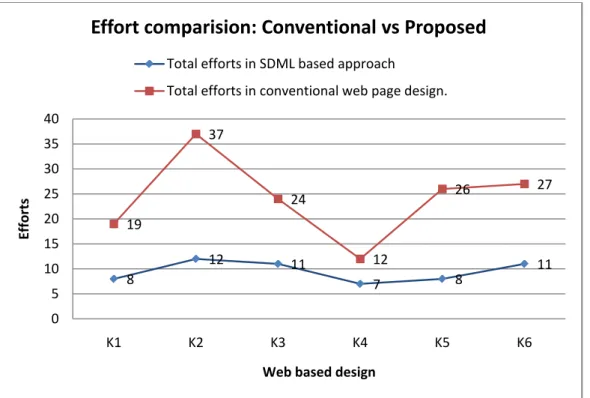
As an observation from Figure 7 we can see the total efforts consumed in the proposed design are less than that of conventional system which is showing the effort minimization after using the SDML based design approach and then applying the DNSIM (Design notation storage and inference mechanism) for reusing the same for achieving the qualitative designs.
Keywords Total efforts in SDML
based approach
Total efforts in conventional web
page design.
K1 8 19
K2 12 37
K3 11 24
K4 7 12
K5 8 26
K6 11 27
International Journal of Research in Engineering & Applied Sciences 49 http://www.euroasiapub.org
Figure 8: Total Efforts comparison: SDML based approach and conventional approach (Source: Table3)
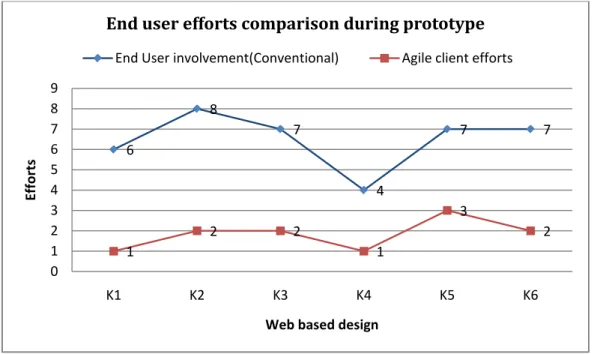
Graphs (Figure 8) shows the comparison and figures in the total effort minimization. SDML based design approach uses requires the less effort, as compared to other methods. SDML based approach produces qualitative design, which helps in minimizing overall efforts in software development life cycle. The end user involvement and efforts for feedback are comparatively less in case of the SDML based approach. For same projects taken in our experiment, we found that there is a big difference in the end user involvement. As for project1 having 4 modules, the efforts consumed by the agile client for feedback are 6hrs for conventional approach where as its only 1hr required for the SDML based user interface design. This also represents that it’s a qualitative design approach towards effort minimization and making SDLC less complex.
Keywords End User involvement.
(Conventional) Agile client efforts
K1 6 1
K2 8 2
K3 7 2
K4 4 1
K5 7 3
K6 7 2
Table 4: User involvement efforts comparison in using two approaches. 8
12 11
7 8
11 19
37
24
12
26 27
0 5 10 15 20 25 30 35 40
K1 K2 K3 K4 K5 K6
Effor
ts
Web based design
Effort comparision: Conventional vs Proposed
Total efforts in SDML based approach
International Journal of Research in Engineering & Applied Sciences 50 http://www.euroasiapub.org
Figure 9: Total Efforts comparison: SDML based approach and conventional approach (Source: Table3)
5 CONCLUSION
SDML based designs representation is a new approach for storing the design elements in the form of specially design SDML-XML tags. These are plain text files, so we can write programs to manipulate and analyze these files for further enhancement.
To simulate the effort minimization, we carry out above-mentioned experiment. It shows that the there is tremendous decrease in the user involvement. We carry out our experiment on five different projects having different number of modules. Table 1 is showing the efforts in man hrs and end user involvement using the conventional, approaches of software design engineering. The graph in the Figure6 depicts that there is big involvement of the end user in the design phase (we consider agile methodology where customer is a member of development team) as for project2 29 hr efforts are from designer team and end user spend 8 hrs.
Table 2 shows the overall efforts for creating the first level design using SDML based approach. The total efforts in automation are less than that of the manual and conventional system. There is a significant minimization in the efforts of the agile client involvement as depicted from the Figure 7 and Table 2.
Figure 8 shows the comparison between the total efforts of SDML based design and conventional design. In SDML based design, there is only on activity, which consumes time and that is the framing of the requirement specification document. This contains finding out
6
8
7
4
7 7
1
2 2
1
3
2
0 1 2 3 4 5 6 7 8 9
K1 K2 K3 K4 K5 K6
Effor
ts
Web based design
End user efforts comparison during prototype
International Journal of Research in Engineering & Applied Sciences 51 http://www.euroasiapub.org
the important keywords from the requirement specification document and using them later in the search process SDML based parsing.
Figure 9 compares the involvement of the end user in the same projects using the two different approaches. It clearly shows that agile client involvement is reduced significantly after following the SDML based approach.
The web page design reusability leads to faster development of the application especially in the area where the web page is of prime importance. Big time and efforts, which are consumed in developing the core web page design functionality, could be minimized. The user involvement in the design phase and efforts could be minimized in the design process. This is because the design elements are stored in the textual format and we can apply several kinds of search algorithms for finding the best solution for the problem. Further, design storage in specified format makes the system scalable and maintainable. The approach of the reusability of software design is novel. Work presented in this paper is an initiative towards using SDML based web page design representation for reusability. The experiment carried on five keywords for effort minimization using web page design reusability is showing interesting and valuable observation of the concept.
6 BIBLIOGRAPHY
[1] Franklin, S., Graesser, A.,” Is it an agent, or just a program?” Proceedings Third International Workshop on Agent Theories, Architectures and Languages, Budapest, Hungary, 193-206. 1996
[2] Markopoulos P., Wilson S., Johnson and P., "Representation and use of task knowledge in a user interface design environment", Computers and Digital Techniques, IEEE Proceedings, Volume 141, Issue 2, pp: 79-84, 1994.
[3] Yam Li [2009], "Intelligent User Interface Design Based on Agent Technology", software Engineering, WCSE '09. WRI World Congress, Volume 1, 19-21 May 2009, pp: 226-229. 2009.
International Journal of Research in Engineering & Applied Sciences 52 http://www.euroasiapub.org
[6] Doane S.M. and Lemke A.C., "Using cognitive simulation to develop user interface design principles", System Sciences, Proceedings of the Twenty-Third Annual Hawaii International Conference on Volume ii, pp: 547-554, 1990.
[7] Bajwa I.S. and Chaudhary M.A., "A Language Engineering System for Graphical User Interface Design (LESGUID): A Rule based Approach", Information and Communication Technologies, 2006. ICTTA '06. 2nd Volume 2, pp: 3582 – 3586, 2006. [8] Ping Zhang; Small, R.V. von Dran, G.M. Barcellos S., "Websites that satisfy users: a theoretical framework for Web user interface design and evaluation", System Sciences, HICSS-32, Proceedings of the 32nd Annual Hawaii International Conference on Volume Track2, pp: 8, Jan. 1999.
[9] Vila J., Beccue B., Furness G., "User interface design for virtual reality: a research tool for tracking navigation", System Sciences, Proceedings of the Thirty-First Hawaii International Conference on Volume 6, 6-9 Jan. 1998, pp: 464-472, 1998.
[10] Maskers J.; Layton K.; Coning K., "Shortening user interface design iterations through real-time visualization of design actions on the target device", Visual Languages and Human-Centric Computing, VL/HCC 2009, IEEE Symposium, pp: 132-135, 2009.
[11] Sunhat V.S., Sukaviriya and Ramachandra, T., "Using User Interface Design to Enhance Service Identification of Web Services", ICWS '08. IEEE International Conference on 23-26 Sept. 2008, pp: 78 – 87, 2008,
[12] Lindgaard G., “Designing CSCW tools to support cooperative research", Computer Human Interaction Conference, Proceedings. Australasian, 30 Nov.-4 Dec. 1998, pp: 61-62, 1998,
[13] Balasubramanian V., Turoff M., "A systematic approach to user interface design for hypertext systems", System Sciences, Proceedings of the twenty-Eighth Hawaii International Conference on Volume 3, 3-6, pp: 241–250, Jan. 1995.
[14] Stary C., "User interface design: the WHO, the WHAT, and the HOW revisited", Computer Software and Applications Conference, COMPSAC 95. Proceedings, Nineteenth Annual International 9-11 Aug. 1995, pp: 178-183, 1995.