Java Method Calls
in the Hierarchy – Uncovering
Yet another Inheritance Foible
E. Nasseri and S. Counsell
School of information Systems, Computing and Mathematics, Brunel University, Uxbridge, United Kingdom
This paper describes an empirical investigation into method calls between classes at each level of the inher-itance hierarchy in four, Java open source systems. We distinguish between method calls made to super classes in the hierarchy and external method calls made outside the line of super classes to the root. The premise on which the research rests is that classes should predomi-nantly make use of super class functionality(as theory suggests)and relatively infrequent use of functionality outside those super classes. Results revealed that the most method calls were made to the methods of the classes where the majority of functionality resided (at shallow hierarchical levels) and not necessarily to the super classes of a class. The evidence presented therefore implies that developers are not using inheritance in the spirit originally intended and lends weight to the growing belief that OO inheritance has more practical foibles than theoretically stated advantages.
Keywords: method calls, inheritance, OO, empirical
1. Introduction
Exploring the evolution of inheritance hierar-chy in a system can provide valuable insights into a system’s dynamics from an inheritance perspective. Indeed, previous studies of inher-itance have provided evidence of the ineffec-tiveness of inheritance beyond a certain level (Basili et al. 1996; Bieman and Zhao 1995; Cartwright and Shepperd 2000; Chidamber et al. 1999; Daly et al. 1996). In this paper, we investigate inheritance from a method call per-spective and its impact in four, Java open source systems. The main research question that we explore is: to what extent do classes take ad-vantage of super class functionality offered(i.e., the subclass-super class relationships inherent in every inheritance hierarchy)when invoking
the functionality of other classes? The main motivation for the study in this paper arises from the dearth of empirical studies into how classes within an inheritance hierarchy inter-act and how that interinter-action might evolve as a system itself evolves(Capiluppi 2004; Lehman 1978; Lehman 1997). While we can view sys-tem evolution at a class level relatively easily (and view systems themselves as a collection of connected black boxes), any such study hides the lower-level granularity of functionality, ac-tivity and extent of coupling(Briand et al. 1999) that classes have across a hierarchy rather than up and down it. Results from our analysis of the four systems demonstrated that most method calls were made to the methods of the class where the functionality resided andnot neces-sarily, as we might expect from a hierarchical inheritance structure, to the super classes of a class.
literature that also casts doubt on the benefits of inheritance before we conclude and point to further work(Section 5).
2. Empirical Study Design
2.1. The Four Open-source Systems
For our study, we used a set of four, Java open-source systems chosen and downloaded from the systems available atwww.sourceforge.net.
The systems in ascending order of number of versions were as follows.
a) HSQLDB: a relational database engine im-plemented in Java. This system comprised 6 versions. HSQLDB consisted of 56 classes and 972 methods in version 1 and 358 classes and 3827 methods in version 6 (latest ver-sion).
b) JasperReports: a business intelligence and reporting system. This system comprised 12 versions. JasperReports contained 818 classes and 8201 methods in version 1 and 1098 classes and 10736 methods in version 12(latest version).
c) SwingWT: an implementation of the Java Swing and AWT APIs. This system con-tained 22 versions. SwingWT concon-tained 50 classes and 378 methods in version 1 and 620 classes and 6956 methods in version 22 (latest version).
d) Tyrant: a graphical fantasy adventure game. 45 versions of this system were studied. Tyrant contained 122 classes and 982 meth-ods in version 1 and ended with 273 classes and 2374 methods in version 45(latest ver-sion).
2.2. Data Collected
We used the JHawk tool(JHawk)to extract the following three OO metrics (Lorenz and Kidd 1994) and refer to the figure in Appendix A where appropriate to aid our explanation. 1) Depth in the Inheritance Tree of a class
(DIT): this metric measures the number of ancestors of a class including class Object (Chidamber and Kemerer 1994). The DIT value for a class inheriting from only Ob-ject is assumed to be one. Henceforward,
we refer to a class at a relatively shallow
DIT level to mean one that is close to the root(i.e., class Object); equally, a relatively
deepDIT level refers to a class further away from the root.
2) Calls to methods in the hierarchy (HIER): the HIER metric measures the number of method calls made to any super class in the hierarchy (JHawk). In the figure in Ap-pendix A, MethodY in ClassB calls MethodX defined in its super class(ClassA)and is thus a contributor to the HIER metric.
3) Number of External methods calls (EXT): the EXT metric measures the number of method calls in a class to methods of other classes (JHawk) and excludes HIER calls. In the figure in Appendix A, MethodY in ClassB calls MethodZ in ClassC not in the same class hierarchy.
The basis of the research presented in this paper is to determine the extent to which classes in an inheritance hierarchy use functionality in their super classes(HIER)rather than that outside the line of classes to the root. OO guidelines would suggest that classes should predominantly use the specialised functionality of the super class-subclass relationship, not relationships between classes across the hierarchy.
3. Version Analysis
To investigate the research question, we ex-plored the specific features of each system in thelatestavailable version to establish how the values of EXT and HIER compared. We chose the latest version in each case, since differences between these two metrics were likely to be more pronounced as a system aged(and invari-ably decayed too). We consider each of the four systems in turn.
3.1. HSQLDB
Table 1 shows the numerical values of HIER and EXT at each DIT level for HSQLDB. The table format(after column 1 and for each DIT level)is as follows:
(3)Frequency and percentage of EXT(EXT). (4)Average number of HIER at each DIT level
(HIER value divided by number of classes). (5)Average number of EXT at each DIT level (EXT value divided by the number of classes).
DIT Classes HIER EXT Ave. Ave. HIER EXT
1 279 0 7050 0 25.27
(77.93%) (74.52%)
2 68 104 2012 1.53 29.59
(18.99%) (91.23%) (21.27%)
3 11 10 399 0.92 36.27
(3.07%) (8.77%) (4.22%)
Table 1.HIER, EXT and DIT(HSQLDB).
From Table 1, the majority of HIER (91.23%) exists at DIT level 2. The average HIER at DIT 2 is also greater than that of DIT 3; the num-ber of EXT at DIT 1 is significantly higher than that of DIT 2 and 3. The average EXT at DIT 3, on the other hand, is significantly higher than that of EXT at DIT 1 and 2. We would expect classes at shallower levels of the hierarchy(i.e., DIT 1) to be more coupled to classes outside the hierarchy than classes at deeper levels since they ‘inherit’ relatively less potential function-ality than classes at those deeper levels; unlike the former, the latter are able to take advan-tage of the functionality offered by their super classes.
Clearly, the HSQLDB does not conform to the model of how we would expect classes to be-have and neither too our research premise.
3.2. JasperReports
Table 2 shows the same numerical values for the final version of JasperReports in the same format of Table 1. The maximum number of HIER (60.52%) exists at DIT 2 and, to a less extent, DIT 3. However, on average, the highest number of HIER(HIER/Classes)exists at DIT 3. We also see that DIT 4 and 5 contain zero HIER. The majority of EXT(56.92%)is found at DIT 1. (DIT 4 is where the minimum number of EXT is found.)
DIT Classes HIER EXT Ave. Ave. HIER EXT
1 761 0 10383 0 13.64
(69.31%) (56.92%)
2 258 305 6468 1.18 25.07
(23.50%) (60.52%) (35.46%)
3 65 199 1334 3.06 20.52
(5.92%) (39.48%) (7.31%)
4 10 0 5 0 0.5
(0.91%) (0.003%)
5 4 0 51 0 12.75
(0.36%) (0.28%)
Table 2.HIER, EXT and DIT(JasperReports).
The average EXT however, shows a different trend. On average, classes at DIT 2 and 3, re-spectively contain the highest EXT. In common with the HSQLDB system, we see a pattern of classes that should use functionality offered by super classes opting to use that of external (to the hierarchy)classes.
3.3. SwingWT
DIT Classes HIER EXT Ave. Ave. HIER EXT
1 429 0 2096 0 4.89
(69.19%) (34.59%)
2 99 85 956 0.87 9.66
(15.97%) (24.50%) (15.78%)
3 24 22 304 0.92 12.67
(3.87%) (6.34%) (5.02%)
4 25 34 890 1.36 35.6
(4.03%) (9.80%) (14.69%)
5 28 112 1289 4 46.04
(4.52%) (32.28%) (21.27%)
6 11 85 455 7.73 41.36
(1.77%) (24.50%) (7.51%)
7 4 9 70 2.25 17.5
(0.65%) (2.59%) (1.16%)
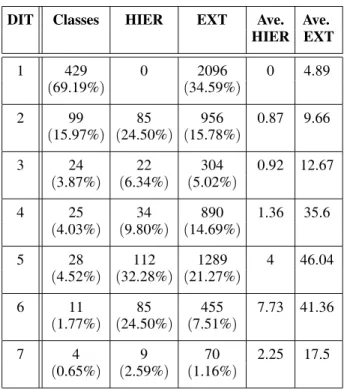
Table 3 shows the values of HIER and EXT for the final version of the SwingWT system. De-spite the fact that the majority of classes reside at shallower DIT levels, the maximum number of HIER is from classes at DIT 5. It is notable that 28 classes (4.52% of all classes) account for 112(32.28%)of HIER and 1289(21.27%) of EXT in the system.
We also see that the majority of EXT is found at DIT 1; however, when taking into account the number of classes, DIT 5, 6 and 4, respec-tively are where the majority of EXT exists. On average, classes at deeper DIT levels have higher coupling, given by HIER and EXT, than classes at shallower levels. While we might have expected the majority of EXT values to occur at shallower levels of the hierarchy from a practical perspective (i.e., DIT 1 and 2), the evidence from the three systems examined so far suggests that this is not always the case. It is worrying that there is such a relatively high level of communicationacrossthe inheritance hierar-chy. From a maintenance perspective, having to comprehend large disparate sections of classes dotted around the hierarchy is likely to be more time-consuming, error-prone and the cause of further faults on the part of the developer ( Ar-isholm and Briand 2006; ArAr-isholm et al. 2007).
3.4. Tyrant
Table 4 shows the numerical values of HIER and EXT for the final version of Tyrant. From Table 4, the majority of HIER(55.13%)exists at DIT 2. The average HIER also exhibits a similar trend. We also see a strong tendency to higher average EXT at shallower DIT levels and the trend seems to be downwards as the DIT increases. It would seem that in the case of the
DIT Classes HIER EXT Ave. Ave. HIER EXT
1 142 0 4321 0 30.43
(50.01%) (64.79%)
2 49 43 1167 0.88 23.82
(17.95%) (55.13%) (17.50%)
3 82 35 1181 0.43 14.40
(30.04%) (44.87%) (17.71%)
Table 4.HIER, EXT and DIT(Tyrant).
Tyrant system, there is some evidence of classes behaving in accordance with theory.
3.5. Coupling Profile
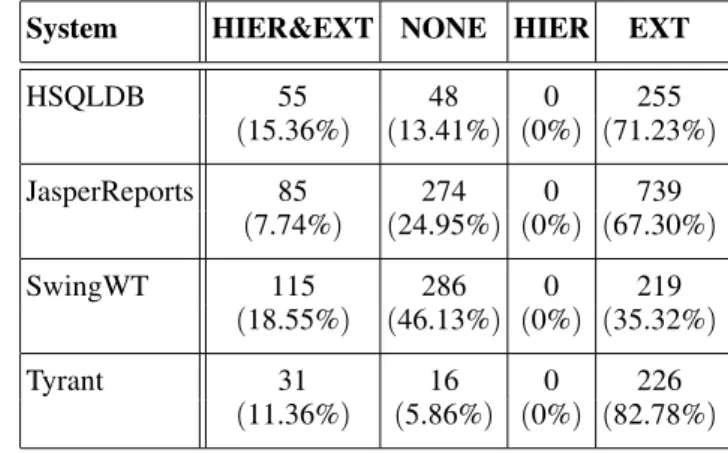
As a further guide to the composition of classes in the four systems, Table 5 shows how method calls are distributed in each of the final versions of the four systems. The column format of Table 5(after column 1 for systems)is as follows: 1) Number and the percentage of classes
con-taining both HIER and EXT(HIER&EXT). 2) Number and percentage of classes
contain-ing neither HIER nor EXT(NONE).
3) Number and percentage of classes contain-ing only HIER.
4) Number and the percentage of classes con-taining only EXT.
From Table 5, we see that the majority of classes contain at least one EXT. It is interesting that from all four systems, we find zero classes containing only HIER. Also remarkable from Table 5 is the large number of classes (286) in SwingWT containing zero HIER and EXT. SwingWT is a GUI application which has a maximum of 7 levels of DIT. Scrutiny of the data revealed that 6407 method calls(both HIER and EXT)were spread across just 334 classes of the 620 in total in the latest version. On average, each class therefore made 19.18 method calls. In comparison to the remaining three systems (HSQLDB: 30.92, JasperReports: 22.75 and Tyrant 26.25). SwingWT contained the mini-mum number of method calls per class.
System HIER&EXT NONE HIER EXT
HSQLDB 55 48 0 255
(15.36%) (13.41%) (0%) (71.23%)
JasperReports 85 274 0 739
(7.74%) (24.95%) (0%) (67.30%)
SwingWT 115 286 0 219
(18.55%) (46.13%) (0%) (35.32%)
Tyrant 31 16 0 226
(11.36%) (5.86%) (0%) (82.78%)
Table 5.The HIER and EXT data in the four systems
From a coupling perspective, this may sound encouraging, but from a design perspective, method calls are not evenly spread across all parts of the system(46.13% of classes contained zero HIER and EXT). This latter result confirms previous findings (Nasseri and Counsell 2008; Nasseri and Counsell 2009)that Swing has been poorly built and consistently shows features in-dicating that the system is decaying; it may also have been significantly patched up.
In the next section, we provide evidence to sup-port the view that inheritance is not as straight-forward a concept as theory might suggest. We draw on past empirical studies to demonstrate that inheritance is used sparingly at deep levels and that maintenance of systems at those lev-els could be problematic. The study we have presented supports the general view that inher-itance is not being used appropriately and there may be many motives and explanations for how and why coupling evolves as it does.
4. Supporting Evidence
An experiment in which subjects were timed performing maintenance tasks on OO systems of varying levels of inheritance was undertaken by Daly et al.(Daly et al. 1996). Systems with 3 levels of inheritance (DIT 3) were found to be easier to modify than systems with no in-heritance. Systems with 5 levels of inheritance were, however, shown to take longer to mod-ify than the systems without inheritance. The same experiment was replicated by Harrison et al. (Harrison et al. 1998) who found that flat systems (i.e. containing no inheritance) were easier to modify than systems containing three or five levels of inheritance. (Larger systems were equally difficult to understand whether or not they contained inheritance.)
Prechelt et al.(Prechelt et al. 2003)found that it took longer to maintain a program with deeper levels of inheritance than a program containing fewer inheritance features. In the study pre-sented, we found very little activity below DIT level 3 and other studies seem to provide in-sights into why that might be the case. Indeed, a study of 19 C++systems by Bieman and Zhao (Bieman and Zhao 1995)found that only 37% of these systems had a median class inheritance depth greater than 1. Cartwright and Shep-perd(Cartwright and Shepperd 2000)collected
a subset of metrics from a large telecommu-nications system comprising 133,000 lines of C++and found a positive correlation between the DIT and number of user-reported problems, casting doubt on the use of inheritance for fault prevention. Wood et al. (Wood et al. 1999) suggests that inheritance should be used only
when necessary and obvious and, even then, with care. The results herein provide one rea-son why this might be the case. In Chidamber et al. (Chidamber et al. 1998), three industrial OO systems were empirically investigated, and, again, none showed significant use of inheri-tance. They also reported relatively little use of inheritance in the system they analyzed. Fi-nally, Basili et al.(Basili et al. 1996)the results of an empirical study of the C&K metrics are presented. The metrics are used as predictors of fault-prone classes. Data from eight medium-sized management systems, developed in C++ was collected. An experimental hypothesis sug-gested that a class located deep in the inher-itance hierarchy was more fault-prone than a class higher up in the hierarchy(at a shallower level); this hypothesis was found to be sup-ported with statistical significance. Far from aiding maintenance, use of inheritance had the opposite effect. We would go as far as to say that Java method calls and their measurement (taken together with the results herein) repre-sent the uncovering of ‘yet another inheritance foible’.
5. Conclusions and Future Work
In this paper, we have presented an empirical analysis of four, Java open-source systems from a method call perspective. We distinguished between number of method calls made within the hierarchy (HIER) and number of external method calls (EXT) in classes of the studied systems. The JHawk tool was used to extract the HIER and EXT from final versions of the same four systems. The question we posed was:
hierarchy. In other words, super class relation-ships and the use of super class functionality by sub classes is systematically undermined. Only one of the four systems showed signs of the opposite.
The results may be of interest to software devel-opers/practitioners as to how classes in a system interact and how that might change as a sys-tem evolves. We view the patterns observed as quite worrying for effective maintenance. Fu-ture work will focus on the analysis of systems from a refactoring perspective to see if that has any influence on the coupling of a system as it evolves(Fowler 1999; Nasseri et al. 2008).
References
[1] E. ARISHOLM, L. C. BRIAND, Predicting fault-prone components in a Java legacy system. Presented in Proceedings of ACM/IEEE International Sympo-sium on Empirical Software Engineering, (2006)
Rio de Janeiro, Brazil.
[2] E. ARISHOLM, L.C. BRIAND, M.J. FUGLERUD, Data
mining techniques for building fault-proneness models in telecom Java software. Simula Research Laboratory Reports, 2007.
[3] V. BASILI, L. C. BRIAND, W. MELO, A validation of object-oriented design metrics as quality indica-tors.IEEE Transactions on Software Engineering, 22(10), 751–761, 1996.
[4] J. BIEMAN, J. ZHAO, Reuse through inheritance: A
quantitative study of C++ software. Presented in Proceedings of ACM Symposium on Software Reuse, Seattle, USA, 1995.
[5] L. C. BRIAND, J. DALY, J. WUST, A unified
frame-work for coupling measurement in object-oriented systems.IEEE Transactions on Software Engineer-ing, 25(1), 91–121, 1999.
[6] A. CAPILUPPI, M. MORISIO, J. RAMIL, Structural
evolution of an open source system: A case study. Presented inProceedings of the International Work-shop on Program Comprehension, Bari, Italy, 2004.
[7] M. CARTWRIGHT, M. SHEPPERD, An empirical
in-vestigation of an OO system.IEEE Transactions on Software Engineering, 26(8), 786–796, 2000.
[8] S. R. CHIDAMBER, S. DARCY, C. KEMERER, Man-agerial use of metrics for object-oriented software: an exploratory analysis.IEEE Transactions on Soft-ware Engineering, 24(8), 629–639, 1998.
[9] S. R. CHIDAMBER, C. F. KEMERER, A metrics suite
for object oriented design. IEEE Transactions on Software Engineering, 20(6), 467–493, 1994.
[10] J. DALY, A. BROOKS, J. MILLER, M. ROPER, M.
WOOD, Evaluating inheritance depth on the
main-tainability of object-oriented software. Empirical Software Engineering: an International Journal, 1(2), 109–132, 1996.
[11] M. FOWLER, Refactoring: Improving the design of
existing code. Addison-Wesley, NJ, USA, 1999.
[12] R. HARRISON, S. COUNSELL, R. NITHI,
Experimen-tal assessment of the effect of inheritance on the maintainability of OO systems. Presented in Pro-ceedings of Empirical Assessment in Software En-gineering, Keele, UK, 1998.
[13] JHAWK tool:
(http://www.virtualmachinery.com/ jhawkprod.html).
[14] M. LEHMAN, Programs, cities, students, limits to
growth? In: Programming Methodology, (D. GRIES Ed.), pp. 42–62, Springer Verlag, 1978.
[15] M. LEHMAN, J. RAMIL, P. WERNICK, D. PERRY, W.
TURSKI, Metrics and laws of software evolution –
the nineties view. Presented inProceedings of IEEE International Symposium on Software Metrics, Al-bequerque, USA, 1997.
[16] M. LORENZ, J. KIDD, Object-oriented Metrics.
Pren-tice Hall New Jersey, 1994.
[17] E. NASSERI, S. COUNSELL, System evolution at the
attribute level: an empirical study of three Java OSS and their refactorings. Presented inProceedings of 32ndInternational Conference on Information
Tech-nology Interfaces, Cavtat, Croatia, 2009.
[18] E. NASSERI, S. COUNSELL, Inheritance, ‘warnings’ and potential refactorings: an empirical study. Pre-sented inProceedings of the 3rdInternational
Con-ference on Software Engineering Advances, Sliema, Malta, 2008.
[19] E. NASSERI, S. COUNSELL, An empirical study of
Java system evolution at the method level. Presented inProceedings of the IEEE International Confer-ence on Software Engineering, Research, Man-agement and Applications, Hainan Island, China, 2009.
[20] E. NASSERI, S. COUNSELL, M. SHEPPERD, An
em-pirical study of evolution of inheritance in Java OSS. Presented in Proceedings of the Australian Software Engineering Conference, Perth, Australia, 2008.
[21] L. PRECHELT, B. UNGER, M. PHILIPPSEN, W. TICHY, A controlled experiment on inheritance depth as a cost factor for code maintenance.Journal of Systems and Software, 65(2), 115–126, 2003.
Appendix A: Method calls inside and across the inheritance hierarchy
Received: March, 2010 Accepted: April, 2010
Contact addresses: Emal Nasseri School of information Systems, Computing and Mathematics Brunel University, Uxbridge Middlesex, UB8 3PH, UK e-mail:[email protected]
Steve Counsell School of information Systems, Computing and Mathematics Brunel University, Uxbridge Middlesex, UB8 3PH, UK e-mail:[email protected]
EMALNASSERIis currently a Research Associate at the University of Wolverhampton and interfaces with industry on a Knowledge Transfer Partnership. Emal received his PhD in 2009 from Brunel University exploring facets of Java inheritance hierarchies. His other research in-terests focus on the use of Java open-source software and the collection of data from these systems.