VOLUME 16 ISSUE 1 (2018), Page 348 – 359
DETERMINING MODEL CONFIGURATION FOR THERMAL SIMULATION OF URBAN MOSQUE FAÇADE DESIGN
Noor Hanita Abdul Majid1, Fauziah Hanum Abdullah2 & Zuraini Denan3
1,2,3Kulliyyah of Architecture and Environmental Design
INTERNATIONAL ISLAMIC UNIVERSITY MALAYSIA
ABSTRACT
Urban mosque (UM) façade design, besides its aesthetical role, is a passive architectural design strategy in handling how much heat penetrates into the internal spaces. In determining the model configuration for thermal simulation of urban mosque façade, the orientation and massing of the UM is tested. The orientation of UM relates to the qiblat direction and sun exposure. On the other hand, the massing is defined by the volume of the UM. This research investigates the effects of form layout and volume on thermal performance of the interior environment. A model with no openings on north-westward façade (NWF) and south-eastward façade (SEF) is simulated for a baseline scenario for comparison purposes. Autodesk Ecotect Analysis 2011 is a computer-based simulation tool used in this research to measure the thermal analysis in the UM model. The results indicate the performance of different types of forms, layouts and volumes. By the end of this study, the configuration of the base model is determined according to the results of the orientation and volume variations.
INTRODUCTION
Urban microclimate of Kuala Lumpur is characterised by high temperatures and humidity with low wind velocity. This condition is in accordance to the observation by Marzita, Mohd Hairy, Mazlini, Che Nidzam and Noraini (2012) that confirmed the increased temperature at urban built-up areas compared to urban fringes and rural areas. Jusuf, Wong, Hagen, Anggoro and Hong (2007) suggested that the gradual rise in urban air temperature in all cities in the world are caused by drastic reduction of the green area. The high temperature in urban areas lead to concerns in attaining indoor thermal comfort with the threat of climate change (Adunola, 2012). Hence in the urban microclimate is a major concern in offering comfortable indoor environment. Mosques in urban area are subjected to the high temperature conditions in urban microclimate that lead to uncomfortable thermal condition for the worshippers to perform prayers.
Congregational prayer times are the critical periods due to high number of people in the prayer hall area. The alternative to maintain a thermally comfortable conditions is using air conditioning to cool the interior space. Dependence on air conditioning system to cool the main prayer hall increased the energy consumption and electricity cost which will burden the management of the mosque. Therefore, it is important for the urban mosque to adopt passive design strategies that will in turn sustain a conducive interior environment of the urban mosque.
Building design have a primary function to provide an internal environment that is suitable for the purpose of the building (Department of Standards Malaysia, 2014a). Façade design is a passive design strategy in response to the climatic context of the urban area. A suitable façade design optimise daylighting and thermal comfort (Department of Standards Malaysia, 2014b) of the interior spaces. Shafizal (2014) found that big openings allow the heating and cooling process faster as the indoor air temperature reaches the same temperature with the outside air. Consequently, the open areas of the building façade have an influence on the heat gain of the indoor environment. Hence, it is important to focus on the façade design over the aesthetic expression, as a reliable passive design strategy contributes to thermal comfort of the indoor environment.
The issues discussed highlight issues on the urban mosque thermal comfort and how façade design is important to control the thermal comfort of the interiors. This research intends to determine the model configuration for thermal simulation of urban mosque façade design. The model is important to test the performance of the façade design for urban mosque.
RESEARCH OBJECTIVES
determine the critical façade orientation (form and layout) and the effects of massing (volume) on thermal performance of the interior environment.
Façade Orientations
The façade orientations are related to direct sun penetration into buildings which consequently affects thermal comfort of the indoor environment. Most researchers such as Liping and Hien (2006), Obaidi and Woods (2006), Al-Tamimi and Sharifah Fairuz (2011), and Al-Al-Tamimi, Sharifah Fairuz and Wan Mariah (2011) suggest that maximising façade orientation towards North and South resulted to better indoor thermal environment compared to east and west orientations. In the case of urban mosque, the building is orientated directly towards Qiblat (the direction towards the Holy Kaabah in the city of Makkah). This orientation is a must rather than being a design variable (Al-Homoud, 1999). The mosque façade orientations can be deemed as North-westward façade (NWF) or qiblat-façade-facing, South-westward façade (SWF), North-eastward façade (NEF) and South-eastward façade (SEF) (Figure 1). The mosque superimposed on a sun path diagram of Kuala Lumpur (see Figure 2) indicates that the NWF and SEF are the facades facing towards direct sun path that consequently affects the indoor thermal condition of the mosque. Hence, the northwest and southeast façades need to be incorporated in the passive design strategies to handle the unwanted exposure to direct sunlight.
Figure 1: Mosque facade orientations Figure 2: Sun path diagram of mosque façade orientation
RESEARCH METHODOLOGY
parameters depend on the essential characteristics of the input and output variables such as building volume, type of layout form and so forth for further simulations of other UM façade design models. Autodesk Ecotect Analysis 2011 software is used to test the baseline model and the design variables.
Baseline Model: Urban Mosque Model Configurations
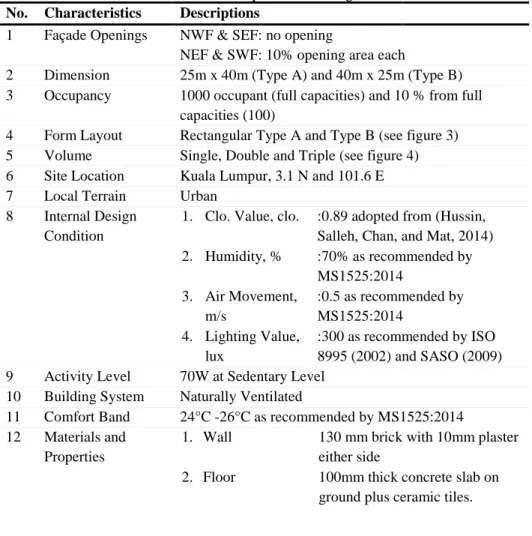
The baseline model for the computational experiment is the configuration to be developed and utilized to test the different façade design variables. A basic UM model with no opening on North-westward façade (NWF) and South-eastward façade (SEF) is proposed as baseline model. All the input required by Ecotect to simulate thermal comfort such as, building system, internal design consideration, activity level, materials and properties and are as described in Table 1.
Table 1: Urban mosque model configurations
No. Characteristics Descriptions
1 Façade Openings NWF & SEF: no opening
NEF & SWF: 10% opening area each
2 Dimension 25m x 40m (Type A) and 40m x 25m (Type B)
3 Occupancy 1000 occupant (full capacities) and 10 % from full
capacities (100)
4 Form Layout Rectangular Type A and Type B (see figure 3)
5 Volume Single, Double and Triple (see figure 4)
6 Site Location Kuala Lumpur, 3.1 N and 101.6 E
7 Local Terrain Urban
8 Internal Design Condition
1. Clo. Value, clo. :0.89 adopted from (Hussin, Salleh, Chan, and Mat, 2014)
2. Humidity, % :70% as recommended by
MS1525:2014 3. Air Movement,
m/s
:0.5 as recommended by MS1525:2014
4. Lighting Value, lux
:300 as recommended by ISO 8995 (2002) and SASO (2009)
9 Activity Level 70W at Sedentary Level
10 Building System Naturally Ventilated
11 Comfort Band 24°C -26°C as recommended by MS1525:2014
12 Materials and Properties
1. Wall 130 mm brick with 10mm plaster
either side
2. Floor 100mm thick concrete slab on
3. Ceiling 150mm THK Concrete with both side each 12mm THK ceramic tiles and gypsum. The air gap is 600mm between concrete and gypsum
13 Measurement
Period
Hottest Day-6 July as recommended by EnergyPlus Weather Data of Kuala Lumpur
The model represents a rectangular building with a plan size of 1000m2
within the dimension of 25m x 40m or 40m x 25m. The 1000m2 is decided based
on 1000 persons with 1m2 is allocated per person occupancy as recommended by
MS2577:2014 (Department of Standards Malaysia, 2014b). However, as seen in Figure 3, the rectangular form can be orientated into two types of form layout (type A and Type B). The investigation discussed in this research focus on the façade opening on NWF and SEF, while the opening on North-eastward façade (NEF) and South-westward façade (SWF) is controlled with 25m2 opening at each
(as shown in figure 4). The orientation of the model is referring to the orientation of mosque building which is orientated towards qiblat direction (232). The solar charts used are for Kuala Lumpur. The exposure to direct solar need to be minimized by having shorter facades towards NWF and SEF.
Type A Type B
Figure 3: Form layout Type A and Type B
*Inventory conducted on UM in Kuala Lumpur City has identified a total of 56 urban mosques. These samples are categorized into three groups; single volume (4-6 metres high), double volume (7-9 metres
Single
Double
Triple
Figure 4: Types of volumes for UM
The building is planned to be occupied by 100 persons for normal prayer times (subuh, asar, maghrib and isya’) and 1,000 occupants (for Friday prayers) for comparison on effect of number of occupancy on thermal comfort.
Autodesk Ecotect Analysis 2011
Weather Data
For the purpose of this research, the weather data of Kuala Lumpur is obtained from EnergyPlus website (EnergyPlus, 2016) and converted to suitable file format for Ecotect. The site location and local terrain is set up respectively to Kuala Lumpur as the selected location for urban mosque in this research. The thermal analysis is experimented on the hottest day of the year or 6th July for hourly
temperature thermal calculation.
Data Analysis
The result of thermal comfort simulation on baseline model will be analysed in three stages;
i. First Stage: Relationship between thermal analysis with Type of Form layout.
ii. Second Stage: Relationship between thermal analysis with Type of Volume.
iii. Third Stage: Thermal analysis of UM Baseline Model
The result will justify model configurations of further UM model simulations on thermal comfort.
RESEARCH ANALYSIS AND FINDINGS
At the first stage, a baseline model of UM with form layout type B was analysed. Second, the result of different types of volume was investigated. The results determined the final model configurations of UM which would be utilized for further investigation on thermal comfort.
Effect of Form Layout
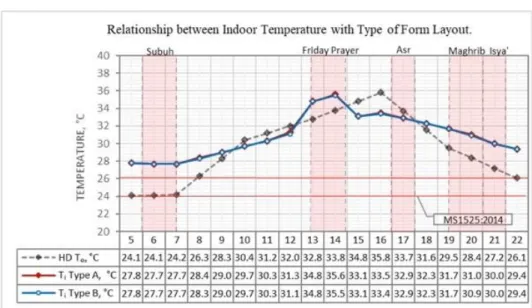
Figure 5: Relationship between hourly temperature with type of UM layout during hottest day (peak)
Table 2: Relationship between annual temperature distribution with type of UM layout
Type of Form Layout UM Comfort Temperature,% (as recommended by MS1525:2014)
Type A, 25m x 40m 37.7
Type B, 40m x 25m 38.0
Effect of Volume
Table 3: Relationship between annual temperature distribution with type of UM volume
Type of Volume Comfort Temperature,% (as recommended by MS1525:2014)
Single 15.3
Double 27.0
Triple 38.0
As recommended by MS1525:2014, triple volume recorded highest comfort temperature percentage along the year compared to double volume and single volume registered the lowest comfort percentage (see Table 3). Through the results of 2 series of investigation on thermal comfort based on hourly temperature and annual temperature distribution, the triple volume UM was selected for further investigation on effect of façade design.
Figure 6: Relationship between hourly temperature with type of um volume during hottest day (peak)
CONCLUSION
1. The triple volume obtained better percentage for thermal comfort conditions compare to double and single volume.
2. The number of occupancies played significant role in indoor thermal condition. The highest number of occupancy increased the level of discomfort. However, the mosque was dealing with intermittent occupancies where the number of occupant was irregular. Therefore, for the purpose of research, occupancy schedule was proposed at 10% occupancy for congregational prayers except during Friday prayer (1300-1430h) and zuhur prayer time that was simulated for full capacity (1,000 persons).
3. The type B (rectangular form with the short façade facing qiblat or North-westward façade (NWF)) recorded better thermal condition. This indicate the small surface of façade would gain low heat than large surface. 4. All result was mapped against the recommended comfort range by
MS1525:2014. The baseline showed that the temperature was beyond the recommended comfort range.
ACKNOWLEDGMENT
This work was supported in part by RIGS17-096-0671.The authors would like to thank all involved in materializing this research.
REFERENCES
Adunola, A. O. (2012, April). Urban residential comfort in relation to indoor and outdoor air temperatures in Ibadan, Nigeria. In 7th Windsor Conference: The changing context of comfort in an unpredictable world Cumberland Lodge, Windsor, UK.
April 12-15, 2012. Windsor, United Kingdom.
Al-Homoud, M. S. (1999). Thermal design optimization of mosques in Saudi Arabia. In
Proceedings of the International Symposium on Mosque Architecture (pp. 15-30).
Retrieved 31 August, 2017 from
http://faculty.kfupm.edu.sa/ARE/
alhomoud/Publications/Mosque_Architecture_Symposium_99.pdf
. Al-Obaidi, M. A. A. H., & Woods, P. (2006). Investigations on effect of the orientationon thermal comfort in terraced housing in Malaysia. International Journal of Low Carbon Technologies, 1(2), 167-176.
Al-Tamimi, N. A. M., & Sharifah Fairuz, S. F. (2011). Thermal performance analysis for ventilated and unventilated glazed rooms in Malaysia (Comparing simulated and field data). Indoor and Built Environment, 20(5), 534-542.
Al-Tamimi, N. A. M., Sharifah Fairuz, S. F., & Wan Mariah, W. H. (2011). The effects of orientation, ventilation, and varied WWR on the thermal performance of residential rooms in the tropics. Journal of Sustainable Development, 4(2), 142-149.
Crawley, D. B., Hand, J. W., Kummert, M., & Griffith, B. T. (2008). Contrasting the capabilities of building energy performance simulation programs. Building and Environment, 43(4), 661-673.
Department of Standards Malaysia (2014a). MS1525:2014.Malaysia standard: Code of practice on energy efficiency and use of renewable energy for non-residential buildings (Second Revision).
Department of Standards Malaysia (2014b). MS2577:2014. Malaysian standard architecture and asset management of masjid - Code of practice.
EnergyPlus (2016). Weather data by location. All regions-Southwest Pacific WMO Region 5-Malaysia. Weather data download-Kuala Lumpur 486470 (IWEC).
Retrieved August 13, 2016 from
https://energyplus.net/weather-location/southwest_pacific_wmo_region_5/MYS//MYS_Kuala.Lumpur.486470_ IWEC
Hussin, A., Salleh, E., Chan, H. Y., & Mat, S. (2014). Thermal comfort during daily prayer times in an air-conditioned mosque in Malaysia. Proceedings of 8th Windsor Conference: Counting the Cost of Comfort in a Changing World, (April), 10-13.
Jusuf, S. K., Wong, N.H., Hagen, E., Anggoro, R., & Hong, Y. (2007). The influence of land use on the urban heat island in Singapore. Habitat International, 31(2), 232-242.
Liping, W., & Hien, W. N. (2006, September). The impact of façade designs : Orientations , window to wall ratios and shading devices on indoor environment for naturally ventilated residential buildings in Singapore. PLEA2006 The 23rd Conference on Passive and Low Energy Architecture. September 6-8, 2006, Geneva, Switzerland.
Marzita, P., Mohd Hairy, I., Mazlini, A., Che Nidzam, C. A., & Noraini, M. N. (2012). Thermal comfort in classroom: Constraints and issues. Procedia - Social and Behavioral Sciences, 46, 1834-1838.
SASO (2009). SAUDI STANDARD DRAFT NO: 4520. Code for Lighting of Indoor Work
Places. Saudi Arabian Standards Organization (SASO).
Shafizal, M. (2014). Roof designs and affecting thermal comfort factors in a typical
naturally ventilated Malaysian mosque (Doctorate dissertation). Cardiff