COMPARISON BETWEEN TWO RECOVERY METHODS: COLD
WATER IMMERSION VERSUS PROGRESSIVE MUSCLE
RELAXATION IN REDUCING DOMS AMONG YOUNG ATHLETES
Mohd Hafiz Muhd Ghoth1, Nurul Hidayah Amir2*, Jamilah Ahmad Radzi3,
Ellail Ain Mohd Aznan4, Siti Jameelah Md Japilus5, and
Muhammad Yusri Mohd Ramle6
Universiti Teknologi MARA Cawangan Perlis 1,2,3,4,5
Malaysia National Institute of Sport, Bukit Jalil6
*Email: [email protected]
(Received 21 September 2018; accepted 26 March 2019; published online 27 July 2019)
To cite this article: Muhd Ghoth, M. H., Amir, N. H., Ahmad Radzi, J., Mohd Aznan, E. A., Md Japilyus, S. J., & Mohd Ramle, M. Y. (2019). Comparison between two recovery methods: Cold water immersion versus progressive muscle relaxation in reducing DOMS among young athletes.
Malaysian Journal of Movement, Health & Exercise, 8(2), 67-80. https://doi.org/10.15282/mohe.v8i2.256
Link to this article:https://doi.org/10.15282/mohe.v8i2.256
Abstract
The aim of this study is to compare the effectiveness of cold water immersion (CWI) and progressive muscle relaxation (PMR) on DOMS markers among young athletes. A total of 30 young athletes with mean age of 18.57 ± .504 years old, weight 61.92 ± 7.96 kg and height 170.67 ±7.57 cm volunteered to participate in this study. Participants were required to perform 20 reps x 5 sets drop jump (DJ) to induce muscle damage. They were randomly assigned into three groups: CWI (n = 10), PMR (n = 10) and control group (n = 10). Immediately following damage-inducing exercise protocol, CWI group were required to submerge lower body until iliac crest level in 15°C±1°C of cold water for 16 minutes; whereas control group applied the same position without immersed in cold water for 16 minutes. Perceived muscle soreness, range of motion (ROM) thigh circumference and the 20 meter sprint have been used as DOMS markers in this study. Markers were measured pre-exercise, post-pre-exercise, post-intervention, and after 24 hours, 48 hours, 72 hours and 96 hours. The results of mixed ANOVA revealed a significant interaction (p < 0.05) in 20-meter sprint between groups and measurements at 24 hours and post-interventions, respectively. Conversely, no significant interactions were found in perceived muscle soreness, ROM and thigh circumference (p > 0.05). In conclusion, a single bout of CWI and PMR are not beneficial to elicit positive effects on DOMS markers used in this study.
Introduction
Delayed-onset Muscle Soreness (DOMS) is an uncomfortable feeling commonly experienced following exercise or physical activity. It is caused by myofibril tears (muscle strains) resulting inflammatory response in intramuscular fluid and electrolyte shifts (Amir, Hashim, & Saha, 2017; Cheung, Hume, & Maxwell, 2003; Connolly, Sayers, & McHugh, 2003; Sellwood, Brukner, Williams, Nicol, & Hinman, 2007; Vaile, Halson, Gill, & Dawson, 2008, Dutto and Braun, 2004). Swelling, altered muscle firing patterns and pain are thought to be the reasons of decrement in muscular strength, range of motions and functional ability impaired in athletes (Paschalis et al., 2007). DOMS is one of the most common soft tissue injuries, which occurs due to repetitive and high intensity contraction (Allen, Dumont & MacIntyre, 2004). DOMS typically peaks at 24 to 48 hours after unfamiliar or strenuous exercise and naturally subsides within three to four days (Cleak and Eston, 1992; Connolly, Sayers, & Mchugh, 2003; Howell, Chleboun, & Conatser, 1993). Among the recovery strategies recommended, cold water immersion (CWI) has been applied extensively to accelerate recovery and minimize DOMS symptoms (Barnett, 2006; Howatson, Goodall, & Someren, 2009; Ingram, Dawson, Goodman, Wallman, & Beilby, 2009; Sellwood, Brukner, Williams, Nicol, & Hinman, 2007; Vaile, Halson, Gill, & Dawson, 2008). CWI helps to reduce swelling, increase the capacity of cardiac output without increasing its energy cost, increase blood flow to the tissues for better nutrition, and enable more efficient transport of waste products (Wilcock, Cronin, & Hing, 2006). Available evidence for CWI suggests that water temperatures between 11- 15°C with immersion duration between 11-15 minutes could increase athletic performance (Macedo, Borges, Lins, & Brasileiro, 2015). Progressive Muscle Relaxation (PMR), on the other hand, is a psychological recovery approach to reduce DOMS. It is a technique of monitoring and controlling the state of muscular tension by sequentially tensing and relaxing muscles (Benson, Klemchuk, & Graham, 1974) which helps individuals to develop body awareness and teaches them how to release tension (Willliams, 2010). PMR is proposed to exert the strongest effects on the somatic aspects of stress or physiological reactions, particularly those involving the musculoskeletal system. A growing number of studies have supported the effectiveness of PMR in reducing musculoskeletal fatigue (Mansour, 2010; Nickel et al., 2005). However, to our knowledge, there are limited studies of PMR in regulating DOMS symptoms despite its popularity and effectiveness in managing muscular fatigue. There are no clear results on the effects of PMR in reducing DOMS. Therefore, this study aims to investigate the effectiveness of CWI and PMR on recovery among young athletes and to determine which recovery method is more effective for DOMS.
Methods and material
Subjects
protocol were included in this study. Subjects were randomly assigned into control group, Progressive Muscle Relaxation (PMR) group and Cold Water Immersion (CWI) group. Each group consists of 10 people.
Material and procedures
Permission to conduct the study was obtained from the Research Ethics Committee, Faculty of Sports Science and Recreation, Universiti Teknologi MARA Perlis Branch. Prior to the start of the study, informed consent forms were obtained from all subjects. Subjects were asked to refrain from taking any enhancement substances such as caffeine for three hours prior testing, to prevent any inaccuracy in data collection during the test. A set of questionnaires on pre-exercise health screening were distributed to each subject. Subjects’ height (Stadiometer OEM, China) and weight (Omron Digital weighing weight scales HN289 Black, Malaysia)were measured in shoeless and light clothing condition.
Perceived muscle soreness
VAS (Visual Analog Scale) was used to measure perceived sensations of muscle soreness. Subjects required to rate muscle soreness whilst performing a 90° squat movement (DOMS-SQ) using a 100 mm Visual Analogue Scale (VAS) with the far–left endpoint representing ‘no pain/sore’ (0) and the far-right endpoint representing ‘extremely painful/soreness’ (100). Three measurements were performed, and average score was recorded (Howatson & van Someren, 2007). This measurement was repeated at post-exercise, 24, 48, 72 and 96 hours post-intervention.
Range of motion
Subjects laid prone with both knees fully extended. From this position, subjects were asked to fully flex their non-dominant knee. The knee joint angle was determined by using a goniometer (Goniometer Teamwin, China) and universal landmarks (lateral epicondyle of the femur, lateral malleolus and greater trochanter) to ensure alignment (Tokmakidis, Kokkinidis, Smilios, & Douda, 2003). Landmarks were marked with a semi-permanent pen to ensure consistency on subsequent measures at post-exercise, 24, 48, 72 and 96 hours post-intervention. Three measurements were performed, and the average reading was recorded.
Thigh circumference
An anthropometric tape measure (Bodycare Products, Warwickshire, UK) was used to determine thigh circumference to indicate swelling. Mid-thigh circumference was determined mid-way between the greater trochanter and the lateral epicondyle of the femur. The site on the subject’s non-dominant leg was measured three times and the averages were recorded. The skin was marked with a semi-permanent marker for consistency after intervention and the subsequent four days.
20-meter sprint test
decimal places. The purpose of this test to measure subjects’ explosive performance capacity. The test was repeated at post-intervention and after 24, 48, 72 and 96 hours.
Plyometric exercise protocol
Subjects were required to perform a drop jump from a 0.6-meter box. After drop and landing, subjects then jump up vertically with maximal effort to induce DOMS. Subjects performed 20 repetitions of drop jump for five sets, with two minute rest intervals between sets. This plyometric exercise protocol was performed only once. All subjects were verbally encouraged throughout the plyometric exercise protocol to provide continuous support and prevent drop out possibility before they can reach minimum 80% of the completed jumps.
Cold water immersion (CWI)
Subjects in the cold water immersion group were required to immerse in icy water for 15 minutes and the water temperature was 15°C ±1°C. The subject was immersed instantly after completed the plyometric exercise protocol. Participants required to sit and submerged in cold water up to iliac crest level.
Progressive muscle relaxation (PMR)
The subjects in this group were required to perform extended version of PMR protocol focusing on 16-muscle groups. This technique was deemed suitable for an inexperienced person and unfamiliar with this recovery technique (Sharifah Maimunah & Hashim, 2016). To ensure program standardization, the sequences of PMR training were recorded on a CD. Audio recordings were recorded, with instrumental music playing at a very low volume in the background. Subjects closed their eyes with their legs set separated at an agreeable separation and their hands set far from their body with the palms confronting upward while adopted the same position as the subjects in CWI group. All subject was told to tune in to the pre-recorded PMR guidelines for 15 minutes, which comprised of instructions for systematically tensing and relaxing of muscle in orderly manner from head-to-toe. Each muscle assemble was strained for five to eight seconds and relaxing muscle for five seconds while exhaled. All subjects underwent PMR sessions in the morning (around 9 am to 10 am) in the same room at a controlled room temperature and lighting conditions. All potentially constraining items, such as shoes and glasses, were removed. The control group subjects were required to sit in a similar position to subjects in both CWI and PMR groups for 15 minutes.
Statistical analysis
Result
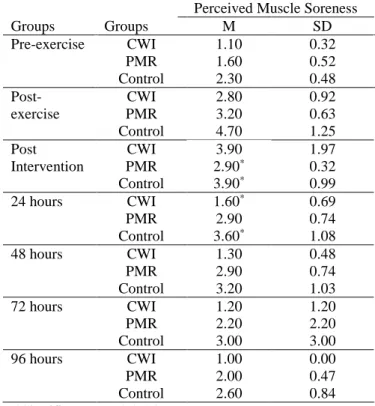
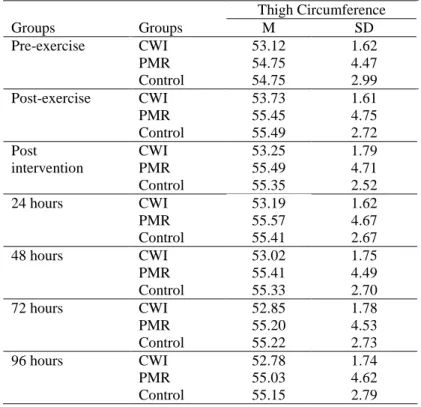
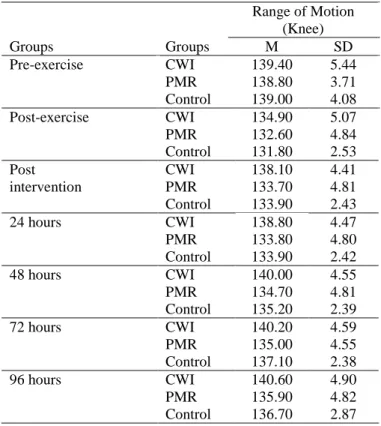
Table 1 presents the demographic data of the subjects. A significant interaction was found across the testing sessions but not between groups for perceived muscle soreness as presented in Table 2 (F = 15.59, df = 2, P = 0.01). Control group and PMR group were found significant in reducing soreness as early as post-intervention. CWI group has significant soreness reduction at 24 hours post-intervention. Meanwhile, a significant interaction reported in the 20-meter sprint performance across testing sessions (F = 7.76, df = 2, P = 0.01) as shown in Table 3. CWI group was observed to be significantly better in 20-meter sprint performance at post-intervention and consistently increased when compared with PMR and control groups which has fluctuating sprint outcome throughout testing sessions. On the other hand, there were no significant interactions found between group across the testing sessions for thigh circumference (Table 4) and knee range of motion (Table 5) with (F = 1.44, df = 2, P = 0.26) and (F = 0.07, df = 2, P = 0.07) respectively.
Table 1: Physical Characteristic of Subjects
Table 2: Descriptive Statistic for Perceived Muscle Soreness
Perceived Muscle Soreness
Groups Groups M SD
Pre-exercise CWI PMR Control 1.10 1.60 2.30 0.32 0.52 0.48 Post-exercise CWI PMR Control 2.80 3.20 4.70 0.92 0.63 1.25 Post Intervention CWI PMR Control 3.90 2.90* 3.90* 1.97 0.32 0.99
24 hours CWI
PMR Control 1.60* 2.90 3.60* 0.69 0.74 1.08
48 hours CWI
PMR Control 1.30 2.90 3.20 0.48 0.74 1.03
72 hours CWI
PMR Control 1.20 2.20 3.00 1.20 2.20 3.00
96 hours CWI
PMR Control 1.00 2.00 2.60 0.00 0.47 0.84 *Significant (p < 0.05) between group
Variables Mean ± SD
Age (years) Height(cm) Weight(kg) BMI(kg/m2)
Table 3: Descriptive Statistic for 20-m Sprint Performance
*Significant (p < 0.05) between group
Table 4: Descriptive Statistic for Thigh Circumference 20 Meter Sprint
Groups Groups M SD
Pre-exercise CWI PMR Control 3.09 3.42 3.23 0.15 0.43 0.21 Post-exercise CWI
PMR Control 3.27 3.59 3.54 0.16 0.21 0.27 Post Intervention CWI PMR Control 3.25* 3.24* 3.59 0.28 0.23 0.18
24 hours CWI
PMR Control 3.19* 3.28 3.49 0.12 0.17 0.30
48 hours CWI
PMR Control 3.14 3.29 3.51 0.07 0.16 0.21
72 hours CWI
PMR Control 3.15 3.23 3.46 0.06 0.17 0.21
96 hours CWI
PMR Control 3.03 3.24 3.42 0.26 0.15 0.22 Thigh Circumference
Groups Groups M SD
Pre-exercise CWI PMR Control 53.12 54.75 54.75 1.62 4.47 2.99 Post-exercise CWI
PMR Control 53.73 55.45 55.49 1.61 4.75 2.72 Post intervention CWI PMR Control 53.25 55.49 55.35 1.79 4.71 2.52
24 hours CWI
PMR Control 53.19 55.57 55.41 1.62 4.67 2.67
48 hours CWI
PMR Control 53.02 55.41 55.33 1.75 4.49 2.70
72 hours CWI
PMR Control 52.85 55.20 55.22 1.78 4.53 2.73
96 hours CWI
Table 5: Descriptive statistic for range of motion (knee)
Range of Motion (Knee)
Groups Groups M SD
Pre-exercise CWI
PMR Control 139.40 138.80 139.00 5.44 3.71 4.08 Post-exercise CWI
PMR Control 134.90 132.60 131.80 5.07 4.84 2.53 Post intervention CWI PMR Control 138.10 133.70 133.90 4.41 4.81 2.43
24 hours CWI
PMR Control 138.80 133.80 133.90 4.47 4.80 2.42
48 hours CWI
PMR Control 140.00 134.70 135.20 4.55 4.81 2.39
72 hours CWI
PMR Control 140.20 135.00 137.10 4.59 4.55 2.38
96 hours CWI
PMR Control 140.60 135.90 136.70 4.90 4.82 2.87 Discussion
The main findings of this study indicate that CWI recorded significantly greater in 20-meter sprint performance markers across testing sessions when compared to control and PMR group. Although there was a significant interaction in perceived muscle soreness marker across time, however no significant improvement observed between groups. It was learned that control group significantly better in soreness reduction as early as post-intervention.
Vaile et al., 2008), the precise mechanism of CWI remains unclear. There was probably a reduction of pain perception in the first three hours attributed to the analgesic effects of cooling rather than inhibition of muscle damage (Denegar & Perrin, 1992; Gulick, Kimura, Sitler, Paolone, & Kelly, 1996; Meeusen & Lievens, 1986). Perceived muscle soreness was recorded immediately post-intervention as suggested by Amir, Hashim, and Saha, (2017); however, it remained elevated at post-intervention in CWI group and only reduced at 24 hours. This contradictory finding is indeed difficult to explain. Inter-individual differences may be a contributing factor. For this study, significant times effects were found however there was no interaction observed between groups and this finding is consistent with Goodall and Howatson, (2008).
Performance markers such as jumping, sprint abilities and muscle strength are commonly used to measure the effectiveness of exercise-induced muscle damage (Warren, Lowe, & Armstrong, 1999). This has been supported by consistent decrement in neurological performance from various previous literatures (Ascensão et al., 2011; Bailey et al., 2007; Goodall & Howatson, 2008; Ingram et al., 2009; Jakeman, Macrae, & Eston, 2009; Vaile, Gill, & Blazevich, 2007). In this study, 20-meter sprint performance was reported to be significantly prominent at post-intervention and 24 hours in both the CWI and PMR groups. Control group was reported to have speed increment at 24 hours testing session. These findings are similar to those of Ingram et al., (2009) as CWI facilitated on rapid return to baseline in sprinting performance. Hence, Warren et al., (1999) preferences on specific muscular function assessment such as isometric maximal voluntary contraction was conflicting as it is more sensitive to decrements in muscular function than muscular sprint and jump performance.
It has been widely acknowledged that CWI is effective in constricting capillaries and reducing vessel permeability and blood flow, thus attenuating swelling and inflammatory response (Vaile et al., 2008; Vaile et al., 2007). However, if this were the case, then statistical analysis should have revealed a significant group interaction on thigh circumference and it was parallel with findings from Amir et al., (2017), Goodall & Howatson, (2008) and Eston & Peters, (1999). Thus, the CWI used in this present study do not support the proposed mechanism of vascular changes. Perhaps, this issue could be properly address with data from biochemical markers such as serum creatine kinase (CK), lactate dehydrogenase (LDH) and c-reactive protein (CRP) as discussed in the previous literatures (Amir et al., 2017; Ascensão et al., 2011; Bailey et al., 2007; Eston & Peters, 1999; Goodall & Howatson, 2008; Ingram et al., 2009; Vaile et al., 2008). Nevertheless, it is worth noting that thigh circumference in the CWI group was much faster to return to baseline when compared to PMR and control groups (99% of baseline level at 96 hours), although this was not statistically significant.
plyometric exercise (Amir et al., 2017). Yamane et al., (2006) claimed that cold application probably interferes with the regenerative process such as heat shock protein production and satellite cell proliferation, which are essential to the repair adaptation process (Barton-Davis, Shoturma, & Sweeney, 1999; Thompson, Maynard, Morales, & Scordilis, 2003) PMR group demonstrated significant reduction in the perception of muscle soreness scores post-intervention when compared to CWI at 24 hours. This was most pronounced at 72 hours onwards. To compare with CWI and control groups, PMR group was appeared to be less effective. It was assumed that subjects were not familiar with instructions given and probably the PMR protocols itself. Hanafi, Hashim, and Ghosh, (2011) and (Sharifah Maimunah & Hashim, 2016) proposed that 16 muscles group protocol was suitable for inexperienced individuals and was purported to reduce signs of muscular tension and performance level of the main skills in ballet (Mansour, 2010). The number of PMR session used in this study was deemed insufficient to yield stress reduction. Lohaus and Klein-Hessling, (2003) and Ghoncheh and Smith, (2004) suggested that a minimum of five PMR training session is sufficient to reduce somatic and psychological symptoms of stress response thus enhancing individual’s ability to cope with related emotional reactions. Therefore, the proposed mechanism was not observed in this finding. Similarly, 20-meter sprint performance in PMR group in the present study was not very impressive when compared to the other two groups, with fluctuating trends of reductions. Although Roth and Holmes, (1987) proposed PMR training could aid in balance between sympathetic responses with parasympathetic activation during intense activity and supposedly delaying the onset of fatigue during sports and exercise, however, that was not the case in this study. Thigh circumference demonstrated little recovery benefit in PMR group as swelling began to subside at 48 hours compared to CWI group at post-intervention. Alternatively, PMR group demonstrated quick reduction in ROM scores at similar timeline with CWI group. Though this improvement was not statistically significant between groups, it is worth noting that PMR still elicited improvement as early as post-intervention. In other study by Jing and Xudong, (2008) reported 15 minutes of one-session of relaxation was beneficial to affect level of fatigue among healthy male college students. Therefore, it is assumed that different results would be expected if the subjects were already familiar with PMR technique prior to the study.
Conclusion
It is also important to point out that the psychological component also plays a role in aiding these physical and physiological changes to DOMS. Most athletes are commonly exposed to different types of recovery techniques, despite little evidence for positive effects found on that technique. However, athletes tend to develop their own preferences for recovery techniques. It was assumed personal recovery preferences may help to perceive psychological benefit when using familiar recovery techniques and thus may have greater influence on performance (Sellwood et al., 2007; Brukner and Khan, 1993).
In summary, this study revealed that a single bout of CWI and PMR training session was insufficient to yield positive effects on DOMS markers, as at least five session of PMR may be appropriate to induce positive outcomes in reducing DOMS (Lohaus and Klein-Hesling, 2003; Ghoncheh and Smith, 2004; Sharifah Maimunah and Hashim, 2016).
References
Allen, T J, Dumont, T L & MacIntyre, D. L. (2004). Exercise-induced muscle damage: mechanisms, prevention, and treatment. Physiotherapy Canada, 56(2), 67–79.
Amir, N. H., Hashim, H. A., & Saha, S. (2017). The effect of single bout of 15 minutes of 15-degree celsius cold water immersion on delayed-onset muscle soreness indicators. In IFMBE Proceedings. https://doi.org/10.1007/978-981-10-3737-5_10
Ascensão, A., Leite, M., Rebelo, A. N., Magalhäes, S., & Magalhäes, J. (2011). Effects of cold water immersion on the recovery of physical performance and muscle damage
following a one-off soccer match. Journal of Sports Sciences.
https://doi.org/10.1080/02640414.2010.526132
Bailey, D. M., Erith, S. J., Griffin, P. J., Dowson, A., Brewer, D. S., Gant, N., & Williams, C. (2007). Influence of cold-water immersion on indices of muscle damage following
prolonged intermittent shuttle running. Journal of Sports Sciences.
https://doi.org/10.1080/02640410600982659
Barnett, A. (2006). Using recovery modalities between training sessions in elite athletes: Does it help? Sports Medicine. https://doi.org/10.2165/00007256-200636090-00005
Barton-Davis, E. R., Shoturma, D. I., & Sweeney, H. L. (1999). Contribution of satellite cells to IGF-I induced hypertrophy of skeletal muscle. In Acta Physiologica Scandinavica. https://doi.org/10.1046/j.1365-201X.1999.00618.x
Benson, H., Klemchuk, H. P., & Graham, J. R. (1974). The Usefulness Of The Relaxation Response In The Therapy Of Headache. Headache: The Journal of Head and Face
Pain. https://doi.org/10.1111/j.1526-4610.1974.hed1401049.x
Cleak, M. J., & Eston, R. G. (1992). Muscle soreness, swelling, stiffness and strength loss
after intense eccentric exercise. British Journal of Sports Medicine.
https://doi.org/10.1136/bjsm.26.4.267
Cochrane, D. J. (2004). Alternating hot and cold water immersion for athlete recovery: A review. Physical Therapy in Sport. https://doi.org/10.1016/j.ptsp.2003.10.002
Connolly, D. a. J., Sayers, S. P., & Mchugh, and M. P. (2003). Treatment and Prevention
of Delayed Onset Muscle Soreness. Journal of Strength and Conditioning Research.
https://doi.org/10.1519/00124278-200302000-00030
Denegar, C. R., & Perrin, D. H. (1992). Effect of transcutaneous electrical nerve stimulation, cold, and a combination treatment on pain, decreased range of motion, and strength loss associated with delayed onset muscle soreness. Journal of Athletic Training.
Dutto, D. J., & Braun, W. A. (2004). DOMS-Associated Changes in Ankle and Knee Joint
Dynamics during Running. Medicine and Science in Sports and Exercise.
https://doi.org/10.1249/01.MSS.0000121957.83226.CC
Eston, R., & Peters, D. (1999). Effects of cold water immersion on the symptoms of
exercise-induced muscle damage. Journal of Sports Sciences.
https://doi.org/10.1080/026404199366136
Ghoncheh, S., & Smith, J. C. (2004). Progressive Muscle Relaxation, Yoga Stretching,
and ABC Relaxation Theory. Journal of Clinical Psychology.
https://doi.org/10.1002/jclp.10194
Goodall, S., & Howatson, G. (2008). The effects of multiple cold water immersions on indices of muscle damage. Journal of Sports Science and Medicine.
Gulick, D. T., Kimura, I. F., Sitler, M., Paolone, a, & Kelly, J. D. (1996). Various treatment techniques on signs and symptoms of delayed onset muscle soreness. Journal of Athletic Training.
Hanafi, H., Hashim, H. A., & Ghosh, A. K. (2011). Comparison of long-term effects of two types of relaxation techniques on choice reaction time and selected psychophysiological variables following repeated sub-maximal intensity exercises in school level athletes. International Journal of Applied Sports Sciences.
Howatson, G., Goodall, S., & Someren, K. A. (2009). The influence of cold water immersions on adaptation following a single bout of damaging exercise. European Journal of Applied Physiology. https://doi.org/10.1007/s00421-008-0941-1
Howatson, G., & van Someren, K. a. (2008). The prevention and treatment of
exercise-induced muscle damage. Sports Medicine (Auckland, N.Z.).
https://doi.org/10.2165/00007256-200838060-00004
Howell, J. N., Chleboun, G., & Conatser, R. (1993). Muscle stiffness, strength loss, swelling and soreness following exercise‐induced injury in humans. The Journal of Physiology. https://doi.org/10.1113/jphysiol.1993.sp019629
Ingram, J., Dawson, B., Goodman, C., Wallman, K., & Beilby, J. (2009). Effect of water immersion methods on post-exercise recovery from simulated team sport exercise. Journal of Science and Medicine in Sport. https://doi.org/10.1016/j.jsams.2007.12.011
Jakeman, J. R., Macrae, R., & Eston, R. (2009). A single 10-min bout of cold-water immersion therapy after strenuous plyometric exercise has no beneficial effect on recovery from the symptoms of exercise-induced muscle damage. In Ergonomics. https://doi.org/10.1080/00140130802707733
Jing, L., & Xudong, W. (2008). Evaluation on the effects of relaxing music on the recovery from aerobic exercise-induced fatigue. Journal of Sports Medicine and Physical Fitness.
Lohaus, A., & Klein-Hessling, J. (2003). Relaxation in children: Effects of extended and
intensified training. Psychology and Health.
https://doi.org/10.1080/0887044021000057257
Macedo, L., Borges, D., Lins, C., & Brasileiro, J. (2015). Cryotherapy and Laser Therapy Do Not Interfere in the Response to Eccentric Exercise-Induced Muscle Damage: A Randomized Clinical Trial. Journal of Exercise Physiology Online.
Sharifah Maimunah, M. P. S., & Hashim, H. A. (2016). Differential effects of 7 and 16 groups of muscle relaxation training following repeated submaximal intensity exercise
in young football players. Perceptual and Motor Skills.
https://doi.org/10.1177/0031512515625383
Manal Mohamed Sayed Ahmed Mansour. (2010). Designing a proposed training program by using the progressive relaxation and its effect on certain signs of muscle tension and performance level of the main skills in ballet. World Journal of Sport Sciences, 3(8), 1174–1180. Retrieved from https://www.idosi.org/wjss/3(S)10/138.pdf
Meeusen, R., & Lievens, P. (1986). The Use of Cryotherapy in Sports Injuries. Sports Medicine. https://doi.org/10.2165/00007256-198603060-00002
Miyama, M., & Nosaka, K. (2004). Muscle Damage and Soreness Following Repeated Bouts of Consecutive Drop Jumps. Advances in Exercise and Sports Physiology. https://doi.org/10.1519/R-13353.1
Nickel, C., Kettler, C., Muehlbacher, M., Lahmann, C., Tritt, K., Fartacek, R., … Nickel, M. K. (2005). Effect of progressive muscle relaxation in adolescent female bronchial
asthma patients: A randomized, double-blind, controlled study. Journal of
Psychosomatic Research. https://doi.org/10.1016/j.jpsychores.2005.04.008
Paschalis, V., Giakas, G., Baltzopoulos, V., Jamurtas, A. Z., Theoharis, V., Kotzamanidis, C., & Koutedakis, Y. (2007). The effects of muscle damage following eccentric
exercise on gait biomechanics. Gait & Posture.
https://doi.org/10.1016/j.gaitpost.2006.04.002
Roth, D. L., & Holmes, D. S. (1987). Influence of aerobic exercise training and relaxation training on physical and psychologic health following stressful life events. Psychosomatic Medicine. https://doi.org/10.1097/00006842-198707000-00004
Sellwood, K. L., Brukner, P., Williams, D., Nicol, A., & Hinman, R. (2007). Ice-water immersion and delayed-onset muscle soreness: A randomised controlled trial. British Journal of Sports Medicine. https://doi.org/10.1136/bjsm.2006.033985
Thompson, H. S., Maynard, E. B., Morales, E. R., & Scordilis, S. P. (2003).
Exercise-induced HSP27, HSP70 and MAPK responses in human skeletal muscle. Acta
Physiologica Scandinavica. https://doi.org/10.1046/j.1365-201X.2003.01112.x
Tokmakidis, S. P., Kokkinidis, E. A., Smilios, I., & Douda, H. (2003). The effects of ibuprofen on delayed muscle soreness and muscular performance after eccentric
exercise. Journal of Strength and Conditioning Research.
https://doi.org/10.1519/1533-4287(2003)017<0053:TEOIOD>2.0.CO;2
Vaile, J., Halson, S., Gill, N., & Dawson, B. (2008). Effect of hydrotherapy on the signs and symptoms of delayed onset muscle soreness. European Journal of Applied Physiology. https://doi.org/10.1007/s00421-007-0605-6
Vaile, J. M., Gill, N. D., & Blazevich, A. J. (2007). The effect of contrast water therapy
on symptoms of delayed onset muscle soreness. Journal of Strength and Conditioning
Research. https://doi.org/10.1519/R-19355.1
Warren, G. L., Lowe, D. A., & Armstrong, R. B. (1999). Measurement tools used in the
study of eccentric contraction-induced injury. Sports Medicine.
https://doi.org/10.2165/00007256-199927010-00004
Wilcock, I. M., Cronin, J. B., & Hing, W. a. (2006). Physiological Response to Water
Willliams, J. M. (2010). Applied sport psychology: Personal growth to peak performance. IAAP Handbook of Applied Psychology.