Genetic Trend for Certain Traits in Pigs Using
Different Selection Criteria
Vitomir Vidovi
ć
1, Dragomir Luka
č
1, Ljuba Štrbac
1, Vladislav Višnji
ć
2, Desanka Punoš
3,
Radomir Ševi
ć
4, Jovanka Krnjaji
ć
5, Milanko Stupar
11Faculty of Agriculture, 21 000-Novi Sad, Trg Dositeja Obradovića 8, Serbia
2SIZIM, 48 317-Veliki Otok bb, Croatia
3Farmdizajn, 21 000-Novi Sad, Drage Spasić, 2a, Serbia
4AD Bačka, 21 400-Bačka Palanka, Novosadski put, 10, Serbia
5DELTA Agrar,22300-Stara pazova, Golubinački put bb, Serbia
Abstract
The trial during 8 generations or 11 years of period has been done at 4 different breeds: Landrace and Yorkshire as dam line and Duroc and Pietrain as sire one. Included were 68 sires, 1.994 dams, 6.794 progeny and slaughtered 868 heads in total. There have no been selection differences for gain and age at slaughtered Y, L and D. Pietrain showed significantly less gain. It means more cost and less profit in case of P. The feeding line of gilts and sows were changed to previous one. It has significant influence to number of piglets at birth. It mean we have to, optimize, feeding regime and milk yield of sows. Phenotypic and genetic improvement was in average 0.25 piglets per generation. Genetic variation was similar from beginning to last generation of selection. Selection on meat content had positive trend. Selection efficiency were higher at D compare with P. Pietrain itself still have 3.4% more meat in carcass but much longer period of fattening. Intramuscular fat was much lover at P. This has negative effect on meat quality. Litter size showed positive effect. There are no significant differences between L and Y.
Keywords: age, genetic trends, litter size, meat content, pigs
1. Introduction
In pig production, the most important traits from economical point of view can be as follow: number of weaned piglets per sow per year, feed conversion, growth and meat content in carcass then protein level in meat. To provide optimal selection effect for each of them it is important to determine genetic correlation between them and size of heritability as well. According to knowledge of negative genetic correlations between fertility or milk yield and meat content in carcass it is necessarily to developed different selection criteria or better says specialized breeds.
*Correspondin author: Vidović Vitomir, Tel: +381 63
526 316, Fax:+381 21 66 14 351, Email: [email protected]
2. Materials and methods
The experiment has been done at 4 farms since mother line and D and P (Table 1) as terminal one. 2000 up to 2012. We included 4 breeds, L, Y as
Table 1. Breed structure and number of animals in trial
Breed Sire Dam Progeny No. carcasses
Landrace 20 684 2742 232
Yorkshire 19 640 2586 236
Duroc 17 482 1163 226
Pietrain 12 188 303 174
The following pictures (Figure 1 and Figure 2) represent different selection criteria that were used. To follow litter size were used data of 1.994 sows, 68 sires and 6.794 of progeny and slaughter
868 head in total. Average alive weight at slaughter of all animals was 103 kg and standard deviation of 2.6 kg.
Figure 1. Used selection criteria for mother breeds: - Landrace and Yorkshire
Figure 2.Selection criteria used for terminal breeds: – Duroc and Pietrain
Following MME LS model has been used to analyze influences of FYS (Farm, Year and Season) then Breed as fixed effect and Sire as random one.
Yijkl = µ + HYSi + Bij + Sijk + Eijkl
Yijkl -Number of observations hierarchically distributed;
µ -General mean of observations;
HYSi -Fixed effect of farm, year and season; Bij -Fixed effect of different breeds; Sijk -Random sire effect;
Eijkl -Residual
3. Results and discussion
Litter size. First of all we used totally different selection criteria to do selection in specialized breeds. Litter size was not of selection interest for D and P. So, we analyzed trend for L and Y (Figure 3).
After generations of selection, selection trend were little less than expected. Probably one of limited factors was FYS effect and feeding regime of sows it can be redefined in the future. Even that selection effect tendency was positive and similar for both L and Y. Similar results have been done by [1, 2]. Genetic variation has shown similar value and trend at the beginning and end of analysis. Inbreeding coefficient was just about zero. Present variation opening possibility for new selection progress.
Figure 3. The effect of selection on litter size at first farrowing of Landrace and Yorkshire
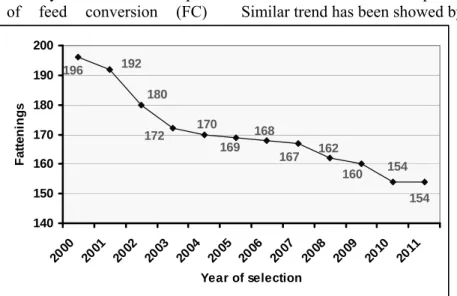
Fattening days and feed conversion. The line (Figure 4) showed expected tendency. It means the selection criteria for most economically important traits have been well defined. Selection intensity was controlled by number of doses per jump. In case of feed conversion (FC)
improvement were 90 kg per head. Most fast improvement was at first 5 years. Since that FC is average heritage there are new possibilities to continue with selection effect, e.g. to decrease FC, reduce cost and increase profit per kg of gain. Similar trend has been showed by [3-8].
196 192
180
172 170 169
168
167 162
160 154
154
140 150 160 170 180 190 200
2000 2001 200 2
2003 2004 200 5
2006 2007 2008 2009 2010 2011
Year of selection
Fa
tt
e
n
in
g
s
Figure 4. Effect of selection on age at slaughter (indirectly on growth) and feed conversion for Landrace, Yorkshire and Duroc
Effects: 1. Less of feed: 90 kg 2. Less fattening days: 42
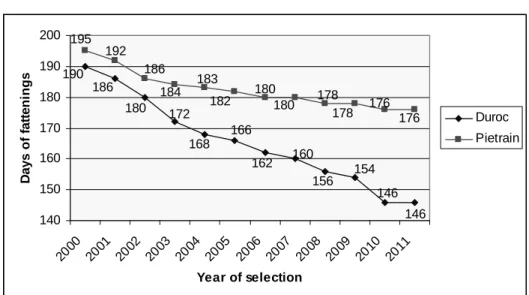
Notes: There are no selection differences between Landrace, Yorkshire and Duroc. Pietrain had significantly less daily gain and age at slaughter compare to three other breeds. According to fattening period we can recognize improvement of 42 days. Economically it is improvement of about
146 146 154 156 160 162 166 168 172 186 180 190 176 176 178 178 180 180 182 183 184 186 192 195 140 150 160 170 180 190 200
2000 2001 2002 2003 2004 2005 2006 2007 2008 2009 2010 2011
Year of selection
D a y s of f a tt e ni ngs Duroc Pietrain
Figure 5. The differences in feed use and age at slaughter between Duroc and Pietrain in test production
The differences: 1. Age: 32 days 2. Feed: 88 kg
Carcass quality. Meat content in Landrace and Yorkshire has no statistical differences even they showed optimal trend. Since those to breed are treated as dam line to provide heterosis effect at F1 daughters selection criteria were concentrate more
on fertility traits. Expected trend were very close to realized one. It is going to back fat between 16- 20 mm at that age. Later on these animals if they are going to be parents mast has some reserve to produce progeny (Figure 6).
54,1 54,2 55
55,4 55,7
56 56,2
56,8 57,1
57,3 57,6 57,6
52 53 54 55 56 57 58
2000 2001 2002 2003 2004 2005 2006 2007 2008 2009 2010 2011
Year of selection
M e a t co n ten t, %
Figure 6. The trend of selection for percentage of meat content for Landrace and Yorkshire
Bones density did not differ significantly between Landrace, Yorkshire and Duroc. Pietrain bones were significantly easier. This demonstrates the viability of lower growth in this race compared to the other and longer feeding for 24 to 32 days. When it comes to the only growth was significantly lower in Pietrain animals were compared to their peers of other races. The content of meat in the carcass was approximately 57.6% in
Duroc. Selection criteria relate to the last eight generations of selection and the effects show the expected trends.
Just to remind case of present negative genetic correlations between milk yield and meat content in carcass mean that breeders have to optimize selection criteria and use specialized sire and dam
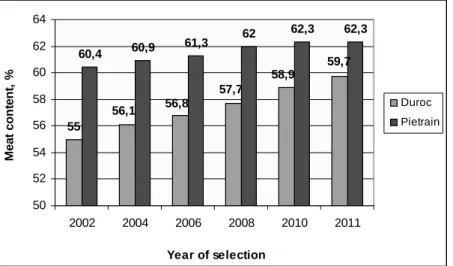
lines in breeding program. In our experiment we divided into two different groups: L and Y as mother line and used totally different selection criteria compare to terminal sire lines: D and P. After 11 years of selection or 8 generations result were present (Figure 6 and 7).
55
60,4 60,9 61,3
62 62,3 62,3
56,1 56,8
57,7
58,9
59,7
50 52 54 56 58 60 62 64
2002 2004 2006 2008 2010 2011
Year of selection
M
e
at
c
o
n
ten
t,
%
Duroc
Pietrain
Figure 7. The effects of selection for meat content of Duroc 59.7 and Pietrain
The effects in meat content, %: - Duroc: 3.9 - Pietrain: 1.9
At figure 6 can be recognized the differences between Duroc and Pietrain even they have the same selection criteria. The only differences were at the beginning of start trial. In conclusion we can say the trend were more or less the same as selection effect. The differences of 3.4% of meat content or raptly 2.5 kg meat between them provide about 8 euro more profit in fewer to P. But in total D made about 14 euro more profit including FC and fattening period as well. Similar conclusion were defined by [4, 6 ,9,11-14].
4. Conclusions
Selection criteria for certain traits have been optimal. It showed clear genetic trend for certain traits. Litter size were with expected trend e.g. 0.25 alive born more piglets per generation. The feeding regime and management of gilts and sows was changed to previous one. This change has significant influence on genetic potential of sows.
There have no been selection differences for gain and age at slaughtered Y, L and D. Pietrain showed significantly less gain and needed longer period to
reach certain weight. So that means more cost and less profit in case of P.
Also selection on meat content had positive trend. Selection efficiency were higher at D compare with P. Pietrain itself still have 3.4% more meat in carcass but much longer period of fattening. Intramuscular fat was much lover at P (0.5%) compare to D (2.5%). This has negative effect on meat quality in case of P.
References
1. Nielsen, M.K., Selection experiments for reproductive rate in mice. WCGALP, Guelph, 1994, pp. 219 – 226.
2. Vidović, V., Lukač, D., Štrbac, L.J., Punoš, D., Stupar, M., Genetic trends using different criteria of selection on specialized breeds in pigs, Biotechnology in Animal Husbandry, 2011, 27, 1779-1786
3. Brascamp, E.W., Smith, C., Gur, D.R., Derivation of economic weight from profit equations, Anim. Prod., 1985, 40, 175 – 180
4. Rotschild, M.F., The role of biology in future pig breeding programs. WCGALP, Guelph, XV, 1990, pp. 415 – 427.
5. Park, Y. I., Kim, J.B., Heritability of litter size and litter weight at birth in swine. WCGALP, Lincoln X, 1986, pp. 59 – 62.
Performance and Growing – Finishing Traits in Pigs. WCGALP, Leipzig, 2010, 41.
7. Vidović, V., Teorija oplemenjivanja životinja. Poljoprivredni fakultet, Novi Sad, 2009, pp.
342.
8. Vidović, V., Šubara, V., Farmski menadžment – ključ uspeha. Poljoprivredni fakultet, Novi Sad, 2011, pp.140.
9. Vidović, V., Višnjić, V., Jugović, D., Punoš, D., Vuković, N., Praktično svinjarstvo. APROSIM, Novi Sad, 2011, pp.287.
10. Višnjić, V., Vidović, V., Štrbac, Lj., Lukač, D., Punoš, D., Stupar, M., Intenzitet porasta hibridnih svinja u tovu očeva rase pitren i durok. XVII Savetovanje o biotehnologiji. Agronomski fakultet
Čačak. 2012, In press.
11. Gama, L.T., Harder, R.R., Johnson, R.K.,Change in ovulation rate and uterine capacity in swine selected for litter size. WCGALP, XVI, 1990, pp. 351 – 354. 12.Vidović, V., Trivunović, S., Punoš, D., Štrbac, Lj., Lukač, D., Stupa, M., Selection efficiency on bons and meat yeald in pigs, Biotechnology in Animal Husbandry, 2011, 27, 1787-1792
13. Vidović, V., Lukač, D., Štrbac, LJ., Punoš, D., Stupar, M., Genetic trends using different criteria of selection on specialized breeds in pigs, Biotechnology in Animal Husbandry. 2011, 27, 1779-1786
14. Vidović, V., Lukač, D., Štrbac, Lj., Punoš, D., Stupar, M., Effect of differnt selection criteria on growth traits and carcass quality in pigs. 6th Central European Congress of Food, Novi Sad. 2012, (In press).