Original Research Article
Deep neck space infections: our experience
Naveen Kumar Korivipati
1*, Sandeep Irvineti
2, Mallikarjun Rao M.
1INTRODUCTION
Deep neck space infections are dreadful infections and are still a potentially life threatening condition with considerable mortality even in this era of modern medicine. This is due to delayed presentation of the patient to a tertiary centre and frequent association with fatal complications as a result of close proximity to aerodigestive tract and major vasculature of neck.1,2
These are commonly seen in low socioeconomic group with poor oral hygiene, and nutritionaldisorders.3-5 There is a rise in the recent past due to reemerging diseases like AIDS and Tuberculosis. With an insight into prevention of these dreadful infections, patient education, oral and dental hygiene has to be strengthened With the advent of new antibiotics and improved methods of managing critically ill patients, fatality due to neck space infections has come down.6-8
ABSTRACT
Background: Deep neck space infections (DNSI) are serious diseases that involve several spaces in the neck. The common primary sources of DNSI are tonsil infections, dental infections, salivary gland infections, foreign bodies and malignancies. With widespread use of antibiotics and early detection facilities, the prevalence of DNSI has been reduced. Common complications of DNSI include airway obstruction, jugular vein thrombosis, and sepsis. Treatment principally comprises airway management, antibiotic therapy, and surgical intervention. This study was conducted to investigate the age and sex distribution of patients, symptoms, presentation, sites involved, bacteriology, and management and complications of DNSI.
Methods: A prospective study of deep neck space infections was done during the period July 2015 to February 2017
i.e. 20 months who attended the outpatient and were admitted as inpatient in Shadan hospital, Hyderabad.50 Cases were included in the study. All parameters including age, gender, co-morbidities, presentation, site, bacteriology, complications, and investigations were studied.
Results: Due to advent of antibiotics, deep neck space infections are in decreasing trend with admission rate accounting to 3% of total inpatients in our hospital. The common age group found to be affected is 10-20 years (28%). Out of all deep neck space infections, Ludwigs infections was common (32%) followed by peritonsillar infections (25%).
Conclusions: Infection of the deep neck spaces is a common and potentially life threatening ENT disease and requires an interdisciplinary approach. Tooth infections and foreign body impaction are the commonest causes of these infections. Diabetes Mellitus is an important predisposing factor. Complications such as mediastinitis, septic shock and pleural effusion are possible; hence the surgeon should be cautious.
Keywords: Deep neck space, Parapharyngeal, Retropharyngeal, Ludwigs angina, Parotid abcess
1Department of ENT, Shadan Institute of Medical Sciences, Hyderabad, Telangana, India 2Consultant ENT Surgeon, BBR Hospital, Hyderabad, Telangana, India
Received: 10 August 2017
Revised: 21 November 2017
Accepted: 22 November 2017
*Correspondence:
Dr. Naveen Kumar Korivipati, E-mail: [email protected]
Copyright: © the author(s), publisher and licensee Medip Academy. This is an open-access article distributed under
the terms of the Creative Commons Attribution Non-Commercial License, which permits unrestricted non-commercial use, distribution, and reproduction in any medium, provided the original work is properly cited.
Etiology and pathogenesis
Etiology of deep neck space infections varies depending on the space involved. In general the neck spaces get involved by various portals of infection. They are: tonsillar and pharyngeal infections, dental infections, upper aerodigestive tract trauma. Sialadenitis, congenital cysts and fistulas, Pott’s disease, infected metastatic neck nodes, intravenous, subcutaneous drug injections, retropharyngeal lymphadenitis: common in children. Infections of temporal bone: That is Bezolds abscess and petrositis. The individual at risk of developing neck space infections are immunocompromised patients with diabetes mellitus, sexually transmitted diseases predominantly HIV, steroid therapy for recent organ transplantation, chemotherapy, chronic ailment like tuberculosis, alcoholic hepatitis, drug addicts injecting into various areas of neck.
Poor socioeconomic status with nutritional deficiency disorders and poor hygiene status.
Clinical features
The general symptoms and signs in neck space infections are:
Pain, fever, dysphagia, dyspnea, change in voice, trismus, tachcardia and tachypnea. Signs of dehydration, chest pain, swelling in the neck.
Aim of study
Deep neck space infections are a neglected entity due to ambiguity of nomenclature of anatomy of neck spaces. This study aims at understanding the changing trends in etiology, bacteriology and different modalities of imaging in neck space infections.
Culture and sensitivity tests aims at knowing the variations in susceptibility to antibiotics and to show a better regimen of antibiotics. It also aims at knowing the best ways of diagnostic methods for applying conservative management and timely surgical intervention so as to prevent complications.
METHODS
A prospective study of deep neck space infections was done during the period July 2015 to February 2017 i.e. 20 months who attended the outpatient and were admitted as inpatient in our Shadan hospital, Hyderabad. 50 cases were included in the study. 21 cases were male including 6 male children. 29 cases were female including 7 female children.
Inclusion criteria
Patients with deep neck space infection clinically, of all age groups, both sexes immune-compromised states and tuberculosis.
Exclusion criteria
Exclusion criteria were malignancy, uncooperative patients and not willing for admission.
The clinical characteristics recorded include age, sex, aetiology, symptoms, organisms cultured, diagnostic methods and type of management. Investigations included complete blood tests, complete urine examination, HIV, HbSAG, RBS, blood urea, s. creatinine. Pus was sent for culture and sensitivity. X-ray soft tissue neck in AP and lateral view, ultrasound, CT scan and MRI were done. Management included medical and surgical treatment.
Statistical tool
Statistical tool used bar diagram and tables.
RESULTS
Our study consist a total of 50 cases
Sex incidence
Out of these 21 cases were male including 6 male children and 29 cases were female including 7 female children. The ratio of male to female being 1:1.38 (Figure 1).
Figure 1: Distribution of cases based on sex incidence.
Age incidence
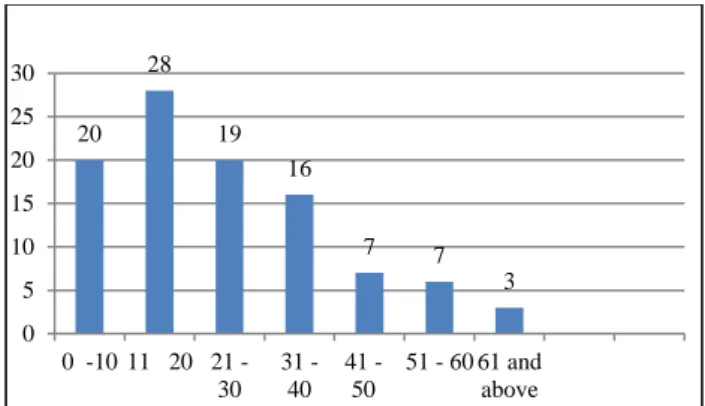
In common to all infections, the age incidence ranges from 2 years child of left parotid abscess to 72 years with Ludwigs angina. The highest incidence of neck space infections were noted in the age group of 11–20 years accounting for 28% cases (Figure 2).
Site incidence
Of all the deep neck space infections, Ludwigs angina was found to be the highest with 16cases, next common was 12 cases of peritonsillar space infections (Figure 3).
30 12
43 15
MALE MALE CHILD FEMALE FEMALE CHILD
0 10 20 30 40 50
Figure 2: Distribution if cases based on age incidence.
Figure 3: Distribution of cases based on site incidence.
The results of 45 cases of pus for culture and sensitivity are
Sterile-11 (48%), Streptococcus-5 (22%), Staphylo-coccus-4 (17%), Pseudomonas -1 (5%), E. Coli 1 (5%), Klebseilla-1 (3%) (Table 1).
Table 1: Organisms from pus culture and sensitivity.
Organism Number Percentage (%)
Sterile 11 48
Streptococcus 5 22
Staphylococccus 4 17
Pseudomonas 1 05
E. coli 1 05
Klebsiella 1 03
The observations of the above results show that 48% were sterile with no growth. This can be due to antibiotic usage prior to admission given by local doctors as our hospital is a tertiary hospital and are being referred from them and also due to trail of conservative treatment including antibiotics prior to incision and drainage at the time of admission. The remaining results showed highest incidence of Streptococcusviridans (22%) followed by S. aureus (17%). Multiple space infections with diabetes was associated in 2 cases with E. Coli organisms. The inference of the above findings was that the commonest organism to cause deep neck space infections is Streptococcus viridans as described by standard text
books. The anaerobic culture could not be done due to non-availability of facilities.
DISCUSSION
Incidence
In this study of 50 cases of deep neck space infections, 21 males (42%) and 29 females (58%), with predisposition to female sex, the ratio of male to female being 1:1.38 which is slightly higher compared to Rizzo and Sichel and Dano study.1,2
Age incidence
In our study the age distribution ranged from 2 yrs to 72 years, this is comparable to the study by Rizzo where the age distribution is from 2 years to 60 years.1 The age group with maximum incidence was noted to be 11–20 yearsin this study i.e. 28%, unlike Rizzo study, which showed 40–60 years as the common age group for deep neck space infections.5,6
Site incidence
This study showed Ludwig’s angina (32%) as the commonest type of DNSI, which is in similarity with Rizzo study unlike other studies like Sichel and Dano study of, Boyanova of Bulgaria which showed peritonsillar infections as the commonest and this was the second commonest infection in our study.1-5,10-12
Socioeconomic status
All studies universally accepted the occurrence to be more in low socioeconomic group which was the same in our study
Etiological agent
According to Rizzo, odontogenic and upper airway infections were the two most common causes of DNSI and 27% were without any etiological reason.1,4 In our study in 77% cases cause could not be found and labelled as idiopathic but it could be because of local suppuration. Rest of the 23 cases had a etiological factor, 17 cases of which had odontogenic infections as etiological agent predominantly predisposing to Ludwig and sub-mandibular space infections.4,5,10-12
Other associated diseases
In our study only 12 cases with other associated diseases as a secondary cause. Of these diabetes was the commonest disease found to be in 7 cases (15% of total cases).9,13 Unlike Rizzo study which showed still more occurrence of diabetes with DNSI.1 The other immunocompromised diseases like Hepatitis B (2 cases), AIDS (Nil) and TB (1 case) were found to be less in our study. This can be because of availability of tertiary care 20
28 19
16
7 7
3 0
5 10 15 20 25 30
0 10 11 20 21 -30
31 -40
41 -50
51 - 60 61 and above
25 32 12
4 9 4
10 2
2
0 10 20 30 40
hospitals exclusively for AIDS, TB (RNTCP centres) and other related diseases which are treating these patients.
Diagnostic methods
Detailed proper history and clinical evaluation stood as the mainstay of diagnosis in our study. The radiological investigations specially X-rays, lateral view and AP view of soft tissue of neck helped to show encroachment of airway to take a decision for securing airway and presence of air bubbles guided us to know that there was anaerobic infection necessitating I/V antibiotics covering anaerobes. Ultrasound is an upcoming and cheap investigating tool and was used in 2 cases in identifying deep seated abscess and multiple neck space infections. CT scan was done in 2 cases with multiple DNSI and MRI was done in 1 cases with multiple DNSI. But it is still the high KV X-rays which suffice diagnosing and assessing the progress of DNSI.
Treatment
Our study showed that medical treatment was sufficient to cure DNSI in 17 cases (34%) which reached nearly 50% in Ludwig’s angina and 44% in peritonsillar infections. These results are in similarity to other studies giving significance to medical management compared to previous old studies relying on surgical treatment before the era of antibiotics. This is stressing the importance of medical management of DNSI as the changing trend in treating these dreadful infections and bringing the morbidity and mortality of DNSI. Surgical treatment included incision and drainage with placement of betadine soaked gauze in the wound which showed best results.
Antibiotics used
Our study used ceftriaxone, amikacin and metronidazole regimen as mainstay in most of cases with good results supported by culture and sensitivity reports. In few cases ceftriaxone was replaced with cefotaxime/ampicillin/ ciprofloxacin.This observation was supported in turn by study done by Lyudmila, B3 on anaerobic bacteria in 115 patients of DNSI with resistance rate to metronidazole to be only 2.5%, thereby strongly recommending metronidazole as part of the regimen. Organisms identified: In our study Streptococcus (viridians and pyogenes) was the frequently isolated organism in 5 out of 12 cases (22%) followed by S. aureus in 4 cases (17%).8,9,14 This is in agreement with other studies.
CONCLUSION
This prospective study of deep neck space infections done during July 2015 to February 2017 (20 months) at Shadan hospital, Hyderabad revealed.
Due to advent of antibiotics, deep neck space infections are in decreasing trend with admission rate accounting to
3% of total inpatients in our hospital. The common age group found to be affected is 10-20 years (28%). These infections had female sex predominance. Out of all deep neck space infections, Ludwig’s infections was common (32%) followed by peritonsillar infections (25%). Irrespective of space involved common symptom was dysphagia. Most neck space infections were idiopathic followed by dental infections as aetiological factors for Ludwig and submandibular infections. Contrary to common belief, these DNSI affect all people with more severity in people with Diabetes, increasing the hospital stay and possibility for complications. History and clinical examination are of great importance in diagnosis supported by X-rays, which still have major role in diagnosis and management. Ultrasound is an upcoming tool and only few cases needed CT scan (2 cases) and 1 cases had undergone MRI. Commonest organism isolated is streptococcus (viridians and pyogenes) followed by S. aureus which responded to ceftriaxone, cefotaxime ampicillin, metronidazole and amikacin. Medical treatment is also important in deep neck space infections (17 cases) thus avoiding traumatic painful surgical management. Incision and drainage is the mainstay of surgical treatment with wide exposure and use of betadine solution impregnated gauze for placement in the wound. Patient education regarding oral and dental hygiene has to be stressed to prevent most of deep neck space infections. Complication rate is very low with proper antibiotic coverage and timely surgical intervention. The common complication is fibrotic contractures of neck and residual dysphagia in I and D patients.
Any case of deep neck space infection its better to start conservative management based on culture sensitivity from the aspirate, which might prevent the patient going into surgical intervention.
Funding: No funding sources Conflict of interest: None declared Ethical approval: Not required
REFERENCES
1. Rizzo PB, Marchiori C, Zanetti F, Vaglia A. Conservative management of deep neck abscesses in adults: The importance of CECT findings Otolaryngol Head Neck Surg. 2006;135(6):894-9. 2. Sichel JY, Dano I, Hocwald E, Biron A, Eliashar R.
Nonsurgical management of parapharyngeal space infections: a prospective study. Laryngoscope. 2002;112(5):906-10.
3. Lyudmila B, Rossen K, Galina G, Elitsa D, Jivko M, Milen M. Anaerobic bacteria in 118 patients with deepspace head and neck infections. J Med Microbiol. 2006;55:1285-9.
5. Lin HW, O'Neill A, Cunningham MJ. Ludwig's Angina in the Pediatric Population. Clin Paediatr. 2009;48(6):583-7.
6. Hawkins DB, Austin JR. Abscesses of the Neck in Infants and Young Children a Review of 112 Cases, Annals Otol Rhinol Laryngol. 1991;100:361-5. 7. Mayor GP, Martinez-San Millan J, Martinez-Vidal
A. Is Conservative treatment of deep neck space infectious appropriate? Head Neck. 2001;23:126. 8. Candamourty R, Venkatachalam S, Babu MR,
Kumar GS. Ludwig's angina: An emergency: A case report with literature review. J Nat Sci Biol Med. 2012;3(2):206-8.
9. Huang TT, Tseng FY, Liu TC, Hsu CJ, Chen YS. Deep neck infection in diabetic patients: Comparison of clinical picture and outcomes with nondiabetic patients. Otolaryngol Head Neck Surg. 2005;132:943-7.
10. Parhiscar A, Har-El G. Deep Neck Abscess: A Retrospective Review of 210 Cases. Otolaryngol Head Neck Surg. 2001;110(11):1051-4.
11. Larawin V, Naipao J, Dubey SP. Head and neck space infections. Otolaryngol Head Neck Surg. 2006;135(6):889-93.
12. Dhanalakshmi S. Lurking Dangers in Deep Neck Abscess Retrospective Study. J Evol Med Dental Sci. 2015;4:7977-85.
13. Lee J, Kim H, Lim S. Predisposing Factors of Complicated Deep Neck Infection: An Analysis of 158 Cases. Yonsei Med J. 2007;48(1):55-62. 14. Tom MB, Rice DH. Presentation and management
of neck abscess: a retrospective analysis. Laryngoscope. 1988;98(8):877-80.
15. Juncar M, Lung T, Onisor F. Infections of Head and Neck Soft Tissues – A Statistical Study over a 10-year Period. Applied Med Informatics Original Res. 2010;27(3):37-42.