International Journal of Research in Engineering and Applied Sciences(IJREAS) Available online at http://euroasiapub.org/journals.php
Vol. 7 Issue 4, April-2017, pp. 38~44
ISSN (O): 2249-3905, ISSN(P): 2349-6525 | Impact Factor: 7.196 | Thomson Reuters Researcher ID: L-5236-2015
SOME PHYSICAL PROPERTIES OF FERMENTED LOCUST BEAN PRODUCED IN FOUR
DIFFERENT LOCATIONS IN NIGERIA
JAIYEOBA, KEHINDE FOLAKE1, Department of Agricultural Engineering, Adeleke University, Ede, Osun State, Nigeria
OGUNLADE, CLEMENT ADESOJI2 Department of Agricultural Engineering, Adeleke University, Ede, Osun State, Nigeria
ABSTRACT:
Literature is very scarce on the variations of the physical properties of locust bean seed produced from different locations in Nigeria with a view to developing single machinery that can process locust bean seed irrespective of its origin or variety. Thus, the main objective of this study was to determine the physical properties of locust bean produced from different locations in Nigeria. Fermented locust bean seeds were procured from four major production centers in Nigeria; Niger State, Oyo State, Edo State and Ondo State; labelled A, B, C and D respectively. The physical properties were determined in accordance with American Society method of evaluation of Agricultural Engineers (ASAE) standard. Physical properties determined include axial dimensions (major, minor and thickness/intermediate diameters), geometric mean diameter, sphericity, projected area, surface area, bulk density and coefficient of friction (determined on stainless steel, plywood and glass). The major, minor, intermediate (thickness), geometric mean diameter obtained from this study ranged from 13.65 – 14.61, 10.02 – 10.75, 5.35 – 6.48, 8.82 – 9.72mm. Sphericity, projected area, surface area and bulk density ranged from 64.67 – 70.47%, 107.44 – 119.58mm2, 244.42 – 296.85mm2 and 1.13 – 1.27 g/cm3 respectively. The coefficient of friction obtained on glass is the lowest while maximum values were obtained on plywood for all the fermented locust bean samples used for the experiment. It was observed that there are variations in the physical properties obtained for the locust bean seeds from one location to another.
Keyword: fermented locust bean, physical properties, production centers, machinery, coefficient of friction
INTRODUCTION
International Journal of Research in Engineering and Applied Sciences(IJREAS) Vol. 7 Issue 4, April-2017
ISSN (O): 2249-3905, ISSN(P): 2349-6525 | Impact Factor: 7.196
tough pericarp. Each pod contains yellow powdery pulp in which seeds are embedded. The seeds have hard, black testa making them less vulnerable to insects and rodent infestations at maturity. More than 100 million inhabitants of West Africa use locust bean as a foodstuff however, despite its wide use as food, reliable figures for the production are quite difficult to obtain. Odunfa (1980) estimated that about 200,000 tons of beans are gathered every year in the Northern part of Nigeria alone. In addition, large quantities are produced in the savannah regions of Oyo and Kwara States in South Western Nigeria. Fermented locust bean otherwise known in Nigeria as
Dawadawa in Niger and Northern Nigeria and Ghana, Iru in Southern Nigeria and Soumbala in Burkina Faso, Mali, Cote d’Ivoire and Guinea and ‘Ogiri-igala’ (in South East and South South part of Nigeria) can be made.
The local processing of locust bean to produce ‘Iru’ has over the years, remained in the hands of rural families and is exclusively carried out by women who process these seeds for home consumption and for sale using rudimentary utensils (Adewumi, 1988, Audu et al. 2004)). Iru, the fermented locust bean seed is a strong smelling product and is normally used as soup or stew flavouring material most especially by low income families. Apart from being a food condiment the fermented bean also contributes to the calorie and protein intake. The production of fermented locust bean has remained a traditional family art practiced in homes with rudimentary utensils. The major processing conditions include: dehulling or decorticating of the pods, de-pulping and fermentation of the seeds. The methods used vary from one locality to another depending on the culture of the people, their beliefs, taste and practise of the fore parents who were involved in the same vocation, these variations in the processing techniques in turn bring about variations in the quality of the condiment produced and the operations are time consuming, laborious and inefficient. Consequently, the derived products from these seeds are not generally acceptable to consumers due to primitive handling procedure and low capacity to meet the International Standard. Several constraints are reported on production and consumption of the condiment; these include: low production due to the use of rudimentary equipment, high wood fuel consumption and poor manufacturing practices (Olaoye, 2010, Adejumo et al., 2013).
International Journal of Research in Engineering and Applied Sciences(IJREAS) Vol. 7 Issue 4, April-2017
ISSN (O): 2249-3905, ISSN(P): 2349-6525 | Impact Factor: 7.196
different locations in Nigeria.
MATERIALS AND METHODS
Sampling: fermented locust bean seeds were procured from four major production centers in Nigeria; Niger State, Oyo State, Edo State and Ondo State; the samples were labeled and numbered A, B, C and D respectively. Experiments were conducted in Federal University of Technology, Akure and University of Ilorin workshop laboratories. Physical properties determined include axial dimensions (major, minor and intermediate diameters), shape, surface area, moisture content, sphericity.
Moisture Content: determined in accordance with ASAE Standard S358.2 (1983). Samples were dried to constant weight in an electric oven at a temperature of 105°C for 24 hours and weighed using a weighing balance at every 6 hours interval. The moisture content of the sample in percent dry basis was calculated using Equation 1.
𝑀𝑠 =100 (𝑊𝑖−𝑊𝑓)
𝑊𝑓 (1)
Where: Ms is the moisture content (% dry basis), Wi is the initial mass of seeds before oven drying (in grams) and Wf is the final mass of seeds after oven drying (in grams).
Axial Dimensions: Neil Micrometer Screw Gauge (Tork Craft Company, VER/ME12150, Quanzhou, China, +0.01) was used for measuring the length (a), width (b) and the thickness (c) of the locust bean seed. The experiment was replicated ten times and average values were reported. Geometric Mean Diameter: this was calculated from the axial dimensions using Equation 2 described by Mohsenin (1986).
𝐺𝑚 = (𝑎𝑏𝑐)13 (2)
Where: Gm is the Geometric Mean, a, b, and c are the length, width and thickness respectively (mm). Projected Area: this was obtained from the axial dimensions using Equation 3.
𝐴𝑟𝑒𝑎 (𝑝𝑟𝑜𝑗𝑒𝑐𝑡𝑒𝑑) =𝑎,𝑏
4 (3)
Sphericity: determined using the practical 3-dimensional expression; the higher the sphericity value of a material, the closer its shape to a sphere, this property is useful in the design of hopper and dehulling equipment for agricultural products, it determines the tendency of a material to roll when placed on a particular orientation. The degree of sphericity of the locust bean seeds was calculated using Equation 4 described by Mohsenin (1986).
𝛷 =(𝑎𝑏𝑐)
1 3 ⁄
𝑎 =
𝐺𝑚
𝑎 (4)
Where: Φ is the Sphericity in decimal and other parameters remain as defined above. Bulk Density: water displacement method was used to obtain the bulk density of the seeds. Surface Area: thesurface area S in mm2 was estimated by the relationship given by Asoiro and
International Journal of Research in Engineering and Applied Sciences(IJREAS) Vol. 7 Issue 4, April-2017
ISSN (O): 2249-3905, ISSN(P): 2349-6525 | Impact Factor: 7.196
𝑆 = 𝜋𝐺𝑚2 (5)
Where: Gm is the geometric mean diameter (mm) and S is the surface area of the ginger rhizomes (mm2).
Coefficient of Friction: determined with respect to different structural materials (stainless steel, plywood and glass) on a tilting table. Locust bean seeds were placed parallel to the direction of motion and the table was raised gently by a screw device, the angle at which the seeds begin to slide was obtained from a graduated scale on the tilting table, coefficient of friction was calculated as the tangent of this angle as shown in Equation 6 (Olaoye, 2000; Adejumo, 2003; Pliestic et al.,
2006, Ajav and Ogunlade, 2014), this was repeated three times for each structural material..
𝜇 = tan 𝜃 (6)
Where: μ is the Static Coefficient of Friction (decimal), 𝜃 is the Angle of Inclination (degrees).
RESULTS AND DISCUSSION
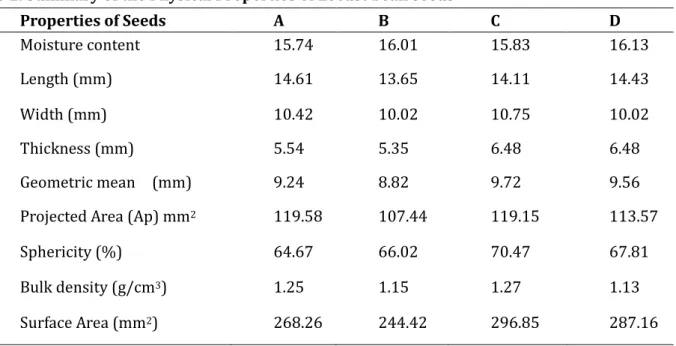
The results obtained from the determination of the physical properties of locust bean seeds produced in four different locations in Nigeria (Niger, Oyo, Edo and Ondo States respectively) is presented in Table 1 and the coefficient of friction obtained on different structural materials is presented in Figure 1.
Table 1: Summary of the Physical Properties of Locust bean seeds
Properties of Seeds A B C D
Moisture content 15.74 16.01 15.83 16.13
Length (mm) 14.61 13.65 14.11 14.43
Width (mm) 10.42 10.02 10.75 10.02
Thickness (mm) 5.54 5.35 6.48 6.48
Geometric mean (mm) 9.24 8.82 9.72 9.56
Projected Area (Ap) mm2 119.58 107.44 119.15 113.57
Sphericity (%) 64.67 66.02 70.47 67.81
Bulk density (g/cm3) 1.25 1.15 1.27 1.13
Surface Area (mm2) 268.26 244.42 296.85 287.16
International Journal of Research in Engineering and Applied Sciences(IJREAS) Vol. 7 Issue 4, April-2017
ISSN (O): 2249-3905, ISSN(P): 2349-6525 | Impact Factor: 7.196
Figure 1: Coefficient of Friction of Locust Bean Seeds produced in four locations in Nigeria A – Niger state, B – Oyo State, C – Edo State and D - Ondo State respectively.
Discussion: major diameter and the sphericity of the locust seeds are inter-related; the higher the major diameter, the smaller the sphericity, this could be seen to apply in all the samples under consideration while sphericity increases as both the minor diameters and the thickness of the locust bean increases. Also, moisture content of dry bean (which ranges between 9.41 and 12.36%) conformed to the standard result of maize and cowpea as given by Hall (1970) as 13.5 and 15% respectively. The bulk density obtained by Mittal et al. (1983) gives the bulk density or sorghum and grape fruit as 0.76g/cm3 and 0.32g/cm3, while Handerson and Perry gave the bulk densities of maize and cowpea to be 0.72g/cm3 and 0.76g/cm3. There is also an appreciable difference between the physical properties of the market locust beans and the treated locust beans.
The major, minor, intermediate (thickness), geometric mean diameter obtained from this study ranged from 13.65 – 14.61, 10.02 – 10.75, 5.35 – 6.48, 8.82 – 9.72 mm. The sphericity, projected area, surface area and bulk density ranged from 64.67 – 70.47%, 107.44 – 119.58 mm2, 244.42 – 296.85 mm2 and 1.13 – 1.27 g/cm3 respectively. it was observed that there are variations in the physical properties obtained for the locust bean seeds from one location to another.
The coefficient of friction obtained on glass is the lowest while maximum values were obtained on plywood. The results obtained from this study are in similar tandem with findings of Ogunjinmi et al. (2002) who reported seed length range of 0.80 to 1.2 cm, width from 0.6 to 0.85 cm and thickness from 0.45 to 0.60 cm; they reported true density of 1098 – 1215.7 kg/m3, bulk density of 538.02 - 565.3 kg/m3 and static coefficient of friction on wood of 0.43 and Olajide and Ade-Omowaye (1999) reported an average length, width, and thickness of locust bean seeds as 10.8, 8.42 4.64 mm respectively at 6.42% db, they reported average geometric mean diameter,
0.35 0.37 0.39 0.41 0.43 0.45 0.47 0.49 0.51 0.53 0.55
Stainless Steel Plywood Glass
Co
e
ff
ic
ie
n
t
o
f Fr
ic
tion
Structural materials
A
B
C
International Journal of Research in Engineering and Applied Sciences(IJREAS) Vol. 7 Issue 4, April-2017
ISSN (O): 2249-3905, ISSN(P): 2349-6525 | Impact Factor: 7.196
sphericity and density as 7.47mm, 0..69 and 1.15 g/cm3 while the static coefficient of friction varied from 0.36 on glass to 0.62 against plywood.
CONCLUSION
Experiments were conducted to determine the physical properties of locust bean seeds produced in four different production locations in Nigeria, with a view of supplying information necessary for designing an appropriate dehulling machinery that will be so versatile and applicable in any locust bean production center. Average range of the major diameter, the minor diameter, thickness and geometric mean diameter was obtained as 13.65 – 14.61, 10.02 – 10.75, 5.35 – 6.48, 8.82 – 9.72 mm for products obtained from the four locations while sphericity, projected area, surface area and bulk density ranged from 64.67 – 70.47%, 107.44 – 119.58 mm2, 244.42 – 296.85 mm2 and 1.13 – 1.27 g/cm3 respectively. it was observed that there are variations in the physical properties obtained for the locust bean seeds from one location to another.
REFERENCES
Adejumo, A. A., I. O. Azeez, J. J. Geply and F. O. Oboite (2013). Processing, utilization and challenges of African locust bean (Parkia biglobosa, Jacque Benth), 13 (1): 39 – 49
Adejumo, O. I. (2003). Physical Properties of Neem Seeds. Landzun Journal of Engineering and Appropriate Technology, 1(2), 68-77.
Adewumi, B.A. (1988). Design fabrication and testing of locust bean dehuller machine. Unpublished M.Sc. Thesis, University of Ibadan, Nigeria.
ASAE Standard S 358.2 (1983): Moisture Measurement of Grain and Seeds. 37th Ed. St. Joseph.
Asoiro, F. U. and Anthony, O. A. (2011).Determination of some Physical Properties of African Yam Beans. The Pacific Journal of Science and Technology, Volume 12: Number 1. Also available online http://www.akamaiuniversity.us/PJST.htm
Audu, I., A. Oloso and B. Umar (2004). Development of concentric cylinder locust bean dehuller.
Agricultural Engineering Int.: the CIGR Journal of scientific reaserch and Development, Vol. 6
Bilanski, W.K. and Lal R. (1965). The behaviour of threshed material in a vertical wind tunne.. transactions of the ASAE p. 411 – 413, 1416.
Campbell – Platt, G. (1980). Locust Bean (Parkia Species) and its West African fermented food products: Dawadawa. Ecology of food and Nutrition, P. 9, 123 – 132.
Cobley, A., Steel, W.M., (1960). An introduction to the botany of tropical crops ELBS publishers 3rd Edition, Pg. 71 – 109. City of Publicaiton.
Folayan, K.F. (1992). Variation in the physical and mechanical properties of locust beans at various production centres in Nigeria. Unpublished B.Eng. Project.
International Journal of Research in Engineering and Applied Sciences(IJREAS) Vol. 7 Issue 4, April-2017
ISSN (O): 2249-3905, ISSN(P): 2349-6525 | Impact Factor: 7.196
– 62.
Mohsenin, N. N. (1970). Physical Properties of Plant and Animal Materials. 2nd Updated and revised
Ed. Gordon and Breach Science Publishers. New York.
Mohsenin, N. N. (1986). Engineering Properties of Plants and Animal Materials. Gordon and Breach Science publishers, New York, London. 2nd Edition
Odunfa, S.A. (1983). Legumes base fermented foods, O.K. CRC Press Inc. P. 173 – 189.
Ogunjinmi, L. A. O., N. A. Aviara and O. A. Aregbesola (2002). Some engineering properties of locust bean seeds. Journal of Food Engineering, 55: 95 - 99
Oje (1993). Locust bean pods and seeds: Some physical properties relevance to dehulling and seed processing. Journal of Food Science Technology, Vol. 30 94): 253 – 255
Olajide, J. O. and B. I. O. Ade-Omowaye (1999). Some physical properties of locust bean seeds. J. agric Engrng Res. 74: 213 – 215
Olaoye, J. O. (2000). Some Physical Properties of Castor Nut Relevant to the Design of Processing Equipment. Journal of Agricultural Engineering Research. Vol. 77(1), 113 - 118.
Olaoye, J. O. (2010). Machinery Needs for Processing of Locust Bean Seeds in Nigeria. Proceedings of International Agricultural Engineering Conference 2010. 53 - 62
Pliestic, S. N., N. Dobricevic, D. Filipovic and Z. Gospodaric (2006). Physical properties of Filbert Nut and Kernel. Journal of Biosystems Engineering 93 (2): 173 - 178
Sadiku, O. A. (2010). Processing Methods Influence the Quality of Fermented African Locust Bean (Iru/ogiri/dadawa) Parkia biglobosa. Journal of Applied Sciences Research, 6(11): 1656 -1661
Yudkin and John (1985). The Pengrim Encylopedia of Nutrition Richard Clay Ltd. Bugay, Cuffloc P. 222 – 230.