Bayesian Network Automata
for Modelling Unbounded Structures
James Henderson Department of Computer Science
University of Geneva Geneva, Switzerland
Abstract
This paper proposes a framework which unifies graphical model theory and formal language theory through automata theory. Specifically, we propose Bayesian Network Automata (BNAs) as a formal framework for specifying graphical models of arbitrar-ily large structures, or equivalently, spec-ifying probabilistic grammars in terms of graphical models. BNAs use a formal au-tomaton to specify how to construct an arbi-trarily large Bayesian Network by connect-ing multiple copies of a bounded Bayesian Network. Using a combination of results from graphical models and formal language theory, we show that, for a large class of au-tomata, the complexity of inference with a BNA is bounded by the complexity of in-ference in the bounded Bayesian Network times the complexity of inference for the equivalent stochastic automaton. This il-lustrates that BNAs provide a useful frame-work for developing and analysing models and algorithms for structure prediction.
1 Introduction
Work in Computational Linguistics has devel-oped increasingly sophisticated probabilistic mod-els of language. For example, Latent Probabilistic Context-Free Grammars (LPCFGs) (Matsuzaki et al., 2005) have been developed with latent head labels (Prescher, 2005), multiple latent variables decorating each nonterminal (Musillo and Merlo, 2008), and a hierarchy of latent nonterminal sub-categories (Liang et al., 2007). In this paper we propose a general framework which facilitates the specification and parsing of such complex mod-els by exploiting graphical modmod-els to express local bounded statistical relationships, while still allow-ing the use of grammar formalisms to express the unbounded nature of natural language.
Graphical models were developed as a unifica-tion of probability theory and graph theory. They
have proved a powerful framework for specifying and reasoning about probabilistic models. Dy-namic Bayesian Networks (Ghahramani, 1998) extend this framework to models which describe arbitrarily long sequences. There has been work applying ideas from graphical models to more complex unbounded structures, such as natural language parse trees (e.g. (Henderson and Titov, 2010)), but the power of the architectures pro-posed for such extensions have not been formally characterised.
The formal power of systems for specifying ar-bitrarily large structures has been studied exten-sively in the area of formal language theory. For-mal language theory has proved a wide range of equivalences and subsumptions between grammar formalisms, the most well known example be-ing the Chomsky hierarchy (i.e. finite languages
<regular languages <context-free languages <
context-sensitive languages<recursively enumer-able languages). It has also demonstrated the equivalence between formal grammars and for-mal automata (e.g. finite state automata ate regular languages, push-down automata gener-ate context-free languages, Turing machines gen-erate recursively enumerable languages). While grammar formalisms are generally more readable than automata, they appear in a wide variety of notational variants, whereas automata provide a relatively consistent framework in which differ-ent grammar formalisms can be compared. Au-tomata also provide a clearer connection to Dy-namic Bayesian Networks. For these reasons, this paper uses automata theory rather than grammars, although many of the ideas are trivially transfer-able to grammars.
We propose Bayesian Network Automata (BNAs) as a framework for specifying stochastic automata which generate arbitrarily large (i.e. un-bounded) structures. A BNA is a standard stochas-tic automaton, but uses a Bayesian Network (BN)
to specify its stochastic transition function. For ex-ample, the specification of a stochastic push-down automaton (PDA) requires a specification of the conditional probability distribution over push(X) andpopactions given the current state, input sym-bol, and top stack symbol. This distribution can be specified in a BN. While not changing the theoreti-cal properties of the stochastic automaton, this use of BNs allows us to merge algorithms and theoret-ical results from BNs with those for the stochastic automaton, and thereby with those for the equiva-lent probabilistic grammar formalism. In the PDA example, the algorithm discussed in section 5.2 al-lows us to sum over all possible values forX in push(X) while at the same time summing over all possible parse tree structures, as is used in unsu-pervised grammar induction. We argue that this merging with graphical model theory simplifies the specification of more complex stochastic tran-sition functions or grammar rules (e.g. (Musillo and Merlo, 2008)), and reduces the need for ad-hoc solutions to such inference problems.
BNAs can also be seen as a generalisation of Dynamic Bayesian Networks to more complex un-bounded structures. BNAs simplify the specifica-tion and analysis of these more complex BNs by drawing a distinction between a finite set of statis-tical relationships, represented in a Bayesian Net-work, and the recursive nature of the unbounded structures, represented by the control mechanisms of the automaton. To illustrate the usefulness of this framework, we exploit the separation between the automaton and the Bayesian Network to pro-vide bounds on the complexity of inference in some classes of BNAs. In particular, for a large class of grammar formalisms, the complexity of marginalising over variables in the Bayesian Net-work and the complexity of marginalising over structures from the automaton are independent factors in the complexity of inference with the BNA. We also exploit results from formal lan-guage theory to characterise the power of previ-ously proposed models in terms of the generative capacity of their automata.
In the rest of this paper, we first define the framework of Bayesian Network Automata, and discuss its key properties. This provides the for-mal mechanisms we need to compare various Bayesian Network architectures that have been previously proposed. We then provide results on the efficiency of inference in BNAs.
2 Bayesian Network Automata
Bayesian Network Automata is a framework for specifying stochastic automata which generate un-bounded structures. Formally, a BNA is simply an alternative notation for its equivalent stochastic automaton. In this section, we provide a formal definition of BNAs, without limiting ourselves to any specific class of automata.
2.1 Generating Unbounded Structures with BNAs
The purpose of a BNA is to specify a probabil-ity distribution over an infinite set of unbound-edly large structures. It does this by specifying an equivalent stochastic automaton. Each complete run of the automaton generates a single structure, which is derived from the semantics of the opera-tions performed by the automaton. The sequence of operations performed in a complete run of the automaton is called aderivationfor its associated structure. Typically automata are designed so that derivations are isomorphic to structures, but even if multiple derivations map to the same structure, to specify a probability distribution over structures it is enough to specify a probability distribution over derivations. Stochastic automata do this in terms of a generative process for derivations, gen-erating each operation incrementally conditioned on the derivation prefix of preceding operations.
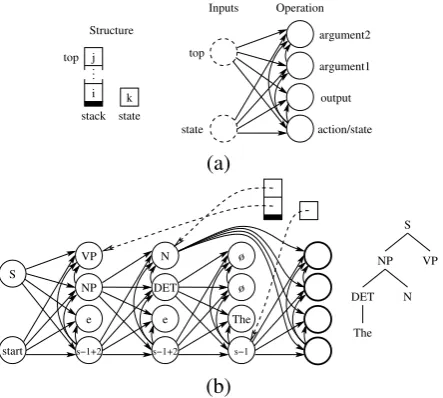
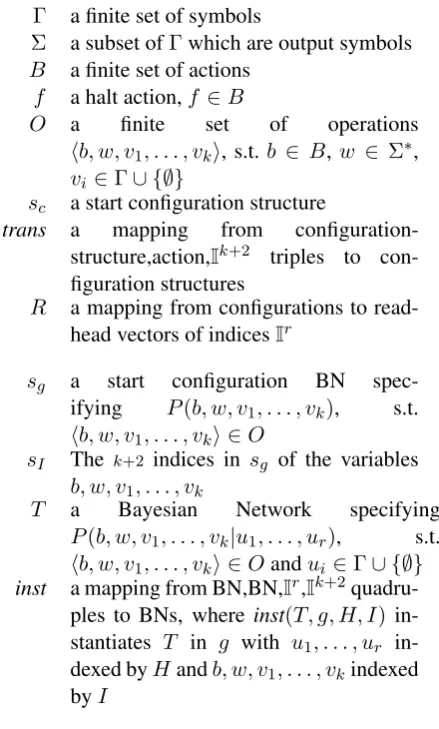
Standard specifications of stochastic automata include specific operations acting over specific data structures. These data structures are used to represent each state of the automaton (called the configuration) as it proceeds through the compu-tation. For example, the configuration of a finite state machine is a single state symbol, and the con-figuration of a push-down automaton is a single state symbol plus an arbitrarily deep stack of stack symbols.1Here we do not want to restrict attention to any specific class of automata, so the operations and data structures of BNAs are necessarily ab-stract (see the top half of table 1 below). For con-creteness, we will illustrate the definitions with the example of push-down automata for Probabilis-tic Context-Free Grammars (PCFGs), illustrated
1
in figure 1. The left side of figure 1(a) illustrates the data structures used in a PDA’s configuration.
Standard non-stochastic automata specify how to choose which operation to apply in a given con-figuration using a nondeterministic mapping spec-ified in a finite transition table. The symbols input to this mapping are determined by pointers into the configuration, called read-heads.2 Stochas-tic automata simply add a probability distribu-tion over each nondeterministic choice of opera-tion given read-head values. Thus, the probabilis-tic transition table defines the conditional distribu-tion over operadistribu-tions used in each step of generat-ing a derivation.
The central difference between BNAs and stochastic automata is that a BNA specifies its probabilistic transition table in a Bayesian Net-work (BN) (T in table 1). Such a BN is illus-trated on the right side of figure 1(a), discussed below. To determine the probability distribution to be used for generating the next operation, the values for the BN’s input variables must be set to the values pointed to by the associated read-heads in the automaton’s current configuration. Since these values were themselves determined by previous operations, setting the input variable values is equivalent to equating the input vari-ables with the relevant previous output varivari-ables from these previous operations. The resulting compound Bayesian network is illustrated in fig-ure 1(b) as the graph of circles and arrows.
2.2 BNA Configurations
The configurations of BNAs make use of this com-pound BN in specifying the intermediate states of derivations. Each configuration includes a com-pound BN that has been constructed by instantiat-ing copies of the transition table BNT and equat-ing their input variables with the appropriate pre-vious output variables. To be more precise, this compound BNgtis iteratively constructed by
tak-ing the BNgt−1 from the previous configuration,
setting the values hbt−1, wt−1, v1t−1, . . . , vkt−1i
chosen in the previous operation, adding a new in-stantiation of the transition table BNT, and equat-ing its input variables with the appropriate vari-ables fromgt−1. This construction process is
per-formed by theinstfunction in table 1. In the exam-ple in figure 1, the BN in (b) includes four copies
2For consistency, we generalise the notion of read-head to include all inputs to the transition function, including the state.
stack top
state Structure
j
i .. .
k
Operation
top
state
argument2
argument1
output
action/state Inputs
(a)
s−1
ø ø
The S
start
e DET
s−1+2
e NP VP
s−1+2
N NP
S
VP
The
DET N
[image:3.595.308.530.63.262.2](b)
Figure 1: Illustrations of (a) a BNA specification and (b) its configuration after generating a partial tree
of the BN in (a). It includes all the instances of variables needed to specify the generation of the portion of tree shown on the right of figure 1(b), plus one set for choosing the next operation. The actions are “s-1” for popping one symbol from the stack and “s-1+2” for popping one and pushing two symbols. The pattern of edges reflects which variable instance was pointed to by the top of the stack at the time when each copy of the BN in (a) was added to the configuration’s BN.
To determine which variables fromgt−1 should
be equated with each input variable in the new instantiation of T, BNA configurations include a second component that records information for the read-heads. This structural componentctis
equiv-alent to the data structures employed in standard automata, such as the stack of a PDA. The differ-ence is that, instead of including symbols directly, these data structures include indices of variables in the compound BNgt. The values of these
vari-ables are the symbols of the equivalent configura-tion in a standard automaton. This structural com-ponent is illustrated at the top of figure 1(b), where the indices are shown as dashed arrows. The read-headsRread indexes fromct−1 and pass them to
the functioninstso that it knows where to equate the associated variables from the new instantiation ofT.
After constructing a new compound BNgt, we
book-Table 1: Bayesian Network Automata specifications
Γ a finite set of symbols
Σ a subset ofΓwhich are output symbols
B a finite set of actions
f a halt action,f ∈B
O a finite set of operations
hb, w, v1, . . . , vki, s.t.b ∈ B, w ∈ Σ∗,
vi ∈Γ∪ {∅}
sc a start configuration structure
trans a mapping from configuration-structure,action,Ik+2 triples to
con-figuration structures
R a mapping from configurations to read-head vectors of indicesIr
sg a start configuration BN
spec-ifying P(b, w, v1, . . . , vk), s.t.
hb, w, v1, . . . , vki ∈O
sI The k+2 indices in sg of the variables
b, w, v1, . . . , vk
T a Bayesian Network specifying
P(b, w, v1, . . . , vk|u1, . . . , ur), s.t.
hb, w, v1, . . . , vki ∈Oandui ∈Γ∪ {∅}
inst a mapping from BN,BN,Ir,Ik+2
quadru-ples to BNs, where inst(T, g, H, I) in-stantiates T in g with u1, . . . , ur
in-dexed byHandb, w, v1, . . . , vkindexed
byI
keeping purposes, the indices It of these output
variables are stored in a third component of a BNA configuration. These variables are shown in fig-ure 1(b) as bold circles.
In summary, a BNA configuration consists of three componentshct, gt, Iti, the structurect, the
BNgt, and the next operation variablesItingt.
2.3 BNA Specifications
A formal definition of the generative process for BNA derivations is given in figure 2, according to the definitions given in table 1. The step of stochastically generating an operation of the au-tomaton is given in line 3, which chooses a com-pletely specified operation from the finite set of operations,O, which the equivalent stochastic au-tomaton can perform. These operations specify the basic action b (e.g. push or pop), any argu-ments to that actionv1, . . . , vk, and any stringw
which should be concatenated to the output of the automaton.3 The semantics of operations is
de-3
In addition to generating the elements of a standard au-tomaton’s “input tape”, this specification is notationally
dif-hc0, g0, I0i ← hsc, sg, sIi
Fort= 0,1,2, . . .
Stochastically generate an operation
hbt, wt, v1t, . . . , vkti from distribution
defined by variablesItingt
Writewtto the output
Ifbt=f, then halt
ct+1←trans(ct, bt, It)
Deterministically generate unique It+1 ∈
Ik+2
gt+1←inst(T, gt, R(ct+1), It+1)
Set the values of variables It in gt+1 to hbt, wt, v1t, . . . , vkti
Figure 2: Pseudo-code for generating BNA derivations
fined by the functiontrans. As indicated in fig-ure 2, trans(ct, bt, It) computes the next
configu-ration structure ct+1 given the previous
configu-ration structure ct, the operation’s action bt, and
the indices It of the variables bt, wt, v1t, . . . , vkt
which select the action and its arguments. Any complete sequence of allowable operations is a derivation.
When choosing the next operation to perform, the stochastic automaton’s transition function can only look at those symbols pointed to by its read-heads, specified in R in table 1. For example, the read-heads for a PDA identify the top of the stack and the state. In a BNA, this transition function is specified in the BN T, which has as many input variables as there are read-heads (r), and as many output variables as there are terms in an operation (k+ 2). Conditioning on the vari-ables pointed to by the automaton’s read-heads is achieved by theinstfunction. As indicated in fig-ure 2,inst(T, gt, R(ct+1), It+1)computes the next
configuration BN gt+1 by adding to the previous
configuration BN gt an instance of T, such that
the input variables ofT are equated with the vari-ablesR(ct+1) ingt pointed to by the read-heads,
and the output variables ofT are assigned the new unique indicesIt+1. Any other variables inT are
also assigned new unique indices.
The BN T is required to have no edges whose
ferent from standard ones in that there is a distinction between the action b and the arguments to that action v1, . . . , vk.
[image:4.595.71.291.76.441.2]destination is one of the input variables, so as to prevent edges whose direction conflicts with the temporal order of the automaton’s operations. This property is important for efficient inference in BNAs, as will be discussed in the next section.
3 Bounded Versus Unbounded Generalisations
Bayesian networks capture generalisations by us-ing the same parameters for more than one pattern of variable values. By specifying how parameters are reused across different cases, they specify how to generalise from data on one pattern to previ-ously unseen patterns. This specification is done in the BN’s model structure. Because this model structure is finite, BN’s can only express generali-sations over a bounded number of cases.
In contrast, formal language theory captures generalisations with formalisms that can handle an infinite number of patterns. By proving that a formalism can handle an infinite number of cases for some variation, one proves that the formalism must be capable of generalising across that varia-tion. For example, we know that regular grammars and finite state automata can generalise across po-sitions in a string, because they can generate arbi-trarily large strings despite having a finite specifi-cation. They can model a finite number of specific string positions, but there will always be a larger string position for which they have no special case, and therefore they must treat it in the same way as some other smaller string position. Proofs of this form are called pumping lemmas. Context-Free Grammars and push-down automata generalise to arbitrarily long dependencies within a string, us-ing arbitrarily deep tree structures. Tree Adjoinus-ing Grammars generalise to arbitrarily long dependen-cies within these trees, using arbitrarily deep trees which themselves generate trees.
3.1 Conditionally Bounded Models
Previous work has developed formalisms for spec-ifying graphical models that generalise to an in-finite number of cases. Dynamic Bayesian Net-works (DBNs) (Ghahramani, 1998), such as Hid-den Markov Models, and linear-chain Conditional Random Fields (Lafferty et al., 2001) generalise to unbounded string lengths. These models specify both a template model structure which is used for each position in the string, and the model struc-ture which connects two adjacent position in the
string (or any finite window of contiguous posi-tions). In addition, the strings are padded with start and stop symbols, with the constraint that no positions can exist beyond these symbols. These symbols act like the halt action for BNAs, and are used to ensure a proper probability distribution over sequence lengths. Given a string of a specific length, it is possible to construct the entire relevant model structure for that string, and then apply nor-mal graphical model inference techniques to this constructed model.
If you are given the string length, it is some-times possible to take this approach even for more complex models, such as Probabilistic Con-text Free Grammars. It is common practice with PCFGs to transform them into a form where the depth of the tree is bounded by the length of the string. This transformation (such as binari-sation, or Chomsky normal form) does not gen-erate the same tree structures, but it does gener-ate the same strings. With the transformed PCFG, given the string length, it is possible to construct the whole relevant bounded-depth model structure for that string, for example using case-factor di-agrams (McAllester et al., 2004), or sum-product networks (Poon and Domingos, 2011). Inference can then be done, for example, using belief propa-gation (Smith and Eisner, 2008).
However, this approach is limited to infer-ence problems where the string length is known, which in turn limits the potential training methods. We cannot necessarily use this pre-construction method if we want to take a generative approach, where the string length is determined by a genera-tive process, or if we want to do incremental inter-pretation, where we want to do inference on pre-fixes of the string without knowing to total string length. In this situation, we might need to con-sider an infinite amount of model structure, for all the possible string lengths. In particular, this is true for undirected graphical models, such as Con-ditional Random Fields, which are globally nor-malised (c.f. (Rohanimanesh et al., 2009)).
3.2 Model Structure Prediction
ex-ample, a Hidden Markov Model can be applied to any string prefix to infer the probability distribu-tion over the following element of the string, with-out needing to know the length of the total string. In general, an inference can be done independently of the unconstrained portion of the model structure provided there are no edges directed from the un-constrained portion to the portion where informa-tion is given. More precisely, consider the set G
of complete model structures consistent with the given visible variablesV, and let Gbe the inter-section of all theG0 ∈ G. If for all G0 ∈ G, for allh ∈ (G0−G), and for allv ∈ V, there is no directed path from h to v, then for all G0 ∈ G,
P(V|G0) = P(V|G). This follows directly from well known properties of BNs, which rely on the fact that normalisingP(V|G)can be done locally toG. ThusP
G0P(G0)P(V|G0) = P(V|G), and
therefore we can do inference looking only at the known portionGof the model structure.4
For BNAs, this means that, given a prefix of an automaton’s derivation, we can determine a unique model structure which is sufficient to com-pute the probability distribution for the automa-ton’s next operation. There is no need to consider all possible future derivations.
Interestingly, not all variables in the derivation prefix must be given in order to determine a finite specification of the model structure. In some for-malisms, it is sufficient to know the length of the string generated by the derivation prefix. But this approach may not take full advantage of existing algorithms for doing inference with grammars or automata. On the other extreme, the approach we took in section 2 of completely specifying all vari-ables does not take full advantage of existing algo-rithms for doing inference in graphical models. As we will see in section 5.2, BNAs provide a frame-work where these two types of algorithms can be combined in a conceptually and computationally modular way.
More specifically, BNA derivations make a dis-tinction between variablesbtwhich specify the
ac-tion and variables wt, v1t, . . . , vkt which specify
the arguments to the action. The action (e.g.push versus pop) must be sufficient to determine the structure ct of the configuration. The
configura-4
This argument for directed models was recognised pre-viously in (Titov and Henderson, 2007). Garg and Hender-son (2011) proposes a model which mixes directed and rected edges, but which still has this property because undi-rected edges are all local to individual derivation steps.
tion structure in turn determines the placement of the read-headsR(ct), which determines the model
structure of the configuration’s BNgt. Therefore,
the sequence of derivation actionsb0, . . . bnis
suf-ficient to uniquely determine the model structure of the final configuration’s BNgn+1.
In BNA derivations, the arguments (e.g. push(A) versus push(B)) only affect the labels in the configuration’s BNgt. We can exploit this
fact by only choosing specific values for the action variables, and leaving the argument variables un-specified. The constructed BNgtwill then specify
a distribution over values for the argument vari-ables. For example, a BNA configuration for a PDA must specify a specific depth for the stack, but could specify a distribution over the symbols in each position on a stack of that depth.
To illustrate this distinction between actions and arguments, consider an alternative two-pass gen-erative process for BNA derivations. In the first pass of the generative process, it chooses the se-quence of actionsb0, . . . bnfor a derivation, which
predicts the model structure of the final configura-tion’s BNgn+1. The probability distributions for
generating this sequence is defined by marginal-ising out the values for the argument variables. The probability distribution over argument vari-ables defined by the final configuration’s BNgn+1
then defines a distribution over argument variable values. In the second pass of the generative pro-cess, the argument values are chosen according to this distribution. This two-pass generative process will generate the same distributions over deriva-tions as the characterisation in section 2.3.
4 Related Architectures and Grammars
In this section we discuss how BNAs are related to some previous proposals for the probabilistic mod-elling of unbounded structures.
the configuration of a finite state automaton con-sists only of a state variable with a bounded num-ber of values, so all information about the config-uration can be encoded in the bounded BN. The only structure-modifying actions which are neces-sary are continue versus stop, which are used to generate the length of the sequence.
Switching DBNs (Ghahramani, 1998; Murphy, 2002) are DBNs which include variables that switch between multiple BN models during each position in the sequence. They are also covered by finite state BNAs, by the same argument. Al-though different BN models may be chosen for different positions, there are only a bounded num-ber of possible BNs, so they can all be included in a single T. The switching decisions must be encoded in the structure-modifying actions.
The previous work on graphical models which is closest to our proposal is Incremental Sigmoid Belief Networks (ISBNs) (Henderson and Titov, 2010). Sigmoid Belief Networks (SBNs) (Neal, 1992) are a type of Bayesian Network, and IS-BNs use the same technique as here for modelling arbitrarily large structures, namely incrementally constructing an SBN that generates the deriva-tion of the structure. Henderson and Titov (2010) used this framework to reinterpret previous work on neural network parsing (Henderson, 2003) as an approximation to inference in ISBNs, and pro-posed another approximate inference method for natural language parsing. However, the control mechanism needed to construct an SBN for a derivation was not formalised.
Without any formal specification of how to con-struct an SBN for a derivation, it is hard to deter-mine the power of the ISBN architecture. The spe-cific ISBN models developed for natural language parsing cannot be expressed with a finite state con-troller, and thus they are not DBNs. They re-quire at least a push-down automaton. The deriva-tions modelled in (Henderson and Titov, 2010) are predictive LR derivations, which are equiva-lent in power to context-free derivations. How-ever, the statistical dependencies which are speci-fied as edges in their constructed SBN are not re-stricted to the context-free structure of the deriva-tions. Edges may refer to any “structurally local” variables decorating the derived tree, even if they are not immediately local (such as the leftmost sib-ling). To translate such a model into a BNA, the read-headRwould have to have access to symbols
which are not on the top of the stack, and there-fore the derivation structure would not be context-free. Given the restriction of locality, it is probably possible to devise chains of variables which pass the necessary information through the context-free structure of the tree. But without such a transfor-mation, our analysis of inference algorithms in the next section suggests that it would be difficult to devise efficient algorithms for exact inference with this model. Henderson and Titov (2010) avoid this question by only considering approximate infer-ence methods, since inferinfer-ence in the bounded SBN of their model is already intractable even before combining it with a parsing algorithm.
Koller et al. (1997) propose a framework for specifying complex recursive probabilistic models in terms of a stochastic functional programming language. As with BNAs, these models are lo-cally normalised. They propose an inference al-gorithm for this framework, and discuss Bayesian networks and context-free grammars as examples of what can be implemented in it. The use of a functional programming language suggests a close relationship to the context-free derivation struc-tures discussed in the next section.
5 Inference in Bayesian Network Automata
To illustrate the usefulness of the BNA framework, we look at algorithms for exact inference in BNAs. The way in which BNAs allow us to separate is-sues of structure from isis-sues of labelling greatly facilitates the analysis and design of algorithms for calculating probabilities and exploring the space of derivations. In many important cases, previ-ous algorithms for grammars can be combined di-rectly with previous algorithms for Bayesian Net-works, and the resulting algorithm has a complex-ity where the complexcomplex-ity of its two components are independent factors.
A BNA is a specification of a generative proba-bilistic model, and as such can be used to answer many questions about the probability distributions for some variables given others. We might want to find the most probable derivation given some sequence of output symbols (as in statistical pars-ing, or decoding), to marginalise over the deriva-tions (as in language modelling), or to find the most probable values for a subset of the variables while marginalising over others (as in latent vari-able models of parsing). Although in some ways the most interesting, this last class of problems is in general NP-hard. Even for models based on fi-nite state automata (e.g. HMMs), mixing the max-imisation of some probabilities with the sum over others results is an NP-hard problem (Lyngsø and Pedersen, 2002). Because for reasons of space we are limiting our discussion to exact inference, we therefore also limit our discussion to the first two types of problems. However, the arguments given in section 5.2 for marginalising over all the un-known variables can also be applied to many ap-proximations to latent variable models of parsing.
5.1 Fully-Specified BN Computation
The first case we consider is when the space of in-puts and operations of the BNT is small enough that it is feasible to compute the complete condi-tional probability distribution of all possible op-erations given each possible input. In this case, the conditional probability distribution can be pre-computed and used to fill the transition table for the equivalent stochastic automaton. Then any standard algorithm for the stochastic automaton can be applied. Under this assumption, if the complexity of inferring the complete conditional probability distribution for T is O(FB), and the
complexity of the standard algorithm is O(FA),
then the complexity of the complete problem is
O(FB+FA). In other words, computation time
is dominated by whichever of these complexities is worse. For most previously proposed statistical parsing models, the parsing complexity does dom-inate and this pre-compilation strategy is in effect adopted. However, the interest of the BNA frame-work is in allowing the specification of more com-plicated models, where inference in the BN T is not so simple.
The second case we consider also uses any stan-dard algorithm for the stochastic automaton, but computes probabilities with the BNTon-line dur-ing the runndur-ing of the algorithm. This strategy may require forward inference of the distribution over operations given a specific input, or backward inference of the distribution over inputs given a specific operation, but in general it avoids the need to compute the complete joint distribution over both. In this case, if the complexity of the nec-essary inference inT isO(FB0 ), and the complex-ity of the standard algorithm is O(FA), then the
complexity of the complete problem isO(FB0 FA).
This is a good strategy ifO(FB0 )is much smaller than O(FB) from the previous case, as might be
the case for lexicalised models, whereO(FB)is a
function of the vocabulary size butO(FB0)is only a function of the number of words in the sentence.
5.2 Marginalisation in the BN
Both of the above cases require computing prob-abilities given completely-specified values for all the inputs and/or all the outputs of the BNT. To fully exploit previous work on inference in BNs, we would like to develop inference algorithms which work directly with probability distributions over values for both the inputs and outputs ofT. A full treatment of such algorithms is beyond the scope of this paper, but here we provide some re-sults on cases where inference algorithms for BNs can be extended to BNAs. In particular, we look at what classes of automata can be combined with belief propagation (Pearl, 1988).
the BN. Therefore, if we can guarantee that the configuration BN gtconstructed by a BNA is
al-ways a tree, then we can apply belief propagation to inference ingt, or in any sub-graph ofgt.
The structure ofgtreflects the structure of
con-ditioning allowed by the derivations of the au-tomaton. In formal language theory, this is called the derivation structure. If necessary, we can ab-stract away from any undirected cycles that might be introduced by the specific form of the BNT by collapsing all the non-input non-action variables inT into a single variable. By using this collapsed version of T to construct gt, the structure of gt
becomes isomorphic to the derivation structure.5 Thus, we can guarantee that (a version of)gtwill
have a tree structure if the derivation structures of the automaton are trees, or more precisely, if the automaton has context-free derivation structures.
The most important class of grammar for-malisms which have context-free derivation struc-tures is Linear Context-Free Rewriting Systems (LCFRS) (Weir, 1988). In addition to Context-Free Grammars, popular examples of LCFRS in-clude Synchronous Context-Free Grammars and Tree Adjoining Grammars (Joshi, 1987). This lat-ter grammar formalism can specify classes of lan-guages much larger than context-free lanlan-guages, and Synchronous CFGs express languages over pairs of strings. For our purposes, the observations can be of any form and the formalism can have any method for combining the observations gen-erated by sub-derivations, provided the derivation structures are context-free and there exists an algo-rithm for marginalising over the derivation struc-tures given an observation.
Given an automaton whose derivations have a context-free tree structure, we can apply belief propagation to compute the marginal probability for any derivation generated by that automaton (if necessary collapsing the non-input non-action variables in T into a single variable). This will be feasible if it is feasible to propagate beliefs through one instance of T. This requirement is different from the one in the previous subsection in that the given information is a probability distribu-tion (the belief), whereas above it was assumed to
5
Note that all action variablesbt0 ingt will have known values, because this is necessary in order to know the model structure. Thus, the concern here is the structure of the interdependencies between the possibly-unknown variables
wt0, v1t0, . . . , vkt0 ingt, because these are the variables we
need to marginalise over using belief propagation.
In(i−1, i, a) =P(a⇒wi|a)
In(i, k, a) =
k−1
X
j=i+1
X
b,c
P(a⇒bc|a)In(i, j, b)In(j, k, c)
Out(0,|w|, c) = 1 ifc=S; 0 otherwise
Out(i, k, c) =
i−1
X
j=0
X
a,b
Out(j, k, a)In(j, i, b)P(a⇒bc|a) +
|w| X
j=k+1
X
a,b
[image:9.595.311.526.65.230.2]Out(i, j, a)P(a⇒cb|a)In(k, j, b)
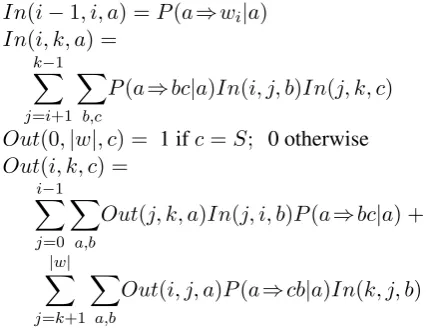
Figure 3: The Inside-Outside algorithm for PCFGs, wherea, b, c are symbols, i, j, k are indices in string
w, anda⇒bc, a⇒wiare CFG rules
be completely specified values. So, assuming that it is feasible to propagate beliefs through T and given an automaton with context-free derivations, we can feasibly compute the marginal probability of any derivation using belief propagation.
So far in this subsection we have only con-sidered inference for a given derivation structure. In general, inference in BNAs requires marginal-ising both over labellings and over the struc-ture itself, as is commonly required for unsu-pervised or partially-suunsu-pervised grammar induc-tion. Marginalising over structures can be done with the inside-outside algorithm for Context-Free Grammars (Baker, 1979) (given in figure 3) or the inside-outside algorithm for Tree-Adjoining Grammars (Schabes, 1992). These are dynamic programming algorithms. The inside calculations are very similar to bottom-up parsing algorithms such as CKY (Younger, 1967), except they com-pute sums of probabilities instead of taking the maximum probability. The outside calculations are also done in a single pass, but top-down.
Both inside and outside calculations work by incrementally considering equivalence classes of increasingly large sub-graphs of the derivation structure. For example in the equations in fig-ure 3, each step computes a sum over the vari-ous ways that an operation can be used to con-struct a larger sub-derivation out of smaller ones, such that they all have the same start i, end k
and label. As discussed at the end of section 3.2, with BNAs we can easily representIn(i, k,·)and
Out(i, k,·) as distributions over labels, i.e. the
equa-tions (P
b,cP(a⇒bc|a)In(i, j, b)In(j, k, c) and
P
a,bOut(i, j, a)P(a⇒cb|a)In(k, j, b)) can then
be done using belief propagation through the BN representation ofP(a⇒cb|a).
If the configuration BN gt is a tree, then any
connected sub-graph ofgtwill also be a tree, so we
can apply belief propagation to the sub-graph ofgt
for any of the sub-derivations. In addition, belief propagation can be applied either forward or back-ward through the edges of gt, so the probability
distribution for any node in a sub-graph ofgtcan
be computed in a single pass over the sub-graph by propagating beliefs towards the desired node. This allows belief propagation to be integrated into an outside algorithm; whenever the inside-outside algorithm considers building larger sub-derivations out of smaller ones, belief propaga-tion is applied to continue the propagapropaga-tion of be-liefs out of the smaller sub-derivations’ graphs and into the instance ofT for the operation used in the combination. This belief propagation can then be interleaved with the sums over structural alterna-tives (the sums overjin figure 3).
Because each use of an operation considered by the inside-outside algorithm corresponds to be-lief propagation through a single instance of T, the time complexity of performing belief propaga-tion throughT is a constant factor in the complex-ity of the entire algorithm. For the inside part of the algorithms, only backward inference through
T is required, and then for the outside computa-tions forward inference is required. Thus, given an O(FA)inside-outside inference algorithm and
anO(FB00)inference algorithm for propagating be-liefs (forward or backward) throughT, the com-plexity of parsing will be O(FB00FA). As with
the results from the previous subsection, this com-plexity result factors the two components of the algorithm.
6 Conclusions
In this article we have proposed a framework for specifying and reasoning with complex prob-abilistic models of unbounded structures, called Bayesian Network Automata. The BNA frame-work combines the theory of graphical models with automata theory and formal language theory. It uses Bayesian Networks to provide a perspic-uous representation of local statistical generalisa-tions. It uses automata to provide a precise spec-ification of how to generalise to arbitrarily large
model structures, even when the model structure must be predicted during inference. Together they provide a precise and perspicuous representation of probability distributions over unbounded struc-tures.
Using this framework, we have clarified the power of various previously proposed probabilis-tic models of unbounded structures. Without any additional control structure, Dynamic Bayesian Networks are equivalent to BNAs with finite state automata. This limited power also applies to switching DBNs. Incremental Sigmoid Belief Networks potentially have greater power, but pre-vious work did not formally characterise the na-ture of the additional control strucna-ture which they employ. The model of parsing which has been pro-posed for ISBNs appears to be a BNA with a push-down automaton, but the nature of the BN used prevents direct application of the efficient parsing methods we have discussed.
We have also used this framework to explore how the complexity of inference with the bounded Bayesian Network interacts with the complexity of inference with the automaton. We have shown that for a large class of automata (which can gen-erate more than just context-free languages), the complexity of inference with a BNA is simply the multiplication of the complexity of inference in the Bayesian Network times the complexity of in-ference with the automaton.
BNAs have the potential to greatly expand the class of problems which we can effectively model with graphical models, through their simple mech-anism for increasing the power of these models and the large body of existing theory and algo-rithms that help us limit this power in ways that retain tractability. They provide a useful frame-work for future frame-work on many issues, includ-ing approximate inference methods that interface well with parsing algorithms. We believe that the BNA framework will be most useful with large Bayesian Networks where only approximate infer-ence methods are tractable.
Acknowledgements
References
J. K. Baker. 1979. Trainable grammars for speech recognition. The Journal of the Acoustical So-ciety of America, 65(S1):S132–S132.
Nikhil Garg and James Henderson. 2011. Tem-poral restricted boltzmann machines for depen-dency parsing. InProc. 49th Annual Meeting of the Association for Computational Linguistics: Human Language Technologies, pages 11–17.
Zoubin Ghahramani. 1998. Learning dy-namic bayesian networks. In C. Giles and M. Gori, editors, Adaptive Processing of Se-quences and Data Structures, pages 168–197. Springer-Verlag, Berlin, Germany.
James Henderson and Ivan Titov. 2010. Incre-mental sigmoid belief networks for grammar learning. Journal of Machine Learning Re-search, 11(Dec):3541–3570.
James Henderson. 2003. Inducing history rep-resentations for broad coverage statistical pars-ing. In Proc. joint meeting of North American Chapter of the Association for Computational Linguistics and the Human Language Technol-ogy Conf., pages 103–110.
Aravind K. Joshi. 1987. An introduction to tree adjoining grammars. In Alexis Manaster-Ramer, editor,Mathematics of Language. John Benjamins, Amsterdam.
D. Koller, D. McAllester, and A. Pfeffer. 1997. Effective Bayesian inference for stochastic pro-grams. In Proc. 14th National Conf. on Artifi-cial Intelligence (AAAI 1997), pages 740–747.
John Lafferty, Andrew McCallum, and Fernando Pereira. 2001. Conditional random fields: Probabilistic models for segmenting and label-ing sequence data. In Proc. 18th International Conf. on Machine Learning, pages 282–289. Morgan Kaufmann, San Francisco, CA.
Percy Liang, Slav Petrov, Michael Jordan, and Dan Klein. 2007. The infinite PCFG using hi-erarchical dirichlet processes. InJoint Conf. on Empirical Methods in Natural Language Pro-cessing and Computational Natural Language Learning, pages 688–697, Prague, Czech Re-public.
Rune B. Lyngsø and Christian N.S. Pedersen. 2002. The consensus string problem and the complexity of comparing hidden markov mod-els. Journal of Computer and System Sciences, 65:545–569.
Takuya Matsuzaki, Yusuke Miyao, and Jun’ichi Tsujii. 2005. Probabilistic CFG with latent an-notations. InProc. 43rd Annual Meeting on As-sociation for Computational Linguistics, pages 75–82.
David McAllester, Michael Collins, and Fernando Pereira. 2004. Case-factor diagrams for struc-tured probabilistic modeling. In Proc. 20th Conf. on Uncertainty in Artificial Intelligence, pages 382–391.
Kevin P. Murphy. 2002. Dynamic Belief Net-works: Representation, Inference and Learning. Ph.D. thesis, University of California, Berkeley, CA.
Gabriele Musillo and Paola Merlo. 2008. Unlex-icalised hidden variable models of split depen-dency grammars. In Proc. 46th Annual Meet-ing of the Association for Computational Lin-guistics: Human Language Technologies, pages 213–216.
Radford Neal. 1992. Connectionist learning of belief networks. Artificial Intelligence, 56:71– 113.
Judea Pearl. 1988. Probabilistic Reasoning in In-telligent Systems: Networks of Plausible Infer-ence. Morgan Kaufmann.
Slav Petrov, Leon Barrett, Romain Thibaux, and Dan Klein. 2006. Learning accurate, com-pact, and interpretable tree annotation. InProc. 44th annual meeting of the ACL and the 21st Int. Conf. on Computational Linguistics, pages 433–440.
Hoifung Poon and Pedro Domingos. 2011. Sum-product networks: A new deep architecture. In Proc. 12th Conf. on Uncertainty in Artificial In-telligence, pages 337–346.
Khashayar Rohanimanesh, Michael Wick, and Andrew McCallum. 2009. Inference and learn-ing in large factor graphs with adaptive proposal distributions and a rank-based objective. Tech-nical Report UM-CS-2009-008, University of Massachusetts.
Yves Schabes. 1992. Stochastic Tree-Adjoining Grammars. In Proc. workshop on Speech and Natural Language, pages 140–145.
David A. Smith and Jason Eisner. 2008. Depen-dency parsing by belief propagation. In Proc. 2008 Conference on Empirical Methods in Nat-ural Language Processing, pages 145–156.
Ivan Titov and James Henderson. 2007. Incre-mental bayesian networks for structure predic-tion. InProc. 24th International Conf. on Ma-chine Learning, pages 887–894.
David Weir. 1988. Characterizing Mildly Context-Sensitive Grammar Formalisms. Ph.D. thesis, University of Pennsylvania, Philadel-phia, PA.