VOLUME 16 ISSUE 4 (2018), Page 176 – 187
SOCIAL CAPITAL IN YOUTH VOLUNTEERISM
Mohd Hafiz Mohd Nor1, Asmidar Alias2 & Mohd Faizal Musa3
2UNIVERSITI KEBANGSAAN MALAYSIA
1&3UNIVERSITI TEKNOLOGI MARA, MALAYSIA
Abstract
The theoretical framework of social capital suggests that individuals bound together in dense social networks, and infused with the norms of reciprocity and trust, are better able and more inclined to act collectively for mutual benefits and social purposes as opposed to atomized individuals. The objective of the social capital model is to improve and maintain society well-being and the economic efficiency. ‘Social capital’ is a contemporary idea defined by Robert Putnam (2000) as those connections among individuals, social networks and the norms of reciprocity and trustworthiness that arise from them. This notion is therefore seen as “sociological superglue” that holds society together. The effectiveness depends strongly on a structural and cultural phenomenon. Recently, volunteerism has flourished within youths which have given beneficial effects to local communities. It is worth to scrutinize the elements of social capital within voluntary activities. Thus, youth volunteerism is studied and highlighted based on the social capital model suggested by Putnam (2000). This study is to inspect factors that bind youth in society as with the case study of Teach for the Needs (Malaysia) Berhad (TFTN). A field study is conducted whereby questionnaires were distributed to 100 respondents. Data collected were analysed using SPSS programme. Findings indicate that the norm of reciprocity and trust have a positive relationship with youths’ skills and commitments.
INTRODUCTION
The social capital concept has been discussed carefully based on the constructive theory from Pierre Bourdieu (1970) and Robert Putnam (2000). Social capital is defined as the resource that stems from social interactions, networks and network opportunities which take place in specific environments. Based on Putnam’s concept, social capital has three components: 1) moral obligations and norms 2) social values (trust) and 3) social networks (voluntary associations) (Siisiäinen, 2000; Chong, Koh, Fauziah, & Samsudin, 2017). This concept has been tested on different kinds of interactions. First, from voluntary associations of specific types, such as sports clubs and cultural associations. This is from the perspective of Putnam. Second, Bourdieu’s approaches which scrutinize social capital as a resource in the social struggles that are carried out in different social arenas or fields (Siisiäinen, 2000; Chong, Farquharson, Choy, Lukman, & Mokhtar, 2011). In the context of this study, it is aimed to apply the basic concept of Putnam’s social capital, and how it binds the structure in youth volunteerism in society. Further discussions in this essay are on social capital, youth volunteerism and the importance of volunteerism, and the case study on Teach for the Needs (Malaysia) Berhad. This paper is a discussion to emphasize on the current developments of voluntary education activism known as Teach for the Needs (Malaysia) Berhad, (thereafter referred as TFTN) and how TFTN defines its moral obligations and norms.
SOCIAL CAPITAL
THE IMPORTANCE OF VOLUNTEERISM
Volunteerism is the act of giving without expecting any reward or returns. The act can be seen in many forms of social works. UNESCO (2001) defines social work as ‘a discipline within human services. Its main goal is to assist individuals and families with their needs and solve their problems using multiple disciplined approaches’. Volunteerism founded on the values of solidarity and mutual trust transcends all cultural, linguistic and geographical boundaries. By giving their time and skills without expectation of material rewards, volunteers themselves are uplifted by a singular sense of purpose. Research findings have shown that volunteering whilst studying at university provides opportunities for learning a wide range of different skills which in turn are useful for students’ future employability, regardless of age or degree type. Thus, it can be said that volunteerism not only benefit the students from an increased skills portfolio but also from an enriched educational experience, increased social capital and deeper socio-political awareness. It would also inculcate a sense of responsibility in giving back to the society (Boeck et al., 2009; Sahri, Murad, Alias, & Sirajuddin, 2013)
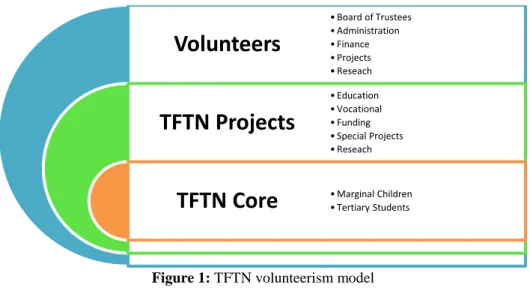
Figure 1: TFTN volunteerism model Source: Field Study (2018)
TFTN Projects focus on i) education ii) vocational iii) funding iv) special projects and v) research. Vocational education in TFTN is one of the ways to uncover and develop the potential of the children particularly in the aspects of arts and skills. Through theatre and art workshops, TFTN children are exposed to the creative aspects of theatrical and visual arts. Meanwhile, for the development of skills, TFTN focuses on entrepreneurship and product development.
.
RESEARCH METHODOLOGY
The research was conducted on 100 respondents (100%) representing TFTN activism at the early stage of its establishment. The respondents were youths who volunteering in Malaysia. Questionnaires were given to identify those who were active in volunteerism and matter in volunteer work. The questionnaire was divided to two sectors, Sector A and Sector B. Sector A is to identify; 1) age, occupation and education level 2) involvement in volunteerism, 3) involvement, experience and commitment level 4) role of social media and 5) level of involvement and skills in volunteerism work. Sector B investigated respondents’ perceptions on 1) Individual networking 2) Social Network 3) Norm of reciprocity and 4) Norm of trust. The inventory was designed on a 5-point Likert scale as Strongly Disagree (SD), Disagree (D), Agree (A), Strongly Agree (SA) and Not Sure (NS).
Volunteers
TFTN Projects
TFTN Core
•Board of Trustees
•Administration
•Finance
•Projects
•Reseach
•Education
•Vocational
•Funding
•Special Projects
•Reseach
•Marginal Children
RESULTS
Respondents Profile
50% (50 people) of the respondents were 21-23 years old. 28% (28 people) of the respondents were 20 years old and below while only 1% (one person) was of the age 30 years and above. In terms of employment, majority of the respondents found to be involved in volunteer work were students, which accounted for 81% (81 people). The second highest were the respondents who worked in the private sector, which was 9% (nine people) and the lowest was 2% (two persons) referring to the respondents who were unemployed. Meanwhile, respondents who were involved in volunteer work were mostly educated at the level of bachelor’s degree at 64% (64 people), followed by respondents with diploma at 20% (20 people) and the lowest was 1% (one people), which was respondent with certificate level education.The study conducted showed that 75% respondents (75 people) were involved in volunteer work and 25% respondents (25 people) were not involved in any volunteer work.
Involvement, Experience and Commitment Level in Volunteerism
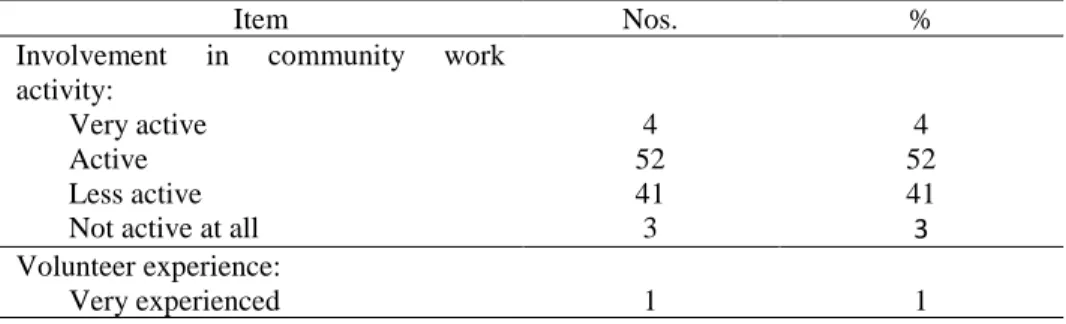
The research also inquired on the involvement, experience and commitment level as shown in Table 1. Majority of the respondents who were involved in community service were active at 52% while the least active was at 41%. 3% of the respondents were not active at all in community service. Next, the results of respondents’ experience as volunteers showed that 61% of the respondents were experienced, 28% were less experienced and 1% was very experienced as a volunteer. On the other hand, viewed from the angle of their commitment to community service activities, the highest group consisted of respondents who were committed at 60% followed by respondents who were less committed at 29%. Nevertheless, 5% of the respondents were very committed to community service activities. This clearly shows that respondents who were very active in community service were also highly committed. Meanwhile, only 1% of the respondents was very experienced.
Table 1: Levels of involvement, experience and commitment in community work activity and volunteerism
Item Nos. %
Involvement in community work activity:
Very active Active Less active Not active at all
4 52 41 3
4 52 41 3 Volunteer experience:
Experienced Less experienced Not experienced at all
61 28 10 61 28 10 Commitment in community work:
Very committed Committed Less committed Not committed at al
5 60 29 6 5 60 29 6 Source: Field Study (2014)
Social Media
Results on social media channels used by respondents to access information on volunteer work revealed that 94% of the respondents used Facebook, 5% used Twitter and 1% used Blog. From these findings, Facebook was the most popular channel used by respondents to access information on volunteer work.
Levels of Involvement and Skills in Volunteerism
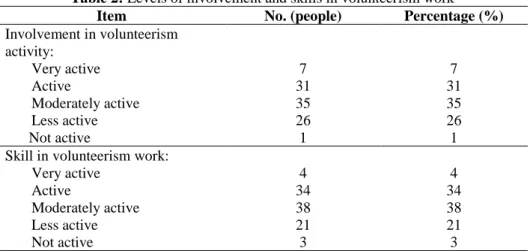
Table 2 shows the level of involvement and skills of respondents in volunteer work. In terms of the respondents’ involvement, the results show that although there were respondents who were moderately active and active in volunteer work, there were also those who were not active. Therefore, there should be awareness among volunteers that by becoming volunteers they should be ready to carry out the responsibilities and provide their services to people in need.
Table 2: Levels of involvement and skills in volunteerism work
Item No. (people) Percentage (%)
Involvement in volunteerism activity: Very active Active Moderately active Less active Not active 7 31 35 26 1 7 31 35 26 1 Skill in volunteerism work:
Individual Networking
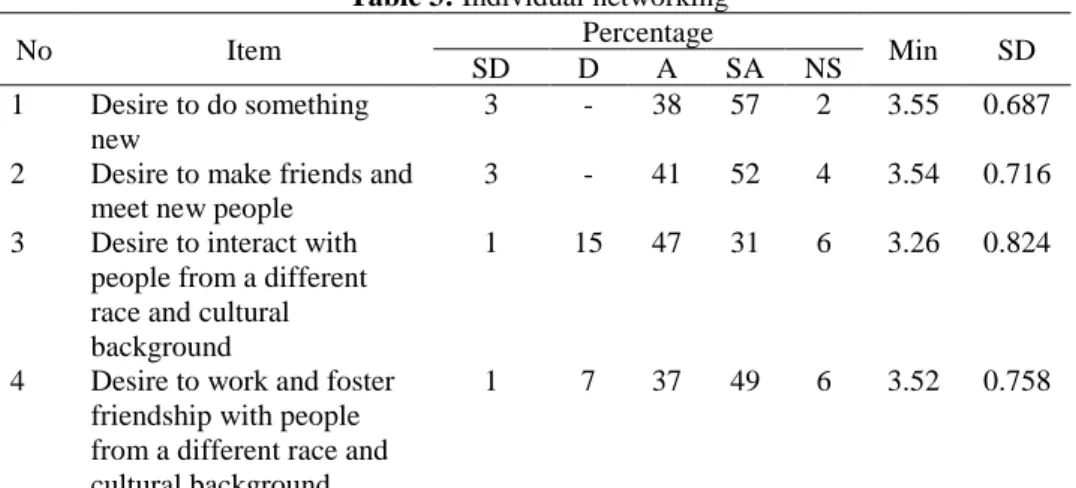
Individual networking was one of the social capital factors which influenced the youths to participate in volunteerism. Table 3 shows that the majority of respondents who strongly agreed, were open-minded when it came to dealing with people from different backgrounds. The min value for this component was 3.52. From the discussion, it was concluded that for the individual networking factor, a majority of the respondents strongly agreed and agreed. This clearly indicated that as individuals, every youth in volunteer work must be more responsible towards other people in order to realize the creation of networking between them and the others.
Table 3: Individual networking
No Item Percentage Min SD
SD D A SA NS
1 Desire to do something new
3 - 38 57 2 3.55 0.687
2 Desire to make friends and meet new people
3 - 41 52 4 3.54 0.716
3 Desire to interact with people from a different race and cultural background
1 15 47 31 6 3.26 0.824
4 Desire to work and foster friendship with people from a different race and cultural background
1 7 37 49 6 3.52 0.758
Notes: SD=Standard Deviation SD=Strongly Disagree, D=Disagree, A=Agree, SA=Strongly Agree, NS=Not Sure
Source: Field Study (2014)
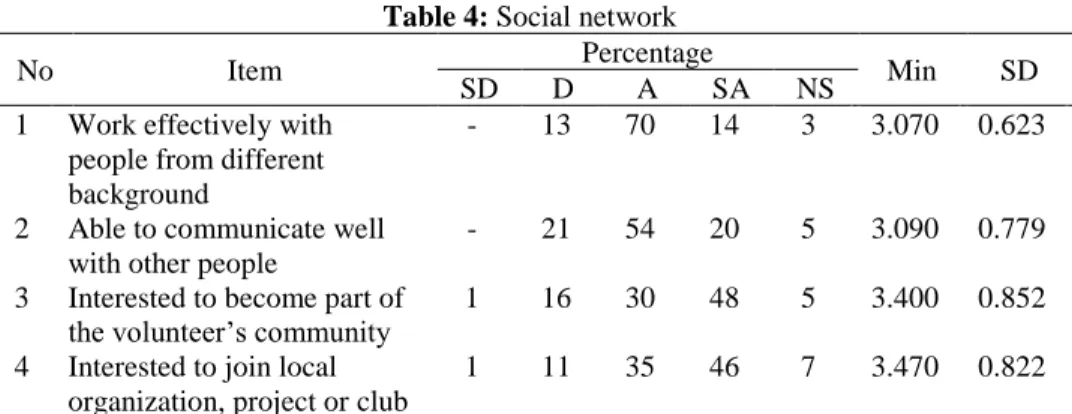
Social Network
Table 4: Social network
No Item Percentage Min SD
SD D A SA NS
1 Work effectively with people from different background
- 13 70 14 3 3.070 0.623
2 Able to communicate well with other people
- 21 54 20 5 3.090 0.779
3 Interested to become part of the volunteer’s community
1 16 30 48 5 3.400 0.852
4 Interested to join local organization, project or club
1 11 35 46 7 3.470 0.822
Note: SD=Standard Deviation, SD=Strongly Disagree, D=Disagree, A=Agree, SA=Strongly Agree, NS=Not Sure
Source: Field Study (2014)
Norm of Reciprocity
Table 5 shows that most of the youths understood the reasons behind the social problems and through participation in volunteer work they had indirectly, suggested ways to overcome the problems. It could be concluded that if someone did good deeds, he would receive good rewards.
Table 5: Norms of reciprocity No
. Item
Percentage
Min SD
SD D A SA NS
1 Can contribute towards development of other people
3 - 70 21 6 3.270 0.708
2 Able to make a difference 1 14 59 20 6 3.160 0.774
3 Always write to newspaper, e-mail or organization to voice out opinion
14 46 33 5 2 2.350 0.857
4 Have good understanding of social problems globally
1 21 60 11 7 3.020 0.803
Note: SD=Standard Deviation SD=Strongly Disagree, D=Disagree, A=Agree, SA=Strongly Agree, NS=Not Sure
Source: Field Study (2014)
Norm of Trust
Table 6: Norm of trust
Item
Percentage Min SD
SD D A SA N
S 1 High appreciation towards the
culture and custom of other races
1 15 53 21 10 3.240 0.865
2 Very flexible in thinking and ideas
1 10 60 21 8 3.250 0.783
3 Try to look from the point of view of everyone who disagree before making any decision
1 13 49 35 2 3.240 0.740
4 Regardless of the condition, always look from many viewpoints
1 14 52 32 1 3.180 0.716
Note: SD=Standard Deviation
SD=Strongly Disagree, D=Disagree, A=Agree, SA=Strongly Agree, NS=Not Sure Source: Field Study (2014)
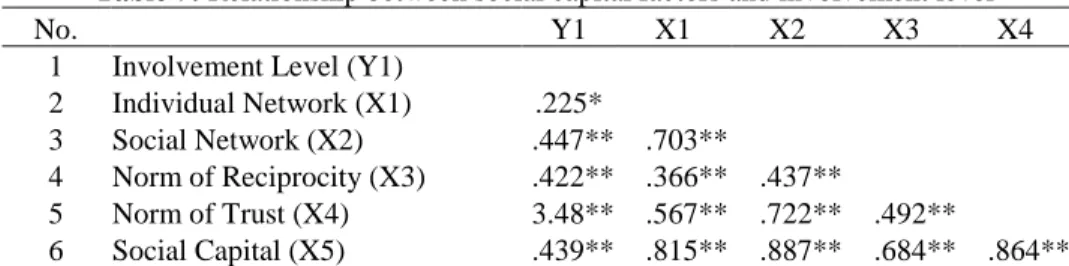
Relationship between Social Capital Factors and Levels of Involvement and Skills in Volunteer Work
Correlation analysis was used to observe the relationship between social capital factors and youth involvement levels in volunteer work. Variable Y was tested with four variables X namely individual network, social network, norm of reciprocity and norm of trust. The results of the study in Table 7 showed a weak and significant positive relationship between individual network and youth involvement (r=.225, p<0.05). This means that youths who were weak in creating individual networking may not be active in volunteer work. Meanwhile, the results of the analysis for social network and youth involvement level show a weak and significant positive relationship (r=.447, p<0.01). This indicates the lower the social network score of youths in an organization or association, the lower their level of involvement in volunteer work.
Table 7: Relationship between social capital factors and involvement level
No. Y1 X1 X2 X3 X4
1 Involvement Level (Y1)
2 Individual Network (X1) .225*
3 Social Network (X2) .447** .703**
4 Norm of Reciprocity (X3) .422** .366** .437**
5 Norm of Trust (X4) 3.48** .567** .722** .492**
6 Social Capital (X5) .439** .815** .887** .684** .864**
Next, there was a weak and significant positive relationship between the norm of reciprocity factor and youth involvement level (r=.422, p<0.01). This indicated that youths with low norm of reciprocity scores might not be active and lacked responsibility in volunteer work. Moreover, the result between the norm of trust factor and youth involvement level also showed a weak and significant positive relationship (r=.348, p<0.01). This means that youths with low norm of trust scores were also less involved in volunteer work. Hence, the study conducted on all social capital factors and youth involvement levels in volunteer work show a weak and significant positive relationship (r=.439, p<0.01).
All in all, the correlation of youth involvement levels in the volunteer work dimension showed a low power relationship with correlation coefficients 0.30 – 0.50, which included social network, norm of reciprocity and norm of trust factors. Furthermore, it also had a low power relationship with correlation coefficients 0.01 – 0.30, which was the individual network factor. Therefore, the study of the social responsibility of youths in carrying out volunteer work had been analysed and was recorded as low.
Relationship between Social Capital Factors and Levels of Skills and Commitment
Table 8 shows the relationship between social capital factors and levels of skills and commitment of youths in volunteer work. The results between individual network factor and youth skills and commitment level show no significant relationship (r=.148, p>0.05). This indicates that individual network factor was not influenced by the level of involvement and commitment in volunteer work. Furthermore, there was a weak and significant positive relationship (r=.412, p<0.01) between social network factor and youth skills and involvement level, thus implying that youths with low scores in the social structure of an organization or association might have low levels of skills and commitment in volunteer work, too.
Table 8: Relationship between social capital factors and levels of skills and commitment
No. Y1 X1 X2 X3 X4
1 Level of Skills (Y1)
2 Individual Network (X1) 0.148
3 Social Network (X2) .412** .703**
4 Norm of Reciprocity (X3) .460** .366** .437**
5 Norm of Trust (X4) .433** .567** .722** .492**
6 Social Capital (X5) .443** .815** .887** .684** .864**
Moreover, there was also a weak and significant positive relationship between the norm of reciprocity factor and youth skills and commitment levels (r=.460, p<0.01). This shows that youths with low norm of reciprocity scores have low levels of skills and commitment in volunteer work. Other than that, the relationship between the norm of trust factor and youth skills and commitment levels also weak and significant positive (r=.460, p<0.01). Hence, the lower youth norm of trust score, the lower their level of skills and commitment in carrying out their responsibilities as volunteers. The result of the analysis between the social capital factors and youth level of skills and commitment in volunteer work shows a low but significant positive relationship (r=.443, p<0.01).
CONCLUSION
The understanding on the theoretical concept of social capital and the nature of volunteerism has shed some light on the understanding of social ties to promote beneficial impacts for the local community in particular and the nation in general. Having the real benefits, social capital is the best concept to empower voluntary associations based on the nature of a community’s sociological behaviour. The voluntary sector has even been regarded as the nation’s third sector which gives a direct impact on the economy, thus, the results in community well-being. In the case of TFTN volunteers, there are weak and significant positive relationships between individual networks and youth involvements. Individual network factors and youth skills are not significant to ensure commitment in volunteer work. However, norms of reciprocity and trust have a positive relationship with youths’ skills and commitments.
REFERENCES
Ahmad, F., Salman, A., Rahim, S. A., Pawanteh, L., & Ahmad, A. L. (2013). Interethnic tolerance among multiethnic youth Accommodating differences in the construction of social citizenship. Journal of Asian Pacific Communication, 23(2), 275-290.
Boeck, T., Makadia, N., Johnson, C., Cadogan, N., Salim, H., & Cushing, J. (2009). The impact of volunteering on social capital and community cohesion. Available at http://www.youthaction.network.org.uk
Bourdieu, P. (1970). Reproduction in education, culture and society. London: Sage. Chong, S. T., Koh, D., Fauziah, I., & Samsudin, A. R. (2017). Neighbourhood social
capital and neighbourhood safety in predicting the subjective well-being of young Malaysians. Pertanika Journal of Social Sciences and Humanities, 25(June), 155-163.
Faizli, A. A. (2012). Sukarelawan pendidikan melalui teach for the needs. Retrieved from http://www.freemalaysiatoday.com/category/nation/ 2012/09/12./sukarelawan-pendidikan-melalui-teach-for-the-needs/
Putnam, R. D. (2000). Bowling alone: The collapse and revival of American community. New York: Simon and Schuster.
UNESCO (2011). Module 3: Social Work. France: Ag2i Communication.
Sahri, M., Murad, K., Alias, A., & Sirajuddin, M. D. M. (2013, September). Empowering youth volunteerism: The importance and global motivating factors. 3rd International Conference on Human and Social Sciences, September 20-22, 2013, Rome Italy.
Siisiainen, M. (2000, July). Two concepts of social capital: Bourdieu vs. Putnam. ISTR Fourth International Conference. July 5-8, 2000, Dublin, Ireland.
Sulaiman, W. I. W., Mahbob, M. H., & Sannusi, S. N. (2015). Social capital and the learning organization: Transformation in Malaysian public sector. Journal of Asian Pacific Communication, 25(2), 208-219.
TFTN (2013). TFTN’s Company Profile