UM
a
T
GUIDELINES
FOR
POSTGRADUATE
STUDIES
2016/17
i | P a g e
UNIVERSITY OF MINES AND TECHNOLOGY (UMaT), TARKWA
SCHOOL OF POSTGRADUATE STUDIES
GENERAL REGULATIONS FOR POSTGRADUATE PROGRAMMES 2016/2017 ACADEMIC YEAR
INTRODUCTION
This brochure is specially prepared to afford those who are interested in pursuing postgraduate studies at this University the opportunity of having a firsthand knowledge of programmes available and the regulations thereof.
ENQUIRIES
All enquiries and/or applications for admission, etc, must be addressed to:
The Secretary
School of Postgraduate Studies University of Mines and Technology Post Office Box 237
Tarkwa, Western Region Ghana.
Telephone: +233 (0) 3123 20935 or (0) 3123 20324/20280 Ext. 228 Facsimile: +233 (0) 3123 20306
Email: [email protected]
BOARD OF SCHOOL OF POSTGRADUATE STUDIES
Dean, School of Postgraduate Studies - Chairman
Vice Dean - Member
A representative from Faculty of Mineral Resources
Technology Board not below the rank of senior lecturer - Member A representative from Faculty of Engineering Board
not below the rank of senior lecturer -Member HODs of the students concerned - Member Faculty Officer of the School
ii | P a g e
FUNCTIONS OF BOARD OF POSTGRADUATE STUDIES
i. To give approval of candidatures, supervisors, coursework, theses topics, titles and synopses for higher qualifications based upon the recommendations from the Departmental and Faculty Boards.
ii. To recommend the appointment of Internal and External Examiners in respect of written papers, dissertations or thesis to the Academic Board based upon recommendations from the Departmental and Faculty Boards.
iii. To keep records of all Postgraduate students.
iv. To give provisional approval to postgraduate examination results upon recommendations from the Departmental and Faculty Boards.
v. To liaise with the Deans on postgraduate matters in their various Faculties.
vi. To establish, through the Dean of International Programme, and maintain links with Postgraduate Schools in other universities or institutions and promote exchanges of postgraduate students and staff engaged in postgraduate work between this University and other institutions.
iii | P a g e
PROGRAMMES
&
GUIDELINES
iv | P a g e
Table of Contents
1 INTRODUCTION ... 1 1.1 VISION STATEMENT... 1 1.2 MISSION STATEMENT ... 1 1.3 CORE VALUES ... 1 2 PROGRAMMES ... 12.1 DEGREES AND DIPLOMAS ... 1
3 GENERAL REGULATIONS ... 2
3.1 APPLICATIONS AND PROCEDURE FOR ADMISSION ... 2
3.2 DESCRIPTION OF POSTGRADUATE STUDIES ... 2
3.3 REGISTRATION ... 3
3.4 ACADEMIC CALENDAR ... 4
4 REGULATIONS FOR HIGHER DEGREES ... 4
4.1 AIMS AND OBJECTIVES ... 4
4.2 ADMINISTRATION OF POSTGRADUATE PROGRAMMES ... 4
4.3 PhD PROGRAMMES ... 5
4.4 MASTER'S PROGRAMMES ... 12
4.5 POSTGRADUATE DIPLOMA PROGRAMMES ... 19
5 GENERAL INFORMATION ... 20
5.1 SOCIAL AND SPORTING FACILITIES ... 20
5.2 THE ASSOCIATION OF GRADUATE STUDENTS (GRASAG) ... 20
5.3 COST/FEES ... 21
DEPARTMENT OF GEOMATIC ENGINEERING ... 22
6 MASTER’S (MODULAR) PROGRAMME IN GEOMATIC ENGINEERING ... 22
v | P a g e
6.2 PROGRAMME OBJECTIVES... 22
6.3 ENTRY REQUIREMENTS ... 22
6.4 PROGRAMME REQUIREMENTS ... 23
6.5 PROGRAMME STRUCTURE ... 23
7 DOCTOR OF PHILOSOPHY PROGRAMME IN GEOMATIC ENGINEERING ... 33
7.1 ENTRY REQUIREMENTS ... 33
7.2 PROGRAMME DURATION ... 34
7.3 AREAS OF RESEARCH ... 34
7.4 EMPLOYMENT OPPORTUNITIES ... 35
DEPARTMENT OF GEOLOGICAL ENGINEERING ... 38
8 MASTER’S (MODULAR) PROGRAMME IN GEOLOGICAL ENGINEERING ... 38
8.1 TITLE OF PROGRAMME ... 38
8.2 PROGRAMME OBJECTIVES... 38
8.3 ENTRY REQUIREMENTS ... 39
8.4 PROGRAMME REQUIREMENTS ... 39
8.5 PROGRAMME STRUCTURE ... 40
9 DOCTOR OF PHILOSOPHY PROGRAMME IN GEOLOGICAL ENGINEERING... 47
9.1 ENTRY REQUIREMENTS ... 47
9.2 PROGRAMME DURATION ... 47
9.3 AREAS OF RESEARCH ... 48
9.4 EMPLOYMENT OPPORTUNITIES ... 48
DEPARTMENT OF MINING ENGINEERING... 52
10 POSTGRADUATE DIPLOMA PROGRAMME (PgD) IN MINING ENGINEERING ... 52
10.1 ENTRY REQUIREMENTS ... 52
10.2 PROGRAMME REQUIREMENTS ... 52
vi | P a g e
11 MASTER’S (MODULAR) PROGRAMME IN MINING ENGINEERING ... 53
11.1 TITLE OF PROGRAMME ... 53
11.2 PROGRAMME OBJECTIVES... 53
11.3 ENTRY REQUIREMENTS ... 54
11.4 PROGRAMME REQUIREMENTS ... 55
11.5 PROGRAMME STRUCTURE ... 56
12 DOCTOR OF PHILOSOPHY PROGRAMME IN MINING ENGINEERING ... 63
12.1 ENTRY REQUIREMENTS ... 63
12.2 PROGRAMME DURATION ... 63
12.3 AREAS OF RESEARCH ... 64
12.4 EMPLOYMENT OPPORTUNITIES ... 64
12.5 AVAILABLE RESOURCES ... 64
DEPARTMENT OF MINERALS ENGINEERING ... 66
13 MASTER’S (MODULAR) PROGRAMME IN MINERALS ENGINEERING ... 66
13.1 TITLE OF PROGRAMME ... 66
13.2 PROGRAMME OBJECTIVES... 66
13.3 ENTRY REQUIREMENTS ... 66
13.4 PROGRAMME REQUIREMENTS ... 67
13.5 PROGRAMME STRUCTURE ... 68
14 DOCTOR OF PHILOSOPHY PROGRAMME IN MINERALS ENGINEERING ... 73
14.1 ENTRY REQUIREMENTS ... 73
14.2 PROGRAMME DURATION ... 74
14.3 AREAS OF RESEARCH ... 74
14.4 AVAILABLE RESOURCES ... 75
14.5 EMPLOYMENT OPPORTUNITIES ... 75
vii | P a g e
15 MASTERS (MODULAR) PROGRAMME IN MECHANICAL ENGINEERING ... 79
15.1 TITLES OF PROGRAMMES ... 79 15.2 PROGRAMME OBJECTIVES... 79 15.3 ENTRY REQUIREMENTS ... 79 15.4 PROGRAMME REQUIREMENTS ... 80 15.5 PROGRAMME STRUCTURE ... 80 15.6 AREAS OF RESEARCH ... 86 15.7 EMPLOYMENT OPPORTUNITIES ... 87 15.8 AVAILABLE FACILITIES ... 88
DEPARTMENT OF ELECTRICAL AND ELECTRONIC ENGINEERING……….97
16 MASTER’S (MODULAR) PROGRAMME IN ELECTRICAL AND ELECTRONIC ENGINEERING ... 89 16.1 TITLE OF PROGRAMME ... 89 16.2 PROGRAMME OBJECTIVES... 89 16.3 ENTRY REQUIREMENTS ... 90 16.4 PROGRAMME REQUIREMENTS ... 90 16.5 PROGRAMME STRUCTURE ... 91
17 DOCTOR OF PHILOSOPHY PROGRAMME IN ELECTRICAL AND ELECTRONIC ENGINEERING ... 98 17.1 ENTRY REQUIREMENTS ... 98 17.2 PROGRAMME DURATION ... 98 17.3 AREAS OF RESEARCH ... 99 17.4 EMPLOYMENT OPPORTUNITIES ... 100 17.5 AVAILABLE RESOURCES ... 100 DEPARTMENT OF MATHEMATICS………..112 18 MASTER’S (MODULAR) PROGRAMMES IN MATHEMATICS ... Error! Bookmark not defined.
viii | P a g e
18.2 PROGRAMME OBJECTIVES... Error! Bookmark not defined.
18.3 ENTRY REQUIREMENTS ... Error! Bookmark not defined.
18.4 PROGRAMME REQUIREMENTS ... Error! Bookmark not defined.
18.5 PROGRAMME STRUCTURE ... Error! Bookmark not defined.
19 DOCTOR OF PHILOSOPHY PROGRAMMES ... Error! Bookmark not defined. 19.1 TITLE OF PROGRAMME ... Error! Bookmark not defined.
19.2 ENTRY REQUIREMENTS ... Error! Bookmark not defined.
19.3 PROGRAMME DURATION ... Error! Bookmark not defined.
19.4 AREAS OF RESEARCH ... Error! Bookmark not defined.
19.5 EMPLOYMENT OPPORTUNITIES ... Error! Bookmark not defined.
1 | P a g e
1
INTRODUCTION
The University of Mines and Technology (UMaT) started in 1952 as the Tarkwa Technical Institute. In 1961, it was reorganised to become the Tarkwa School of Mines to train the required manpower for the mining and allied industries in Ghana. In 1976, the School was affiliated to the Kwame Nkrumah University of Science and Technology (KNUST) as a faculty of that University. It became the Western University College of KNUST in 2001. UMaT was established in November 2004 by an Act of Parliament (Act 677).
1.1 VISION STATEMENT
The vision of the University is to become a Centre of Excellence in Ghana and Africa for producing world-class professionals in the fields of mining, technology and related disciplines.
1.2 MISSION STATEMENT
The mission is to provide higher education in mining, technology and related disciplines, to promote knowledge through effective teaching and learning; to promote knowledge through active research and dissemination of information and to offer professional services through extension activities to the mining and allied industries.
1.3 CORE VALUES
Knowledge, Truth and Excellence
2
PROGRAMMES
2.1 DEGREES AND DIPLOMAS
All postgraduate programmes of study in the University may require coursework together with research work, leading to the award of the following:
Postgraduate Diploma (PgD)
Master of Science (MSc)
Master of Philosophy (MPhil)
2 | P a g e
Postgraduate Diploma programmes are offered by some Departments.
3
GENERAL REGULATIONS
3.1 APPLICATIONS AND PROCEDURE FOR ADMISSION
Applications for admission shall be made on a prescribed form obtainable on-line at www.umat.edu.gh, to which the completed form shall be returned not later than the 28th February preceding the academic year in which a candidate wishes to start the programme or any other approved deadline.
All candidates applying for admission to research programmes shall be required to submit (in about 700 and 2,000 words for MPhil and PhD respectively) an outline of proposed research.
Applications shall then be considered, in the first instance, by the appropriate Departmental Board. The Departmental Board shall satisfy itself of the suitability or otherwise of the candidate and the availability of resources for the successful completion of the candidate's work. Where an interview or a qualifying examination is required for determining the suitability or otherwise of an applicant, the Departmental Board shall decide the form of interview or qualifying examination and appoint a panel from its members to administer the interview or examination. The School of Postgraduate Studies shall be represented at such interview or examination.
The Head of Department shall submit to the School of Postgraduate Studies for its approval, a list of candidates recommended for admission together with:
(a) The pertinent extracts from the minutes of the Departmental Board meeting (b) Statement on the nature of the programme
(c) Dissertation/thesis topic(s) and an outline of the proposed research (where applicable) (d) Name(s) of proposed Internal Supervisor(s).
3.2 DESCRIPTION OF POSTGRADUATE STUDIES
Postgraduate studies shall be categorised under two main headings: namely, full-time and part-time.
3 | P a g e
A full-time study shall be completed within a maximum duration of twenty-four months from the date of registration for a master's programme and thirty-six months for a doctorate programme. A full time student is one who is fully engaged in a programme of study and research throughout the entire duration of his/her programme.
A part-time study shall be completed within a maximum duration of thirty-six months from the date of registration for a master's programme and forty-eight months for a doctorate programme.
These maximum durations may be extended by the Board, on the recommendation of the Supervisor through the Departmental and Faculty Boards, by periods not more than six months to a maximum of one year.
3.3 REGISTRATION
(a) Students admitted to the Postgraduate programmes of this University shall register at their respective Departments and at the School of Postgraduate Studies at the beginning of each semester by filling in the appropriate forms prescribed for that purpose. The student shall plan his/her courses in consultation with his/her Supervisor.
(b) Full time students will be required to register a minimum of three (3) modules per semester.
(c) Students should register modules they intend to participate in by the third week of every semester.
(d) To be of good standing a part-time student must do, at least, three modules per annum.
(e) A student who is unable to register within the formal registration period on grounds of ill-health, shall on provision of a Medical Report issued or endorsed by the University Medical Officer, be allowed to register within ten days from the day of the closure of formal registration.
(f) In the event of the inability of such a student to register within the ten days stipulated in paragraph (e) above, he/she will be allowed a deferment for a semester. In a situation where the first semester courses are prerequisite for the second semester
4 | P a g e
courses, the deferment shall be for the whole academic year (i.e. two semesters). (g) There shall be no registration by proxy.
(h) In circumstances of force majeure the case shall be referred to the Vice Chancellor.
3.4 ACADEMIC CALENDAR
The semester periods shall be:
First Semester June to November Second Semester December to May
4
REGULATIONS FOR HIGHER DEGREES
4.1 AIMS AND OBJECTIVES
(a) To train high level manpower and improve students’ academic competence.
(b) To solve national/international problems with greater emphasis on solving national problems.
(c) To contribute to knowledge.
4.2 ADMINISTRATION OF POSTGRADUATE PROGRAMMES
Postgraduate programmes are administered by a network of persons, panels and committees/boards at various levels.
(a) The following structure outlines the Boards responsible for the administration of Postgraduate Studies at UMaT:
i. Departmental Board.
ii. Faculty Board.
iii. Board of Postgraduate Studies (hereinafter referred to as the Board).
iv. Academic Board.
(b) The composition and duties of the various Boards are as follows:
(i) Departmental Board Composition
The composition is as specified in the Statutes.
Duties
Admission of suitable candidates into Postgraduate programmes in the Department.
Dealing with matters relating to admission, registration of students, extension of studies, nomination of Supervisors and examinations.
5 | P a g e
Nomination of panel of Examiners (Internal and External).
Final assessment of students for graduation.
Review of Postgraduate academic curriculum of the Department within approved regulations.
(ii) Faculty Board Composition
The composition is as specified in the Statutes.
Duties
To consider Faculty Postgraduate matters and make recommendations to the Board
To deal with matters initiated by it or referred to it by the Board or the Departmental Board
To recommend to the Academic Board, through the Board, Internal and External Examiners for appointment
To advise on regulations and syllabuses dealing with courses of study for Postgraduate degrees and other awards of the Faculty.
To make recommendations to the Academic Board, through the Board, for the award of Postgraduate degrees (other than honorary degrees), diplomas, certificates, University fellowships, studentships, scholarships and prizes within the Faculty.
(iii) Board of Postgraduate Studies
The composition and duties are as specified in the Statutes.
(iv) Academic Board
The composition and duties are as specified in the Statutes.
4.3 PhD PROGRAMMES
The degree of Doctor of Philosophy (PhD) is awarded upon completion of an approved programme of study in which a candidate has made an original and significant contribution to knowledge.
4.3.1 Entry Requirements
(a) A candidate shall hold a Master’s degree or its equivalent from a recognised institution and shall submit evidence of adequate training and ability to undertake the proposed programme.
6 | P a g e
he/she proves himself/herself to be academically capable by the end of the first year of the programme, he/she may be permitted by the Board of Postgraduate Studies on the recommendation of the Department to register for the PhD degree. This registration shall be deemed retrospective from the date of the original registration of the Master’s degree. (c) A candidate who does not satisfy the requirements stated (a) and (b) above but is
otherwise adjudged suitable may be admitted. For the purpose of assessing his suitability, such a candidate may be interviewed on the recommendation of the Department concerned.
(d) All foreign applicants must have proficiency in English language.
(e) Admission Letters issued to foreign applicants shall be valid for two years.
4.3.2 Duration of Programme
Subsequent to registration, the candidate shall pursue a full-time programme of study and research for at least two academic years, except that:
(a) A candidate fully engaged in advanced study and research for his/her degree, who before registration, was engaged in research to the satisfaction of the Department concerned, may be exempted from not more than one academic year.
(b) In special circumstances, the Department may recommend, that a candidate be allowed to spend not more than one academic year of his/her programme in advanced study and research at another institution, provided that this work can be supervised in a manner satisfactory to the Department and the Board.
(c) A member of the full-time academic staff of the University may be accepted as a part-time candidate. Where the Board is satisfied that a Senior Member has been engaged in research evidenced by publication(s), he/she may submit a thesis on the research at any time without previous registration.
(d) In special circumstances, the Board on the recommendation of the Departmental and Faculty Boards concerned may accept as a part-time candidate a person who is not a member of the full-time staff of the University but is engaged in an occupation which, in its opinion, affords the candidate the opportunity to pursue his/her programme. In such a case the Board, on the recommendation of the Departmental and Faculty Boards, shall prescribe a minimum period for his/her programme, which in its opinion, having regard to the time he/she is able to devote to the programme
7 | P a g e
prescribed by the appropriate Department, is equivalent to two academic years of full-time study.
(e) A full-time candidate shall complete his/her programme not later than thirty-six months from the date of registration. A part-time candidate shall complete his/her programme not later than forty-eight months from the date of registration. These maximum times may be extended by the Board, on the recommendation of the Supervisor through the Departmental and Faculty Boards, by periods of not more than six months, to a maximum of forty-eight months for full-time students and sixty-months for part-time students.
(f) Under no circumstances should a full-time PhD programme extend beyond four years (g) Under no circumstances should a part-time PhD programme extend beyond five years.
4.3.3 Course Work
(a) Course work may be required at the PhD level. A PhD student is required to make a minimum of 36 credits (30 credits for Thesis and six credits for two Seminars). Where a candidate is required to take courses, the credits earned shall be added. Research methods (credit 0) shall be compulsory for all students at the PhD level.
(b) All examination results for the course work shall be considered by the Departmental and Faculty Boards, which in turn, shall make their recommendations to the Board not later than three months after the examination.
(c) The Dean of Postgraduate Studies shall call a meeting of the Board, at least once a semester, for the exclusive purpose of approving examination results, subject to the approval of the Academic Board.
(d) Any postgraduate course recommended by the supervisor taken from either within or without the candidate’s Department shall count and be included in his/her transcript.
4.3.4 Thesis
The thesis shall comply with the following conditions:
(a) The greater portion of the work submitted must have been done subsequent to the registration of the student as a candidate for the degree.
(b) The thesis shall be written in English.
(c) The thesis shall consist of the candidate's own account of his/her research, and be certified. It may describe work done in conjunction with the candidate's Supervisor, provided the
8 | P a g e
candidate states clearly his/her share in the investigation, and that the Supervisor certifies this statement. Under no circumstances shall a paper written or published in the joint names of two or more persons be accepted as a thesis. Work done conjointly with persons other than the candidate's Supervisor shall be accepted as a thesis in special cases only. In such cases the approval of the Departmental, Faculty and Postgraduate Boards shall be given. (d) Where a thesis is submitted without previous registration by a full-time academic staff of the
University, the Head of Department in consultation with the Deans of the Faculty and the School of Postgraduate Studies, shall appoint a three-member Committee to certify the thesis prior to oral examination.
(e) A candidate shall not be permitted to submit a thesis which has been submitted elsewhere. Nonetheless, a candidate shall not be precluded, at the discretion of his/her Supervisor, from incorporating work which he/she has already submitted for a degree in this University or elsewhere, provided that he/she indicates in his/her thesis any work which has been so incorporated.
(f) Not later than six months before the date when he/she proposes to enter for the examination a candidate shall submit the title of his/her thesis to the appropriate Departmental and Faculty Boards for approval and submission to the Board. After the final title of the thesis has been approved it may not be changed except with the express permission of the Board on the recommendation of the Departmental and Faculty Boards.
(g) The thesis shall be submitted, accompanied by the prescribed form (obtainable from the School of Postgraduate Studies), not later than thirty-six months after the beginning of the programme. In the case of part-time students, this period shall be forty-eight months. (h) At least FIVE typed or printed comb-bound copies of the thesis shall be submitted to the Board through the Head of Department. The paper size shall beA4 except for drawings and maps, on which no restriction shall be placed. Only one side of the paper shall be used with a margin of 3.05 cm on the left-hand side of the page. Top/Bottom/Right margins shall be 2.54 cm. The thesis shall be typed in either one and half or double line spacing with a maximum of 200 pages excluding appendices.
After the thesis has been approved it must be bound in a standard form as follows:
art vellum or cloth; overcast; edges uncut; lettered boldly up spine in gold (0.625 cm - 1.255 cm) degree, date, name. Black cover.
9 | P a g e
(i) One copy each of the thesis that has been accepted for the award of a PhD degree shall be deposited at the University Library, the Department and the School of Postgraduate Studies.
4.3.5 Seminar
All PhD candidates are required to present at least two seminars having direct relationship to their thesis. The two seminars must be done before submission of the thesis. A candidate who fails to present a registered seminar on an agreed date without permission shall pay a penalty of 20% of the seminar module fee before he/she shall be allowed to present at the next scheduled date.
4.3.6 Publications
All PhD candidates are encouraged to publish at least a technical paper arising out of their work before graduation.
4.3.7 Progress Report
(a) Candidates’ progress on thesis should be monitored through the use of progress report forms every year (see Appendix 1). The forms shall be completed by each student and Supervisor, and each Supervisor shall submit a copy to the Dean of Postgraduate Studies through the Head of Department and the Dean of his/her Faculty.
(b) A candidate who fails to make progress for one year will be put on probation.
(c) A candidate who fails to make progress on his/her programme for two academic years will be withdrawn from the programme.
(d) On the basis of work done in the course of the year, the Departmental and Faculty Boards may recommend for approval by the Board that a candidate continues or terminates his/her studies.
4.3.8 Supervision Committee
(a) For the supervision of a PhD thesis, a team of a minimum of two (2) and a maximum of three (3) Supervisors is recommended to serve as Supervision Committee. The principal Supervisor should be a Senior Lecturer (with a PhD) or above. A Lecturer with a PhD may serve on the committee. The Supervision Committee shall include the Internal Supervisor (s).
10 | P a g e
prescribed forms to the Deans of the Faculty and Postgraduate Studies through the Head of the Department.
4.3.9 Assessment
The examination for the award of a PhD degree shall comprise:
Written examination (where appropriate) and Seminars.
Assessment of thesis, and
Oral examination.
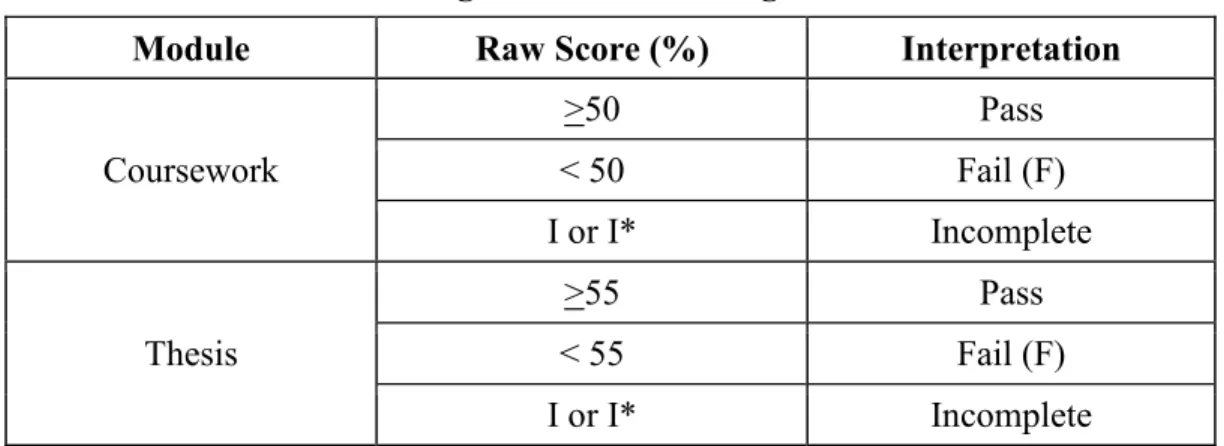
The Pass marks for coursework and thesis are as shown in Table 4.1.
Table 4.1: UMaT Grading Scale for PhD Programmes
(a) Two External Examiners and at least three Internal Examiners shall be appointed to examine the thesis. A panel of not less than five Examiners including the two External Examiners shall conduct the oral examination. Only Senior Lecturers (with PhD) and above may be appointed as Internal Examiners except where a Lecturer with PhD is a member of the Supervision Committee. The oral examination shall be public but only the Examiners shall examine the candidate.
(b) The panel for the oral examination shall be made up of the following:
Dean of Postgraduate Studies or a representative - Chairman The Head of Department or a representative - Member Two External Examiners and at least three Internal Examiners - Members
(c) In recommending the appointment of an External Examiner for the purpose stated above, the Head of Department, in consultation with the Dean of the Faculty, shall submit to the Board an outline curriculum vitae of the proposed examiner based on a format obtainable
Module Raw Score (%) Interpretation
Coursework >50 Pass < 50 Fail (F) I or I* Incomplete Thesis >55 Pass < 55 Fail (F) I or I* Incomplete
11 | P a g e
from the School of Postgraduate Studies. The External Examiner should show significant contribution in the area concerned.
(d) (i) The Examiners may recommend to the School of Postgraduate Studies that the candidate whose thesis is not up to the required standard be permitted to re-submit his/her thesis in a revised form within a specified period up to a maximum of twelve (12) months for oral examination;
(ii) Subject to the provisions of Clause d (i), if a candidate’s thesis is still not up to the required standard, the Examiners may advise that the candidate re-submits his/her thesis in a revised form within a specified period up to a maximum of 90 days for an oral examination towards the award of either a MPhil degree or Postgraduate Diploma if the candidate so wishes.
(iii) Where a candidate fails to pass the oral examination for the first time, the Examiners may advise that the candidate re-submits his/her thesis in a revised form within a specified period up to a maximum of 90 days for an oral examination towards the award of a PhD degree.
(iv) Where a candidate fails to pass the oral examination for the second time, the Examiners may advise that the candidate re-submits his/her thesis in a revised form within a specified period up to a maximum of 90 days for the award of either a MPhil degree or Postgraduate Diploma if the candidate so wishes.
(e) The panel shall submit its recommendations to the Dean of Postgraduate Studies in the form of a joint report signed by both Internal and External Examiners with respect to the oral examination, and separate reports with regard to the thesis on the basis of prescribed criteria. The appropriate copies of the approved thesis (with the necessary corrections) shall be submitted to the School of Postgraduate Studies through the Head of Department.
(f) A maximum period of 90 days shall be allowed for final corrections to the thesis. (g) A full fee shall be paid for any oral examination.
4.3.10Procedure for Award of a Degree
(a) After an oral examination, extracts from the Examiners’ report shall be submitted to the Department concerned to enable the student make the necessary corrections in the thesis.
12 | P a g e
through the Departmental and Faculty Boards.
(c) The recommendations of the Board shall be submitted to the Academic Board for approval.
(d) Each successful candidate shall thereafter be awarded a certificate under the seal of the University at a congregation of the University for that purpose.
4.4 MASTER'S PROGRAMMES
There are two levels of Master’s programmes in the University: MSc and MPhil.
4.4.1 Designation
(a) Master of Philosophy (MPhil) based on research with limited taught courses.
(b) Master of Science (MSc) based on a combination of taught courses and research.
4.4.2 Entry Requirements
(a) A candidate shall hold a First Class or Second Class (Upper Division) honours degree, or its equivalent, in an appropriate field of study, from a recognised University.
(b) A candidate who does not satisfy the requirement stated in (a) but is otherwise adjudged suitable by the Departmental Board, may, where practicable, be interviewed as determined by the Departmental Board concerned.
(c) A candidate who has satisfactorily completed a Postgraduate Diploma programme may be considered for admission on the recommendation of the Departmental Board concerned.
(d) All foreign applicants must have: i. Proficiency in English language.
ii. BSc First Class or Second Class (Upper Division) in an appropriate field of study, from a recognised University.
iii. A candidate who satisfies the requirement in (i) and not (ii) but is otherwise adjudged suitable by the Departmental Board, may, where practicable, be interviewed as determined by the Departmental Board concerned.
iv. A candidate who has satisfactorily completed a Postgraduate Diploma course may be considered for admission on the recommendation of the Departmental Board
13 | P a g e
concerned.
v. Admission Letters issued to foreign applicants shall be valid for two years.
4.4.3 Duration of Programme
A full-time programme leading to a Master's degree shall be not less than one academic year except that:
(a) In special circumstances, the Department may recommend that a candidate be allowed to spend not more than six months of his programme in advanced study and research at another institution provided that his work can be supervised in a manner satisfactory to the Departmental, Faculty and Postgraduate Boards.
(b) In special circumstances, the Board, on the recommendation of the Departmental and Faculty Boards concerned, may accept as a part-time candidate for the degree, any person who is engaged in an occupation, which in their opinion, affords the candidate the opportunity to pursue his/her programme. In such a case the Board on the recommendation of the Departmental and Faculty Boards shall prescribe a minimum period for the duration of his/her programme which in their opinion, having regard to the proportion of his/her time which he/she is able to devote to the programme prescribed by the appropriate Department, is equivalent to twelve months full-time study.
(c) A full time candidate shall complete his/her programme not later than twenty-four months from the date of registration. A part-time candidate shall complete his/her programme not later than thirty-six months from the date of his/her registration.
(d) These maximum times may be extended by the Board, on recommendation of the Supervisor through the Departmental and Faculty Boards, by periods of not more than six months to a maximum of twelve months.
(e) Under no circumstances should a full-time MPhil/MSc programme extend beyond three years.
(f) Under no circumstances should a part-time MPhil/MSc programme extend beyond four years.
4.4.4 Course Work
(a) Course work is required of all Postgraduate programmes at the Master’s level. A Master’s student is required to make a minimum of 42 credits. Research Methods
14 | P a g e
(credit 0) shall be compulsory for all registered students at the Master’s level.
(b) The minimum credits shall comprise: Thesis (15 credits), Seminar (3 credits), Field Trip and Report (3 credits) and minimum of four core courses (12 credits) and three optional courses (9 credits) for MSc students; and Thesis (24 credits), Seminar (3 credits), Field Trip and Report (3 credits) and minimum of four core courses (12 credits) for MPhil students.
(c) A candidate registered for the MPhil degree shall be required to pass all Faculty core courses and may be required to take appropriate courses on the recommendation of the Supervisor and the Departmental Board concerned.
(d) Each module shall run for a maximum of two weeks (10 working days) duration; examination in any module shall be taken immediately after the completion of the module but not later than a week from the completion of the module.
(e) There shall be a minimum of forty (40) contact hours in each module.
(f) A prospective applicant may participate in a module(s) within two (2) years prior to applying for a Postgraduate programme. The results of such a module(s) shall, upon request by the applicant, be credited to him/her upon admission.
(g) Any graduate course taken from either within or without the candidate’s Department on the recommendation of the Supervisor shall count and be included in his/her transcript.
(h) All examination results for the coursework shall be considered by the Departmental and Faculty Boards, which in turn, shall make recommendations to the Board not later than three months after the examination.
(a) The Dean of Postgraduate Studies shall call a meeting of the Board, at least once a semester, for the exclusive purpose of approving examination results of coursework, subject to the approval of the Academic Board.
4.4.5 Thesis
The thesis shall comply with the following conditions:
(a) The thesis shall be written in English.
(b) The thesis shall consist of the candidate's own account of his/her research and be so certified. It may describe work done in conjunction with the candidate's Supervisor, provided the candidate states clearly his/her share in the investigation, and that his/her statement is certified by the Supervisor. Under no circumstances shall a paper written or published in the joint names of
15 | P a g e
two or more persons be accepted as a thesis. Work done conjointly with persons other than the candidate's Supervisor may be accepted as a thesis provided his/her contribution is at least 60%. In such cases the approval of the Departmental, Faculty and Postgraduate Boards shall be given.
(c) A candidate shall not be permitted to submit a thesis, which has been submitted elsewhere, but a candidate shall not be precluded, at the discretion of his Supervisor, from incorporating work, which he/she has already submitted for a degree in this university or elsewhere, provided that he/she indicates in his/her thesis any work which has been so incorporated.
(d) The candidate may submit subsidiary matter in support of his/her candidature any printed contributions to the advancement of his/her subject which he/she may have published independently or conjointly or any other supporting material. In the event of a candidate submitting subsidiary matter of a conjoint nature, he/she shall be required to state fully his/her share of such conjoint work.
(e) A provisional thesis topic shall be submitted through the Departmental and Faculty Boards within the first six months and the final topic before the last six months of the course. Within the last six months of the course any significant change in the thesis topic shall be submitted to the Board for approval.
(f) The thesis shall be submitted, accompanied by the prescribed form obtainable from the School of Postgraduate Studies, not later than the maximum duration for the programme.
(g) At least three typed or printed comb-bound copies of the thesis shall be submitted through the Head of Department to the Board. The paper size shall be A4 except for drawings and maps on which no restrictions are placed. Only one side of the paper shall be used with a margin of 3.05 cm on the left-hand side of the page. Top/Bottom and Right margins shall be 2.54 cm. The thesis shall be typed in either double or one and half line spacing and a maximum of 100 pages excluding appendices.
A thesis, which consists of a collection of excerpts or pamphlets, shall be bound in a similar cover. After the thesis has been approved, it must be bound in a standard form as follows:
art vellum or cloth; overcast; edges uncut;
lettered boldly up spine in gold (0.625 cm - 1.255 cm)
16 | P a g e
(h) One copy each of the thesis that has been accepted for the award of a Master’s degree shall be deposited at the University Library, the Department and the School of Postgraduate Studies.
4.4.6 Seminar
Every MSc/MPhil student is required to present at least one seminar having direct relationship to his/her thesis. This must be done before submission of the thesis. A candidate who fails to present a registered seminar on an agreed date without permission shall pay a penalty of 20% of the seminar module fee before he/she shall be allowed to present at the next scheduled date.
4.4.7 Publications
All MSc/MPhil students are encouraged to publish at least one paper having relationship to their theses.
4.4.8 Progress Report
(a) Students’ progress on thesis should be monitored through the use of progress report forms every year (see Appendix 1). The forms shall be completed by each student and Supervisor, and each Supervisor shall submit a copy to the Dean of Postgraduate Studies through the Head of Department and the Dean of his/her Faculty.
(b) A MPhil/MSc student who fails to make progress in his/her thesis or fails to achieve a CWA of at least 55% after one year will be put on probation.
(c) A student who fails to make progress on his/her programme for two academic years will be withdrawn from the programme.
(d) On the basis of work done in the course of the year, the Departmental and Faculty Boards may recommend for approval by the Board that a candidate continues or terminates his/her studies.
4.4.9 Supervision
(a) A Senior Member of the rank of Senior Lecturer and above is eligible to supervise an MSc/MPhil candidate, though more than one person is preferred. A Lecturer may serve as a co-supervisor.
(b) Supervisors shall submit reports on the work of each student at the end of each year on prescribed forms to the Dean of Postgraduate Studies through the Head of the Department concerned.
17 | P a g e
4.4.10Assessment
The examination for the award of MSc and MPhil shall include:
Written examination (where appropriate)
Assessment of thesis
Oral examination
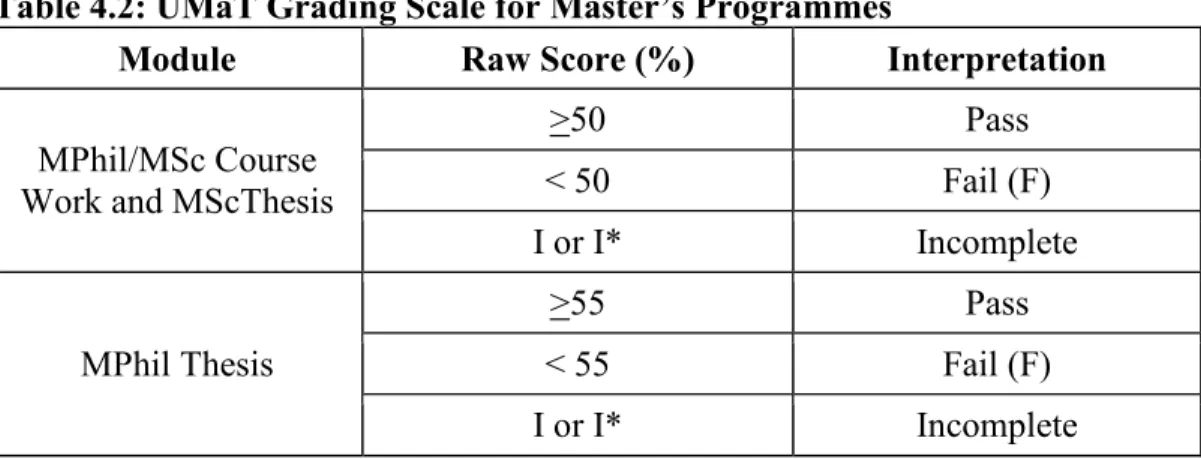
The Pass marks for course work are as shown in Table 4.2.
Table 4.2: UMaT Grading Scale for Master’s Programmes
Module Raw Score (%) Interpretation
MPhil/MSc Course Work and MScThesis
>50 Pass < 50 Fail (F) I or I* Incomplete MPhil Thesis >55 Pass < 55 Fail (F) I or I* Incomplete
(a) Not less than three Examiners, of whom at least, one shall be an External Examiner appointed by the Board, on the recommendation of the Departmental Board, shall examine the thesis. A panel of not less than three Examiners, including at least one External Examiner, shall conduct the oral examination.
(b) The panel for the oral examination shall be made up of the following:
Dean of Postgraduate Studies or a representative - Chairman
The Head of Department or a representative - Member
One External Examiner and at least two Internal Examiners - Members
(c) When recommending the appointment of an External Examiner, the Departmental Board shall submit outline curriculum vitae of the proposed examiner based on a format obtainable from the Board.
(d) The panel shall submit its recommendations to the Departmental Board in the form of a joint report signed by both Internal and External Examiners with respect to the oral examination and separate reports with respect to the thesis, on the basis of prescribed criteria approved by the Board. These reports together with appropriate copies of approved thesis with the necessary corrections shall be submitted to the School of Postgraduate Studies through the Departmental Board.
18 | P a g e
(e) In the case of theMSc degree, the components of the examinationshall be coursework, thesis and oral examination. Candidates shall be required to pass in each component and the candidate’s performance shall determine his/her success or failure. Fifty percent shall be pass for all courses, with fifty-five percent being the CWA for success or failure. A candidate who does not satisfy the Examiners at the oral examination shall not be recommended for the award of a degree, the standard of the thesis notwithstanding.
(f) For both MPhil/MSc degrees a candidate who does not pass the oral examination shall not be recommended for theaward of a degree irrespective of the standard of his/her thesis. In such a situation, the candidate will have only one opportunity to re-submit himself for oral examination within a period of six (6) months. The candidate shall pass the Departmental core courses.
(h) (i) The Examiners may recommend to the School of Postgraduate Studies that the candidate whose thesis is not up to the required standard be permitted to re-submit his/her thesis in a revised form within a specified period up to a maximum of six (6) months for oral examination;
(ii) Subject to the provisions of Clause h(i), if a candidate’s thesis is still not up to the required standard, the Examiners may advise that the candidate re-submits his/her thesis in a revised form within a specified period up to a maximum of 90 days for the award of Postgraduate Diploma if the candidate so wishes.
iii) Where a candidate fails to pass the oral examination for the first time, the Examiners may advise that the candidate re-submits his/her thesis in a revised form within a specified period up to six (6) months for oral examination.
iv) Where a candidate fails to pass the oral examination for the second time, the Examiners may advise that the candidate re-submits his/her thesis in a revised form within a specified period up to a maximum of 90 days for the award of a Postgraduate Diploma if the candidate so wishes.
4.4.11Procedure for the Award of a Degree
(a) After an oral examination, extracts from the Examiners’ report shall be submitted to the Department concerned to enable the student make the necessary corrections in the thesis.
(b) The results of the course work and oral examinations shall be submitted to the Board through the Departmental and Faculty Boards.
19 | P a g e
(c) The recommendations of the Board shall be submitted to the Academic Board for approval.
(d) Each successful candidate shall thereafter be awarded a certificate under the seal of the University at a congregation of the University for that purpose.
4.5 POSTGRADUATE DIPLOMA PROGRAMMES
A Postgraduate Diploma is awarded on the basis of a programme of taught courses and a project work.
4.5.1 Entry Requirements
The entry requirement shall be a Bachelor's degree or its recognised equivalent. In addition, candidates must satisfy the appropriate Departmental requirements.
4.5.2 Duration of Programme
A programme leading to a Postgraduate Diploma shall be for a period of one academic year.
4.5.3 Examinations
There shall be written and oral examinations. Practical examinations may also be given where appropriate.
4.5.4 Registration
Candidates shall register in their Department and at the School of Postgraduate Studies at the beginning of each semester for courses in which they are to be examined.
4.5.5 Examiners
(a) A panel comprising not less than three examiners, of whom at least one shall be an External Examiner, shall be appointed by the Board of Postgraduate Studies on the recommendation of the Departmental Board to assess the project work. When recommending the appointment of an External Examiner, the Departmental Board shall submit outline curriculum vitae of the proposed examiner based on a format obtainable from the School of Postgraduate Studies.
20 | P a g e
Examiner shall be appointed by the Board on the recommendation of the Departmental Board to conduct the oral examination.
4.5.6 Assessment
Candidates shall be assessed in accordance with current university regulations. Results of the examinations shall be submitted by the Departmental Board to the School of Postgraduate Studies through the Faculty Board for approval, in the first instance, before being forwarded to the Academic Board for final approval.
4.5.7 Procedure for the Award of a Postgraduate Diploma
Each successful candidate shall be awarded the appropriate Postgraduate Diploma of the University, at a congregation of the University assembled for that purpose.
5
GENERAL INFORMATION
5.1 SOCIAL AND SPORTING FACILITIES
The following facilities exist for the convenience of students:
Community Service (Halls of Residence)
Sports and Recreation
Chaplaincy
Health and Counseling Services
Students' Union
5.2 THE ASSOCIATION OF GRADUATE STUDENTS (GRASAG)
(a) The Association, which embraces all Postgraduate students of the University, provides both social and academic facilities for its members. Membership is open to Postgraduate students pursuing approved courses of study and registered with the School of Postgraduate Studies.
(b) Further enquiries should be addressed to: The President, GRASAG,
c/o School of Postgraduate Studies,
21 | P a g e
Tarkwa, Ghana.
5.3 COST/FEES
(a) Academic Facility User Fee as determined by Government.
(b) Module Fees shall be determined from time to time.
(c) Internet Connectivity Fee shall be charged per student per year. This fee is subject to change without notice.
(d) The examination fees shall be as determined from time to time by the University. Fees shall not be refunded, but in the case of justifiable unforeseen circumstances acceptable to the Board, fees may be transferred from one examination to the next.
(e) All fees must be paid into any of the following Account:
i) Account Name – Ecobank UMaT, SPS E-Collect Account Account Number – 0193 0244 0251 0005
Bank - Ecobank Branch – Tarkwa
ii) Account Name - University of Mines and Technology Foreign Account Account Number – 0192 0844 0251 0004
Bank - Ecobank Ghana Limited Swift Code - ECOCGHAC
Payment of fees by cash is not acceptable by the University.
All information pertaining to fees and other expenses may be obtained from: The SPS Officer
University of Mines and Technology P. O. Box 237
Tarkwa, Ghana
22 | P a g e
DEPARTMENT OF GEOMATIC ENGINEERING
6
MASTER’S (MODULAR) PROGRAMME IN GEOMATIC
ENGINEERING
6.1 TITLE OF PROGRAMME
The title of the programme is MSc/MPhil Programme (Modular) in Geomatic Engineering.
6.2 PROGRAMME OBJECTIVES
The main objectives of the programme are:
To provide an avenue for practising Surveyors/Geomatic Engineers in the mining and other establishments to continue their education.
To turn out competent postgraduates to meet the current demands of the Surveying/Geomatics industry.
To produce competent postgraduates capable of pursuing careers in the minerals and allied industries, universities and research institutions.
6.3 ENTRY REQUIREMENTS
(a) The entry requirements for the Master’s degree in Geomatic Engineering are:
i. Applicants must have BSc First Class or Second Class (Upper Division) in Geomatic or Geodetic Engineering or its equivalent in Earth Sciences and related Engineering programmes from a recognised university.
ii. Holders of UMaT Diploma in the Earth Sciences who hold senior positions in a relevant industry and have at least 5 years professional experience and proven ability in his/her discipline are eligible for admission.
iii. Foreign applicants with proficiency in English language who satisfy the requirements of (i) or (ii) above are eligible for admission after careful consideration of relevant documents.
iv. Applicants who have satisfactorily completed a Postgraduate Diploma programme may be considered for admission on the recommendation of the Departmental Board concerned.
23 | P a g e
6.4 PROGRAMME REQUIREMENTS
The Department offers two Master’s Degree Programmes. These are: i.MSc Geomatic Engineering Degree Programme
ii. MPhil Geomatic Engineering Degree Programme
a) Graduation Requirements
i. MSc Geomatic Engineering Degree
A minimum of 48 credit hours is required for the award of MSc degree. This is made up of a minimum of nine (9) modules (at least 27 credit hours). A Graduate Seminar (3 credit hours) and Field trip & Report (3 credit hours) and a Thesis (15 credit hours)
ii. MPhil Geomatic Engineering Degree
A student is required to do six (6) core modules outlined in Section 6.5a. In addition, he/she may audit modules recommended by the Supervisor to facilitate the student’s research work. The candidate is also required to present at least one seminar.
The successful defense of a thesis is required for the award of the award of the MPhil Degree in Geomatic Engineering. The thesis should be an embodiment of independent research conducted by a student under the guidance of a Supervisor on a significant problem in a chosen area of Geomatic Engineering.
b) Programme Duration
Full Time: A maximum of 4 semesters for course work and Thesis work.
Part Time: A maximum of 6 semesters.
6.5 PROGRAMME STRUCTURE
a) Core and Compulsory Modules
The MSc coursework comprises 6 core modules namely:
i.Geodesy (GM 504)
ii. Remote Sensing (GM 511)
iii. Digital Photogrammetry (GM 502)
iv. Geographic Information Systems (GM 507)
v.Global Navigation Satellite Systems (GM 510)
24 | P a g e
Research Methods (GM 521) is compulsory but does not earn any credit.
In addition, a minimum of three (3) other modules must be selected by the candidate in consultation with his/her Supervisor. Introduction to Computer Applications is compulsory but a candidate may apply for exemption.
Applicants without adequate Geomatics background will be required to register for the module in “Introduction to Geomatic Engineering”. Field trips will be organised and all students will be required to participate in at least one of them. An essential requirement of the modules is that students devote the afternoons to tutorials, practicals or field trips.
b) Content of Modules
The module to be run, credit hours and module numbers are as follows:
Module
No. Number Course Name of Course Credit Hours
- GM 261 Introduction to Geomatic Engineering** 0 - GM 521 Research Methods* 0 - GM 351 Introduction to Computer Applications* 0
1 GM 500 Thesis 15
2 GM 501 Shoreline Modelling and Prediction 3 3 GM 502 Digital Photogrammetry 3 4 GM 503 Operations Research 3
5 GM 504 Geodesy 3
6 GM 505 Spatial Data Modelling for 3D GIS 3 7 GM 506 Mine Economic and Financial Evaluation 3 8 GM 507 Geographic Information System (GIS) 3 9 GM 508 Principles of Mine Planning and Design 3 10 GM 509 Statistical Models 3 11 GM 510 Global Navigation Satellite Systems 3 12 GM 511 Remote Sensing 3 13 GM 512 Geographic Information Management 3 14 GM 513 Environmental Management 3
25 | P a g e
16 GM 515 Postgraduate Seminar 3 17 GM 516 Engineering Surveying 3 18 GM 517 Geographic Data for Resource Management 3 19 GM 518 Field Trip & Report 3 20 GM 519 Land Administration and Information Systems 3 21 GM 520 Mine and Sub-Surface Surveying 3 22 GM 522 Application of GIS & Remote Sensing 3 23 GM 523 Fleet Management 3 24 GM 524 Environmental and Spatial Statistics 3 25 GM 525 Geo-information for Disaster Risk Management 3 26 GM 526 Sustainability and Corporate Social Responsibility 3 *Preparatory Module **Pre-requisite Module for non-Geomatic Engineers
GM 261 Introduction to Geomatic Engineering
Credits: 0
Digital levels. Digital theodolite. Modern surveying techniques: Classical positioning systems, Triangulation, and Trilateration. Engineering surveying. Modern positioning system: GPS, IPS and DPS.
GM 521 Research Methods
Credits: 0
Definition of research. Objectives of research. Motivation in research. Characteristics of research. Types of research. Problems in starting research. Definition of ethics and professionalism. How ethics and values intersect with professionalism. Ethical theory and applications: Branches of ethics, Classification of ethical theories, Standards of ethical conduct in science, Common ethical principles in science, Code of ethics for engineers. Fraud in Science. Choosing a research topic. Identification and sources of problem. Formulating hypothesis. Functions of literature review. References and Bibliography. Research designs and approaches. Principles of experimental designs. Sampling basics. Characteristics of a good sample design. Methods of data collection. Validity and Reliability of Data. Processing, anaysis and interpretation of data. Report writing: Significance of report writing. Papers and reports: Management reports, Proposals, Journal papers, Conference papers, Thesis. Format for
26 | P a g e
presentation of thesis at UMaT: Structure and form of a thesis, Headings and numbering, Style and punctuation, Extra-linguistic material, Production of the thesis, Editing and revising, Assessment ( Seminars, Thesis)
GM 351 Introduction to Computer Applications
Credits: 0
Introduction to PC. Basic hardware components of the PC. Operating systems software DOS. Operating systems hardware (Dosshell, Windows, File Managers and Utilities). Word processing. Data processing. Database. Graphics. Software installation and interfacing. Summary.
GM 500 Thesis
Credits: 15/24
An independent research work under the guidance of Supervisor(s) on a topic in the student’s area of specialisation. A thesis embodying the results of the research will be presented to the Department after an oral defense. A panel will assess thesis.
GM 501 Shoreline Modelling and Prediction
Credits: 3
The coastal environment. Oceanographic and geomorphologic factors influencing the coast: currents, waves, tides, sea-level rise due to climate change and anthropogenic intervention in coastal processes. Shoreline modelling techniques: the Erosion based approach and the recession based methods, Erosion based volumetric methods, application and limitation, Recession based methods (Bruun’s rule; modified Bruun’s rule; Beach slope, sea-level rise rate shoreline excursion method). The SCAPE model for shoreline modelling and prediction, (merits and limitations). Modelling shoreline and prediction using Multi variates regression analysis (Specification of variables; generation of the regression model, beta values determination and testing of model).
GM 502 Digital Photogrammetry
Credits: 3
27 | P a g e
Charge-Coupled Device (CCD) architecture, operation and error sources. Automated interior, relative and absolute orientation. Image matching techniques: signal-based, feature-based and relational, with emphasis on cross-correlation and least squares matching. Use of epipolar constraints in image matching. Multi-resolution analysis and image pyramids. Digital image rectification. Feature extraction.
GM 503 Operations Research
Credits: 3
Nature of Operations research in mining, Linear, the simplex algorithm for integer & Goal programming, transportation and assignment problems, decision analyses, markov analysis, simulation, queuing models, inventory control models, production scheduling methods-CPM, dynamic programming.
GM 504 Geodesy
Credits: 3
Physical geodesy: potential theory, earth, reference and anomalous gravity field, measurement of gravity. Figure of the earth. boundary value problems. Geometrical and gravimetric geoid determination. Dynamic satellite geodesy. Satellite alimetry. Fundamentals of coordinates reference systems. Quality measures and integrity. Satellite Based Augmentation Systems (SBAS) and Ground Based Augmentation Systems (GBAS). Reference frames and coordinate transformations. Height systems. Earth rotation. Solid earth tides. Geodynamics: geodetic and geophysical setting, terrestrial reference frames.
GM 505 Spatial Data Modelling for 3D GIS
Credits: 3
An overview of 3D GIS development. 2D and 3D spatial data representations. The fundamentals of geo-spatial modelling. The conceptual design. The logical design. Object-orientation of tins spatial data. The supporting algorithms. Applications of the model. The web and 3D GIS.
GM 506 Mine Economic and Financial Evaluation
Credits: 3
28 | P a g e
value of money and economic equivalence, estimation of revenue and costst. Investment allowance, Mine Taxation and royalties. Financial alternatives. Cash flow models and analysis, investment decision methods and criteria, sensitivity and risk analysis, mine feasibility study. Case studies.
GM 507 Geographic Information Systems (GIS)
Credits: 3
Introduction to GIS: Purpose of GIS, Representation of real world. Geographic information and spatial data types. Data processing systems. Determining and mapping position: Data quality, Spatial referencing, Measures of location, Error on maps, Satellite based position. Data entry and preparation. Spatial data analysis. Data visualisation: GIS and maps, The visualisation process, The cartographic toolbox, Map cosmetics and dissemination.
GM 508 Principles of Mine Planning and Design
Credits: 3
General mine planning and design principles. Surface mine planning and design. Underground mine planning and design. Siting of facilities. Risk analysis in Mine planning. Environmental control measure in mine planning. Sustainable use of mined land and closure planning.
GM 509 Statistical Models
Credits: 3
Basic Statistical Procedures, Regression and Linear Models, Application of Multiple Regression, Statistical Inference and Modeling, Use of Transformation, Correlation and its Relationship with Regression
GM 510 Global Navigation Satellite Systems
Credits: 3
Principles and theory of satellite positioning. Space-base positioning systems (such as GPS and GLONASS). An overview of the theory and applications of satellite surveying: Artificial satellites, Satellite orbital motion, Kepler element. GNSS concepts and characteristics. GNSS measurement: Pseudoranging, Carrier phase measurement, GNSS time, Error sources and measurement accuracy, Mission planning. Position determination techniques: Single point and
29 | P a g e
differential positioning, Static and kinematic, Post mission and real time processing. DGPS concepts. Using GPS for height determination. Reference datum and datum transformation. Integrating satellite data into local co-ordinate systems. Satellite orbits and GPS observables, Physical influence of GPS Survey, Ambiguity Resolution Techniques, GPS Positionng modes, GPS observation equations and Equivalence Properties, GPS application.
GM 511 Remote Sensing
Credits: 3
Concepts of digital remote sensing and energy interaction. Remote Sensing Platforms. Image statistics, display, preprocessing. Rectification of digital imagery. Digital image processing: Image processing, Image enhancement, and classification. Spectral and Spatial filtering. Thematic information extraction, change detection and accuracy assessment. Special sensors: Thermal, Hyperspectral and Microwave.
GM 512 Geographic Information Management
Credits: 3
Concept of geo-information technology and management. Motivation for acquiring basic knowledge in technology. Presentation of basic terminology in management. Discussion of the challenges for land administration and national surveys in a changing technological and institutional environment. Presentation of examples of innovative approaches to Geospatial data infrastructures. Emerging concepts in linking objectives of Geo-spatial data policy, land policy and policy instruments (World Bank, UN and FAO policies). Data sources, acquisition, conversion and processing. Data models, process models and databases (central/local). Electronic exchange and distribution of geo-information. Quality parameters and review procedures.
GM 513 Environmental Management
Credits: 3
Environmental impacts of mining. Air quality/pollution. Air quality modeling: Water quality/ pollution, water quality modeling. Noise. Environmental aspects of ground vibrations and air blasts. Environmental impact assessment methodologies and practices. Ghana’s Environmental
30 | P a g e
Policy.
GM 514 Cartography
Credits: 3
GIS and cartographic visualisation. Data sources. Development and management of a cartographic database. Cartographic modeling and data analysis: Spatial, Temporal and Thematic comparisons. Terrain visualisation. Scientific Visualisation. The use of colour in non-temporal animations. Dynamic variables. Visualisation in GIS. Hypermaps. Rendering systems for interactive scientific visualisation. Definitions of terrestrial coordinate systems and reference frames. Coordinate transformations between geodetic datum: Molodensky, Bursa-Wolf. Map projection theory-conformity, differential geometry. Map projection types: Conical, Cylindrical, Azimuthal. Choosing optimal projections. Case studies of projections used in Ghana and overseas.
GM 515 Postgraduate Seminar
Credits: 3
Students will be required to make a minimum of one presentation on the progress and research underway in their areas of specialisation. The seminar will be assessed by a Departmental Panel. Postgraduate students are required to attend.
GM 516 Engineering Surveying
Credits: 3
Control networks for engineering projects: Methods used in determining horizontal control, Traversing, Triangulation, Trilateration, Intersection, Intersection, Resection and Satellite Position Fixing. Vertical controls-levelling Datum and principle of levelling. Inverted staffs. Trigonometric levelling methods. Deformation monitoring: Causes, Types and Importance and Analysis of deformation measurements. Underground surveys. Transfer of controls underground: Weisbach triangle method, Weiss quadrilateral method, gyro-theodolite method. Transfer of height underground: Digital Terrain Modelling- DTM generation, DTM representation as grid or TIN visualisation. Highway functional classification; Highway location survey. Geomatic design of highways: Cross-sectional elements, Factors affecting design, Horizontal alignment design
31 | P a g e
and Vertical alignment design. Computer application in geometric design. Intersection design and control: Basic principles of grade-separated intersections. Pavement design: Pavement types and structure. Stresses and strain in pavement maintenance and management: Problem of highway maintenance, Defects in pavements and their causes, Road maintenance activities, Methods for measuring road condition and Pavement management systems.
GM 517 Geographic Data for Resource Management
Credits: 3
Geographic data to information for resource management (extract and integrate spatial and non-spatial data from various sources and formats). Explore, analyze and interpret information contained in geographical data. Data obtained through sampling, statistic and cartographic visualization, descriptive and inferential statistics. Multi-Criteria Decision Analysis. Validity and reliability of results.
GM 518 Field Trip & Report
Credits: 3
Field trip will be organized and students are required to participate in, at least, one of them. They are required to submit a written report and make oral presentation on it/them.
GM 519 Land Administration and Information Systems
Credits: 3
Concepts of land policy and land management and administration, process design. Simulation and management of workflows. Land dispute and adjudication. Cadastral and social tenure mapping. Value assessment and land use classification. Business administration. Planning and control. Financial management. Modelling of data, processes, stakeholder analysis, community participation, information system design, development, (re-)engineering, information management (legal aspects, authentication, pricing, costing), SDI concept and application (authentic registers).
GM 520 Mine and Sub-Surface Surveying
Credits: 3