МОДЕЛЮВАННЯ ЗАДАЧ ТРАНСПОРТУ
ТА ЕКОНОМІКИ
UDC 624.953.014.2.004.15
S. N. SEMENETS
1*, S. S. NASONOVA
2*, G. I. SEMENETS
3*1*Dep. «Applied Mathematics and Information Technologies», Pridneprovsk State Academy of Civil Engineering and
Architecture, Chernishevskiy St., 24-A, Dnipro, Ukraine, 49600, tel. +38 (067) 639 60 64, e-mail [email protected], ORCID 0000-0002-6359-1069
2*Dep. «Higher Mathematics», Ukrainian State Chemical-Technological University, Gagarin Av., 8, Dnipro, Ukraine, 49005,
tel. +38 (097) 940 98 56, e-mail [email protected], ORCID 0000-0002-0920-7417
3*Dep. «Higher Mathematics», Dnipropetrovsk National University of Railway Transport named after Academician V. Lazaryan,
Lazaryan St., 2, Dnipro, Ukraine, 49010, tel. +38 (096) 879 48 19, e-mail [email protected], ORCID 0000-0003-2693-3282
OPTIMAL STRUCTURAL RESERVATION OF TECHNICAL SYSTEMS
Purpose.The purpose of the article is to give designers of highly reliable technical systems that do not have special knowledge in the field of optimization and programming skills, a simple and accessible mathematical tool for choosing the optimal solution for structural redundancy of systems. Methodology. The article poses the problem of optimal structural redundancy of technical systems. Two typical redundancy schemes are considered: a) a separate «hot» back-up scheme; b) a separate «cold» backback-up scheme. The computational models for estimating the reliability of redundant systems are formulated. We offer optimization models that allow us to find a rational option for reserving a system that is being designed, taking into account conflicting requirements for its reliability and cost. These models are numerically implemented in the operating environment of the Excel spreadsheet as applied to the main object, consisting of 7 ele-ments. The optimal variants of reserving this object according to the «hot» and «cold» separate reservation schemes are given. Findings. Calculated models for estimating reliability, as well as models for optimizing the systems reserved for the «hot» and «cold» separate backup schemes, have been developed. With the use of the Excel spreadsheet, the opti-mal options for reserving 7 element objects are found for separate «hot» and «cold» backups. Originality. New com-putational models for estimating the reliability of redundant systems are proposed, as well as optimization models de-veloped on the basis of these, which are formulated using the decomposition of unknown initial problem of structural redundancy into binary components. In this case, the obtained optimization models belong to the class of problems of non-linear mathematical programming with binary variables, for the numerical solution of which (even for a sufficient-ly large dimension) well-known packages of applied computer programs, in particular, the MS Excel spreadsheet, are well adapted. Thus, the process of solving the initially very complicated problem of optimal structural redundancy is much simpler and reduced to performing elementary actions in the corresponding software interfaces.
Practical value. The proposed calculation models for estimating the reliability of redundant systems, models for opti-mal structural redundancy, and the methodology for their formation, in order to simplify further numerical implementa-tion, can be useful in solving problems of ensuring the reliability of technical systems in the early stages of their design.
Keywords: system; design; reliability; structural reservation; model; optimization; binary variables
Introduction
Inadequate design reliability of technical
sys-tems leads to a significant increase in the share of
operating costs in total expenditures for their
de-sign, fabrication and application. At the same time,
the cost of operation can many times exceed the
cost of designing and manufacturing the system [1,
3, 10]. Therefore, the reliability of technical
sys-tems should be ensured, first of all, at the design
stage [2, 12, 13].
in-doi : 10.15802/stp2018/141008 © S. N. Semenets, S. S. Nasonova, G. I. Semenets, 2018
volves the use of redundant elements in the system.
The essence of structural redundancy lies in the
fact that in addition to the main (reserved) object
containing the minimum required number of
ele-ments for the normal performance of the system's
functions, in the system structure the additional
identical (in terms of performed operational
func-tions and reliability) elements are introduced.
These redundant elements are designed to perform
the work functions of the main elements. Thus,
a system with redundancy is a system containing
redundant structural components with respect to
being reserved object that perform the same work
functions as the corresponding components of the
main object. The redundant system remains
opera-ble after subsequent failure of any element if the
number of operable elements does not become less
than the minimum required number provided for
by regulatory requirements for the main object.
The problem of rational choice of one of the
several variants of the system composition always
arises during the structural redundancy. On the one
hand, to increase reliability it is desirable to
pro-vide each of the system elements with maximum
possible number of redundant elements, and, on
the other hand, it is impossible to design a system
with too large cost, weight or dimensions.
There-fore, the actual task is how to reserve the system in
such a way as to provide the required level of
sys-tem reliability at acceptable costs. The choice of
the cost characteristic is determined by the type of
the system and its purpose. For example, for
air-crafts the essential factor is weight, and for the
ground system – the cost. Regardless of the
physi-cal essence, the selected cost characteristic for
brevity below will be referred to as cost. Usually,
the problems of optimal structural redundancy of
technical systems are formulated as non-linear
programming problems, and to solve them,
de-pending on the complexity and required accuracy,
the special algorithms are used. They are based
primarily on the dynamic programming method
[6]. In this article, the initial optimization model is
represented in terms of the problem of non-linear
integer programming with binary variables, which
greatly simplifies its numerical implementation.
Purpose
The purpose of the article is to give the
design-ers of highly reliable technical systems that do not
know modern optimization methods and
program-ming skills, a simple mathematical tool for
choos-ing the optimal structure of a redundant system.
Methodology
During problem definition of the optimal
struc-tural redundancy, the main object is considered as
a system consisting of
n
of various elements that
have a coherent connection [4] (see Fig. 1).
Fig. 1. Structural diagram of reliability of the main object
As the main indicator of reliability of the
re-dundant system, the probability of its fail-safe
op-eration is assumed. It is believed that the failure
flow of elements put into operation is described by
the Poisson arrival [5]. Possible variants of the
main object redundancy are limited to the
consid-eration of typical schemes of separate «cold»
backup with an integer multiplicity with an ideal
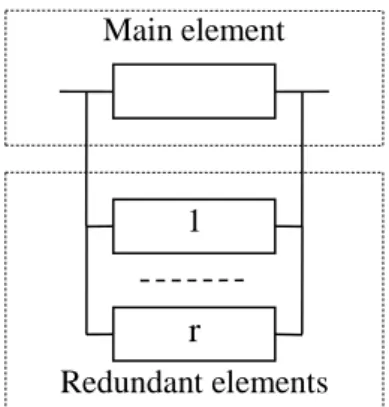
switch (see Fig. 2) and «hot» backup with parallel
connection of elements (see Fig.3) [7].
Fig. 2. Structural scheme of reliability at «cold» backup
Fig. 3. Structural scheme of reliability at «hot» backup
1
r
Main element
Redundant elements
1r
Main element
Redundant elements
Note that, taking into account the assumptions
made, the probability of failure-free operation of
the redundant group of elements, the scheme of
structural reliability of which is shown in Fig. 2, is
determined by the Erlangian formula [5, 9]
0
(
)
( )
!
i r t it
P t
e
i
,
(1)
and the formula for calculating the probability of
failure-free operation of a redundant group of
ele-ments, the structural scheme of reliability of which
is shown in Fig. 3, has the form
1
( ) 1 (1
t r)
P t
e
,
(2)
where
– is the failure rate of the element put
into operation;
r
– is the redundancy rate.
Let us introduce the following designations:
k–
is the failure rate of the element of the
k
-th type
put into operation;
m
– is the maximum allowable
redundancy rate of main elements;
c
k– is the cost
of one element of the
k
-th type;
x
ki– is the binary
variable, equal to 1, if the number of redundant
elements of the
k
-th is equal to
i
, and
x
ki
0
, f
the number of redundant elements of the
k
-th type
is not equal to
i
;
p t
k( )
– is the probability of
fail-safe operation of the main element of the
k
-th
type, over the time
t
( )
ktk
p t
e
.
Let us consider a redundant group of elements,
consisting of the elements of the
k
-th type. Taking
into account the introduced designations, the
prob-ability of failure-free operation of a redundant
group at «cold» backup is estimated by formula
0 0
(
)
( )
!
k j m i t k k ki i jt
P t
e
x
j
,
(3)
and when using the «hot» backup scheme, this
probability is represented as follows
1
0 0
( )
[1 (1
)
]
m i
t r
k ki
i j
P t
x
e
.
(4)
With neglect of the cost of switching equipment
in case of «cold» backup, the cost of the redundant
group consisting of the elements of the
k
-th type in
both backup schemes can be found using formula
0
(
),
1, 2,..,
m
k k ki
i
C
i c
x
k
n
.
(5)
Taking into account the coherent connection of
the main elements and the product rule, the
proba-bility of failure-free operation and the cost of the
entire redundant system are determined as follows:
1
( , )
( )
n
s k
k
P X t
P
t
;
(6)
1
( )
ns k
k
C X
C
,
(7)
where
X
– is the matrix describing composition
of the elements of the redundant system
10 11 1
20 21 2
0 1
...
...
. . . .
...
m mn n nm
x
x
x
x
x
x
X
x
x
x
,
and the probabilities
P t
k( )
are determined using
formulas (3) and (4) depending on the backup
scheme used.
In terms of the mathematical programming
prob-lem, the following two typical statements of the task
of optimal structural redundancy are possible.
The problem 1: it is required to find the
compo-sition of redundant elements (matrix elements
X
)
that provides the required level of system
reliabil-ity for a given time at the lowest possible cost
*
0
( )
( , )
,
[0, ] ;
1,
1, 2,..,
.
s
s m
ki i
C X
min
P X t
P
t
T
x
k
n
(8)
The problem 2: it is required to find the
compo-sition of redundant elements, which provides the
highest possible level of system reliability for
a given time
T
, with a restriction on its cost
*
0
( , )
max
( )
;
[0, ];
1,
1, 2,..,
.
s
s m
ki i
P X t
C X
C
t
T
x
k
n
(9)
prob-doi : 10.15802/stp2018/141008 © S. N. Semenets, S. S. Nasonova, G. I. Semenets, 2018
lems of integer nonlinear programming with binary
variables. The model (8) was numerically realized
for cases of «cold» and «hot» separate backup
us-ing the MS Excel Solver add-in. The problem was
solved with the following initial data:
n
7
;
10
m
;
P
*
0,999
;
T
10000
h. The failure rates
and cost of elements were taken using Table 1.
T a b l e 1
Initial data
Number of element
Failure rate (hour-1)
Cost (thous. UAH)
1 0.02·10-4 25
2 0.014·10-4 52
3 0.09·10-4 12
4 0.30·10-4 17
5 0.11·10-4 29
6 0.01·10-4 43
7 0.07·10-4 34
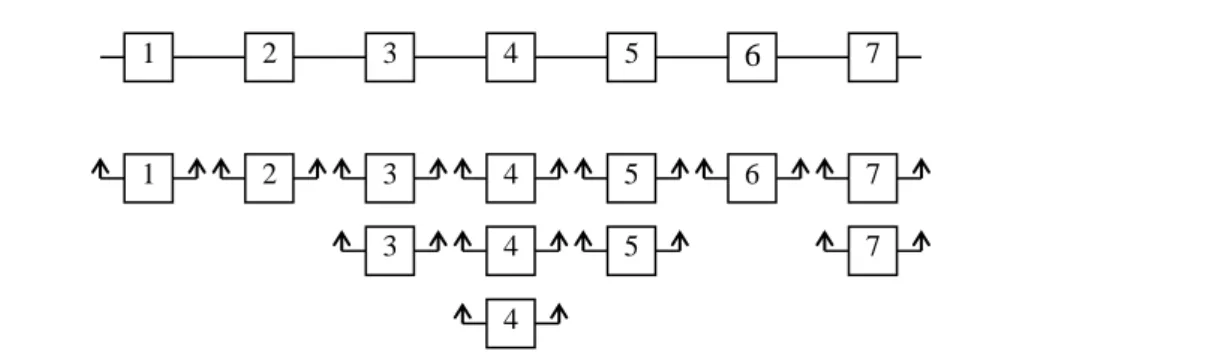
The optimal values of the unknowns
x
kiin
cas-es of «cold» and «hot» backup are found in Tablcas-es,
respectively, 2 and 3, and the corresponding
struc-tural diagrams of the system reliability are shown
in Figures 4 and 5. The calculated reliability
esti-mates and the cost of the optimal system for
«cold» and «hot» backup are listed in Table 4.
T a b l e 2
Optimal parameters of the «cold» backup
k\i 0 1 2 3
1 0 1 0 0
2 0 1 0 0
3 0 0 1 0
4 0 0 1 0
5 0 0 1 0
6 0 1 0 0
7 0 0 1 0
T a b l e 3
Optimal parameters of the «hot» backup
k\i 0 1 2 3 4 5 6
1 0 0 1 0 0 0 0
2 0 0 1 0 0 0 0
3 0 0 0 1 0 0 0
4 0 0 0 0 0 0 1
5 0 0 0 0 1 0 0
6 0 0 1 0 0 0 0
7 0 0 0 0 1 0 0
T a b l e 4
The reliability parameters and the cost of optimal system
Backup type
P1 P2 P3 P4 P5 P6 P7 Ps Cs
cold 0.99982 0.99995 0.99982 0.99983 0.99981 0.99992 0.99993 0.99908 533
Fig. 4. Optimal structural scheme of thesystem reliability with «cold» redundancy
Fig. 5. Optimal structural scheme of thesystem reliability with «hot»redundancy
Findings
The calculated models for estimating
reliabil-ity, as well as the optimization models for the
re-dundant systems according to the «hot» and
«cold» separate backup schemes, have been
de-veloped. The optimal options for reserving the
7 element object at separate «cold» and «hot»
backup using the Excel spreadsheet were found.
Originality and practical value
New calculation models for estimating the
re-liability of redundant systems are proposed, as
well as the optimization models developed on
their basis, which are formulated using the
un-known decomposition of initial problem of
struc-tural redundancy into binary components. The
obtained optimization models belong to the class
of problems of non-linear mathematical
program-ming with binary variables, for the numerical
so-lution of which (even for a sufficiently large
di-mensions) the well-known packages of applied
computer programs, in particular, the MS Excel
spreadsheet, are well adapted. Thus, the process of
solving the initially very complicated problem of
optimal structural redundancy is greatly simplified
and reduced to performing elementary actions in
the corresponding programming interfaces. The
proposed calculation models for estimating the
reliability of redundant systems, the models of
optimal structural redundancy, and the
methodol-ogy for their formation in order to simplify further
numerical implementation can be useful in solving
the problems of ensuring the reliability of
tech-nical systems at the early stages of their design.
Conclusions
The results obtained in the article using the
specific examples show the efficiency and
suffi-cient generality of the considered approach to
solving the problems of optimal structural
redun-dancy. The optimization models (8) and (9)
be-long to the class of non-linear programming
prob-lems with binary variables and are easily
imple-mented numerically in the operating environment
of the Excel spreadsheet. The obtained calculation
models for estimating the reliability of redundant
systems (3) – (6), the models for optimal
structur-al redundancy (8) and (9), and the methodology
for their formation can be used in practical
prob-lems of ensuring the reliability of technical
sys-tems at the early stages of their design.
1 2 3 4 5
6
71 2 3
3
4
4
4
5
5
6 7
7
1 2 3 4 5 6 7
1 2
2 1
3
3
4
4
4
4
4 3
5
5
5
5
6
6
7
7
7
doi : 10.15802/stp2018/141008 © S. N. Semenets, S. S. Nasonova, G. I. Semenets, 2018
LIST OF REFERENCE LINKS
1. Афанасьев, В. П. Надежность тонкостенной оболочки в условиях коррозионного износа / В. П. Афана-сьев, Г. И. Семенец // Вісн. Дніпропетр. нац. ун-ту залізн. трансп. ім. акад. В. Лазаряна. – Дніпропет-ровськ, 2006. – Вип. 11. – С. 171–174.
2. Безопасность и надежность сложных систем : учеб. пособие / Л. Н. Александровская, И. З. Аронов,
В. И. Круглов [и др.]. – Москва : Логос, 2017. – 376 с.
3. Бородин, А. В. Технико-экономическое обоснование варианта резервирования сетевой компоненты отказоустойчивой масштабируемой вычислительной системы специального назначения / А. В. Бородин // Кибернетика и программирование. – 2015. – № 6. – С. 55–70.
4. Капур, К. Надежность и проектирование систем : [пер. с англ.] / К. Капур, Л. Ламберсон. – Москва : Мир, 1980. – 604 с.
5. Каштанов, В. А. Теория надежности сложных систем / В. А. Каштанов, А. И. Медведев. – Москва : Физматлит, 2010. – 606 с.
6. Насонова, С. С. Оптимизация риска отказа в задачах управления надежностью стальных резервуаров для нефтепродуктов / С. С. Насонова // Вісн. Дніпропетр. нац. ун-ту залізн. трансп. ім. акад. В. Лазаря-на. – Дніпропетровськ, 2008. – Вип. 20. – С. 126–130.
7. Обеспечение надежности сложных технических систем / А. Н. Дорохов, В. А. Керножицкий, А. Н.
Ми-ронов, О. Л. Шестопалова. – Санкт-Петербург : Лань, 2011. – 352 с.
8. Половко, А. М. Основы теории надежности / А. М. Половко, С. В. Гуров. – Санкт-Петербург : БХВ, 2006. – 704 с.
9. Рябинин, И. А. Надежность и безопасность структурно-сложных систем / И. А. Рябинин. – Санкт-Петербург : Политехника, 2000. – 248 с.
10. Трошин, А. В. Оптимизация резервирования в коммутируемых пакетных сетях / А. В. Трошин // Инфо-коммуникационные технологии. – 2017. – Т. 15, № 4. – С. 354–360.
11. Шишмарев, В. Ю. Надёжность технических систем : учебник / В. Ю. Шишмарев. – Москва : Юрайт,
2018. – 306 с.
12. Chanda, N. Redundant Transmitting System in Aircraft (RTSA) / N. Chanda // SAE Technical Paper Series 2015-01-2443. – 2015. doi: 10.4271/2015-01-2443
13. Jaberipur, G. Redundant Number System-Based Arithmetic Circuits / G. Jaberipur // Arithmetic Circuits for DSP Applications. – Hoboken : John Wiley & Sons, 2017. – P. 273–312. doi: 10.1002/9781119206804.ch8
С. М. СЕМЕНЕЦЬ
1*, С. С. НАСОНОВА
2*, Г. І. СЕМЕНЕЦЬ
3*1*Каф. «Прикладна математика та інформаційні технології», Придніпровська державна академія будівництва та
архітек-тури, вул. Чернишевського, 24-а, Дніпро, Україна, 49600, тел. +38 (067) 639 60 64, ел. пошта [email protected], ORCID 0000-0002-6359-1069
2*Каф. «Вища математика», Український державний хіміко-технологічний університет, пр. Гагаріна, 8, Дніпро, Україна,
49005, тел. +38 (097) 940 98 56, ел. пошта [email protected], ORCID 0000-0002-0920-7417
3*Каф. «Вища математика», Дніпропетровський національний університет залізничного транспорту імені академіка
В. Лазаряна, вул. Лазаряна, 2, Дніпро, Україна, 49010, тел. +38 (096) 879 48 19, ел. пошта [email protected], ORCID 0000-0003-2693-3282
ОПТИМАЛЬНЕ СТРУКТУРНЕ РЕЗЕРВУВАННЯ ТЕХНІЧНИХ
СИСТЕМ
Мета. Основна мета статті – дати проектувальникам високонадійних технічних систем, які не володіють спеціальними знаннями в галузі оптимізації та навичками програмування, простий і доступний математич-ний інструмент для вибору оптимального рішення під час структурного резервуванні систем. Методика. За
головний показник надійності резервованої системи прийнята ймовірність її безвідмовної роботи. Розгляну-ті дві типові схеми резервування: 1) схема роздільного «гарячого» резервування; 2) схема роздільного «хо-лодного» резервування. Сформульовані розрахункові моделі оцінки надійності резервованих систем.
«га-рячого» й «холодного» роздільного резервування. Наукова новизна. Запропоновані нові розрахункові мо-делі оцінки надійності резервованих систем, а також розроблені на їх основі оптимізаційні момо-делі, які сфор-мульовані з використанням розкладання невідомих вихідної задачі структурного резервування на бінарні складові. При цьому отримані оптимізаційні моделі відносяться до класу задач нелінійного математичного програмування з двійковими змінними, для чисельного вирішення яких (навіть за досить великої розмірнос-ті) добре пристосовані широко відомі пакети прикладних комп’ютерних програм, зокрема табличний проце-сор MS Excel. Таким чином, процес вирішення спочатку досить складної задачі оптимального структурного резервування значно спрощується і зводиться до виконання елементарних дій у відповідних програмних інтерфейсах. Практична значимість. Запропоновані розрахункові моделі оцінки надійності резервованих систем, моделі оптимального структурного резервування, а також методологія їх формування з метою спрощення подальшої чисельної реалізації можуть бути корисні при вирішенні задач забезпечення надійно-сті технічних систем на ранніх стадіях їх проектування.
Ключові слова: система; проектування; надійність; структурне резервування; модель; оптимізація; бінарні змінні
С. Н. СЕМЕНЕЦ
1*, С. С. НАСОНОВА
2*,
Г. И. СЕМЕНЕЦ
3*1*Каф. «Прикладная математика и информационные технологии», Приднепровская государственная академия
строите-льства и архитектуры, ул. Чернышевского, 24-а, Днипро, Украина, 49600, тел. +38 (067) 639 60 64, эл. почта [email protected], ORCID 0000-0002-6359-1069
2*Каф. «Высшая математика», Украинский государственный химико-технологический университет, пр. Гагарина, 8,
Днипро, Україна, 49005, тел. +38 (097) 940 98 56, эл. почта [email protected], ORCID 0000-0002-7228-7499
3*Каф. «Высшая математика», Днепропетровский национальный университет железнодорожного транспорта имени
ака-демика В. Лазаряна, ул. Лазаряна, 2, Днипро, Украина, 49010, тел. +38 (096) 879 48 19, эл. почта [email protected], ORCID 0000-0003-2693-3282
ОПТИМАЛЬНОЕ СТРУКТУРНОЕ РЕЗЕРВИРОВАНИЕ
ТЕХНИЧЕСКИХ СИСТЕМ
Цель.Основная цель статьи – дать проектировщикам высоконадежных технических систем, не облада-ющим специальными знаниями в области оптимизации и навыками программирования, простой и доступ-ный математический инструмент для выбора оптимального решения при структурном резервировании си-стем. Методика. В качестве главного показателя надежности резервированной системы принята вероятность ее безотказной работы. Рассмотрены две типовые схемы резервирования: 1) схема раздельного «горячего» резервирования; 2) схема раздельного «холодного» резервирования. Сформулированы расчетные модели оценки надежности резервированных систем. Результаты. В работе предложены оптимизационные модели, позволяющие найти рациональный вариант резервирования проектируемой системы с учетом противоречивых требований к ее надежности и стоимости. Данные модели численно реализуются в опера-ционной среде табличного процессора Excel применительно к основному объекту, состоящему из 7 элемен-тов. Приведены оптимальные варианты резервирования этого объекта по схемам «горячего» и «холодного» раздельного резервирования. Научная новизна. Предложены новые расчетные модели оценки надежности резервированных систем, а также разработанные на их основе оптимизационные модели, которые сформулированы с использованием разложения неизвестных исходной задачи структурного резервирования на бинарные составляющие. При этом полученные оптимизационные модели относятся к классу задач нелинейного математического программирования с двоичными переменными, для численного решения которых (даже при достаточно большой размерности) хорошо приспособлены широко известные пакеты прикладных компьютерных программ, в частности табличный процессор MS Excel. Таким образом, процесс решения изначально весьма сложной задачи оптимального структурного резервирования значительно упро-щается и сводится к выполнению элементарных действий в соответствующих программных интерфейсах.
Практическая значимость. Предложенные расчетные модели оценки надежности резервированных систем, модели оптимального структурного резервирования, а также методология их формирования с целью упрощения дальнейшей численной реализации могут быть полезны при решении задач обеспечения надежности технических систем на ранних стадиях их проектирования.
doi : 10.15802/stp2018/141008 © S. N. Semenets, S. S. Nasonova, G. I. Semenets, 2018
REFERENCES
1. Afanasev, V. P., & Semenets, G. I. (2006). Reliability of a thin-walled shell under conditions of corrosive wear. Bulletin of Dnipropetrovsk National University of Railway Transport named after Academician V. La-zaryan, 11, 171-174. (in Russin)
2. Aleksandrovskaya, L. N., Aronov, I. Z., & Kruglov, V. I. (2017). Bezopasnost i nadezhnost slozhnykh sistem: uchebnoe posobie. Moscow: Logos. (in Russian)
3. Borodin, A. V. (2015). Tekhniko-ekonomicheskoe obosnovanie varianta rezervirovaniya setevoy komponenty ot-kazoustoychivoy masshtabiruemoy vychislitelnoy sistemy spetsialnogo naznacheniya. Kibernetika i pro-grammirovanie, 6(6), 55-70. doi: 10.7256/2306-4196.2015.6.17523 (in Russian)
4. Kapur, K., & Lamberson, L. (1980). Reliability in engineering design. Moscow: Peace. (in Russian)
5. Kashtanov, V. A., & Medvedev, A. I. (2010). Teoriya nadezhnosti slozhnykh system. Moscow: Fizmatlit. (in Russian)
6. Nasonova, S. S. (2008). The optimization of failure risk in management tasks reliability of steel storage tanks for petroleum products. Bulletin of Dnipropetrovsk National University of Railway Transport named after Academician V. Lazaryan, 20, 126-130. (in Russian)
7. Dorokhov, A. N., Kernozhitskiy, V. A., Mironov, A. N., & Shestopalova, O. L. (2011). Obespechenie nadezh-nosti slozhnykh tekhnicheskikh system. Saint Petersburg: Lan. (in Russian)
8. Polovko, A. M., & Gurov, S.V. (2006). Fundamentals of the theory of reliability. Saint Petersburg: BHV. (in Russian)
9. Ryabinin, I. A. (2000). Reliability and safety of structurally complicated systems. Saint Petersburg: Politekhni-ka. (in Russian)
10. Troshin, A. V. (2017). Optimizatsiya rezervirovaniya v kommutiruemykh paketnykh setyakh.
Infokommunikatsionnye tekhnologii, 15(4), 354-360. (in Russian)
11. Shishmarev, V. Y. (2018). Nadezhnost tekhnicheskikh sistem: uchebnik dlya bakalavriata i magistratury.
Moscow: Yurayt. (in Russian)
12. Chanda, N. (2015). Redundant Transmitting System in Aircraft (RTSA). SAE Technical Paper Series, 2015-01-2443. doi: 10.4271/2015-01-2443 (in English)
13. Jaberipur, G. (2017). Redundant Number System-Based Arithmetic Circuits. In Arithmetic Circuits for DSP Applications (рр. 273-312). Hoboken: John Wiley & Sons. doi: 10.1002/9781119206804.ch8 (in English)