Post-polymerization modi
fi
cation of phosphorus containing conjugated
copolymers
Hongda Cao
a, Nicole Bauer
b, Sheng Bi
c,1, Dawen Li
c, Wei You
b, Paul A. Rupar
a,⁎aDepartment of Chemistry and Biochemistry, University of Alabama, Tuscaloosa, AL 35487, United States bDepartment of Chemistry, University of North Carolina at Chapel Hill, Chapel Hill, NC 27599, United States
cDepartment of Electrical and Computer Engineering, Center for Materials for Information Technology, The University of Alabama, Tuscaloosa, AL 35487, United States
A R T I C L E I N F O
Keywords: Heterofluorene Phosphafluorene
Inorganic-element containing polymer D-A conjugated copolymers Polymer solar cells
A B S T R A C T
A new phosphafluorene (PF) based monomer, featuring a phosphine oxide substituted with a dodecyl chain, was synthesized. PF was copolymerized with benzodithiophene (BDTT) to form the copolymer PPF-BDTT which has a donor (BDTT)–acceptor (PF) structure. For thefirst time, direct post-polymerization modifications were per-formed on the phosphorus center of phosphafluorene-containing conjugated polymers. With Lawesson's Reagent, PPF-BDTT was transformed from a phosphine oxide to a phosphine sulfide. Reduction of the phosphine oxide of PPF-BDTT with HSiCl3, followed by reaction with AuCl∙SMe2, produced PPF-BDTT-Au, which contains AuCl
coordinated to the phosphafluorene moiety. PPF-BDTT, PPF-BDTT-S, and PPF-BDTT-Au were characterized optically and electrochemically and the results compared to related BDTT containing copolymers. PPF-BDTT and its derivatives were found to have high LUMO and HOMO levels and larger bandgaps compared to common donor-acceptor copolymers. Organic solar cells were fabricated from PPF-BDTT, PPF-BDTT-S, and PPF-BDTT-Au, although the performances of these devices were poor with power conversion efficiencies ranging from 0.13% to 0.60%.
1. Introduction
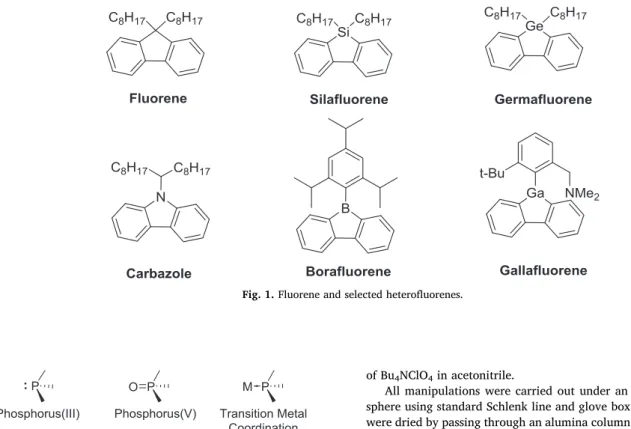
Conjugated polymers (CPs) have been researched intensively for their applications in photovoltaic cells (PVCs)[1–6], organicfield effect transistors (OFETs) [7–10], organic light-emitting diodes (OLEDs) [11,12], and sensors[13–15]. Due to its ease of synthesis,fluorene is one of the most commonly used moieties in CPs. However, fluorene based CPs tend to have large bandgaps and high HOMO energy levels which limits their use in situations where lower lying HOMOs and narrow bandgaps are desirable[16–18]. A common strategy to modify the properties of conjugated materials is to embed inorganic elements into the conjugated systems[19–22]. Usingfluorene as an example, this can be accomplished by the replacement of the 9-carbon onfluorene. Many inorganic-element containingfluorenes and their resulting poly-mers (Fig. 1) have been developed, including silafluorene [23,24], carbazole[25,26], and germafluorene[27–29]. These have been used as effective electron donors in high-performance PVCs[25,30], OFETs [24], and as in-vivo bio-imaging agents[23]. Borafluorene possesses strong electron-withdrawing properties [20,31–34], and its homo-polymer showed reversible fluorescence sensing of NH3 vapor [35].
Gallafluorene was reported by Chujo and coworkers and its
corresponding polymers exhibit controllable emission color by chan-ging the co-monomer units[36,37].
Phosphorus containing conjugated systems are particularly inter-esting due to their high versatility and tunability[38–41]. In addition to the possibility of two different oxidation states (phosphorus(III) and phosphorus(V)), the lone pair of electrons of phosphorus(III) are ac-cessible for functionalization with transition metals and other Lewis acids (Fig. 2)[42–44]. The Réau group has reported on small molecule phospholes, including phosphine, phosphine sulfide, and gold(I) co-ordinated derivatives, and their resulting use in OLEDs[45,46]. How-ever, to our best knowledge, the modifications of the phosphorus center have mostly been performed in conjugated small molecules, and only few in conjugated polymers reported[47,48]. Recently, Park and Kim designed a series of dithienophosphole oxide (DTP) containing poly-mers and showed these to have power conversion efficiencies (PCEs) greater than 6.5% when incorporated into solar cells[49,50]. These high efficiencies were hypothesized to occur because of improved charge separation due to the large dipole moment of the phosphole oxide present in these polymers.
Phosphafluorene (PF), the phosphorus substitutedfluorene, has re-ceived less attention in the literature relative to other heterofluorenes
⁎Corresponding author.
1Present address: Key Laboratory for Precision and Non-traditional Machining Technology of the Ministry of Education, Dalian University of Technology, Dalian 116024, PR China. E-mail address:[email protected](P.A. Rupar).
https://doi.org/10.1016/j.eurpolymj.2018.05.009
Received4April2018;Receivedinrevisedform7May2018;Accepted8May2018 Available online 09 May 2018
[51–54]. The synthesis of PF is most often achieved through lithiation of a biphenyl precursor[55], although alternative methods are known [56,57]. Reported applications of PF include an iridium complex that was used to create high external quantum efficiency OLEDs[53]. To the best of our knowledge, only two PF containing polymers are known, which were described by the Huang and Masato groups[51,58]. These polymers showed white or blue electrolumininescence with different substituents on the phosphorus centers[51,58].
Herein, we report on a series of novel phosphafluorene-based con-jugated polymers. We examined a donor-acceptor (D-A) copolymer structure, with the phosphafluorene as an acceptor moiety and benzo-dithiophene (BDTT) as the donor moiety [59–62]. Direct post-poly-merization modification of the phosphorus atoms within the polymers was performed, which demonstrated a new synthetic method to tune phosphorus containing conjugated polymers. The properties of the re-sulting polymers were measured, and their performance in polymeric organic solar cells was investigated.
2. Experiment
2.1. Instrument and materials
Gel permeation chromatography (GPC) was performed using a Malvern Viscotek VE 2001 Gel Permeation Chromatograph equipped with an automatic sampler, a pump, an injector, an inline degasser, a column oven (30 °C), and two in-series Malvern T6000M SEC columns. Reported molecular weights are versus a polystyrene standard. Detection was conducted by means of a photodiode array detector operating between 190 nm and 500 nm. Cyclic voltammograms (CVs) were acquired using a CHI760 potentiostat with a Pt wire quasi re-ference electrode and an Ag wire counter electrode. Scanning rates were kept at 0.1 V/s with a minimum 3 s quiet period before each scan. Ferrocene standards were added to the CV solution after measurements had been completed to avoid overlap of signals. Polymer CVs were measured by casting afilm on the working electrode in a 0.1 M solution
of Bu4NClO4in acetonitrile.
All manipulations were carried out under an anhydrous N2
atmo-sphere using standard Schlenk line and glove box techniques. Solvents were dried by passing through an alumina column and then stored over 4 Å molecular sieves. 4,4′-dibromo-6,6′-diiodo-3,3′-dimethoxybiphenyl [55], 2,6-bis(trimethylstannyl)-4,8-bis(5-decylthiophen-2-yl)benzo [1,2-b:4,5b′]dithiophene (BDTT) [63]were synthesized according to known literature procedures. The synthesis of1was based on reports for similar dicholoro(alkyl)phosphanes)[64]. All other reagents were purchased commercially and used without further purification.
2.2. Materials synthesis
2.2.1. Synthesis of 1-dodecylphosphonic dichloride (1)
1-dodecylphosphonic acid (2.5 g, 10 mmol) and DCM (30 mL) were combined. The mixture was heated to reflux for 30 mins, and a catalytic amount of DMF (2–3 drops) was added. Then excess oxalyl chloride (45 mmol, 4.0 mL) was added slowly into the mixture, and the resulting solution was refluxed for 12 h. The volatiles were removed by vacuum and a yellow oil was obtained with good purity (based on31P NMR) and was used directly in the next step.1H NMR (360 MHz, 298 K, CDCl
3):δ
0.86 (t, J= 7.2 Hz, 3H), 1.17–1.37 (m, 16H), 1.41–1.49 (m, 2H), 1.75–1.88 (m, 2H), 2.50–2.59 (m, 2H);13C NMR (125.7 MHz, 298 K, CDCl3):δ43.77, 42.70, 32.12, 29.96, 29.80, 29.72, 29.55, 29.44, 29.14,
29.13, 23.18, 23.11, 22.91, 14.34, 1.24;31P NMR (202.5 MHz, 298 K,
CDCl3):δ51.23 (SeeFig. S3–S5in theSupporting Informationfor NMR
spectra).
2.2.2. Synthesis of 2,7-dibromo-3,6-dimethoxy-9-dodecyl-9-phosphafluorene oxide (PF)
Butyl lithium (1.6 M in hexane, 2.0 mmol, 1.25 mL) was added dropwise to 4,4′-dibromo-6,6′-diiodo-3,3′-dimethoxybiphenyl (1.25 g, 2.0 mmol) dissolved in 50 mL of THF at −98 °C. The solution was stirred at−98 °C for 30 mins before 1-dodecylphosphonic dichloride (0.60 g, 2.1 mmol) in 10 mL of THF was added over 5 min. After 1 h, the solution was allowed to warm to room temperature and was then stirred for 15 h. The mixture was extracted by Et2O three times. The
organic layers were combined, dried with magnesium sulfate, and then removed under vacuum leaving an orange oil. The crude product was purified by chromatography on silica gel with hexane/ethyl acetate (1:1) to give the title compound as a yellow solid (0.34 g, 30% yield).
1H NMR (360 MHz, 298 K, CDCl
3):δ0.85 (t,J= 7.2 Hz, 3H), 1.15–1.34
(m, 18H), 1.40–1.49 (m, 2H), 2.02–2.04 (m, 2H), 4.04 (s, 6H), 7.15 (d, Fig. 1.Fluorene and selected heterofluorenes.
improved charge mobilities, and current popularity in CP research [65,66]. A Stille coupling between PF and benzodithiophene monomers was used to form the co-polymer PPF-BDTT. The1H NMR spectrum of
PPF-BDTT (Fig. S9) was consistent with its proposed structure and31P
NMR of the polymer (Fig. S10) showed a single broad peak at 42 ppm, which is characteristic of a phosphine oxide. Analysis by GPC revealed that PPF-BDTT had a modest molecular weight of Mn= 11.0 kDa vs. a
polystyrene standard. Attempts to increase the polymer molecular weight through the use of different conditions were not successful likely because of poor solubility at higher molecular weights.
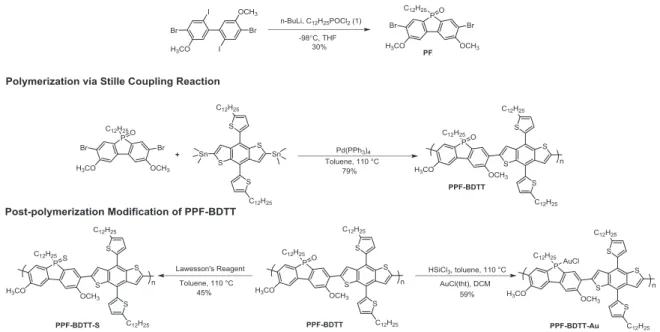
A significant advantage of including phosphorus within a conjugate system is the potential to modify and tune the phosphorus center. This can lead to significant changes in the electronic properties of the con-jugated material and also impact solubility[43,67–69]. In this work, we looked at three different modifications to the phosphorus center: transformation from the phosphine oxide to the phosphine sulfide, re-duction to phosphorus(III), and coordination of AuCl to the phosphorus (III) center.
Attempts to reduce the phosphorus center in PPF-BDTT with HSiCl3
were successful, although the resulting polymer rapidly re-oxidized back to the phosphine oxide in open air. However, subsequent co-ordination of AuCl∙SMe2to the reduced polymer formed PPF-BDTT-Au,
which is stable towards atmospheric oxygen. Reaction of PPF-BDTT with Lawesson's Reagent produced the phosphine sulfide PPF-BDTT-S. Unsurprisingly, the1H NMR spectra of PPF-BDTT (Fig. S9), PPF-BDTT-S
(Fig. S11), and PPF-BDTT-Au (Fig. S13) are nearly identical; for-tunately, the31P NMR spectra are distinct and confirmed quantitative functionalization of the phosphorus center (Fig. 3). The 31P NMR
spectrum of PPF-BDTT-S (Fig. S12) showed a single signal at 45 ppm, which is consistent with a phosphine sulfide. The gold functionalized PPF-BDTT-Au exhibited a31P NMR (Fig. S14) chemical shift of 20 ppm, which is indicative of a phosphole gold chloride. All three polymers are modestly soluble in common organic solvents such as chloroform, di-chlorobenzene, tetrachloroethane, and THF.
3.2. Optical properties
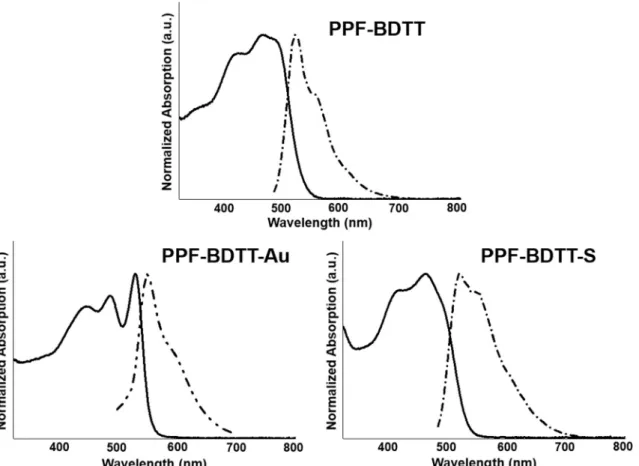
The UV–Vis absorption spectra of the polymers in dichloromethane (DCM) solution are shown inFig. 4and listed inTable 1. PPF-BDTT exhibited absorption bands centered at 425 nm in the UV which are attributed to theπ-π* transitions and an absorption band at longer wavelength (centered at 465 nm), thought to originate from intra-mo-lecular charge transfer. The absorption spectra of PPF-BDTT-S is very similar to that of PPF-BDTT. Conversely, PPF-BDTT-Au has a unique triple peak absorption pattern and redshift of ca. 65 nm. The emission spectra of PPF-BDTT and PPF-BDTT-S are similar, while PPF-BDTT-Au is distinctly redshifted (Fig. 4andTable 1).
3.3. Electrochemical properties
The electrochemical properties of polymerfilms were evaluated by cyclic voltammetry (Table 1andFig. S1). PPF-BDTT and PPF-BDTT-S had quasi-reversible oxidations and reductions. In the case of PPF-BDTT-Au, the oxidation was quasi-reversible, while the reduction was irreversible (Fig. S1). The HOMO and LUMO energy levels of these polymers were estimated from the CV oxidation and reduction onsets [70]. For PPF-BDTT, a LUMO of−2.99 eV and HOMO of−5.56 eV was determined. In comparison with PPF-BDTT, PPF-BDTT-S has a slightly lower LUMO level of−3.03 eV. For PPF-BDTT-Au, it showed a higher lying HOMO level of −5.23 eV and lower LUMO level of−3.43 eV. Comparison of the band gaps (Eg,cv) show that PPF-BDTT-Au has by far the smallestEg,cv at 1.80 eV, whereas PPF-BDTT and PPF-BDTT-S are 2.56 eV and 2.43 eV, respectively.
Since there are many BDTT containing D-A copolymers in the lit-erature and comparison to the PPF-BDTT copolymers described in this work can be made to provide insights into the influence of PF on J=3.6Hz,2H),7.91(d,J=7.2Hz,2H);13CNMR(125.7MHz,298K,
CDCl3): δ 160.38, 160.36, 142.24, 142.08, 134.51, 134.42, 126.32,
125.50, 113.90,113.79, 104.76,104.67,57.07,32.37,31.32,31.20, 31.02,30.45,30.06,29.98,29.81,29.79.29.42,23.14,22.71,22.68, 14.56;31PNMR(202.5MHz,298K,CDCl3): δ 40.56(seeFig. S6–S8 in
theSupporting Information fortheNMRspectra); HRMS(EI,[M+], C12H20Br2O2Si2):calcd,584.0691;found,584.0685.EA(%):Calculated
forC26H35Br2O3P:C53.26,H6.02;found:C53.49,H6.17.
2.2.3. SynthesisofPPF-BDTT
The 2,6-Bis(trimethylstannyl)-4,8-bis(5-decylthiophen-2-yl)benzo [1,2-b:4,5b′]dithiophene monomer(0.1000mmol,101.7mg),and PF (0.10mmol, 58.6mg), and Pd(PPh3)4 (0.0043mmol, 5.0mg,) were
combinedin5mLofdrytoluene.Thereactionmixturewasstirredand heatedtorefluxfor24h.Thenthereactionmixturewascooledtoroom temperature,andthepolymerwasprecipitatedinto100mLmethanol, collected byfiltration,andthenpurifiedvia Soxhletextraction with methanolandhexane,eachfor 12h. Finally,thepolymerwas redis-solvedinchloroformandprecipitatedintomethanolandthesolidwas collectedanddriedundervacuumovernight.Theproductwasisolated asadarkredsolid,88mg(79%yield).31PNMR(202.5MHz,298K,
CDCl3): δ 42;GPCData(vsPSstandard):Mn=11.0kDa;Ð=2.4;See
Fig. S9 and S10 intheSupporting Information forNMRspectra.
2.2.4. SynthesisofPPF-BDTT-S
Adrytoluenesolution(20mL)ofPPF-BDTT(30mg,0.029mmol) and Lawesson's Reagent (40mg, 0.10mmol) was heated to 110°C overnightandstirredfor12h.Thereactionmixturewasthencooledto roomtemperatureandpouredintomethanol,resultingintheformation ofanorangeprecipitate.Theprecipitatewascollectedandplacedina Soxhlet extractor. The precipitate was extracted with methanoland hexane,eachfor12h,andthendissolvedinchloroform. Finally,the chloroform solutionwas precipitated inmethanol andthesolid was collectedanddriedundervacuumovernighttoyieldabrown-orange solid,13.5mg(45.0%yield).31PNMR(202.5MHz,298K,CDCl
3): δ 45.
SeeFig. S11 and S12 intheSupporting Information forNMRspectra.
2.2.5. SynthesisofPPF-BDTT-Au
Atoluenesolution(15mL)ofPPF-BDTT(69mg,0.066mmol);and trichlorosilane(0.10mL,1.0mmol)washeatedto110°Candstirredfor 12h.Thereactionmixturewasthencooledtoroomtemperatureand thesolventswereremovedbyvacuum.Theresiduewasthendissolved in dry DCM (20mL) and chloro(dimethylsulfide)gold(I) (60mg, 0.20mmol)wasadded,andstirred for3h.Thereactionmixturewas poured into methanol, resulting in the formation of dark red pre-cipitate.TheprecipitatewascollectedandplacedinaSoxhletextractor. Theprecipitatewasextractedwithmethanolandhexaneeachfor12h, andthendissolvedinchloroform.Finally,thechloroformsolutionwas precipitatedinmethanol,thesolidwascollectedanddriedunder va-cuumovernighttoyieldaredorangesolid,48.6mg(59%yield).31P
NMR(202.5MHz, 298K,CDCl3):δ 20.SeeFigs. S13 and S14 inthe
Supporting Information forNMRspectra.
3. Resultsanddiscussion
3.1. Synthesisandcharacterization
Thesynthetic routeof thephosphafluorene monomer(PF) is de-pictedin Scheme 1 andis basedon amodifiedliterature procedure [55]. The structure of PF is similar topreviously reported fluorene monomers,except thatthephosphorusis substitutedwitha dodecyl chaininstead ofthetypicallyused phenylmoiety[51]. Thedodecyl chainwaschoseninanefforttoincreasethesolubilityoftheresulting polymer.
conjugated systems[49,63,70–72].Fig. 5depicts the HOMO and LUMO levels for a series of BDTT-containing copolymers, including the phos-phaflourene containing copolymers reported in this work.Fig. 5clearly shows that the LUMO and HOMO levels of PPF-BDTT, PPF-BDTT-S, and PPF-BDTT-Au are higher in energy than those of the other BDTT con-taining copolymers, suggesting that PF is significantly less electron withdrawing compared to other common acceptor moieties. We were especially surprised that the LUMO of PPF-BDTT is ca 0.97 eV higher than the phosphole containing copolymer PDTP-BDTT[49], in spite of the fact that the DTP group has two electron-rich thiophene moieties. We believe that the decreased accepting properties of PF likely arises due to the presence of the methoxy groups at the 3 and 6 positions, as well as the fact that the phosphorus center is substituted with an alkyl chain rather than the more electron withdrawing phenyl group found in DTP.
3.4. Device fabrication
To further explore the potential applications of these polymers, we fabricated organic solar cells using BDTT, BDTT-S, and PPF-BDTT-Au as electron donors with phenyl-C71-butyric acid methyl ester
(PC71BM) as the electron acceptor. The performance details of these
devices are summarized inTable S1, and the current density versus voltage (J–V) characteristics of representative devices are shown inFig. S2. Among these three polymers devices, PPF-BDTT-S exhibited the best performance with an average power-conversion efficiency (PCE) of 0.60%, while PPF-BDTT-Au had a PCE of 0.26% and PPF-BDTT had a PCE of 0.13%, which demonstrated that small changes on the phos-phorus center can impact device performance. Encouragingly, PPF-BDTT-S showed a relatively high Vocof 0.90 V and a better PCE than
PPF-BDTT. Although the exact reason for the improved performance is Scheme 1.Synthesis of PPF-BDTT, PPF-BDTT-S, and PPF-BDTT-Au.
not immediately clear, similar substitutions of sulfur atoms for oxygen atoms in conjugated dimides was observed to improve charge mobility in OFETS[67,68].
In comparison, a solar cell based on the structurally related PDTP-BDTT (DTP = dithienophosphole oxide), was reported to have a PCE of 5.98% [49], which is much higher than that of PPF-BDTT (0.13%). Many factors could contribute to the poor performance of PPF-BDTT compared to PDTP-BDTT. For example, PPF-BDTT has a lower mole-cular weight of 11.0 kDa (22.0 kDa for PDTP-BDTT); usually polymers with higher molecular weight show better device performance[73,74]. In addition, the wide optical band gap of PPF-BDTT results in absorp-tion to 538 nm and poor utilizaabsorp-tion of the solar spectrum, while PDTP-BDTT has a narrower optical band gap and absorbs out to 656 nm[49].
4. Conclusion
A new polymerizable phosphafluorene and its copolymer with benzodithiophene PPF-BDTT were synthesized and studied. Post-poly-merization modification of PPF-BDTT using easily accessible methods
such as reduction, thiolation, and metal coordination produced the phosphine sulfide polymer PPF-BDTT-S and phosphine gold chloride polymer PPF-BDTT-Au, which demonstrated a powerful and efficient pathway to functionalize organophosphorus polymers.
The optical and electrochemical properties of these polymers were studied, showing the effect of different substituents on the phosphorus atom on the properties of the polymers. The absorption spectra of PPF-BDTT and PPF-PPF-BDTT-S are very similar, while PPF-PPF-BDTT-Au showed a unique triple peak absorption pattern with a redshift of 65 nm. Compared with other BDTT containing copolymers with different electron-acceptor moieties, these PPF-BDTT and its derivative polymers show higher energy levels and wider bandgaps. To further explore the applications of these polymers, solar cell devices comprising of PPF-BDTT, PPF-BDTT-S, and PPF-BDTT-Au were fabricated, and average PCEs of 0.13%, 0.60%, and 0.26% were obtained, respectively. Despite the relatively low performance, we demonstrated that small changes on phosphorus could affect materials properties and examined, for thefirst time, the potential abilities of phosphafluorene based polymers as electron donors for application in organic solar cells.
Fig. 4.Normalized UV-vis absorption spectra (solid lines) and emission spectra (dashed lines) of PPF-BDTT, PPF-BDTT-Au and PPF-BDTT-S measured in DCM.
Table 1
Photophysical and Electrochemical Data.
Compound λaba(nm) λema(nm) logε λonset(nm) LUMOb(eV) HOMOb(eV) Eg,cvb(eV)
PPF-BDTT 465 521 4.38 538 −2.99 −5.56 2.57
PPF-BDTT-S 466 520 4.57 534 −3.03 −5.46 2.43
PPF-BDTT-Au 530 550 4.55 555 −3.43 −5.23 1.80
a In DCM (10−5M).
b Polymers were measured by casting afilm on a working electrode in a 0.1 M solution of Bu
4NClO4in acetonitrile at a scan rate of 0.1 V s−1, Eox(Ered) estimated
from oxidation(reduction) onset potentials vs ferrocene/ferrocenium, HOMO/LUMO =−(Eox/Ered+ 5.1 eV).
Acknowledgements
We thank the National Science Foundation (Grant CHE-1507566) and the University of Alabama forfinancial support.
Appendix A. Supplementary material
Supplementary data associated with this article can be found, in the online version, athttps://doi.org/10.1016/j.eurpolymj.2018.05.009.
References
[1] Z. Zheng, S. Zhang, J. Zhang, Y. Qin, W. Li, R. Yu, Z. Wei, J. Hou, Over 11% effi -ciency in tandem polymer solar cells featured by a low-band-gap polymer withfi ne-tuned properties, Adv. Mater. 28 (2016) 5133–5138.
[2] L. Dou, Y. Liu, Z. Hong, G. Li, Y. Yang, Low-bandgap near-IR conjugated polymers/ molecules for organic electronics, Chem. Rev. 115 (2015) 12633–12665. [3] L. Lu, T. Zheng, Q. Wu, A.M. Schneider, D. Zhao, L. Yu, Recent advances in bulk
heterojunction polymer solar cells, Chem. Rev. 115 (2015) 12666–12731. [4] X. Xu, K. Feng, K. Li, Q. Peng, Synthesis and photovoltaic properties of
two-di-mensional benzodithiophene-thiophene copolymers with pendent rational naphtho [1,2-c:5,6-c]bis[1,2,5]thiadiazole side chains, J. Mater. Chem. A 3 (2015) 23149–23161.
[5] B. Kan, H. Feng, X. Wan, F. Liu, X. Ke, Y. Wang, Y. Wang, H. Zhang, C. Li, J. Hou, Y. Chen, Small-molecule acceptor based on the heptacyclic benzodi(cyclopenta-dithiophene) unit for highly efficient nonfullerene organic solar cells, J. Am. Chem. Soc. 139 (2017) 4929–4934.
[6] X. Xu, Z. Li, Z. Wang, K. Li, K. Feng, Q. Peng, 10.20% Efficiency polymer solar cells via employing bilaterally hole-cascade diazaphenanthrobisthiadiazole polymer donors and electron-cascade indene-C70 bisadduct acceptor, Nano Energy 25 (2016) 170–183.
[7] C. Kanimozhi, N. Yaacobi-Gross, K.W. Chou, A. Amassian, T.D. Anthopoulos, S. Patil, Diketopyrrolopyrrole–diketopyrrolopyrrole-based conjugated copolymer for high-mobility organicfield-effect transistors, J. Am. Chem. Soc. 134 (2012) 16532–16535.
[8] J. Mei, H.-C. Wu, Y. Diao, A. Appleton, H. Wang, Y. Zhou, W.-Y. Lee, T. Kurosawa, W.-C. Chen, Z. Bao, Effect of spacer length of siloxane-terminated side chains on charge transport in isoindigo-based polymer semiconductor thinfilms, Adv. Func. Mater. 25 (2015) 3455–3462.
[9] Y.-Q. Zheng, T. Lei, J.-H. Dou, X. Xia, J.-Y. Wang, C.-J. Liu, J. Pei, Strong electron-deficient polymers lead to high electron mobility in air and their morphology-de-pendent transport behaviors, Adv. Mater. 28 (2016) 7213–7219.
[10] C. Wang, H. Dong, W. Hu, Y. Liu, D. Zhu, Semiconductingπ-conjugated systems in
field-effect transistors: a material odyssey of organic electronics, Chem. Rev. 112 (2012) 2208–2267.
[11] M.E. Cinar, T. Ozturk, Thienothiophenes, dithienothiophenes, and thienoacenes: syntheses, oligomers, polymers, and properties, Chem. Rev. 115 (2015) 3036–3140. [12] A.C. Grimsdale, K. Leok Chan, R.E. Martin, P.G. Jokisz, A.B. Holmes, Synthesis of light-emitting conjugated polymers for applications in electroluminescent devices,
Chem. Rev. 109 (2009) 897–1091.
[13] S. Rochat, T.M. Swager, Conjugated amplifying polymers for optical sensing ap-plications, ACS Appl. Mater. Interfaces 5 (2013) 4488–4502.
[14] B. Koo, T.M. Swager, Interfacial pressure/area sensing: dual-fluorescence of am-phiphilic conjugated polymers at water interfaces, ACS Macro Lett. 6 (2017) 134–138.
[15] J.G. Weis, T.M. Swager, Thiophene-fused tropones as chemical warfare agent-re-sponsive building blocks, ACS Macro Lett. 4 (2015) 138–142.
[16] J.-I. Lee, G. Klaerner, R.D. Miller, Oxidative stability and its effect on the photo-luminescence of poly(fluorene) derivatives: end group effects, Chem. Mater. 11 (1999) 1083–1088.
[17] S. Setayesh, D. Marsitzky, K. Müllen, Bridging the gap between polyfluorene and ladder-poly-p-phenylene: synthesis and characterization of
poly-2,8-indeno-fluorene, Macromolecules 33 (2000) 2016–2020.
[18] F. Huang, H. Wu, D. Wang, W. Yang, Y. Cao, Novel electroluminescent conjugated polyelectrolytes based on polyfluorene, Chem. Mater. 16 (2004) 708–716. [19] Y.-C. Pao, Y.-L. Chen, Y.-T. Chen, S.-W. Cheng, Y.-Y. Lai, W.-C. Huang, Y.-J. Cheng,
Synthesis and molecular properties of tricyclic biselenophene-based derivatives with nitrogen, silicon, germanium, vinylidene, and ethylene bridges, Org. Lett. 16 (2014) 5724–5727.
[20] X. Yin, F. Guo, R.A. Lalancette, F. Jäkle, Luminescent main-chain organoborane polymers: highly robust, electron-deficient poly(oligothiophene borane)s via stille coupling polymerization, Macromolecules 49 (2016) 537–546.
[21] H. Cao, I.A. Brettell-Adams, F. Qu, P.A. Rupar, Bridged difurans: stabilizing furan with p-block elements, Organometallics 36 (2017) 2565–2572.
[22] H. Cao, P.A. Rupar, Recent advances in conjugated furans, Chem. Eur. J. 23 (2017) 14670–14675.
[23] S.-Y. Liou, S. Ke, J.-H. Chen, Y.-W. Luo, S.-Y. Kuo, Y.-H. Chen, C. Fang, C.-Y. Wu, C.-M. Chiang, C.-Y.-H. Chan, Tuning the emission of semiconducting polymer dots from green to near-infrared by alternating donor monomers and their appli-cations for in vivo biological imaging, ACS Macro Lett. 5 (2016) 154–157. [24] H. Usta, G. Lu, A. Facchetti, T.J. Marks, Dithienosilole−and dibenzosilole−
thio-phene copolymers as semiconductors for organic thin-film transistors, J. Am. Chem. Soc. 128 (2006) 9034–9035.
[25] F. Lombeck, H. Komber, D. Fazzi, D. Nava, J. Kuhlmann, D. Stegerer, K. Strassel, J. Brandt, A.D. de Zerio Mendaza, C. Müller, W. Thiel, M. Caironi, R. Friend, M. Sommer, On the effect of prevalent carbazole homocoupling defects on the photovoltaic performance of PCDTBT:PC71BM solar cells, Adv. Energy Mater. 6 (2016) 1601232.
[26] M. Wakioka, S. Ishiki, F. Ozawa, Synthesis of donor-acceptor polymers containing thiazolo[5,4-d]thiazole units via palladium-catalyzed direct arylation polymeriza-tion, Macromolecules 48 (2015) 8382–8388.
[27] Y. Yabusaki, N. Ohshima, H. Kondo, T. Kusamoto, Y. Yamanoi, H. Nishihara, Versatile synthesis of blue luminescent siloles and germoles and hydrogen-bond-assisted color alteration, Chem. Eur. J. 16 (2010) 5581–5585.
[28] N. Allard, R.B. Aïch, D. Gendron, P.-L.T. Boudreault, C. Tessier, S. Alem, S.-C. Tse, Y. Tao, M. Leclerc, Germafluorenes: new heterocycles for plastic electronics, Macromolecules 43 (2010) 2328–2333.
[29] V.H.K. Fell, A. Mikosch, A.-K. Steppert, W. Ogieglo, E. Senol, D. Canneson, M. Bayer, F. Schoenebeck, A. Greilich, A.J.C. Kuehne, Synthesis and optical char-acterization of hybrid organic-inorganic heterofluorene polymers, Macromolecules 50 (2017) 2338–2343.
Chem. Soc. Rev. 39 (2010) 2399–2410.
[31] M.F. Smith, S.J. Cassidy, I.A. Adams, M. Vasiliu, D.L. Gerlach, D.A. Dixon, P.A. Rupar, Substituent effects on the properties of borafluorenes, Organometallics 35 (2016) 3182–3191.
[32] C. Dou, X. Long, Z. Ding, Z. Xie, J. Liu, L. Wang, An electron-deficient building block based on the B←N unit: an electron acceptor for all-polymer solar cells, Angew. Chem., Int. Ed. 55 (2016) 1436–1440.
[33] S. Saito, K. Matsuo, S. Yamaguchi, Polycyclicπ-electron system with boron at its center, J. Am. Chem. Soc. 134 (2012) 9130–9133.
[34] C. Dou, S. Saito, K. Matsuo, I. Hisaki, S. Yamaguchi, A. Boron-Containing, PAH as a substructure of boron-doped graphene, Angew. Chem., Int. Ed. 51 (2012) 12206–12210.
[35] I.A. Adams, P.A. Rupar, A poly(9-borafluorene) homopolymer: an electron-deficient polyfluorene with“turn-on”fluorescence sensing of NH3 vapor, Macromol. Rapid Commun. 36 (2015) 1336–1340.
[36] T. Matsumoto, K. Tanaka, Y. Chujo, Synthesis and characterization of gallafl uorene-containing conjugated polymers: control of emission colors and electronic effects of gallafluorene units onπ-conjugation system, Macromolecules 48 (2015) 1343–1351.
[37] T. Matsumoto, K. Tanaka, Y. Chujo, Synthesis and optical properties of stable gal-lafluorene derivatives: investigation of their emission via triplet states, J. Am. Chem. Soc. 135 (2013) 4211–4214.
[38] T. Baumgartner, Insights on the design and electron-acceptor properties of con-jugated organophosphorus materials, Acc. Chem. Res. 47 (2014) 1613–1622. [39] C. Reus, T. Baumgartner, Stimuli-responsive chromism in organophosphorus
chemistry, Dalton Trans. 45 (2016) 1850–1855.
[40] C. Reus, M. Stolar, J. Vanderkley, J. Nebauer, T. Baumgartner, A convenient N-arylation route for electron-deficient pyridines: the case ofπ-extended electro-chromic phosphaviologens, J. Am. Chem. Soc. 137 (2015) 11710–11717. [41] X. He, J.-B. Lin, W.H. Kan, T. Baumgartner, Phosphinine lipids: a successful
mar-riage between electron-acceptor and self-assembly features, Angew. Chem., Int. Ed. 52 (2013) 8990–8994.
[42] X. He, J.-B. Lin, W.H. Kan, P. Dong, S. Trudel, T. Baumgartner, Molecular en-gineering of“click”-phospholes towards self-assembled luminescent soft materials, Adv. Func. Mater. 24 (2014) 897–906.
[43] Y. Dienes, M. Eggenstein, T. Neumann, U. Englert, T. Baumgartner, Synthesis and optoelectronic properties of transition metal complexes incorporating dithieno[3,2-b:2[prime or minute],3[prime or minute]-d]phosphole ligands, Dalton Trans. 1424–1433 (2006).
[44] X. He, J. Borau-Garcia, A.Y.Y. Woo, S. Trudel, T. Baumgartner, Dithieno[3,2-c:2′,3′ -e]-2,7-diketophosphepin: a unique building block for multifunctionalπ-conjugated materials, J. Am. Chem. Soc. 135 (2013) 1137–1147.
[45] C. Fave, T.-Y. Cho, M. Hissler, C.-W. Chen, T.-Y. Luh, C.-C. Wu, R. Réau, First ex-amples of organophosphorus-containing materials for light-emitting diodes, J. Am. Chem. Soc. 125 (2003) 9254–9255.
[46] H.-C. Su, O. Fadhel, C.-J. Yang, T.-Y. Cho, C. Fave, M. Hissler, C.-C. Wu, R. Réau, Toward functionalπ-conjugated organophosphorus materials: design of phosphole-based oligomers for electroluminescent devices, J. Am. Chem. Soc. 128 (2006) 983–995.
[47] B.W. Rawe, M.R. Scott, C.M. Brown, H.K. MacKenzie, D.P. Gates, Poly(p-phenyle-nediethynylene phosphine)s and relatedπ-conjugated phosphine-diyne polymers: synthesis, Characterization Photophysical Prop. Macromol. 50 (2017) 8916–8927. [48] M. Sebastian, M. Hissler, C. Fave, J. Rault-Berthelot, C. Odin, R. Réau, Phosphole-modified poly(thiophene)s: unique postfunctionalizable conjugated polymers that sense elemental chalcogenides, Angew. Chem., Int. Ed. 45 (2006) 6152–6155. [49] K.H. Park, Y.J. Kim, G.B. Lee, T.K. An, C.E. Park, S.-K. Kwon, Y.-H. Kim, Recently
advanced polymer materials containing dithieno[3,2-b:2′,3′-d]phosphole oxide for efficient charge transfer in high-performance solar cells, Adv. Func. Mater. 25 (2015) 3991–3997.
[50] Y.J. Kim, M.J. Kim, T.K. An, Y.H. Kim, C.E. Park, A new multi-functional conjugated polymer for use in high-performance bulk heterojunction solar cells, Chem. Commun. 51 (2015) 11572–11575.
[51] R.-F. Chen, R. Zhu, Q.-L. Fan, W. Huang, Synthesis, structure, and optoelectronic properties of phosphafluorene copolymers, Org. Lett. 10 (2008) 2913–2916. [52] S. Zhang, R. Chen, J. Yin, F. Liu, H. Jiang, N. Shi, Z. An, C. Ma, B. Liu, W. Huang,
Tuning the optoelectronic properties of 4,4′-N, N′-dicarbazole-biphenyl through
heteroatom linkage: new host materials for phosphorescent organic light-emitting diodes, Org. Lett. 12 (2010) 3438–3441.
[53] X. Xu, H. Guo, J. Zhao, B. Liu, X. Yang, G. Zhou, Z. Wu, Asymmetric tris-heteroleptic iridiumiiicomplexes containing a 9-phenyl-9-phosphafluorene oxide moiety with enhanced charge carrier injection/transporting properties for highly efficient so-lution-processed organic light-emitting diodes, Chem. Mater. 28 (2016) 8556–8569. [54] R. Kabe, V.M. Lynch, P. Anzenbacher Jr, Enhanced phosphorescence in
dibenzo-phosphole chalcogenide mixed crystal, CrystEngComm 13 (2011) 5423–5427. [55] R.-F. Chen, Q.-L. Fan, C. Zheng, W. Huang, A general strategy for the facile synthesis
of 2,7-dibromo-9-heterofluorenes, Org. Lett. 8 (2006) 203–205.
[56] Y. Kuninobu, T. Yoshida, K. Takai, Palladium-catalyzed synthesis of dibenzo-phosphole oxides via intramolecular dehydrogenative cyclization, J. Org. Chem. 76 (2011) 7370–7376.
[57] K. Baba, M. Tobisu, N. Chatani, Palladium-catalyzed direct synthesis of phosphole derivatives from triarylphosphines through cleavage of carbon-hydrogen and carbon-phosphorus bonds, Angew. Chem., Int. Ed. 52 (2013) 11892–11895. [58] M. Yoshikazu, H. Teruyuki, T. Masato, Poly[2,7-(9-oxo-9-phosphafl
uorenylene)-alt-co-(1,4-arylene)]s: phosphorus-containingπ-conjugated polymers, Chem. Lett. 33 (2004) 44–45.
[59] H. Benten, D. Mori, H. Ohkita, S. Ito, Recent research progress of polymer donor/ polymer acceptor blend solar cells, J. Mater. Chem. A 4 (2016) 5340–5365. [60] Z.-G. Zhang, J. Wang, Structures and properties of conjugated Donor-Acceptor
co-polymers for solar cell applications, J. Mater. Chem. 22 (2012) 4178–4187. [61] R.S. Kularatne, H.D. Magurudeniya, P. Sista, M.C. Biewer, M.C. Stefan,
Donor–acceptor semiconducting polymers for organic solar cells, J. Polym. Sci. A Polym. Chem. 51 (2013) 743–768.
[62] K. Müllen, W. Pisula, Donor-acceptor polymers, J. Am. Chem. Soc. 137 (2015) 9503–9505.
[63] J. Yuan, Z. Zhai, H. Dong, J. Li, Z. Jiang, Y. Li, W. Ma, Efficient polymer solar cells with a high open circuit voltage of 1 V, Adv. Func. Mater. 23 (2013) 885–892. [64] R.S. Rogers, A general synthesis of phosphonic acid dichlorides using oxalyl
chloride and DMF catalysis, Tetrahedron Lett. 33 (1992) 7473–7474.
[65] H. Yao, L. Ye, H. Zhang, S. Li, S. Zhang, J. Hou, Molecular design of benzodithio-phene-based organic photovoltaic materials, Chem. Rev. 116 (2016) 7397–7457. [66] L. Ye, S. Zhang, L. Huo, M. Zhang, J. Hou, Molecular design toward highly efficient
photovoltaic polymers based on two-dimensional conjugated benzodithiophene, Acc. Chem. Res. 47 (2014) 1595–1603.
[67] T.-F. Yang, S.-H. Huang, Y.-P. Chiu, B.-H. Chen, Y.-W. Shih, Y.-C. Chang, J.-Y. Yao, Y.-J. Lee, M.-Y. Kuo, Pyromellitic dithioimides: thionation improves air-stability and electron mobility of N-type organicfield-effect transistors, Chem. Commun. 51 (2015) 13772–13775.
[68] L.M. Kozycz, C. Guo, J.G. Manion, A.J. Tilley, A.J. Lough, Y. Li, D.S. Seferos, Enhanced electron mobility in crystalline thionated naphthalene diimides, J. Mater. Chem. C 3 (2015) 11505–11515.
[69] H. Chen, W. Delaunay, J. Li, Z. Wang, P.-A. Bouit, D. Tondelier, B. Geffroy, F. Mathey, Z. Duan, R. Réau, M. Hissler, Benzofuran-fused phosphole: synthesis, electronic, and electroluminescence properties, Org. Lett. 15 (2013) 330–333. [70] C.M. Cardona, W. Li, A.E. Kaifer, D. Stockdale, G.C. Bazan, Electrochemical
con-siderations for determining absolute frontier orbital energy levels of conjugated polymers for solar cell applications, Adv. Mater. 23 (2011) 2367–2371. [71] P. Sista, R.S. Kularatne, M.E. Mulholland, M. Wilson, N. Holmes, X. Zhou,
P.C. Dastoor, W. Belcher, S.C. Rasmussen, M.C. Biewer, M.C. Stefan, Synthesis and photovoltaic performance of donor–acceptor polymers containing benzo[1,2-b:4,5-b′]dithiophene with thienyl substituents, J. Polym. Sci. A Polym. Chem. 51 (2013) 2622–2630.
[72] S.A. Elkassih, P. Sista, H.D. Magurudeniya, A. Papadimitratos, A.A. Zakhidov, M.C. Biewer, M.C. Stefan, Phenothiazine semiconducting polymer for light-emitting diodes, Macromol. Chem. Phys. 214 (2013) 572–577.
[73] C. Ta-Ya, L. Jianping, B. Serge, Z. Yanguang, P. Jean-Rémi, Z. Jiayun, N. Ahmed, L. Mario, T. Ye, Effects of the molecular weight and the side-chain length on the photovoltaic performance of dithienosilole/thienopyrrolodione copolymers, Adv. Func. Mater. 22 (2012) 2345–2351.