THE EFFECTS OF WEB-BASED PUBLISHING ON STUDENTS’ READING MOTIVATION
Kris A. Zorigian
A thesis submitted to the faculty of the University of North Carolina at Chapel Hill in partial fulfillment of the requirements for the degree of Master of Arts in the School of Education.
Chapel Hill 2009
ABSTRACT
Kris A. Zorigian The Effects of Web-Based Publishing on Students’ Reading Motivation (Under the direction of Dr. Melissa Miller)
Researchers have suggested that students referred to special education services for specific learning disabilities also experience reading difficulties. Research also suggests that students who experience reading difficulties also tend to have low reading and achievement motivation scores. This study examined the effects of a web-based publishing website Voice Thread have on student reading and achievement motivation. The study specifically addressed two questions. The first question: will students’ reading motivation improve after participating in a Voice Thread web-based publishing project? The second question: What aspects of the
technology used during the Voice Thread project will students perceive as positively impacting their reading motivation? Findings indicated that through participation in the web-based
iii
TABLE OF CONTENTS
Page
LIST OF TABLES………...………v
LIST OF FIGURES………..………..vi
Chapter I. INTRODUCTION………..………1
The Link between Motivation and Reading…..……….2
Theoretical Framework………..………...5
Purpose of the Study………..………...8
II. LITERATURE REVIEW………..………....10
Achievement Motivation………..……….10
Reading Motivation………..……….16
Technology………..………..19
III. METHODS………....………..………...22
Participants………..………..22
Measures…………....………...………...24
Procedures………..………...28
Design and Data Analysis………...…………..30
IV. RESULTS………..………...34
Qualitative Results………...…….38
V. DISCUSSION………...42
Summary of Results………..42
Interpretation of Findings………..44
Implications for Future Research………...45
Limitations……….47
APPENDICES….………..49
v
LIST OF TABLES Table
3.1 Demographic Data of Teachers………23
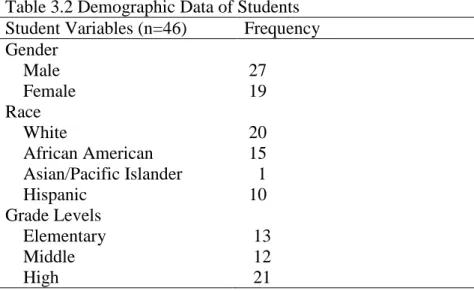
3.2 Demographic Data of Students………24
4.1 Descriptive Statistics for MRQ………36
4.2 Paired Samples Correlations………36
LIST OF FIGURES Figure
1.1 Theoretical Framework of Web-Based Influences on
Reading Motivation.………...6
3.1 Formula for Computing the Test Statistic………...31
4.1. Computation of the Test Statistic Value………37
CHAPTER 1 INTRODUCTION
In their book Reading Don’t Fix No Chevys, researchers Michael W. Smith and Jeffrey D. Wilhelm examined the perceptions of reading and motivation of boys both in and out of school. One student they interviewed ranked reading low on his list of priorities because “It feels like it is almost a waste of time, because you are not accomplishing anything” (Smith & Wilhelm, 2002, p.33). Student achievement motivation is a topic of increasing interest within educational communities. Although the majority of research in this field of motivation deals with typically developing students, there is a continuously evolving and increasing body of
knowledge concerning achievement motivational orientation in students diagnosed with or suspected of having specific learning disabilities (SLD) (Licht, 1983; Schunk, 1989 & 1991; Pintrich & Anderman, 1994; Fulk, Brigham & Lohman, 1998; Grolnick & Ryan, 2001; Brooks, 2001; Sideridis, 2003; Lackaye & Margalit, 2006). The Individuals with Disabilities Education Act (IDEA) of 2004, defines a learning disability as “a disorder in one or more of the basic psychological processes involved in using or understanding, written or spoken language and may be the cause of struggle in listening, reading, speaking, writing, spelling, or mathematical
has become a daunting task for teachers, especially taking into consideration that 40 percent of fourth graders surveyed in a nationwide study would rather clean their room than read (Juel, 1988).
The Link Between Motivation and Reading
Unfortunately, the short-term prognosis for children who experience reading deficits is not good. A child who leaves first grade as a struggling reader will most likely become a poor reader in third grade (Juel, 1988; Torgesen & Burgess, 1998). It has also been reported that a child who does not learn to read and get meaning from text by fourth grade has an 88% chance of never learning to read, even in the presence of reading interventions (Juel, 1988; Torgesen & Burgess, 1998). For students who are unable to read fluently by third grade, it is improbable that they will earn a high school diploma (U.S. Department of Education, 1998; Slavin, Karweit, Wasik, Madden & Dolan, 1994; National Longitudinal Transition Study-2, 2003). Additionally, reading failures bring about negative long-term consequences for children’s self-confidence, motivation to learn, overall school performance, and cause many negative post-school outcomes such as unemployment, drug abuse, dependence upon government assistance, and even
3
effective, often resulting in school failure, thus producing a cycle of academic failure that leads to the previously mentioned negative school and life outcomes.
To further complicate matters, researchers (Guthrie & Wigfield, 1999; Verhoeven & Snow, 2001) have found that motivation to read is directly related to the number of texts and books read, and the use of reading strategies leading to reading comprehension, but, to get students to read well, they must read frequently, and to get them to read frequently, they must be able to read well (Adams, 1990). Given that young children’s reading skills correlate with measures of motivation to read and that students who perceive themselves as good readers are highly motivated to read more than their less motivated peers (Chapman & Tunmer, 1995; Gottfried, 1990; Guthrie et al., 2006), it would seem that increasing students’ use of reading strategies would improve motivation and reading comprehension. However, students who report using reading strategies often perceive themselves as poor readers creating a paradoxical cycle of reading engagement and achievement (Chapman & Tunmer, 1995; Gottfried, 1990; Guthrie et al., 2006; Lepola et al, 2005; Lepola, Vauras & Maki, 2000; Pressley, 1998).
Finding ways to motivate students to read has received even more attention with the No Child Left Behind Act (NCLB) (2001) mandating that all children be proficient readers by 2013. Additionally, NCLB requires that every child must be technologically literate by 8th grade, creating the need for educators to redefine the traditional definitions of literacy. Researchers have begun searching for ways in which technology and the Internet can be used to improve students’ reading skills and engagement. Some research has found that combining
peer) during web-based instructional tasks demonstrated higher achievement and higher self-efficacy in comparison to students who did not receive feedback (Kauffman, 2004; O’Brien & Scharber, 2008; Witt, 2007). The link between reading strategy instruction (both traditional and technological) and the use of web-based instructional strategies may provide the link for which teachers have been looking.
Research however does provide positive support that most reading failure is preventable and students identified as “high risk” can improve their reading and writing achievement with quality instruction (Adams, 1990). In their publication Put Reading First, the National Reading Panel (NRP) (2000) advocates for the use of scientifically based reading interventions and strategies in the classroom in order to improve children’s reading achievement. Finding a way to get children to not only want to read, but also become proficient readers is a very complicated but necessary process. To effectively meet the standards imposed by national and statewide initiatives, and to meet the needs of diverse groups of students in the classroom, many teachers are implementing strategies that incorporate the use of technology (International Reading Association, 2001). In fact, Spires and Estes (2002) point out the benefits of presenting reading within the context of a web-based environment in their research on the cognitive and
motivational challenges facing reading instruction. The use of hypertext and web-based environments not only serve to motivate students to read, but also provide students with the opportunity to access literature using technology; a skill necessary to be successful in today’s global community.
5
capture voices, share information, photos, links, and opinions on a particular topic. Voice Thread serves as a technological medium for students to compile research on current affairs or content that support curriculum. Voice Thread incorporates a variety of motivational elements such as teacher and peer feedback. The overall purpose is for students, through the use of technology, to develop skills of critical thinking and creativity, while building appreciation for knowledge about the content area they are studying.
Theoretical Framework for the Study
Achievement motivation can best be described as the motive to achieve and to avoid failure as influenced by an expressed level of aspiration and willingness to put forth effort and to persist in an activity (Atkinson & Feather, 1966). Achievement motivation is now seen as a vital component when considering academic development in school-aged children. Specifically, there are two types of motivation as means for reference concerning achievement motivation (1) intrinsic motivation and (2) extrinsic motivation. Intrinsic motivation concerns the performance of activities for personal benefit, in which pleasure is inherent in the activity itself (Gottfried, 2001). Intrinsic motivation also includes pleasure from the learning process itself, curiosity, the learning of challenging and difficult tasks, persistence, mastery orientation and a high degree of task involvement (2001). In contrast, extrinsic motivation can be defined as the external
constructs concerning academic endeavors including student dependence upon others, teacher directed learning and competitiveness (Clinkenbeard, 1996).
introduction of web-based instructional strategies for students with reading deficits. The particular theoretical framework presented in this paper supports the claim that Voice Thread serves as effective motivational tool based on the implementation of external elements incorporated in Vygotsky’s socio-cultural theory of learning.
According to Vygotsky, learning can be experienced through the dialectical process consisting of three factors illustrated in Figure 1.1, described as the thesis, antithesis, and synthesis (Miller, 1993). First, the thesis can be described as a child’s current level of functioning concerning a particular aspect of learning, in this case a child’s level of reading motivation. Second, the antithesis is the participation experience that produces change, which is represented here by the participation in a Voice Thread project. Finally, the synthesis is the overall result stemming from the antithesis, represented in this paper by any increase in student reading motivation as a result of participation in a Voice Thread project. Vygotsky’s dialectical process was selected for this particular paper because of the specific elements illustrated in the antithesis portion shown in Figure 1.1 that align with the key aspects of the Voice Thread intervention.
THESIS
Low Reading Self-Efficacy
Poor Reading Motivation
SYNTHESIS
Increased Self-Efficacy
7
Figure 1.1. Theoretical Framework of Web-Based Influences on Reading Motivation The first element of interest illustrated in Figure 1.1, described by Vygotsky and incorporated in Voice Thread is scaffolding. Salkind (2004) describes scaffolding as the techniques used by educators to bridge the gap between what the child knows and needs to know. Teachers have a responsibility to be a key individual in a student’s learning experience by creating an environment where the student can learn from a more experienced person. This process is an important element in Voice Thread because of the use of technology. Considering the novelty of computer programs and websites such as Voice Thread, it is important that teachers provide examples of how to use the website as well as guide the students through the process providing students with the knowledge needed to create individual projects.
The second element of interest shown in Figure 1.1 is the incorporation of empowerment and autonomy. Vygotsky describes the importance of students having a role as an active creator of knowledge (Miller, 1993). Once the teacher provides students with the instruction as to how to create their own Voice Thread, students experience autonomy collecting information to
incorporate into their projects. Voice Thread also allows students to act as a presenter of their own project which can result in a sense of accomplishment and provide a sense of autonomy regarding their work. This sense of empowerment and autonomy is of particular significance as it provides a basis for the increase in student reading motivation concerning future experiences.
Assigning a group project provides students with the social interaction in which Vygotsky places heavy emphasis. Students can learn together and from each other through collaboration in
research and production of the Voice Thread itself. In addition to collaboration as a social factor, Voice Thread also provides students with the opportunity to receive peer and teacher feedback. Students and teachers can comment on Voice Threads providing feedback for each student to learn from the social reinforcement Vygotsky claims is needed for the development of learning.
Purpose of the Study
Research has shown that reading strategies and engagement/motivation are necessary to promote reading achievement (Guthrie & Wigfield, 1999; Verhoeven & Snow, 2001).
Consequently, these two ideologies tend to be represented in isolation, but ideally must go hand in hand in order for student achievement to occur. There is a lack of research that examines specifically how reading comprehension strategies and situational interests can be applied to different instructional contexts, especially to reading instruction, and how the two variables affect student reading achievement or growth in reading. To address the limited research in this area, future research should address these key questions. The purpose of this study is to address the following questions:
1. Will students’ reading motivation improve after participating in a Voice Thread web-based publishing project?
2. What aspects of the technology used during the Voice Thread project will students perceive as positively impacting their reading motivation?
In Chapter 2, a review of related literature is presented to provide theoretical and
9
CHAPTER 2 LITERATURE REVIEW
The studies reviewed were the result of a combination of computer searches as well as manual searches of bibliographies of articles dealing with the research. These searches were conducted through online databases including ERIC, Education Full Text, and PsychINFO. All reports that appeared eligible on the basis of the title and abstract were retrieved. The criteria for including the studies selected were (1) those which dealt with the assessment of achievement motivation in students diagnosed with learning disabilities, (2) those which specifically examined the effects of reading interventions on students’ motivation to read, and (3) those which examined the use of technology as a way of motivating students academically. It should be noted that for the purposes of this review not all studies available to the researcher are included in this summation of the literature. The studies selected however attempt to provide a foundation through which an increased understanding of achievement motivation in students with learning disabilities is represented. Altogether, 18 studies were selected which met the specified criteria and in attempt to review the most recent studies conducted in this area of research all were published in the last two decades.
Achievement Motivation
SLD, a group of randomly selected typically developing students, and a group of low achieving students. Subjects in all groups completed domain specific measures of self-concepts,
perceptions of control, and motivation. In addition, teachers rated these students on motivation and competence indices and classroom behavioral adjustment. Results indicated that children diagnosed with SLD were lower in perceived cognitive competence and academic self regulation in comparison to typically developing students, yet were comparable to the low achieving group in these domains. Children diagnosed with SLD were also more likely to perceive academic outcomes as controlled by others in power such as teachers. However, there were no significant group effects found for general self-perceptions of control or competence. These results provide additional support for students diagnosed with SLD as having lower achievement motivation in comparison to typically developing students and provide support for future research.
Similarly, Bouffard and Couture (2003) conducted a study comparing self-perceptions of academic competence, learning goals, and judgments of usefulness of school subjects as
13
comprehend the situational variables affecting motivation in both high achieving and average achieving students diagnosed with SLD.
Sideridis (2003, 2005) conducted studies examining the presence of helplessness in students diagnosed with SLD and evaluating the role of goal orientation in relation to attitudes, motivation, and academic achievement for students with learning disabilities in middle school settings. The sample consisted of a group of 5th and 6th grade students diagnosed with SLD and a group of typically developing 5th and 6th grade students for comparison. In both studies students were given a self-report questionnaire investigating the measured variables. Overall results suggested that following induction of failure (running out of time) students diagnosed with SLD displayed an increase in negative affectivity and lower ratings of self-esteem and helplessness in comparison to typically developing students. Additionally researchers noted that a mastery orientation towards academics was a positive indicator of academic growth and a negative predictor of helplessness. Results also indicated that students diagnosed with SLD had their academic intentions significantly influenced by the normative educational system, while students not diagnosed with SLD were mediated more so by individual attitudes. Although these results strongly support the theory that students diagnosed with SLD differ from students not diagnosed with SLD in motivational variables, Sideridis (2005) acknowledges that goal orientations are not the only important variables associated with the learning process. Results from this set of studies support previous research in this area and provide a quality reference for future studies
investigating motivational orientations.
Lackaye and Margalit (2006) conducted a study comparing the social-emotional
an academic setting of 7th grade students. End of grade reports and a questionnaire were used to measure motivational variables including effort, self-efficacy, and hope concerning academics. In accordance with research previously described, students diagnosed with SLD showed lower levels of achievement, effort investment, academic self-efficacy and hope as well as increased levels of loneliness and negative mood in the classroom setting. Students diagnosed with SLD were then compared with typically developing peers across four groups of different academic achievement levels: low achievers, low-average achievers, high-average achievers and high achievers. Results from these comparisons indicated that students diagnosed with SLD showed higher achievement than the low-average group but their social-emotional profiles were similar to the low and low-average groups. Results also indicated that achievement, academic self-efficacy, and hope were significant predictors of effort investment and motivation for students diagnosed with SLD. These results demonstrate the significance academic achievement, self-efficacy, and hope have in understanding the motivational functioning in students diagnosed with SLD and should be considered in future research.
Klassen and Lynch (2007) conducted a qualitative methodological study investigating self-efficacy beliefs of students diagnosed with SLD among an 8th and 9th grade population. The study involved a series of focus group interviews among the population of students diagnosed with SLD as well as individual interviews with seven specialist SLD teachers. The researchers measured motivational variables including self-efficacy, student self-awareness, and attributions for failure in an academic setting. Results from this study also support previous research in this field as self report data suggested students diagnosed with SLD tend to view themselves lower in self-efficacy, and were generally accurate in their calibration of efficacy with academic
15
with SLD were viewed as over confident concerning academic tasks. Additionally, students self reports indicated that they viewed verbal persuasion/support from parents and teachers as a valued source influencing self-efficacy. Results also indicated that students diagnosed with SLD attributed failures to lack of effort whereas teacher interview data attributed these failures to uncontrollable deficits. This study highlights the severe discrepancy between student self reports and teacher interview data concerning children diagnosed with SLD. This discrepancy reveals a need for further investigation into the relationship between teachers and students diagnosed with SLD concerning motivational attributions in academic settings.
Deci, Hodges, Pierson and Tomassone (2001) conducted a study investigating autonomy and competence as motivational factors in students diagnosed with SLD. The study used
questionnaires in assessing students’ self perceptions and perceptions of home and classroom contexts. Researchers noted that all variables theoretically reflected either competence or autonomy aspects of internal motivation or students’ personal academic adjustments. Students’ achievement and adjustment were predicted from motivational relevant self-perception and perception of context variables. Results indicate different patterns revealed for students
Pintrich, Anderman, & Kloucar (1994) conducted a study examining the cognitive and motivational variables distinguishing between students diagnosed with SLD and those not diagnosed with SLD in a fifth-grade sample. During individual sessions with researchers students were administered two self-report questionnaires designed to measure motivational strategies. Results indicated that students diagnosed with SLD, when compared with typically developing students, displayed lower levels of metacognition and reading comprehension. However the authors indicated no significant differences between groups in terms of self-efficacy. In addition, results indicated no signs of learned helplessness in academic settings; however results indicated the students diagnosed with SLD did tend to attribute success and failure to more external causes than the comparison group.
17
strategies for increasing motivation to achieve academically. Further research is needed in order to clarify the impact these types of programs have on different academic motivational variables.
Overall the evidence resulting from the empirical studies reviewed provide mixed results concerning achievement motivation of children diagnosed with SLD. The majority of the
research findings support the claim that low self-efficacy leads to academic frustration and therefore a lack of intrinsic motivation (Brooks, 2001; Deci et al, 2001; Grolnick & Ryan, 2001; Bouffard & Couture, 2003; Klassen & Lynch, 2007). These findings support the claim put forth by Lincoln & Chazan (1979) that students diagnosed with SLD would have more external motivational orientation when compared to students without a diagnosis of SLD, due to a lack of self-efficacy and self-perception of academic confidence. Additional results from multiple studies (Fulk et al, 1998; Sideridis, 2005) found that there are significant positive effects in performance-approach orientations, and negative or minimal effects in performance-avoidance orientations concerning students diagnosed with SLD. Findings from the research also implicate motivational orientation as a function of individual, cultural and situational characteristics dependent upon the academic setting (Bouffard & Couture, 2003; Garcia & de Caso, 2004). Although these results produce encouraging findings, it is important to note how each study strongly suggests a need for further research investigating the claims brought forth from these research findings.
Reading Motivation
Aarnoutse and Schellings (2003) conducted a study investigating the effectiveness of an intervention incorporating the development of reading motivation and reading strategies
received instruction based on an experimental program based on multiple texts, increased interaction with peers and maintained a focus on students choosing the problems themselves increasing individual autonomy. The control group received the typical reading comprehension instruction designed in the schools’ program. Student progress was evaluated in a pre and post-test format using measures such as a reading comprehension post-test, questionnaire, and a motivation scale. Results of the study indicate a significant increase for the experimental group in reading motivation however no significant differences were found concerning reading comprehension (Aarnoutse & Schellings, 2003). Additionally, the experimental group also outperformed the control group in both number and use of reading strategies, providing evidence for the support of the researchers’ intervention.
Taboada, Tonks, Wigfield, and Guthrie (2007?) conducted a study examining the role motivation and cognitive variables play in predicting reading comprehension in elementary aged students. Over a three month period 205 fourth-grade students were assessed in background knowledge, internal motivation, and reading comprehension through the use of multiple
measures including reading tests, and teacher and student ratings. Results indicated that the same cognitive and motivation variables predicted reading comprehension growth over the three month period (Taboada, Tonks, Wigfield, & Guthrie, 2007). More notably results indicate that background knowledge, cognitive strategy-use, and internal motivation all contributed
significantly to reading comprehension (2007). This finding is incredibly important in the
19
In a series of studies (2004, 2004, 2006) Guthrie, Wigfield, et al, investigated the relationship between reading motivation and reading comprehension mediated by specific instruction designed to increase student intrinsic motivation by creating situational interest. The studies all incorporated the experimental instruction called Concept Oriented Reading Instruction (CORI). CORI is a type of instruction encouraging teachers to link reading to science activities and stimulating tasks more than typical types of instruction (Guthrie et al, 2006). Researchers theorized that teachers using situational interest and stimulating tasks such as science
observations and experiments, student reading motivation and reading comprehension would increase. Researchers found that student motivation has a role as predictor of level of reading comprehension in elementary aged students (Guthrie, et al, 2004). Wigfield, et al, (2004) found that over a 12 week period CORI significantly increased student self-efficacy, intrinsic
motivation, and reading frequency. Guthrie et al (2006) found that students in the experimental instruction receiving more stimulating tasks exemplified an increase in reading comprehension when compared with students from the typical instruction classrooms. Interestingly, it is noted that the number of stimulating tasks did not increase reading comprehension levels on
standardized tests when motivation was controlled for, leading researchers to believe that student motivation acts as a mediator between number of stimulating tasks and reading comprehension (2006). Results from these studies represent a variety of information regarding student
and efficacy. The study included a sample of 31 fourth graders spread across eight classrooms, all participating in the reading intervention CORI. Students’ reading motivation and
comprehension progress were assessed by pre-and post-intervention interviews, teacher ratings, motivational self-reports, and reading comprehension test scores. Results of the study indicated that the motivational constructs were semi-independent however constructs such as student interest and perceived control were highly collaborative (Guthrie, et al, 2006). Results also indicated that situated and general reading motivation were highly correlated and that student motivation predicted reading comprehension growth, however interestingly enough reading comprehension did not predict growth in motivation (Guthrie et al, 2006).
The results from studies investigating the relationship between reading motivation and reading comprehension leave many questions unanswered. Although most of the results indicate a significant positive relationship between reading motivation and reading comprehension, there are some results that refute that claim. One common strand among all of the articles however is the report that experimental programs based on incorporating the different motivational
constructs can lead to increased reading motivation. All of the studies using experimental forms of instruction such as multiple texts, increased peer interaction, increased autonomy, stimulating tasks and increased situational interest, led to an increase in the students’ reading motivation. This finding is of significant importance because it supports the claim that through specific instruction and participation, students’ reading motivation can be increased. In a relatively young field, the previous studies provide a solid building block for practitioners and researchers to further explore this encouraging phenomenon.
21
Teachers often use computer-assisted instruction (CAI) to provide students with special needs access to reading content in a motivating context (Kim, Vaughn, Klingner, Woodruff, Reutebuch, & Kouzekanani, 2006). Often implemented through digitalized texts, reading software, or hand-held games, CAI has been documented as an effective tool for students to interact with text in meaningful ways (Gersten, Fuchs, Williams, & Baker, 2001; Snow, 2002). Considering the relative novelty of research investigating the use of technology and its effect on reading motivation, there is a somewhat limited literature investigating this phenomenon. Although the majority of research in this field attempts to describe the impact technology can have on students writing ability, the purpose of this section of the literature review investigates the impact technology has on reading motivation. Due to gaps in this literature, in addition to the three selected published research studies, additional information was collected via informational publications from a variety of experienced teachers and practitioners.
One study conducted by Kramarski & Feldman (2000) investigated the contributions an Internet environment embedded within metacognitive instruction on students reading
comprehension, motivation and metacognitive awareness. Although results indicated there were no significant improvement in reading comprehension or metacognitive awareness, there was a significant increase in student motivation reported (2000). A genuine excitement and willingness to continue and engage in the lessons by students in the Internet group was also reported through observations in the study (2000). These results support the hypothesis that the incorporation of the Internet into daily classroom activities will positively impact student achievement
motivation.
projects. Two students worked with the author creating multimedia presentations developing authoring skills such as planning, drafting, composition, revision, reflection, proof reading, and presentation (Dimitriadi, 2001). Results indicate that students became more active and more motivated learning supporting the hypothesis that multimedia packages encourage creative thinking and interest in students. The author claims the introduction of multimedia computer applications enhance the approach to information by creating a familiarity for the students with their everyday lives such as incorporating their interests in technology and playtime activities (2001). This research describes how the use of multimedia authoring programs combine a multisensory environment where students find themselves taking a more active role in developing their own ideas, making the work more meaningful and increasing motivations.
Kauffman (2004) conducted a study investigating how web-based instructional prompts can influence college undergraduates’ note taking, self-efficacy, and self-monitoring. The
students were randomly placed into two groups for a 2x2x2 factorial design. The groups differed in that each group randomly was either assigned to take notes, selected to receive prompts that encouraged self-monitoring, or received feedback designed to enhance self-efficacy. Results indicated that both academic self-efficacy feedback and self-monitoring prompts produced a slight increase in student achievement. However note-taking method had the strongest influence on both achievement and information gathered (Kauffman, 2004). Evidence from this article supports the use of web-based instructional prompts as means of increasing academic
performance from a note-taking perspective and should inspire future research across additional domains.
23
provide educators with increased opportunities to expand the ways in which they can present lessons to students with disabilities. Specific computer programs and the use of the Internet as described in the previous studies supports an increase in student achievement motivation and the use of these multimedia projects should complement and support student’s development of reading across the curriculum (2006).
CHAPTER 3 METHODS
Research has shown that reading strategies and engagement/motivation are necessary to promote reading achievement (Guthrie & Wigfield, 1999; Verhoeven & Snow, 2001).
Consequently, these two ideologies tend to be represented in isolation, but ideally must go hand in hand in order for student achievement to occur. There is a lack of research that examines specifically how reading strategies and situational interests can be applied to different instructional contexts, especially to reading instruction, and how the two variables affect
students’ reading motivation. To address the limited research in this area, future research should address these key questions. The purpose of this study is to address the following questions:
1. Will students’ reading motivation improve after participating in a Voice Thread web-based publishing project?
2. What aspects of the technology used during the Voice Thread project will students perceive as positively impacting their reading motivation?
Participants Teachers
motivation of students across grade levels, (b) these teacher recruits were enrolled in coursework to obtain a Master’s degree in Special Education, and expressed an interest in learning about novel ways in which they could motivate their students academically, and (c) the classroom teachers being recruited were engaged in classroom inquiry, focused on improving the reading skills and motivation of their students who exhibit both learning and behavior problems. Table 3.1 Demographic Data of Teachers
Teacher Variables (n=7) Frequency Gender Male Female 1 6 Race White African American 5 2 Degree Held Bachelor’s Master’s 5 2 Teaching Experience 1-5 6-10 11.15 4 2 1 Students
27
an alpha level of .05 for a two-tailed test yielded a total sample size of 41. To account for participant attrition, 46 students were selected for participation in this study.
Despite the attempt to ensure that the sample of student participants was evenly distributed, the gender representation of males and females accurately reflected what research has shown regarding the increased identification of males versus females with learning and behavior difficulties (Salend, Garrick-Duhaney, and Montgomery, 2002; Share, & Silva, 2003; Wehmeyer & Schwartz, 2001). Additionally, all attempts were made by the teachers to ensure that students selected from their elementary through high school classrooms represented diverse cultural and ethnic background. These data are reported in Table 3-2, but were not considered as a predictor variable for the purposes of this study.
Table 3.2 Demographic Data of Students Student Variables (n=46) Frequency Gender Male Female 27 19 Race White African American Asian/Pacific Islander Hispanic 20 15 1 10 Grade Levels Elementary Middle High 13 12 21 Measures Reading Motivation
used to measure students’ motivation for reading. The MRQ was selected because it addresses students’ specific motivations related to reading, rather than overall motivation which is often reported by alternative motivation scales. A total of 20 items related to specific dimensions of reading were selected from the questionnaire that related directly to the research questions posed in this study, as they relate to students’ reading motivation and the context in which reading is presented within the classroom. The MRQ was designed to assess 11 possible dimensions of reading motivation, including self-efficacy, several types of intrinsic and extrinsic reading motives, social aspects of reading, and the desire to avoid reading (Wigfield & Guthrie, 1997). Of these dimensions, those questions that focused on intrinsic motivation and reading efficacy were selected for the version used in this study. Intrinsic motivation includes pleasure from the learning process itself, curiosity, the learning of challenging and difficult tasks, persistence, mastery orientation and a high degree of task involvement (Gottfried, 2001; Ryan & Deci, 2000). Readers who are intrinsically motivated express curiosity for reading and desire to read for the sake of reading. A sample item that addresses this aspect of reading is: “When I grow up I will spend a lot of my time reading” or “Being able to read well is important.” Similarly, readers who demonstrate efficacy in reading believe they have the ability to read. According to Bandura (1997), self-efficacy includes the belief an individual has in their capacity to accomplish an activity or task. Features of self-efficacy demonstrated within items of the MRQ include: “My friends think I am a ____ reader” or “I am a good reader.”
Validity and Reliability
29
MRQ has been used in many studies (e.g., Wigfield & Guthrie, 1997; Wigfield et al., 2004), both as an independent and dependent variable. To determine its predictive ability, Wigfield and Guthrie (1997) used the MRQ as a measure of 105 fourth and fifth grade students’ breadth of reading. This study allowed them, as researchers and developers of the MRQ, to demonstrate that this measure could be used reliably to predict students’ reading motivation. Specifically in
relation to this study, alpha coefficients were reported at .76 for intrinsic motivation to read and .68 for reading efficacy. In terms of predictive validity, these intrinsic composites for reading motivation and reading efficacy could significantly predict the influence on reading motivation on increases in reading amount and breadth of reading for the students in their study. Other researchers have replicated these and similar findings regarding intrinsic motivation and self-efficacy in reading (Cox & Guthrie, 2001a; Wigfield at al., 2004).
Related to the technological construct developed within this study, and as part of a series of studies, Guthrie and colleagues (2004, 2004, 2006) investigated the relationship between reading motivation and reading comprehension mediated by specific instruction designed to increase student intrinsic motivation by creating situational interest. The studies all incorporated the experimental instruction called Concept Oriented Reading Instruction (CORI). These researchers used the MRQ as a dependent variable to examine aspects of intrinsic motivation as a composite, and utilized 17 items from the MRQ to determine if instructional contexts had an effect on students’ reading motivation. These items had a Cronbach’s alpha reliability of .86, indicating that in classrooms where a reading strategy that promoted motivation was used, students demonstrated higher levels of intrinsic motivation and efficacy.
Guthrie, 1997; Wigfield et al., 2004). To assess the MRQ’s ability to generalize for diverse populations of students, Baker and Wigfield (1999) used the MRQ with middle school students. This study demonstrated that different components of reading motivation could be measured reliably using the MRQ, with internal consistency reliabilities within the reading motivation and self-efficacy scales ranging from .66 to.76. The findings from this study also indicated that the reading motivation and efficacy scales from the MRQ correlated with increases in variety and number of books read by students. In addition, researchers used their results to predict students’ performance on state standardized tests.
Items, Format, and Scoring
The 20 items selected from the original 54-item MRQ represented ways in which students expressed their motivation to read based on a 4-point Likert-type scale. These choices range in scale from a choice of one (1) representing a feeling about reading or a reading behavior that is not like me or very different from me to four (4) representing a feeling about reading or a reading behavior that is a lot like me or very much like me. High scores on this subscale indicated higher levels of reading motivation for student participants. In order to avoid any social desirability from participating students to achieve a certain score, each question’s answers varied in order. Technology Use in Relation to Reading Motivation
31
likely to engage in reading. A study by Cosgrove (2003), found that students who regarded reading as boring or viewed themselves as poor readers had negative views toward reading. Similarly, when Smith and Wilhelm conducted their research on boys’ reading motivation, they shared the remarks of one student who explained why he ranked reading so low: “It feels like it is almost a waste of time, because you are not accomplishing anything” (Smith & Wilhelm, 2002, p.33).
Procedures
Voice Thread, a free software program accessible through the Internet, is used to capture voices, share information, photos, links, and allow viewers to express opinions on a particular topic (Lowensohn, 2007). Voice Thread serves as a medium for students to compile research on current affairs, literature, or content that supports curriculum. The overall purpose is to develop skills of critical thinking and creativity, while building appreciation for knowledge about the content area they are studying. Teachers were trained in the use of Voice Thread using the materials contained in Appendix B. These materials provide a tutorial that can also be provided to students. Further, teachers were also provided with materials that they could use to train students on the creation and use of the Voice Thread technology. Student resources can also be found in Appendix B.
Prior to beginning the Voice Thread instructional strategy, teachers administered the MRQ to students in each of their classroom. All items were administered to the students by reading them aloud with the class of students to account for students with different reading abilities. Teachers read the following directions to students prior to the questionnaire’s administration:
“The purpose of this questionnaire is to let me find out more about how you feel about reading. I will read some questions to you out loud and then give you time to circle your answer after I read each of the choices out loud. There is no right or wrong answer. Listen to each statement and circle the answer that best describes how you feel about each item I read aloud. “
33
projects other students created using this technology. The teachers then modeled the creation of a Voice Thread for students, providing students with the resources and tools to create a thread of their own. Once the teacher felt the students were familiar with the mechanics involved with creating their own Voice Threads, specific student and teacher roles were assumed. Students engaged in typical classroom reading activities involving fiction and non-fiction texts
appropriate with students’ educational capabilities. Students then completed group or individual Voice Thread projects to demonstrate what they learned from the text.
Students completed Voice Thread projects over a period of 12 weeks. At the conclusion of the study, the students completed a follow-up MRQ to determine if there was any growth on domains of reading motivation. At the conclusion of the study, teachers also conducted their conversational interviews with the group of student participants in their classrooms. These questions address aspects of students’ perceptions of Voice Thread procedures, enjoyment of reading, and potential uses of Voice Thread in the classroom. Sample questions are provided in Appendix C.
Consent
Prior to beginning the study, which employed the use of existing data from the teacher’s inquiry projects, the student researcher obtained Institutional Review Board (IRB) approval. Teachers provided their consent to participate in this study by providing the researcher access to the project notebooks that contained the data they collected from their Voice Thread projects.
Design and Data Analysis
that teachers enrolled in a Special Education Master’s program designed for classroom-based instructional strategies.
Quantitative Data Analysis
The Statistical Package for the Social Sciences (SPSS), Version 17.0 was used for quantitative data analysis, specifically for the descriptive and inferential statistics. The student researcher examined the existing data that these teachers collected for their inquiry projects, which included student MRQ data and interview data. The MRQ data were analyzed
quantitatively to answer research question one: Will students’ reading motivation improve after participating in a Voice Thread web-based publishing project? To determine the relationship between this novel web-based reading instructional strategy (delivered via Voice Thread technology) and reading motivation for participating students, a dependent samples t-test was conducted. A t test for dependent means is ideally suited for the type of research questions posed in this study, where the same subjects are being studied under two conditions (a pre- and post-test measure of reading motivation using the MRQ). By convention, if there is a less than 5% chance of getting the observed differences by chance, we reject the null hypothesis and say we found a statistically significant difference between the two testing situations. To calculate the t value, the following formula shown in Figure 3-1 was used.
t =
Figure 3.1 Formula for Computing the Test Statistic
Because the t test for dependent means focuses on the differences between the pre- and post-test scores for the repeated measure on the MRQ, the formula for the t test also focuses on
D
∑
35
the sum of the differences between the pre- and post-test scores. In this formula, ΣD is the sum of the all the differences between scores, ΣD 2 is the sum of the differences between scores squared, and n is the number of observation pairs (Salkind, 2004). The significance level will be set at .05, indicating 5% risk of committing Type 1 error, rejecting the null hypothesis when it is true. After the t value has been calculated, it will be necessary to use the t table to determine the critical value needed for rejection of the null hypothesis.
Using a dependent samples t-test will enable the researcher to examine the effects of the web-based instructional strategy on students’ reading motivation across repeated measures using the MRQ (Salkind, 2004). Similarly, Kramarski and Feldman (2000) employed dependent samples t-tests in their evaluation of an Internet intervention on students reading comprehension, motivation, and metacognitive awareness, and found significant differences between students groups who used the Internet strategy and those who did not. The dependent samples t-test allowed the researcher to answer research question one by using the t-test statistic to determine if the p-value indicated how likely we could have gotten these results by chance. The following hypotheses were tested using the dependent samples t-test.
Null and Alternate Hypotheses: H0 : µPost – µPre = 0
Ha : µPost – µPre > 0
Qualitative Data Analysis
qualitative analytic coding, the first phase consists of open coding, in which field notes or interview data are analyzed to formulate themes. Notes were written in the margins of the teachers’ field notes so that concepts or themes could be derived from the students’ responses. Themes were identified from the researchers’ notes taken directly on the conversational
interviews. Connections were made to the conceptual framework presented in this study, which identified three areas from Vygotsky’s theory of social cultural learning: scaffolding,
peer/teacher feedback, and empowerment/autonomy. During the focused coding phase of qualitative data analysis, the researcher conducted a line-by-line analysis of the conversational interviews to draw out the specific comments students made in relation to the themes of
scaffolding, peer/teacher feedback, and empowerment/autonomy. These data were then compiled and recorded on a separate sheet of paper. For the purposes of this paper, the researcher sought at least three instances or representations of the identified themes within the conversational
CHAPTER 4 RESULTS Introduction
This study was conducted to address the following research questions:
1. Will students’ reading motivation improve after participating in a Voice Thread web-based publishing project?
2. What aspects of the technology used during the Voice Thread project will students perceive as positively impacting their reading motivation?
The following hypotheses were tested in this study:
Null Hypothesis: Student participation in a Voice Thread web-based publishing project will not increase students’ reading motivation as measured on the pre- and post-test measures of the Motivation for Reading Questionnaire (MRQ). H0 : µPost – µPre = 0
Alternate Hypothesis: Student participation in a Voice Thread web-based publishing project will increase students’ reading motivation as measured on the pre- and post-test measures of the Motivation for Reading Questionnaire (MRQ). Ha : µPost – µPre > 0
sample t test conducted to answer Research Question 1 and both the Null and Alternate Hypotheses. The final section presents qualitative data from student interviews conducted to answer Research Question 2.
Quantitative Results Sample Description
The sample in this study consisted of 46 students in K-12 exceptional student education programs across four school districts in the Research Triangle area of North Carolina. Of the 46 students, nearly 59% were male (N = 27), with a relatively even distribution with regard to race as roughly 43% (N = 20) responding as white and 57% (N = 26) reporting being African American, Hispanic, or Asian/Pacific Islander. The sample is also relatively evenly distributed across Elementary and Middle grade levels with 28% (N = 13) of students in Elementary grades, 26% (N = 12) in Middle grades, however nearly half the sample, 45% (N = 21), are in High School.
Descriptive Statistics
Table 4-1 represents the means, standard deviations, and minimum/maximum scores on the Motivation for Reading Questionnaire (MRQ) for all 46 students both pre- and
39
The mean scores for the MRQ were 42.7174 for the pre instructional strategy scores and 57.0217 for the post instructional strategy scores, indicating a 14-point increase between the means of pre- and post-test instructional strategy scores. Despite the fact that these two means are different, and mean scores increased on the post-test, it has not yet been determined that this might be due to chance. The t-test will determine if the difference is significant.
Table 4.1 Descriptive Statistics for MRQ
Mean N Standard
Deviation
Std. Error Mean
Minimum Maximum
Pair 1 Pre Post 42.7174 57.0217 46 46 10.33153 6.81987 1.52330 1.00553 22 40 60 69 Inferential Statistics
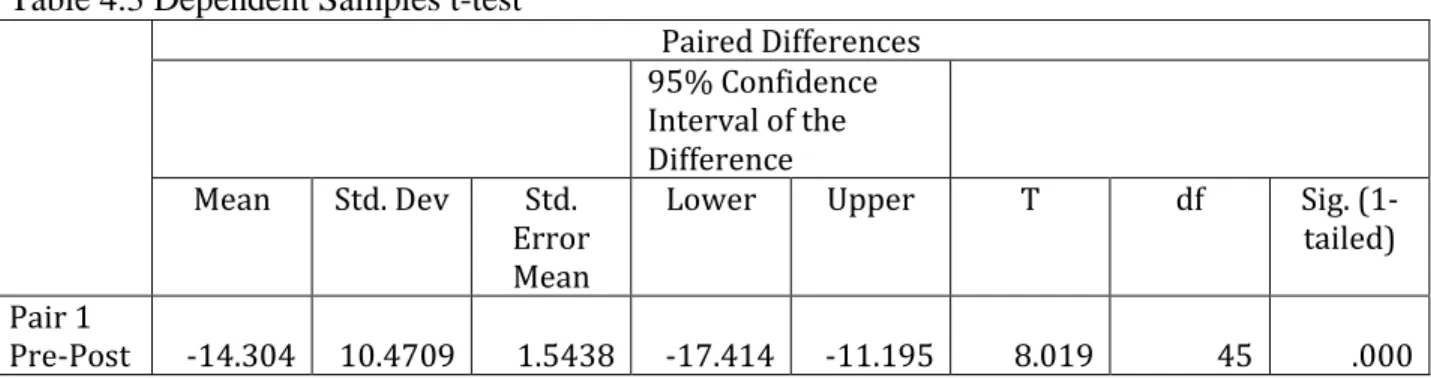
Tables 4.2 and 4.3 represent statistical analysis used to answer the following research question and address the listed hypothesis:
Question 1: Will students’ reading motivation improve after participating in a Voice Thread web-based publishing project?
Null Hypothesis: Student participation in a Voice Thread web-based publishing project will not increase students’ reading motivation as measured on the pre- and post-test measures of the Motivation for Reading Questionnaire (MRQ). H0 : µPost – µPre = 0
Alternate Hypothesis: Student participation in a Voice Thread web-based publishing project will increase students’ reading motivation as measured on the pre- and post-test measures of the Motivation for Reading Questionnaire (MRQ). Ha : µPost – µPre > 0
Table 4.2 Paired Samples Correlations
N Correlation Sig.
Table 4.2, the Paired Samples Correlations, provides correlations between the paired scores on the pre- and post-instructional strategy scores. An examination of the correlation reveals that there is a positive relationship (r = .309) between the pre and post scores. With a Sig. value of .036, this means that at the .001 alpha level, the relationship between the scores is significantly different from 0, in which there would be no relationship at all. However promising these results may seem, they still do not indicate a significant difference between pre- and post- instructional strategy scores on the MRQ.
Table 4.3 Dependent Samples t-test
Paired Differences 95% Confidence Interval of the Difference Mean Std. Dev Std.
Error Mean
Lower Upper T df Sig.
(1-tailed)
Pair 1
Pre-Post -14.304 10.4709 1.5438 -17.414 -11.195 8.019 45 .000
Table 4.3 presents the findings on the paired differences and dependent samples t test. The mean of -14.30435 indicates the difference between the means scores for the pre and post tests. This means on average, according to the MRQ, student reading motivation increased approximately 14 points between pre and post scores. Additionally this table also provides the obtained t value for a one-tailed test (t(45)=8.019, p=.05) and the significance level (.000), which was calculated using the formula in Figure 3.1, with the following data entered into the formula (see Figure 4.1 below). Using the t table of t values need for rejection of the Null Hypothesis, it was determined that with 45 degrees of freedom (df) and a significance level of .05, tcrit =1.68 for a one-tailed test.
t(45) =
616
41 Figure 4.1 Computation of the Test Statistic Value
Also to be noted, the significance of a p-value of .000 indicates the probability of obtaining the given t value by chance alone is less that .001%. This finding provides additional support for the rejection of the Null Hypothesis indicating that student participation in a Voice Thread web-based publishing project could be one factor that contributes to an increase in students’ reading motivation. As a result of this finding, the researcher sought to derive an effect size to determine the relationship between the pre-and post-test scores obtained on the MRQ. Using the formula represented in Figure 4-2, a Cohen’s d of 1.367 was then calculated to evaluate the degree that the mean of the difference scores is equal to zero. The d statistic was computed by dividing the pooled Mean (14.30435) by the Standard Deviation (10.47085). This d means that the difference between the two sample means is 1.367 standard deviation units away from zero, indicating a large effect size.
_ _
d = X(pre) – X (post) = 14.30435 = 1.367 SD 10.47085
Figure 4.2 Formula for Computing Cohen’s d
Qualitative Results Student Interviews
At the conclusion of the study, students were asked to respond to four structured
interview questions. The following consists of these questions and some of the typical responses from multiple students. The responses are grouped thematically to best illustrate the different areas of student focus.
with how Voice Thread provides the means to produce a tangible product which can be shared with others. The student interviews produced responses such as “Voice Thread was a cool way to show my work on the Internet” or “Voice Thread was an interesting tool to show what our group learned” and “it made us feel like we accomplished something positive as a group”. Responses such as these provide support for the claim that Voice Thread can be an effective tool when it comes to empowering students and enhancing autonomy. Students seemed to feel comfortable and proud showing their work, supporting the claim that there was an increase in reading motivation.
A second theme provided in the first question of the student interviews deals with the inclusion of peer/teacher feedback and social interaction. Responses such as “when I showed my mom she was proud” and “I liked showing my friends” help support the claim Vygotsky makes concerning the necessity of social interaction in learning. Additionally responses such as “it was fun to see other kids’ stuff” show that students had an increased interest in learning about peer works. Complements and critiques of peer projects were also represented in the student
interviews as it was common to see responses like”…is really good at reading”. These types of responses display peer feedback concerning academic processes that might not be observed in a more traditional classroom assignment.
43
Question 2: What was the hardest thing about using the technology? What would have made it easier? The overwhelming amount of responses to this question in the student interviews pertain to all three elements of the theory previously described. Students responded with
comments such as “Once we figured out how to do Voice Thread, it was easy and fun and we wish we could do this in other classes” and “we couldn’t wait to get to class once we got the hang of it”. These types of responses illustrate the importance of all three elements. The
empowerment and autonomy is shown through the increase in confidence students experienced through the use of the Voice Thread projects. The peer and teacher feedback along with the social influence of Voice Thread helped produce such enthusiasm described in the comments. Additionally scaffolding proved to be of the utmost importance as some students reported “difficulty at first”, however later describing that after they were instructed as to how to use Voice Thread, it became “no problem” and “quite easy”.
Question 3: Would you use this technology again and how? Responses to this question in the student interviews produced similar results concerning the theoretical elements supporting Voice Thread. Students exhibited a desire to continue working with Voice Thread which can be illustrated in comments such as “we want to use Voice Thread for projects from now on”. Responses also described enjoyment in the autonomy Voice Thread can provide as shown in comments such as “it is so cool that we can show our work and we get to be the teachers”. Feedback and social interaction were also described with comments like “we can show how our skills complement each other” as the students seemed to collaborate with each other and use each other as soundboards for ideas concerning their projects.
produced encouraging responses concerning the effectiveness of Voice Thread. Responses such as “I don’t know if I’m a better reader but I am not afraid to do the work” show a support for the claim that the use of Voice Thread increases student motivation and autonomy. Additionally peer feedback and social interaction is described in responses like “I like the idea of working in groups on this project…it makes me feel like I can do the same things that big people do”, as the emphasis on collaboration and peer responses show support for the theoretical background. Finally, responses also illustrated that scaffolding is a useful tool as some students felt
empowered. Responses such as “I am not as bad a reader as I thought and it helps when I have someone to help sit next to me”, illustrate that through the scaffolding provided by the teacher, Voice Thread can be an effective tool in increasing student autonomy and reading motivation.
Summary
CHAPTER 5 DISCUSSION
Introduction
Researchers have found that of the 20% of children in the United States who experience serious reading difficulties, a majority tend to struggle with those difficulties over time and that students in early elementary grades who struggle with reading are more likely to have reading difficulties well into their secondary years (Juel, 1988; Grossen, 1997; Torgesen & Burgesss, 1998). As a result, many initiatives have been made at the local, state, and national levels to not only identify reliable indicators of students at risk for early reading failure, but also to develop evidence based practices that will help students develop the skills they need to learn to read (Snow et al., 1998; Torgesen and Burgess, 1998).
Results of this current study yielded similar conclusions to those reviewed in the literature on reading motivation and the use of technology interventions presented in Chapter 2 of this paper. First of all, this study found that specific types of classroom reading instructional strategy have a positive impact on students’ reading motivation. Researchers studying
experimental programs based on various motivational constructs found that targeted
increase in the students’ reading motivation. This finding is of significant importance because it supports the claim that through specific instruction and participation, students’ reading
motivation can be increased.
Second, this study, despite the sparse research in the use of technology to improve students reading motivation, found a link between the use of a web-based publishing program and increases in student reading motivation. Similarly, researchers found links between students’ use of Internet based literacy interventions and increased motivation to read
(Dimitriadi, 2001; Elder-Hinshaw, Manset-Williamson, Nelson & Dunn, 2006; Kauffman, 2006; Kramarski & Feldman, 2000). Additionally, the qualitative interview analysis conducted within this study found that specific elements of the Voice Thread program had more positive effects on dimensions of student perceived efficacy in reading.
This study used data collected from 7 teachers and their 46 students to examine the relationship between the use of technology on students’ reading motivation. The study took place in seven elementary, middle, and high schools found in four school districts in the Research Triangle are of North Carolina. The Motivation for Reading Questionnaire (MRQ) (Wingfield & Guthrie, 1997) was used to establish a connection between students reading motivation and the use of Voice Thread, a free software program, accessible through the Internet that is used to capture voices, share information, photos, links, and opinions on a particular topic. Voice Thread serves as a technological medium for students to compile research on current affairs or content that support curriculum. Voice Thread incorporates a variety of motivational elements such as teacher and peer feedback, increased autonomy, and the use of scaffolding. The overall purpose is for students, through the use of technology, to develop skills of critical
47
are studying. A qualitative analysis of Conversational Interviews conducted with student participants provided insights into the aforementioned elements of Voice Thread that students perceived as being highly motivating and related to Vygotsky’s Social Learning theory in Chapter 1.
Interpretation of Findings
One interpretation of these findings is that when teachers use novel reading instructional strategies that incorporate elements of technology, and specifically Internet-based programs, students may be more motivated to participate in reading related activities. In response to Research Question 1 (Will students’ reading motivation improve after participating in a Voice Thread web-based publishing project?), a strong relationship was found between students increase in scores on the MRQ and their participation in the Voice Thread web-based publishing project. Although it should be noted that even though a significant relationship was found, participation in Voice Thread cannot be attributed as a causal factor for the increase in the motivation scores. It can only be described as a variable that contributed to the differences in reading motivation scores during this study.
were no longer afraid to participate in literacy related activities. This demonstrates the extensive power of reading motivation, not only on students’ sense of efficacy, but on the
self-awareness that can be learned about one’s own personal growth in reading. Implications for Future Research
Despite these limitations, the significant increase in reading motivation scores in students during this study does provide support for the claim that a technological instructional strategy such as Voice Thread can be a contributing factor concerning student reading motivation. Teachers cry out for opportunities to learn new strategies and instructional strategies that help them promote students’ reading achievement and motivation and to help them manage their classroom (Moody et al., 2000; Vaughn et al., 1998). According to the results of this study, instructional strategies such as Voice Thread can provide teachers with the means to implement those strategies for increasing student reading motivation. Future research should continue to investigate the effectiveness technological instructional strategies such as Voice Thread have on student reading motivation. As technology becomes an integral part of our educational system, it is important to follow the suggestion of research that combining reading/writing with online technology allows teachers to provide opportunities for students to develop digital fluency while also strengthening traditional literacy skills (Kauffman, 2004; O’Brien & Scharber, 2008; Witt, 2007).
49
sample of the study it would be interesting for future researchers to investigate whether there are differences among these sample variables with regards to student reading motivation. Are boys affected more than girls? Is there a cultural difference between students with regards to their reading motivation? Is there a difference among grade levels concerning the impact of this instructional strategy? These three additional questions would be of significant value to further evaluate the effectiveness technological instructional strategies such as Voice Thread have on student reading motivation.
Additionally, teachers often report that reading instruction is effective and important to student reading achievement (Pressley, 2002) but state that time, lack of knowledge in
instructional skills, and classroom management issues prevent them from adequately meeting the needs of all their students (Schumm, et al., 2000; Vaughn et al., 1998). Because this particular study solely focused on the Voice Thread instructional strategy and its effect on student reading motivation, future research should be conducted to investigate the impact such an instructional strategy has on the teachers themselves. Research investigating the effects on the teachers could lead to some valuable information regarding the implementation of such technological
instructional strategies and the applicability in the classroom settings. Additionally future
research should incorporate individual teacher interviews both pre and post instructional strategy in order to investigate any influence this type of instructional strategy has on teacher enthusiasm regarding reading instruction. These interviews, in addition to the student data could provide researchers with important information regarding the impact an alternative technological tool such as Voice Thread can have on teacher interest and practice.