© 2020 by University of Niš, Serbia | Creative Commons License: CC BY-NC-ND
UDC: (37.014.22:004):811.111'276.6 https://doi.org/10.22190/JTESAP2001017K
THE USE OF DIGITAL TECHNOLOGY IN ESP:
CURRENT PRACTICES AND SUGGESTIONS
FOR ESP TEACHER EDUCATION
Elis Kakoulli Constantinou, Salomi Papadima-SophocleousCyprus University of Technology, Cyprus E-mail: [email protected]
Abstract. Developments in Information and Communication Technology (ICT) have transformed the way people communicate, interact and also the way they learn. ICT tools are widely used in language teaching and learning, and the benefits have been repeatedly expressed in literature. ESP is yet another area of language education that has been affected by these developments. Despite the fact that there are ESP practitioners who utilise technologies in their teaching, more research is needed in order to identify how widely technology tools are used in ESP, so that action is taken to empower practitioners and provide them with the help they need in order to integrate technology in their practices. This paper reports on the findings of a study conducted among 67 ESP practitioners from Tertiary Education in Greece and the Republic of Cyprus, the data of which were obtained through the use of an electronic questionnaire. The paper aims at examining the profiles of ESP practitioners in Greece and the Republic of Cyprus describing their use of technology (hardware and software) for the preparation and delivery of their courses. Furthermore, it outlines ESP practitioners’ views on the inclusion of a component on the use of technology in ESP teacher education. The paper concludes with suggestions regarding opportunities for professional development on issues related to the integration of ICT tools in ESP teaching and learning.
Key words: ESP, Information Communication Technologies (ICT), Social Constructivism, Connectivism, ESP Teacher Education
1. INTRODUCTION
The use of technology in language teaching and learning has undergone a dramatic change in the last 30 years, a change which is also evident in the vocabulary used to describe it. From the advent of Computer Assisted Language Learning (CALL) that reached its peak in the 1980s, focus has shifted to Technology Enhanced Language Learning (TELL), and today’s literature revolves around the integration of Information and Communication Technologies (ICT) in language education (Dudeney and Hockly 2012). Since the 1980s a lot of developments have taken place in ELT including developments in hardware and software. According to Dudeney and Hockly (2012), integration of technology began with the use of word processors, text reconstruction, simple games and simple feedback, and learners could only interact with the text rather
than produce language in a communicative manner. With the advent of the internet in the 1990s, and later on with Web 2.0, things changed since learners had access to online resources and tools for synchronous and asynchronous communication such as chat and email; then followed the formulation of WEbQuests (internet-based enquiry activities), websites and different resources for teachers, online discussion groups, virtual learning environments, blogs, wikis, Interactive Whiteboards, social networks, mobile devices, etc.
Nowadays, the use of ICT in education in general, and language education in particular, has proceeded with the creation of Massive Open Online Courses (MOOCs), communities of practice (CoPs) and Open Educational Resources (OERs) and tools such as Learning Management Systems (LMSs), cloud technologies, and artificial intelligence systems. Technological developments and innovations are reflected in the work published in Journals specialising in the use of technology in language learning and teaching, i.e. ReCALL, CALL,
CALICO, Language Learning and Technology, etc. These advances are also evident in the
work of the European Commission to empower people with the use of digital technologies (European Commission 2020) and the launch of more EU-funded research and innovation projects, such as the Digital Competences for Language Teachers (DC4LT) (DC4LT Consortium 2019).
The field of Languages for Specific Purposes (LSP), and more specifically English for Specific Purposes (ESP) has not remained unaffected by all these shifts in the field of language teaching and learning. This paper presents a study on the use of ICT tools by a group of 67 Higher Education (HE) and Vocational Education (VE) ESP practitioners in Greece (Gr) and the Republic of Cyprus (RoC), analysing their needs in terms of ESP teacher education and eliciting their views on the matter. Based on the findings of the study, the paper concludes with useful suggestions for ESP professional development opportunities in the integration of technologies in ESP practices.
2. WHY GO DIGITAL?
Despite all the practical challenges, nowadays technology constitutes one of the main sources of learning. Among the most influential learning theories in the last years is social constructivism, according to which knowledge is constructed through the interaction of the existing knowledge with new ideas and experiences and through interaction with social environment (Vygotsky 1978). In the age of the fourth industrial revolution (Hirschi 2018), social constructivist approaches can only be applicable through the use of technologies. Another prevailing learning theory nowadays is connectivism, according to which learning is achieved through networking, in other words establishing connections with other professionals or resources (Siemens 2005). Since technology plays a central role in the establishment of such networks, its use in all aspects of education is of paramount importance for learning to take place.
employment and in the 21st century, this preparation needs to include digital literacy and competencies‖. Furthermore, technology could serve as a place for publishing and sharing work and a means of communication between all the participants in the learning process (e.g. through social media, online meeting platforms and cloud technologies) (Bloch 2013; Arnó-Macià 2014). Technologies also promote learner autonomy (Blin 2012), and they create opportunities for communication and engagement in partnerships with stakeholders worldwide (Arnó-Macià 2012).
Therefore, technology should have a central position in ESP, and LSP in general, teaching and learning processes. There are many tools and applications that ESP practitioners could integrate in their courses (Bloch 2013); these could prove useful and efficient, should they be directed by the pedagogies governing each course.
2.1. Technology and ESP today
In this context of continuous social, economic and political transition, many developments are occurring in the field of ESP pertaining to the use of technology in the ESP teaching and learning processes (Dashtestani and Stojković 2015).
Among the latest developments in the ESP field is ESP practitioners’ and students’ involvement in telecollaboration projects (Sevilla-Pavón and Haba-Osca 2017; Bohm, Koeper-Saul, and Mossmann 2019) that foster real-life communication and enhance intercultural awareness. Another advancement in ESP is the use of VR or immersive virtual reality that enables the creation of entirely digital environments and augmented reality (AR) that enhances reality with digital resources (Bonner and Reinders 2018). Additionally, serious gaming, which involves gaming with a primary purpose other than entertainment, has been used in ESP; the integration of the serious game Escape From
Desolo in the course English for Shipping (Safety at Sea component) at the Cyprus
University of Technology is one such example (Pappa and Papadima-Sophocleous 2019). Cloud computing is yet another type of technology used in ESP, with a focus on how ―pedagogy implemented to support such tools, might generate greater participation and interaction between students, and between students and their teachers‖ (Heggart and Yoo 2018, 140). An example of employing cloud technologies in ESP is the use of the G Suite for Education, in two English for Specific Academic Purposes at the Cyprus University of Technology (Kakoulli Constantinou 2018; Kakoulli Constantinou 2019). Last but not least, the employment of social media, such as Twitter, in ESP (Plutino 2017; Rosell-Aguilar 2018) is another advancement in the ESP field that has linguistic, cultural and social benefits.
3. THE RESEARCH STUDY
3.1. The rationale and purpose of the study
The impetus for the study was the researchers’ personal experience in teaching ESP. Being experienced ESP practitioners, the researchers were aware of the challenges ESP practitioners in general faced in their teaching practice and the value of utilising technology inside and outside the classroom. Moreover, they recognised ESP practitioners’ need for more ESP teacher education opportunities, especially as far as integrating technologies in their practice is concerned. Therefore, the research study aimed at delineating the profiles of HE and VE ESP practitioners in Greece and the Republic of Cyprus, focusing on their needs in terms of ESP teacher education. The purpose was to provide suggestions on how the situation could improve. The present paper concentrates on the data elicited from the study that relate to the practitioners’ use of technology (hardware and software) for the preparation and delivery of their courses as well as their students’ use of technology in their ESP courses. Furthermore, the paper outlines ESP practitioners’ views on the inclusion of a component on how to use technology in ESP teacher education.
3.2. The research questions
The research questions that the researchers attempt to provide answers to were the following:
1. What are the duties of ESP practitioners in HE and VE in Greece and the Republic
of Cuprus?
2. How frequently do these ESP practitioners use technologies in their teaching practices?
3. What technology tools do they employ in their ESP practices?
4. What are their views on including training on using technology in ESP teacher education?
3.3. Methodology
3.4. Participants
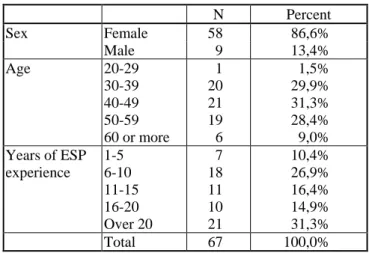
A total of 67 ESP practitioners form HE and VE in Greece and the Republic of Cyprus (56,71%, n=38 from Greece and 43,28%, n=29 from the Republic of Cyprus) participated in the research, the majority of whom were middle-aged female teachers with more than six years of ESP teaching experience, as shown in Table 1.
Table 1 Profile of ESP practitioners
N Percent
Sex Female 58 86,6%
Male 9 13,4%
Age 20-29
30-39 40-49 50-59 60 or more
1 20 21 19 6 1,5% 29,9% 31,3% 28,4% 9,0% Years of ESP
experience 1-5 6-10 11-15 16-20 Over 20 7 18 11 10 21 10,4% 26,9% 16,4% 14,9% 31,3%
Total 67 100,0%
3.5. Results and discussion
The results of the data elicited from the study revolved around 1) the duties of ESP practitioners; 2) the use of technology in their ESP courses; 3) issues related to ESP teacher education.
3.5.1. ESP practitioners’ duties
In order to establish the profile of the ESP practitioners who participated in the study, apart from the demographic information obtained, participants were asked to state their duties as ESP practitioners through a multiple-responses question. As Table 2 illustrates, ESP practitioners had a wide range of responsibilities, with almost everyone being involved in teaching and almost half being involved in research.
Table 2 Duties of ESP practitioners
Duties N Percent Percent of cases
Course Design 61 19,2% 91,0%
Teaching 66 20,8% 98,5%
Materials Selection 59 18,6% 88,1%
Materials Development 60 18,9% 89,6%
Course Evaluation 39 12,3% 58,2%
Research 33 10,4% 49,3%
The fact that ESP practitioners have multiple tasks to perform was originally reported in the literature by Dudley-Evans and St. John (1998) and later on by Johns (2013). The use of technology in this context is crucial, as it could facilitate all of the above processes providing practical assistance, being an infinite source of information and fostering communication and interaction (Bloch 2013; Arnó-Macià 2014).
3.5.2. Use of technology
The ESP practitioners that participated in the study stated that they made use of technology frequently, as according to the responses, the majority always utilised technology in their ESP courses (44,78%, n=30) or very frequently (35,82%, n=24), while only 17,91% (n=12) of the practitioners used technology occasionally, and just 1,49% (n=1) never used technology at all.
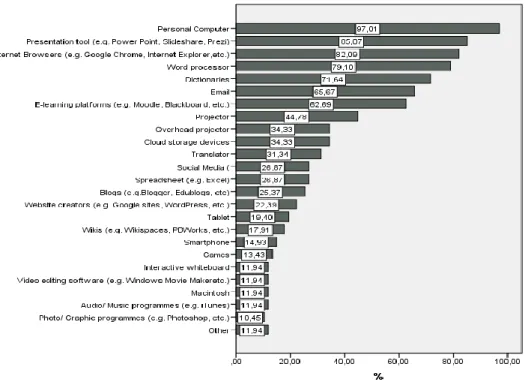
Identifying the different technologies/tools (hardware and software) they used for both course preparation and course delivery, the ESP practitioners indicated the following:
Fig. 1 Technologies used for course preparation
interactive whiteboard, video editing software, audio/music programmes and photo editing software.
Regarding the technologies used for the delivery of ESP courses (Figure 2), the results were the following:
Fig. 2 Technologies used for course delivery
Even though the ESP practitioners appeared to integrate different tools in their teaching practices, the percentages of practitioners who actually utilised technologies for the delivery of their courses were lower than those of the practitioners who used technologies to prepare their courses, as presented in Figures 1 and 2. As in the case of course preparation, the PC and presentation tools were identified as the most popular tools for course delivery, along with projector, word processor, internet browsers, overhead projectors, e-learning platforms, email and dictionaries. On the other hand, tools like social media, blogs, websites, games, wikis, chat tools or smartphones were not listed as popular tools for the delivery of ESP courses among Cypriot and Greek ESP professionals.
could be the lack of the necessary equipment. Since according to recent theories of learning (i.e. social constructivism and connectivism) knowledge is constructed through communication and interaction, it is essential that ESP professionals become acquainted with such technologies.
Furthermore, ESP professionals were also requested to state how often they asked their students to use technology for the course. Almost 48% (n=32) responded that they did that very frequently, whereas 26% (n=17) said that they always did. Few were the practitioners who responded that they asked their students to use technology occasionally (19,40%, n=13), rarely (5,97%, n=4) or never (1,49%, n=1). These results prove that ESP practitioners in fact encouraged the use of technology among their students.
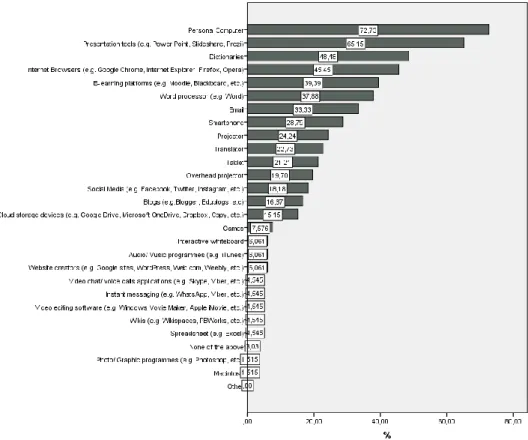
ESP practitioners were also asked to name which technologies were used by students in their ESP classes (Figure 3):
Fig. 3 Technologies used by students for ESP learning in class
these findings reinforce the assumptions that ESP practitioners might lack training in integrating technologies in their teaching practices or that they were not provided with the appropriate facilities or support in order to be able to use a variety of tools in their classes.
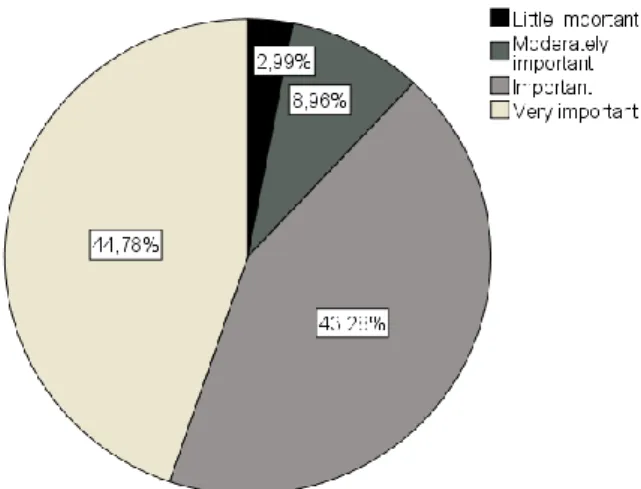
Nevertheless, in spite of the above results, ESP practitioners appeared to realise the significance of using technology in ESP, as the majority acknowledged the use of technology in ESP teaching as important or very important, while the percentage that considered the use of technology as moderately important or little important was small (Figure 4). These results are in agreement with Dogoriti and Pange’s (2012) study, which showed that ESP practitioners in Greece were positively oriented towards the idea of making more use of technology in their practices, despite the fact that they mostly used basic technology tools.
Fig. 4 Importance of using technology for ESP practitioners
3.5.3. Suggestions for ESP teacher education
Apart from the effort to describe ESP practitioners’ use of technology, the questionnaire also aimed at identifying their needs in terms of ESP teacher training. According to the results, the needs that were mentioned by most of the practitioners were the following: using technology was regarded by 34,33% of the participants as one of the aspects in which they needed improvement along with collaboration with subject specialists and colleagues (58,21%), development of learners’ productive skills (47,76%), designing activities and tasks (38,81%), having specialised knowledge on the matter (35,82%) and selecting materials and resources and teaching methodology (34,33%). These may constitute the main areas on which future endeavours in ESP teacher education could concentrate.
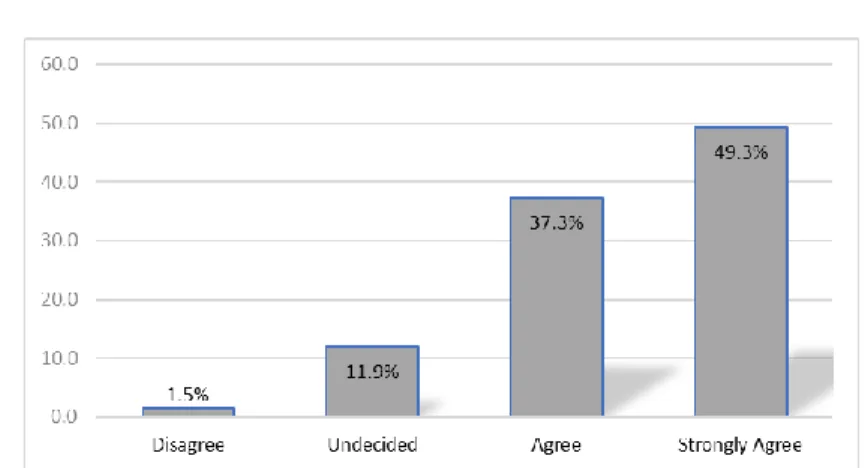
Fig. 5 ESP practitioners’ view on including ways of teaching with technology in ESP teacher education
Almost 90% of the participants agreed with including ways to teach with technology in ESP teacher education courses, a fact that reinforces the assumption that ESP practitioners regard the use of technology as important in the ESP teaching practice and shows that they are positively oriented towards receiving training on the use of technology. This intense need for teacher education on the use of technology in ESP was also expressed in other research studies in different educational contexts (Vukicevic-Dordevic 2015; Kniazian and Khromchenko 2019).
4. CONCLUSION
This paper aimed at examining the use of ICT tools in the teaching practices of HE and VE institutions ESP practitioners in Greece and the Republic of Cuprus. The results of the study showed that the majority of the practitioners had multiple duties to address, which made the use of technology even more important. Additionally, the study showed that even though ESP practitioners used technology in their courses regularly, the ICT tools that they employed for both the preparation and the delivery of their courses were basic, while the majority appeared hesitant to make use of more specialised and advanced tools. Nevertheless, they encouraged the use of technology among their students. All the above, in combination with the fact that most of them appreciated the value of using technology in ESP and were positively oriented towards receiving more education on the matter, lead to the conclusion that more opportunities for ESP teacher education on issues pertaining to the use of technology are needed.
continuous since developments in technology are constant. Therefore, ESP practitioners need more than just occasional training workshops in order to keep themselves updated on the latest developments in the field. Participation in professional networks could prove very useful, as they correspond with the latest learning theories of social constructivism and connectivism, which have also affected ESP teacher education processes. Such networks could involve participation in professional organisations related to ESP or CALL/TELL or different communities of practice (CoPs). Moreover, more ESP teacher education programmes should be offered which include components on incorporating ICT tools in ESP teaching and learning. Finally, institutions should provide ESP practitioners with the necessary equipment and technical support in order to be able to apply these technologies in the teaching and learning processes.
REFERENCES
Arnó-Macià, Elisabet. 2012. ―The Role of Technology in Teaching Languages for
Specific Purposes Courses.‖ The Modern Language Journal 96 (January): 89–104.
https://doi.org/10.1111/j.1540-4781.2012.01299.x.
———. 2014. ―Information Technology and Languages for Specific Purposes in the EHEA: Options and Challenges for the Knowledge Society.‖ In Languages for
Specific Purposes in the Digital Era, edited by Elena Barcena, Read Timothy, and
Jorge Arus, 3–25. Switzerland: Springer International Publishing.
Blin, Françoise. 2012. ―Bologna and the 21st-Century Language Learner: Integrating
Technology for Learner Autonomy.‖ In Foreign Language Instructional Technology:
Theory & Practice, edited by Jack Burston, Dina Tsagari, and Fryni Doa. Nicosia: University of Nicosia Press.
Bloch, Joel. 2013. ―Technology and ESP.‖ In The Handbook of English for Specific Purposes, edited by Brian Paltridge and Sue Starfield, 385–401. Chichester: Wiley Blackwell. Bohm, Anke, Veronika Koeper-Saul, and Christian Mossmann. 2019. ―The European
University Tandem Project – an Integrated Online Platform to Foster Intercultural
Language Exchanges across Europe (and Beyond).‖ In Innovative Language
Teaching and Learning at University: A Look at New Trends, edited by Nelson
Becerra, Rosalba Biasini, Hanna Magedera-Hofhansl, and Ana Reimão, 53–61. Research-publishing.net. https://doi.org/10.14705/rpnet.2019.32.902.
Bonner, Euan, and Hayo Reinders. 2018. ―Augmented and Virtual Reality in the Language Classroom: Practical Ideas.‖ Teaching English with Technology 18 (3): 33–53. https://bit.ly/2Q31URG.
Chostelidou, Dora, Eleni Griva, and Eleni Tsakiridou. 2009. ―A Record of the Training Needs of ESP Practitioners in Vocational Education.‖ In Selected Papers from the 18th
ISTAL, 131–43. http://www.enl.auth.gr/symposium18/papers/14_CHOSTELIDOU_
GRIVA_TSAKIRIDOU.pdf.
Dashtestani, Reza, and Stojkovic Nadezda. 2015. ―The Use of Technology in English for Specific Purposes ( ESP ) Instruction: A Literature Review.‖ The Journal of Teaching
English for Specific and Academic Purposes 3 (3): 435–56. http://espeap.junis.ni.
ac.rs/index.php/espeap/article/view/304.
DC4LT Consortium. 2019. ―Digital Competences for Language Teachers (DC4LT).‖ 2019. https://www.dc4lt.eu/.
Deacon, Amanda, Lucy Parkin, and Carolin Schneider. 2017. ―Looking beyond Language Skills – Integrating Digital Skills into Language Teaching.‖ In Innovative Language
Teaching and Learning at University: Enhancing Employability, edited by Carmen
Álvarez-Mayo, Angela Gallagher-Brett, and Franck Michel, 137–44. Research-publishing.net. https://doi.org/10.14705/rpnet.2017.innoconf2016.663.
Dogoriti, Evriklea, and Jenny Pange. 2012. ―Teaching ESP with ICT in Higher Education: Foreign Language Teachers’ Perceptions and Expectations of Computer Technology Use in Foreign Language Learning and Teaching.‖ ICICTE 2012 Proceedings, 24–34. Dudeney, G., and N. Hockly. 2012. ―ICT in ELT: How Did We Get Here and Where Are
We Going?‖ ELT Journal 66 (4): 533–42. https://doi.org/10.1093/elt/ccs050. Dudley-Evans, T., and M.J. St. John. 1998. Developments in English for Specific Purposes: A
Multi-Disciplinary Approach. Cambridge: Cambridge University Press.
European Commission. 2020. ―European Commission.‖ 2020. https://ec.europa.eu/info/ index_en.
Harmer, Jeremy. 2001. The Practice of English Language Teaching. 3rd ed. Harlow: Longman.
Heggart, Keith R., and Joanne Yoo. 2018. ―Getting the Most from Google Classroom: A Pedagogical Framework for Tertiary Educators.‖ Australian Journal of Teacher
Education 43 (3): 140–53. https://files.eric.ed.gov/fulltext/EJ1174198.pdf
Hirschi, Andreas. 2018. ―The Fourth Industrial Revolution: Issues and Implications for Career Research and Practice.‖ Career Development Quarterly 66 (3): 192–204. https://doi.org/10.1002/cdq.12142.
Johns, Ann M. 2013. ―The History of English for Specific Puproses Research.‖ In The
Handbook of English for Specific Purposes, edited by Brian Paltridge and Sue
Starfield, 5–30. Chichester: Wiley Blackwell.
Kakoulli Constantinou, Elis. 2018. ―Teaching in Clouds: Using the G Suite for Education for the Delivery of Two English for Academic Purposes Courses.‖ The Journal of
Teaching English for Specific and Academic Purposes 6 (2): 305–17. https://doi.org/
10.22190/jtesap1802305c.
———. 2019. ―Revisiting the Cloud: Reintegrating the G Suite for Education in English for Specific Purposes Teaching.‖ In Professional Development in CALL: A Selection
of Papers, edited by Christina Nicole Giannikas, Elis Kakoulli Constantinou, and
Salomi Papadima-Sophocleous, 55–69. Research-publishing.net. https://doi.org/ 10.14705/rpnet.2019.28.870.
Kniazian, Marianna, and Olena Khromchenko. 2019. ―The ESP Lecturers’ Sélf
-Development Competence in Higher Educational Context?.‖ The Journal of
Teaching English for Specific and Academic Purposes 7 (3): 385–93.
Pappa, Giouli, and Salomi Papadima-Sophocleous. 2019. ―Embedding a Serious Game into an ESP Curriculum.‖ In ESP Teaching and Teacher Education: Current
Theories and Practices, edited by Salomi Papadima-Sophocleous, Elis Kakoulli
Constantinou, and Christina Nicole Giannikas, 111–29. Research-publishing.net. https://doi.org/10.14705/rpnet.2019.33.929.
Plutino, Alessia. 2017. ―Teachers as Awakeners: A Collaborative Approach in Language Learning and Social Media.‖ In Innovative Language Teaching and Learning at
University: Enhancing Employability, edited by Carmen Álvarez-Mayo, Angela
Gallagher-Brett, and Franck Michel, 115–25. Research-publishing.net. https://doi.org/ 10.14705/rpnet.2017.innoconf2016.661.
Rosell-Aguilar, Fernando. 2018. ―Twitter as a Formal and Informal Language Learning Tool : From Potential to Evidence.‖ In Innovative Language Teaching and Learning at
University: Integrating Informal Learning into Formal Language Education, edited by
Fernando Rosell-Aguilar, Tita Beaven, and Mara Fuertes Gutiérrez, 99–106. Research-publishing.net. https://research-publishing.net/manuscript?10.14705/rpnet. 2018.22.780.
Sevilla-Pavón, Ana, and Julia Haba-Osca. 2017. ―Learning from Real Life and Not Books: A Gamified Approach to Business English Task Design in Transatlantic Telecollaboration.‖ Iberica 33 (2017): 235–60.
Siemens, George. 2005. ―Connectivism: A Learning Theory for the Digital Age.‖
International Journal of Instructional Technology and Distance Learning 1: 1–8.
https://doi.org/10.1.1.87.3793.
Thaine, Craig. 2010. Teacher Training Essentials: Workshops for Professional Development. Cambridge: Cambridge University Press.
Ur, P. 1996. A Course in Language Teaching. Cambridge: Cambridge University Press.
Vukicevic-Dordevic, Ljiljana. 2015. ―Emerging Technologies: Does It Feel Like Learning?‖ Journal of Teaching English for Specific and Academic Purposes 3 (3): 483–97. http://espeap.junis.ni.ac.rs/index.php/espeap/article/view/263