153 |
P a g e
IMPLEMENTATION OF NOISE CANCELLATION
FROM AUDIO SIGNAL USING LMS ALGORITHM
¹Shweta Sharma, ²Gagandeep Kaur
¹M.Tech Scholar, ECE Deptt.CEC Landran (Mohali), ²Academic and Consultancy Services-Division,
Centre for Development of Advanced Computing (C-DAC), Mohali, (India)
ABSTRACT
This paper presents a approach for noise reduction or cancellation of noise through Least Mean Square algorithm.
Filtering method is used for this approach is adaptive filtering. when the signal introduced by noise it get distorted
and disturbed by the noise and hence reduced audio quality. Here to overcome this problem we use this filtering
technique. This technique helps to improve audio quality and hence minimize losses at the end of result. The
qualitative result is based on human hearing acuity of frequency of signal and in this various real world audio
signal sources with noise are also discussed.
Keywords: Frequency, Noise Cancellation, Adaptive filtering, Least Mean Square Algorithm (LMS)
I INTRODUCTION
Acoustic noise becomes more utter as increases in number of industrial equipment such as transformer, blowers and
engines that are in use. In this paper, noise is define as any kind of undesirable signal whether it is done by electrical
vibrations or any kind of media. signal are superimpose with each other and create an effect with noise.
The main objective of this paper is to build a noise cancelling of audio signal by adaptive filters and LMS algorithm.
Basically noise cancellation is a technique to reduce the undesirable noise from the original signal. An adaptive filter
is use for filtration of noise from any audio signal using feedback. In many applications, adaptive noise cancellation
is an effective method for recovering a signal corrupted by additional noise.
II BASIC CONCEPT OF NOISE
In general term, noise is simply an unwanted signal or sound. Noise in the sound means any variations in air
pressure that is detected by human ear. Signal that is transmitted over the media is combination of both useful and
superimpose with each other and create an effect with noise.
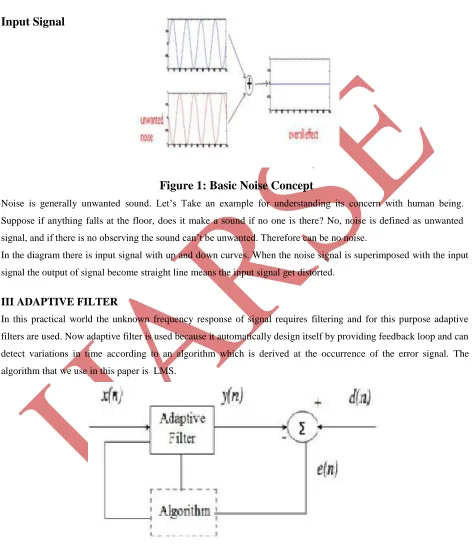
Input Signal
Figure 1: Basic Noise Concept
Noise is generally unwanted sound. Let’s Take an example for understanding its concern with human being.
Suppose if anything falls at the floor, does it make a sound if no one is there? No, noise is defined as unwanted
signal, and if there is no observing the sound can’t be unwanted. Therefore can be no noise.
In the diagram there is input signal with up and down curves. When the noise signal is superimposed with the input
signal the output of signal become straight line means the input signal get distorted.
III ADAPTIVE FILTER
In this practical world the unknown frequency response of signal requires filtering and for this purpose adaptive
filters are used. Now adaptive filter is used because it automatically design itself by providing feedback loop and can
detect variations in time according to an algorithm which is derived at the occurrence of the error signal. The
algorithm that we use in this paper is LMS.
155 |
P a g e
x (n)=input signal y (n)=output signal
d (n)=desire reference response e (n)=error signal
e(n)=y(n)-d(n)
y(n) is concluded by the convolution of the filter weight vector and input signal.
ie y(n)=w(n)*x(n)
Here w is the filter weight vector
The dotted lines show the algorithm is being implemented here in this circuit. The basic elements of adaption are
filter structure, performance criterion and adaption rule. Adaptive filter are used in many application such as echo
cancellation, adaptive equalization, speech coding.
Echo cancellation: when the characteristics of medium changes in which wave is propagating, there occur a
repetition of waveform due to reflection, this is called Echo. In communication echo can degrade the quality of
service. Hence to remove these adaptive filters are used. Echo cancellation is basically used in telephony to improve
quality.
Speech coding: it means compression of data. it is a method of reducing the information that is used to represent the
signal. The reduction is done to send the efficient data over a link. For this purpose adaptive filters are used.
Adaptive equalization: when the signal is transmitted over a channel, it may get distorted, to compensate the
distortion adaptive equalization is being processed with the use of the adaptive filter.
IV LEAST MEAN SQUARE ALGORITHM
LMS algorithm is a noise cancellation algorithm and was developed by Bernard Widrow, a professor at Stanford
University in 1960.His first PhD student Ted Hoff gave equal contribution in his work. It uses continuous adaption
process to remove the noise efficiently and precisely from the system by using updated weight
Vector (W) in all iteration till error signal becomes zero.
4.1 Noise Cancellation Concept
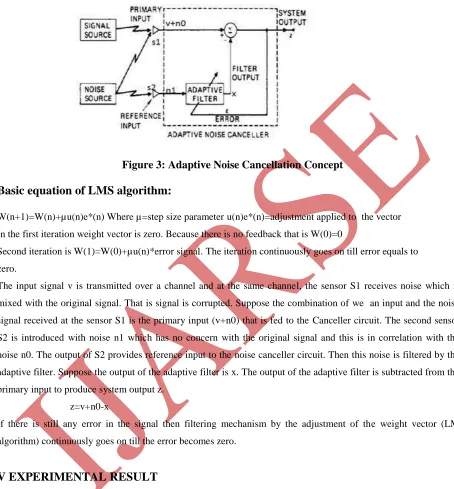
Noise canceller is used to recover the original signal from the noisy signal. The original signal is obtained by doing
Figure 3: Adaptive Noise Cancellation Concept
Basic equation of LMS algorithm:
W(n+1)=W(n)+µu(n)e*(n) Where µ=step size parameter u(n)e*(n)=adjustment applied to the vector
In the first iteration weight vector is zero. Because there is no feedback that is W(0)=0
Second iteration is W(1)=W(0)+µu(n)*error signal. The iteration continuously goes on till error equals to
zero.
The input signal v is transmitted over a channel and at the same channel, the sensor S1 receives noise which is
mixed with the original signal. That is signal is corrupted. Suppose the combination of we an input and the noisy
signal received at the sensor S1 is the primary input (v+n0) that is fed to the Canceller circuit. The second sensor
S2 is introduced with noise n1 which has no concern with the original signal and this is in correlation with the
noise n0. The output of S2 provides reference input to the noise canceller circuit. Then this noise is filtered by the
adaptive filter. Suppose the output of the adaptive filter is x. The output of the adaptive filter is subtracted from the
primary input to produce system output z.
z=v+n0-x
If there is still any error in the signal then filtering mechanism by the adjustment of the weight vector (LMS
algorithm) continuously goes on till the error becomes zero.
V EXPERIMENTAL RESULT
In this section we performed the LMS algorithm for the filtration of the noise. The algorithm was implemented step
by step as discussed earlier. Figure 4 shows the original signal .in this signal no noise is present. Figure 5 shows the
noise introduced in the signal. Which distorted the original signal? A figure 6 show the signal where whole
algorithm is applied i.e. output of a signal, which may or may not contain any noise signal. Figure 7 shows the error
157 |
P a g e
Figure 4: Original Signal Figure 5: Noisy Signal
Figure 6: Filtered Output Signal Figure 7: Error Efficiency
VI CONCLUSION
This paper shows a application based on noise cancellation using adaptive filter. The main aim of this paper is to
use LMS algorithm as a noise cancellation algorithm. The noise free output is obtained after some LMS iterations.
Therefore it gives good results in notice cancellation problem.
REFERENCES
[1] Adaptive Filter Theory by Simen Haykin: 3rd edition, Pearson Education Asia.LPE.
[2] Adaptive Signal Processing by John G Proakis, 3rd edition, Perntice Hall of India.
[3] B. Widow, "Adaptive noise canceling: principles and applications", Proceedings of the IEEE, vol. 63, pp.
1692-1716, 1975.
[4] Adaptive Signal Processing by Bernard Widrow and Samuel D.Stearns; Pearson Education Asia, LPE.
[5] G. Goodwin, K. Sin, Adaptive Filtering, Prediction and Control. Englewood Cliffs, Prentice-Hall, 1985.
[6] Chassaing R. DSP Application using C and the TMS320C6x DSK. Wiley Inter Science. 2002.
[7] Haykin S. Adaptive filter theory. Prentice Hall. 2002.
[8] Kehtarnavaz N and Kim N. Real-time digital signal processing based on the TMS320C6000. Elsevier. 2004.
[9] Deependra T, Sathyanarayan SR, Lizy KJ. An Evolutionary computation embedded IIR LMS algorithm.
Texas advanced technology program #403. 1999.
[10] Treichler JR, Johnson R, Larimore MG. Theory and design of adaptive filters. International Edition.
Prentice Hall. 2001.
[11] Astrom KJ, Wittenmark B. A survey of Adaptive control applications. Conference on decision and control.
1995. 649-654.