TECHNICAL UNIVERSITY OF CLUJ-NAPOCA
ACTA TECHNICA NAPOCENSIS
Series: Applied Mathematics, Mechanics, and Engineering Vol. 61, Issue Special, September, 2018
EDUCATIONAL SERVICES USING CLOUD COMPUTING
TECHNOLOGIES A LITERATURE SURVEY
Dorian UNGURAŞ, Mircea RADU
Abstract: ICT, internet and cloud have added to the real world a complementary, virtual one, where day by day applications including services connected to education, business world, management, informatics, medicine etc. are continuously developed. This paper tries to be a systematic literature review summarizing some relevant researches focused on cloud utilization in the education domain and pointing out connected issues. Each learning environment depends on the requirements of the study program and with the help of cloud software there are numerous advantages that can be obtain which will be covered. A number of 80 papers have been analysed in the current literature review. The resulted conceptual framework highlights the opportunity, the specific technological components, the application areas, quality, performance and security as well as other specific issues that may arise. An overview on cloud computing, cloud learning methods and services, the benefits of using cloud learning as well as the mentioning of the necessary software tools is here included.
Key words: Cloud computing, cloud learning, elearning, ilearning, mlearning
1. INTRODUCTION
For several years cloud computing, has been transforming the IT environment, managing to change the mentality of users by making the software products more attractive than hardware products. Big parts of hardware solutions have been replaced by software applications, mainly because of lower expenses. The cloud environment has become important because of the motivation to improve data processing and storage resources to be done more efficiently, being cost-effective and offering multiple resources [12]. There is a high importance for the costs of businesses to be reduced and the work productivity to improve. Cloud technology is a key figure in Europe and in 2009 has been founded a department to look over this technology: The European Union Agency for Network and Information Security (ENISA) which is the centre of cyber security in Europe. ENISA provided cloud security risk assessments, analysis of security parameters in cloud and created a cloud security and resilience expert group which presented in UE overviews of cloud adoptions in public sectors [8].
The cloud learning environment has been adopted in UE because it offers benefits like: lower costs, data security and accessibility of products from every corner of the world. It is influential in people’s lives, offering services and applications that have access to worldwide knowledge and online trainings. In 2016 there was an increase in using cloud technologies like the usage of cloud-based files and sharing-presentation applications from 20% to 49%, and virtual meetings from 65% to 79 % [13]. For example, with the help of cloud learning products Northern European countries are favouring constructivist pedagogy. UNESCO is encouraging the use of cloud resources because it can help the digital educational world and the learning styles can evolve [30].
cloud influence in education and the tools that are used for high level performance for non-contact education. There are necessary software and hardware tools that are used in the implementation of cloud learning that will be covered. Conceptual framework highlights the opportunity, the specific technological components, the application areas, quality, performance and security as well as other specific issues that may arise.
It is also offered an overview over cloud computing and cloud learning including methods and tools that were used. Afterwards the benefits and issues of implementing cloud learning are addressed. From the cloud learning domain, 2 main subdomains: eLearning and iLearning are analysed. There will be presented some systematic analyses and there will be identified ideas that are relevant in cloud education.
The study has been conducted on over 80 papers identified and analyzed, filtered by criteria’s such as: relevance to the subject, the covered subdomains and number of citations. A number of 40 papers have been preserved which were divided in subdomains as: cloud computing, cloud learning technologies and specific tools used. The benefits and issues encountered when implementing cloud learning, eLearning, ilearning and other virtualized learning systems were also followed.
2. BACKGROUND
In the 21st century, students and teachers can’t be restricted to traditional teaching and learning methods. The classical mode of teaching is not supported by all the types of learners. Making the physical presence in class mandatory should be reconsidered and reanalyzed. In present times students depend and resonate with technology almost every day so why not use it in the advantage of learning.
With the implementation of cloud products in the learning environment the students experience will change regarding to study and gaining knowledge on new ideas.
A grow in the cloud computing environment was predicted and there was an estimate that the usage of cloud software has grown over 6 times from 2013 until present [1].
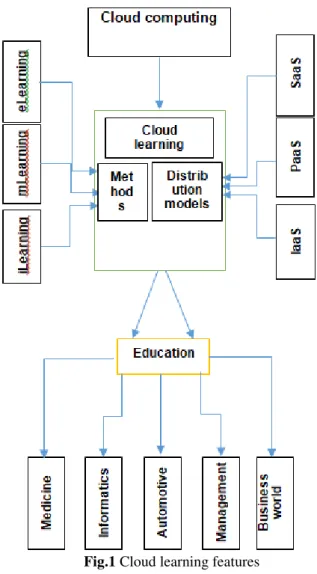
Fig.1 Cloud learning features
Figure 1 represents the processes that form cloud learning and their usage in influential domains. The main focus of this paper will be on the methods of cloud learning and their components, distribution models and applications. The virtual environment learning methods are eLearning, ilearning, mLearning and the distribution models that supports them are IaaS (Infrastructure as a Service), PaaS (Platform as a Service) and SaaS (Software as a Service). All of these features from picture 1 will be presented in more details in the following rows.
Education is the most influenced by cloud learning because it is growing learners into fully qualified specialists every year, and as it can be seen in figure 1 all the other domains are benefiting from this.
operations can be stored on the cloud and can be accessed by doctors [5].
In the informatics domains, cloud learning is well spread with some of the technologies covered in this paper and the other domains will have to import these features.
The automotive field has implemented features of cloud computing by storing technical information on the cloud with different services. Also, a lot of vehicles are gaining traffic information from the cloud environment [2].
In the management and business field cloud has been introduced with different concepts like cloud management or quality cloud management or even with the technique identity management as a service (IDaaS). This domain is very familiar with the cloud technologies and has embraced them [25].
2.1 Distribution Models
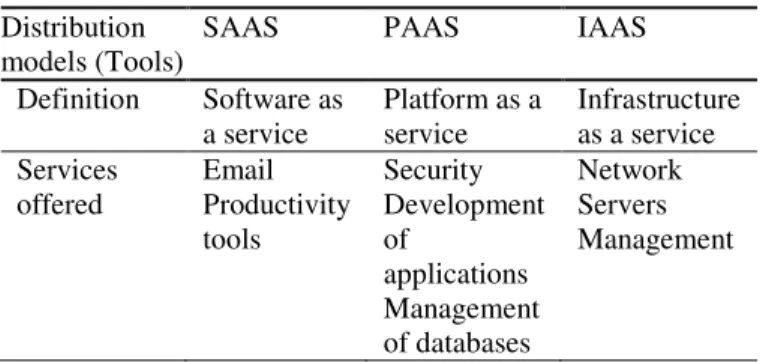
Presented in figure 1, the distribution models, in this paper can be considered as tools that are used when implementing cloud products and cloud education: SAAS, PAAS, and IAAS. Software as a service (SAAS) it is referring to a software licensing model where software is licensed on a subscription and is centrally hosted being accessed by users via a web browser [18].
Platform as a service (PAAS) makes available to users a platform where there can develop, run and manage applications without the expensive of hardware components and infrastructure [21].
Infrastructure as a service (IAAS) is the delivery of the network infrastructure, servers, storage and the software from these resources into a service.
Table 1: Tools, services and applications used in cloud
Distribution models (Tools)
SAAS PAAS IAAS
Definition Software as a service
Platform as a service
Infrastructure as a service Services
offered
Email Productivity tools
Security Development of
applications Management of databases
Network Servers Management
Applications used
IBM Oracle Google apps
Windows azure Amazon
Cisco Microsoft
In table 1 we can observe the main services that are offered by the 3 distribution models. Services like email, security, servers and network are used daily indirectly or directly by any user with an internet connectivity, so it can be assumed that the usage of the learning methods will be the same.
Big companies like Microsoft, Google are developing platforms for education with the help of cloud learning.
For example Microsoft has developed office 365 for education, web apps and exchange hosted services.
Google apps have provided the email, calendar and documents for collaborative study. Also chromebooks are developed for education and also the app google play for education [7]
2.2 Cloud learning methods
Cloud learning is influenced by the 3 learning methods: eLearning, iLearning and mLearning which come in the support of students, teachers or employees that simply want to learn something on-line.
Cisco systems, the first leaders in developing internet and networking technologies that changed the way peoples work, interact and live, were the first ones focusing on eLearning in the 1990’s [14].
eLearning is short for electronic learning and can be described as the use of web-based technology tools and enables the form of distance and non-contact education. eLearning promotes face to face education, distance education and facilitates the education content [10].
Another definition can be that elearning is an internet-based learning process that will improve the efficiency of education [3].
eLearning helps the user obtain new searching abilities and concentrate on learning objectives. Weller listed a couple of eLearning pedagogies:
• Constructivism
• Resource based learning • Collaborative learning • Problem based learning • Situated learning
Narrative based teaching [28]
eLearning offers a virtual environment learning that it belongs to an organization and is available on an intranet/extranet network that is available only for the employees of that specific company.
iLearning has the same principles and concepts as eLearning. It is short from internet-based learning and it can be defined as a process of searching data online and the learner stores the information found and will use that information [9].
iLearining experience is different from eLearning experience because the user must enrol on a website that will offer courses, trainings and videos and will have professional guidance, basically doing an online schooling. On the other hand, eLearning includes self-motivation and self-education and dedication. [10].
mlearning refers to mobile learning and is focusing on using mobile technology for learning purposes. It is a new technology and it
allows people that have a
smartphone/tablet/laptop and an internet connection to obtain learning materials. People using this technology are just downloading the documents needed and can share them by email or other chatting applications to different colleagues or teachers. mlearning is taking part in the mass adoption of mobile devices in the last years by influencing people lives and helping them gain knowledge and documentations.
mlearning has managed to eliminate geographic boundaries because the learning materials and documents are shared all over the world [18]. Also with mLearning students can expand different topics or discussions from school in their free time with their colleagues and friends and so creating a social constructivism [23].
3. RESEARCH RESULTS 3.1 Cloud computing
Cloud computing has different definitions from different sources and in a short description it can deliver hosted services over the internet. In addition, it can be categorized piece by piece. For example, we can call cloud the software and data center the hardware. If there is available a service on the internet that should be paid for usage it can be called a public cloud. The service that is sold can be called utility computing. If there is a business or organization with data center infrastructure that is not available to public, then it should be named private cloud [4].
In the IT industry, the changes that will come will put a lot of pressure on the budget of the organisations hence cloud services could provide opportunities at affordable costs [18]. Cloud computing holds the potential of solving some of the ICT problems in domains like education, medicine economics and many more [28].
The documentation, the information and all the data that is used in the learning environments on line are stored on the cloud computing. Cloud computing can be described as delivering services over the internet [15]. Many of this services that are hosted on cloud are related to education and there are a lot of databases containing educational information’s. The services provided by cloud environment will improve delivery and content to the education field [27]. Hence the education field is spreading rapidly on the cloud environment and this has been observed with the appearance of eLearning, iLearning, mLearning and cloud learning.
For example, if there are software products implemented on major business applications, like support or marketing or even sales, that will be defined as an enterprise computing in the cloud. The second example is in the direction of infrastructure where cloud environment has taken over a big part of the data center. Also, the hosting environment has been gaining ground because a lot of big companies like amazon.com or google are investing and focusing on this software. The last example is the cloud operating system where in the future the entire user-interface will be on web browser page, where there will be applications, folders, and icons, all there is on a familiar pc/laptop desktop [9].
3.2 Cloud learning
The concept of learning can be defined as changing people’s behaviour and lives [22]. With the help of cloud computing technology, the cloud learning environment appeared, or it can be named the distance learning experience that brings new concepts, resources and opportunities.
Cloud learning can be looked as a replacement or more like a supplement of traditional teaching practices. It can be defined as a non-contact education or self-education of the user which can establish connections, interactions and sharing in a cloud learning environment. The users that attends cloud learning can meet their personal needs or the employer’s needs because many corporates have opted for this technology in the last years [6].
Cloud learning environment can be described as a learning institute that has learning services and information stored on the cloud [17]. It needs to be available in different languages and fulfil all requirements of the customers when using this software knowledge technology. On-line learning is becoming more popular, and there are predictions that this trend will be delivered by at least 50% on all classes by the year 2019. National Student Clearinghouse Research Centre is stating that in the US between years 2012 and 2013 there was an increase by 23% of the institutes that launched e-learning platforms. Furthermore, in 2015 23% of students stated that if their programs will not
be available on-line they will not pursue a degree. Udemy is an on-line learning platform for students, and they stated that 13million people choose to study development and 8.5 to study business. Most students think that on-line learning is better than traditional classroom experience [37].
3.3 Learning methods
People are changing and adapting to technologies that are using to communicate, to work and to study with. Devices that are connected to the internet can be a source of education. Also, the teachers that are trying to learn students have evolved by embracing technology and using projectors, online courses, laptops and intelligent boards [22]. In the past we had only teachers that where holding courses and trainings but with the help of technology new learning methods have been created, like eLearning, iLearning, mLearning which in many times do not need a presenter. All this new learning technologies can be considered as non-contact education because people that use them are having contact only with a laptop/pc/mobile phone and are not interacting with a person.
These learning management systems are used by academic institutions for delivering distance learning programs [12]
Cloud learning is an online learning technology that is described as education only through the web with no physical learning materials. There could be used some learning resources like lecture notes, podcasts or video casts to help and to decrease the time spend by students when learning through the cloud environment [24].
With the implementation of ICT technology in the process of teaching it can be determined a critical need for the teacher/trainer to have specific trainings with the cloud learning methods.
In order to fulfill this expectations, would be better if the teachers/trainer could enroll into a program and complete an application with their educational background, knowledge of cloud learning methods and subject matter level they were teaching. Also the teacher/learner that will present the materials to students/learners must be able to offer high quality when presenting the materials and be a good pedagogical communicator [24].
There is no doubt that using virtual teachers/trainers in cloud learning is a plus because of the knowledge and the explanations they could bring on different topics.
The process of teaching learning can obtain something creative, for example complex games to make teaching more likeable, more interesting and with a higher impact on students/ learners [33].
4. LEARNING DISCUSSIONS 4.1 Learning environments
Using eLearning as a part of a learning program comes with a couple of benefits:
• Using technology to facilitate learning like simulations that support explanation of theories • Websites that provide course information to students, on-line courses
• Accessing materials directly from home or other place if there is available an interne connectivity
• Communication tools that facilitate teacher-student interaction or student-student interaction: emails, forums, chats [23]
Other methods that are helping the cloud learning environment are ilearning and mlearning.
ilearning is referring to an enrolment in a schooling program that is taken online that offers videos and communication programs. This learning style is ideal to people who need guidance in understanding better the information and sometimes an expert teacher will offer guidance [35].
mlearning refers to mobile learning and accessing the cloud content from devices like
mobile phones or tablets. This technology is expanding in present because people resonate to a more affordable technology that is used every day [8]. People are depending on their smartphone and tablets and mlearning is the easy way to obtain information and knowledge with different courses.
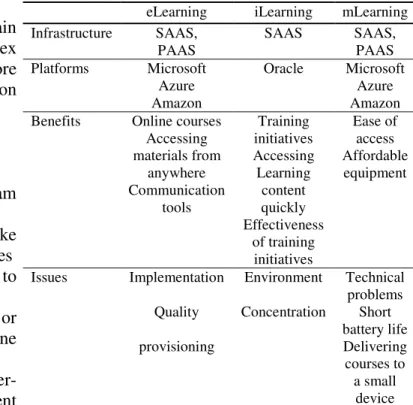
In table 2 are presented the platforms supported by the cloud learning methods and also the benefits they bring.
As it can be observed in table 2 every distribution model comes with different platforms, benefits and could encountering a couple of issues when implemented. This paper has highlighted a couple of issues that will be described mode deeply in the following subchapter 4.2.
Table 2: Cloud learning methods
eLearning iLearning mLearning Infrastructure SAAS,
PAAS
SAAS SAAS,
PAAS Platforms Microsoft
Azure Amazon
Oracle Microsoft Azure Amazon Benefits Online courses
Accessing materials from
anywhere Communication
tools
Training initiatives Accessing Learning
content quickly Effectiveness
of training initiatives
Ease of access Affordable equipment
Issues Implementation Quality
provisioning
Environment
Concentration
Technical problems
Short battery life Delivering courses to a small
device
4.2 Cloud learning issues
There are a couple of issues encountered when implementing the presented cloud learning methods, applications and technologies.
Cultural aspects should be discussed with the interaction of males and females and cultural sensitivities must be taken in consideration. Another concern that must be addressed is the likeliness of trust of the material provided and the reputation of the person that is teaching the material is important [11].
Some questions need to be asked when implementing cloud learning.
Does tablets and phones offer a learning experience as good as the one in a classroom with the presence of a teacher?
Will students and attendees to elearning courses or ilearning courses be attention to the course as in a school with the presence of a teacher? What does a personal learning environment from home look like? Is it suitable for learning? Will the cloud learning experience give students/learners the opportunity to obtain the skills and knowledge needed in the work field? And finally an issue that could appear is the lack of communication between teachers and students because the interaction from abnormal class will be missed by both parties [9]
5. CONCLUSIONS
Cloud learning is helping and emerging as a useful resource in education, influencing and helping the main fields of the world economy. With the help of cloud learning the definition of studying can be changed to a more attractive way, with different types of interaction with teachers/students from any place on the planet. It can be considered that the learning experience will be improved consistently in the years to come as this method is just at the beginning. Also, people will need to be prepared to invest in this learning technologies because a couple of them will come with a cost if they are not supported by an institution or business company.
On the other hand, by using the power of the cloud learning technologies, students and teacher will be able to use the tools they need in a limited amount of time with no costs and from different locations.
The main purpose of this paper was to identify and analyze major challenges for cloud learning and the learning methods: elearning, ilearning, mlearning.
Delivery of education carries great potential, but it must be done in awareness of challenges with the right infrastructure and cost effective. A couple of issues were identified that might be encountered when implementing cloud learning: teaching and learning activities, cultural aspects, cost effective, lack of communication.
Future research is needed to answer and analyze this questions after the cloud learning methods will be implemented on a large scale in the near future.
6. REFERENCES
1. Ahuja, S., & Mani, S. (2012). Availability of
services in the era of cloud computing.
2. Akihito, I., & Mikio, A. (2011, September).
Automotive Cloud Service Systems Based on
Service-Oriented Architecture and Its
Evaluation.
3. Anwar Hossain, M., & Xiaodi, H. (2012). An
E-learning System Architecture based on cloud computing.
4. Armbrust, M., Fox, A., & others. (2010). A View
of Cloud Computing.
5. Carlos, O., Fernando Luiz, K., & Carlos Becker,
W. (2010). A Cloud Computing Solution for
Patient’s Data Collection in Health Care Institutions.
6. Cloudlearning.weebly.com. (2018, 2 4).
Retrieved from
http://cloudlearning.weebly.com/what-is-cloud-learning.html
7. crucial.com.au. (2018, 5 15). Retrieved from http://www.crucial.com.au:
http://www.crucial.com.au
8. ENISA. (2018, 3 15). Retrieved from ENISA: https://www.enisa.europa.eu/topics/cloud-and-big-data/cloud-security
9. Fariborz, M., & Ehsan, B. (2014). Comparing
two methods of education(virtual versus traditional) on learning of Iranian dental students.
10. futureschool. (2018, 6 15). Retrieved from futureschool:
https://www.futureschool.com/resources/ilearnin g-vs-elearning/
11. Hayes, B. (2008). Cloud Computing. 10-11.
12. Hirsch, B., & W.P. Ng, J. (2016). Education
Beyond the Cloud: Anytime-anywhere learning in a smart campus enviroment.
13. Johnson, L., Smith, R., & Willis, H. (2011). The
14. L.C., J., R.J., H., & others. (2002). Virtual Enviroments for Teaching & Learning.
15. Lee, C. (2012). Cloud Computing for teaching
and learning.
16. Lyalina, Y., Langmann, R., & Krisilov, V.
(2011, November). The Interaction Model in
iLearning Environments and its use in the Smart Lab concept.
17. Marinescu, D. C. (2018). Cloud computing,
theory and practice. Morgan Kaufmann, an imprint of Elsevier.
18. Nabil, S. (2010). Cloud computing for
education: A new dawn?
19. Nichols, M. (2003). A theory for eLearning.
20. Nilcan, C. O., & Feride, T. (2012). Is M-learning
versus E-learning or are they supporting each other?
21. Overton, L., & Dr Dixon, G. (2016, April).
Preparing for the future of Learning.
22. Panagiotis, K., & Panagiotis, K. (2011). Cloud Computing Learning.
23. Paul, L., Jack, L., & Mavin, C. (n.d.). Students’
use of eLearning strategies and their perceptions of eLearning usefulness.
24. Reza, C., John D., C., & others. (2014). Cloud
Computing for Education: A Professional Development Program for HighSchoolTeachers.
25. Rita, K., & Fiona, C. (2015). Cloud Computing
and Creativity: Learning on a Massive Open Online Course.
26. Rossing, J., Miller, W., & others. (2012).
iLearning: The future of higher education?
27. Ruth, L. (2012). Bring Your Own Device (BYOD) with Cloud 4 Education.
28. Sameera, A., & Chan Yeob, Y. (2010). Cloud
Computing Security Management .
29. Tao, W. (2009). Learning in the Virtual World:
the Pedagogical Potentials of massively multiplayer online role playing games.
30. Unesco. (2018, 3 15). Retrieved from Unesco: https://en.unesco.org/courier/july-september-2017/sharing-legally-and-freely-better-learning
31. Victor, C., & Gary, W. (2012, September). A
University of Greenwich Case Study of cloud computing - education as a service.
32. Weller, M. (2002). Delivering Learning on the
Net: the why, what and how of online education. 33. wikipedia. (2018, 6 15). Retrieved from
wikipedia:
https://en.wikipedia.org/wiki/Software_as_a_ser vice
34. wikipedia. (2018, 6 15). Retrieved from wikipedia:
https://en.wikipedia.org/wiki/Platform_as_a_ser vice
35. www.futureschool.com. (2018, 1 24). Retrieved
from www.futureschool.com:
https://www.futureschool.com/resources/ilearnin g-vs-elearning/
36. www.igi-global.com. (2018, 1 24). Retrieved
from www.igi-global.com:
https://www.igi- global.com/chapter/inquiry-based-learning-on-the-cloud/144100
37. www.imodeducation.com. (2018, 2 4). Retrieved from ttps://www.imodeducation.com/popularity- online-courses-e-learning-2016-based-trends-statistics/
Servicii de educatie cu utilizarea tehnologiilor de computatie de tip cloud. Studiu al literaturii
Rezumat: TIC, internet și nor au adus în lumea reală o abordare complementară, virtuală, în care se
dezvoltă continuu aplicații zilnice, inclusiv servicii legate de educație, mediul de afaceri,
management, informatică, medicină etc. Această lucrare încearcă să fie o revizuire sistematică a
literaturii care rezumă unele cercetări relevante axate pe utilizarea norului în domeniul educației și
evidențierea problemelor conexe. Fiecare mediu de învățare depinde de cerințele programului de
studiu și cu ajutorul software-ului cloud există numeroase avantaje care pot fi obținute care vor fi
acoperite. Un număr de 80 de lucrări au fost analizate în cadrul revizuirii actuale a literaturii. Cadrul
conceptual rezultat evidențiază oportunitatea, componentele tehnologice specifice, domeniile de
aplicare, calitatea, performanța și securitatea, precum și alte aspecte specifice care pot apărea. Este
inclusă aici o prezentare generală a cloud computing, metodele și serviciile de învățare în cloud,
avantajele utilizării învățării în cloud, precum și menționarea instrumentelor software necesare.
Dorian UNGURAȘ, Technical University of Cluj-Napoca, Romania, 28 Memorandumului Street, 400114, [email protected].