Omiko Akani, IJSRE Volume 05 Issue 03 March 2018 Page 6254 Volume||5||Issue||03||March-2017||Pages-6254-6261||ISSN(e):2321-7545 Website: http://ijsae.in Index Copernicus Value- 56.65 DOI: http://dx.doi.org/10.18535/ijsre/v5i03.02
A Effect of Children’s Radio/Television Programmes on Basic Science and Technology
Education
Authors Omiko Akani
Ph.D, Department of Science Education Faculty of Education Ebonyi State University, Abakaliki E-mail: [email protected]
ABSTRACT
This study focused on the effect of children’s Radio/Television programmes on childhood education. Specifically, it considered whether the chidren are familiar with those programmes that are specifically meant and produced for their consumption, things that children believe they learn from these programmes; whether the Radio/Television programmes created for the children are desirable. 400 pupils randomly sampled from 20 primary schools in Ebonyi State of Nigeria were used for the study, questionnaire was the instrument used for data collection. The results of the data analysis showed that majority of the children were familiar with the programmes, a large number of the children learn the skills which the programmes set out to inculcate. Based on these, recommendations were made on the use of Radio/Television programmes for effective education of the primary school children on basic science and technology.
INTRODUCTION
Teaching a child to embrace the culture of his society has been of great concern of people all over the world (Upe, 2006) and Omiko, 2016). According to history, the male child was introduced into the profession of the father at a very tender age while the female child joined the mother in the family chores (Okafor, 1981). In the traditional system of education, all human society, in order to perpetuate and transmit its culture to the offspring developed system of education by which a child can learn the tenants of the culture.
Learning Process: There are several ways by which a child can learn and acquire skill. He can learn by receiving direct and life instructions from his elder ones, teachers or parents in the society. A child can learn by doing or discovery. Learning can also take place through play. In this case, instead of talking about situation, teachers contrive or simulate a variety of learning environment (Maccoby, 1981). In some cases the child is given a project to tackle and is expected to take some initiative; in this way the child learns the various techniques involved in handling apparatus during experiments. The children also learn when they are exposed to real life situations.
Learning can also occur through modeling and imitation of real life situation, reading of printed materials, telling stories, listening to news, Radio/Television programmes, dancing, discussion and even Music and Upe (2006).
Omiko Akani, IJSRE Volume 05 Issue 03 March 2018 Page 6255 In some developing countries, the use of television in Education is a new concept. The use of television started in Nigeria in 1959. Since then, the acquisition of this all important medium of communication has been on the increase and many families have access to it on daily basis. As a result many Nigerian children have become familiar with a wide variety of television programmes shown in stations around their states. The television stations on their own part have developed some programmes that are specifically meant for children. However, many people have continued to question the educational values of these programmes. Enuesike (1985) and Upe (2006) were of the same opinion when they observed that the influence of television and radio in the society had led some people to view it as a source of vicarious socialization that tends to supplement other agents of socialization like the family, the school, the peer group and the church among others in providing influential models that may be emulated. While some people see television and radio as good teaching materials others contend that television is an ambivalent medium, Mkpa (1987). Based on the opinions expressed above by the researchers on the influence of television and radio programmes on the education of the children, one questions the potentials that television has as an education medium. In answer to this question, the researcher decided to carry out this study.
Statement of the Problem
Studies carried out in different countries and observations made within Nigeria show that television viewing and listening to radio influences the behaviour, attitude, habit and cognitive ability of children, (Upe, 2006), Enuesike (1985) observed that recent utterance’s of parents, programme consumers and teachers indicate concerns about the effect of Radio/Television programmes on our young people. Similarly, some experienced teachers emphasized that television programming results in decrease in imaginative play and increase in aimless running around, non-involvement in playing activities/materials, low frustration, tolerance and confusion about reality and fantasy.
Presently there is general anxiety on falling standard of education, increase in aggressive behaviour of children and general moral decay. This concern has motivated this study in an attempt to answer the following questions; are children familiar with programmes meant for them? What are the educational implications of these radio/television programmes?
Purpose of the Study
The main purpose of this study is to find out the influence of Radio/Television programmes on children’s Basic Science and Technology education. Specifically this study will;
1. Identify television programmes related to children’s education
2. Determine whether these Radio/Television programmes are science based
3. Find out the influence of these programmes on basic science and technology of education. Significance of the Study
In recent time, most television stations both old and new have developed programmes specifically for children. They focus attention on children for a number of reasons.
Omiko (2015) observed that young children learn better through perception as they cannot think logically and in an abstract form. They accept all things they see as real. Children at a young age develop such virtues as cooperation, sense of fair play and honesty and a sense of value. At this stage, development of intellectual ability continues in the children. What they learn in one stage influences the next stage. Thus any healthy development in the first stage may be carried over to the next stage and may create obstacles and problems in the child’s development. The intellectual development of the child may be retarded due to the fact that he or she did not complete his developmental task at the first stage. Therefore, we need to derive the best way of educating the child at early stage of development.
Considering the importance of television generally in enhancing education and influencing behaviour either positively or negatively, the researcher sees an obvious need for embarking on the study.
Omiko Akani, IJSRE Volume 05 Issue 03 March 2018 Page 6256 our institutions. They would therefore serve as a useful guide to the establishment and running of the television and radio houses in places where the facilities and labour for such is yet to mature. It will also help parents and teachers in guiding the television viewing habits of the children.
Scope of the Study
This study was carried out in Ebonyi State of Nigeria. It was focused on the influence of Radio/Television programmes on Basic science and technology education, its familiarity and desirability to primary school children.
Research Questions
The following research questions guided the study:-
1. Are the majority of the children familiar with those radio/television programmes that are specifically meant for their consumption?
2. Do the children believe they learn intellectually, physically, socially and morally from these Radio/Television programmes?
3. Are Radio/Television programmes desired by children for proper social life? Methodology
This deals with the strategies used in carrying out the research, such strategies include design of the study, area of the study, population of the study, sample and sampling technique, the instrument for data collection, validation of the instrument and data analysis.
Design of the Study: The study is a survey research. This is a design in which data is collected from a sample of a large population to enable the researcher describe in a systematic manner and interprets the characteristic features and facts about things that exist (Abonyi, 2013).
Population of the Study
The population of the study comprised of all the primary schools in Ebonyi State school system. Sample and Sampling Technique
Out of 847 public primary schools in Ebonyi State of Nigeria, 20 schools representing approximately 2.36% were randomly selected for the study. The method used in selecting the sample for the study was the simple random sampling method.
Instrument for Data Collection
Questionnaire was the instrument used for the data collection. The questionnaire items were generated based on the information gotten from literature review and interview with the programme producers regarding the categories, contents, aims and objectives of the programmes.
Validation of the Instrument
The questionnaire instrument was given to two experts, one from Mass Communication Department and the other one from Measurement and Evaluation. These experts helped in validation of the instrument in terms of face validation and content validation.
Method of Data Collection
The questionnaire was administered personally to four hundred (400) pupils by the researcher with the help of the classroom teachers as research assistants. In each school, twenty (20) copies of the questionnaire were administered to 20 selected pupils. All the 400 copies of the questionnaire were administered, they were properly filled by the respondents and they were collected by the researcher on the spot.
Method of Data Analysis
Omiko Akani, IJSRE Volume 05 Issue 03 March 2018 Page 6257 RESULTS
The results of the data analysis were organized according to the research questions and placed in tables. Research Question 1
Are majority of the children familiar with those radio/television programmes that are specifically meant for their consumption?
Table 1: Children’s Familiarity with Radio/Television Programmes Radio/Television
Programmes
Yes No Total
f % f % f %
Do it yourself 303 75.75 97 24.25 400 100
Children’s time 368 92.00 32 8.00 400 100
Junior opinion 344 86.00 56 14.00 400 100
Trip learn 277 69.25 133 30.75 400 100
Quiz time 281 70.25 119 29.75 400 100
The data analysis on the table above show the reactions of the respondents to the five (5) items in the questionnaire. As indicated in the table column “yes” represents those that are familiar with each programme while “no” stands for those that are not familiar.
In the table, the result indicates that in the item, “Do it yourself”, 75.75% are familiar with programme while 24.25% are not familiar. In children’s time, 92.00% are familiar while 8.00% are not, “junior opinion” has 86.00% as those who are familiar while 14.00% are not. The rest, trip learn, quiz time had 69.25% and 70.25 respectively as those who are familiar while 35.75% and 29.75% respectively are not familiar with the programmes.
Research Question 2
Do the children believe they learn intellectually, physically, socially and morally from these radio/Television programmes?
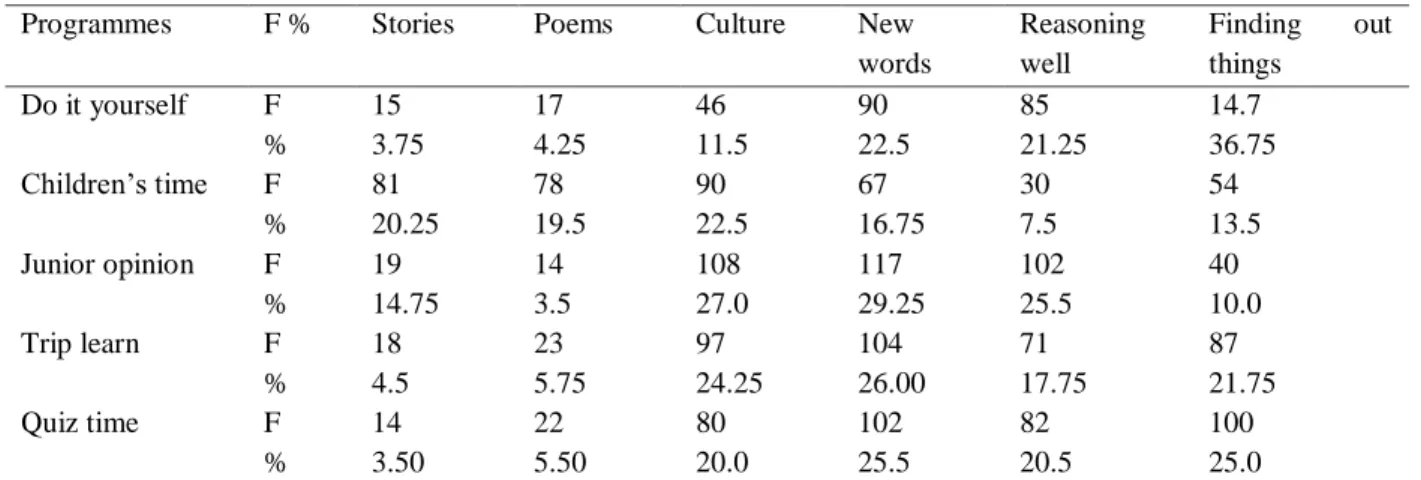
Table 2: Programmes in relation to intellectual leaning skills
Programmes F % Stories Poems Culture New
words
Reasoning well
Finding out things
Do it yourself F 15 17 46 90 85 14.7
% 3.75 4.25 11.5 22.5 21.25 36.75
Children’s time F 81 78 90 67 30 54
% 20.25 19.5 22.5 16.75 7.5 13.5
Junior opinion F 19 14 108 117 102 40
% 14.75 3.5 27.0 29.25 25.5 10.0
Trip learn F 18 23 97 104 71 87
% 4.5 5.75 24.25 26.00 17.75 21.75
Quiz time F 14 22 80 102 82 100
% 3.50 5.50 20.0 25.5 20.5 25.0
The data in the above table show the reactions of the respondents to the five items of the questionnaire. It seeks to find out what the respondents learn intellectually from the programmes.
The results above show that “ Do it yourself have 36.75% in learning how to find out things, 21.25% learn to reason well, 22.5% learn new words, while only 3.75%, 4.25%, 11.5% respectively indicated that they learn stories, poems and culture.
For the children’s time, 20.25% learn stories 19.5 learn poems 22.5 learn their culture, 16.75% learn new words, while, 7.5% and 13.5% respectively indicate that they learn reasoning and finding out things.
In “junior opinion”, 4.75% learn stories, 3.5% learn poems, 27.00% learn their culture, 29.25% learn new words, 25.5% learn to reason while 10.0% learn how to find out things.
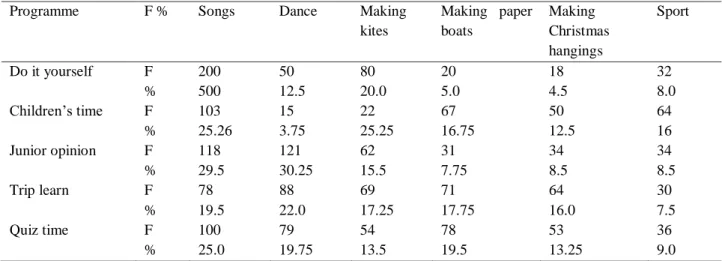
Omiko Akani, IJSRE Volume 05 Issue 03 March 2018 Page 6258 Table 3: Programmes in Relation to Physical Learning skills
Programme F % Songs Dance Making
kites
Making paper boats
Making Christmas hangings
Sport
Do it yourself F 200 50 80 20 18 32
% 500 12.5 20.0 5.0 4.5 8.0
Children’s time F 103 15 22 67 50 64
% 25.26 3.75 25.25 16.75 12.5 16
Junior opinion F 118 121 62 31 34 34
% 29.5 30.25 15.5 7.75 8.5 8.5
Trip learn F 78 88 69 71 64 30
% 19.5 22.0 17.25 17.75 16.0 7.5
Quiz time F 100 79 54 78 53 36
% 25.0 19.75 13.5 19.5 13.25 9.0
The above data on table 3 indicate the reactions of the respondents to six of the items in the questionnaire. It focused on finding out what physical learning’s that are obtained by the children from the programmes. From the table, “Do it yourself item had 50.0%, 12.5%, 20.0% and 5.0% respectively for songs, dances, making kites and making paper boats while 4.5% and 8.0% learn making of Christmas hangings and sports. Data from “children time” showed that 25.26%, 3.75% 25.25% and 16.75% learn songs, Dances, making kites and making paper boats, respectively, while 12.5% 16.0% learn making of Christmas hangings and sports respectively.
For “junior opinion” 29.5%, 30.25%, 15.5% and 7.75% learn songs, dances, making of kites making of paper boat while 8.5% and 8.5 learn making of Christmas hangings sports respectively. Data for “trip learn” indicates that 19.5%, 22.0%, 17.25% and 17.75% learn songs, dances, making of kite and making of paper boats, while 16.09%, 7.5% respective learn making of Christmas hangings and sports. For quiz time, 25.0%, 19.75%, 13.5% and 19.5% learn songs, dances, making of kites, making of paper boats while 13.25% and 9.0% learn making of Christmas hangings and sports respectively.
Table 4: Programmes in Relation to Social/Moral Learning
Programmes F% Punctuality Truth Help
others
Behave well
Respect for others
Do it yourself F 88 100 91 34 87
% 22.0 25.0 22.75 8.5 21.75
Children’s Time F 101 81 89 100 29
% 25.25 20.25 22.25 25.0 7.25
Junior opinion F 118 121 85 58 18
% 29.5 30.25 21.25 14.5 4.5
Trip learn F 73 90 111 70 56
% 18.25 22.5 27.75 17.5 14.0
Quiz time F 89 77 101 85 48
% 22.25 18.25 25.25 21.25 12.0
From the above table, it shows the reaction of the respondents on the item seven of the questionnaire which sought to find out what the respondents learn socially/morally from the programmes. The results indicate that in “Do it yourself” 22.0% learn to be punctual, 25.0% learn to tell the truth, 22.75% learn to help others, 8.5% learn behave well while 21.7 learn to respect others. Data fro children’s time, show that 25.25%, 20.25, 22.25% learn to be punctual, learn to tell the truth, learn to help others respectively while, 25.00% 7.25% learn to behave well and respect for others. Data for junior opinion shows that 29.5%, 30.25%, 21.25%, 14.5% and 4.5% learn to be punctual, learn to be truthful, learn to help others, learn to behave well and respect for others.
Omiko Akani, IJSRE Volume 05 Issue 03 March 2018 Page 6259 punctual, 19.25 learn to tell the truth, 25.25% learn to help others, while 21.25% learn to behave well and 12.0% learn to respect others.
Research Question 3
Are radio/television programmes desired by children for proper social life?
The answers and responses to this question were based on the objective of the programmes in relation to the objectives of Basic Science the National policy on Education (FRN, 2008) the objectives of the National policy on Education for primary schools are as follows:
The inculcation of permanent literacy and innumeracy and the ability to communicate effectively. The laying of a sound basis for scientific and reflectively thinking.
Citizenship education as a basis for effective participation in the contribution of the life of the society.
Character and moral training and the development of sound attitudes. Developing in the child the ability to adapt to his changing environment.
Giving the child opportunities for developing manipulative skills that will enable him to function effectively in the society within the limits of its capacity.
Providing basic tools for further educational advancement, including preparations for trades and crafts of the locality.
Discussion of the Findings
The findings of this study are summarized as follows:
Majority of the children are familiar with the Radio/Television programmes
So many of the children learn the skills which the programmes set out to inculcate, but there are still some of them who are not familiar with the programmes and seem not to learn from those programmes.
In some of the programmes, some children indicated they learn certain skills contrary to the objectives of the programmes involved.
There are some programmes where responses of the children are low to the skills taught by the programmes.
The skills taught by these children’s programmes are desirable, based on the objectives of primary school Education in the National Policy on Education (FRN, 2008).
Educational Implications of the Findings
The findings of this study have positive educational implications on the following stakeholders, programme producers of Radio/Television programmes, parents, teachers and the whole process of children’s education. It was found out that majority of the children are familiar with the programmes. If majority are familiar, it means that Radio and Television programmes are good and viable medium of communication and instruction therefore, it means that the use of Radio/ Television as means of childhood education should be continued and expanded to include new scientific and technological discoveries.
For the fact that a large number of children learn the skills those programmes teach, the challenge is that we should not ignore the educational potentials of the programmes. We should encourage the children to watch those programmes that are desirable.
Omiko Akani, IJSRE Volume 05 Issue 03 March 2018 Page 6260 Recommendations
Based on the findings, the following recommendations were made:
Efforts should be made to the use of Radio/TV as means of instruction since it has been found to be good in communication media.
Both the States and Federal Ministries of Education should intensify effort towards making the use of Radio/Television as teaching and learning aids by encouraging the use of National Educational Technology centre which produces Radio and Television programmes for schools. This would be done through organizing workshops for teachers/programme producers, and through direct visitation. Teachers and parents should try to help in regulating and directing Radio/Television programme
preferences and viewing habits of children by calling their attention to the programmes that are specifically meant for them.
The Radio/Television programme producers should produce the programmes in local/indigenous language(s) of the station of viewers. This should be done with careful consideration of the specific needs of the children, their culture, beliefs, religion and way of life.
Since the programmes are desirable, the skills (intellectual, physical, social/moral) learnt in them should be emphasized more in the curriculum.
The teacher should also help in explaining the content of the programmes for better understanding on the part of the children.
CONCLUSION
This study focused on the influence of children’s Radio/Television programmes on children education. The findings indicate that children are not only familiar with these programmes but also learn intellectually, physically and socially/morally from them. However, teachers and parents should be aware that children do not fully grasp the aims and objectives, and the contents of these Radio/Television programmes, hence their guidance is fundamental for enhancing or facilitating the children’s understanding of the programmes. The impact they make on these children help to determine the success or failure of the programmes and so enhance school learning, school work and education in general.
REFERENCES
1. Abonyi, O.S. (2013). Ethnoscience and sustainable science education for Africa: In B. Akpan (ed) Science Education: Global perspective. Abuja: Next Generation Education Ltd.
2. Enuesike, J.O. (1985). Adolescent television programme preferences and viewing habits. A survey of secondary school students in Anambra State. Unpublished Thesis of the Department of Education, University of Nigeria, Nsukka.
3. Federal Republic of Nigeria (FRN, 2008). National policy on Education
4. Maccoby, E.E. (1981). Television: Its impact on school children publication of opinion. Quarterly Journal, 15, 421-444.
5. Mkpa, M.A (1987). Curriculum Development and Implementation. Owerri, Totan Publishers.
6. Nigeria and the Convention on the Rights of the Child. (2000). A workbook for Nigeria. Junior secondary school students. UNICEF Country Office, Lagos (2000).
7. Okafor, F.C (1981). Philosophy of Education and the third world perspective. Bruswick Publishing Company Virginia.
8. Okagbu, M. (1987). Programming for children needs and objectives. A paper presented in a workshop on children’s TV programmes at TV College Jos.
Omiko Akani, IJSRE Volume 05 Issue 03 March 2018 Page 6261 10. Omiko, A. (2016). Using computer instruction. Unpublished Lecture Note. Department of Science
Education, Ebonyi State University, Abakaliki.
11. Upe, I. D. (2006). Influence of children’s Radio/Television programmes on childhood primary