AN ALTERNATIVE FOR SOCIETY PUBLISHERS
A SPARC Discussion Paper
Raym Crow
Senior Consultant
SPARC Consulting Group
February 2006
The Scholarly Publishing & Academic Resources Coalition - Washington, DC | http://www.arl.org/sparc/
Publications
© 2006, Scholarly Publishing & Academic Resources Coalition (SPARC), 21 Dupont Circle, Suite 800, Washington, DC 20036
http://www.arl.org/sparc/
This work is licensed under the Creative Commons License Attribution-NoDerivs 2.5
(http://creativecommons.org/licenses/by-nd/2.5/). SPARC permits others to copy, distribute, and display the work. In return, licensees must give the original author credit. In addition, SPARC permits others to copy, distribute, and display only unaltered copies of the work—not derivative works based on it.
Version 1.0, February 2006.
contents
Acknowledgments iii
Abstract & Executive Summary v
i. introduction
1
1.1 The Importance of Society Publishers 1 1.2 Structural Constraints of Society Publishers 1 1.3 Publishing Cooperatives: A Comprehensive & Scalable Solution 2
ii. the market context for society publishers
4
2.1 The Mixed Market for Journals 4 2.2 Pursuing Society Missions in a Mixed Market 6 2.3 Structural Constraints of Society Publishers 7
iii. publishing cooperatives as an alternative model
10
3.1 Basic Cooperative Principles 10 3.2 Publishing Cooperative Structures 11 3.3 Publishing Cooperative Services 13 3.4 Cooperative Benefi ts to Society Publishers 15 3.5 Limitations of Publishing Cooperatives 18 3.6 Cooperatives & Existing Collaborative Publishing Initiatives 19
iv. financial issues for publishing cooperatives
22
4.1 Cooperative Corporate Structures 22
4.2 Capital Requirements 22
4.3 Sources of Equity Capital 23
v. cooperative benefits to other stakeholders
27
vi. next steps
28
Sources Cited 29
Notes 33
About SPARC 39
acknowledgments
The author thanks the Scholarly Publishing and Academic Resources Coalition and SPARC Director Heather Joseph for funding the research on which this paper is based. The author also thanks the following people for their feedback on previous drafts of this paper: Karla L. Hahn (Director of the Offi ce of Scholarly Communication, the Association of Research Libraries), Bruce L. Anderson (Professor Emeritus, Business Management and Marketing, Cornell University), Brian M. Henehan (Senior Extension Associate, Department of Applied Economics and Management, Cornell University), Howard Goldstein (Senior Consultant, SPARC Consulting Group), John Willinsky (Professor, Language and Literacy Education, University of British Columbia), Rebecca Simon (Assistant Director for Journals Publishing, University of California Press), Tom Moritz (Associate Director for Administration of the Getty Research Institute and Chief, Knowledge Management), David Prosser (Director, SPARC Europe), Rick Johnson (SPARC Senior Advisor), and Alison Buckholtz (SPARC Communications Consultant). Their insightful comments have strengthened and clarifi ed the presentation of the proposal set forth here. Any errors of fact or misinterpretation that remain are the sole responsibility of SPARC and the author.
SPARC thanks James P. McGinty, Vice-Chairman of the Cambridge Information Group, for generously extending access to the Ulrich’s Periodicals Directory via ulrichsweb.com for Ulrich’s Periodicals Directory via ulrichsweb.com for Ulrich’s Periodicals Directory the purpose of the market analysis provided in this paper, and Laurie Kaplan of R.R. Bowker for providing guidance and support in the use of Ulrich’s. Responsibility for the construction of the search queries and interpretation of the results remains that of the author.
abstract
This SPARC discussion paper proposes a federation of discipline-specifi c publishing coop-eratives as an alternative operating model for society publishers. Publishing coopcoop-eratives would be owned, capitalized, and controlled by nonprofi t publishers as users, with publish-ers sharing risks and benefi ts proportional to their use of the cooperative. Such publishing cooperatives can provide a scaleable publishing model that aligns well with the values of the academy while providing a practical fi nancial framework capable of sustaining society pub-lishing programs and supporting their transition to non-subscription funding models.
executive summary
This paper makes three points:
1) The ability of scholarly and scientifi c societies to continue publishing journals has signifi cant fi nancial implications for universities, their libraries, and for the societies themselves;
2) Most society publishers face structural constraints—including insuffi cient market leverage, low tolerance for risk, undercapitalization, and lack of specialized business expertise—that prevent them from sustaining themselves effectively in an increas- ingly competitive market for academic journals, thus jeopardizing the sustainability of society publishing in the long-term; and
3) Publishing cooperatives have the potential to provide a powerful fi nancial and organi-zational model that will allow society publishers to serve their dual imperatives of hon-oring their missions while remaining fi nancially sustainable.
i. introduction
1.1 The Importance of Society Publishers
Societies and other nonprofi t organizations publish over half the peer-reviewed scholarly and scientifi c journals published today. However, while the number of such journals con-tinues to grow in absolute terms, the proportion of nonprofi t journals is declining relative to those published by for-profi t fi rms. This gradual shift from self-publishing has profound implications for society publishers and—given the price differential between nonprofi t and for-profi t journals—for libraries and their host institutions as well. The centrality of societ-ies to publishing peer-reviewed research, and the economic implications of a continued shift toward commercial publishers, make addressing the future of society programs a prerequi-site to effecting meaningful change in the academic journal publishing system.
Many society publishers seek a model that allows them to retain control of their publish-ing programs while remainpublish-ing (or becompublish-ing) fi nancially self-sustainpublish-ing. Such publishers face considerable challenges maintaining their operations in an increasingly tight and com-petitive market. For many journals, aggressive competition for market share, perennially tight library budgets, and the complexity of managing a transition to electronic distribution have led to annually slight—but cumulatively critical—declines in institutional library sub-scriptions.
At the same time, societies are struggling to retain members while under pressure to tran-sition to electronic publishing and to explore new pricing and access models. In this market context, publishing cooperatives offer a fl exible collective resource capable of helping society publishers respond to the fi nancial and organizational challenges they confront. Publishing cooperatives will help small society publishers sustain themselves under current subscrip-tion models and can support potential migrasubscrip-tions to new business and access models.
1.2 Structural Constraints of Society Publishers
The ability of society publishers to compete effectively in a market dominated by large commercial publishers, and to adopt alternative business models that support both their mission and fi nancial sustainability, has been limited by structural constraints inherent in the society publishing operations themselves:
n The vast majority of society and nonprofi t publishers run independent and very small
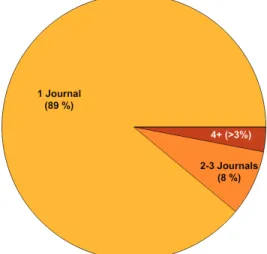
journal publishing operations. Over 97% of society publishers publish three or fewer journals, with almost 90% publishing just one title. Individually, these societies enjoy little market presence when disseminating their content and wield slight economic leverage when purchasing technology, printing, and other publishing services.
n Unlike commercial publishers, nonprofi ts do not have ready access to equity markets
and other sources of capital. Nor do most societies have substantial endowments or capital reserves. Given the diffi culties nonprofi t publishers face in raising capital, the investments required to meet the demand driven by the rapid growth of the journals market and the demand for digital dissemination put society publishers at a disadvan-tage vis-à-vis for-profi t publishers.
n Publishing societies naturally devote more resources to their core competencies in the
publishing value chain—content acquisition and certifi cation—than on business plan-ning and publishing support functions. This lack of publication management resources becomes especially critical as the transition to electronic dissemination accelerates and the effi cacy of traditional subscription models declines for many small publishers.
n Most societies—both by design and necessity—act as conservative stewardships, rather
than as risk-taking entrepreneurial organizations. This attitude, coupled with the resource scarcity already described, often amplifi es the perceived risk of change, includ-ing migration to a new publishinclud-ing fi nancial model.
Given their relatively small size, low risk tolerance, undercapitalization, and lack of business management depth, individual society publishing programs rarely command the resources necessary to compete effectively under current business models, let alone to evalu-ate, design, and implement alternative publishing models. Any proposal encouraging society publishers to adopt new business models—including a potential transition to open access— must be both economically compelling and recognize the structural constraints described above. Advocating alternative business and access models while failing to appreciate and mitigate the real risks that publishing societies face could result in an accelerated exodus of societies from self-publishing to less academy-friendly (and signifi cantly more expensive) publishing channels.
1.3 Publishing Cooperatives: A Comprehensive & Scalable Solution
Federated publishing cooperatives—with shared services cooperatives supporting mul-tiple subject-oriented satellite cooperatives—offer an alternative operating model for society publishers. Publishing cooperatives can provide a scaleable publishing model that aligns with the ethos of learned societies while providing a fi nancial framework capable of sustain-ing society publishsustain-ing programs.
Publishing cooperatives—owned and controlled by nonprofi t publishers—will allow those publishers to act collectively to compete more effectively. Society publishers will gain multiple benefi ts through participation in cooperatives, including:
n Lower costs, via economies of scale and increased bargaining power, for a
comprehen-sive set of publishing services;
n Increased market visibility and leverage to compete against for-profi t publishers under
current subscription models;
n Risk analysis and mitigation to support transitions to new business and access models; n Professional business management expertise and a broader strategic perspective; and n Access to capital to allow a greater role in serving growing market demand.
Publishing cooperatives will also be in the best interests of universities, academic librar-ies, and other stakeholders in scholarly and scientifi c publishing. Cooperatives will:
n Provide societies with an alternative to publishing through commercial channels and
slow the exodus of society publishers to commercial outsourcing. The substantial price differential between self-published society journals and society-sponsored journals out-sourced to for-profi t fi rms makes an alternative channel attractive to libraries and other stakeholders.
n Expand the capacity of societies to meet the growing demand for new journals and
scholarly communications channels, rather than ceding that expansion to for-profi t publishers. Whether these new society journals are available open access or simply at reasonable prices, the result would still be preferable for universities and their libraries.
n Offer a framework that makes a transition to new funding and access models more
prac-tically feasible. Although the cooperative model does not eliminate the barriers to open access and/or new funding models, it can provide society publishers the wherewithal to address such issues constructively.
This paper focuses on how publishing cooperatives could address the issues confronting nonprofi t publishers of scholarly and scientifi c journals. However, the model also supports the publication of monographs, conference proceedings, and gray literature, as well as new scholarly publishing channels as they evolve. Publishing cooperatives might also provide an attractive alternative publishing channel for other nonprofi t publishers as well, including non-governmental organizations (NGOs) and university presses.
ii. the market context for society publishers
2.1 The Mixed Market for Journals
Nonprofi t publishers operate in an increasingly competitive environment, including a market characterized by signifi cant ownership concentration, dominant commercial pub-lisher market share, fl at library acquisitions budgets, and aggressive commercial pubpub-lisher pricing and demand leverage strategies. These market factors make it increasingly diffi cult for society publishers to compete successfully on their own.
The scholarly and scientifi c journal market comprises both for-profi t and nonprofi t pub-lishers, each group with its own organizational imperatives.1 Understanding the composition
and dynamics of this mixed market will help us understand the pressures that societies face and identify the underserved and unserved market needs that publishing cooperatives can address. It will also help us appreciate the economic signifi cance of society publishers for academic libraries and other stakeholders.
An analysis of the academic journals market2 reveals the following:
n Fueled by the expansion of scientifi c research, the number of scientifi c and scholarly
journals continues to grow at a steady rate of 3.25-3.50% per year.3 On the current base
of some 20,000 active peer-reviewed journals, this translates into a doubling in the num-ber of journals approximately every 20 years.4
n Commercial publishers now play a role in publishing over 60% of all peer-reviewed
journals, owning 45% outright and publishing another 17% on behalf of nonprofi t organizations. Nonprofi ts self-publish the remaining 38% of peer-reviewed journals (see
Figure 1).
The market’s current complexion refl ects a gradual shift over the past century toward greater commercial publisher participation. Commercial journal publishers actively seek to add society-sponsored journals to their lists in response to market demands for more comprehensive digital aggregations of journal content. While it is diffi cult to gauge the rate at which nonprofi t publishers are abandoning self-publishing in favor of commer-cial co-publishing or outsourcing arrangements, it is clear that many societies are fi nd-ing such an alternative attractive. If current market trends continue, by 2025 for-profi t publishers will account for almost 70% of a projected universe of 38,000 journals.
n The per-page prices for commercially owned journals average four to fi ve times higher
than prices for journals published by societies, and the prices for journals published by commercial publishers on behalf of societies average three times those of journals pub-lished by the societies themselves (see Figure 2).5 Further, prices for journals published
by for-profi t publishers have increased at a faster rate than those of self-published society journals.6
n With college and university library serials budgets remaining essentially fl at for the past
20 years, the rapid climb in academic journal prices has forced institutions of all types and sizes to cancel existing subscriptions and to forgo new titles.7 Larger publishers have
the market and pricing power to survive these market dynamics, while small nonprofi t publishers do not.
n Although self-published nonprofi t journals represent almost 40% of the total number
of titles, commercial publishers control a disproportionate market share in terms of revenue. Six major commercial publishers, responsible for approximately 30% of all peer-reviewed titles, account for over 60% of the market’s total revenue. In the sci-ence, technology, and medicine (STM) market, nonprofi t publishers claim just 18% of revenue, and only the largest—the American Chemical Society—can begin to compete with for-profi t publishers.8
n The vast majority of self-publishing societies run very small journal publishing
opera-tions. Almost 90% of such societies publish a single journal and over 97% publish three or fewer journals (see Figure 3).
While the for-profi t segment comprises a relatively small number of large commercial publishers, the nonprofi t segment represents a very large number of mostly small pub-lishers. The commercial concentration of journal ownership has increased dramatically as a result of corporate mergers and acquisitions coupled with commercial publishers launching a larger share of new journals.9
This ownership concentration allows large publishers to bundle journals in aggrega-tions that offer libraries discounts relative to the prices of individual journals but limit a library’s ability to cancel individual titles. Bundled contracts capture a disproportion-ate share of library budgets and reduce the funds available to purchase journals from smaller publishers with little market power.
n Approximately 40% of peer-reviewed journals remain available only in print editions.
As most commercial publishers have already moved to online distribution, this suggests that several thousand society publishers have yet to move to online content distribu-tion.10 A variety of factors have slowed society publisher migration to online
distribu-tion, including cost issues, fear of losing society members by decreasing the perceived value of their publication benefi t, and concern for undermining existing print income streams.
As this market description indicates, society publishers face considerable hurdles in competing with large commercial pub-lishers for available institutional budgets. Additionally, nonprofi t publishers face inherent structural constraints that hinder their ability to overcome the market barriers outlined above. Despite frequent editorial excellence, many small society publishers do not have the resources to compete in this market on their own.
2.2 Pursuing Society Missions in a Mixed Market
Those nonprofi t publishers that do com-pete effectively in the mixed market for aca-demic journals typically display the same
traits of effective and effi cient business operation as for-profi t publishers. These include an entrepreneurial approach, strategic awareness, competitive response, and attention to profi t-ability. However, for society publishers, participating simultaneously in the market economy and the intellectual commons of the university, profi t-seeking business imperatives are nei-ther wholly appropriate nor wholly irrelevant.11
Commercial publishers have a responsibility to generate profi t and build value for their shareholders. For society publishers, however, profi t maximization is not the principal goal. Publishing societies typically operate under charters dictating that they promote research and scientifi c advancement in their fi eld, and a society’s publications typically represent the most visible manifestation of the organization’s mission beyond its membership. Although income surpluses generated by journal publishing may provide an important source of non-dues revenue for some societies—for many organizations publishing represents the second largest source of revenue after dues—few societies initiate journal publishing programs in order to generate profi t. Most surpluses represent an incidental result, rather than the intent, of the publishing program.
Society publishers must balance their distinctiveness as nonprofi ts against the need to survive fi nancially. Pursuit of a profi t-maximizing strategy can result in pricing and mar-ket practices that compromise the society’s mission by limiting its ability to disseminate research broadly.12 At the same time, competitive market pressures require society publishers
to operate effi ciently to ensure fi nancial sustainability. Institutional subscription fees that originated to partially offset publication costs and cross-subsidize mission-related services have become core revenue sources critical to many societies’ survival.
Publishing cooperatives will allow society publishers to reconcile effi cient market per-formance with serving the organizations’ missions. Publishing cooperatives assume that participating publishers seek a set of benefi ts, both tangible and intangible, not simply the highest possible return on their investment. These benefi ts might include production cost
reductions, access to otherwise unavailable business management services and resources, increased market presence and access to markets, risk sharing and mitigation, and alignment with the society’s mission and nonprofi t ethos—as well as an adequate and reasonable return on the capital invested.
2.3 Structural Constraints of Society Publishers
The ability of society publishers to compete effectively in the mixed market for academic journals, as well as the capacity of societies to adopt alternative business models, have been limited by structural constraints inherent in the society publishing operations themselves.
2.3.1 Low Market Leverage
The vast majority of society publishers run very small journal publishing operations. The small size and limited capacity of these operations place them at a disadvantage relative to larger publishers in terms of market leverage, business expertise, access to capital, and com-petitive response.
Individually, small societies enjoy little market presence when disseminating their con-tent, rendering it diffi cult for them to compete effectively in a rapidly changing, highly com-petitive, subscription-driven market. The consolidation of large commercial publishers, and the cumulative effect of their pricing and bundling practices, has led to decreased market access for society publishers.
Large commercial publishers, controlling thousands of journal titles, exercise greater market power than individual small societies publishing one or two journals. The effect of this imbalance becomes more pronounced in an online distribution environment where large electronic journal bundles absorb a disproportionate share of acquisitions budgets. A number of nonprofi t initiatives—including the Association of Learned and Professional Society Publishers (ALPSP) Learned Journals Collection, BioOne, and Project MUSE—bring together journals from multiple society publishers to afford a collective market presence. Many society publishers, however, continue to compete on their own or gain only a diluted market presence via large multi-subject online aggregations.
Besides a limited market presence, society publishers also exert slight economic lever-age when negotiating printing and digital distribution services, marketing and sales lever-agency relationships, and other publishing services. Some nonprofi t organizations—including university presses and society federations—seek to provide scale economies for negotiat-ing and purchasnegotiat-ing not available to small publishers actnegotiat-ing on their own. Other nonprofi t initiatives focus solely on providing online distribution services (see Section 3.6). Despite the best efforts of these current collective purchasing channels, many society publishers remain unserved.
2.3.2 Lack of Business Expertise & Staff Resources
Publishing societies naturally devote more resources to their core competencies in the publishing value chain—content acquisition, certifi cation (typically via peer review), and other editorial functions—than to business planning and publishing support activities. Societies with suffi cient staff dedicated to business-related issues are the exception rather
than the norm. This lack of in-house resources becomes especially critical as the transition to electronic dissemination accelerates and the effi cacy of subscription models declines for many small publishers.
The mission focus of society publishers, compounded by a lack of deep in-house publica-tion management resources, can lead to a somewhat passive management of institupublica-tional subscription bases. Although society member subscriptions typically remain stable, in many cases member dues allocations barely cover the incremental cost of printing and deliver-ing the journal. In these instances, societies rely on institutional subscriptions to sustain journals fi nancially.13 In a market where new subscriptions to a mature journal are quite low,
even a seemingly high institutional renewal rate of 95% can result in a potentially ruinous decrease in revenue over time.14
At the same time, few small society publishers have the operational resources necessary to migrate confi dently to online publishing. Such a transition requires that a society assess the implications of online access on its member base, implement a rational and equitable institutional pricing model, and understand the direct and indirect returns on the new costs incurred. A lack of resources to undertake such an assessment will increase a society’s under-standable reluctance to change the basis of its journal income.
Given that most societies do not have the resources to manage their current subscription model as actively as they might like, it should come as no surprise that few societies command the resources to develop alternative funding and access models on their own. Even societies sympathetic to open access and other liberal content access policies will fi nd them diffi cult to implement without the resources to assess and manage the fi nancial risk involved.
2.3.3 Low Tolerance for Risk
Most societies—both by design and necessity—act as conservative stewardships, rather than as risk-taking entrepreneurial organizations. Due in large part to their nonprofi t cul-tures, volunteer leadership, and lack of capital reserves, publishing societies are often poorly positioned to assume risk, whether real or perceived. Coupled with the lack of business man-agement resources already noted, this often amplifi es the risk perceived in implementing change in response to market forces. Yet, a society that manages risk solely by avoiding or minimizing it may forgo opportunities to strengthen its publishing operations in the long term by better positioning itself to serve members, fulfi ll its mission, and remain fi nancially self-sustaining.
2.3.4 Undercapitalization
Unlike commercial publishers, nonprofi ts do not have ready access to equity markets and other sources of capital. Although many societies have modest endowments or reserves, these are rarely of a scale suffi cient to fund substantial investments in new products or pub-lishing technologies. Given the diffi culties nonprofi t publishers face in raising capital, the investments required to meet the market demand for new journals and to keep pace with ever-evolving publishing technologies put society publishers at a strategic disadvantage rela-tive to for-profi t publishers.15
The inability of nonprofi t publishers to accommodate the rapid increase in the overall scope and scale of scientifi c research is one reason behind the increasing participation of commercial publishers in the academic journal market over the past 50 years. Only large and well-funded societies can readily assume the fi nancial risk of launching new journals.16 The
ability of society publishers to capture a larger proportion of the growing journals market will depend, in part, on societies having access to adequate capital to launch new journals. Given the price differentials between society and commercially published journals, the abil-ity of societies to launch new journals will have signifi cant fi nancial implications for univer-sities, libraries, and other research consumers.
The ongoing shift to digital dissemination, value-added content, and enhanced online service functionality has also put pressure on nonprofi t publishers to incorporate new tech-nologies into their operations.17 Because such publishing technologies are resource
inten-sive—they can entail signifi cant initial development or acquisition costs, ongoing operating and staff training requirements, and frequent replacement and upgrade cycles—they have also given for-profi t publishers another competitive advantage over nonprofi ts. Large com-mercial publishers invest considerable sums to develop and maintain their electronic journal systems, and few nonprofi t publishers command the capital required to compete with this investment.
iii. publishing cooperatives as an
alternative model
The structural constraints described above, along with the strategic barriers to competi-tion such as ownership concentracompeti-tion and price bundling, make it diffi cult for society pub-lishers to survive on their own. Publishing cooperatives will allow small society pubpub-lishers to operate collectively to overcome both structural and strategic disadvantages and to address the ineffi ciencies and imperfections in the market for academic journals.18
3.1 Basic Cooperative Principles
Cooperatives, as a special type of corporation owned and controlled by the members that use their services, have existed formally since the industrial revolution. Typically, coopera-tives have formed to promote the shared economic welfare of individuals and groups that have determined that they can wield more market infl uence collectively than individually.19
Conventional businesses return net income to investors on the basis of their common equity investment. In contrast, cooperatives return net income (and other benefi ts) to mem-bers based on their patronage or use of the cooperative’s services. Thus, cooperatives differ fundamentally from non-cooperative enterprises in that they exist not to maximize their own profi ts, but to promote the economic success of their members. This economic linkage creates reciprocal incentives for the cooperative to serve its members and for the members to patronize the cooperative.
Several principles guide virtually all cooperatives:20
n Member ownership: Members contribute equitably to the capital of the cooperative and
fi nance the cooperative by transacting business with it. The cooperative gets operating capital by retaining a portion of its net income.
n Member control: Members exercise collective control over the cooperative via an elected
board of directors and democratic participation. Most cooperatives operate on a one-member, one-vote basis, though some permit a limited proportional vote based on a member’s patronage level. The cooperative’s governing board sets policies, manages the distribution of member benefi ts, and hires and oversees professional management to handle day-to-day operations.
n Member-benefi ted: Cooperatives provide benefi ts to members as users, not investors.
Unlike investor-owned fi rms, which distribute returns in proportion to the amount invested, cooperatives distribute the fi nancial benefi ts to members in proportion to their use of the cooperative.
Nonprofi t publishers will support a cooperative to the extent that they perceive it as an effective agent representing their interests. A successful cooperative is essentially a projection of the economies and interests of its individual members. These strong economic, philosophi-cal, and cultural linkages allow cooperatives to integrate member economic activity and gain effi ciencies and scale economies that conventional nonprofi t business models can seldom
match. Over time, the economies of the members and the cooperative may even evolve and integrate to form a single, unifi ed system.21
Cooperative organizational structures have proven readily adaptable and able to address the requirements of a variety of market sectors. Although few publishing cooperatives provide precedents,22 the cooperative model appears well suited to the needs of the nonprofi t section
of the academic publishing market.23 Cooperatives in other industries sometimes combine
both social and economic objectives, which suggests that the cooperative model should be well suited to balancing society publishers’ twin imperatives of fi nancial sustainability and mission fulfi llment. Publishing cooperatives will be governed by principles similar to those guiding cooperatives in other market sectors. Here, too, the cooperatives will be owned by their members and the fi nancial benefi ts of cooperative membership will be distributed to members in proportion to their use of the cooperative.
For society publishers, cooperatives can offer signifi cant benefi ts over conventional busi-ness models. In the absence of market dysfunctions, an effi cient market would obviate the formation of cooperatives. In journal publishing, however, the oligopolistic market power wielded by a core group of large commercial publishers, combined with the structural limi-tations of society publishers, prevents societies from competing effectively to sustain their journals fi nancially. The collective power of cooperatives will help nonprofi t publishers counter these market constraints and imbalances.
Publishing cooperatives will typically have defi ned or closed memberships; that is, mem-bership will be limited to organizations that fi t the cooperative’s member profi le, with the type and (perhaps) number of members determined by the capacity of the cooperative’s operations. Membership would not need to be permanently limited. If the cooperative were to expand its scope or capacity, it could seek participation from publishers outside the initial membership. As we will discuss below, defi ning and maintaining a membership with mutual interests can be critical to a cooperative’s success and long-term organizational resilience.
3.2 Publishing Cooperative Structures
Options for structuring a publishing cooperative range from a unitary structure to net-works of discrete yet interrelated cooperatives. Given the lack of publishing cooperative precedents, no single structure can yet be advanced as demonstrably superior to another. However, the experiences of cooperatives in other market sectors makes it possible to suggest which cooperative structures might be appropriate for society publishers.
For a cooperative to succeed, its members must perceive it to be committed to their best interests and to be an effective agent acting on their behalf. Therefore, cooperatives with rela-tively homogenous memberships are more likely to succeed than cooperatives with hetero-geneous memberships. These mutual interests will allow publisher cooperatives to develop strong economic linkages with their members—for example, via patronage refunds, cross-subsidies, and risk pooling—serving their members’ collective interests. The more closely coordinated and integrated the economic linkages of the publishers and the cooperative, the more effi cient and useful the cooperative relationship will become.
This suggests that cooperatives comprising publishers from cognate disciplines, and shar-ing similar editorial experiences and the same niche publishshar-ing environment, will expe-rience greater member cohesion and generate stronger member commitment than coop-eratives with members from disparate fi elds.24 Defi ning a cooperative’s fi eld of membership
to maintain member compatibility also supports the cooperative’s marketing function by yielding coherent content aggregations and by supporting the manner in which researchers use online journal collections.
At the same time, individual disciplinespecifi c cooperatives are unlikely to have suffi -cient scale to offer shared publishing services as cost-effectively as larger organizations com-prising multiple affi liated cooperatives. The need to accommodate publishers from multiple fi elds with discipline- or geographically specifi c needs, to provide a comprehensive suite of publishing services, and to support a scaleable cooperative network, all combine to suggest a federated cooperative structure. Federated cooperatives are organizations whose member-ship comprises other cooperatives rather than individual publishers. By supporting mul-tiple affi liated or satellite cooperatives, federated cooperatives can facilitate intercooperative coordination to provide a greater range of services more cost-effectively.25 By providing a
model that can be replicated across multiple disciplines, organization types, and geographic regions, federated cooperatives can create a network of publishing cooperatives, with indi-vidual satellite cooperatives within the network remaining autonomous.
Figure 4 illustrates how federated publishing cooperatives can support an extensible net-work of interrelated cooperatives. Federated cooperatives can be extended by accreting mul-tiple satellite cooperatives—for example, clusters of cooperatives representing cognate dis-ciplines—further extending scale economies and market power. A federated structure will allow satellite cooperatives to share scale resources while maintaining equity allocation and content distribution policies that serve their specifi c requirements. The satellite coopera-tives will also provide a communication channel to the member publishers that will increase the transparency of the federated cooperative’s operations. A federated structure can thus support both local accountability and centralized operating effi ciency, both of which are important to maintaining member commitment and loyalty.
Satellite cooperatives could collect the member equity investments necessary to purchase membership in the federated shared-services cooperative. A satellite would then adopt mem-ber equity allocation and redemption policies—based on the model(s) supported by the fed-erated cooperative—and elect a board of directors to manage the satellite’s interests, both independently and vis-à-vis the federated cooperative. In addition to providing shared ser-vices, the federated cooperative could manage the equity accounting and redemption process for the satellite cooperatives, including management of a satellite’s fi nances.
Relying on a larger federated cooperative to provide publishing, bargaining, and market-ing services would allow satellite cooperatives to adopt a relatively simple administrative structure. This would permit them to form more quickly and to focus their energies on the patronage commitment and governance issues critical to the cooperative’s success. Lowering the barriers to launching satellite cooperatives would also increase the economies of scale available to the federated cooperative with which they affi liate. At the same time, a federated
cooperative can provide new satellite cooperatives with organizational models and commu-nications support to reach and educate potential participating publishers.
Besides specifi c disciplines, membership in satellite cooperatives can be defi ned in a vari-ety of other ways, including national or regional groupings, organization types (e.g. NGOs or university presses), or other logical affi liations. Direct government subsidies play a greater role in scientifi c and scholarly publishing in some countries than in others, and central-ized or coordinated national publishing initiatives might lend themselves to country-specifi c publishing cooperatives. Further, publishers of journals in local languages might consider the benefi ts of local collaboration to outweigh (or complement) the advantages of discipline-specifi c satellite cooperatives. Whatever their basis, the publishers’ mutual interests and shared characteristics will lend a greater sense of common purpose and ease the launch and governance of the cooperative.
3.3 Publishing Cooperative Services
Nonprofi t publishing cooperatives can offer a range of functions that address the needs of their members. These functions can include providing shared services, including strategic planning and management; adding value to publisher content; bargaining, negotiating, and purchasing on behalf of members; marketing, selling, and distributing publisher content; and grant-seeking and administration.26 A federated cooperative structure would allow
mul-tiple cooperatives to collaborate to provide a wide range of capital-intensive services cost-effectively.
3.3.1 Shared Services
The shared-services component can provide publishing services at a lower cost than the cooperative’s members could achieve themselves, and can also deliver resources that society publishers often cannot afford individually. The services a cooperative might effi ciently pro-vide include strategic planning; business and publishing management; capital budgeting sup-port; copyediting and other editorial services; online submission and peer review systems; digital distribution platforms; legal, fi nance, accounting, and other professional services; customer service and support; subscription and membership management; and virtually any other publishing support service that the participating publishers may require. Depending on the cost-effectiveness and effi ciency in each case, these services could be performed by a cooperative’s staff, delivered by other federated cooperatives, or contracted from third-party providers. The sourcing of services will be a matter of the cooperative’s size and scale and might change over time to serve evolving needs.27
3.3.2 Bargaining & Purchasing
The cooperative can provide bargaining and purchasing assistance for any services that the cooperative cannot provide as effi ciently itself. For example, the cooperative can negoti-ate for printing and print and digital pre-press services, copyediting and pre-press services, retrospective digital conversion, and other publishing services. The cooperative will realize savings for its members through lower administrative costs (by managing bid development, tabulation, and evaluation), volume purchase discounts, and assured levels of business for vendors. Whether a cooperative provides services itself or secures their provision by third parties, it will allow publishers to address supply chain issues from a well-coordinated posi-tion of strength.
3.3.3 Marketing
Publishing cooperatives could also allow society publishers to exercise greater market power in competing against larger publishers for a share of library acquisition budgets. As some nonprofi t journal aggregations have already demonstrated, acting collectively increases the visibility of society-sponsored journals and allows society publishers to compete more effectively for limited library budgets.
The cooperative’s marketing services can offer publisher content to libraries and end users, both as individual print or online journals and as part of an online aggregation. As with all cooperative services, this marketing and sales function can be performed by a cooperative’s in-house staff or negotiated with third-party sales agents and distributors. Shared marketing services can negotiate prices and license terms with libraries, library consortia, and other users and serve as a clearinghouse for contract and licensing information. The cooperative can also support article-level distribution through pay-per-view channels and permissions clearinghouses.
While cooperatives can offer a comprehensive range of services, participating publishers should be able to pick and choose the cooperative services they require. This will lower the barriers to publisher participation and help ensure that the cooperative’s services remain competitive.
Whatever group of services a cooperative offers, it must serve the specifi c needs of its members. Offering a generic service, without suffi cient differentiation, would open the cooperative to price competition. Leaving some member needs unserved would subject the cooperative to poaching from more specialized competitors. Publisher ownership and con-trol will allow the cooperative to avoid such competition by offering services that serve the society publishers’ best interests, rather than services that maximize the profi t of the coop-erative itself.
3.4 Cooperative Benefi ts to Society Publishers
Publishing cooperatives would allow societies to retain control of their publishing opera-tions while benefi ting from the reduced costs, greater income stability, and lowered risks attendant on collective action. We describe below some of the major benefi ts that publishing cooperatives could deliver to their member-owners.
3.4.1 Improved Bargaining Power & Reduced Publishing Costs via Scale Economies
Collective action via publishing cooperatives will give society publishers greater mar-ket leverage and presence. Publishing cooperatives can negotiate lower costs for mutually required services and resources than societies could achieve individually. Representing a larger number of journals will give cooperatives more bargaining power and allow them to be more effective in their negotiations with service providers.
Cooperatives can deliver scale effi ciencies for both print and online distribution. As online journal dissemination is more dynamic than print publishing, the need for such shared services becomes even more acute in an online distribution environment.28 Besides
ongo-ing technology upgrades, digital distribution requires an ongoongo-ing revision of a publisher’s licensing policies and pricing. This reworking requires legal support, the cost of which can be shared via a cooperative. Similarly, customer service and user support is typically more intensive in an electronic distribution environment.
The cooperative will provide goods and services to members at cost. In practice, this will be effected by setting prices at a level suffi cient to cover costs plus a reasonable return on invested capital, and then refunding to members at the end of the year the net returns in proportion to the volume of business each member has done with the cooperative. Such pay-ments, called patronage refunds, are discussed more fully below.
Many cooperatives have moved to differential pricing, where prices may vary by the size or patronage of each member organization. This often means lower prices for larger orga-nizations that make signifi cant use of the cooperative. This completely satisfi es cooperative principles and the goal of service-at-cost because it recognizes that different members will impose different costs on the cooperative. Also, differential pricing will encourage larger nonprofi t publishers to patronize the cooperative, which benefi ts smaller members by increasing economies of scale.29
3.4.2 Increased Society Publisher Market Presence & Circulation
Publishing cooperatives can increase publisher market reach and end-user content access in several ways. Collective activity and shared marketing support resources will increase the publishers’ market visibility and allow them to wield greater market leverage than they
would possess individually. Representing a larger number of journals will give the coopera-tive more market presence and make the aggregation more attraccoopera-tive to libraries and library consortia.
Although the market appeal of such aggregations has been proven, aggregations must often overcome publisher aversion to fi nancial uncertainty and reluctance to cede control of their content.30 Given that an online aggregation may provide a ready substitute for the primary
journal, member publishers must trust the cooperative to manage and protect the value and income of their journals. A cooperative’s member ownership and democratic nature should assuage publisher concerns about relinquishing control and jeopardizing income streams. Further, by increasing their control over how their publications reach end users, and allow-ing them to bypass intermediaries in the market channel, nonprofi t publishers can capture more of their returns, allowing them to pass some of this savings on to libraries and end users.31
3.4.3 Provide Specialized Business Management
Cooperative participation would allow a society to focus on its core publishing competen-cies of content creation and certifi cation while relying on the cooperative to support aspects of the publishing process not directly related to the society’s mission. Through a publishing cooperative, societies can pool their resources to secure access to professional business and publication management services that they could not otherwise afford. These services could include business and fi nancial management, technical expertise, pricing and value manage-ment, legal and intellectual property advice, society membership and non-member subscrip-tion management services, contract and license negotiating, strategic insight and tactical guidance, and other services identifi ed by cooperative members.
A publishing cooperative could also serve as a communications and information nexus, providing members with a forum for addressing issues of mutual concern. Publishing coop-eratives can inform their members about developments in the academic publishing market, educating them to ensure that members understand the market’s issues and trends. Access to this information and to the cooperative’s professional management resources would also promote conformity with industry best practices and promote greater fi nancial and operat-ing effi ciency for each participatoperat-ing publisher.
3.4.4 Ability to Manage & Mitigate Risk
Society publishers operate in a market environment of considerable uncertainty and risk, including:
n Increasing pressure on traditional subscription-based income models; n A rapid rate of change in publishing technologies;
n A decline in the demand for print editions;
n Mounting market pressure for lower access barriers to content; n Aggressive competitive behavior by other publishers;
n Competition from innovative online scholarly communications channels; and
Society publishers must be prepared to make decisions about these and other issues in an overall environment of change, while reducing the uncertainty associated with any specifi c decision. The potential losses that societies confront are not limited to fi nancial assets; they can also suffer loss to their reputations, membership bases, external funding sources, and other tangible and intangible assets.
Federated cooperatives can help society publishers address risk constructively through both risk retention and risk transfer fi nancing methods. With risk retention, the funds needed to offset potential losses would come from the cooperative members themselves. The cooperative could assess the risk profi le of any particular activity, line of business, or envi-ronmental threat and implement an appropriate retention technique to offset the loss.32 The
cooperative’s board could fund such retained risk reserves by managing the cooperative’s equity generation and equity redemption policies.33 The cooperative might employ this
approach to manage risk stemming from the migration from print to digital distribution, the adoption of new journal income models, the introduction of new publications and new types of content channels, and other activities with a potentially substantial impact on pub-lisher income.
Risk transfer would seek funds from beyond the cooperative’s membership, with external organizations indemnifying the publishers against loss. Such risk transfers could provide a means by which libraries and other stakeholders could indemnify publishers against fi nan-cial risks incurred in the transition to a new funding or content access model. If libraries and other stakeholders are unwilling to share the publishers’ risk, they can anticipate publisher adoption of more liberal access policies to be slow and halting. Even publishers sympathetic to the concept of open access might consider the risk inherent in transitioning from sub-scription-based income to a new business model too great to risk unilaterally. As institu-tional libraries and their users would benefi t directly from a shift to open access distribution, libraries might expect to share the publishers’ risk in moving to new business models capable of supporting open access. Federated cooperatives could act as agents for contractual risk transfers between libraries and a cooperative’s publishers.34
3.4.5 Stabilized or Improved Financial Performance Under Current Business Models
As already noted, subscription income models are becoming increasingly diffi cult to sup-port for many society publishers, especially those lacking active sales and marketing pro-grams. By applying a federated cooperative’s shared marketing services, society publishers will be able to perform better fi nancially under a subscription model, slowing or even revers-ing the decline of institutional subscriptions bases.
A federated cooperative’s greater marketing and sales resources can also create supple-mental income streams, which individual societies would not have the in-house capacity to pursue effectively. A variety of revenue sources—including corporate sponsorships, advertis-ing, and commercial use licenses—might reduce the upward pressure on subscription prices or help support alternatives to subscription-charging models.
3.4.6 Support a Framework for Long-term Structural Changes in Access & Funding Models
The initial reliance of cooperative publishers on a subscription model would not preclude their subsequent migration to alternative business and access models. In a market of
declin-ing subscriptions and risdeclin-ing prices, new income models might well be in the publishers’ best interests. A cooperative can provide the strategic vision that will allow society publishers to move from a defensive posture to a more proactive approach. Without the management, business analysis, and risk mitigation capabilities afforded by a federated cooperative, most society publishers will lack the means to evaluate or effect such a transition.
3.4.7 Provide Access to Capital
Publishing cooperatives can help societies overcome the competitive disadvantages that stem from undercapitalization. Cooperatives can address this issue indirectly by lowering costs and capital requirements through shared services and scale economies and directly through their own capital generation methods.35
Publishing cooperatives can obtain equity capital by retaining a portion of the coopera-tive’s operating surplus (e.g. through retained patronage refunds), by retaining a percentage of fees levied on members for cooperative services, through direct member investment (e.g. membership fees), through net profi ts from non-member business, and even through the sale of common or preferred stock to external stakeholders. We discuss these capital genera-tion methods more fully below (see Secgenera-tion 4.3).36
3.4.8 Maintaining Society Relevance Amidst Changing Scholarly Communications Practices
The transformative impact of the Web and digital publishing technologies on scholarly and scientifi c communication has yet to be fully felt. Although still relevant and prevalent, a linear model of scholarly publishing—from the author through the publisher to the audi-ence—does not capture the full value of the disaggregated digital publishing models that are emerging. A networked model, linking interdependent nodes of the publishing value chain (including certifi cation, dissemination, and preservation), may more accurately represent the evolution of scholarly publishing in a disaggregated digital environment.
Although much of our discussion of cooperatives has taken the current journal publish-ing paradigm as its startpublish-ing point, cooperatives will afford society publishers a framework within which to expand their publication programs beyond the limits of the journal format itself. Cooperatives can do this by offering strategic perspective on publishing and market trends, by providing affordable access to innovative publishing technologies, and by encour-aging innovation by mitigating risk. By reducing new product development risk while simul-taneously ensuring high production and distribution effi ciency, publishing cooperatives will allow society publishers greater fi nancial latitude to experiment with new scholarly informa-tion services.
3.5 Limitations of Publishing Cooperatives
Despite their benefi cial effects, publishing cooperatives cannot address all the challenges facing society publishers. For example, publishing cooperatives cannot:
n Guarantee that publishers will realize fi nancial returns commensurate with a
The cooperative model assumes that society publishers seek the broadest reach for their content and a more stable market position, rather than trying to maximize profi t or sub-sidize substantial non-publishing activities.
n Address member retention issues that result from a society’s membership perceiving
insuffi cient value relative to their dues—
Cooperatives cannot counter a decline in society membership except to the extent that they allow societies to enhance their membership value. However, by lowering publish-ing costs they can help societies better cope with the fi nancial pressures that result from declining membership and circulation bases.
n Lower most editorial and content acquisition costs—
Cooperatives can help lower many of the costs of publishing a journal however, most of the content creation and editorial costs will remain with the publisher and will be dif-fi cult for a cooperative to lower.37
n Ensure the long-term survival of a journal of inadequate quality or value—
Although a cooperative model can stabilize society publishing income and provide a framework within which to change the basis for monetizing content creation and certi-fi cation, it will not provide an income guarantee scheme that insulates publishers from market preferences and priorities.
Although publishing cooperatives cannot solve all the problems confronting society pub-lishers, they will help many society publishers address a common set of problems. At the same time, cooperatives will not introduce market distortions or artifi cially support sub-standard journals.
3.6 Cooperatives & Existing Collaborative Publishing Initiatives
As with any new large-scale venture, launching publishing cooperatives will entail sig-nifi cant effort and expense. It makes sense, therefore, to consider whether cooperatives offer advantages relative to existing collaborative initiatives serving society publishers.
A variety of nonprofi t initiatives offer society publishers scale economies, collaborative marketing services, and other shared services that partially overlap those that cooperatives can provide. Those that serve society journal publishers include:
n Discipline-specifi c publishing programs, sponsored by libraries or universities (e.g.
BioLine International,38 BioOne,39 the History Cooperative,40 Project Euclid41) or
schol-arly societies themselves (e.g. AnthroSource, GeoScienceWorld);
n Federated society programs that provide publishing services and infrastructure for
member societies (e.g. the American Geological Institute (AGI), the American Institute of Biological Sciences (AIBS), the Federation of American Societies for Experimental Biology (FASEB));42 and
n Journal aggregations offered by nonprofi t organizations (e.g. the ALPSP Learned
Journals Collection,43 Project MUSE44);
n University-sponsored online publishing platforms and digital preservation and
archiving services (e.g. the California Digital Library at the University of California; Igitur at Utrecht University;45 the University of Michigan Scholarly Publishing Offi ce;
the German Academic Publishers Project;46 Stanford University’s HighWire Press;
SciELO in Brazil;47 the European SciX initiative;48 the Public Knowledge Project’s
Online Journal System; the developing DpubS initiative; JSTOR; LOCKSS); and
n University presses in North America, the U.K., Western Europe, Australia, and
else-where.
As might be expected, the structural limitations that prevent society publishers from competing effectively on their own also hinder some societies from participating in existing collaborative publishing initiatives. Barriers to such participation include:
n Initial and ongoing costs of participation—
Publishing cooperatives, designed to provide publishing services at cost, and utilizing proven mechanisms for generating operating capital, will lower the cost barrier to par-ticipation that excludes many society publishers from some of the existing initiatives.
n Incomplete or undifferentiated service offerings (e.g. a digital publishing platform without
business management support)—
By providing business management services as well as comprehensive publishing pro-gram support, cooperatives can offer societies a complete and unifi ed package solution that competes effectively with commercial publishing outsourcing services.
n Fear of relinquishing control and/or submerging individual publication identity or brand—
Exercising control through the cooperative’s democratic governance mechanism should help allay the publisher apprehensions that often impede participation in content aggre-gations.
n Aversion to the uncertainty entailed in a move to aggregated online distribution,
exacer-bated by the lack of internal resources to evaluate a potential alternative—
As their express purpose is to serve as effective agents for the best interests of their mem-ber-owners, publishing cooperatives will provide an attractive alternative for nonprofi t publishers that are risk averse, keen to remain independent, and underresourced. All the above initiatives provide services that help society publishers compete more effec-tively in the scholarly publishing market. Publishing cooperatives will complement, rather than supplant, viable alternative publishing models already in place. Cooperative members might continue to participate in existing initiatives, while using a cooperative for any ser-vices not offered by their current provider.
If any of the existing organizational models could be effi ciently scaled to address the pub-lishing needs of thousands of society publishers worldwide, they might obviate pubpub-lishing cooperatives or other alternative publishing models. However, most of the initiatives do not seek to support a highly scaleable and easily replicated network of similar organizations. Further, although each of the above initiatives responds to critical needs of society publish-ers, most focus specifi cally on digital publishing, and not on providing a comprehensive solution addressing all the strategic, business, and operational issues that confront publish-ing societies. None of this detracts from the considerable value these initiatives continue to deliver to many societies; however, it does suggest that federated publishing cooperatives might fi ll a need not adequately served by existing initiatives.
iv. financial issues for publishing cooperatives
4.1 Cooperative Corporate Structures
A cooperative is a special type of corporation that is owned, controlled, and fi nanced by the members who use its services. Depending on the jurisdiction in which it is incorporated, a cooperative can form as virtually any type of legal entity, including a nonprofi t corporation, a general business corporation, a limited liability corporation, or a general partnership.49
Because a publishing cooperative organized as a nonprofi t corporation could not return patronage refunds to its members, publishing cooperatives might be formed as general cor-porations. In any event, a cooperative’s distinctive operating practices are governed by the cooperative’s articles of incorporation and by-laws, not the organization’s formal corporate structure.50
A cooperative’s distinctive operating practices—which stem from the principles of mem-ber ownership and control—are intended to provide services to the cooperative’s memmem-bers at the lowest possible cost, not to generate the highest return for the cooperative itself. At the same time, as with any self-sustaining business, a cooperative must generate suffi cient rev-enue to meet its continuing expense and capital needs. To ensure that a cooperative remains suffi ciently capitalized while distributing ownership equitably based on member patronage, a number of cooperative equity generation and allocation models have evolved. We describe below how these models can be applied to publishing cooperatives to generate capital, allo-cate equity among members, and return equity to participating publishers over time.
4.2 Capital Requirements
To ensure its long-term sustainability, a cooperative needs to determine its capital require-ments for both its initial development stages and its ongoing operation. A publishing cooper-ative’s capital requirements can be separated into organization launch funds, short-term or operating capital, and long-term or fi xed capital.
Organization launch funds cover the one-time expenses incurred in establishing the coop-erative. These would typically include professional services (legal, accounting, and other consultant fees), initial communications and promotional expenses, and other expenses incurred in organizing the cooperative. The amount of launch funds needed will depend on the size of the cooperative; the scope of the cooperative services offered; the type of coopera-tive (e.g. a satellite cooperacoopera-tive or a federated publishing cooperacoopera-tive); and the availability of outside development grant funding and institutional support. Federated cooperatives can provide resources and assistance that will lower satellite cooperative launch costs.
A publishing cooperative will use operating capital for staff salaries, rent, supplies, mak-ing negotiated payments to vendors (e.g. for printmak-ing and editorial management system licenses), for maintenance and upgrades to a digital publishing platform, for payments from risk or indemnifi cation pools, and for other current expenditures. The cooperative may also require substantial operating capital if it undertakes extensive contracting for services or vertical integration of the publishing value chain.
Long-term capital includes the investment a federated cooperative might make in capital
Long-term capital includes the investment a federated cooperative might make in capital
Long-term capital
investment a satellite cooperative makes in membership in a federated cooperative.51 Most
publishing cooperatives, at least initially, would need little long-term capital.
Cooperatives make two common mistakes in trying to please their members: 1) under-pricing the cooperative’s services to members and 2) not requiring a suffi cient equity contri-bution by their members. In the fi rst instance, cooperatives fail to build suffi cient operating margin into the pricing for the member services they offer. An inadequate margin lowers the operating capital that the cooperative can generate and can even lead to losses when margins are insuffi cient to cover unexpected operating exigencies. In the second case, a cooperative keeps its initial member equity requirements low in order to encourage a greater number of members. However, this can lead not only to inadequate capitalization, but also to an insuf-fi cient commitment on the part of members. Often, a larger member equity requirement will encourage greater member participation in the governance of the cooperative and increase commitment to patronizing the cooperative services. This active engagement increases a cooperative’s long-term vitality.52
4.3 Sources of Equity Capital
Equity capital is that portion of the cooperative’s assets owned by the cooperative’s mem-bers. For cooperatives, equity capital represents a means to an end, rather than an end in itself. Patronage of the cooperative, which generates much of the member-publisher equity, creates the economic rationale for the cooperative’s existence in the fi rst place.
The cooperative obtains equity capital from participating publishers without incurring a legal obligation to repay the funds at a stated time. Equity capital is risk capital in that all or part of it can be lost if the cooperative’s operations are not profi table. Under most cooperative structures, however, member risk would be limited to the amount of capital invested in the cooperative.
A publishing cooperative can obtain equity capital by combining any of the following:
n Direct investment—
Direct investment can include a membership fee or a requirement to purchase one share of voting stock. The size of the initial investment will depend on the particular capital needs of the cooperative. In addition to the initial investment, a cooperative can levy an annual membership fee, with the fee being either fl at or proportional to the publisher’s usage of the cooperative.
n Retained patronage—
Retained patronage refunds will provide the cooperative’s most common means of acquiring operating capital. In the U.S., up to 80% of the cooperative’s annual net surplus from member patronage can be retained for operating capital, with the remain-der refunded to the publishers in cash. The cooperative will accumulate the deferred patronage refunds until it has suffi cient capital to fi nance its operations, then will begin to redeem the equity under a systematic plan (see Section 4.4).