Development of Students Activity Sheets (LKPD) on
Human and Animal Organs Science Material for Class
V Elementary School
Esti Untari
1, *, Sukamti
1, Dian Wahyu Lestari
1,
Nikmatul Rohmah
1,
Aryna Chintya
Devy
11 Department of Elementary and Preschool Education, Faculty of Education, Universitas Negeri Malang, Malang, Indonesia
*Corresponding author. Email: [email protected]
ABSTRACT
This research is development research that aims to produce a valid and effective student worksheet theme for human and animal organs for fifth-grade elementary school students. Development is carried out referring to the Dick & Carey model which consists of ten development steps, namely the learning system, learning analysis, student analysis, and its context, determining learning objectives, developing instruments, developing learning strategies, developing and selecting learning materials, designing and conducting formative evaluations, revisions. , and designing and conducting summative evaluations. The results of validation by material experts get a proportion of 89,5%, media experts by 100%, and user validation of 93%. Furthermore, the results of trials on students with the acquisition proportion of 96,3%. LKPD is suitable for use in learning activities.
Keywords: worksheet, human and animal organs, elementary school
1.
INTRODUCTION
LKPD is a student learning support book that is used to increase understanding of the material that has been studied. LKPD contains guidelines for students to carry out the investigation and problem-solving activities (Trianto, 2010). LKPD in the form of printed teaching materials is equipped with questions that must be done by students, the material presented is a summary that is not too broad in terms of understanding, but includes what the student will do or do. Also, LKPD consists of components such as a foreword, introduction, table of contents, materials, and experimental activities (Sungkono, 2009).
The use of LKPD can accelerate the learning process and assist students in grasping the concept of the material being taught (Jannah, 2017). Also, the use of LKPDs makes students more active in learning activities, because they do not only listen to explanations from the teacher. LKPD as a learning support book for students must meet several criteria to ensure the effectiveness of its use, including: (1) it contains an emphasis on process skills, connects science and technology with life, and is able to invite students to be active in learning; (2) has the
correctness of supported concepts with expert opinion; (3) has a depth of conceptual material that is in accordance with the curriculum; (4) the sentence is clear; (5) uses standard language; (6) the learning evaluation is structured to measure cognitive, affective, and psychomotor abilities in depth; (7) student activities / experiments that are arranged can provide direct experience, encourage students to conclude concepts, laws / facts, and the level of suitability of student activities with the subject matter of K13; (8) the implementation of activities according to the planned time allocation; and (9) physical appearance in the form of design, consistency, organizational format, book attractiveness in the form of clarity of writing and images can mend Rong asks students to read (Widjajanti, 2008). The use of LKPD is very suitable for use in learning content that requires practicum activities in its implementation, one of which is science content.
Science is a field of study that discusses material about objects, natural phenomena, living things, and cause and effect relationships that cause new problems that can be solved through the right procedures. Science learning in grade V Elementary School according to the 2013 curriculum, consists of 9 themes. However,
learning which discusses the material of human and animal organs only consists of 4 themes, namely studied in odd semesters. The four themes discuss human and animal organs, the importance of clean air for respiration, the way the body processes food, and the circulation of human and animal blood.
Based on the results of research conducted by Sukamti, et al (2017), it shows that the science material contained in student books is still limited in general knowledge and has not shown practicum activities on each theme. Even though the implementation of science learning should be carried out by scientific inquiry (scientific inquiry) to foster the ability to think, work, and be scientific, and communicate it as an important aspect of life skills (Retno & Yuhana, 2016). As a result, students’ understanding of the learning material is less sharp, because it is not followed up with activities that can add insight. This sharpening is not only limited to material, but also practicum activities. Teachers must use learning methods and techniques that can foster students’ scientific abilities. Therefore, it is very necessary that student activity sheets (LKPD) can be used to support the implementation of student learning in grade V Elementary School.
Based on these problems, it is necessary to develop material followed by LKPD to facilitate students and teachers in implementing learning. This study aims to produce worksheets with the theme of human and animal organs in grade V that is valid and effective for grade V elementary school students. The resulting LKPD is focused on learning human and animal organs.
2.
METHODS
This type of research is research and development (research and development). The development model used refers to the Dick & Carey model which consists of ten stages of the process. These stages are: (1) identification of learning objectives through observation and interviews; (2) learning analysis, (3) student analysis and context; (4) determining learning objectives; (5) developing assessment instruments consisting of validation instruments experts and users, as well as student response questionnaires; (6) developing learning strategies, which include learning activities from beginning to end; (7) developing and selecting products, namely LKPD on human and animal organs; (8) designing and conducting formative evaluations by validating and testing students; (9) revising based on expert and student suggestions; and (10) designing and conducting summative evaluations (Dick and Carey, 2009). However, this study only uses 4 stages of development, namely the needs analysis stage, the product design stage, the validation and evaluation stage, and the final product stage.
Validators who assess this LKPD product are material experts, media experts, and teachers as product users.
While the trial was conducted in class V Islamic Elementary School, Blitar City, Indonesia. The trial was conducted to determine the quality and feasibility of the product. The data collection techniques used were observation and questionnaire filling. The data that has been collected is then analyzed and concluded. The results of the analysis are then used to determine the success of the product results. The formula used to process expert and user validation data is a formula adopted from Sudjana (2005), as follows:
P = ∑𝑋
∑𝑋𝑖 x 100%
P = the percentage of respondent’s answers.
∑X = the total score of respondent’s answers for each item.
∑Xi = total score of answers if all respondents answered the same.
The conclusion from the data obtained using the limited test eligibility criteria in Table 1 is as follows:
Table 1 Feasibility Criteria
Percentage Feasibility Criteria Information
80% - 100% Valid / feasible Fine, no need for revision 60% - 79% Quite valid / decent
enough
Good, needs some revision 50% - 59% Less valid
Not good, partial revision, and review of content
< 50% Invalid Not good, even total revisions were replaced
Source: Sudjana (2005)
Based on the feasibility criteria in Table 1, LKPD can be tested, if the percentage of eligibility reaches at least 60%. If the percentage result is below 60%, it is necessary to make a major revision of LKPD by taking into account the suggestions of material experts, media experts, and users.
3.
RESULTS
The resulting product is a rectangular LKPD on A4 paper size. LKPD contains a description of the material organs of the human and animal bodies, including motion organs, respiratory organs, digestive organs, and circulatory organs in humans and animals. LKPD is equipped with video links related to learning materials that can be downloaded by students and teachers.
Products that have been made are then validated by material experts, media experts, and teachers as users. The results of the validation by material experts are presented in Table 2. Based on Table 2, it is known that the results of material expert validation obtained a percentage of 89,5% with valid/feasible criteria.
Table 2 Material Expert Validation Results
No Aspects Assessed Score
1 Feasibility Content 88%
2 Serving Feasibility 75%
3 Languages 100%
4 Contextual 95%
Total Average Score 89,5%
Criteria Valid/feasibility
There are suggestions obtained from material expert validators, namely that activities in LKPD should be classified according to their classification, LKPD presentation techniques should be adjusted to work steps, modeling should not be work steps, but activity steps, and in writing learning objectives the words “and” should be avoided. in one goal. The LKPD products are then validated by media experts. The results of validation by media experts can be seen in Table 3.
Table 3 Media Expert Validation Results
No Aspects Assessed Score
1 Serving Feasibility 100%
Total Average Score 100%
Criteria Valid/feasibility
Based on the results of the media expert’s validation in table 3, it is known that the validation results obtained a percentage of 100% with valid/feasible criteria. This means that in terms of media, the resulting LKPD can be used without revision as a learning medium. After being validated by material experts and media experts, the LKPD was then validated by the teacher as a user, to determine the feasibility of the LKPD before being tested on students. The results of the validation of the teacher as a user can be seen in Table 4 as follows.
Table 4 User Validation Results
No Aspects Assessed Score
1 Feasibility Content 96%
2 Serving Feasibility 100%
3 Languages 92%
4 Contextual 85%
Total Average Score 93%
Criteria Valid/feasibility
Based on the data validation results in Table 4, it is known that the results of user validation get a percentage of 93% in the valid/feasible category. There are notes in the form of suggestions given by users to improve LKPD, namely that the product should be equipped with videos or special links to make it easier for students and teachers to access videos. Also, for media / practical materials, it should be directed to materials that can be obtained directly at the shop/provider.
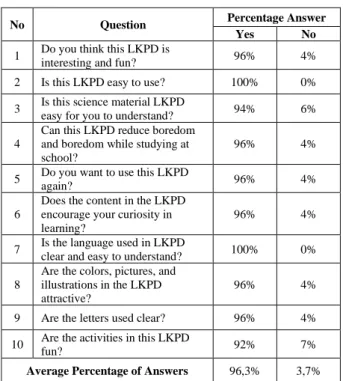
The revised LKPD was based on suggestions from material experts, media experts, and users, then it was tried out on fifth-grade students of Islamic Elementary School, Blitar City. Students respond to the use of LKPD by filling out a questionnaire. 26 students participated in filling out this questionnaire. The results of the
recapitulation of student responses to LKPD can be seen in Table 5 as follows.
Table 5 Student Response Results to LKPD
No Question Percentage Answer
Yes No
1 Do you think this LKPD is
interesting and fun? 96% 4% 2 Is this LKPD easy to use? 100% 0% 3 Is this science material LKPD
easy for you to understand? 94% 6% 4
Can this LKPD reduce boredom and boredom while studying at school?
96% 4%
5 Do you want to use this LKPD
again? 96% 4%
6
Does the content in the LKPD encourage your curiosity in learning?
96% 4%
7 Is the language used in LKPD
clear and easy to understand? 100% 0% 8
Are the colors, pictures, and illustrations in the LKPD attractive?
96% 4%
9 Are the letters used clear? 96% 4% 10 Are the activities in this LKPD
fun? 92% 7%
Average Percentage of Answers 96,3% 3,7%
Based on the average percentage of answers in table 5, it is known that the students’ responses to LKPD were 96,3% of students gave “yes” answers and 3,7% of students answered “no”. Many students gave positive responses to the use of LKPD with the theme of human and animal organs.
4.
DISCUSSION
The feasibility of LKPD in this study is known based on the results of the validation that has been carried out by material experts, media experts, and users. Material validation was carried out to determine the feasibility level of LKPD in terms of the suitability of the material to KI and KD in learning. Media validation was conducted to determine the feasibility level of LKPD in terms of attractiveness. While user validation is carried out to determine the feasibility level of LKPD in terms of usage. Material validation includes an assessment of the feasibility of the content, the feasibility of presentation, the aspects of language, and the context. Media validation only assesses aspects of presentation feasibility, and user validation includes assessments of the feasibility of content, presentation feasibility, language, and contextual aspects.
Based on a questionnaire that has been assessed by material experts, information is obtained that: (1) the eligibility of the LKPD material content is 88% with the criteria “valid/feasible”, (2) the feasibility aspect of the presentation of LKPD is 75% with the criteria “quite valid”, (3) the language aspect used in the LKPD is 100% with the criteria “valid/feasible”, and (4) the contextual
aspect of the LKPD is 95% with the criteria “valid/feasible”. The average result of material validity based on a material expert judgment is 89,5%. This shows that LKPD is “valid/feasible” and can be used.
Based on a questionnaire that has been assessed by media experts, information is obtained that the feasibility of presenting LKPD is 100% with the criteria “valid/feasible”. This shows that LKPD is “valid/feasible” in terms of media and can be used. While the questionnaire that has been assessed by the user, namely as a grade V teacher at SDN Tlumpu, Blitar city, obtained information that: (1) the feasibility of the LKPD material content is 96% with the criteria “valid/feasible”, (2) the feasibility aspect of the presentation of LKPD is equal to 100% with the criteria “valid/feasible”, (3) the language aspect used in LKPD was 92% with the criteria “valid/feasible”, and (4) the contextual aspect of the LKPD was 85% with the criteria “valid/feasible”. Based on these results, it is known that the LKPD of Human Body Organ Matter has “valid/feasible” criteria to be applied in class V Islamic Elementary School, Blitar City.
LKPD products that have been validated by material experts, media experts, and users are then tested on students in the Thematic learning of human organs in class V Islamic Elementary School, Blitar City. Researchers act as teachers in providing instructions to students on the use of LKPD in learning. Students are then given a questionnaire containing student responses to the LKPD. This is to find out whether students are interested in using LKPD in learning and to find out whether students find it easy to use LKPD.
The trial, which was conducted on the fifth-grade students of Islamic Elementary School, Blitar, obtained a percentage of results of 96,3% which showed that students were interested and happy to use LKPD in learning so that they were motivated by a sense of their curiosity about science material. In the comments column students also tell that they experience the ease of use and understanding of the material because the forms and letters used in the LKPD are easy to understand, the language and sentences used are easy to understand, students are also not bored and bored when studying at school using this LKPD because it is equipped with illustrations with attractive colors and images.
Based on the results of validity by material experts, media experts, users, and student responses, it can be concluded that this LKPD has met the criteria as a good learning media, in accordance with the opinion of Sungkono (2009) that the criteria for good learning media are: (1) LKPD has questions - problems that students have to do, and activities such as experiments that students have to do; (2) are printed teaching materials; (3) the material presented is a summary that is not too broad in its discussion but includes what students will do or do;
and (4) has components such as an introduction, introduction, table of contents, and so on.
5.
CONCLUSION
Based on the results of this research and development, it can be concluded that the LKPD media of Human Organs material is suitable for use as a learning medium. The evaluation of material experts shows a percentage of 89,5%, media experts at 100%, and teachers as users with a percentage of 93%.
REFERENCES
[1] Dick, W., Carey, L., dan Carey, J.O. 2009. The Systematic Design of Instruction: Pearson.
[2] Jannah, Raudatul. 2017. Pengembangan Lembar Kerja Siswa Berbasis Representasi Kimia pada Materi Interaksi Antar Partikel. Skripsi. Bandar Lampung: Universitas Lampung.
[3] Retno, R. S., & Yuhanna, W. L. 2016. Pembelajaran Konsep Dasar IPA Dengan Scientific Inquiry Untuk Meningkatkan Kemampuan Berpikir, Bekerja, dan Bersikap Ilmiah pada Mahasiswa. Jurnal Pendidikan Biologi Indonesia, 2(1), 1-9.
[4] Sudjana. 2005. Metode Statistika. Bandung: Tarsito. [5] Sukamti, dkk. 2017. Analisis Pelaksanaan Pembelajaran
IPA Kelas V SD Se-Kota Blitar. Universitas Negeri Malang.
[6] Sungkono. 2009. Pengembangan Bahan Ajar. Yogyakarta: Universitas Negeri Yogyakarta.
[7] Trianto. 2010. Model Pembelajaran Terpadu, Konsep, Strategi, dan Implementasinya dalam KTSP. Jakarta: Bumi Aksara.
[8] Widjajanti, Endang. 2008. Kualitas Lembar Kerja Siswa. Dalam staff.uny.ac.id/system/files/pengabdian/endang-widjajanti-lfx-ms-dr/kualitas-lks.pdf accessed on date 13 Maret 2018.
[9] Jihad, Evaluasi Pembelajaran. Yogyakarta: Multi Pressindo, 2010.
[10] I. M. Sadjati, Pengembangan Bahan Ajar In: Hakikat Bahan Ajar. Jakarta: Universitas Terbuka, 2012. [11] D. Rahdiyanta, “Teknik Penyusunan Modul. Artikel,”
2016.
[12] W. E. Blank, Handbook for Developing Competency Based Training Programme. London: Prentice Hall. [13] G. A. Suarsana, M., & Mahayukti, “Pengembangan
E-Modul Berorientasi Pemecahan Masalah Untuk Meningkatkan Keterampilan Berpikir Kritis Mahasiswa,” J. Pendidik. Indones., vol. 2, no. 2, 2013.
[14] L. Tania, “Pengembangan Bahan Ajar E-Modul Sebagai Pendukung Pembelajaran Kurikulum 2013 Pada Materi Ayat Jurnal Penyesuaian Perusahaan Jasa Siswa Kelas X Akuntansi SMK Negeri 1 Surabaya,” J. Pendidik. Akunt., vol. 5, no. 2, 2015.
[15] N. dan A. R. Sudjana, Teknologi Pengajaran. Bandung: CV Sinar Baru Algesindo, 2007.
[16] Gunawan, I. (2017, September). Indonesian Curriculum 2013: Instructional management, obstacles faced by teachers in implementation and the way forward. In 3rd International Conference on Education and Training (ICET 2017). Atlantis Press.
[17] Gunawan, I. (2017). Instructional management in indonesia: a case study. Researchers World, 8(1), 99. [18] Kusumaningrum, D. E., Sumarsoso, R. B., & Gunawan,
Pemberdayaan Sumber Daya Manusia Sekolah dengan Pendekatan Soft System Methodology. JAMP: Jurnal Administrasi dan Manajemen Pendidikan, 2(3), 90-97. [19] Gunawan, I. (2012, May). Mengembangkan Karakter
Bangsa Berdasarkan Kearifan Lokal. In Prosiding Seminar Nasional Meretas Sekolah Humanis untuk Mendesain Siswa Sekolah Dasar yang Cerdas dan Berkarakter, PGSD FKIP Universitas Muhammadiyah Surakarta, hlm (Vol. 50).
[20] Sobri, A. Y., Bafadal, I., Nurabadi, A., & Gunawan, I. (2018, October). Development of Mentoring Modules Based on Self-Reflection for Beginner Principal. In 3rd International Conference on Educational Management and Administration (CoEMA 2018). Atlantis Press. [21] Kusumaningrum, D. E., Arifin, I., & Gunawan, I. (2017).
Pendampingan pengembangan perangkat pembelajaran berbasis Kurikulum 2013. ABDIMAS PEDAGOGI: Jurnal Ilmiah Pengabdian kepada Masyarakat, 1(1). [22] Gunawan, I., & Sulistyoningrum, R. T. (2016). Menggali
Nilai-Nilai Keunggulan Lokal Kesenian Reog Ponorogo Guna Mengembangkan Materi Keragaman Suku Bangsa Dan Budaya Pada Mata Pelajaran IPS Kelas IV Sekolah Dasar. Premiere Educandum: Jurnal Pendidikan Dasar dan Pembelajaran, 3(01).
[23] Gunawan, I. (2018). The Implementation of Lesson Study Based Learning Management and the Effect toward Students’ Activeness in Lecturing. JPP (Jurnal Pendidikan dan Pembelajaran), 24(2), 51-63.
[24] Kusumaningrum, D. E., Sumarsono, R. B., & Gunawan, I. (2019). Professional Ethics and Teacher Teaching Performance: Measurement of Teacher Empowerment with a Soft System Methodology Approach. International Journal of Innovation, Creativity and Change, 5(4), 611-624.
[25] Kusumaningrum, D. E., Sumarsono, R. B., & Gunawan, I. (2017). Problematika Pemberdayaan dan Pengembangan Sumber Daya Manusia di Sekolah Menengah Pertama Berbasis Pesantren. Ilmu Pendidikan: Jurnal Kajian Teori dan Praktik Kependidikan, 2(2), 139-150.
[26] Sultoni, S., Gunawan, I., & Sari, D. N. (2018). Pengaruh Etika Profesional Terhadap Pembentukan Karakter Mahasiswa. JAMP: Jurnal Administrasi dan Manajemen Pendidikan, 1(3), 279-283.
[27] Bafadal, I., Nurabadi, A., Sobri, A. Y., & Gunawan, I. (2019). The Competence of Beginner Principals as Instructional Leaders in Primary Schools. International Journal of Innovation, Creativity and Change, 5(4), 625-639.
[28] Kusumaningrum, D. E., Sumarsono, R. B., & Gunawan, I. (2018, October). Empowering the Principal of Boarding House-Based Junior High School in East Java Province Indonesia. In 3rd International Conference on Educational Management and Administration (CoEMA 2018). Atlantis Press.
[29] Suminah, S., Gunawan, I., & Murdiyah, S. (2018). Peningkatan Hasil Belajar dan Motivasi Belajar Siswa melalui Pendekatan Behavior Modification. Ilmu Pendidikan: Jurnal Kajian Teori dan Praktik Kependidikan, 3(2), 221-230.
[30] Bafadal, I., Nurabadi, A., & Gunawan, I. (2018, December). The Influence of Instructional Leadership, Change Leadership, and Spiritual Leadership Applied at Schools to Teachers’ Performance Quality. In International Conference on Education and Technology (ICET 2018). Atlantis Press.
[31] Gunawan, I. (2016). Perspectives of Pancasila: Leadership Education’s Values and Ethics’. 2nd ICET Theme:“Improving the Quality of Education and Training Through Strengthening Networking, 417.
[32] Bafadal, I., Juharyanto, J., Nurabadi, A., & Gunawan, I. (2018, October). Principal Leadership and its Relationship with Student Learning Achievements: A Regression Analysis. In 3rd International Conference on Educational Management and Administration (CoEMA 2018). Atlantis Press.
[33] Gunawan, I., Kusumaningrum, D. E., Triwiyanto, T., Zulkarnain, W., & Nurabadi, A. (2018, October). Hidden Curriculum and its Relationship with the Student Character Building. In 3rd International Conference on Educational Management and Administration (CoEMA 2018). Atlantis Press.
[34] Gunawan, I. (2017, August). The Application of Instructional Management Based Lesson Study and its Impact with Student Learning Achievement. In 2nd International Conference on Educational Management and Administration (CoEMA 2017). Atlantis Press. [35] Gunawan, I. (2009). Hubungan keterlibatan guru dalam
musyawarah guru mata pelajaran dan kemampuan mengelola kelas dengan motivasi belajar siswa di SMA Negeri se-Kota Malang/oleh Imam Gunawan (Doctoral dissertation, Universitas Negeri Malang).
[36] Gunawan, I., Kusumaningrum, D. E., & Sumarsono, R. B. (2019, December). Investigation of Principal Leadership Based on Pesantren: Descriptive Study about Implementation of Human Resources Empowerment Models Based on Soft System Methodology. In the 4th International Conference on Education and Management (COEMA 2019). Atlantis Press.
[37] Andriningrum, H., & Gunawan, I. (2018, December). Cultivatation of Healthy Life for Students in School: A Literature Review. In International Conference on Education and Technology (ICET 2018). Atlantis Press. [38] Argadinata, H., & Gunawan, I. (2019, December). The
Leadership of Pancasila in Education: Foundation for Strengthening Student Characters in the Industrial Revolution Era 4.0. In the 4th International Conference on Education and Management (COEMA 2019). Atlantis Press.