Caml Virtual Machine — File & data formats
Document version: 1.4
http://cadmium.x9c.fr
Copyright c 2007-2010 Xavier Clerc – [email protected]
Released under the LGPL version 3 February 6, 2010
Abstract: This document describes the binary formats used by Caml1 in its “3.11.2” version for both bytecode files and marshalled data. This document is structured in two parts: the first one exposes the format of bytecode files, and the second one exposes the format of marshalled data.
Bytecode file format
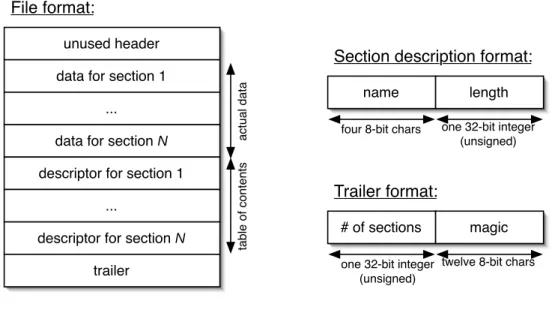
The format of bytecode files is summarized by figure1. Unused header is commonly os-executable code that looks for ocamlrun executable and launch it on the file. Trailer identifies the file as a caml bytecode file by magic (“Caml1999X008”) and indicates the number of sections in the file. One should notice that datas and descriptors of sections do not need to be in the same order. All character and string values use the ISO-8859-1 encoding. The remainder of this section lists possible sections with their contents.
”CODE” section (mandatory) contains the bytecode to be executed. Its size must be a multiple of 4, as the code is composed of 4-byte integers (in little-endian representation). These integers are either insctructions bytecodes or instructions arguments. The list of intructions with related arguments is given in another document “Caml Virtual Machine – Instruction set” that can be downloaded at http://cadmium.x9c.fr.
” DATA ” section (mandatory) contains the global data for the program, in the format defined in the second part of this document.
” PRIM ” section (mandatory) contains a terminated list of null-character-terminated strings. Each string is the name of a primitive requested for program execution. The order of these strings defines the primitive integer identifiers: the first requested primitive is given the ” 0” integer identifier, the second one is given the ”1” integer identifier,etc.
” DLLS ” section contains a null-character-terminated list of null-character-terminated strings. Each string is the name of a linked library requested for program execution.
1
The official Caml website can be reached atcaml.inria.frand contains the full development suite (compiler, tools, virual machine,etc.) as well as links to third-party contributions.
unused header data for section 1
... data for section N
descriptor for section 1 ...
descriptor for section N
trailer
table of contents
actual data
File format:
name length
four 8-bit chars one 32-bit integer (unsigned)
Section description format:
# of sections magic one 32-bit integer
(unsigned)
twelve 8-bit chars
Trailer format:
Figure 1: File format.
” DLPT ” section contains a null-character-terminated list of null-character-terminated strings. Each string is a path for linked library search.
” DBUG ” section contains an unsigned 32-bit integer indicating the number of debug elements. Elements follow, each being a couple containing an offset (as an unsigned 32-bit integer) and a marshalled value representing anInstruct.debug-event instance.
Marshalled data format
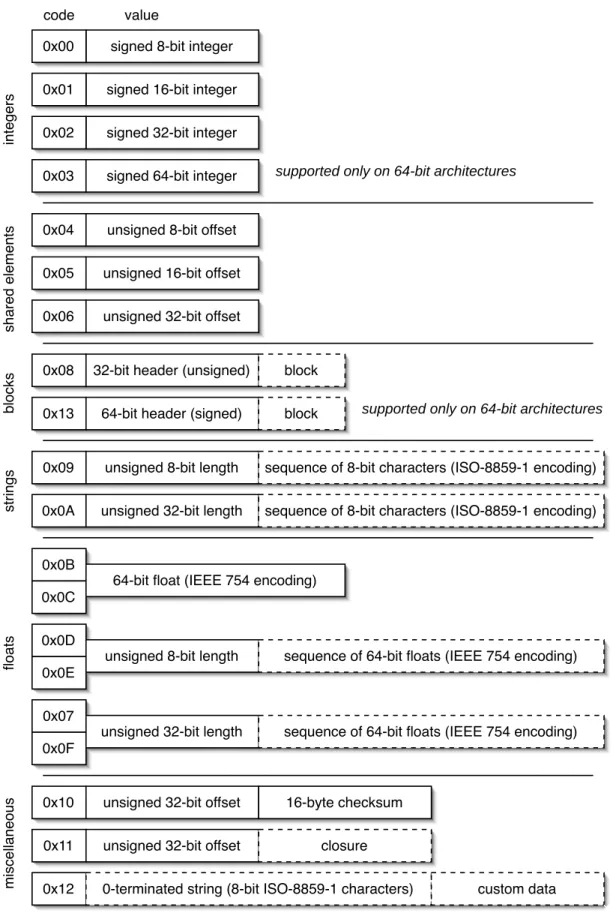
The format of marshalled values is summarized by figure 2. The following paragraphs give some precisions about particular data formats.
Integer values are stored in big-endian format. They encode values of the int type (int32, int64and nativeint types are coded as custom values).
String values are stored using ISO-8859-1 encoding.
Float values are stored using IEEE 754 encoding. According to code, values may be either big-endian (0x0B,0x0D, and 0x0F codes) or little-endian (0x0C,0x0E, and 0x07 codes).
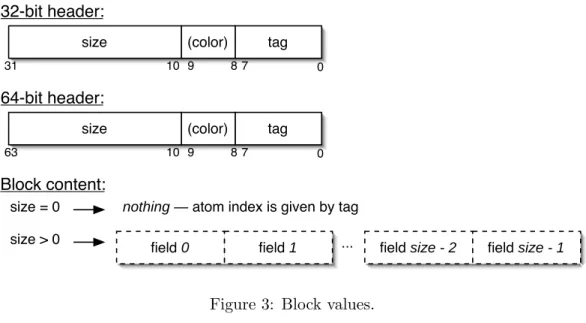
Code offset values (0x10) consist in the offset of a code address, relative to code start. Block values are serialized as shown in figure3. For atoms, no additional data needs to be stored as the tag is given by the header. Other blocks are stored by serializing their fields in ascending order, the size (number of blocks) being given by the header. Color is used by garbage collector and is set to zero in serialized data.
code value
signed 8-bit integer signed 16-bit integer signed 32-bit integer 0x00
0x01 0x02
0x03 signed 64-bit integer supported only on 64-bit architectures
0x08
0x09 0x0A
0x0B 0x0C 0x0D 0x0E 0x07 0x0F
0x10 0x11 0x12 0x13
unsigned 8-bit length unsigned 32-bit length
sequence of 8-bit characters (ISO-8859-1 encoding) sequence of 8-bit characters (ISO-8859-1 encoding)
64-bit float (IEEE 754 encoding)
unsigned 8-bit length sequence of 64-bit floats (IEEE 754 encoding)
unsigned 32-bit length sequence of 64-bit floats (IEEE 754 encoding) 0x04
0x05 0x06
unsigned 8-bit offset unsigned 16-bit offset unsigned 32-bit offset
32-bit header (unsigned)
64-bit header (signed) supported only on 64-bit architectures
integers
shared elements
blocks
strings
floats
miscellaneous 0-terminated string (8-bit ISO-8859-1 characters) custom data block
block
unsigned 32-bit offset unsigned 32-bit offset
closure 16-byte checksum
size = 0 size > 0
nothing — atom index is given by tag
field 0 field 1 ... field size - 2 field size - 1
32-bit header:
64-bit header:
Block content:
(color) tag size
0 7
8 9 10 31
(color) tag size
0 7
8 9 10 63
Figure 3: Block values.
Custom values are stored in two parts: the first one is the custom identifier (as a null-character-terminated string, using ISO-8859-1 encoding), the second one is custom-specific data.
Shared values are references to elements already (de)serialized of the current value. The offset defines this reference, zero pointing to the last read object, one pointing to the preceding object, etc.
Small elements are used to shorten value representation. They are stored using the specific encodig depicted in figure 4. A code from0x20 to0x3F indicates a small string value, a code from 0x40 to 0x7F indicates a small int value, and a code from 0x80 to 0xFF indicates a small block value.
0x20
0x3F
...
0x40
0x7F
...
0x80
0xFF
...
code value
sequence of 8-bit characters (ISO-8859-1 encoding) length = code & 0x1F
value = code & 0x3F
size = (code >> 4) & 0x07 tag = code & 0x0F block