AN
AT
A RESEARCH UPD
ATE:
JUNE 20
13
www
.t
eac
her
s.ab.ca
Early Years of Practice:
ISBN 978-1-927074-17-6
The Alberta Teachers’ Association
11010 142 Street NW, Edmonton, AB T5N 2R1 Telephone 780-447-9400 or 1-800-232-7208 www.teachers.ab.ca
i
Preface
... 1Executive Summary
... 3Purpose of the Study ... 3
Study Design ... 3
Literature Review ... 3
Key Findings ... 4
What It’s Like to Be a New Teacher ... 4
Supports Available at the School Level ... 4
Supports Available at the District Level ... 5
Underemployment and Insecure Employment ... 5
A Cycle of Overwork ... 5
Importance of Collaboration ... 5
Challenges Facing Remote Schools ... 5
Conclusions ... 6
Future Directions ... 6
Background
... 7Why Study Beginning Teachers? ... 7
Teacher Supply, Demand and Attrition in Alberta ... 8
Characteristics of Beginning Teachers ... 8
Effective Teacher Induction ... 9
Study Design
... 11Pilot Study ... 11
Longitudinal Study ... 11
Study Sample ... 11
Data Collection ... 12
Data Analysis ... 12
Sample Attrition ... 13
Findings
... 15Working Conditions ... 15
Changes in Working Conditions Over Time ... 16
Working Conditions and Relationships ... 16
Attractiveness of Teaching as a Career ... 17
Development of a Professional Identity ... 18
The Role of Feedback in Teacher Growth ... 19
Feedback from Administrators ... 20
Evaluations ... 21
ii
Mastering the Art of Teaching ... 24
Developing a Style of Practice ... 25
Learning to Set Priorities ... 26
Learning Organizational and Time-Management Skills ... 26
What New Teachers Value Most ... 27
Synthesis and Analysis: Key Themes
... 28Achieving a Work–Life Balance ... 28
Value of Preservice Preparation ... 30
Employment Stability ... 30
Leaves of Absence ... 31
Mobility ... 32
Impact of Employment Instability on Professional Growth ... 33
Difficulty Attaining a Continuing Contract ... 35
Effective Induction Practices ... 37
Importance of a Multifaceted Approach ... 37
Most Effective Induction Practices ... 38
School-Level Support ... 40
District-Level Support ... 41
Conferences and Off-Site Professional Development ... 43
Ongoing Professional Development ... 44
A Hierarchy of Needs ... 44
Navigating School Politics ... 47
Status Hierarchies in Schools ... 47
The Role of Administrators ... 50
Conclusion
... 52Induction from a Systems Perspective ... 52
Improving Induction Practices at the System Level ... 53
Breaking the Cycle ... 55
Impact of Induction Practices on Teachers Who Stay ... 57
Are Great Teachers Still Waiting for Jobs? ... 58
Accurate Attrition Data Is Difficult to Establish ... 59
Maternity Leaves and Parenting ... 59
The Challenges of Implementing an Induction Program ... 60
Looking Ahead... 61
Preface
This publication reports on the final year of a unique five-year longitudinal study of beginning teachers that the Alberta Teachers’ Association embarked on in 2008. The study was designed to answer three questions:
1. Can the sources of attrition within the first five years of teaching be determined? Why do teachers leave and where do they go?
2. To what extent are mentorship programs and other induction practices being used in Alberta schools and how effective are they?
3. How do working conditions and school cultures affect early-career professional development? J-C Couture, who oversees the Association’s research projects, coordinated the study, which was
undertaken by lead researcher Laura Servage and assistant researcher Jamie Beck, both doctoral candidates at the University of Alberta. As in previous years, data was collected by means of 15- to 30-minute telephone interviews with study participants. Of the 135 original participants, 89 took part in the final year-five
interviews—a relatively modest attrition rate considering the extended period that the study covered. At the end of year five, the researchers were also able to determine the employment status of 125 of the original 135 participants. In addition to asking a number of standard questions designed to measure changes over time, the researchers introduced some new questions in the year-five interviews that were intended to explore certain themes that had emerged from the earlier data. In year five, the researchers supplemented data from the standard telephone interviews by organizing two focus groups and conducting extended telephone interviews with 10 participants. The focus groups and extended interviews invited participants to reflect on their five years of teaching and to discuss other factors that had shaped their professional identity.
In addition to tracking overall trends, the study offers a unique glimpse into the lived experiences of the early-career teachers who have shared their stories with the research team over the past five years. The study suggests that beginning teachers embark on teaching with enthusiasm and hope and look forward to a fruitful career that will enable them to make a positive impact on the lives of students. Although certain experiences dampened their expectations over the five years during which they were tracked, participants generally remained committed to the profession and to enhancing the lives of students. The study highlights the intense emotional and intellectual work involved in teaching and identifies the key factors that influence and shape the early years of practice. I hope that this study will encourage education partners to work together in supporting the early-career development of Alberta teachers.
Gordon R Thomas
Executive SecretaryExecutive Summary
Purpose of the Study
Commissioned by the Alberta Teachers’
Association (ATA), this five-year longitudinal study of beginning teachers in Alberta schools was initially designed to answer two major questions: (1) Why do so many early-career teachers leave the profession? and (2) Where do such teachers go?
As it evolved, the study yielded insights into the following additional topics:
• The gap between the support that schools and school boards currently offer new teachers and the kind of support that new teachers would like to receive
• The specific ways in which the culture of a school can make new teachers feel either welcome or professionally isolated
• The qualities and behaviours that new teachers value in both informal and formal mentors
• The stages through which new teachers develop as they gain self-confidence, acquire skills and forge professional identities
• The factors that determine whether beginning teachers will either perpetuate the “trial by fire” that they may have experienced when they began teaching or break the pattern by choosing to nurture succeeding generations of beginning teachers
• The factors that enable most beginning teachers to secure stable continuing contracts and that launch others (a significant minority) on an unstable career trajectory
• The challenges that beginning teachers experience in maintaining a work–life balance
Study Design
The study sample consisted of 135 beginning teachers who were drawn randomly from the approximately 850 teachers who participated in
a Beginning Teachers’ Conference that the ATA organized in the fall of 2007. The sample was representative of the provincial teacher population in terms not only of gender (83 per cent of participants were female and 17 per cent were male) but also of geography (all convention areas were represented as well as urban, rural, remote and semirural settings). Although a number of participants dropped out over the course of the study, 89 of the original 135 teachers participated in all years of the study. Furthermore, the researchers were able to track 125 of the original 135 participants to determine if they had moved and whether they were employed.
Data for the study came from three sources: 1. Telephone interviews: Each year, the researchers
conducted telephone interviews with participants. These 15- to 30-minute interviews included both closed- and open-response questions. Interviewers documented the responses using a standardized survey form.
2. Focus groups: In years four and five of the study, the researchers organized a total of five focus groups that involved 18 participants. These focus groups explored such emerging themes as career paths, early-career learning, professional identity and the kinds of support that participants had received from colleagues, administrators, school districts and the ATA.
3. Individual extended interviews: In year five, the researchers conducted extended individual interviews with 10 participants who were selected to represent the range of career trajectories that participants had experienced.
Literature Review
In conjunction with the study, the researchers reviewed the literature on early-career attrition, the experiences of new teachers and the efficacy of various induction practices. This review yielded the following findings:
• Early-career attrition rates are difficult to measure. • Among the major causes of early-career attrition
are low salaries (an issue more evident in the United States than in Canada), inadequate preservice preparation (again, a greater concern in the United States than in Canada), difficult working conditions (particularly in under-resourced schools) and professional isolation. • Effective induction programs include mentorship,
collaboration with skilled colleagues and classroom-based observations that involve both formative and summative feedback.
• An effective way of lessening stress for beginning teachers is to reduce the volume and complexity of their assignments.
• The tone of a school, including the attitudes of experienced colleagues toward new teachers, is largely determined by the administration.
• The size and composition of the school staff play a major role in determining how much support is available to new teachers. New teachers benefit from having ready access to colleagues who teach the same grade and/or subjects. • The notion that new teachers should “sink or
swim” is deeply embedded in the teaching profession despite compelling evidence that such an approach drives some promising new teachers out of the profession altogether and negatively affects the careers of many who stay.
Key Findings
What It’s Like to Be a New Teacher
Study participants varied greatly not only in the amount of support that they received but also in the self-confidence, resourcefulness and persistence they themselves exhibited in their first years. Despite these differences, participants generally agreed that what they most wanted during their initial years of teaching were the following conditions:• A stable teaching assignment that would give them a sense of community and enable them to build on their past learning experiences
• A safe environment in which colleagues would seek them out, offer support and answer their
questions
• A supportive administrator capable of
communicating his or her expectations clearly • Orientation to the school’s norms, routines, rules
and idiosyncrasies
• A manageable teaching assignment and reasonable limits on extracurricular expectations • Ample formative feedback from colleagues and
administrators
• Transparency in hiring criteria and hiring practices During their first years of teaching, beginning teachers experience periods of intense overwork. By years four and five of the study, many participants were pulling back due to exhaustion and family commitments, leaving novice teachers to pick up the demands. The study suggests that some school boards and administrators may regard the energy and enthusiasm of new teachers as expendable resources rather than as enduring assets to the school community.
Even with excellent supports in place, new teachers need time and experience to grow professionally. Colleagues and administrators can help in this process by allowing new teachers the freedom to experiment, learn from mistakes and successes, and develop a unique and authentic professional identity.
Supports Available at the School
Level
Generally, new teachers rely on their
administrators to provide them with instructional leadership, help them with classroom-management issues and support them in dealing with parents. New teachers want to feel that they have the backing of their administrators who, as several participants observed, set the tone for how colleagues treat one another.
According to participants, mentorship initiatives in schools tend to be hit and miss. For one thing, not all mentors have the desire or the skills required to provide new teachers with the support they need.
Furthermore, some schools, especially small ones, do not have other teachers available to mentor who teach at the same grade level or in the same subject area as new teachers.
Nonetheless, mentorship is enormously important to new teachers. Participants who did not have mentors or whose assigned mentor did not work out did their best to forge informal mentoring relationships.
Beyond mentorship, among the simple but often-neglected site-based supports that new teachers want are a thorough orientation to the school, a clear explanation of what is expected of them and a designated staff member who can answer their questions and provide them with support.
Supports Available at the District
Level
Aware that supporting new teachers is important, many school boards in Alberta are offering
mentorship programs and other district-level initiatives to orient new teachers and provide them with structured professional development to meet their needs and priorities.
Districts can best support new teachers by (1) offering them targeted professional development after the first four to six weeks of the school year on such topics as assessment practices, working with parents, and district policies and procedures; (2) providing mentors with support and training; (3) creating opportunities for new teachers to meet one another; and (4) arranging for new teachers to collaborate with more experienced teachers who share their areas of specialization.
Underemployment and Insecure
Employment
Approximately 10 per cent of participants, through no choice of their own, were still underemployed by the end of the study. A substantial minority of participants had difficulty obtaining continuing contracts, and a number remained insecurely employed. Participants who had become parents
during the course of the study and did not have a continuing contract to return to were especially at risk of remaining insecurely employed.
Many participants reported that their school board’s hiring and evaluation practices lacked transparency. Because they could not get clear answers about what they needed to do to improve their chances of gaining a contract, a number of participants became frustrated and discouraged. Such discouragement can lead new teachers to leave the profession.
A Cycle of Overwork
Some schools continue to subscribe to the notion that rookie teachers should be made to “pay their dues” by taking on difficult teaching assignments and doing more than their fair share of extracurricular work. In their first years, many participants were afraid to decline these requests because they felt that doing so might jeopardize their chances of securing a contract. By the last years of the study, however, some participants had become less willing to participate in extracurricular activities, arguing that, just as they had had to earn their position, so new teachers coming into the system should do the same. Thus the cycle was perpetuated.
Importance of Collaboration
Although the culture of many schools hasteachers working in isolation much of the time, most participants expressed the view that collaboration and reciprocity, because they are foundational to a teacher’s professional growth, should be the norm. Many participants reported that they had made a point of supporting new teachers who had started after them, thereby establishing a “virtuous induction cycle” to counter the cycle of overwork noted above.
Challenges Facing Remote Schools
Alberta Education (2010b; 2012) reports that rural and remote districts have difficulty attracting and retaining teachers. The current study suggests
that sparsely populated regions, where economies of scale are generally lacking, also have difficulty bringing teachers together for collaboration and mentorship. Participants from rural and remote areas appreciated the efforts that their districts made to organize professional development days at which they could meet other teachers in the district. In some cases, Alberta Initiative for School Improvement (AISI) funding had been used to sponsor peer-coaching initiatives and other opportunities for beginning teachers to collaborate.
Conclusions
Although some studies have reported attrition in the first five years of teaching to be as high as 50 per cent, the rate of attrition in the study group was considerably lower. However, a relatively low attrition rate does not mean that all is well. Rather, the study suggests that many schools not only have poor induction practices but also tend to overload new teachers with difficult assignments and extracurricular activities. Although teachers who experience these circumstances may remain in the profession, their early experiences may negatively affect their resilience and professional growth for years to come. Furthermore, questionable hiring practices may leave some qualified and motivated teachers languishing in substitute teaching and temporary contract positions for many years or cause them to leave the profession altogether.
The study also suggests that beginning teachers value collaboration and are working to ensure that collaborative professional development becomes the norm in their schools. According to participants, many schools and districts are recognizing the needs of beginning teachers and are working to implement and improve induction practices.
The study reinforces the importance of providing beginning teachers with an induction that is
comprehensive and that is integrated into ongoing, shared professional learning for all teachers. The culture of a school is extremely important. Attempting to implement induction initiatives in schools in which staff believe that beginning teachers should “sink or swim” is largely futile. What is needed is a broad-based induction initiative that provides professional development not just for novice teachers but also for administrators and mentors.
The research literature contains a wealth of information on how to establish induction programs for new teachers. This study affirms the validity of many of the suggested strategies.
Future Directions
The study suggests that additional research and development is needed on the following topics: • District-level initiatives to track and improve hiring
and evaluation practices. Many good teachers fall through the cracks because they cannot get contracts, and too many new teachers are obtaining continuing contracts on the basis of very limited evaluation.
• The mobility and stability of early-career teachers. A large-scale study is needed.
• Strategies for sharing research and exemplary practices with respect to induction, both within and between districts.
• The unique challenges facing rural schools, schools in remote areas and schools serving high-needs populations.
• The development of staged professional learning models that recognize the unique learning needs of beginning teachers.
Background
Why Study Beginning
Teachers?
The ATA has participated in Alberta Education’s Teacher Workforce Planning Committee since 2007. One reason that the department established this committee was to examine concerns that many Albertans trained as teachers are either not entering or not staying in the teaching profession. To explore these concerns further, the ATA decided to embark on a beginning teachers study. The original intention of the study was to answer two key questions: (1) If new teachers are leaving the profession, where are they going? and (2) Why are they leaving?
The last few years have seen an increase in research on teachers’ early professional years (Glassford and Salinitri 2007; Ingersoll and Smith 2004). A number of factors have contributed to the increased interest in this topic. First, the extensive retirement of senior teachers and administrators is producing a shortage of teachers and school leaders in some areas (Johnson, Harrison Berg and Donaldson 2005; Strong 2005; Whisnant, Elliot and Pynchon 2005).1 Second, the United States and, to a lesser extent, Canada are experiencing high attrition rates among new teachers (Alberta Education 2012; Goddard and Foster 2001; Glassford and Salinitri 2007). Third, approximately three decades of school-improvement research and the more recent emphasis on accountability in public education have shone a spotlight on the quality and effectiveness of teachers (Ingersoll and Smith 2004). Indeed, some authors (OECD 2005; Whisnant, Elliot and Pynchon 2005) have argued that the most significant determinant of student learning is the effectiveness of the teacher.
Whisnant, Elliot and Pynchon (2005) cite compelling evidence that retaining beginning teachers results in a considerable cost benefit. For one thing, recruiting, hiring and training new teachers is an expensive undertaking. Furthermore, high turnover damages “stability, cohesion and morale” in a school community (Ingersoll and Smith 2004, 32). Johnson, Harrison Berg and Donaldson (2005) observe that students pay indirectly for high turnover and attrition, noting that students in schools with high staff turnover rates tend to be taught by a succession of novice teachers who lack the teaching skills and refinements that experience brings. The authors also note that losing new teachers affects the system as a whole by diminishing institutional memory, weakening collegial relationships and eroding leadership capacity.
Researchers have come up with at least three possible explanations as to why some new teachers leave the profession shortly after embarking on their career, whereas others carry on:
1. Working conditions: Many studies link attrition to difficult working conditions and weak or absent induction practices. Such studies often go on to examine local conditions and the policies they produce.
2. Characteristics of teachers: Some studies suggest that personal characteristics like resilience, efficacy, motivation, racial background and socioeconomic status have a role in determining whether a teacher perseveres or leaves the profession. Related studies suggest that the quality of preservice preparation has an impact on early-career attrition.
3. Demographics and policy analysis: Still other studies look at teacher attrition as a function of broader government and institutional policies, population demographics and labour-market conditions.
1 Kardos and Johnson (2007) argue that school culture is a much more important factor than demographics in contributing to staff shortages. However, shortages tend to occur in schools in which teaching is more difficult (such as those having many high-needs students and those serving poorer communities). Schools in impoverished urban neighbourhoods and in isolated rural communities have difficulty attracting and retaining teachers.
Researchers in the current study have kept an open mind with respect to these various approaches, being careful not to accept any one explanation as more valid than the others. In reality, beginning teachers probably leave the profession for a variety of complex and interrelated reasons: personal, interpersonal, institutional and political. Focusing on one explanation for early attrition—say, school culture and other immediate local conditions—can cause one to underestimate the impact of other factors such as systemic structural conditions. For example, attrition rates are consistently higher in schools that are geographically isolated and/or in which the student population consists mainly of poor, visible-minority students whose first language is other than English. At the same time, provincial and district policies and budgets determine not only teachers’ working conditions, classroom composition (the proportion of English as an additional language [EAL] and students with special needs, in particular) and class size but also the curriculum and the extent to which standardized tests are used to assess student progress. Focusing solely on school culture or on the characteristics, skills and training of individual teachers, in other words, can blind one to the broader systemic factors that may also affect teacher-attrition rates.
Teacher Supply, Demand
and Attrition in Alberta
The challenge will be to promote career opportunities in northern and rural communities, as competition for teaching positions in Alberta’s metro regions is extremely high. As a result, graduates who wish to work as teachers need to be open to the possibility of moving to smaller, rural or northern communities.
—Alberta Education 2012
When Alberta Education launched its teacher workforce planning strategy in 2010, it observed that the province’s labour markets were being affected by such factors as an aging population, increasing urbanization, a shortage of skilled labour and an increasingly diverse population. Among the challenges affecting public education were a shortage of teachers in rural and remote school districts and the under-representation of First Nations and visible minorities in the teaching population. Additional concerns included (1) a decline in the number of male teachers; (2) the difficulty of attracting and retaining teachers in such fields as early childhood education, second language studies, and career and technology studies; and (3) an estimated attrition rate of 25 per cent among teachers within their first five years (Alberta Education 2012). To address the high attrition among new teachers, Alberta Education implemented a provincewide induction program, a major component of which is mentorship. Pilot induction programs are now under way in 11 northern school districts, and Alberta Education has been working with an advisory council on which the ATA is represented to develop a framework for the induction program.
Characteristics of
Beginning Teachers
New teachers consistently experience “praxis shock,” the challenge of coping with classroom realities for which preservice training has not adequately prepared them (Goddard and Foster 2001). One of the goals of preservice education is to try to mitigate praxis shock (Anagnostopoulos, Smith and Basmadjian 2007). The teaching profession is not kind to novices: beginning teachers are expected to undertake the same responsibilities as veteran teachers while adapting to their new work environment (Casey and Childs 2007; McCormack, Gore and Thomas 2006).
Because many new teachers start their careers under temporary contracts, school administrators and staff may be reluctant to invest time, energy
and resources into what they consider transient staff members. New teachers tend to be on their “best behaviour” when working under temporary and probationary contracts. Study participants reported that, in order to increase their chances of obtaining a continuing contract, they had taken on unreasonable workloads, avoided asking for help and made sure that they did not “rock the boat.” These behaviours, coupled with weak, erratic or absent feedback structures, can create a situation in which new teachers are constantly off balance, unsure what colleagues, administrators, parents and students expect of them.
Identifying his or her strengths, weaknesses and philosophies is a significant focus of a beginning teacher’s learning (Clandinin and Connelly 1996; Goddard and Foster 2001; Hong 2010). The literature suggests that a teacher’s evolving professional identity gradually manifests itself in more or less effective practices and, ultimately, in the teacher’s effectiveness as a professional (Day and Gu 2010). Because identity work is neither visible nor urgent, it receives little explicit attention during teacher induction.
The findings of the study corroborate what the literature suggests: new teachers spend a great deal of time grappling with such major concerns as mastering classroom management and learning to communicate with parents (Melnick and Meister 2008). Participants reported spending the preponderance of their time as new teachers locating resources, planning lessons and building relationships with colleagues. Although a reduced workload would permit new teachers to reflect on and refine their learning, the reality is that they are usually assigned the same duties as experienced teachers. As a result, beginning teachers have what might be called survival or basic learning needs. The learning needs of beginning teachers are described in more detail later in the section entitled “A Hierarchy of Needs.”
Most induction programs are designed to elicit specific practice and behaviour outcomes from participants. Furthermore, they generally focus on the first year or two of practice and give little
attention to helping teachers develop ongoing professional habits (Levin 2003). However, the current study suggests that, while new teachers have professional development needs distinct from those of their more experienced colleagues, these needs should not be construed as constituting a distinct stage of professional learning. Indeed, as they gained experience, many study participants came to the conclusion that professional learning is an ongoing process.
Effective Teacher Induction
Induction is a system-wide, coherent, comprehensive training and support process that continues for two or three years and then seamlessly becomes part of the lifelong
professional development program of the district to keep new teachers teaching and improving toward increasing their effectiveness.
—Wong 2004
The extensive literature on effective induction practices sheds considerable light on the conditions that foster the professional growth of new teachers (Glassford and Salinitri 2007; Howe 2006). Experts agree that the best induction programs are
multifaceted, offering supports in multiple ways and in multiple contexts. The literature also suggests— and this study confirms—that good induction programs contain the following components: Mentorship: Although it is the cornerstone of an effective induction program, mentorship, in and of itself, is not sufficient to meet new teachers’ needs (Ingersoll and Smith 2004; Wong 2004). Mentorships are more likely to be successful when the mentor is genuinely committed to the relationship, when both parties teach the same grade or subject, and when the mentor and protegé have regular embedded professional development time to work together. Mentors also need support and professional
development to make them more effective in their roles.
Collaboration with colleagues: While not geared specifically to the inductee’s needs, learning
communities are often focused on planning lessons, identifying resources and developing teaching strategies—in short, on the “meat and potatoes” of what new teachers are trying to master. Learning communities expose new teachers to a variety of practice styles and teaching philosophies against which they can compare and evaluate their own evolving practice. Learning communities have the added advantage of establishing collaboration as a cultural norm of practice during a teacher’s formative years (Carroll 2005). Communities also provide a structure for ongoing professional growth, allowing new teachers to change roles over time as they evolve from being apprentices to equal contributors. Classroom observations: New teachers can learn a great deal from observing experienced colleagues (Anast-May et al 2007; O’Leary 2012). They also benefit from being observed. Administrators undertake formal evaluations for permanent certification and contract purposes. However, colleagues and mentors can also undertake
classroom observations for the purpose of providing novice teachers with supportive formative feedback.
Good classroom observation can lie at the heart of both understanding professional practice and improving its quality. When used insightfully,
observation can have a profound impact, which can lead to a more open climate, greater trust between colleagues and the development of strong professional relationships.
—O’Leary 2012
Manageable workloads: New teachers need time
to learn the curriculum, find resources and develop lesson plans. One recognized strategy for freeing up time is to limit beginning teachers’ involvement in extracurricular activities. Another is to reduce their workload by ensuring that they are not given complex assignments involving many special needs students or split-level classes (Grossman and Thompson 2004). Reducing the complexity of new teachers’ assignments helps them to focus on their learning and on the development of important foundational skills (Ingersoll 2001; Wilson et al 2004). Expanding networks: Teachers who have no
professional contacts outside their own school can become isolated. Professional isolation is especially problematic in small rural schools where a teacher may be the only person teaching a particular grade level or subject. Teachers can expand their horizons by accessing district-level supports, attending conferences, joining ATA specialist councils and becoming active in their ATA local. It is essential that teachers have opportunities to network and collaborate with colleagues from other schools and districts.
Study Design
Pilot Study
At the end of the 2006/07 school year, the ATA conducted a pilot study involving 100 teachers randomly selected from among the first-year teachers who had attended the ATA’s Beginning Teachers’ Conference in the fall of 2006. Each participant was contacted by telephone in the summer of 2007 and asked a series of open- and closed-response questions. The interviews lasted approximately 15 minutes, and participants’
responses were recorded on the survey form. Many of the closed-response questions were drawn from among those that the ATA asks in its annual opinion survey of the general membership. The open-response questions probed such matters as the rewards, challenges and frustrations that participants had experienced in their first year of teaching as well as the kinds of support that they had received. The data was analyzed and the findings were published in an internal report.
Longitudinal Study
Findings from the pilot study were taken into account in designing a five-year longitudinal study
of beginning teachers, which the ATA launched in 2008.
Study Sample
The study sample consisted of 135 new teachers randomly selected from among approximately 850 teachers who had attended the ATA’s Beginning Teachers’ Conference in the fall of 2007. The majority of the participants were first-year teachers. A very small number were either teachers who had some previous experience and were returning to the profession after a long absence or early-career teachers who had moved to Alberta from another province. The sample was fairly representative of the general Alberta teaching population: 83 per cent of participants were female; 53 per cent were elementary specialists; 4 per cent were kindergarten or ECS teachers; and 43 per cent were either secondary teachers or were teaching a combination of grades. Participants from rural schools were more likely than their urban counterparts to have nonstandard teaching assignments. Participants from large urban centres were underrepresented in the sample, which, as Figure 1 shows, nevertheless contained teachers from all convention areas in the province.
School setting: In year one of the study, 32 per cent of the teachers (n=135) described their school
Figure 1: Sample by Teachers’ Convention Area (Year One)
Southeast South West Calgary City Palliser Central Alberta Central East Greater Edmonton North Central North East Mighty Peace
0% 5% 10% 15% 20% 25% 30%
Population Sample
setting as “rural” and 52 per cent as “urban.” The remaining participants came from settings described variously as “satellite communities,” “towns” or “commuter communities.”
University preparation: The majority of respondents (49 per cent) had completed their degrees at the University of Alberta, 13 per cent at the University of Lethbridge, 13 per cent at the University of Calgary and 4 per cent at Concordia University College, in Edmonton. An additional 16 per cent had completed their degrees out of province. The remaining 5 per cent had completed their teacher preparation either at another Alberta institution or (in the case of 2 participants) in another country.
Data Collection
Data for the longitudinal study came from three sources:
1. Telephone interviews: Beginning in the summer of 2008 and in each of the four successive summers, participants were contacted by telephone and asked a series of closed- and open-response questions. Responses to the interviews, which lasted between 15 and 30 minutes, were recorded by the interviewer on a standardized survey form. 2. Focus groups: In years four and five, the
researchers organized a total of six focus groups involving 18 participants. The focus groups explored such emerging themes as career paths, early-career learning, professional identity and the kind of support that participants had received from colleagues, administrators, school districts and the ATA.
3. Individual extended interviews: In year five, the researchers conducted extended individual interviews with 10 participants who were selected to represent the range of career trajectories that participants had experienced.
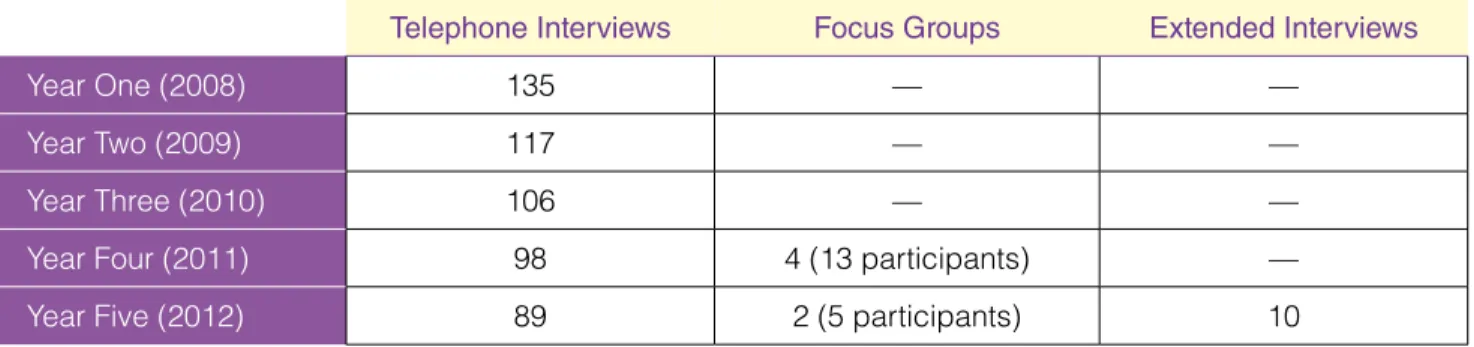
The preponderance of the data came from the annual telephone interviews. Some questions were repeated each year to facilitate the identification of trends over time. Other questions were added or revised to elicit information about themes that emerged as the study progressed. The focus groups held in years four and five and the extended interviews held in year five were designed to affirm and supplement findings derived from the telephone interviews. The sources of data are summarized in Table 1.
Data Analysis
Answers to the closed-response questions asked during the telephone interviews were compiled into basic descriptive statistics. NVivo data-analysis software was used to code responses to the open-response questions and to organize the codes into themes. Some themes were implicit in the questions asked. One question, for example, asked teachers to describe their relationships with colleagues. Another asked them to assess how changes had affected their practice. Other themes emerged as participants gained experience and were able to look back on their first years. During the course of the study, the researchers conducted an ongoing review of the literature on new teachers’ experiences in schools, induction practices, school leadership, the attrition of new teachers from the profession and Telephone Interviews Focus Groups Extended Interviews
Year One (2008) 135 — —
Year Two (2009) 117 — —
Year Three (2010) 106 — —
Year Four (2011) 98 4 (13 participants) —
Year Five (2012) 89 2 (5 participants) 10
Subset Description Number Contacted in All Years
Teachers in this group were contacted in each year of the study. The teachers chosen to participate in focus groups and in extended interviews were drawn from this pool.
82
Missed One Year
Teachers in this group missed being interviewed in one year of the study but were contacted in year five. Their data was included with that of the 82 continuous participants. The researchers felt that they could reliably discuss the career paths of these participants and the ways in which their thoughts and feelings about teaching had changed over the course of the study.
7
Dropped Out But Status Known
Teachers in this group dropped out of the study at various stages, either by moving or by not returning calls. The researchers used social media, school directories and other sources of public
information to locate these teachers and confirm their teaching status. Individuals in this group are included in the demographic summary (n=125).
24
Left Profession These participants left the profession at some point during the study. 6 Teaching Elsewhere These teachers left Alberta to teach in another province or to teach
overseas. They are included in the demographic summary (n=125). 6 Unable to Locate/Confirm These participants were unaccounted for at the end of the study. 10
Table 2: Contact with Participants Over the Course of the Study (n=135)
labour dynamics in the K to 12 education sector. The researchers reviewed the research literature on an ongoing basis to determine how the findings of the study to date compared with those of others in the field of new-teacher induction.
The focus groups and the extended individual interviews explored the following themes:
• The effectiveness of formal mentorship programs compared with other forms of collegial and administrative support
• The quality of the support that participants received in their first years of teaching • The extent to which hiring practices affected
participants’ employment stability and the extent to which employment stability (or lack thereof) affected participants’ early-career development • The factors that shaped participants’ emerging
personal philosophy of professional learning • The ways in which participants’ induction
experiences had shaped their practice
The focus group conversations and the
extended interviews were transcribed and analyzed thematically using NVivo software. The focus groups and extended interviews enabled the researchers to gather information about the background and personality of the participants. This information, in turn, helped the researchers better understand how the major themes of the study had played out in the career trajectory of several participants.
A second researcher joined the study in year four. The researchers analysed the qualitative data independently and met frequently to compare insights and interpretations.
Sample Attrition
Attrition is always a factor in a longitudinal study. The most reliable data came from a core of 82 teachers who were contacted in each of the five years. An additional 7 teachers missed one year but re-established contact in year five. The final
report focuses on two subsamples, teachers who are parents and untenured teachers, both of which are drawn from the core group of 82 participants. The 18 participants who took part in the year-four and year-five focus groups and the 10 participants who took part in the extended interviews also came from this core group. Studying the core group shed light on how beginning teachers’ perspectives and prospects changed over time.
An additional 24 teachers stopped participating in the interviews at some point in the study. Using email and staff lists, the researchers were able to determine where these individuals were teaching at the end of year five and ascertain the status of their employment contracts. The researchers were able to confirm that 6 teachers left the province to teach elsewhere and that 6 others left the profession. Despite their best efforts, the researchers were unable to locate the remaining 10 participants. The fact that the phone numbers and email addresses of some of the 10 participants were no longer valid suggests that a number of them had moved. Others simply did not return phone calls, even though they had not formally dropped out of the study. Some may be substitute teaching, others may be teaching on temporary contracts in other districts and others may have left the profession. A summary of the subsets is presented in Table 2.
The employment status of participants at the end of the study is summarized in Table 3.
Status Number Percentage of sample
Securely Employed 98 73%
Insecurely Employed/ Involuntarily
Underemployed (FTE<.8 )
15 11%
Teaching or Intending to
Teach Outside of Alberta 6 4%
Left the Profession 6 4%
Unknown 10 7%
Table 3: Employment Status of Participants at Year Five (n=135)
Don
— I Lucked Out!
Don is a Grade 6 teacher in a large urban
elementary school. He has friends in the teaching profession who had rocky starts in their first years, so he counts himself as among those who “lucked out” by obtaining a secure position in a great school right from the start of his career. Don received a probationary contract in his second year. He has never changed schools and doesn’t see himself changing in the future, a decision that he attributes to the fact that his school is a “real learning community.”
Because Don’s school is large, he’s always had the benefit of grade-level partners to work with. His school’s administration team supports weekly collaboration sessions that, Don says, helped him access lesson plans, resources and ideas from colleagues. He was also able to use these sessions to find solutions to difficulties he was having with a student or parent.
Don attributes the positive climate he works in not only to “great colleagues” but also to his administration team. “I had really strong administration supporting the approach I was taking in the classroom. They supported me and wanted me to improve. So it never felt judgmental. I could talk to them, knowing that they’re not just walking by thinking that I wasn’t doing my job correctly. They understand that there are struggles.”
For Don, supporting the new teachers who have come after him is “just normal because we’re trying to be a collaborative school and we share stuff.” Don also describes how he encourages new teachers to take risks and try new things, because the safe school culture he came into allowed him to do this when he was a novice. Don’s district didn’t start offering a formal mentorship program until he was in his fourth year of teaching. He thinks it is great that the board is providing this support and says he would have liked to have had a mentor. But he’s also grateful that, in the absence of a formal induction program, he came into a school that helped him to be successful and that keeps him fresh and enthusiastic as he moves into his sixth year of practice.
Findings
Working Conditions
The demands on schools and teachers are becoming more complex. Society now expects schools to deal effectively with different languages and student backgrounds, to be sensitive to
culture and gender issues, to promote tolerance and social cohesion, to respond effectively to disadvantaged students and students with learning or behavioural problems, to use new technologies, and to keep pace
with rapidly developing fields of
knowledge and approaches to student assessment.
—OECD, 2005
At the end of each year of the study, participants were asked to evaluate their working conditions
with respect to nine indicators: class size, support for students with special needs, access to technology, access to resources, access to professional development, amount of preparation time, extracurricular expectations, relationships with students and relationships with parents. The results of this evaluation are shown in Figure 2. In ranking each indicator, participants used the following five-point scale: very negative (-2), somewhat negative (-1), neutral (0), somewhat positive (+1) and very positive (+2). Evaluations were averaged for each indicator in each year. Average ratings of 2 or more indicate a very positive evaluation, while ratings close to 0 indicate a neutral evaluation. Low averages resulted when a majority of participants ranked an indicator as “somewhat negative” or “very negative.” Participants who answered “not applicable” were factored out.
Like the teaching population at large, new teachers are concerned about class sizes and support for students with special needs (ATA 2009). However, participants gave the most negative rankings to preparation time and extracurricular expectations. In discussing working conditions, participants raised the following concerns:
Figure 2: Working Conditions, Years One to Five (n= 82)
Very positive impact on practice
Somewhat positive impact on practice
Neutral to negative impact on practice
A
verage evaluation
2.00 1.80 1.60 1.40 1.20 1.00 0.80 0.60 0.40 0.20 0.00
Class sizes
Special needs suppor t
Access to technologyAccess to r
esour ces
Access to pr ofessional
developmentPreparation time
Extracurricular expectationsRelationships with studentsRelationships with par
ents
• Insufficient preparation to complete Individualized Program Plans (IPPs) for special needs students or to meet the diverse learning needs of students. • Insufficient aide time to support special needs
learners. (Participants praised the quality of the support they received but lamented the lack of it.) • Being assigned to a high number of
extracurricular activities in comparison with more veteran colleagues.
• Having to teach split classes or prepare for multiple classes (of particular concern to participants from small rural schools).
• Difficulties accessing professional development (again, a particular concern in small rural schools).
• Disparities in access to technology. Some participants taught in schools where laptops were the norm, while others had no whiteboards or computers or had to contend with outdated technology. Some participants complained about insufficient lab time.
Changes in Working Conditions Over
Time
The changes in conditions that participants noted from one year to the next may reflect actual changes in working conditions or a shift in teachers’ perspectives as they gained experience. However, throughout the study, participants consistently cited class composition, lack of preparation time and extracurricular expectations as the greatest sources of stress.2 Over time, participants’ rating of their relationships with students declined somewhat, an indication, perhaps, that their initial idealism had begun to wane. Nevertheless, participants in year five continued to characterize their relationship with students as the primary source of their commitment
to teaching and of their job satisfaction. Over time, participants expressed greater satisfaction with their relationships with parents and the community. This trend likely reflects the fact that, toward the end of the study, participants felt more at home in their schools and had more confidence and skill in communicating with parents.
Working Conditions and Relationships
At the end of year one and again at the end of year five, participants were asked to describe the greatest challenges and rewards that they had experienced. Their responses changed little over the five years, suggesting that new teachers experience rewards and challenges in much the same way as their more veteran colleagues.Not surprisingly, participants described their relationships—whether with students, colleagues or administrators—as being extremely important. Indeed, some respondents suggested that relationships had the potential to make or break a semester, a year or even a career. The experiences of building relationships with students and seeing students grow academically enrich the professional and personal lives of teachers. As one teacher put it, “many amazing things happen on a day-to-day basis that make the job worthwhile.” Teachers who worked in the same school for a number of years, particularly in small rural schools, were especially enriched by relationships that they had developed with students and families over time. Being a role model, creating a positive space and “knowing that, for some students, school is the best six hours of their day” add to a teacher’s professional satisfaction. Being a caregiver can also be taxing, especially in the case of students who have difficult home lives and for whom teachers can only do so much.
2 In their study of teachers in British Columbia, Naylor and White (2010) found that five of the top ten stressors that they had identified were directly related to classroom composition and lack of support for teaching students with special needs. Other stressors identified were relationships with colleagues and administrators, lack of resources, lack of professional autonomy and, for substitute teachers and early-career teachers, lack of job security.
It’s key to be in a supportive staff
environment where people are working as a team instead of opposing one another. I’ve experienced both, and it really affects your day-to-day life.
Participants also stressed the importance of developing supportive relationships with colleagues. Such relationships, according to participants, can mitigate the stress of working with demanding administrators and parents or with high-needs students. As one teacher noted, “I think that’s why we all work so well together: we understand the challenges that we’re all facing.” Some participants who had changed schools during the course of the study were struck by the dramatic difference in the quality of collegial relationships that exists in one school as opposed to another, an observation that supports one of the major findings of this study: namely, that school cultures play a highly significant role in shaping teachers’ feelings about the profession.
Relationships between teachers and
administrators are also important. However, the study suggests that one-to-one relationships of this kind are probably more significant in smaller schools and play a bigger role during the first couple of years of a teacher’s practice. Furthermore, once teachers obtain a continuous contract, they tend to be less anxious about their relationships with administrators. Administrators played a huge role in determining whether participants perceived their school as a positive place to work. Whether participants depicted the climate of their school as negative or positive was closely related to the extent to which they perceived work in the school as being fairly distributed among various members of staff. Participants who had good leaders described their entire school as positive, supportive, friendly, innovative and open. Participants who worked in schools where the leadership was weak or absent, by contrast, described the school climate as negative. To cope with a negative culture, they resorted to such strategies as withdrawing to their own classroom or forging supportive “subcultures” with grade-level partners, friends or department colleagues.
Attractiveness of Teaching as a
Career
In year one, participants were asked the following question: “Would you go into teaching again if you had to start your life over?” Ninety per cent of participants stated that they would. In year two and in each subsequent year, the following question was asked instead: “If you were able to start a new career tomorrow with the same salary and benefits, would you do so?” In year two, 67 per cent of participants stated that they would still choose to teach (18 per cent indicated that they were “not sure”); in year three, 59 per cent said they would still choose teaching; and in year four, 70 per cent said they would still teach. By year five, 53 per cent stated that they would continue to teach, while 20 per cent of the remaining participants stated that they would change jobs if they could. Given that many of the teachers who did not feel strongly committed to teaching had presumably already left the profession by this point, these five-year figures are concerning. The participants who wanted to change careers likely felt that they were being “pushed” out of the profession because it had lost its appeal rather than being “pulled” out of teaching because they had found a more attractive line of work.
Participants who still did not have a contract by year five were seriously questioning their career choice. Likewise, participants who had become parents expressed some ambivalence or regret about choosing teaching as a career. In general, participants became more concerned about the challenges of achieving a work–life balance as the study progressed. In the first years, participants expected to be overwhelmed and overworked. By year five, however, many participants felt that their workload, though somewhat more manageable, had not improved to the extent that they might have anticipated. In answering this question, many participants commented on the “24/7” nature of their profession and how much less stressful it would be to have a job that, rather than carrying over into the evening and weeks, simply ended when they left the workplace.
Beginning in year two and continuing through each remaining year of the study, participants were asked the following question: “Comparing this past year of teaching to previous years, would you say that your quality of life is better, worse or about the same?” The results of this question are summarized in Table 4.
Year
Response Two Three Four Five
Better 71% 57% 44% 49%
About the
Same 20% 23% 36% 23%
Worse 5% 11% 13% 21%
N/A 4% 10% 7% 7%
Table 4: Participants’ Perception of the Quality of Their Life, Years Two to Five (n=89)
The comments accompanying the year-five responses to this question suggest that some participants were experiencing fatigue and
beginning to question whether they could maintain the pace for an entire career. Some were worried about burnout. Others had become parents and were struggling to maintain a work–life balance. Although most participants continued to find working with students rewarding, some were questioning whether they could continue to meet what often seem like relentless expectations.
Each year, participants were asked two more questions designed to gauge their feelings about teaching as a career: “Do you see teaching as a lifelong career?” and “Is teaching a career that you would highly recommend to others?” As in the case of the question above concerning quality of life, participants were less positive and more ambivalent with each passing year. Responses to this question are summarized in Table 5.
The reasons that participants gave for their responses changed little over the course of the study. Those who did not regard teaching as a lifelong career stated that they might like to make a change for themselves at some point. As was the case in the question about quality of life, most
participants wanted to work in the field of education in some capacity but did not want the day-to-day stress of being a classroom teacher. Many who said they would recommend teaching to others qualified their response by noting that the other person would have to be someone who genuinely wanted to make a difference, who wanted to work with youth, who “knew what they were getting into” and who was “ready for the long hours and the workload.” Ironically, many participants, in answering other questions, talked about the impossibility of being fully prepared for all parts of the job.
Year
Response One Two Three Four Five
Yes 85% 71% 57% 44% 49%
No 5% 20% 23% 36% 23%
Not Sure 11% 5% 11% 13% 21%
N/A 0% 4% 10% 7% 7%
Table 5: Do You See Teaching as a Lifelong Career? (n=89)
Consistent concerns throughout the study have been workload, work complexity and the “24/7” emotional labour of being a teacher. Participants who have remained committed to teaching have simply accepted these concerns as part of the job they love: helping students learn and forging positive relationships with students, colleagues and parents.
Development of a Professional
Identity
Each year, participants were asked to rate themselves on six measures of professional identity: confidence, preparedness, satisfaction, stress, efficacy and enthusiasm. Their responses to these questions are summarized in Figure 3.
Although participants’ confidence and
preparedness varied somewhat from year to year depending on their teaching assignments and other circumstances, these measures generally increased over time. Stress levels, by contrast,
Figure 3: Professional Identity, Years One to Five (n=89)
Very High Somewhat High Moderate Somewhat Low
Very Low A
verage evaluation
Year1 Year2 Year3 Year4 Year5
5.0 4.5 4.0 3.5 3.0 2.5 2.0 1.5 1.0 0.5 0.0
Confidence
Prepar
edness
Satisfaction
Stress Efficacy
Enthusiasm
declined somewhat over the course of the study. However, participants’ comments suggest that what changed was not so much the amount of their stress but the nature of that stress. Year-one participants were more likely to cite uncertainty and lack of experience as contributing to their high level of stress. Throughout the study, however, participants continued to report working conditions and relationships as sources of stress.
Figure 3 suggests that participants’ efficacy and enthusiasm also declined somewhat over time, a reflection, perhaps, that the idealism that had initially drawn them to the profession had begun to wane. Overall, however, participants’ commitment to the profession did not significantly decline during their first five years of practice. The researchers also analyzed the responses of a number of individual participants to these questions during the course of the study and found little change.3 Those who were
most ambivalent with respect to their confidence, sense of commitment, belief that they could make a difference and overall enthusiasm at the beginning of the study tended to report similar feelings at the end. On the other hand, participants who were more emphatic about teaching as a calling at the onset tended to retain this sensibility, although, by the end, they were somewhat more tempered in assessing their working conditions, successes, goals and challenges.
The Role of Feedback in
Teacher Growth
The importance to beginning teachers of receiving feedback emerged as an increasingly dominant theme as the study progressed. Based on discussions at the year-four focus groups, the
3 Woolfolk Hoy (2008) reviewed a number of studies suggesting that, while teachers do bring varying personal characteristics and motivations to their work, their teaching environment plays a significant role in determining the extent to which these characteristics will manifest themselves. In a small study that controlled for individual teachers’ dispositions in evaluating early-career burnout, Goddard, O’Brien and Goddard (2006) found that working conditions—specifically, the extent to which teachers were allowed to be innovative—played a bigger role than personality in predicting early-career burnout. The authors propose that future studies on burnout should also control for personality variables so that the effect of environmental factors can be isolated.
researchers incorporated the following question into the year-five telephone interviews: “As you reflect back on your career to date, how much feedback have you received in each of the following areas: classroom management, lesson planning, teaching strategies, evaluation and value to school community?” Responses to this question are summarized in Figure 4.
Participants reported receiving the most feedback in the area of classroom management, possibly because it constitutes an immediate need that is of concern to teachers at all grade levels. Feedback on other areas of practice such as lesson planning, teaching strategies and evaluation was less common. Teachers in small schools who had no grade-level partners or colleagues in their specialization areas tended to rely on administrators and district staff rather than colleagues for feedback. In retrospect, the question would have been improved had it asked participants to specify whether the feedback they received came from administrators or from colleagues. However, comments that participants made in conjunction with the question suggest that much of the feedback they received came informally from colleagues.
Year-five respondents observed that they had welcomed feedback in their first years of practice. Feedback helps new teachers understand how their feelings, experiences and practices compare with those of more experienced teachers. Feedback from
Figure 4: Amount of Feedback Received on Various Aspects of Practice (n=89)
Classroom management Lesson planning Teaching strategies Evaluation Value to school community
A great deal Some Little None
39%
10%
24%
21%
39%
40%
48%
49%
47%
42%
13%
37%
18%
18%
9%
6%
12%
10%
11%
4%
trusted colleagues and school leaders also helps new teachers gain self-confidence. Participants noted that, as they gained confidence and
experience, they still appreciated receiving ongoing, informal feedback on their practices. As one teacher put it, “I wouldn’t want to be micromanaged. But it’s nice to have someone come in for observation and informal feedback, someone to bounce ideas off of and to get suggestions and ideas.” Participants also continued to appreciate regular visits from their administrators.
Once someone points stuff out to me, I’m much more aware of it, and I can start applying it to other things. That makes things much better in the long run for lesson planning and for the students. Sometimes it’s hard to hear constructive feedback, but I want to hear it. Lay it down, be honest.
Feedback from Administrators
New teachers relied upon their administrators to evaluate their progress and to recommend them for future placements and permanent certification. In addition to undergoing these summativeevaluations, participants valued receiving formative assessments, which helped them to learn and improve. Here’s how one participant described the value of the support he received from his
administrator:
He gives you positive feedback. He comes into the class constantly. He builds relationships with you and the staff. The support makes you more eager to come to school. You’re willing to do more and to offer more.
Evaluations
According to participants, the quality and continuity of evaluations they received from administrators varied greatly. One teacher, for example, noted that the evaluations she received were worlds apart from those obtained by a colleague in a different school:
I had four different administrators who didn’t even know who I was. I wasn’t accountable to anybody and I did whatever I wanted in my classroom. [My colleague] had a principal coming in every week seeing yearly plans and lesson plans.
In the most egregious cases, the only feedback participants received were formal evaluations from administrators or district officials whom the teacher did not know. At the other extreme, some participants received comprehensive, ongoing support from administrators who went out of their way to forge relationships with new teachers by dropping in on their classes, performing informal evaluations and maintaining an open-door policy. Participants who enjoyed this kind of support found formal evaluations more meaningful and less threatening.4 In the best cases, participants also received informal evaluations on their practices from mentors, coaches or colleagues who came into their classrooms. In short, the study suggests that feedback can range from a cursory, formal
evaluation, on the one hand, to an integral part of an ongoing trusting relationship, on the other.
What Participants Said About Feedback
• Both formal and informal feedback is valuable. Informal feedback, which serves as formative assessment, can help new teachers feel more comfortable and prepared when it comes to formal evaluations.
• Feedback is most effective in the context of a trusting relationship with administrators and/or peers.
• Teachers want to know the things they are doing right as well as constructive, specific suggestions for how they can improve.
• Teachers are most in need of feedback during their first couple of years of practice.
• The amount and quality of feedback that new teachers receive vary considerably.
• Colleagues are an important source of informal feedback.
The Importance of Setting
Boundaries
According to the study, one of the most
contentious issues for new teachers is participation in extracurricular activities. Many participants stated that, until they had secured a continuing contract, they complied with virtually every request made of them. The study also revealed that, before turning down a request from a colleague or administrator, a new teacher must learn to gauge ongoing social
4 Some participants stated that they felt intimidated by the presence of an administrator in their classroom, an observation that supports Leana’s (2011) contention that “losing face” in front of administrators can be a stressful prospect for novice teachers. Leana argues that school-improvement efforts should focus more on the expertise of teachers and less on the role of administrator as instructional leaders. Horng, Klasik and Loeb (2009) concur.