Abstract
Apache Drill is a distributed system for interactive ad-hoc analysis of large-scale datasets. Designed to handle up to
petabytes of data spread across thousands of servers, the goal of Drill is to respond to ad-hoc queries in a
low-latency manner. In this article, we introduce Drill’s architecture, discuss its extensibility points, and put it into the
context of the emerging offerings in the interactive analytics realm.
Introduction
When it comes down to large-scale data processingin
the enterprise, we encounter a variety of workloads. In order to achieve a business goal, we often see a combination of said workloads deployed:
batch-oriented processing, for example, MapReduce-based1 frameworks like Hadoop, for recurring tasks such as large-scale data mining or aggregation;
OLTP, such as user-facing e-commerce transactions, where NoSQL data-stores shine, including Apache HBase (http://hbase.apache.org/) or Apache Cassandra (http://cassandra.apache.org/);
stream processing, to handle stream sources such as
social media feeds or sensor data, with Storm (http:// storm-project.net/) being a representative framework;
search over semistructured data items and documents—
a widely used platform in this category is Apache Solr (http://lucene.apache.org/solr/);
and last but not least, interactive ad-hoc query and analysis.
In this article, we focus on the last category: workloads that involve a human, interacting online with a system, de-manding low-latency answers and support for formulating ad-hoc queries.
From Design to Implementation
Given a human in the loop who sits, say, in front of a business analytics application such as Tableau Desktop, clearly, a query should take only seconds or less to execute—even at scale. Further, allowing the user to issue ad-hoc queries is essential; often, the user might not necessarily know ahead of time what queries to issue. Also, one may need to react to changing circumstances. The lack of tools to perform inter-active ad-hoc analysis at scale is a gap that Apache Drill fills. For a concrete motivation, imagine a marketing analyst trying to experiment with ways to target user segments for an upcoming campaign. Let us further assume that the necessary data for the analysis resides in different data sources, as is often found in the enterprise: the web logs, containing the customers’ click behav-ior, may be stored in Hadoop Distributed File System (HDFS), while user profiles might come from a MongoDB instance as well as transaction data stemming from a conventional relational database management system (RDBMS) such as Oracle. Currently, in order to realize an interactive analysis, one would need to Extract, Transform and Load (ETL) data between the different systems and deal with the issues on a one-off basis, including impedance mismatches and delays in the actual analysis due to data preparation tasks. What is needed is an
APACHE DRILL:
Interactive Ad-Hoc Analysis at Scale
Michael Hausenblas and Jacques Nadeau
in-situ data processing method that can deal with different data sources in a flexible and scalable way. Enter Apache Drill.
High-level architecture
Back in 2010, Google published the seminal Dremel2research paper, introducing two main innovations: generically han-dling nested data with column-striped representations (in-cluding record assembly) and multilevel query execution trees, allowing for parallel processing of data spread over thousands of computing nodes. In mid 2012, these innova-tions were taken to The Apache Software Foundation, forming the core of a new incubator, Apache Drill.
At a high level, Apache Drill’s architecture (Fig. 1) comprises the following layers:
User: providing interfaces such as a command line
terface (CLI), a REST in-terface, JDBC/ODBC, etc., for human or application-driven interaction.
Processing: allowing for pluggable query languages as well as the query plan-ner, execution, and storage engines.
Data sources: pluggable data sources either local or
in a cluster setup, providingin-situ data processing. Note that Apache Drill is not a database but rather a query layer that works with a number of underlying data sources. It is primarily designed to do full table scans of relevant data as opposed to, say, maintaining indices. Not unlike the Map-Reduce part of Hadoop provides a framework for parallel processing, Apache Drill provides for a flexible query exe-cution framework, enabling a number of use cases from quick aggregation of statistics to explorative data analysis.
The workers in Apache Drill, suitably called drillbits, run on each processing node in order to maximize data locality. The
coordination of the drillbits, the query planning, as well as the optimization, scheduling, and execution are performed and distributed.
Key features
In the following, we highlight key features of Apache Drill and argue how the design of Apache Drill has been influenced by observations made in practical settings as well as re-quirements stated by the community.
Extensibility rules: Apache Drill is designed for exten-sibility, with well-defined application programming in-terface (API) and inin-terfaces. This includes, starting from the user layer, pluggable query languages via the query API as well as support for user-defined functions (UDF). Also, custom operators can be implemented, which is already being done for Apache Mahout, for example. Further, the default cost-based optimizer can be replaced or ex-tended. Last but not least, custom scanners for data sources (such as new NoSQL datastores) or file formats can be implemented via the API. The latter can be handy for cases in which the data is em-bedded in container formats, for example, metadata contained in video or audio documents.
Full Structured Query Language (SQL) please: many settings require the integration with deployed Business intelligence (BI) tools, including but not limited to Tableau, Excel, SAP Crystal Reports, etc. For this, SQL-like is not sufficient and consequently Apache Drill supports standard American National Standards Institute (ANSI) SQL 2003 along with allowing for standard Open Database Connectivity (ODBC)/Java Database Connectivity (JDBC) drivers.
Nested data as a first-class citizen: Apache Drill is rather flexible concerning supported data shapes.3As nested data is becoming prevalent (think JSON/BSON in document stores, XML, ProtoBuf, etc.) and flat-tening of nested data is error-prone, we support nested data directly in Apache Drill, effectively establishing an extension to above-mentioned SQL support.
Use but don’t abuse schema: data sources increasingly do not have rigid schemas; the schema might change rapidly or differ on a per-record level (for example, the case with HBase). Apache Drill hence supports queries against unknown schemas. The user is free to define a schema upfront or let Apache Drill discover it.
Query Execution
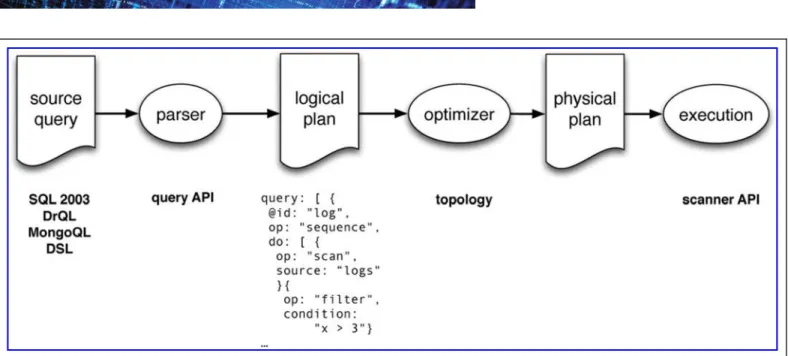
In order to appreciate Apache Drill’s flexibility, let us now have a closer look at the query execution in greater detail. As depicted in Figure 2, Apache Drill works by transforming a
FIG. 1. Apache Drill’s high-level architecture.
‘‘NOTE THAT APACHE DRILL IS
NOT A DATABASE BUT RATHER
A QUERY LAYER THAT WORKS
WITH A NUMBER OF UNDERLYING
query written in a human-readable syntax, such as SQL, into an internal form known as the logical plan. Then, Apache Drill transforms the logical plan into a physical plan, which is executed against the data source(s).
In Figure 2, an interface, which may be a JDBC/ODBC li-brary, provides the query to Apache Drill. Once presented with the source query, it is parsed and transformed to gen-erate the logical plan. Typically, the logical plan lives in memory in the form of Java objects, but it also possesses a textual form (an example snippet is shown in Fig. 2). Alter-natively, one can directly inject the logical plan via a domain-specific language (DSL) stemming, for example, from Ruby, Python, or Scala. The logical query is then transformed and optimized into the physical plan, representing the actual structure of computation. The optimizer can, taking the to-pology into account, substantially restructure the logical plan as it produces the physical plan; one of the most important ones is the introduction of parallel computation. Another is the exploitation of columnar data to improve processing speed. Finally, in the execution, Apache Drill benefits from the flexible scanner API, allowing to push down the queries to the internals of the data source.
Pivotal to Apache Drill’s query execution is the so called logical plan. We hence provide some more details in the following text. The logical plan describes a dataflow pro-gram using a JavaScript Object Notation (JSON)-based syntax (http://j.mp/apache-drill-plan-syntax) consisting of a directed acyclic graph (DAG). The DAG is composed of operators—the nodes in the graph—operating on sequences of records that traverse the edges of the graph. Structurally, the logical plan consists of a top-level object with three components:
1. Aheaderproviding metadata about the query (version, software used to generate the query, etc.).
2. Thedata sources, specifying where data resides. 3. Aquery component, defining the dataflow DAG. To obtain a better understanding of the concrete internals, we discuss an exemplary logical plan in the following (see Supple-mentary Material, available online at www.liebertonline.com/ big, for details on how to set it up and execute it). The exemplary logical plan defines a JSON document in the local files system (donuts.json) as the one and only data source and specifies a series of operations (filter, aggregation, ordering) on it. Finally, it defines the console as the data sink, that is, as output destination.
{ head:{
type:"apache_drill_logical_plan", version:"1",
generator:{ type:"manual", info:"na" }
}, storage:[
{
type:"console", name:"console" },
{
type:"fs", name:"fs1", root:"file:///" },
{
type:"classpath", name:"cp"
} ], query:[
{
op:"sequence", do:[
{
op: "scan",
memo: "initial_scan",
ref: "donuts", storageengine: "cp", selection: {
path: "/donuts.json", type: "JSON"
} }, {
op: "transform", transforms: [
{ ref: "quantity", expr: "donuts.sales"} ]
}, {
op: "filter",
expr: "donuts.ppu<1.00" },
{
op: "segment", ref: "ppusegment", exprs: ["donuts.ppu"] },
{
op: "collapsingaggregate", within: "ppusegment", carryovers: ["donuts.ppu"], aggregations: [
{ ref: "donuts.typeCount", expr: "count(1)" }, { ref: "donuts.quantity", expr: "sum(quantity)" }, { ref: "donuts.sales", expr: "sum(donuts.ppu *
quantity)" } ]
}, {
op: "order", orderings: [
{order: "desc", expr: "donuts.ppu" } ]
}, {
op: "project", projections: [
{ ref: "output", expr: "donuts" } ]
}, {
op: "limit", first: 0, last: 100 },
{
op: "store", memo: "output sink", storageengine: "console", target: {pipe: "STD_OUT"} }
] } ] }
Emerging Offerings
The work that the open source community has put into Apache Drill since mid 2012 has since been validated by commercial offerings. Only recently, right before and during the Strata Conference 2013, a number of new announcements have been made. We will review the emerging offerings in this paragraph and discuss their relation to Apache Drill. The contenders listed in Table 1 are as follows:
Apache Drill (http://incubator.apache.org/drill/), sub-ject of this article
Apache Hive (http://hive.apache.org/), Hadoop-based
data warehouse
BigQuery (https://developers.google.com/bigquery/), Google’s hosted offering of Dremel
CitusDB (http://citusdata.com/docs), hybrid analytics database
Hadapt (http://hadapt.com/product/), analytical plat-form based on hybrid storage layer
HAWQ (www.greenplum.com/blog/topics/hadoop/ introducing-pivotal-hd), relational database running atop HDFS
Impala (https://github.com/cloudera/impala), distrib-uted query execution engine on top of HDFS
Phoenix (https://github.com/forcedotcom/phoenix),
SQL layer over HBase
We note that the Stinger initiative (http://hortonworks.com/ blog/100x-faster-hive/) has recently been announced as well, with the goal to ‘‘enhance Hive with more SQL and better performance for these human-time use cases.’’ However, when writing this article, too little details were known in order to include it in the above review.
Looking at Table 1 suggests that Apache Drill has some ar-chitectural commonalities with other systems that have been inspired by Dremel, including columnar storage support and the query dispatching. Beside the community consensus on the APIs, there are a number of unique technological points to Apache Drill: the extensibility regarding both data sources and query languages, vectorized columnar execution, nested data support, as well as the capability to benefit from an upfront defined schema without forcing it upon the user.
Conclusions and the Road Ahead
Dealing with latencies in large-scale systems4 is subject to active development and research. With Apache Drill, the open source community has taken an important step to make the innovations introduced by Google’s Dremel available to a large audience, under a free license. Apache Drill’s design is motivated by requirements from a range of use cases in the interactive analysis realm as well as informed by the ‘‘expe-rience of the crowd,’’ addressing extensibility, support for full SQL, and nested data, as well as optional schema handling. As the community is growing, more and more people start engaging via the mailing lists (http://incubator.apache.org/ drill/mailing-lists.html). At the time that writing contribu-tions from multiple organizacontribu-tions and individuals are pro-vided, a reference implementation including a single-node demo is available (https://cwiki.apache.org/confluence/ display/DRILL/). The work-in-progress spans from a SQL interpreter to storage engine implementations (Accumolo, Cassandra, HBase, etc.) with an alpha release of the entire system expected for Q2 of 2013.
Acknowledgments
The authors would like to thank the Apache Drill community for their contributions, be it concerning the design of Apache Drill or in terms of code commits. Further, the authors are grateful for MapR Technologies sponsoring their work on Apache Drill.
Author Disclosure Statement
No competing financial interests exist.
References
1. Sakr S, Liu A, Fayoumi AG. The family of MapReduce and large scale data processing systems. arXiv:1302.2966, 2013.
2. Melnik S, Gubarev A, Long JJ, et al. Dremel: interactive analysis of web-scale datasets. Proceedings of the 36th International Conference on Very Large Data Bases 2010, pp. 330–339.
3. Hausenblas M, Villazon-Terrazas B, Cyganiak R. Data shapes and data transformations. arXiv:1211.1565, 2012. 4. Dean J, Barroso LA. The tail at scale. Communications of
the ACM 2013; 56:74–80. Address correspondence to:
Michael Hausenblas MapR Technologies, Europe 32 Bushypark Lawn Galway
Ireland
E-mail:[email protected]
Table1. Offerings in the Interactive Large-Scale Data Processing Space in Early2013
Apache Drill Apache Hive BigQuery CitusDB Hadapt HAWQ Impala Phoenix
Owner Community Community Google CitusData Hadapt Greenplum Cloudera Salesforce.com
Low-latency Yes No Yes Yes Yes Yes Yes Yes
Operational mode
On-premise On-premise Hosted,
SaaS offering
On-premise On-premise Part of Pivotal HD appliance
On-premise On-premise
Data shapes Nested, tabular Nested, tabular
Nested, tabular
Nested, tabular
Tabular Tabular Tabular Tabular
Data sources Extensible, incl. HDFS, HBase, Cassandra, MongoDB, RDBMS, etc.
HDFS, HBase N/A PostgreSQL,
MongoDB, HDFS
HDFS/ RDBMS
HDFS, HBase HDFS,
HBase
HDFS, HBase
Hadoop dependent
No Yes No No Yes No Yes Yes
Schema Optional Required Required Required Required Required Required Required
License Apache 2.0 Apache 2.0 ToS/SLA Commercial Commercial Commercial Apache 2.0/
Open Source
Proprietary
Source code Open Open Closed Closed Closed Closed Open Open
Query languages
Extensible, incl. SQL 2003, MongoQL, DSL, etc.
HiveQL SQL subset SQL SQL subset SQL subset SQL/HiveQL
subset
SQL subset
Columnar storage
Yes Possible Yes No No Yes Yes No
This work is licensed under a Creative Commons Attribution 3.0 United States License. You are free to copy, distribute, transmit and adapt this work, but you must attribute this work as ‘‘Big Data. Copyright 2013 Mary Ann Liebert, Inc. http://liebertpub.com/big, used under a Creative Commons Attribution License: http://creativecommons.org/licenses/ by/3.0/us/’’