EVALUATION REPORT
Public Defender System
FEBRUARY 2010
PROGRAM EVALUATION DIVISION
Centennial Building – Suite 140 658 Cedar Street – St. Paul, MN 55155
Telephone: 651-296-4708 ● Fax: 651-296-4712
E-mail: [email protected] ● Web Site: http://www.auditor.leg.state.mn.us Through Minnesota Relay: 1-800-627-3529 or 7-1-1
within the Office of the Legislative Auditor (OLA) in 1975. The division’s mission, as set forth in law, is to determine the degree to which state agencies and programs are accomplishing their goals and objectives and utilizing resources efficiently. Topics for evaluations are approved by the Legislative Audit Commission (LAC), which has equal representation from the House and Senate and the two major political parties. However, evaluations by the office are independently
researched by the Legislative Auditor’s professional staff, and reports are issued without prior review by the commission or any other legislators. Findings, conclusions, and recommendations do not
necessarily reflect the views of the LAC or any of its members.
A list of recent evaluations is on the last page of this report. A more complete list is available at OLA's web site (www.auditor.leg.state.mn.us), as are copies of evaluation reports.
The Office of the Legislative Auditor also includes a Financial Audit Division, which annually
conducts an audit of the state’s financial statements, an audit of federal funds administered by the state, and approximately 40 audits of individual state agencies, boards, and commissions. The division also investigates allegations of improper actions by state officials and employees.
Joel Alter Emi Bennett Valerie Bombach Jody Hauer Deborah Junod David Kirchner Carrie Meyerhoff Judith Randall Sarah Roberts KJ Starr
Julie Trupke-Bastidas Jo Vos
John Yunker
To obtain a copy of this document in an accessible format (electronic ASCII text, Braille, large print, or audio), please call 651-296-4708. People with hearing or speech disabilities may call us through Minnesota Relay by dialing 7-1-1 or 1-800-627-3529. All OLA reports are available at our web site:
http://www.auditor.leg.state.mn.us
If you have comments about our work, or you want to suggest an audit, investigation, or evaluation, please contact us at 651-296-4708 or by e-mail at
Room 140 Centennial Building, 658 Cedar Street, St. Paul, Minnesota 55155-1603 • Tel: 651-296-4708 • Fax: 651-296-4712 E-mail: [email protected] • Web Site: www.auditor.leg.state.mn.us • Through Minnesota Relay: 1-800-627-3529or 7-1-1
STATE OF MINNESOTA • James Nobles, Legislative Auditor
February 2010
Members of the Legislative Audit Commission:
Public defenders fulfill a constitutional requirement. By representing people who cannot
afford an attorney in criminal proceedings, public defenders can also help the judicial process
operate more efficiently.
However, budget cuts and growing workloads have raised concerns about the state’s public
defender system. In response, the Legislative Audit Commission requested an evaluation.
We found that the public defender system faces significant challenges. Workloads are too
high, affecting both the ability of public defenders to represent clients and the operation of
state courts. We offer several recommendations to improve the system, but options for
significant change will require additional resources.
Our evaluation was conducted by Deborah Parker Junod (evaluation manager) and KJ Starr.
We received the full cooperation of the public defender’s office. We also received full
cooperation and helpful insight from members of the district court bench and court
administrators.
Sincerely,
James Nobles
Legislative Auditor
Table of Contents
Page
SUMMARY ix
INTRODUCTION 1
1. BACKGROUND 5
Appointment of a Public Defender 5
Standards for Public Defense 8
Minnesota's Public Defender System 9
Criminal Case Statistics 14
2. MANAGEMENT 17
Statewide Administration 17
Accountability for Performance 20
Reliance on Part-Time Public Defenders 24
Strategic Planning and Budgeting 28
Management of Resource Reductions 32
3. DELIVERY OF PUBLIC DEFENDER SERVICES 35
Public Defender Workloads 35
Quality of Representation 40
Case Outcomes 43
Impact on the Criminal Court System 46
Options 49
4. ELIGIBILITY AND REIMBURSEMENTS 51
Statutory Standards 51
Application of Eligibility Criteria 52
Procedures for Determining Eligibility 56
Accuracy of Eligibility Determinations 60
Reimbursements 64
LIST OF RECOMMENDATIONS 71
APPENDIX: Samples of Eligibility Determination Guides 73
AGENCY RESPONSE 75
List of Tables and Figures
Tables Page1.1 Levels of Offenses in Minnesota 7
1.2 American Bar Association's Principles of a Public Defense
Delivery System, 2002 9
1.3 Public Defender Staffing, July 2009 12
1.4 Criminal Cases Filed for Case Types Likely to Involve a
Public Defender, 1999 to 2008 14
2.1 Findings from the Office of the Legislative Auditor's 1992
Evaluation of the Public Defender System 17
2.2 Board-Established Goals for the Public Defender System
in Minnesota, 2009 20
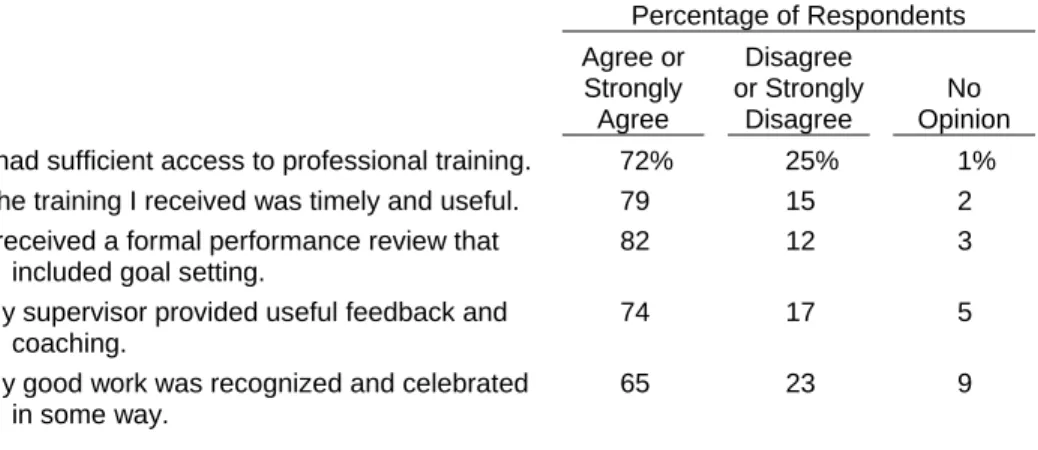
2.3 Public Defenders' Opinions of Training and Performance
Appraisal, 2009 22
2.4 State Public Defender's Conclusions Regarding the Benefits
and Risks of Using Full-Time Public Defender Offices, 1996 25
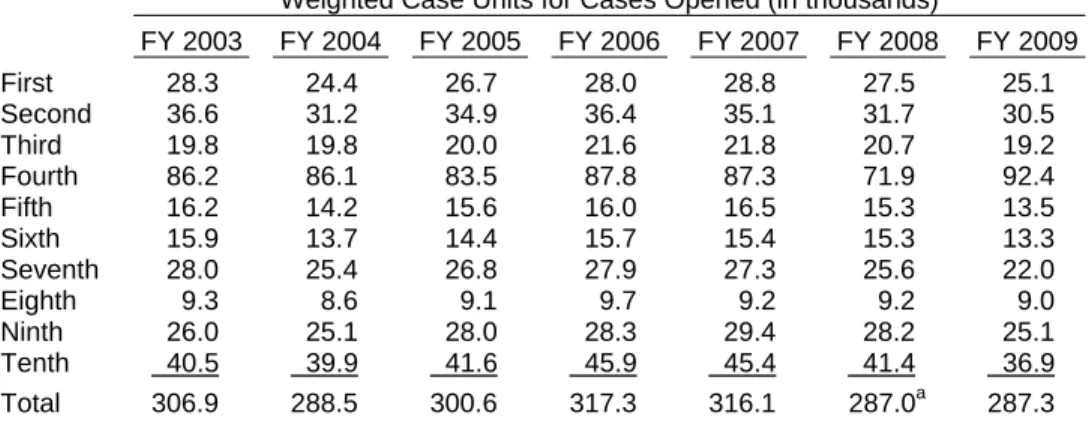
2.5 Weighted Case Units by District, Fiscal Years 2003 to 2009 29
2.6 Changes to Public Defender Services Resulting from Budget
Actions, 2008 34
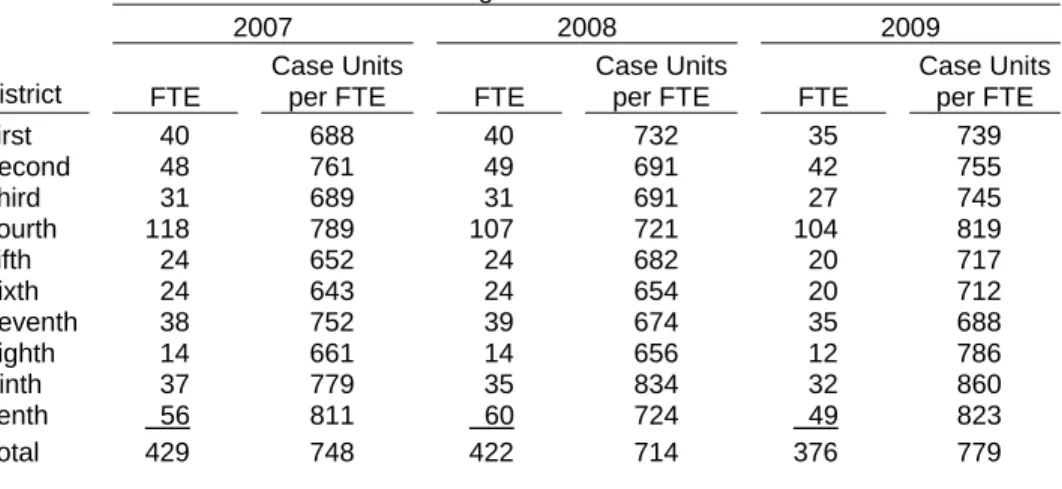
3.1 Number of Full-Time-Equivalent Attorneys and Case Units
per Attorney, 2007 to 2009 36
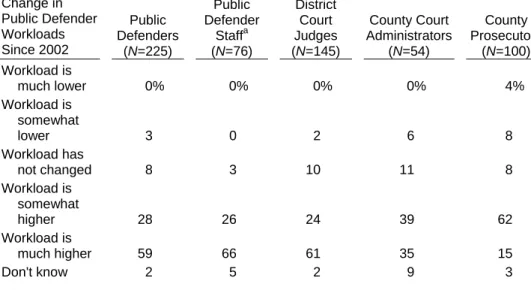
3.2 Opinions of the Change in Public Defender Workloads from
2002 to 2009 37
3.3 Increased Severity of Consequences Associated with Crimes
in Minnesota 39
3.4 Public Defenders' Opinions of their Ability to Represent Clients,
2009 41 3.5 Public Defender Client Survey Results, 2009 42 3.6 District Judges' Opinions of the Representation Provided by
Public Defenders, 2009 43 3.7 Disposition of Public Defenders' Felony, Gross Misdemeanor,
and Misdemeanor Cases, Fiscal Years 2004 to 2009 44 3.8 Opinions of Factors Causing Delays in the Progress of Criminal
Cases Through the Courts, 2009 48
3.9 Recommendations to Reform Minnesota's Criminal Justice
System, 1997 to 2009 50
4.1 How Judges Weigh Various Factors When Considering
Appointment of a Public Defender, 2009 53
4.2 Public Defender Application Practices in Minnesota District
Courts as Reported by District Court Administrators, 2009 57 4.3 Judges' Views on the Accuracy of Information Used to
Determine Eligibility for a Public Defender, 2009 61 4.4 Reimbursement Amounts Ordered by District, Fiscal Years
2007 to 2009 65
4.5 Court Fees Applicable to Public Defender Clients in Dakota
County, 2009 66
4.6 Reimbursement Receipts and Reimbursements Ordered by
District, Fiscal Years 2007 to 2009 67
4.7 Distribution of Reimbursement Receipts to Part-Time Public
Figures Page
1.1 Organization of the Minnesota Public Defender System, 2010 11
1.2 Board of Public Defense Budget Data by Biennium,
Fiscal Years 2000 to 2011 13
1.3 Means of Case Resolution by Level of Offense, 2008 15
2.1 Minnesota Public Defender Districts, 2010 19
3.1 Felony, Gross Misdemeanor, and Misdemeanor Case Dispositions
by District, Fiscal Years 2004 to 2009 45
Summary
Major Findings:
Public defender workloads are too high, resulting in public defenders spending limited time with clients, difficulties preparing cases, and scheduling problems that hinder the efficient operation of criminal courts. (pp. 35-49)
Staff reductions in 2008 are the most immediate cause of high workloads, but case complexity and other factors add to the time required per case. (pp.38-40)
Minnesota's heavy reliance on part-time public defenders presents risks that need to be addressed, but the public defender’s office has few staff resources available for planning, research, and policy-development activities. (pp. 24-28)
The Minnesota Board of Public Defense has strengthened
accountability in the state's public defender system but could do more to measure and supervise the quality of public defender services. (pp. 20-24)
Standards for determining
eligibility for a public defender are not clearly defined in state law, and district court judges reported wide differences in how they weigh eligibility factors. (pp. 51-54)
District court judges reported having little confidence in the accuracy of information they use to assess defendants' financial
circumstances, but it appears that
the vast majority of applicants cannot afford a private attorney. (pp. 60-63)
State law requires defendants with some financial means to reimburse the state for a portion of their public defender costs, but these reimbursements are inconsistently ordered and collected. (pp. 64-68)
Recommendations:
The Board of Public Defense should improve management practices for the supervision of public defenders and for measuring performance of the public defender system as a whole. (p. 23)
The Board of Public Defense should study long-range staffing needs, the proper balance of full-time and part-full-time public defenders, and the merits of establishing additional full-time offices. (p. 27)
The Legislature should enact fixed income standards for public defender eligibility and define circumstances warranting a judicial waiver of the standards. (p. 59)
The Legislature should enact a single standard governing which clients should contribute toward the cost of their public defenders and how much they should pay. (p. 69)
The Legislature should strengthen statutory procedures granting recipients of public assistance automatic eligibility for a public defender. (p. 63)
High public
defender
workloads have
created significant
challenges for
Minnesota's
criminal justice
system.
Report Summary
In 1963, the U.S. Supreme Court ruled that the assistance of counsel in criminal prosecutions was essential to fair trials and a fundamental right under the Constitution. Minnesota state government employs attorneys, called public defenders, to represent persons unable to afford an attorney. The Minnesota Board of Public Defense oversees the public defender system. The system is administered by the state public defender, district chiefs in each of the state's ten judicial districts, a chief appellate public defender, and a chief administrator. About 450 full- and part-time assistant public defenders represent clients.
Resources for the public defender system have fluctuated along with the state's fiscal condition.
Public defender system expenditures totaled $136 million in the fiscal year 2008-09 biennium, with staffing of about 528 full-time-equivalent staff. About 95 percent of the office’s fiscal year 2009 budget went to personnel, lease, and other mandatory costs. Budget deficits resulted in staff reductions affecting fiscal years 2003 through 2005. The Legislature provided funding for additional staff in fiscal years 2006 and 2007, but budget challenges again resulted in staff reductions in the next biennium.
The Board of Public Defense has taken important steps to improve accountability.
About 20 years ago, Minnesota state government assumed responsibility for public defender services, shifting from a patchwork of local public defense systems. Since then, the
Board of Public Defense has established a clear chain of
accountability from assistant public defenders in the field to the board, and it has adopted systemwide policies, procedures, and
compensation systems. The state public defender has established training programs for public defenders and procedures for assessing their performance.
The supervision of public
defenders needs to be strengthened.
We found weaknesses in day-to-day supervision of assistant public defenders. For example, 43 percent of public defenders responding to our survey said their supervisors in the past year had not reviewed any of their cases in the context of assessing performance. Several district chiefs told us they were seriously concerned about the performance of some part-time public defenders, particularly those that often work alone and with limited supervision.
One problem is that supervisors also represent individual clients. Officials from around the state told us that supervisors’ caseloads limit the time they can spend monitoring and coaching assistant public defenders. This also hinders their ability to handle performance problems before they become serious. Public defense officials said they want to increase the ratio of supervisors to assistant public defenders, but have been stymied by budget constraints.
Minnesota may need to reconsider its heavy reliance on part-time public defenders.
As of July 2009, about half of the state's 450 public defenders (and 65 percent of public defenders outside the Twin Cities) worked on a part-time basis. Many of them worked
Caseloads of
supervisors limit
the time they can
spend monitoring
the performance
of assistant public
defenders.
without the benefit of a local public defender office housing support staff and district managers. District chief public defenders said that without access to a public defender office, part-time defenders may not request investigative or support services when needed. They also have less opportunity to interact with other public defenders in brainstorming sessions, mentoring, and support.
The public defender’s office has had problems accurately
quantifying public defender workloads.
Minnesota has a system for measuring caseloads that weights cases based on the level of defense effort required. However, the methodology used to develop the weighting system in 1991 was flawed. Weighting standards do not reflect regional differences affecting the time needed to defend cases. For example, in sparsely populated but geographically large districts, public defenders spend much more time driving to see clients or attend court. The weighting standards also do not reflect the changes in criminal law and procedure that have taken place over the past 20 years. For example, cases involving sex crimes are now more time-intensive.
Public defender workloads are high, exceeding state and national standards.
State and national standards call for public defenders to carry no more than 400 case units per year. In 2009, Minnesota public defenders carried an average weighted caseload of 779 case units.
During our site visits, we observed public defenders working under severe time pressures. Roughly 60
percent of public defenders, public defender staff, and district court judges responding to our surveys reported that public defenders’ workloads were much higher in 2009 than 2002.
Heavy workloads have hurt public defenders' ability to represent clients as well as court efficiency.
Those we interviewed and surveyed agreed that public defenders were, on the whole, excellent criminal defense attorneys. However, stakeholders also reported that workloads were having a noticeable impact on public defenders’ ability to adequately and ethically represent their clients. Public defenders responding to our survey felt strongly that they were not spending enough time with clients. This has made it difficult for them to build trust, explain the system and charges, and make decisions with their clients regarding their defense.
Time pressures have made it more difficult for public defenders to prepare their cases. In order to effectively represent their clients, attorneys need sufficient time to interview clients and witnesses, perform legal research, draft motions, request investigative and expert services, and otherwise prepare for hearings and trials.
About 50 percent of district court judges responding to our survey said that criminal cases in their
courtrooms progressed too slowly or much too slowly toward disposition. Judges and court administrators responding to our surveys reported that problems scheduling public defenders for hearings and trials was the most significant cause of delays relative to other factors, such as a general increase in the number of
High workloads
limit the time
public defenders
have to meet with
clients and
prepare cases.
Lack of
preparation by
public defenders
can affect court
efficiency.
criminal cases or availability of prosecutors.
Judges' considerations when appointing a public defender vary widely.
State law establishes two general standards controlling eligibility for a public defender. Recipients of means-tested public assistance should be automatically granted eligibility. However, we found that this did not always happen.
The second standard for eligibility is a judge's determination that the defendant cannot afford private counsel. When evaluating an applicant's financial circumstances, judges are to consider income, assets, and local costs for a private attorney. District court judges weigh these eligibility factors differently. In our survey, 63 percent of judges
responding said they adjusted income based on household expenses; 28 percent did not. When considering assets, 27 percent of judges said they placed little or no weight on
ownership of a primary residence. And contrary to requirements in state law, 24 percent of district judges reported that they did not consider the local cost of private counsel.
Absent good information on
applicants' financial circumstances, judges often rely on "gut instinct."
We asked district court judges how confident they were in the accuracy of the information they use to determine eligibility. Only half of judges responding to our survey thought they had an accurate picture of applicants’ earned income. Judges felt even less confident in the
accuracy of information on unearned income or the availability of assets
that could be converted to cash or used to secure a loan.
Judges stated they must make eligibility decisions very quickly and without sufficient evidence. In practice, judges told us they rely on their “gut feelings” and a belief that most applicants would not ask for a public defender if they could afford a private attorney.
We reviewed about 100 public defender applications, comparing information provided by applicants with state public assistance and unemployment data. While the evidence is limited, it appears that the vast majority of applicants are very low income and likely cannot afford an attorney.
State law requires clients with some financial means to contribute to the cost of their defense, but these payments are inconsistently ordered and collected.
By law, judges must order reimbursements from employed defendants and others who can afford to make partial payment toward the cost of their defense. These reimbursements are inconsistently ordered. In our survey, 30 percent of judges responding said they rarely if ever order defendants to make any reimbursement. Data for fiscal years 2007 to 2009 from the state court information system confirm that judges in some districts were far more likely to order reimbursements from defendants than their peers in other districts.
District court
judges told us
they determine
eligibility to be
represented by a
public defender
very quickly and
without sufficient
evidence.
Introduction
n 1963, the U.S. Supreme Court ruled that the assistance of counsel in criminal prosecutions was essential to fair trials and a fundamental right under the Sixth Amendment of the Constitution. Accordingly, Minnesota state government employs attorneys, called public defenders, to represent persons who are charged with a crime in Minnesota, but are unable to afford a private attorney. Minnesota has a broad eligibility standard meant to assure that those who cannot afford an attorney have access to one. Minnesota’s District Court Judges appoint public defenders.
In Minnesota, the Board of Public Defense oversees the public defender system. It appoints the state public defender and chief public defenders for each of the state’s ten judicial districts and the appellate office. The board also determines how state funds are allocated to the districts and appellate office.
The Legislative Audit Commission directed the Office of the Legislative Auditor to evaluate Minnesota’s public defender system in April 2009. Legislators’ concerns centered around the following questions, which we used to structure the evaluation:
How well are the resources of Minnesota’s public defender system being managed?
To what extent do the resources and administrative structure of the public defender system support adequate representation of clients and efficient operation of the criminal justice system?
Does Minnesota have reasonable criteria and procedures for determining eligibility, and are they applied consistently?
To understand Minnesota’s public defender system and how it is managed, we interviewed staff and managers in the public defender’s office, directors of Minnesota’s four public defense corporations, officials from the State Court Administrator’s Office, district court judges, and local prosecutors. We also reviewed Minnesota statutes, public defender’s office policies and publications, state budget submissions, and other documents. In addition, we attended two meetings of the Board of Public Defense.
To help put Minnesota’s public defender system and issues in context, we reviewed national literature on public defense standards and national efforts to evaluate and improve public defender systems around the country. We also identified 18 states with public defense systems similar to Minnesota’s. For each state, we obtained documents and conducted interviews to collect comparative information on public defender eligibility and reimbursement standards.
We obtained and analyzed data from two main sources. The state court administrator’s office provided summary-level trend data on criminal case filings, cases pending, and case dispositions for all criminal cases. The public defender’s office provided historical and current data on public defender cases, case management, budget, and staffing.
It is possible that data related to a specific crime was recorded differently in the two systems. For example, cases in the state court information system may count one criminal complaint with five defendants and five public defenders as a single case. In the public defender case management system, it would be recorded as five separate cases. Because of these differences, we used the statewide data from the courts primarily for background. All analyses specific to the public defender system was derived from the public defender case management system data.
We conducted site visits in four of the state’s ten judicial districts to learn in detail how the public defender system operates in metropolitan, suburban, and rural areas of the state. We selected districts that provided diversity in caseloads, staffing levels, geographic size, and location. The four districts were the first district (Dakota and six surrounding counties), the fourth district (Hennepin County only), the sixth district (St. Louis and three other northeastern counties), and the eighth district (Meeker and 12 counties extending west). We focused on two counties each in the first, sixth, and eighth districts: (1) the county where the main public defender office is located and (2) a county among the smallest in population. We visited both juvenile and adult court in Hennepin County. In each of the four selected districts, we interviewed the chief district public defender and a supervising attorney. In each county (seven in total), we interviewed and observed assistant public defenders, and we interviewed the county court administrator and a district court judge. In each district, we
interviewed a lead prosecutor from a county attorney’s office. We also observed the eligibility determination process in several counties. After completing the site visits, we conducted extended interviews with the chief district public defenders in the remaining six districts and the interim chief appellate public defender.
We conducted six separate surveys to learn how the public defender system works from various stakeholders’ points of view. One was directed at all assistant public defenders, supervising public defenders, and district chief public defenders in Minnesota. The second survey went to nonattorney staff in public defender offices, including investigators, sentencing advisors, paralegals, legal secretaries, and office administrators. The third survey was directed to all district and appellate court judges and Supreme Court justices. The fourth survey went to all court administrators. The fifth survey went to the county attorney and a lead prosecutor for criminal cases in each county.
Most questions in each of these five surveys were tailored to the survey’s target population, but each contained three common sets of questions about
Minnesota’s public defender system. We administered the surveys online in September 2009 and sent reminders to nonrespondents in October. Response rates were: 277 of 532 public defenders (52 percent); 107 of 182 nonattorney
staff (59 percent); 206 of 305 judges (68 percent); 57 of 69 court administrators (83 percent); and 104 of 173 prosecutors (60 percent).
Our sixth survey went to public defender clients. Because of logistical and privacy-related barriers, we were not able select a statistically representative sample of public defender clients. Instead, we created a short, paper survey that could be given to and collected from public defender clients who had just
concluded their cases in a courthouse or were visiting their probation officers.1
The survey included six questions related to the client’s satisfaction with his or her public defender.
To administer the client survey, we enlisted the aid of probation officers in Dakota, Hennepin, McLeod, Olmsted, and Sibley counties (encompassing 14 probation office locations). The probation officers handled a range of clients with felony, gross misdemeanor, and misdemeanor convictions. Parole officers or administrators in each office handed a survey to visiting clients who said they had been represented by a public defender. Clients completed and immediately returned the survey. In addition, a member of our evaluation team visited three courthouses and approached public defender clients who had just completed a settlement conference in which they were sentenced or the case was dismissed. In total, we obtained completed surveys from 317 former clients.
We also reviewed public defender applications collected during one week in each of our site visit counties (including both juvenile and adult courts in Hennepin County). Of these, we judgmentally selected 127 to review in more detail. We obtained information on public assistance status from the Department of Human Services for 81 applicants. From the Department of Employment and Economic Development, we obtained for 102 applicants any information on unemployment benefits received in the month the applicant applied for a public defender and wages reported by employers in the previous quarter.
1 To respect the boundaries of attorney-client privilege, we did not contact clients in open public
Background
n 1963, the United States Supreme Court ruled in Gideon v. Wainwright that
the assistance of counsel in criminal prosecutions was essential to fair trials and a fundamental right under the Sixth Amendment of the U.S. Constitution. The Court also held that the right to counsel was obligatory on states by virtue of
the due process of law provision in the Fourteenth Amendment.1 Accordingly,
Minnesota state government employs attorneys, called public defenders, to represent persons unable to afford an attorney.
Our evaluation focused on management of Minnesota’s public defender system, eligibility determination, public defender workloads, and the quality of
representation provided. As background, this chapter provides an overview of who can qualify for a public defender in Minnesota; federal and state standards governing public defenders; the organization and funding of Minnesota’s public defender system; and data on the type and number of criminal cases in
Minnesota’s judicial system.
APPOINTMENT OF A PUBLIC DEFENDER
The right to have an attorney in criminal prosecutions applies to crimesestablished in federal, state, and local laws. The federal government provides public defenders to people charged with a crime under federal law. Minnesota’s public defender system applies to those charged with crime under state or local
law. In Minnesota, district court judges appoint public defenders.2 Public
defenders are obligated to represent any clients assigned to them, regardless of
caseloads or difficulty of the case.3
The Bill of Rights in Minnesota’s Constitution directly addresses the rights of the accused in criminal prosecutions. The Constitution says:
The accused shall enjoy the right to be informed of the nature and cause of the accusation, to be confronted with the witnesses
1 The scope of the Gideondecision was limited to felony prosecutions, but the right to counsel has
since been expanded. In 1967, the U.S. Supreme Court extended the right to counsel to children charged with juvenile delinquency and in 1972 to any case in which the defendant could be sentenced to imprisonment. In 2002, the Court found that defendants must receive counsel if they received a suspended jail sentence or were placed on probation, and later, the probation was revoked and imprisonment imposed. Defendants also have a right to counsel in their first direct appeal of a verdict and in appeals following a guilty plea.
2 Public defenders may also, at their discretion or upon request, represent individuals prior to a
court appearance if it appears that the individual is financially unable to obtain counsel. For example, a public defender may represent an arrested individual during a police interrogation. Minnesota Statutes 2009, 611.18.
3 Dzubiak v. Mott, 503 N.W.2d 771, 775 (Minn. 1993).
I
1
Public defenders
are obligated to
represent all
clients assigned to
them by a judge.
against him, to have compulsory process for obtaining witnesses
in his favor and to have the assistance of counsel in his defense.4
Minnesota courts have interpreted this language as guaranteeing the assistance of counsel in “any criminal matter in which the accused [stands] a substantial
chance of facing incarceration.”5
Within this constitutional framework, Minnesota statute requires a public defender to be appointed to persons who are financially unable to obtain counsel and fit into one of the following categories:
Persons charged with a felony, gross misdemeanor, or misdemeanor
(see Table 1.1);
Persons appealing a conviction of a felony or gross misdemeanor, or
pursuing a post-conviction proceeding prior to having a direct appeal of the conviction;
Convicted persons who face revocation of probation or supervised
release;
Minors ten years of age or older who are (a) charged with a juvenile
offense (other than a petty offense or habitual truancy) or (b) a child
in need of protection or services (CHIPS).6
Minnesota statutes elaborate on the meaning of “financially unable to obtain counsel,” but the criteria leave room for judicial discretion. The law states that
“a defendant is financially unable to obtain counsel if: (1) the defendant, or any dependent of the defendant who resides in the same household as the defendant, receives means-tested
governmental benefits; or (2) the defendant, through any combination of liquid assets and current income, would be unable to pay the reasonable costs charged by private counsel in
that judicial district for a defense of the same matter.”7
The first category of eligibility, receipt of means-tested government benefits, sets a relatively straight-forward eligibility standard. The second category, however, allows substantial discretion in evaluating applicants’ financial circumstances. We discuss the implications of this level of discretion in Chapter 4.
4 Minnesota Constitution, art. I, sec. 6.
5State v. Dumas, 587 N.W.2d 299, 301 (Minn. Ct. App. 1998), citing State v. Borst, 154 N.W.2d
888, 894 (Minn. 1967).
6 Minnesota Statutes 2009, 611.14. In addition, Minnesota law requires public defenders to
represent predatory offenders subject to community notification hearings. Minnesota Statutes 2009, 244.052, subd. 6(b). There is no statutory requirement that public defenders represent those facing revocation of supervised release. However, these individuals do have a constitutional right to representation which has traditionally been fulfilled by the Appellate Office.
7 Ibid. Programs that provide means-tested benefits include food stamps, Medical Assistance, and
the Minnesota Family Investment Program, among others.
Public defenders
are appointed to
defendants unable
to afford private
counsel.
Table 1.1: Levels of Offenses in Minnesota
Offense DescriptionEligibility for a Public
Defender Felony A criminal offense punishable by more than one year
in prison. It usually also involves the possibility of a fine of more than $3,000.
Examples include murder, manslaughter, and most criminal sexual misconduct crimes.
Yes
Gross Misdemeanor
A criminal offense punishable by imprisonment of more than 90 days but not more than one year. It may also involve a fine of more than $1,000 but not more than $3,000.
Examples include a second domestic assault in ten years and contributing to a child’s habitual truancy.
Yes
Misdemeanor A criminal offense punishable by up to 90 days imprisonment and/or a fine of up to $1,000. Examples include disorderly conduct or first-time driving while impaired.
Yes
Petty
Misdemeanor
An offense punishable only by a fine of up to $300. Examples include most traffic violations and other minor violations.
Noa
a
Because it carries no possibility of imprisonment, a petty misdemeanor is not a crime under state law. As a result, persons charged with a petty misdemeanor are not eligible for a public defender. SOURCES: Minnesota House of Representatives Research Department, The Minnesota Judiciary: A Guide for Legislators(St. Paul, 2008); Minnesota Sentencing Guidelines Commission, Minnesota Sentencing Guidelines and Commentary (St. Paul, 2009); and Minnesota Statutes 2009, 169.89, subd.1, 169A.27, 609.20, 609.2242, subd.2, 609.26, subd.1(7), 609.72, subd.1,and 611.14.
District court judges appoint public defenders, and state law requires each judicial district to screen requests for representation by a public defender and
make “appropriate inquiry into the financial circumstances of the applicant.”8
Application and screening procedures vary by judicial district, but applicants for
a public defender are required to submit a financial statement under oath.9
Persons appointed a public defender also have a continuing duty to disclose any
changes in their financial circumstances.10
State law requires individuals appointed a public defender to share in the cost of these services. Public defender clients must make a $75 copayment for public
defender services unless the copayment has been waived by a judge.11
Copayment receipts are deposited in the state’s general fund. In addition, judges
8 Minnesota Statutes 2009, 611.17(a) and (b). 9 Minnesota Statutes 2009, 611.17(b). 10 Ibid.
11 Minnesota Statutes 2009, 611.17(c). Laws of Minnesota 2009, chapter 83, art. 2, sec. 47, raised
may order defendants who are employed or otherwise able to pay to reimburse
the state in some amount for the cost of the public defender.12 Receipts from
these reimbursement payments are allocated to the Minnesota Board of Public
Defense.13
STANDARDS FOR PUBLIC DEFENSE
Various types of federal, state, and professional standards apply to public defenders in Minnesota. At the highest level, the U.S. Supreme Court has ruled that defendants have a constitutional right to the “effective assistance ofcounsel.”14 The U.S. Supreme Court has also held that indigent defendants must
have access to the “raw materials integral to the building of an effective
defense.”15 The Minnesota Court of Appeals (among other courts) has stated that
this means that a defendant has a constitutional right to adequate investigative
and expert services.16
The Minnesota Supreme Court has authorized rules of professional conduct for
attorneys, including public defenders.17 The rules require attorneys to provide
prompt, competent, and diligent representation. Among other things, the rules require attorneys to (1) possess necessary legal knowledge, skill, thoroughness, and preparation; and (2) communicate promptly with clients to keep the client informed about the case and respond to requests for information. Lawyers’ workloads must be controlled so that each matter in the case can be handled competently. Breach of these rules can result in disciplinary action up to disbarment.
Although not binding on states, the American Bar Association in 2002 issued guidance that set forth principles of a public defense delivery system. It was intended to be a practical guide for policymakers and others to design efficient, effective, and ethical public defense delivery systems. As shown in Table 1.2, the principles address the organizational structure of a public defense system and effective working conditions for public defenders, among other things.
12 Minnesota Statutes 2009, 611.20, subd. 2 and subd. 4.
13 Minnesota Statutes 2009, 611.20, subd. 3 and 4, allocates reimbursements from employed
defendants to “the state” and reimbursements from those with an ability to make partial payments to part-time public defenders to offset their overhead costs. In practice, however, all
reimbursements are paid to part-time defenders.
14Strickland v. Washington, 466 U.S. 668 (1984). The Supreme Court said that for an attorney to
be found ineffective, his or her conduct must have ”so undermined the proper functioning of the adversarial process that the trial cannot be relied on as having produced a just result.” Also, the defendant must show that, but for the attorneys’ conduct, the result of the proceeding would have been different. This two-pronged test has made the ineffectiveness standard hard to meet. In past cases, defense attorneys who have slept through the trial, used illegal drugs during the trial, or said they were not prepared were not deemed “ineffective.” Thus, a finding of ineffectiveness is more a measure of egregious dysfunction than a useful measure of quality.
15Ake v. Oklahoma, 470 U.S. 68, 77 (1985).
16 In Re the Application of Charles Ray Wilson for Payment of Services, 509 N.W.2d 568, 571
(Minn. Ct. App. 1993).
17 Minnesota Rules of Professional Conduct (2007), http://www.courts.state.mn.us/lprb/mrpc.html,
accessed May 8, 2009.
State standards
require public
defenders to
provide prompt,
competent, and
diligent
Table 1.2: American Bar Association’s Principles of a
Public Defense Delivery System, 2002
1. The public defense function, including the selection, funding, and payment of defense counsel, is independent.
2. Where the caseload is sufficiently high, the public defense delivery system consists of both a defender office and the active participation of the private bar. 3. Clients are screened for eligibility, and defense counsel is assigned and notified of
appointment, as soon as feasible after clients’ arrest, detention, or request for counsel.
4. Defense counsel is provided sufficient time and a confidential space within which to meet with the client.
5. Defense counsel’s workload is controlled to permit the rendering of quality representation.
6. Defense counsel’s ability, training, and experience match the complexity of the case.
7. The same attorney continuously represents the client until completion of the case. 8. There is parity between defense counsel and the prosecution with respect to
resources, and defense counsel is included as an equal partner in the justice system.
9. Defense counsel is provided with and required to attend continuing legal education.
10. Defense counsel is supervised and systematically reviewed for quality and efficiency according to nationally and locally adopted standards.
SOURCE: American Bar Association, Ten Principles of a Public Defense Delivery System (2002).
MINNESOTA’S PUBLIC DEFENDER
SYSTEM
The organization of Minnesota’s public defender system has evolved over time. Historically, the public defense system consisted of part-time attorneys working for and funded by counties. The Minnesota Legislature created the State Board
of Public Defense in 1981 to oversee the public defense system.18 In establishing
the board, the Legislature made it part of the judicial branch of state government but not under judicial administrative control. The state began assuming financial responsibility for public defense in 1989, phasing in full state control over several years.19
Minnesota’s transition to state control of the public defender system was part of a national trend. Researchers had found that county-based systems were more likely than state systems to have excessive caseloads, judicial interference, and
18Laws of Minnesota 1981, chapter 356, sec. 360, subd. 1 and 2. 19 Laws of Minnesota 1989, chapter 355, art. 1, sec. 7.
Minnesota’s
public defender
system is part of
the state’s judicial
branch but not
under judicial
administrative
control.
insufficient training for public defenders.20 Further, locally-funded systems more often led to inequitable representation because local caseloads and revenue varied. Minnesota has sought to promote uniformity in the access to public defender services across the state and is now one of about 20 states with a centrally funded and managed system.
Organization
The current organization of Minnesota’s public defender system is illustrated in Figure 1.1. By law, the State Board of Public Defense consists of seven members, including four attorneys appointed by the Supreme Court and three
public members appointed by the governor.21 The board is charged with
appointing a state public defender, chief district public defenders in each judicial district, a chief appellate public defender, and (with the advice of the state public
defender) a chief administrator.22 The State Board of Public Defense must also
recommend a budget to the Legislature and establish procedures for distribution
of state funding.23 Members are reimbursed for expenses and a per diem of $55
per day of board activities.24
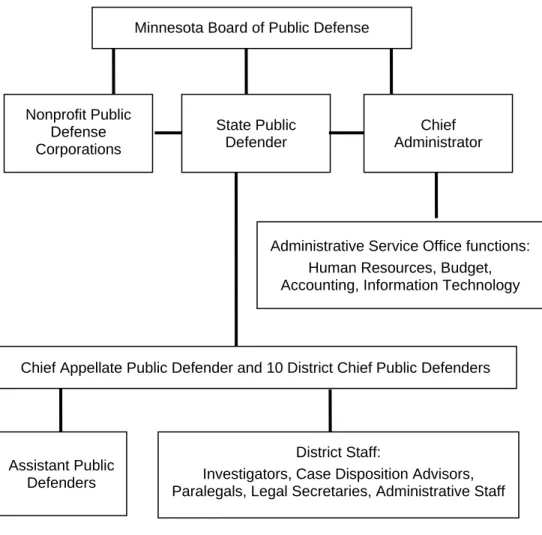
The state public defender and chief administrator have primary administrative responsibility for the public defender system. The state public defender establishes (1) standards regarding qualifications, training, size of legal staff, caseloads, and eligibility; and (2) policies and procedures to administer the
district public defense system.25 The chief administrator serves at the pleasure of
the board and is the head of the Administrative Services Office, which operates the budget, accounting, human resources, and information technology functions. The chief administrator also has direct responsibilities to the board, including enforcing board rules, regulations, and orders; managing research and planning; assisting the board with its financial duties; and making recommendations to
improve the efficient operation of the public defense system.26
Responsibility for providing public defense services is divided among ten public defense districts that align with the court system’s ten judicial districts and an appellate office. Each district has one administrative office and may have satellite offices as well. An appointed chief public defender leads each district and is responsible for managing the budget allocated to the district, hiring and supervising personnel, and managing case assignments. Chief public defenders
20 National Legal Aid & Defender Association, A Race to the Bottom: Trial-Level Indigent Defense
Systems in Michigan (Washington, D.C., 2008); National Legal Aid & Defender Association, Justice Impaired:The Impact of the State of New York’s Failure to Effectively Implement the Right to Counsel (Washington, D.C., 2007).
21 Minnesota Statutes 2009, 611.215, subd. 1(a).
22 Minnesota Statutes 2009, 611.215, subd. 2(a); 611.23; 611.24(a); and 611.26, subd. 2. 23 Minnesota Statutes 2009, 611.215, subd. 2(a) and subd. 2(b).
24 Minnesota Statutes 2009, 611.215 subd. 1(b) and 15.0575, subd. 3. 25 Minnesota Statutes 2009, 611.215, subd. 2(c) and 611.25, subd. 3. 26 Minnesota Statutes 2009, 611.215, subd 1a.
The Minnesota
Board of Public
Defense oversees
the public
Figure 1.1: Organization of the Minnesota Public
Defender System, 2010
SOURCE: Office of the Legislative Auditor, analysis of Minnesota Statutes 2009, chapter 611.
may also carry caseloads. The chief appellate public defender represents defendants appealing felony or gross misdemeanor convictions, those pursuing other post-conviction proceedings, those facing revocation of supervised release, and children appealing a delinquency adjudication.
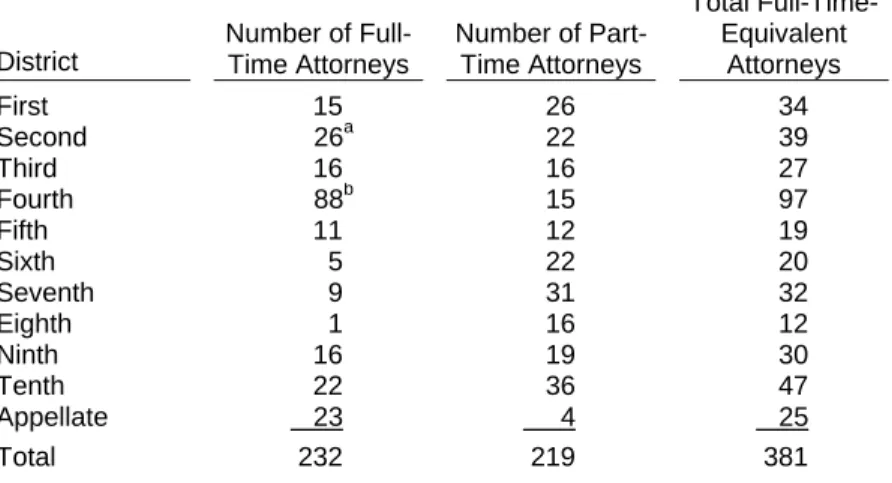
The staff attorneys representing clients on a daily basis are called “assistant public defenders,” and they are supervised by “managing attorneys.” As shown in Table 1.3, Minnesota employs a mix of full-time and part-time public
defenders.27 Part-time public defenders usually maintain a private practice in
27 As a carryover from the county-based system, some public defenders in Hennepin and Ramsey
counties are still county employees. Their numbers are dwindling through attrition as all new hires must be state employees.
Nonprofit Public Defense Corporations
Chief Administrator
Chief Appellate Public Defender and 10 District Chief Public Defenders State Public
Defender
Administrative Service Office functions: Human Resources, Budget, Accounting, Information Technology
District Staff:
Investigators, Case Disposition Advisors, Paralegals, Legal Secretaries, Administrative Staff Assistant Public
Defenders
addition to representing public defender clients. All public defender offices are staffed with investigators, paralegals, legal secretaries, case disposition advisors, and support staff.
Table 1.3: Public Defender Staffing, July 2009
DistrictNumber of Full- Time Attorneys
Number of Part- Time Attorneys
Total Full-Time-Equivalent
Attorneys
First 15 26 34
Second 26a 22 39
Third 16 16 27
Fourth 88b 15 97
Fifth 11 12 19
Sixth 5 22 20
Seventh 9 31 32
Eighth 1 16 12
Ninth 16 19 30
Tenth 22 36 47
Appellate 23 4 25
Total 232 219 381
a
As a carryover from the county-based system, 23 public defenders in the second district are still Ramsey County employees.
b
In the fourth district, 61 public defenders remain Hennepin County employees. SOURCE: Public Defender Administrative Services Office.
In addition to distributing state funds to the district public defenders and the Appellate Office, the Board of Public Defense may appropriate money to nonprofit criminal and juvenile defense corporations that serve low-income
clients.28 These public defense corporations may accept felony, gross
misdemeanor, misdemeanor, and juvenile cases where defendants meet financial eligibility standards. In order to receive state funds, the public defense
corporations are required to provide matching funds. The Board of Public Defense currently funds four public defense corporations that primarily serve
minorities who would otherwise need public defender services.29
Resources
Public defender system expenditures totaled $136 million in the fiscal year
2008-09 biennium, with staffing of about 528 full-time-equivalent staff.30 About
91 percent of these expenditures and staff were allocated to the ten public defender districts. The appellate office accounted for seven percent of spending,
28 Minnesota Statutes 2009, 611.216, subd. 1.
29 The four public defense corporations are the Neighborhood Justice Center (St. Paul), the Legal
Rights Center (Minneapolis), Duluth Indian Legal, and the Regional Native Public Defense Corporation (serving members of the Leech Lake and White Earth tribal communities).
30 Full-time-equivalent staff counts include assistant public defenders in Hennepin and Ramsey
counties who remain county employees.
Budget reductions
resulted in two
rounds of layoffs
in 2003 and 2008.
and administrative office expenditures accounted for the remainder. As shown in Figure 1.2, expenditures and staffing for the public defender system have
fluctuated. Budget deficits resulted in staff reductions affecting fiscal years 2003 through 2005. The Legislature provided funding for additional staff in fiscal years 2006 and 2007, but budget challenges again resulted in staff reductions in the 2008-09 biennium.
Figure 1.2: Board of Public Defense Budget Data by
Biennium, Fiscal Years 2000 to 2011
NOTES: FTE is full-time-equivalent staff. Fiscal year 2010-11 expenditures are as budgeted; all other years are actual expenditures except for fiscal year 2003 where we used the budgeted amount because the actual amount was not available. Data are not indexed for inflation. FTE data are imprecise. According to the public defender’s office, FTE counts compiled for biennial budget documents did not consistently account for those public defenders in Hennepin and Ramsey counties who are county, not state, employees. FTE counts may also include open positions that the state public defender did not intend to fill. The Public Defender’s Office does not maintain historical staffing data; thus, we relied on the information in state budget documents.
SOURCE: Office of the Legislative Auditor, analysis of Minnesota Board of Public Defense biennial budget documents, fiscal years 2000 to 2011.
In fiscal years 2008-09, roughly 95 percent of the office’s budget was dedicated to personnel costs, mandatory expenditures (such as mileage reimbursement), and lease costs. Important among remaining expenditures are funds set aside for services other than counsel, including expert witnesses, interpreters, grand jury transcripts, and short-term lawyer help for complex cases.
0 100 200 300 400 500 600 700
0 20 40 60 80 100 120 140 160
FY00-01 FY02-03 FY04-05 FY06-07 FY08-09 FY10-11 Expenditures FTE
CRIMINAL CASE STATISTICS
According to the state public defender’s office, public defenders are quite likely to be appointed in felony and gross misdemeanor cases. In 2008, the courts recorded filings of about 29,000 felony cases and 32,000 gross misdemeanor
cases, as shown in Table 1.4.31 Compared to filings in 1999, this represents a 37
percent increase in felony cases and a 12 percent increase in gross misdemeanor cases. As we discuss more in Chapter 3, the increase in felony and gross
Table 1.4: Criminal Cases Filed for Case Types Likely
to Involve a Public Defender, 1999 to 2008
Felony
Gross
Misdemeanor Misdemeanora
Juvenile
Delinquencyb Total
1999 21,420 28,579 244,060 25,030 319,089
2000 22,262 29,121 246,566 24,740 322,689
2001 24,448 30,127 229,722 24,020 308,317
2002 28,239 29,574 246,315 23,493 327,621
2003 29,119 28,566 264,580 22,388 344,653
2004 30,075 30,737 263,344 20,916 345,072
2005 31,749 32,004 248,148 20,511 332,412
2006 32,607 34,029 258,152 22,577 347,365
2007 31,268 33,984 234,595 22,094 321,941
2008 29,287 32,043 214,612 20,144 296,086
Percentage Change, 1999-2008
36.7% 12.1% -12.1% -19.5% -7.2%
NOTES: The data include all criminal cases filed. Public defenders may or may not have been assigned.
a
Filing counts include three misdemeanor types: fifth degree assault, misdemeanor DWI, and other nontraffic misdemeanors. The counts exclude parking, juvenile traffic, and other traffic-related misdemeanors.
b
Filing counts include felony, gross misdemeanor, and misdemeanor juvenile delinquency cases. Public defenders could be appointed in other types of juvenile cases, but according to the public defender’s office, they are most likely to be involved in delinquency cases.
SOURCE: Office of the Legislative Auditor, analysis of Minnesota court information system data.
misdemeanor cases tracks with a general legislative trend of recategorizing offenses to higher levels (for example, reclassifying misdemeanors as gross misdemeanors and gross misdemeanors as felonies).
In misdemeanor cases, public defenders are more likely to be appointed when the offense is more likely to result in jail time, for instance in charges of fifth degree assault or driving while under the influence of drugs or alcohol. Table 1.4 shows the number of misdemeanor cases filed for case types likely to involve a public
31 Counting criminal cases is actually quite complicated because a crime can involve multiple
charges, defendants, and court events. Thus, case counts can vary depending on which element is the focus of analysis.
The number of
felony cases in
Minnesota’s
criminal justice
system grew by
37 percent
between 1999
and 2008.
defender.32 As shown, the number of misdemeanor cases in these categories declined by about 12 percent from 1999 to 2008.
Public defenders also represent juveniles, commonly in cases with charges of felony, gross misdemeanor, or misdemeanor juvenile delinquency. As shown in Table 1.4, juvenile delinquency case filings declined by almost 20 percent between 1999 and 2008.
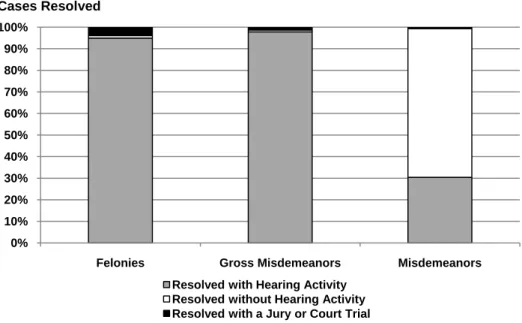
The vast majority of criminal cases were closed without a trial in 2008, as shown in Figure 1.3. About 95 percent of felony cases and 98 percent of gross
misdemeanor cases were closed at a hearing, often through a plea agreement (an agreement between the prosecutor and defense attorney in which a defendant pleads guilty as part of a bargained-for resolution of the case). Among
misdemeanor cases, about 30 percent of cases were resolved at a hearing, and 69 percent were resolved outside of a hearing or trial. For example, many
misdemeanors (such as traffic violations) are settled with payment of a fine. Court data for 1999 through 2007 show very similar resolution patterns.
Figure 1.3: Means of Case Resolution by Level of
Offense, 2008
NOTES: Jury trials are heard by a panel of citizens, while court trials are heard by a judge but no jury. Cases resolved without a hearing could be settled with a plea bargain, payment of a fine, or dismissal of the case by the prosecutor. Cases resolved with a hearing generally refers to cases in which the defendant agrees to a plea bargain with prosecutors in order to avoid a trial. It may also refer to cases where the judge dismisses a case, or where the defendant pleads guilty as charged. SOURCE: Office of the Legislative Auditor, analysis of Minnesota court information system data.
32 As agreed with the public defender’s office, we included three misdemeanor case types as
categorized in the state court information system: fifth degree assault, misdemeanor driving while under the influence, and “other nontraffic.” Including all misdemeanor case types, there were 1.5 million misdemeanor cases filed in 2008.
0% 10% 20% 30% 40% 50% 60% 70% 80% 90% 100%
Felonies Gross Misdemeanors Misdemeanors Resolved with Hearing Activity
Resolved without Hearing Activity Resolved with a Jury or Court Trial
Percentage of Cases Resolved
The vast majority
of criminal cases
are resolved
without a trial.
Management
bout 20 years ago, the Minnesota Legislature determined that the public defense system was properly the state’s responsibility and began shifting control of public defender services from counties to the state. In 1992, the Office of the Legislative Auditor evaluated the adequacy of the public defender
system’s organizational structure and administration. We found numerous management challenges stemming from limited progress at the time in moving from a county-financed system to a statewide system, as shown in Table 2.1. In this evaluation, we again assessed how well the public defense system is managed by the Board of Public Defense and its management team. Specifically, we evaluated the uniformity of the public defender system across the state, performance assessment and accountability, reliance on part-time public
defenders, strategic planning and budgeting, and management of recent resource reductions.
Table 2.1: Findings from the Office of the Legislative
Auditor’s 1992 Evaluation of the Public Defender
System
Eight of ten districts did not have full-time public defender offices.
State funds for public defenders were being spent by counties without adequate reporting and review of expenditures.
District chiefs provided limited supervision of assistant public defenders, particularly those based in other communities.
District chiefs lacked sufficient training in administration, personnel, and financial management.
Compensation for part-time public defenders was inequitable.
Goals for the state public defender system were not clearly articulated and defined. The board and administrative staff had not done enough systematic, long-range
planning.
The board and its administrative staff had established few written, uniform management policies and procedures.
The board allocated money to districts based on historical tradition, not assessments of need.
SOURCE: Office of the Legislative Auditor, Public Defender System (St. Paul, 1992).
STATEWIDE ADMINISTRATION
We assessed the extent to which the public defender system has uniformity in its administrative control over staff, compensation practices, public defense policies, and information systems. We found that:
A
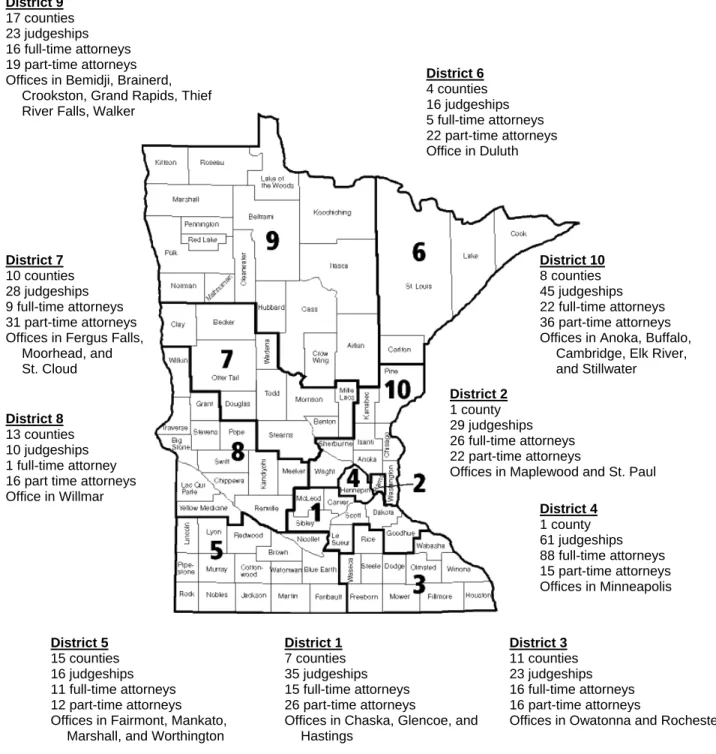
The administration of the public defender system has become more uniform following the state’s assumption of responsibility for it. Minnesota now has a centrally managed public defender system. Financial authority, policy setting, and other administrative control is centralized with the Board of Public Defense, chief public defender, and chief administrator. In addition, each of the ten districts are staffed with at least one full-time public defender and at least one office, as shown in Figure 2.1. With the exception of Hennepin County, counties do not provide funds for public defender services that
are by law the responsibility of the state.1 The board allocates funds to district
chiefs who manage each district’s budget and staffing.
For the most part, the public defender system operates under a unified
compensation structure. Assistant public defenders have been represented by a union since 2000, and their contract with the Board of Public Defense sets forth the terms of compensation and benefits. Nonattorney staff, including
investigators and paralegals, are also covered by a union contract.
Certain assistant public defenders in Hennepin and Ramsey counties are county employees covered by county compensation systems, although their salaries are funded by the state. At the time the state assumed responsibility for public defense, only Hennepin and Ramsey counties employed full-time public defenders. These attorneys were allowed to remain county employees; newly hired public defenders were (and still are) state employees.
Pay disparities exist among assistant public defenders employed by the state and those who are still employed by Hennepin and Ramsey counties. Both counties’ pay scales are higher than the state’s, allowing county-employed public
defenders to earn more than state-employed public defenders with comparable years of experience. Absent other changes to the system, attrition among the
county-employed attorneys will eventually eliminate these differences.2
The Board of Public Defense has adopted systemwide policies and procedures. Several of the statewide policies respond to issues raised in our 1992 report. For example, the board has established statewide standards for caseloads, public defender qualifications, staffing of public defender offices, and conflicts of interest. The board has also adopted standard procedures for personnel matters and handling client complaints.
The public defender’s office has struggled with creating a useful case
management system since the state assumed responsibility for public defense. In 1992, we reported that the Board of Public Defense needed to establish a uniform management information system for monitoring cases and hours across districts. The board developed a case information management system, and all districts
1 Hennepin County pays for the office space used by the District 4 public defender’s office, an
expense paid in all other districts by the state. Also, Hennepin County pays the cost of having the public defender’s office provide certain services that are the responsibility of counties, including appeals of misdemeanor convictions and representation of adults in child protection cases.
2 We discuss another compensation disparity in Chapter 3 that relates to payments made to certain
part-time public defenders.
The Board of
Public Defense
has addressed
many of the
problems
identified in our
1992 evaluation of
the public
Figure 2.1: Minnesota Public Defender Districts, 2010
SOURCE: Office of the Legislative Auditor, analysis of public defender and state court administrator’s office data, as of February 2010.
District 10
8 counties 45 judgeships 22 full-time attorneys 36 part-time attorneys Offices in Anoka, Buffalo,
Cambridge, Elk River, and Stillwater
District 6
4 counties 16 judgeships 5 full-time attorneys 22 part-time attorneys Office in Duluth
District 2
1 county 29 judgeships 26 full-time attorneys 22 part-time attorneys
Offices in Maplewood and St. Paul
District 4
1 county 61 judgeships 88 full-time attorneys 15 part-time attorneys Offices in Minneapolis
District 3
11 counties 23 judgeships 16 full-time attorneys 16 part-time attorneys
Offices in Owatonna and Rochester
District 1
7 counties 35 judgeships 15 full-time attorneys 26 part-time attorneys
Offices in Chaska, Glencoe, and Hastings
District 5
15 counties 16 judgeships 11 full-time attorneys 12 part-time attorneys Offices in Fairmont, Mankato,
Marshall, and Worthington
District 8
13 counties 10 judgeships 1 full-time attorney 16 part time attorneys Office in Willmar
District 7
10 counties 28 judgeships 9 full-time attorneys 31 part-time attorneys Offices in Fergus Falls,
Moorhead, and St. Cloud
District 9
17 counties 23 judgeships 16 full-time attorneys 19 part-time attorneys Offices in Bemidji, Brainerd,
Crookston, Grand Rapids, Thief River Falls, Walker
were using online case reporting as of January 2002. The system is outdated, however, and the office plans to implement a new case management information system in 2010. The new system will pull case data directly from the court information system (making it more accurate) and is expected to support better tracking of cases.
ACCOUNTABILITY FOR PERFORMANCE
In addition to weaknesses in uniform administration of public defender services in Minnesota, we also found in 1992 that the public defender system lacked a clear chain of command leading to the board, defined goals, and adequate training and supervision of assistant public defenders. In this evaluation, we found that: The Board of Public Defense and state public defender have taken important steps to improve accountability, but they could do more to measure and supervise the quality of public defender services.
Performance Goals and Accountability
The Board of Public Defense has established five performance goals to guide the public defender system. They are listed in Table 2.2. The state public defender makes annual work plans structured around these goals and submits annual reports to the board on his success in meeting his plan. Several years ago, the state public defender began requiring district chiefs to submit annual work plans as well. The board’s personnel committee reviews and approves these plans.
Table 2.2: Board-Established Goals for the Public
Defender System in Minnesota, 2009
Ensure that the statewide system of public defense is a fully involved partner in the criminal justice system.
Encourage excellent, creative, collaborative advocacy.
Provide client-centered representation at both the trial and appellate level. Pay continual attention to training, skills-development, and mentoring for all staff. Demonstrate a commitment to recruiting and retaining a highly dedicated, well
trained, and diverse workforce.
NOTES: The Board of Public Defense originally adopted performance goals in December 2006. The goals presented in this table reflect wording revisions adopted by the board in August 2009.
SOURCE: Minnesota Board of Public Defense policy document, August 2009.
The chain of accountability from assistant public defenders in the field to the Board of Public Defense is organizationally clear, and the state public defender uses a variety of mechanisms to ensure communication up and down the chain. The Board of Public Defense meets regularly with the state public defender, chief administrator, and district chiefs. On a rotating schedule, chiefs make
presentations on their districts to the board.