The Allocation of Interest Rate Risk and the
Financial Sector
Juliane Begenau
Stanford
Monika Piazzesi
Stanford & NBER
Martin Schneider
Stanford & NBER
May 2012
Abstract
This paper studies US banks’ exposure to interest rate risk. We exploit the factor structure in interest rates to represent many bank positions as portfolios in a small number of bonds. This approach makes exposures comparable across banks and across the business segments of an individual bank. We also propose a strategy to estimate exposure due to interest rate derivatives from regulatory data on notional and fair values together with the history of interest rates.
PRELIMINARY & INCOMPLETE. Email addresses: [email protected], [email protected], [email protected]. We thank seminar participants at Arizona State, Chicago, the Econometric Society Meeting in Seoul, the Federal Reserve Bank of Chicago, the Federal Reserve Bank of San Francisco, NYU, Princeton University, SITE, and Wharton.
1
Introduction
The economic value of …nancial institutions depends on their exposure to market risk. A traditional bank borrows short term via deposits and lends long term via loans. Modern institutions have increasingly borrowed short term in the money market, for example via repurchase agreements and lent long term via holding securities such as mortgage bonds. Modern institutions also play a prominent role in derivatives markets. The value of positions taken as a result of these activities changes if interest rates change, for example because of news about future monetary policy or default rates.
Measuring …nancial institutions’risk exposure is clearly important for regulation, but it is also relevant for economic analysis more broadly. Institutions are the main players in markets for …xed income instruments. For example, many short term instruments are not traded directly by households (for example„ commercial paper.) Moreover, banks choose risk exposures that are di¤erent from each other and therefore have di¤erent experiences when conditions change (for example, Lehman versus JP Morgan during the 2007-2009 …nancial crisis.) This has motivated a literature that aims to explain asset prices from the interaction of heterogeneous institutions. To quantify such models, we need to know banks’exposures.
It is di¢ cult to discern exposures from institutions’reported credit market posi-tions. Indeed, common data sources such as annual reports and regulatory …lings record accounting measures on a large and diverse number of credit market instruments. Ac-counting measures are not necessarily comparable across positions. For example, the economic value of two loans with the same book value but di¤erent maturities will react quite di¤erently to changes in interest rates. At the same time, many instruments are close substitutes and thus entail essentially the same market risk. For example, a 10 year government bond and a 9 year high-grade mortgage bond will tend to respond similarly to many changes in market conditions.
This paper constructs comparable and parsimonious measures of institutions’expo-sure to market risk by representing their positions as portfolios in a small number of bonds. We start from balance sheet data from the US Reports on Bank Conditions and Income (“call reports”). We show how to construct, for any bank and for each major class of credit market instruments, replicating portfolios of bonds that have ap-proximately the same conditional payo¤ distribution. We then compare portfolios across positions as well as across banks.
Our …ndings suggest that the overall position of the major dealer banks is a portfolio which is long in long-term bonds and short in cash. We also …nd that these banks have large net positions in interest-rate derivatives. This net derivative position comes close in magnitude to the net position in other …xed income derivatives. We document that,
during much of our sample, the net-interest rate derivative position does not hedge other balance-sheet positions. Instead, banks increase their interest rate exposure through derivatives.
Because of its large size, it is important to account for the net position in interest-rate derivatives when measuring exposure. The key di¢ culty in measuring the exposure in interest-rate derivatives is that banks do not report the sign of their position –whether they represent bets on interest rate increases (e.g., pay-…xed swaps) or decreases (e.g., pay-‡oating swaps.) Moreover, there is no detailed information about the maturities of these net (as opposed to gross) derivatives positions or the start day of these derivatives (and thus their associated locked-in interest rates).
To deal with the lack of reported information, we propose a novel approach to obtain the exposure contained in the net position in interest-rate derivatives. We specify a state space model of a bank’s derivatives trading strategy. We then use Bayesian methods to estimate the bank’s strategy using the joint distribution of interest rates, bank fair and notional values as well as bid-ask spreads. Intuitively, the identi…cation of the bank’s strategy relies on whether the net position (per dollar notional) gains or loses in value over time, together with the history of rates. If rates go up and the bank’s derivative position experiences gains, the Bayesian estimation puts more probability on a derivative position with a pay-…xed interest rate.
Our approach is motivated by the statistical …nding that the market value of …xed income instruments exhibit a low-dimensional factor structure. Indeed, a large literature has documented that the prices of many types of bonds comove strongly, and that these common movements are summarized by a small number of factors. It follows that for any …xed income position, there is a portfolio in a few bonds that approximately replicates how the value of the position changes with innovations to the factors.
For loans and securities, the replication portfolio is derived from detailed information on the maturity distribution provided by the call reports. For loans reported at book value, we follow Piazzesi and Schneider (2010) and represent loan portfolios as bundles of zero coupon bonds. For securities reported at market value, we use those market values together with the properties of zero coupon bond prices. For derivatives, the replication portfolio becomes an observation equation for a state space system, which has unobservable replication weights that can be estimated.
Related literature
2
Institutions’ …xed income portfolios: an
organiz-ing framework
Our goal is to understand …nancial institutions’ …xed income strategies. We want to compare strategies across institutions, as well as relate di¤erent components of an in-dividual institution’s strategy, for example its loan portfolio and its derivatives trading business. We use a discrete time framework for our analysis. Fix a probability space
(S1; S;P). Here S is the state space: one element s 2S is realized every period.
De-note by st the history of state realizations. It summarizes all contingencies relevant to
institutions up to date t; including not only aggregate events (such as changes in inter-est rates), but also events speci…c to an individual institution, such as changes in the demand for loans and deposits, or the order ‡ow for swaps.
We think of a …xed income instrument as simply a history-contingent payo¤ stream y=fyt(st)gthat is denominated in dollars. The simplest example is a safe zero coupon
bond issued at some date that pays o¤ one dollar for sure at the maturity date +m; say. More generally, payo¤s could depend on interest rates – for example, an interest rate swap or an adjustable rate mortgage promise payo¤ streams that move with a short term interest rate –or on other events, such as customers’decisions to prepay or default on a mortgage.
We assume that every instrument of interest can be assigned a fair value. If the payo¤ stream of the instrument is y, we denote its fair value : Following GAAP accounting rules, we view the fair value as the price at which the instrument could be sold “in an orderly transaction”. For instruments traded in a market, fair values can be read o¤ market prices. For nontraded instruments, such as loans, fair values have to be constructed from the payo¤s of comparable instruments.
The fair values of …xed income instruments exhibit a low-dimensional factor structure. In particular, the overwhelming majority of movements in bond prices is due to the “overall level”of interest rates. The latter can be summarized by any particular interest rate, for example a riskless nominal short rate. Since …xed income instruments are fairly predictable payo¤ streams, it is natural that changes in discount rates drive their value. Our key assumption is that fair values of all relevant …xed income instruments can be written as functions of a small number of factorsft;as well as possibly calendar time. Let
ftdenote an (N 1)-vector-valued stochastic process of factors. Here eachftis a random
variable that depends on the historyst;but we mostly suppress this dependence in what follows. The fair value (ft; t) of a …xed income instrument depends on the factors and
calendar time, which is important because the maturity date is part of the description of the payo¤ stream.
As an example, let the payo¤ stream correspond to a riskfree zero coupon bond with maturity date t+m that was issued at date t or earlier. Let i(tm) denote the yield to maturity on an m-period zero coupon bond quoted in the market at date t. The price of the payo¤ streamy at date t isexp( it(m)m). At any later datet+j before maturity date (soj < m), the price isexp( i(tm j+j )(m j)). The payo¤ stream thus satis…es our assumption as long as the interest rate depends on the factors.
We assume further that the distribution of the factors is given by a stationary Gaussian AR(1) process. We thus represent the distribution of ft under P by a
sta-tionary process that satis…es
ft+1 = ft+ "t+1; "t+1 i:i:N(0; IN): (1)
We assume that the riskless one period interest rate is a linear function of the factors. it= 0+ >1ft:
The linear Gaussian dynamics are not necessary for the approach to work, but they simplify the analysis. They also provide a reasonable description of interest-rate dy-namics for quarterly data. More generally, it would be possible to extend the analysis to allow for changes in the conditional volatility of the factors or nonlinearities in their conditional mean.
We approximate the change in the fair value of the instrument as a linear function in the shocks "t+1. If time were continuous, Ito’s lemma would deliver this result exactly,
given normality and the smoothness of . Here we use a second-order Taylor expansion and the properties of normal distributions. We write
(ft+1; t+ 1) (ft; t)t f(ft; t) (ft+1 ft) + t(ft; t) + 1
2 f f(ft; t)
>
= f (ft; t) (Etft+1 ft+ "t+1) + t(ft; t) + 1
2 f f(ft; t)
>
=:at +bt"t+1; (2)
where the …rst (approximate) equality uses the fact that the third moments of a normal distribution are zero and higher moments are an order of magnitude smaller than the …rst and second moments. The coe¢ cient at is the conditional expected change in fair value. If we divide at by the current fair value, (ft; t), we get the expected return.
The 1 N slope coe¢ cients bt is the exposure of the fair value to the factor risks,"t+1:
We are now ready to replicate the payo¤ stream of any instrument by N + 1 simple securities. That is, we de…ne, for each date t; a portfolio of N + 1 securities that has the same value as the instrument in every state of the world at date t+ 1. We always
take one of the securities to be the riskless one period bond; let 1t denote the number
of short bonds in the portfolio at datet. Since 1t is also the face value of the one-period riskless bonds, we will refer to 1t ascash. For the payo¤ stream corresponding to a short bond, the coe¢ cients in (2) are given by at =ite it and bt = 0. Consider N additional
“spanning" securities that satisfy
^
Pt+1 P^t= ^at+ ^bt"t+1 (3)
The N 1 vector ^t denotes the holdings of spanning securities at date t. In our one
factor implementation below the only spanning security will be a long bond (so that ^t
will be a scalar).
For each period t; we equate the change in the values of the payo¤ stream y and its replicating portfolio. This means that for every realization of the shocks "t+1, the
holdings of cash 1t and spanning securities ^t solve
at bt 1 "t+1
= 1t ^>t ite it 0 ^
at ^bt
1
"t+1
: (4)
These areN+ 1 equations inN+ 1unknowns, the holdings 1t;^>t of cash and longer spanning bonds. If the matrix on the left hand side is nonsingular then we can …nd portfolio holdings ( 1t;^>t) that satis…es this equation.
If the market prevents riskless arbitrage, then the value of the replicating portfolio at date t should be the same as the value of the payo¤ stream (ft; t). Suppose to the
contrary that the value of the replicating portfolio, b(ft; t)say, was lower than (ft; t).
Then one could sell short one unit of the payo¤ streamy;buy one unit of the replicating portfolio and invest the di¤erenceb(ft; t) (ft; t)in the riskless asset. Since the change
in value for y and the replicating portfolio is identical, this strategy delivers a riskfree pro…t that consists of the interest earned onb(ft; t) (ft; t). It follows that one period
ahead a position in the payo¤ can be equivalently viewed as a position in the replicating portfolio: it has the same value at date t as well as in each state of the world at date t+ 1:
Once positions are represented as portfolios, we can measure risk by considering how the value of the position changes with the prices of the long term spanning securities
^
Pt, or equivalently with the factor innovations"t+1. If the short interest rate is the only
factor, then the exposure of the position is closely related to duration, which is de…ned as (minus) the derivative of a bond’s value with respect to its yield. In this case, the holdings of the spanning bonds^t are the delta of the position, and the change in value
(4) can be used for VaR computations that determine the threshold loss that occurs with a certain probability. For example, we might determine that a given bond has a
one-quarter 5% VaR of 90 cents. This would correspond to a 5% probability that the bond’s price will fall by more than 90 cents over the quarter.
The advantage of the portfolio representation (4) over VaR is that it fully describes the conditional distribution of risk in the instrument, not just the probability of a certain tail event. Another advantage is that the replicating portfolios of various …xed-income positions are additive, making these positions easy to compare. The same is not true for VaR computations of complex positions. Moreover, our approach can easily incorporate factors in addition to the short rate, such as liquidity factors.
3
Data
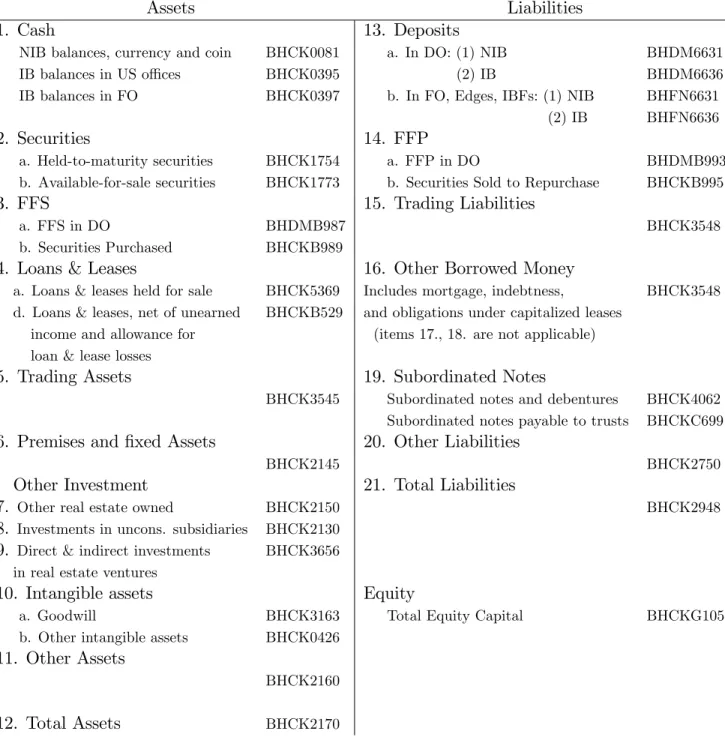
Our data source for bank portfolios are the Bank Reports of Conditions and Income, or "call reports”, …led quarterly by US commercial banks and bank holding companies (BHCs). The call reports contain detailed breakdowns of the key items on an institution’s balance sheet and income statement. The breakdowns are for most items more detailed than what is contained in corporations’SEC …lings for banks. At the same time, the call reports contain all banks, not simply those that are publicly traded. They also contain additional information that helps regulators assess bank risk. Of particular interest to us are data on the maturity distribution of balance sheet items such as loans and borrowed money, as well as on the notional value and maturity of interest rate derivative contracts. Table 1 shows a bank balance sheet which is based on the Consolidated Financial Statements for Bank Holding Companies (FR-Y-9C) from December 31, 2011. These …nancial statements are required by law and are …led by Bank holding companies to the Board of Governors of the Federal Reserve System. The abbreviations in the balance sheet are domestic o¢ ce (DO), foreign o¢ ce (FO), interest bearing (IB), noninterest bearing (NIB), Federal Funds sold (FFS), and Federal Funds purchased (FFB).
In this paper we are interested in representing banks’net exposures due to di¤erent types of business. To provide a …rst impression, Figure (1) shows various net positions as a percentage of assets for the largest bank in recent years, JP Morgan Chase. In particular, the dotted dark blue line shows the net fair value of interest rate derivatives. The solid dark blue line describes a net …xed income position without interest rate derivatives: it comprises loans plus securities plus net trading assets less deposits and other debt. To put these numbers in perspective the red line is (book) equity over assets. Finally, the light blue line labeled "net other" is a residual de…ned so that all three blue lines together add up to equity. The remainder of this paper is about understanding the risk exposure inherent in the leveraged …xed income positions represented by the dark blue lines.
1995 2000 2005 2010 -2
0 2 4 6 8
%
assets
net fixed income
net i.r. derivs
equity
net other
Figure 1: Balance sheet positions of JP Morgan Chase
The risk exposures in these positions are not evident from the variation in the fair values in Figure 1 over time. The reason is that these fair values only represent the overall value of their replicating portfolio
(ft; t) = 1te it + ^
tP^t
in the notation of Section 2. To learn about the risk exposure of the portfolio, we would need to know the portfolio weights ^(tn)P^t(n)= (ft; t) on each of the n = 1; :::; N risky
spanning securities and how these weights change over time. The spanning securities depend on the risk in the factors"t+1 through the loadings^btin equation (3). Therefore,
once we know the portfolio weights for each periodt, we know how the overall portfolio depends on the risk factors. In the rest of the paper, we will compute the replicating portfolio 1t;^>t for each of the fair values in Figure 1 and for each of the U.S. banks.
Sample selection
We are interested in the risk exposure of domestic BHCs. We thus work with data series that are consolidated at the BHC level. We consider only BHCs that are the top tier company in their BHC, and thus eliminate BHC that are subsidiaries of another BHC. We also eliminate all BHC that have a foreign parent. The risk exposure of a US subsidiary of a foreign bank is likely to depend on very di¤erent considerations than that of a US top tier bank. Most data series are directly available from the consolidated BHC …les in the call reports. However, the maturity distribution of loans, securities and borrowed money is more detailed in the bank data. For these items, we thus sum up the bank-level holdings over all banks in the same BHC to obtain the BHC level maturity distribution. We verify that this procedure comes up with the correct aggregate holdings. Our sample is 1995:Q1-2011:Q4. We choose this period because accounting rules allow consistent de…nitions of the main fair value and notional value series. In particular, the fair value of interest rate derivatives positions is available over this whole period and we have three maturity buckets for notionals. Our sample period also contains the years 2009-2011, during which the call reports also contain the major surviving investment banks, Goldman Sachs and Morgan Stanley. This fact together with new regulatory requirement on the reporting of credit exposure in derivatives markets makes this latest part of the sample particularly interesting for studying swap positions.
Holding companies with less than $500 million assets report semiannually to the Federal Reserve. For tiered bank holdings companies, only the top-tier holding company must …le a report. We use information on merger and acquisition activities of our sample from the Federal Reserve Bank of Chicago. This data has date of merger, the identity number of the non-surviving and the acquiring bank and their respective bank holding company identity number. We convert the merger date to the quarter date.
Data on loans and securities
Under traditional accounting rules, deposits and loans are recorded in balance sheets at face value. The face value of a deposit position is the amount of money deposited in the account. The face value of a loan is usually the amount of money disbursed when the loan is taken out (although there can be small di¤erence, for example, when a mortgage borrower buys points.) The balance sheet therefore does not contain a proper measure of economic value, and it cannot answer questions on how the loan portfolio is exposed to interest rate risk. Under the traditional rules, ‡uctuations in interest rates show up only in the income statement. Indeed, interest paid on deposits or earned on loans is recorded as part of interest income and expense, respectively.
Table 1: Bank Balance Sheet
Assets Liabilities
1. Cash 13. Deposits
NIB balances, currency and coin BHCK0081 a. In DO: (1) NIB BHDM6631
IB balances in US o¢ ces BHCK0395 (2) IB BHDM6636
IB balances in FO BHCK0397 b. In FO, Edges, IBFs: (1) NIB BHFN6631
(2) IB BHFN6636
2. Securities 14. FFP
a. Held-to-maturity securities BHCK1754 a. FFP in DO BHDMB993
b. Available-for-sale securities BHCK1773 b. Securities Sold to Repurchase BHCKB995
3. FFS 15. Trading Liabilities
a. FFS in DO BHDMB987 BHCK3548
b. Securities Purchased BHCKB989
4. Loans & Leases 16. Other Borrowed Money
a. Loans & leases held for sale BHCK5369 Includes mortgage, indebtness, BHCK3548 d. Loans & leases, net of unearned BHCKB529 and obligations under capitalized leases
income and allowance for (items 17., 18. are not applicable) loan & lease losses
5. Trading Assets 19. Subordinated Notes
BHCK3545 Subordinated notes and debentures BHCK4062 Subordinated notes payable to trusts BHCKC699
6. Premises and …xed Assets 20. Other Liabilities
BHCK2145 BHCK2750
Other Investment 21. Total Liabilities
7. Other real estate owned BHCK2150 BHCK2948
8. Investments in uncons. subsidiaries BHCK2130
9. Direct & indirect investments BHCK3656 in real estate ventures
10. Intangible assets Equity
a. Goodwill BHCK3163 Total Equity Capital BHCKG105
b. Other intangible assets BHCK0426
11. Other Assets
BHCK2160
12. Total Assets BHCK2170
Abbreviations: domestic o¢ ce (DO), foreign o¢ ce (FO), interest baring (IB), noninterest baring (NIB), Federal Funds sold (FFS), and Federal Funds pur-chased (FFB).
Recent statements by the Financial Accounting Standard Board (FASB) have moved US GAAP rules increasingly towards marked-to-market (MTM) accounting. Statement FAS 115, issued in 1993, introduced a three way split of positions into "held to maturity" (HTM), "available for sale" (AFS), and "held for trading" instruments. The latter two categories are recorded at fair value on the balance sheet, while HTM instruments are recorded at face value. The di¤erence between AFS and trading assets is how changes in fair values a¤ect earnings: trading gains and losses directly a¤ect net income, whereas gains and losses on AFS assets enter other comprehensive income (OCI), a component of equity.
The call reports show how many loans and securities are designated as "available for sale" and recorded at fair value versus "held to maturity" and recorded at face value. Over our sample, the majority of positions in loans, deposits and "other borrowed money" is recorded at face value, while the majority of positions in securities is recorded at fair value. We thus work with face value numbers for loans and deposits and compute fair values, as described further below. We work with fair value numbers for securities. Loans or securities held for trading must be held with the purpose of resale in the near future. The call report show these trading assets separately.
Interest rate swaps: terminology and market structure
In terms of both notionals and gross fair values, interest rate swaps are by far the most important derivatives used by banks. A plain vanilla single currency interest rate swap is an agreement by two parties to exchange interest payments at regular intervals. The interest payments are proportional to a notional amount. One party pays a …xed interest rate, the swap rate, while the other party pays a ‡oating rate. The payments are made at a certain frequency up to a given maturity. The stream of …xed interest rate payments together with the notional value paid at maturity, is referred to as the “…xed leg” of the swap. Similarly, the stream of ‡oating payments together with the notional value at maturity is called the “‡oating leg”. Although the notional values cancel exactly, including them in the streams is helpful in calculations.
Consider a frictionless market without bid ask spreads. The swap rate is then chosen at the inception date (when the swap agreement is written) to equate the present values of the …xed and ‡oating legs. In other words, the fair value of the swap at inception is zero. After the inception date, the fair value of the swap moves with market interest rates. In particular, the fair value of a pay …xed (receive ‡oating) swap becomes positive if interest rates rise above what they were at the inception date. This is because higher ‡oating rates are received. Similarly, the fair value of a pay ‡oating (receive …xed) swap increases when rates fall, as lower ‡oating rates are paid.
It is helpful to restate these e¤ects by comparing swaps with bonds. Consider the value of the two payment streams. On the one hand, the present value of the …xed leg
is the sum of a coupon bond that pays the swap rate every period until maturity plus a zero coupon bond that pays the notional value at maturity. The present value of the …xed leg thus works like a long bond that falls as interest rates increase. On the other hand, the present value of the ‡oating leg is simply equal to the notional value and does not respond to interest rates. This is because owning the ‡oating leg is equivalent to owning the notional in cash and rolling it over at the short interest rate until maturity –both strategies give rise to a ‡oating stream of interest payments plus the notional at maturity. Another way to understand the e¤ects of rate changes on fair value is thus to view a pay …xed (pay ‡oating) swap as a leveraged position in long (short) bonds which loses (gains) as interest rates rise.
In practice, most swaps are traded over the counter. As for many classes of bonds, a few large dealers make the market and frequently retrade swaps among each other. The concentration of the market is illustrated in Figure 2. It shows the total notionals of interest rate derivatives held for trading, for all BHCs as well as for the top three BHCs in terms of interest rate derivatives hgeld for trading. Here we exclude the Goldman-Sachs and Morgan Stanley, …rms that became BHCs only after the …nancial crisis.
There is an important di¤erence in how swap dealing and bond dealing a¤ect a dealer’s position. A bond dealer makes the market by buying and selling bonds. He makes money because he buys at a lower bid price and sells at a higher ask price. The inventory of bonds currently held is recorded on the dealer’s books as trading assets (or trading liabilities if the dealer allows a short sale). Once the dealer sells a bond, it is no longer on the dealer’s balance sheet. The bidask spread enters as income once it is earned.
In contrast, a swap dealer makes the market by initiating a swap with one client at and then initiating an o¤setting swap with another client. The dealer makes money by adjusting the swap rates to incorporate a spread. In particular, the swap rate on a pay-…xed (pay-‡oating) swap is typically lower (higher) than the rate that makes the fair value zero. Moreover, the both swaps remain in the accounts of the dealer and contribute to the reported numbers for notional and fair values. The income on the swap is earned only period by period as the swap payments are made and are recorded as income when they received.
Interest rate derivatives: accounting rules & data
Banks hold a variety of derivatives – for example, options, futures or swaps – with payo¤s that depend on credit events, exchange rates, stock prices or interest rates. FAS 133 requires that all derivatives are carried on the balance sheet at fair value. Banks thus compute for every derivative position whether the fair value is positive or negative. Positions with positive (negative) fair value are included on the asset (liability)
1995 2000 2005 2010 20
40 60 80 100 120 140 160
T
rillion
s
$
US
for trading
not for trading
top 3 dealers
Figure 2: Total notionals in interest-rate derivatives of US banks. The notionals are for trading, not for trading, and the top three dealer banks.
side of the balance sheet. In the call reports, schedule HC-L provides both fair values and notional values for derivatives by type of exposure. For interest rate derivatives, there is also information on the maturity distribution: it is known how many notionals have maturity less than one year, between one and …ve years or more than …ve years. Unfortunately, there is no information about the direction of trades. Thus, we do not know whether, for example, swaps are pay-…xed or pay-‡oating.
The call reports distinguish between derivatives "held for trading purposes" or "not held for trading”. The di¤erence lies in how changes in fair value a¤ects income, as for nonderivative assets. However, the meaning of "held for trading" is broader for derivatives than for loans and securities and does not only cover short term holdings. The broad scope of the term "held for trading" is clari…ed in the Federal Reserve Board’s Guide to the BHC performance report: "Besides derivative instruments used in dealing and other trading activities, this line item [namely, derivatives held for trading purposes] covers activities in which the BHC acquires or takes derivatives positions for sale in the
near term or with the intent to resell (or repurchase) in order to pro…t from short-term price movements, accommodate customers’needs, or hedge trading activities”. In contrast, derivatives "not held for trading" comprise all other positions.
Independently of whether a derivative is designated as "for trading", FAS 133 pro-vides rules for so-called hedge accounting. The idea is to allow businesses to shelter earnings from changes in the fair value of a derivative that is used to hedge an existing position (a "fair value hedge") or an anticipated future cash ‡ow (a "cash ‡ow hedge"). In both cases, there are stringent requirement for demonstrating the correlation between the hedging instrument and the risk to be hedged. If the derivative quali…es as a fair value hedge, then the fair value on the hedged position may be adjusted to o¤set the change in fair value of the derivative. This is useful if the hedged position is not itself marked to market, for example if it is …xed rate debt and the derivatives is a pay ‡oating swap. If the derivative quali…es as a cash ‡ow hedge, then a change in its fair value can initially be recorded in OCI, with a later adjustment to earnings when the hedged cash ‡ow materializes.
An unfortunate implication of current accounting rules is the call reports cannot be used to easily distinguish hedging, speculation and intermediation. In particular, there is no clean mapping between "held for trading" and short term holdings due to intermediation or short term speculation, and there is no clean mapping between "not held for trading" and hedging. On the one hand, "held for trading" derivatives could contain long term speculative holdings, but also hedges, in principle even qualifying accounting hedges. On the other hand, derivatives “not held for trading”could contain speculative holdings, as long as they are not short term.
At the same time, we take away three observations that help us interpret our …ndings below. First, short term holdings, due to intermediation or short-term speculation, must be "held for trading". Second, hedging of positions in (nonderivative) trading assets or securities are likely to be “held for trading”. If the position to be hedged is in the balance sheet at fair value with changes going to directly to income, then it makes sense to account for the derivative the same way. Finally, derivatives that hedge positions that are not marked to market are more likely to be "not held for trading", unless they satisfy the requirements for fair value hedges.
We obtain information on bid ask spreads in the swap market by maturity from Bloomberg.
4
A Portfolio View of Bank Call Reports
In this section we replicate major bank positions in the call reports by portfolios in two “spanning”zero coupon bonds –a one quarter bond (which we often refer to as "cash") as well as a …ve year bond. Zero coupon bonds are useful because most instruments can be viewed as collections of such bonds, perhaps with adjustments for default risk. For example, a loan or a swap can be viewed as collection of zero coupon bond positions of many di¤erent maturities – one for every payment. We now describe a pricing model that gives rise to a linear representation of fair values as in (??) as well as the pricing of zero coupon bonds for that model.
4.1
Summarizing interest rate dynamics
We consider an exponential a¢ ne pricing model that describes the joint distribution of riskfree nominal government bonds and risky nominal private sector bonds. The nominal pricing kernel processMt+1 represents one step ahead dollar state prices (normalized by
conditional probabilities) for dollar payo¤s contingent on the factor innovation "t+1. In
particular, for any payo¤y(st; "t+1(st))the datetprice isE[Mt+1(st+1)y(st; "t+1(st))jst].
We choose the functional form
Mt+1 = exp it 1 2
>
t t >t "t+1 (5)
t = l0+l1ft
Since"t+1 is standard normal, the price of a certain payo¤ of one is simply the one period
zero coupon bond price Pt(1) = exp ( it). The price of the payo¤exp ("t+1;n 1=2) is
given byexp ( it t;n). In this sense t;n is the market price of the risk introduced by
the nth factor innovation. Market prices of risk can in general vary over time with the factors.
Riskfree government bonds
The price of an n-period riskless zero coupon bond is given recursively by Pt(n) st =E
h
Mt+1 st+1 Pt(+1n 1) s
t
; "t+1 st jst
i
:
This recursion starts with the bond’s payo¤ at maturity, Pt(0) = 1. Our functional form assumptions ensure that is can be written as
where the coe¢ cientsAn and Bn satisfy a system of di¤erence equations with boundary
conditions An = 0 and Bn= 1. The di¤erence equations are
An+1 = An Bn> l0+
1 2B
>
n >Bn 0
Bn>+1 = Bn>( l1) >1
The recursion of the coe¢ cients Bn shows how the di¤erence equation re‡ects the
ex-pectations hypothesis of the term structure. Indeed, with risk neutral pricing ( t = 0),
the log price is minus the sum of expected future short rates (plus a Jensen’s inquality term.). With risk adjustment, the mechanics are the same, but expectations are taken under a risk-adjusted probability. After risk adjustment, expectations are formed using di¤erent AR(1) coe¢ cients l1 for the factors and a di¤erent long-run mean ( l0
rather than 0.)
The expected excess returns on a riskfree n-period bond held over one period is EtlogP
(n 1)
t+1 logP (n)
t + 1
2vart logP
(n 1)
t+1 it (7)
=An 1 +B>n 1Etft+1 An B>nft 0 >1ft =Bn> 1 t
The amount of risk in the excess return on a long bond is B>n 1 , which is a vector describing the amount of risk due to each of the shocks "t+1. The vector t of market
prices of risk captures a contribution to expected excess returns that is earned as a compensation for a unit exposure to each shock.
Suppose that there is a single factor (N = 1) which is positively related to the riskless short rate, that is 1 >0. A large positive shock "t+1 means an increase in the
short rate, which lowers the one-period bond price Pt(1)+1. If t <0, a higher short rate
represents a bad state of the world. With a negative t, the pricing kernelMt+1 depends
positively on"t+1, which means that payo¤s in bad states are valued highly. Since bond
prices are exponential-a¢ ne (6) and the coe¢ cient Bn 1 is negative, the conditional
standard deviation of the log return on the long-term bond is Bn 1 . This suggests
an alternative interpretation of t in equation (7) as the (positive) Sharpe ratio of the
bond, its expected excess return divided by the return volatility. The expected excess return on long bonds and their Sharpe ratio is positive if long bonds have low payo¤s in bad states –in which case they are unattractive assets that need to compensate investors with a positive premium.
Risky private sector bonds
Private sector bonds are subject to credit risk. For each dollar invested in risky bonds betweent andt+ 1, there is some loss from default. We treat a risky bond is a claim on
many independent borrowers, such as a mortgage bond or an index of corporate bonds. For every dollar invested in the risky bond at datet, there will be some loss from default between dates t and t+ 1 due to the law of large numbers. This loss can be larger or smaller depending on the state of the economy at datet, captured by the factors ft, as
well as the state of the economy at date t+ 1, captured by ft+1 (or equivalently, given
knowledge of ft; by the innovation "t+1. To retain the tractability of the a¢ ne model,
we follow Du¢ e and Singleton (1999) and assume that the recovery value on a bond in default is proportional to the value of the bond. In particular, supposeP~t(n) is the value of ann-period zero coupon bond trading at datet. As of date t, investors anticipate the value of the bond att+ 1 to be t+1P~
(n 1)
t+1 , where the loss factor
t+1 = exp d0 d>1ft 1 2d
>
2d2 d>2"t+1 :
captures jointly the probability of default and the recovery value.
The prices of risky bonds are determined recursively as risk adjusted present values:
~
Pt(n) st =E Mt+1 st+1 exp d0 d>1ft 1 2d
>
2d2 d>2"t+1 P~t(+1n 1) s
t; s
t+1 jst
As for riskless bonds, there is an exponential a¢ ne solution solution
~
Pt(n)= exp A~n+ ~Bn>ft ;
where A~n and B~n satisfy a system of di¤erence equations ~
An+1 = A~n B~n> (l0+d2) +
1 2
~
Bn> >B~n 0 d0+d>2l0
~
B>n+1 = B~n>( l1) >1 d>1 +d>2l1 (8)
with boundary conditions A~1 = 0 d0+d>2l0 and B~1 = >1 d>1 +d>2l1:The private
sector short rate is given by
~{t= log ~P
(1)
t =it+d0+d>1ft d>2 t
and incorporate a spread over the riskless rate that depends on the parameter of . With risk neutral pricing, the spread~{t it re‡ects only the expected loss per dollar
invested d0+d>1ft which can vary over time with ft. More generally, the spread can be
higher or lower than the risk-neutral spread because of risk premia. In particular, t<0
means that high interest rates are a bad state of the world. Ifd2 >0means less payo¤
Together we have a positive expected excess return on the one-period risky bond over the short rate
Etlog t+1+
1
2vart(log t+1) log ~P
(1)
t it = d>2 t
So we can think of d2 as giving the expected excess return on risky bonds over riskless
bonds.
Replication of risky zero coupon bonds
The a¢ ne model leads to simple formulas for the coe¢ cients at and bt in (2) if the payo¤ stream is a risky zero coupon bond. Taking default into account, the change in the portfolio value between t and t+ 1 is
t+1P~ (n 1)
t+1 P~ (n)
t P~
(n)
t log t+1P~ (n 1)
t+1 log ~P (n)
t + 1
2vart log t+1 ~
Pt(+1n 1)
= P~t(n) d0 d>1ft+ ~An 1+ ~Bn> 1( 1)ft A~n + ~Pt(n) B~n 1 B~n
>
ft+ 1 2
~
Bn> 1 >B~n 1
+ ~Pt(n) B~n> 1 d>2 "t+1
= P~t(n) it+ B~n> 1 d>2 t + B~n> 1 d>2 "t+1;
where the second equality uses the coe¢ cient di¤erence equations.
Using these coe¢ cients a~nt and~bnt; the percentage change in value can be written as
t+1P~t(+1n 1) P~ (n)
t ~
Pt(n) =it+
~
B>n 1 d>2 ( t+"t+1)
Note that the parametersd0 and d1 do a¤ect the replication of the change in value only
through the coe¢ cients B~n 1. This is because they represent predictable losses from
default which a¤ect the value of the risky position, but not its change over time. The coe¢ cient ~a(tn)=P~t(n) is the expected log return on the risky bond, which is equal to the riskless short rate plus the risk premium B~n> 1 d>2 t: The risk premium has two
terms as it compensates investors for both time variation in the bond price at t+ 1 as well as the default loss between t and t+ 1. For the riskless bond, this risk premium is just equal toB>
n 1 tas computed above. The coe¢ cient B~>n 1 d>2 is the volatility
of the return on the bond betweent and t+ 1. In the one factor case, the market prices of risk t is again the Sharpe ratio.
Replication with a single factor
Suppose we have a single factor, so that we can replicate any instrument using cash
1
t and a public bond ^t with spanning maturity m. To replicate a private bonds with
maturity n, we equate the changes in value Pt(1) 1tit+P
(m)
t ^t(it Bm 1 ( t+"t+1)) = ~P (n)
t it+ B~n 1 d2 ( t+"t+1) :
The replicating portfolio does not depend on time and is given by Pt(m)^t
~
Pt(n) =
~
Bn 1 d2
Bm 1
on the m-period public bond, which is constant over time. To translate this portfolio weight into holdings ; we also match the value P~t(n):
If the bond we are replicating is riskless, the portfolio weight has the simpler formula Pt(m)^t
Pt(n) = Bn 1
Bm 1
Intuitively, if m =n, the portfolio weight is equal to 1. Moreover, the Bs are negative and their absolute value increases in maturity, so we will …nd a larger portfolio weight if n > m and smaller otherwise. If n = 1, then B0 = 0; and the portfolio weight on the
long riskless bond is zero, because the replicating portfolio consists only of cash.
A risky, private sector bond is like a riskless bond with a di¤erent duration. Whether it is shorter or longer depends on the parameters of . There are two e¤ects. First, the replicating portfolio captures exposure to the interest rate induced by losses from default between t and t+ 1. The direction of this e¤ect depends on the sign of d2: If
d2 >0, then there is more default (or a lower payo¤ in default) when interest rates are
high. As a result, a riskier bond will have more exposure to changes in interest rates and is thus more similar to a longer riskless bond. In contrast, if d2 < 0 then the loss
between t and t+ 1 induces less exposure to interest rate risk and the risky bond will be more similar to a shorter riskless bond.
The second e¤ect comes from the di¤erence between the coe¢ cientsB and B~. From (8), this e¤ect depends not only on d2, but also on d1. If d1 >0, then there are larger
expected losses from default if interest are high. This means that risky bond prices are more sensitive to interest rates than riskless bond prices of the same maturity, so that again risky bonds work like longer riskless bonds. The opposite result obtains if d1 < 0. In addition to the e¤ects of d1, the coe¢ cients B~ also depend on the product
d2l1. However, in our estimations this part of the risk premium turns out to be an order
4.2
The estimated one factor model
We estimate the government and private sector yield curves using quarterly data on Treasury bonds and swap rates from 1995:Q1-2011:Q4. As our single factor, we choose the two-year swap rate, which will capture both interest rate risk as well as credit risk. The estimation of the government yield curve is in several steps. First, we estimate the parameters and with OLS on the (demeaned) factor dynamics (1). Then we estimate the parameter 0 as the mean of the riskless short rate and 1 with an OLS regression of
the short rate on the factor. Finally, we estimate the parametersl0 and l1 by minimizes
the squared errors from the model
min l0;l1
X t;n
i(tn) bi(tn)
2
(9) where
bi(tn) = An
n
B>
n
n ft:
The estimation of the private sector yield curve gets the parameters d0 and d1 from
minimizing the squared errors
min d0;d1;d2
X t;n
~{(tn) b~{(tn)
2
(10) where the model-implied private yields are
b~{(tn) = ~
An
n
~
B>n n ft:
Panel A in Table 2 contains the estimation results together with Monte Carlo stan-dard errors. The parameter 0 times four is the average short rate, 3.07%. The riskless
short rate has a loading of almost one on the factor, 1 = 0:999: The factor is highly
persistent with a quarterly autoregressive coe¢ cient of 0.97. The market prices of risk are on average negative, l0 = 0:25 (since the factor has a mean of zero), implying
that high nominal interest rates represent bad states of the world. Investors want to be compensated for holding assets – such as private or public nominal bonds – that have low payo¤s (low prices) in those states. These prices of risk are, however, imprecisely estimated in small samples. The spreads of risky over riskless bonds is positive and covaries positively (d1 >0) with the level of interest rates. Moreover,d2 <0, indicating
that the payo¤ in default is higher when rates are surprisingly high.
Panel B in Table 2 shows average absolute …tting errors around 30 basis points (per year), with larger …tting errors for 30-year Treasuries. The spreads between risky and riskless bonds are …tted with an error of roughly 20 basis points.
Table 2: Yield Curve Estimations Panel A: Parameter estimates
0 0.0077 (0.4215) 0.9702 (0.0079)
1 0.9990 (0.1249) 0.0012 (0.0001)
l0 0:2523 (39.773) d0 0.0010 (0.0002)
l1 0.0018 (40.305) d1 0.0814 (5.9903)
d2 0:0022 (0.0124)
Panel B: Mean absolute errors (% per year)
maturity n (in qrts) 1 4 8 12 20 40 120
public yields i(tn) 0.35 0.31 0.27 0.29 0.38 0.51 0.68 spreads~{(tn) it(n) 0.35 0.20 0.24 0.28 0.25 0.15 0.29
Note: Panel A reports parameter estimates and small sample standard er-rors. The data are quarterly zero coupon yields from Treasuries and swaps, 1995:Q1-2011:Q4. The single factor is the two-year zero-coupon yield from swaps. The sequential estimation procedure is described in the text. The small sample standard errors are computed from 10,000 Monte Carlo sim-ulations with the same sample length as the data. Panel B reports mean absolute …tting errors for public interest rates i(tn) and spreads ~{t(n) i(tn) between private and public interest rates in annualized percentage points.
4.3
Replication: loans, securities, deposits and borrowed money
For short term assets and liabilities, book value and fair value are typically very similar. Here “short term”refers not to the maturity date, but rather to the next repricing date. For example, a 30 year adjustable rate mortgage that resets every quarter will also have a fair value close to its book value. We treat all assets and liabilities with repricing date less than one quarter as a one quarter bond, applying a private sector or government short rate depending on the issuer. In contrast, long term securities are revalued as news about future interest rates and payments arrive. For those long terms positions that are recorded at book value –in particular most loans and long term debt –it is thus necessary to construct measures of market value as well as replicating portfolios from book value data. For long term securities where we have fair value data, the construction of replicating portfolios is straightforward.
Loans and long term debt
We view loans as installment loans that are amortized following standard formulas. We derive a measure of market value for loans by …rst constructing a payment stream corresponding to a loan portfolio, and then discounting the payment stream using the yield curve. The resulting measure is not necessarily the market price at which the bank could sell the loan. Indeed, banks might hold loans on their portfolios precisely because the presence of transaction costs or asymmetric information make all or parts of the portfolio hard to sell. At least part of the loan portfolio should thus best be viewed as a nontradable “endowment”held by the bank. Nevertheless, our present value calculation will show how the economic value of the endowment moves with interest rates.
The …rst step is to …nd, for each date t, the sequence of loan payments by maturity expected by the bank. Let xm
t denote the loan payment that the expected as of datet
by the bank int+m,(xm):To construct payment streams, we use data on the maturity
distribution of loan face values (Ntm) together with the yield to maturity on new loans by maturity (rm
t ). For the …rst period in the sample, we assume that all loans are new.
We thus determine the payments (xm
t ) by a standard annuity formula: Ntm must equal
the present value of an annuity of maturitymwith paymentxmt and interest ratermt . We can also determine how much face value from the initial vintage of loans remains in each following period, assuming that loans are amortized according to the standard schedule. We then calculate recursively for each period the amount of new loans issued, as well as the expected payments and evolution of face value associated with that period’s vintage. In particular, for period t we compute new loans as the di¤erence between total loan face values observed in the data and the partially amortized “old loans”remaining from earlier periods.
This procedure produces a complete set of payment streams for each date and ma-turity. The market value can then be calculated by applying the appropriate private or public sector prices to the payment streams. For long term debt, we follow a similar procedure for constructing vintages. The di¤erence is that long term debt is treated as coupon bonds issued at a par value equal to the face value. As a result, the payment stream consists of a sequence of coupon payments together with a principal payment at maturity, and the face value is not amortized.
Maturity data in the call reports are in the form of maturity (or repricing) buckets. The buckets contain maturities less than one quarter, 1-4 quarters, 1-3 years, 3-5 years, 5-15 years and more than 15 years. We assume that maturities are uniformly distributed within buckets and that the top coded bucket has a maximal length of 20 years.
Securities & trading assets
(F Vtm). Without information on face values, it is di¢ cult to construct directly the pay-ment stream promised by the securities. As a result, the construction of the replicating portfolio from payo¤ streams is not feasible. However, we can use the maturity informa-tion to view securities as zero coupon bonds that can be directly replicated. Consider the case of riskless bonds –here we count both government bonds and GSE-insured mortgage bonds. We assume that the fair value F Vm
t is the market value of
(m)
t = F Vtm=P
(m)
t
riskless zero coupon bonds. We then replicate these bonds according to (4). Similarly, for private sector bonds – all private sector bonds that are not GSE-insured – we can …nd (tm) =F Vtm=P~
(m)
t and then replicate the resulting portfolio of private sector zero
coupon bonds. As for loans, the call reports provide maturity buckets for di¤erent types of securities. We again proceed under the assumption that the maturity is uniform conditional on the bucket and that the maximal maturity is 20 years.
For securities held for trading, detailed data on maturities is not available. This item consists of bonds held in the short term as inventory of market making banks. We proceed under the assumption that the average maturity is similar to that of securities not held for trading. From the breakdown of bonds held for trading into di¤erent types we again form private and public bond groups and replicate with the respective weights.
4.4
Interest rate derivatives
The data situation for interest rate derivatives is di¤erent than that for loans and secu-rities. In particular, we do not observe the direction of trades, that is, whether a bank wins or loses from an increase in interest rates. For this reason, we infer the direction of trade from the joint distribution of the net fair value in interest rate derivatives together with the history of interest rates. Intuitively, if the bank has a negative net fair value and interest rates have recently increased, we would expect that the bank has position that pays o¤ when interest rates fall, for example it has entered in pay-…xed swaps or it has purchased bonds forward. The strength of this e¤ect should depend on the bid and ask prices that the bank deals at.
Our goal is to approximate the net position in interest rate derivatives by a replicat-ing portfolio. We work under the assumption that all interest rate derivatives are swaps. In fact, swaps make up the majority of interest rate exposures, followed by futures which behave similarly as they also have linear payo¤s in interest rates. A more detailed treat-ment of options, which have nonlinear payo¤s, is likely to be not of primary importance and in any case is not feasible given our data.
To value swaps with our pricing model, the following notation is helpful. De…neC~t(m) as the date t price of a privately issued annuity that promises one dollar every period up to date t+m. Consider now a pay …xed swap of maturity m that promises …xed
payments at the swap rate sand receives ‡oating payments at the short rate log ~Pt(1). As explained in Section 3, the …xed leg is the sum of a zero coupon bond and an annuity, and the fair value of the ‡oating leg is equal to the notional value. Using P~t(m) to again denote a private sector zero coupon bond of maturity m, the fair value of a pay …xed swap can be written as the di¤erence between the ‡oating and …xed legs
F Vt =Nt sC
(m)
t +Pe
(m)
t Nt =:Ft(s; m)Nt
Here Ft(s; m)is the fair value of a pay …xed swaps with a notional value of one dollar.
At the same time, the fair value of a pay ‡oating swap with notional value of one dollar is equal to Ft(s; m)
We now develop the relationship between net and total notionals and their e¤ects on the fair value. Let Ntm+ denote the amount of notionals in pay …xed swaps of maturity m held at date t and let Ntm denote the maturity m pay ‡oating notionals. Assume further that all pay-…xed swaps are of maturity m have the same locked in swap rate sm
t +ztm. Here smt is the “midmarket”swap rate (that is, the rate at the midpoint of the
bidask spread) and zm
t is one half the bidask spread for maturity m. Moreover, all pay
‡oating swaps of maturity m have the same locked in rate smt ztm.
With this notation, the fair value of the net position in pay …xed swaps is
F Vt = X
m
Ntm+Ft(smt z m t ; m)
X m
Ntm Ft(sm+ztm; m)
= X
m
Ntm+ Ntm Ft(smt ; m) + X
m
Ntm++Ntm ztmCtm
= : X m
Ntm!mt Ft(smt ; m) + X
m
Ntmzmt Ctm (11) where Nm
t = N m+
t +N m
t is the total amount of notionals of maturity m and !t is
the net position in pay …xed swaps expressed as a share of total notionals. For every maturity, the fair value thus naturally decomposes into two parts. The …rst sum, F Vta say, is the net fair value due to the bank trading on its account, valued at the midmarket rate. Its sign depends on the direction and size of the bank’s trade (captured by the sign and size of !mt ) as well as on the history of interest rates since the swap rate smt was locked in. The second termF Vb
t say, consists of the present value of bidask spreads,
which scales directly with total notionals.
Our estimation strategy treats the two terms separately. The reason is that we have data on the maturity distribution for total notionals, but not for net notionals. Since total notionals are potentially much larger than net notionals, especially for large
dealer banks, we cannot know at what maturities the banks trade on their own account. We therefore use data on bidask spreads and maturities to obtain an estimate of F Va
t .
We then subtract that estimate from the total net fair value to obtain an estimate of F Vta. We then specify a state space model that replicates F Vta by a portfolio of 5 year swaps and cash, up to measurement error. This estimation step allows replication in the absence of maturity information on F Va
t . Rents from market making
For every maturity m, the spread factor ztm in (11) re‡ects (one half) the average bidask spread for all the swaps currently on the bank’s books. To the extent that bidask spreads change over time, its magnitude depends on how many current swaps were ini-tiated in the past when bidask spreads were, say, higher. To capture this e¤ect, we construct a vintage distribution of swap notionals analogously to the vintage distribu-tions of loans and long term debt discussed above. We use data on bidask spreads on new swaps to …nd, for each maturity and period, the total bidask spread payment earned by swaps of that maturity in that period.
More speci…cally, suppose we know the distribution (Ntm) of total notional values by maturity as well as the distribution of bidask spreads on new swaps by maturity, that is, the sequence (2zm
t ). We assume that in the …rst sample period, all swaps are
new, and we record the stream of bidask spread payments (z1m) on those swaps. We then proceed recursively: for each period and maturity, new swaps are de…ned as the di¤erence between total notionals for that period and “old”notionals that remain from the previous period, taking into account that the old swaps have aged by one period. We then use the current bidask spreads to add to the stream of payments for all future periods.
Trading on own account
At any point in time the net position in pay …xed swaps is replicable by a portfolio in a long term spanning bond and cash. Alternatively, we can think of a position in cash and a long term swap, say of maturity m^. Suppose that, at date t 1, the bank’s net position in pay …xed swaps per dollar of notional value can be written as a position
^
!t 1 in them^ period pay …xed swap with swap rate st 1 as well as Kt 1 dollars in cash.
From (11), the fair value of this position at date t is
(^!t 1Ft(st 1;m^ 1) +Kt 1)Nt 1:
Here the fair value is the present value of future payments on the swap; current interest payments are not included since it is booked as income in the current period.
triple (^!t; Kt; st). We de…ne the state space model
F Vta=Nt 1 = ^!t 1Ft(st 1;m^ 1) +Kt 1+ut (!t; st; Kt) = Tt(!t 1; st 1; Kt 1);
whereut is an iid sequence of measurement errors. The transition equation captures the
evolution of the state variables which has two parts. First, since! describes the position in a …xed maturity instrument that ages between periods t 1 and t, the transition equation must adjust the ! position for aging. Second, the transition equation must describe how the bank’s trades in long term swaps a¤ect its swap rate and cash position. We now describe these parts in turn.
Consider …rst the updating of maturities. It is useful to view !t 1 as the long swap
position of maturity m^ at the end of period t 1. The bank then enters date t with a long swap position !t 1 of maturitym^ 1 as well as cash Kt 1. We want to transform
this position into a beginning of period position in maturitym^ swaps and cash, denoted
^
!oldt ; Kold
t . Here we use the same replication argument as in (4). For the …xed leg of
a swap of maturity m^ 1; there exist coe¢ cients as
t and bst such that the …xed leg is
replicated by bs
t units of the …xed leg of a swap of maturity m^ together with ast dollars
in cash. We thus update the position in long swaps by !^oldt =bs t!t 1:
It remains to update the cash position. Replication of the …xed leg involves !t 1ast
dollars in cash which must be subtracted from the cash position. Consider now the ‡oating legs, which are equivalent to positions in cash since the fair value of a ‡oating leg is equal to its notional value. The ‡oating leg of the original swap (of maturitym^ 1) can be viewed as a position of !t 1 dollars in cash. The ‡oating leg of the maturity m
swap is a cash position of only bs
t!t 1 dollars. We must therefore add the di¤erence
!t 1(1 bst)dollars to the cash position. The updating rule is therefore
Ktold =Kt 1+!t 1(1 ast b s t):
For large m^, such as m^ = 20 quarters, swaps of maturitiesm^ and m^ 1tend to be very similar. The replicating portfolio must capture the fact that the maturitym^ 1swap is less (but almost as) responsive to interest rates as the maturity m^ swap. As a result, bst will be close to but less than one andas
t will be close to but greater than zero, and the
sum will generally be close to one. This explains why the cash positions we …nd tend to be small in size.
Consider now the trades the bank can make, that is, how it moves from the beginning of period position !oldt ; Ktold to the end of period position (!t; Kt). Since the only long
swaps are of maturity m^, there are two possibilities. On the one hand, the bank can either increase or decrease its exposure to those swaps. If the bank increases its exposure, it combines!oldt Nt 1 swaps with the old locked in ratest 1 with!newt Ntnew swaps that
are issued at the current market rate smt . The payment stream of the combined swaps is equivalent to holding !old
t Nt 1+!newt Nt swaps at the adjusted swap rate
st=
!old t Nt 1
!tNt
st 1 +
!new t
!t
smt :
On the other hand, the bank can decrease its exposure to long swaps by canceling some of the old swaps. In practice, cancellation is often accomplished by initiating an o¤setting swap in the opposite direction. If the current swap rate for the relevant maturity is di¤erent from the original locked in rate, the cancellation will also involve a sure gain or loss. We assume that this gain or loss is directly booked to income and does not appear as part of the fair value after cancellation. The remaining long swaps then retain the same locked in swap rate, that is st =st 1.
We assume that, in any given period, the bank makes moves between positions !old t
and !t in the simplest possible way. In particular, if the sign of ! remains the same,
then it makes only one of the above trades –it either increases or decreases its exposure. the only exception to this rule is the case where the bank changes the sign of !t: in
this case we assume that it cancels all existing long swaps and issues all new swaps in the opposite direction. Let t denote the fraction of old long swaps that is canceled in period t. The transition for !t can be summarized by
!tNt= (1 t)! old
t Nt 1+!newt Nt:
Given these assumption, a sequence!^ttogether with initial conditions for s1 and K1
implies a unique history of all three state variables.
We take a Bayesian approach to infer the sequence of !^t. Our prior is that changes
in the strategy are hard to predict and are broadly similar in magnitude over time. We thus assume that !^t follows a random walk without drift, with iid innovation that have
variance 2
!. Under the prior, the variance 2! as well as the variance of the measurement
error 2u follow noninformative gamma priors and are mutually independent as well as
independent of the!^ts. We …x the initial swaprate to the swap rate at the beginning of
the sample and set the initial cash position to zero.
We jointly estimate the sequence (^!t) and the variances 2! and 2u using Markov
chain Monte Carlo methods. The conditional posterior of either one of the variances given the other variance, the data and the !^ts is available in closed form. However,
the conditional distribution of the sequence(!t)given the variances and the data is not
simple. This is because the value of !^t a¤ects the swap rate and the cash position in a
nonlinear fashion. Moreover, since we need the entire sequence of !t to infer the swap
We thus follow a Metropolis-within-Gibbs approach. We draw variances in Gibbs steps. We draw sequences (!t) in a Metropolis step. To tune the proposal density, we use the
log adaptive proposal algorithm developed by Shaby and Wells (2010).
Estimation results
To illustrate how the estimation works, Figure 3 shows the trading positions for two major dealer banks, JPMorganChase (blue/dark lines) and Bank of America (green/light lines.) The top panels display the data. The top left panel shows the evolution of notional values. These numbers are large because of the lack of netting of interdealer positions in the call reports: the notionals of each bank by itself amounts to several times US GDP. While JPMorgan Chase was for the most part larger than BofA, the notionals held by the latter jumps with the takeover of Merrill Lynch in 2008. The top right panel shows the net fair value as a share of notionals. Here we show the ratio F Va
t =Nt 1 de…ned
above –the fair value is already net of the present value of bidask spreads F Vb t.
The bottom panels display the estimation results, with posterior medians as thick solid lines and the 25th and 75th percentiles as thin dashed lines. The bottom left panel shows the estimated sequence of positions in long (m^ =5 years) swaps !t. The bottom
right panel shows the locked in swap rateston those swaps. In addition to the blue and
green lines that show the posterior medians for the locked in rates for both banks, the gray line shows the current midmarket swap rate.
5
Replication results
Figure 4 illustrates the results of the replication exercise for JP Morgan Chase. The solid lines represent the replicating portfolio for the bank’s “traditional” net …xed income position, de…ned as loans plus securities less deposits and other borrowings. The solid green line shows the face values of 5 year zero coupon bonds, and the solid red line shows the face value of short bonds. The dotted line shows the replicating portfolio for the total net position in interest rate derivatives. Finally, the dashed line presents the replicating portfolio for bonds in the bank’s trading portfolio. This position is broken out separately in part because the replication results are more uncertain for this item due to the lack of information on maturities.
Figure 5 shows the replicating portfolio for four top dealer banks. The top left panel replicates Figure 4, and the other panels show Bank of America, Wells Fargo and Citibank.
19950 2000 2005 2010 20
40 60
notionals
$ tri
llio
ns
1995 2000 2005 2010
-0.1 -0.05 0 0.05 0.1
net fair value / notional (%)
1995 2000 2005 2010
2 4 6
5 year swap rate (% p.a.)
1995 2000 2005 2010
-2 0 2 4 6
omega (%)
current locked in
Figure 3: Trading positions for JP MorganChase (blue/dark) and Bank of America (green/light.)
1995
2000
2005
2010
-0.8
-0.6
-0.4
-0.2
0
0.2
0.4
0.6
0.8
1
Tr
il
li
ons
$US
Figure 4: Replication portfolios for JP Morgan Chase. The portfolios are holdings of cash (in red) and a 5-year riskless zero coupon bond (in green). Solid lines are replicating porfolios for the traditional …xed income position, while dotted lines are for derivatives and dashed lines are for bonds held for trading.
1995
2000
2005
2010
-0.5
0
0.5
1
Tr
il
lions
$U
S
JPMORGAN CHASE & CO.
cash
5 year
1995
2000
2005
2010
-0.5
0
0.5
1
Tr
il
lions
$U
S
BANK OF AMERICA CORPORATION
1995
2000
2005
2010
-0.5
0
0.5
Tr
il
lions
$U
S
WELLS FARGO & COMPANY
2000
2005
2010
-0.5
0
0.5
Tr
il
lions
$U
S
CITIGROUP INC.
Figure 5: Replication portfolios of four top dealer banks. The portfolios are holdings of cash (in red) and a 5-year riskless zero coupon bond (in green). Solid lines are replicating porfolios for the traditional …xed income position, while dotted lines are for derivatives and dashed lines are for bonds held for trading.