SECTION
O b j e c t i v e s
1
Solve problems using
systems of equations.
2
Use functions to model
revenue, cost, and profit.
3
Perform a break-even
analysis.
PROBLEM SOLVING AND BUSINESS APPLICATIONS
USING SYSTEMS OF EQUATIONS
.
Driving through your neighborhood, you see kids selling lemonade. Would it surprise you to know that this activity can be analyzed using functions and systems of equations? By doing so, you will view profit and loss in the business world in a new way. In this section, we use systems of equations to solve problems and model business ventures.
A Strategy for Solving Word Problems Using Systems of Equations When we solved problems in Chapter 1, we let x represent a quantity that was unknown. Problems in this section involve two unknown quantities. We will let x and y represent these quantities. We then translate from the verbal conditions of the problem into a
system of linear equations.
1
Solve problems using
systems of equations.
Solving a Problem Involving Energy Efficiency
of Building Materials
A heat-loss survey by an electric company indicated that a wall of a house containing 40 square feet of glass and 60 square feet of plaster lost 1920 Btu (British thermal units) of heat. A second wall containing 10 square feet of glass and 100 square feet of plaster lost 1160 Btu of heat. Determine the heat lost per square foot for the glass and for the plaster. SOLUTION
Step 1. Use variables to represent unknown quantities. Let heat lost per square foot for the glass. Let heat lost per square foot for the plaster.
Step 2. Write a system of equations describing the problem’s conditions. The heat loss for each wall is the heat lost by the glass plus the heat lost by the plaster. One wall containing 40 square feet of glass and 60 square feet of plaster lost 1920 Btu of heat.
A second wall containing 10 square feet of glass and 100 square feet of plaster lost 1160 Btu of heat.
Step 3. Solve the system and answer the problem’s question. The system
can be solved by addition. We’ll multiply the second equation by and then add equations to eliminate x.
Now we can find the value of x by back-substituting 8 for y in either of the system’s equations.
We’ll use the second equation. Back-substitute 8 for y. Multiply.
Subtract 800 from both sides. Divide both sides by 10.
x = 36 10x = 360 10x + 800 = 1160 10x + 100182 = 1160 10x + 100y = 1160 40x + 60y = 1920
No change "
40x + 60y = 1920 10x + 100y = 1160 Multiply by
-4. "
-40x - 400y = -4640 Add: -340y = -2720
y = -2720
-340 = 8 -4 10x + 100y = 1160
40x + 60y = 1920
10 x + 100 y = 1160
Number of ft2
a b aheat lostper ft 2 b + a numberof ft2 baheat lostper ft 2 b = total heatlost.
Heat lost by the glass
40 x + 60 y = 1920
Number of ft2
a b aheat lostper ft 2 b
heat lost by the plaster total heat lost.
total heat lost. number
of ft2
a baheat lostper ft 2 b
+ =
= +
y = the x = the
E X A M P L E 1
We see that and Because x represents heat lost per square foot for the glass and y for the plaster, the glass lost 36 Btu of heat per square foot and the plaster lost 8 Btu per square foot.
Step 4. Check the proposed solution in the original wording of the problem. The problem states that the wall with 40 square feet of glass and 60 square feet of plaster lost 1920 Btu.
Our proposed solution checks with the first statement.The problem also states that the wall with 10 square feet of glass and 100 square feet of plaster lost 1160 Btu.
Our proposed solution also checks with the second statement.
■
✔
CHECK POINT1 Two Snickers bars and one ThinkThin bar contain 70 grams of carbohydrates. One Snickers bar and two Think Thin bars contain 35 grams of carbohydrates. Find the carbohydrate content in each item.
Next, we will solve problems involving investments, mixtures, and motion with systems of equations. We will continue using our four-step problem-solving strategy. We will also use tables to help organize the information in the problems.
Dual Investments with Simple Interest Simple interest involves interest calculated only on the amount of money that we invest, called the principal. The formula is used to find the simple interest, I, earned for one year when the principal, P, is invested at an annual interest rate, r. Dual investment problems involve different amounts of money in two or more investments, each paying a different rate.
Solving a Dual Investment Problem
Your grandmother needs your help. She has $50,000 to invest. Part of this money is to be invested in noninsured bonds paying 15% annual interest. The rest of this money is to be invested in a government-insured certificate of deposit paying 7% annual inter-est. She told you that she requires $6000 per year in extra income from both of these investments. How much money should be placed in each investment?
SOLUTION
Step 1. Use variables to represent unknown quantities.
Let amount invested in the 15% noninsured bonds. Let amount invested in the 7% certificate of deposit.
Step 2. Write a system of equations describing the problem’s conditions. Because Grandma has $50,000 to invest,
plus equals $50,000.
The amount invested at 15%
the amount invested at 7%
x + y = 50,000 y = the
x = the
E X A M P L E 2
I = Pr
101362 + 100182 = 360 + 800 = 1160 Btu of heat Proposed solution is 36 Btu per ft2 for glass and 8 Btu per ft2 for plaster.
40(36)+60(8)=1440+480=1920 Btu of heat y = 8.
x = 36
Furthermore, Grandma requires $6000 in total interest. We can use a table to organize the information in the problem and obtain a second equation.
15% Investment x 0.15 0.15x
7% Investment y 0.07 0.07y
The interest for the two investments combined must be $6000.
Step 3. Solve the system and answer the problem’s question. The system
can be solved by substitution or addition. Substitution works well because both variables in the first equation have coefficients of 1. Addition also works well; if we multiply the first equation by or adding equations will eliminate a variable. We will use addition.
Because x represents the amount that should be invested at 15%, Grandma should place $31,250 in 15% noninsured bonds. Now we can find y, the amount that she should place in the 7% certificate of deposit. We do so by back-substituting 31,250 for x in either of the system’s equations.
We’ll use the first equation. Back-substitute 31,250 for x. Subtract 31,250 from both sides.
Because and Grandma should invest $31,250 at 15%
and $18,750 at 7%.
Step 4. Check the proposed answers in the original wording of the problem. Has Grandma invested $50,000?
Yes, all her money was placed in the dual investments. Can she count on $6000 interest? The interest earned on $31,250 at 15% is or $4687.50. The interest earned on $18,750 at 7% is or $1312.50. The total interest is or $6000, exactly as it should be. You’ve made your grandmother happy. (Now if you would just visit
her more often Á)
■
$4687.50 + $1312.50,
1$18,750210.072, 1$31,250210.152, $31,250 + $18,750 = $50,000
y = 18,750, x = 31,250
y = 18,750 31,250 + y = 50,000 x + y = 50,000 x + y = 50,000 Multiply by
-0.07. "
-0.07x - 0.07y = -3500
= 31,250 0.15x + 0.07y = 6000 No change " 0.15x + 0.07y = 6000
Add: 0.08x = 2500
x x
= 2500
0.08 -0.07,
-0.15 0.15x + 0.07y = 6000
x + y = 50,000
plus is $6000.
Interest from the 15% investment
interest from the 7% investment
0.15x + 0.07y = 6000
Interest earned
Interest rate :
Principal (amount invested)
✔
CHECK POINT2 You inherited $5000 with the stipulation that for the first year the money had to be invested in two funds paying 9% and 11% annual interest. How much did you invest at each rate if the total interest earned for the year was $487?Problems Involving Mixtures Chemists and pharmacists often have to change the concentration of solutions and other mixtures. In these situations, the amount of a particular ingredient in the solution or mixture is expressed as a percentage of the total.
Solving a Mixture Problem
A chemist working on a flu vaccine needs to mix a 10% sodium-iodine solution with a 60% sodium-iodine solution to obtain 50 milliliters of a 30% sodium-iodine solution. How many milliliters of the 10% solution and of the 60% solution should be mixed?
SOLUTION
Step 1. Use variables to represent unknown quantities.
Let number of milliliters of the 10% solution to be used in the mixture.
Let number of milliliters of the 60% solution to be used in the mixture.
Step 2. Write a system of equations describing the problem’s conditions. The situa-tion is illustrated in Figure 3.6.
y = the x = the
E X A M P L E 3
Percent
Percentage of U.S. Men and Women in the Civilian Labor Force
60 40 80 100
Men
Women
FIGURE 3.6
The chemist needs 50 milliliters of a 30% sodium-iodine solution. We form a table that shows the amount of sodium-iodine in each of the three solutions.
Solution
10% Solution x 0.1x
60% Solution y 0.6y
30% Mixture 50 30% = 0.3 0.31502 = 15
60% = 0.6 10% = 0.1
Amount of Sodium-Iodine
Percent of Sodium-Iodine :
Number of milliliters
The chemist needs to obtain a 50-milliliter mixture.
The 50-milliliter mixture must be 30% iodine. The amount of sodium-iodine must be 30% of 50, or
Step 3. Solve the system and answer the problem’s question. The system
can be solved by substitution or addition. Let’s use substitution. The first equation can easily be solved for x or y. Solving for y, we obtain
We substitute for y in the second equation. This gives us an equation in one variable.
This equation contains one variable, x.
Apply the distributive property.
Combine like terms.
Subtract 30 from both sides.
Divide both sides by
Back-substituting 30 for x in either of the system’s equations ( is easier to use) gives Because x represents the number of milliliters of the 10% solution and y the number of milliliters of the 60% solution, the chemist should mix 30 milliliters of the 10% solution with 20 milliliters of the 60% solution.
Step 4. Check the proposed solution in the original wording of the problem. The problem states that the chemist needs 50 milliliters of a 30% sodium-iodine solution. The amount of sodium-iodine in this mixture is or 15 milli-liters. The amount of sodium-iodine in 30 milliliters of the 10% solution is or 3 milliliters. The amount of sodium-iodine in 20 milliliters of the 60% solution is The amount of sodium-iodine in the
two solutions used in the mixture is or 15
milli-liters, exactly as it should be.
■
3 milliliters + 12 milliliters, 0.61202 = 12 milliliters.
0.11302,
0.31502, y = 20.
x + y = 50
0.5.
x = -15 -0.5
= 30 -0.5x = -15 -0.5x + 30 = 15 0.1x + 30 - 0.6x = 15 0.1x + 0.6150 - x2 = 15
50 - x
y =
50 - x 0.1x + 0.6 y = 15 y = 50 - x.0.1x + 0.6y = 15 x + y = 50
plus equals
Amount of sodium-iodine in the 10% solution
amount of sodium-iodine in the 60% solution
amount of sodium-iodine in
the mixture.
0.1x + 0.6y = 15 10.321502 = 15 milliliters.
plus equalmust
50 milliliters. The number of
milliliters used of the 10% solution
the number of milliliters used of the 60% solution
STUDY TIP
It is not always necessary to use x and y to represent a problem’s variables. Select let-ters that help you remember what the variables represent. For example, in Example 4, you may prefer using p and rather than x and y:
w = wind’s average rate. in still air
p = plane’s average rate
w
✔
CHECK POINT 3 A chemist needs to mix a 12% acid solution with a 20% acid solution to obtain 160 ounces of a 15% acid solution. How many ounces of each of the acid solutions must be used?Problems Involving Motion We have seen that the distance, d, covered by any moving body is the product of its average rate, r, and its time in motion, t:
Distance equals rate times time.
Wind and water current have the effect of increasing or decreasing a traveler’s rate.
Solving a Motion Problem
When a small airplane flies with the wind, it can travel 450 miles in 3 hours. When the same airplane flies in the opposite direction against the wind, it takes 5 hours to fly the same distance. Find the average rate of the plane in still air and the average rate of the wind.
SOLUTION
Step 1. Use variables to represent unknown quantities. Let average rate of the plane in still air. Let average rate of the wind.
Step 2. Write a system of equations describing the problem’s conditions. As it travels with the wind, the plane’s rate is increased. The net rate is its rate in still air, x, plus the rate of the wind, y, given by the expression x + y.As it travels against
y = the x = the
E X A M P L E 4
d = rt
STUDY TIP
Problems involving dual investments and problems involving mixtures are both based on the same idea: The total amount times the rate gives the amount.
Our dual investment problem involved mixing two investments. Our mixture problem involved mixing two liquids. The equations in these problems are obtained from similar conditions:
Being aware of the similarities between dual investment and mixture problems should make you a better problem solver in a variety of situations that involve mixtures.
Interest from investment 1
interest from investment 2
amount of interest from mixed investments.
+ =
Dual Investment Problems
Ingredient amount in solution 1
ingredient amount in solution 2
amount of ingredient in mixture.
+ =
Mixture Problems
total money amount
total solution amount
amount of ingredient percent of ingredient,
or rate of concentration rate of
interest
amount of interest
Percents are expressed as decimals in these equations.
Dual Investment Problems: principal rate = interest
the wind, the plane’s rate is decreased. The net rate is its rate in still air, x, minus the rate of the wind, y, given by the expression Here is a chart that summarizes the problem’s information and includes the increased and decreased rates.
Rate Time Distance
Trip with the Wind 3
Trip against the Wind 5
The problem states that the distance in each direction is 450 miles. We use this information to write our system of equations.
Step 3. Solve the system and answer the problem’s question. We can simplify the system by dividing both sides of the equations by 3 and 5, respectively.
Solve the system on the right by the addition method.
Divide both sides by 2.
Back-substituting 120 for x in either of the system’s equations gives Because and the average rate of the plane in still air is 120 miles per hour and the average rate of the wind is 30 miles per hour.
Step 4. Check the proposed solution in the original wording of the problem. The problem states that the distance in each direction is 450 miles. The average
rate of the plane with the wind is In 3 hours,
it travels or 450 miles, which checks with the stated condition. Furthermore, the average rate of the plane against the wind is per hour. In 5 hours, it travels which
is the stated distance.
■
✔
CHECK POINT 4 With the current, a motorboat can travel 84 miles in 2 hours. Against the current, the same trip takes 3 hours. Find the average rate of the boat in still water and the average rate of the current.Boat in still water: 35 miles per hour; Current: 7 miles per hour
90
#
5 = 450 miles, 120 - 30 = 90 miles150
#
3,120 + 30 = 150 miles per hour. y = 30,
x = 120
y = 30. x + y = 150
x - y = 90
Add: 2x = 240
x = 120
31x + y2 = 450 Divide by 3. " x + y = 150 51x - y2 = 450 Divide by 5. " x - y = 90
The distance of the trip against the wind is 450 miles.
5(x-y) = 450
The distance of the trip with the wind is 450 miles.
3(x+y) = 450
51x- y2
x - y
31x+ y2
x + y
:
2
Use functions to model
revenue, cost, and profit.
Functions of Business: Break-Even Analysis As a young entrepreneur, did you ever try selling lemonade in your front yard? Suppose that you charged 55 cents for each cup and you sold 45 cups. Your revenue is your income from selling these 45 units, or Your revenue function from selling x cups is
For any business, the revenue function, is the money generated by selling x units of the product:
Back to selling lemonade and energizing the neighborhood with white sugar: Is your revenue for the afternoon also your profit? No. We need to consider the cost of the business. You estimate that the lemons, white sugar, and bottled water cost 5 cents per cup. Furthermore, mommy dearest is charging you a $10 rental fee for use of your (her?) front yard. Your cost function for selling x cups of lemonade is
For any business, the cost function, is the cost of producing x units of the product:
The term on the right, cx, represents variable cost, because it varies based on the number of units produced. Thus, the cost function is the sum of the fixed cost and the variable cost.
Cost per unit x units produced
C(x)=(fixed cost)+cx. C1x2,
This is your $10 fixed cost.
This is your variable cost: 5¢ for each cup produced.
C(x)=10+0.05x.
Price per unit x units sold
R(x)=px. R1x2,
This is the unit price: 55¢ for each cup.
This is the number of units sold.
R(x)=0.55x. $0.551452 = $24.75.
REVENUE AND COST FUNCTIONS A company produces and sells x units of a product.
Revenue Function
Cost Function
C1x2 = fixed cost + 1cost per unit produced2x R1x2 = 1price per unit sold2x
Figure 3.7 shows the graphs of the revenue and cost functions for the lemonade business. Similar graphs and models apply no matter how small or large a business venture may be.
Revenue is 55¢ times the number of cups sold.
R(x)=0.55x
Cost is $10 plus 5¢ times the number of cups produced.
C(x)=10+0.05x
y
x
Units Produced and Sold
40 35 30 25 20 15 10 5 0 $25
20 15 10
Loss
Gain
5 Break-even point: (20, $11)
R(x) = 0.55x C(x) = 10 + 0.05x
FIGURE 3.7
The lines intersect at the point This means that when 20 cups of lemonade are produced and sold, both cost and revenue are $11. In business, this point of intersection is called the break-even point. At the break-even point, the money coming in is equal to the money going out. Can you see what happens for x-values less than 20? The red cost graph is above the blue revenue graph. The cost is greater than the revenue and the business is losing money. Thus, if you sell fewer than 20 cups of lemonade, the result is a
loss. By contrast, look at what happens for x-values greater than 20. The blue revenue
graph is above the red cost graph. The revenue is greater than the cost and the business is making money. Thus, if you sell more than 20 cups of lemonade, the result is a gain. Because the break-even point is the point of intersection of the graphs of revenue and cost functions, we can interpret each coordinate of this point. The x-coordinate of the point reveals the number of units that a company must produce and sell so that money coming in, the revenue, is equal to money going out, the cost. The y-coordinate of the break-even point gives the amount of money coming in and going out. Example 5 illus-trates the use of the substitution method in determining a company’s break-even point.
Finding a Break-Even Point
Technology is now promising to bring light, fast, and beautiful wheelchairs to millions of disabled people. A company is planning to manufacture these radically different wheelchairs. Fixed cost will be $500,000 and it will cost $400 to produce each wheel-chair. Each wheelchair will be sold for $600.
a. Write the cost function, C, of producing x wheelchairs. b. Write the revenue function, R, from the sale of x wheelchairs. c. Determine the break-even point. Describe what this means. SOLUTION
a. The cost function is the sum of the fixed cost and variable cost.
plus Fixed cost of
$500,000
Variable cost: $400 for each chair produced
C(x) = 500,000 + 400x
E X A M P L E 5
120, 112.
3
Perform a break-even
analysis.
USING TECHNOLOGY
The graphs of the wheelchair company’s cost and revenue functions
and
are shown in a
viewing rectangle. The inter-section point confirms that the company breaks even by pro-ducing and selling 2500 wheel-chairs.
y2= 600x
y1= 500,000 + 400x
(2500, 1,500,000) 30, 5000, 10004 by 30, 3,000,000, 1,000,0004
R1x2 = 600x
C1x2 = 500,000 + 400x
b. The revenue function is the money generated from the sale of x wheelchairs.
c. The break-even point occurs where the graphs of C and R intersect. Thus, we find this point by solving the system
Using substitution, we can substitute 600x for y in the first equation.
Substitute 600xfor yin
Subtract 400xfrom both sides. Divide both sides by 200.
Back-substituting 2500 for x in either of the system’s equations (or functions), we obtain
The break-even point is This means that the company will break even if it produces and sells 2500 wheelchairs. At this level, the money coming in is equal to the money going out: $1,500,000.
■
✔
CHECK POINT5 A company that manufactures running shoes has a fixed cost of $300,000. Additionally, it costs $30 to produce each pair of shoes. They are sold at $80 per pair.a. Write the cost function, C, of producing x pairs of running shoes. b. Write the revenue function, R, from the sale of x pairs of running shoes.
c. Determine the break-even point. Describe what this means.
.
What does every entrepreneur, from a kid selling lemonade to Donald Trump, want to do? Generate profit, of course. The profit made is the money taken in, or the revenue, minus the money spent, or the cost. This relationship between revenue and cost allows us to define the profit function,P1x2.
12500, 1,500,0002.
We used R(x) = 600x.
R(2500)=600(2500)=1,500,000. x = 2500
200x = 500,000
y 500,000 400x.
600x = 500,000 + 400x C1x2 = 500,000 + 400x R1x2 = 600x
or y = 500,000 + 400x y = 600x.
Revenue per chair, $600, times
the number of chairs sold
R(x) = 600x
THE PROFIT FUNCTION The profit, generated after producing and selling x units of a product is given by the profit function
where R and C are the revenue and cost functions, respectively. P1x2 = R1x2 - C1x2,
y
−15
Units Produced and Sold
30 20 10
x
15
0
−5
−10
Business is in the black.
Business is in the red. Profit function
P(x) = 0.50x− 10
FIGURE 3.8 In the red and in the
black
Writing a Profit Function
Use the revenue and cost functions for the lemonade business
to write the profit function for producing and selling x cups of lemonade.
SOLUTION The profit function is the difference between the revenue function and the cost function.
This is the definition of the profit function. Substitute the given functions.
Distribute to each term in parentheses. Simplify.
The profit function is
■
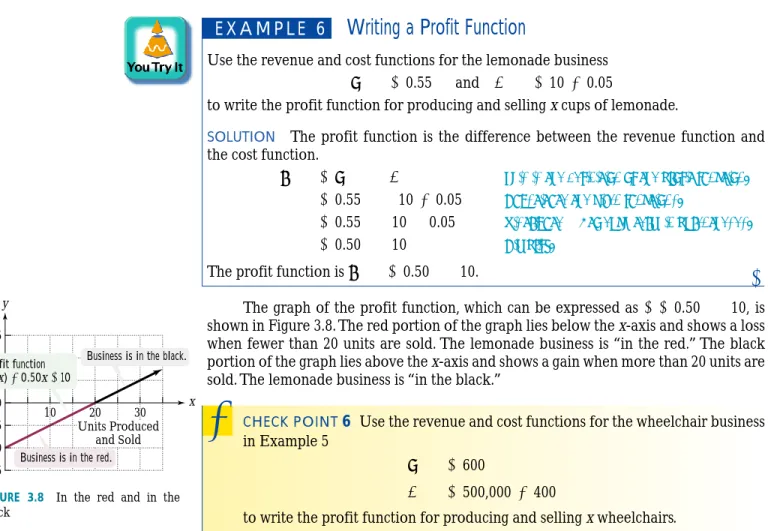
The graph of the profit function, which can be expressed as is shown in Figure 3.8. The red portion of the graph lies below the x-axis and shows a loss when fewer than 20 units are sold. The lemonade business is “in the red.” The black portion of the graph lies above the x-axis and shows a gain when more than 20 units are sold. The lemonade business is “in the black.”
✔
CHECK POINT6 Use the revenue and cost functions for the wheelchair business in Example 5to write the profit function for producing and selling x wheelchairs. P1x2 = 200x- 500,000
C1x2 = 500,000 + 400x R1x2 = 600x
y = 0.50x - 10, P1x2 = 0.50x - 10.
= 0.50x - 10
1
= 0.55x - 10 - 0.05x = 0.55x - 110 + 0.05x2 P1x2 = R1x2 - C1x2
R1x2 = 0.55x and C1x2 = 10 + 0.05x