An exploratory study of role transition from student to registered nurse
(general, mental health and intellectual disability) in Ireland
Christine Deasy
*, Owen Doody
1, Dympna Tuohy
2Department of Nursing and Midwifery, Health Science Building, North Bank Campus, University of Limerick, Ireland
a r t i c l e i n f o
Article history: Accepted 20 November 2010 Keywords: Student nurse Registered nurse Transition Internshipa b s t r a c t
Ireland has seen much change in nurse education resulting in four year degree programmes since 2002. A unique aspect of these programmes was the incorporation of rostered internship. This study explored role transition for a cohort of students at pre and post-registration. The sample consisted of fourth year students registered on BSc nursing programmes (general, mental health and intellectual disability) within an Irish university. The samples were surveyed to compare their perceptions and expectations of role transition pre and post-registration. Data were analysed using SPSS (version 16). Respondents had high levels of confidence in clinical abilities both at pre-registration and post-registration. They also perceived themselves to be competent across a range of domains: managing workload, prioritising care delivery, interpersonal skills, time management and multidisciplinary team working. However, this research highlights pre-registration stress, the need for ongoing feedback and support and differences between expected and actual levels of direct patient care involvement. It is argued that the rostered internship provided students with a valuable opportunity for adjustment and preparation for their role as registered nurse. Recommendations include stress management, a supportive environment and post-registration preceptorship programmes to enhance professional development and gain confidence during the internship.
Ó2010 Elsevier Ltd. All rights reserved.
Introduction
Ireland has experienced dramatic changes in nurse education, moving from certificate to diploma (1994) and to a degree (2002) model of nurse education and training for mental health, general and intellectual disability. Within nursing, the transition from student to graduate nurse marks the end of initial educational preparation and the beginning of the professional journey as a nurse. This transition is often marked by a‘reality shock’, a term coined byKramer (1974)who outlines phases of reaction to the disparity between role expectations and the reality of practice experienced by newly qualified nurses.Melia (1984)highlights that occupational socialisation may be problematic if unplanned and unsupported. A considerable amount of research (Gerrrish, 2000; Delaney, 2003; Duchssher, 2008) has been undertaken interna-tionally exploring transition from student to registered nurse.
However, there is little published in Ireland apart fromMooney’s (2007) study exploring newly qualified nurses’ experiences of transition. Our survey is timely and explored the perceptions of a student cohort, from one Irish university, regarding their transi-tion, six months prior to and six months post-registration. The programme undertaken by the students comprised both theoretical (72 weeks) and clinical (74 weeks) components. Supernumerary clinical placements (27 weeks) are undertaken over thefirst three years, followed in the fourth year by a substantial period of‘ ros-tered internship’ (47 weeks). During the rostered internship, students are paid employees of the health service, assigned responsibility for patient/client groups and receive support from both university and health services.
Background
It is accepted that with programmes of education and training there is a period of transition upon completion of formal studies and commencement of employment (Boxer and Kluge, 2000; Thomka, 2001). The transition from student to registered nurse can be both exciting and challenging and has been the subject of much discussion and debate over the years. Delaney (2003:47) *Corresponding author. Tel.:þ353 61 202415; fax:þ353 61 234219.
E-mail addresses: [email protected] (C. Deasy), [email protected] (O. Doody),[email protected](D. Tuohy).
1 Tel.:þ353 61 213367; fax:þ353 61 234219. 2 Tel.:þ353 61 234213; fax:þ353 61 234219.
Contents lists available atScienceDirect
Nurse Education in Practice
j o u r n a l h o m e p a g e : w w w . e l s e v i e r . c o m / n e p r1471-5953/$esee front matterÓ2010 Elsevier Ltd. All rights reserved. doi:10.1016/j.nepr.2010.11.006
describes transitions as “complex and multidimensional”. There are many factors to be considered when examining the issue of transition such as the stressful nature of the process, feelings of preparedness, confidence in clinical skills and decision making, the need for support and socialisation into the role (Gerrish, 2000; Thomka, 2001; Heitz et al., 2004; Duchscher, 2009). InGerrish’s (2000)study, perceptions of the transition period of two cohorts of newly qualified nurses in 1985 (n¼10) and 1998 (n¼25) were compared. Both cohorts perceived there was inadequate prepa-ration and lack of support, although interestingly the more recent graduates found the transition less stressful. There were similar
findings fromRoss and Clifford’s (2002)qualitative study of nurses (n¼30) pre and post qualification. Theirfindings indicated that this remains a stressful period with stress attributed to the following factors: inconsistencies within the preceptorship pro-gramme, the need for support at pre-registration level and the need for final year planning. More recently, Duchscher (2009)
suggests that newly registered nurses experience “transition shock”which encompasses feelings of anxiety, insecurity, inade-quacy and instability.
Stress, anxiety and uncertainty can be attributed to feeling unprepared and lacking in confidence for the new role of registered nurse (McKenna and Green, 2004). Etheridge (2007:25)suggests that there is a specific process comprising a number of components whereby graduates learn to“think like a nurse”. Such components include developing confidence, learning responsibility, changing relationships and thinking critically.Newton and McKenna (2007)
claim that students underestimate the preparation required for their new role and require assistance to reduce stress and develop confidence.Mooney (2007)emphasises the need for students to be more prepared for the realities of being a registered nurse and the need for support during the period of transition and adjustment has been clearly identified (Hardyman and Hickey, 2001; Whitehead, 2001). Much of the literature recommends a struc-tured preceptorship programme to facilitate the transition period (Gerrish, 2000; Duchscher, 2009; Nash et al., 2009; Strauss, 2009). The preceptor is described as a person, generally a staff nurse, who teaches, counsels and inspires, serves as a role model supporting the growth and development of the novice for afixed and limited amount of time, with the specific purpose of socialising the indi-vidual (Morrow, 1984; Morton-Cooper and Palmer, 2000). It is recommended that such programmes should include support from registered nurses; clinical, organisational and management skills development; constructive feedback; socialisation and role devel-opment (Gerrish, 2000; Hardyman and Hickey, 2001; Duchscher, 2008; Strauss, 2009).
Methods
The aim of this study was to explore the transition from student to registered nurse in a cohort who had a substantial rostered internship in thefinal year of their programme. A core objective of the study was to compare pre-registration student perceptions and expectations regarding their role as a registered nurse, with the reality of practice, six months post-registration. Data were collected over two phases. In phase one, fourth year student nurses (n¼116) registered on BSc nursing programmes (mental health, general and intellectual disability) within a Department of Nursing and Midwifery in an Irish university, were asked to complete a pre-registration survey. In phase two, those from the original sample who met the inclusion criteria of being registered for six months (n¼96) were asked to complete a post-registration survey. The wording of the survey instruments were the same except for changes in tense e.g.“I will be supported”became“I am supported”.
The 28 item surveys were developed by the researchers following a review of the literature and explored demographics, role preparation, role competence, support, the organisation, emotional issues and role expectations. The surveys comprisedfive point Likert rating scales and closed questions, these methods are user friendly, coded quickly and easily analysed (Parahoo, 2006). Reliability and validity of the instruments were addressed by piloting the instruments with students (n ¼20) from different cohorts to determine if questions were clear and unambiguous (Coughlan et al., 2007). Minor changes to the wording of some questions were necessary. An expert panel (a statistician and senior researcher) verified the face validity of the instruments. As direct contact with potential respondents enhances response rates (Pryjmachuk and Richards, 2007), an anonymous survey was distributed to the pre-registration students during a scheduled lecture in year four. Prior to distribution, students were provided with an invitation letter, information leaflet and an opportunity for questions. Absent students were invited to participate via mail with a stamped addressed envelope enclosed to increase response rates (Bryman, 2004). The post-registration survey, invitation letter, information leaflet and stamped addressed envelope were mailed to family home addresses. Ethical approval was granted by the university research ethics committee. Consent was implied via return of the questionnaires.
Data were analysed using SPSS version 16. Descriptive analysis was conducted and statistical summaries presented. Categories were collapsed i.e. agree and strongly agree were recoded to agree and disagree and strongly disagree recoded to disagree. Pre and post variables were analysed as if they were continuous, as the measurements were independent groups rather than the same person’s measurements pre and post-registration. When sum-marised in this way the distributions were skewed so non-para-metric (ManneWhitney U) tests were carried out between the medians pre and post-registration, where the medians repre-sented categories (agree, neutral, disagree). Unfortunately many of the association tests were not valid due to low numbers in the tables, however trends were identified. Larger numbers would be needed in these cases to show these associations with significance.
Findings
The total number of pre-registration respondents was 98 (84%) and post-registration respondents was 21 (22%). Most (95%) of the respondents to both surveys were female. Findings are pre-sented under four main headings: role preparation and expecta-tions, role competence, organisation and support and confidence and stress.
Role preparation and expectations
Over half of respondents (53% pre and 62% post) agreed that they were adequately prepared for the role of registered nurse. The majority of respondents agreed that the course content was rele-vant (62% pre and 57% post). In relation to opportunities within the programme to develop the skills required of a registered nurse, 63% of pre-registration survey respondents agreed that the course provided them with such opportunities. This increased to 81% post-registration. When asked specifically about management skills only 30% of pre-registration and 33% of post-registration respondents agreed that they were provided with sufficient opportunities to develop management skills (Table 1).
More pre than post-registration respondents indicated that they were afforded the opportunity to discuss the transition (43% pre as opposed to 19% post). Yet, the majority of respondents in both
surveys had reflected on the transition. When asked if the transi-tion would be unproblematic the medians pre and post were significantly different (p¼0.025). While 61% of the pre-registration respondents expected that the transition would be problematic only 33% of post-registration respondents found it so. 91% of respondents in the post survey spend most of their time as a registered nurse providing direct patient/client care however only 63% of the pre-registration students had this expectation.
Role competence
Most respondents perceived themselves competent across a range of domains. Nearly all respondents (86%) agreed that they worked effectively within the multidisciplinary team. Most considered that they had effective interpersonal skills. In relation to ‘proficiency in prioritising care delivery’ the respondents were more confident post-registration. Many respondents were confi -dent in their clinical abilities pre and post-registration (58% and 67% respectively). In relation to confidence with knowledge, 35% of respondents were confident with their knowledge pre-registration and this increased to 57% post-registration. The medians pre and post-registration were almost significantly different (p¼0.061). In fact the median pre-registration was 2 and post-registration 1, indicating that there was a shift in opinion from not being confident with regard to knowledge at pre-registration to having confidence in their knowledge post-registration (Table 2).
Organisation and support
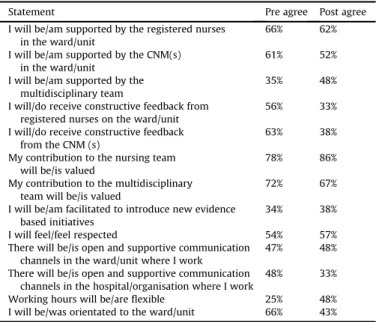
15 pre-registration respondents (15%) expected to be assigned a preceptor, however only one post-registration respondent was assigned a preceptor. Almost two thirds of pre-registration respondents (65%) expected to receive ongoing formal support as a registered nurse, yet only 29% of post-registration respondents received such support. Most pre-registration respondents expected they would have various sources of support as a registered nurse. Post-registrationfindings identified three main sources of informal support, namely registered nurses (RN’s) (62%), Clinical Nurse Managers (CNM’s) (52%) and the multidisciplinary team (MDT) (48%). Respondents received constructive feedback from CNM’s (38%) and RN’s (34%) which was less than anticipated. Most pre-registration respondents (75%) expected to be orientated to their new role whereas this had occurred for 67% of the post-registration group. Although 66% of the pre-registration group expected to be orientated to the ward/unit this had only occurred for 43% of the post-registration respondents (Table 3).
Confidence and stress
When respondents were asked to rate their level of confidence (none, slight, average, more than average, high), in their ability to work as a registered nurse, the medians pre and post were signif-icantly different (p¼0.03). In fact the opinions shifted pre-regis-tration to post-regispre-regis-tration regarding their confidence in their ability to work as a registered nurse from self-reported average confidence (40%e57%) to more than average confidence (21%e 34%). Respondents also rated their level of stress (none, slight, average, more than average, high). Thefindings indicated a reduc-tion from the pre-registrareduc-tion survey to the post-registrareduc-tion survey in the“more than average stress”category (28%e14%) but an increase in the“average stress”category (42%e67%).
Discussion
The main areas for discussion arising from the findings are: expectations of feedback and support; confidence in clinical abili-ties; stress and participation in direct patient/client care.
Table 2
Role competence.
Statement Pre agree Post agree I feel competent in my ability to make
ethical nursing decisions
71% 71% I am competent in providing relevant health
information to clients/patients and families
53% 57% I am competent in educating clients/patients
and families regarding health issues
51% 57% I work effectively within a multi/interdisciplinary
team
86% 86% I have good time management skills 68% 48% I am confident that I can successfully manage
my workload
75% 76% I am proficient in prioritising care delivery 81% 95% I will feel/feel confident delegating aspects of
patient care to colleagues
56% 57% I have effective interpersonal skills 93% 95%
Table 3
Organisation and support.
Statement Pre agree Post agree I will be/am supported by the registered nurses
in the ward/unit
66% 62% I will be/am supported by the CNM(s)
in the ward/unit
61% 52% I will be/am supported by the
multidisciplinary team
35% 48% I will/do receive constructive feedback from
registered nurses on the ward/unit
56% 33% I will/do receive constructive feedback
from the CNM (s)
63% 38% My contribution to the nursing team
will be/is valued
78% 86% My contribution to the multidisciplinary
team will be/is valued
72% 67% I will be/am facilitated to introduce new evidence
based initiatives
34% 38% I will feel/feel respected 54% 57% There will be/is open and supportive communication
channels in the ward/unit where I work
47% 48% There will be/is open and supportive communication
channels in the hospital/organisation where I work
48% 33% Working hours will be/areflexible 25% 48% I will be/was orientated to the ward/unit 66% 43%
Table 1
Role preparation and expectations.
Statement Pre agree Post agree I am adequately prepared for the post
as a registered nurse
53% 62% The course content is relevant to my
future role as a registered nurse
62% 57% I am afforded the opportunity to develop
the skills required of a registered nurse
63% 81% I have/had sufficient opportunities to
develop management skills
30% 33% I am afforded with the opportunity to discuss
the transition from student to registered nurse
43% 19% Most of my time will be/is spent providing
direct patient/client care
63% 91% A large proportion of my time will be/is spent
interacting with patients/clients
74% 71% My desire to help others will be/is fulfilled 81% 76% I will be/amfinancially well rewarded for my
work as a registered nurse
Feedback and support
Constructive feedback is a process of enabling, guided by a belief in the ability of the novice to be successful in role transition (Swanson and Wojnar, 2004; Goodwin-Esola et al., 2009). The students in this study anticipated regular constructive feedback but received less than expected post-registration. Feedback is essential to create awareness of one’s ability in different areas (Lofmark et al., 2006). This fosters an environment of trust and respect amongst staff, often facilitated by a forward-thinking dynamic nurse manager (Maben and Macleod Clark, 1998). While few respondents in this study expected to be assigned a preceptor, most expected that they would be supported and receive regular feedback. In reality, the respondents received informal support, but their expectations for ongoing formal support have not been met. Furthermore they and indeed all newly qualified nurses lose the support system that is in place during their undergraduate education. With no immediate access to previous educators to provide intellectual counsel, emotional support, or practice consultation and feedback, the novice may develop feelings of isolation and self-doubt (Duchscher, 2009). A supportive work environment provides the newly graduated nurse with a welcoming and calming influence leading to greater satisfaction (Winter-Collins and McDaniel, 2000; Ebright et al., 2004). Thefindings of this study indicate the majority of respon-dents expected and were oriented to their new role, but less than expected were oriented to the ward/unit. Orientation is recognised as important in setting the tone for any relationship and helps develop trust (Arnold, 2003).
Therefore, the inclusion of a uniform orientation and support system must be considered to enable the continued development of skills and knowledge (Whitehead, 2001). Furthermore support may facilitate retention, thus positively enhancing patient care (Maben and Macleod Clark, 1998). This support structure needs to incor-porate induction, orientation and preceptorship programmes.
Confidence in clinical abilities
The literature indicates there is a need for time to practice skills, adapt to the new role and gain confidence (Boxer and Kluge, 2000; Thomka, 2001). However, many of the respondents (both pre and post-registration) in this study were confident in their clinical abilities. This may be due to the completion of the mandatory practice placement element of the programmes as well as the linkage between theory and practice through lectures, tutorials and clinical skills laboratories. It is highlighted that for this programme, the rostered internship in thefinal year was substantial (47 weeks) and ensured sustained exposure and active involvement in the provision of direct patient/client care. It is argued that this bridging period from supernumerary status to registered nurse was crucial in preparing them for the reality of practice. Despite confidence with clinical abilities, a minority of pre-registration respondents was not confident in their level of knowledge. This may be attrib-uted to the fact that they had not fully completed the theoretical component of their programme when surveyed. However, these opinions shifted post-registration when respondents were confi -dent with their knowledge. It is noteworthy that a minority of respondents both pre and post-registration (30% and 33% respec-tively) agreed that they had sufficient opportunities to develop management skills. As the management of patient care is integral to the role of a registered nurse, opportunities to develop such skills needs to be incorporated at pre and post-registration. It is encouraging that findings post-registration indicate ongoing opportunities to develop skills and continued engagement in reflective practice.
Stress
In line with previous research the respondents of this survey (pre-registration) anticipated the transition would be stressful. However, as the transition was less stressful and less problematic than expected, their concerns were not actually realised. This supportsBrown & Edelmann’s (2000)assertion that many students and registered nurses perceive more potential problems than they experience in practice. Nevertheless, given that many of the respondents reported stress in relation to their anticipated role there is a need to ensure that supportive measures are available to help reduce transition stress (O’Shea and Kelly, 2007).
Direct patient/client care
Respondents in this study report spending more time providing direct patient/client care than anticipated. It is acknowledged that staff shortages has meant that newly qualified nurses are expected to take on increased responsibility prematurely (Dublin Academic Teaching Hospitals & St. Luke’s Hospital, 2001; Wheeler et al., 2000; Casey et al., 2004; Bates, 2005). The disparity between student expectations and reality may be reflective of the diverging expectations of educators and service providers. It is suggested that service providers believe that graduates are “inadequately prepared for service provision”while educators feel that graduates are prepared to be“beginning rather than competent practitioners” (Greenwood, 2000:17). Similarly, Ellerton and Gregor (2003)
question the feasibility of nursing administration’s contention that new graduates can function and operate at the level of a more experienced nurse. For this to occur there needs to more inter-sectoral collaboration on what the expectations are of the newly registered nurse (Greenwood, 2000).
Limitations
The main limitation of this study is the low response rate to the post-registration survey which impacts on reliability so care must be taken when comparing the groups. The response rate may have been influenced by mailing surveys to the family home when the respondents may be living elsewhere and poor response rates to postal surveys generally (Ryan et al., 2006). However the study provides an insight into how pre-registration student perceptions and expectations regarding their role as a registered nurse compare with the reality of practice post-registration. Thefindings of this study could be further enhanced through using a mixed method study incorporating interviews, allowing greater exploration of the participants’experiences of the transition.
Conclusion
This study reaffirms that transition by its nature is stressful, indicating the need for the development of coping skills pre-registration. This may be addressed by the inclusion of a formal stress management component within undergraduate pro-grammes. While it is acknowledged that there are informal supports available post-registration, a more uniform support system is recommended, to include staff induction, orientation, feedback and preceptorship. The rostered internship is a new development in undergraduate nurse education in Ireland. Research on this initiative and its role in facilitating the transition from student to registered nurse is warranted. The difference between respondents’ expectations and the reality of practice suggests a need for more dialogue between graduates, educators and service providers regarding the role of the graduate.
Acknowledgement
The authors wish to acknowledge the contribution of the respondents.
References
Arnold, E., 2003. Structuring the relationship. In: Arnold, E., Underman Boggs, K. (Eds.), Interpersonal Relationships Professional Communications Skills for Nurses, fourth ed. Saunders, St Louis.
Bates, I., 2005. In at the deep end. Nursing Standard 19, 32e33.
Boxer, E., Kluge, B., 2000. Essential clinical skills for beginning registered nurses. Nurse Education Today 20, 327e335.
Brown, H., Edelmann, R., 2000. Project 2000: a study of expected and experienced stressors and support reported by students and qualified nurses. Journal of Advanced Nursing 31, 857.
Bryman, A., 2004. Social Research Methods. Oxford University Press Ltd, New York. Casey, K., Fink, R., Krugman, M., Propst, J., 2004. The graduate nurse experience.
Journal of Nursing Administration 34, 303e311.
Coughlan, M., Cronin, P., Ryan, F., 2007. Step-by-step guide to critiquing research. British Journal of Nursing 16, 658e663.
Delaney, C., 2003. Walking afine line: graduate nurses’transition experiences during orientation. Journal of Nursing Education 42, 437e443.
Dublin Academic Teaching Hospitals.St. Luke’s Hospital. 2001. Nursing Recruit-ment and Retention Group Report. Dublin Academic Teaching Hospitals, Dublin.
Duchscher, J.E.B., 2008. A process of becoming: the stages of new nursing graduate professional role transition. The Journal of Continuing Education in Nursing 39, 441e450.
Duchscher, J.E.B., 2009. Transition shock: the initial stage of role adaptation for newly graduated registered nurses. Journal of Advanced Nursing 65, 1103e1113.
Ebright, P.R., Urden, L., Patterson, E., Chalko, B., 2004. Themes surrounding novice nurse near-miss and adverse event situations. Journal of Nursing Administra-tion 34, 531e538.
Ellerton, M., Gregor, F., 2003. A study of transition: the new nurse graduate at 3 months. Journal of Continuing Education in Nursing 34, 103.
Etheridge, S.A., 2007. Learning to think like a nurse: stories from new nurse grad-uates. Journal of Continuing Education in Nursing 38, 24e30.
Gerrish, K., 2000. Still fumbling along? A comparative study of the newly qualified nurse’s perception of the transition from student to qualified nurse. Journal of Advanced Nursing 32, 473e480.
Goodwin-Esola, M., Deely, M., Powell, N., 2009. Progress meetings: facilitating role transition of the new graduate. The Journal of Continuing Education in Nursing 40, 411e415.
Greenwood, J., 2000. Critique of the graduate nurse: an international perspective. Nurse Education Today 20, 17e23.
Hardyman, R., Hickey, G., 2001. What do newly-qualified nurses expect from preceptorship? Exploring the perspective of the preceptee. Nurse Education Today 21, 58e64.
Heitz, L.J., Steiner, S.H., Burman, M.E., 2004. RN to FNP: a qualitative study of role transition. Journal of Nursing Education 43, 416e420.
Kramer, M., 1974. Reality shock: why nurses leave nursing. C.V. Mosby, St. Louis. Lofmark, A., Smide, B., Wikblad, K., 2006. Competence of newly-graduated nursese
a comparison of the perceptions of qualified nurses and students. Journal of Advanced Nursing 53, 721e728.
Maben, J., Macleod Clark, J., 1998. Project 2000 Diplomates’perceptions of their experiences of transition from student to staff nurse. Journal of Clinical Nursing 7, 145e153.
McKenna, L.G., Green, C., 2004. Experiences and learning during a graduate nurse programme: an examination using a focus group approach. Nurse Education in Practice 4, 258e263.
Melia, K., 1984. Student nurses’construction of occupational socialisation. Sociology of Health and Illness 6, 132e151.
Mooney, M., 2007. Facing registration: the expectations and the unexpected. Nurse Education Today 27, 840e847.
Morrow, K., 1984. Preceptorships in nursing staff development, In Kramer, M. 1993. Preceptorship policy: a tool for success. Journal of Continuing Education in Nursing 24, 274e276.
Morton-Cooper, A., Palmer, A., 2000. Mentoring, Preceptorship and Clinical Super-vision: a Guide to Professional Roles in Clinical Practice, second ed. Blackwell Science, Oxford.
Nash, R., Lemcke, P., Sacre, S., 2009. Enhancing transition: an enhanced model of clinical placement forfinal year nursing students. Nurse Education Today 29, 48e56. Newton, J.M., McKenna, L., 2007. The transitional journey through the graduate year:
a focus group study. International Journal of Nursing Studies 44, 1231e1237. O’Shea, M., Kelly, B., 2007. The lived experiences of newly qualified nurses on
clinical placement during the first six months following registration in the Republic of Ireland. Journal of Clinical Nursing 16, 1534e1542.
Parahoo, K., 2006. Nursing Research: Principles, Process and Issues. Palgrave Mac-Millan, Basingstoke.
Pryjmachuk, S., Richards, D., 2007. Mental health nursing students differ from other nursing students: some observations from a study on stress and coping. International Journal of Mental Health Nursing 16, 390e402.
Ross, H., Clifford, K., 2002. Research as a catalyst for change: the transition from student to registered nurse. Journal of Clinical Nursing 11, 545e553. Ryan, D., Mannix McNamara, P., Deasy, C., 2006. Health Promotion in Ireland:
Principles, Practice and Research. Gill and Macmillan, Dublin.
Strauss, M.B., 2009. Easing the transition: a successful new graduate program. The Journal of Continuing Education in Nursing 40, 216e220.
Swanson, K., Wojnar, D., 2004. Optimal healing environments in nursing. Journal of Alternative and Complementary Medicine 10, 43e48.
Thomka, L., 2001. Graduate nurses’experiences of interactions with professional nursing staff during transition to the professional role. Journal of Continuing Education in Nursing 32, 15e19.
Wheeler, H., Cross, V., Anthony, D., 2000. Limitations, frustrations and opportuni-ties: a follow-up study of nursing graduates from the University of Birmingham, England. Journal of Advanced Nursing 32, 842e856.
Whitehead, J., 2001. Professional issues. newly qualified staff nurses’perceptions of the role transition. British Journal of Nursing 10, 330.
Winter-Collins, A., McDaniel, A.M., 2000. Sense of belonging and new graduate job satisfaction. Journal for Nurses in Staff Development 16, 103e111.