Valerie A. Moore. Public Perception of the Differences Between Printed and Electronic Books: A Content Analysis. A Master’s Paper for the M.S. in L.S degree. November, 2014. 77 pages. Advisor: Denise Anthony
This study investigated user perceptions of the differences between print and electronic books. Using Marshall McLuhan and others’ contention that media are not neutral conduits of information but rather shape the information they convey according to their own affordances and biases, this study focused upon the fundamental differences that are based on each medium’s essential nature. Seven such differences were drawn from the literature and were used to categorize comments posted to online discussion boards and blogs using qualitative content analysis. Comparisons on all seven dimensions were identified, with tangibility discussed most and the direction of information flow discussed least. Two additional dimensions emerged during the coding process which may form an additional category. The list of fundamental differences may help cultural institutions prioritize what to digitize and inform the discussion as to why these media may be different and suited to different uses.
Headings: Printing
Electronic books
PUBLIC PERCEPTION OF THE DIFFERENCES BETWEEN PRINTED AND ELECTRONIC BOOKS: A CONTENT ANALYSIS
by
Valerie A. Moore
A Master’s paper submitted to the faculty of the School of Information and Library Science of the University of North Carolina at Chapel Hill
in partial fulfillment of the requirements for the degree of Master of Science in
Library Science.
Chapel Hill, North Carolina November 2014
Approved by
Table of Contents
Introduction ... 2
Literature Review... 16
Methodology ... 30
Findings and Discussion ... 43
Conclusion ... 63
Bibliography ... 66
Introduction
In an effort to broaden accessibility, reduce costs, attract new readers, and more, publishers are digitizing print and offering it online and through download. A search for e-books yields millions of titles on commercial sites like Amazon and Barnes and Noble, and libraries are partnering with digital vendors like OverDrive that offer 2,000,000 titles. Even rare books can be accessed electronically. The British Library itself has hundreds of digitized manuscripts available through its Treasure in Full online collection and 35 virtual books that use its Turning the PagesTM software1. By virtue of the digital surrogate, readers may leaf forwards or backwards through the text, magnify passages, access additional information about the content in multimedia formats, and annotate even rare books.
Presenting books digitally, however, may have implications that extend beyond accessibility. The effect of the medium upon the information it carries has been discussed by socio-cultural theorist, Marshall McLuhan. According to McLuhan (1964), media are extensions of the senses, and the affordances and biases of the sense-life are amplified through each medium (p. 4). Media, therefore, are not neutral conduits of information, but rather they shape the information they convey according to their own particular affordances and biases. "The medium is the message," he writes (1964, p. 7), the "message" being "the change of scale or pace or pattern that it introduces into human
1 Turning the PagesTM was developed in collaboration between the British Library and Armadillo New
affairs" (p. 8). Much of McLuhan's work focuses upon the power of such technologies to shape cultures. One particularly important technology is literacy, which revolutionized the oral, tribal culture and founded Western civilization (McLuhan, 1964, p. 84). With the introduction of electric media, society is shifting once again and, along with it, the technologies that formerly reigned. In order to grasp the impact of technology upon information, however, one must understand how technology impacts culture itself.
The Tribal Culture
Before delving into the message of literacy, it is helpful to examine cultures in which the alphabet is not the ruling technology. McLuhan (1964) distinguishes such cultures as "tribal" which, Taylor (2003) clarifies, he uses in a "strictly metaphorical and not in a pejorative sense" (p. 67). Rather, in McLuhan's lexicon, "tribal" and "civilized" are opposing terms, the former signifying the communal characteristics of preliterate culture that contrast with the individualism of phonetic society (Taylor, 2003, p. 67). In tribal cultures, "experience is arranged by a dominant auditory sense-life that represses visual values," McLuhan (1964) explains; "The auditory sense, unlike the cool and neutral eye, is hyper-esthetic and delicate and all-inclusive" (p. 86). The high sensitivity and inclusion McLuhan accords the ear accounts for the involvement and expression of tribal cultures. Sound is both immersive and simultaneous; it engages the hearing whether they attend to it or not (Levinson, 1999, p. 47) from "all directions at once" (McLuhan and McLuhan, 1988, p. 102). Sound is also transient, keeping its users in the moment so that McLuhan (1964) concludes "oral cultures act and react at the same time" (p. 86).
man within such an immediate environment, aurality facilitates his access to diverse stimuli that enrich his participation. McLuhan (1964) pronounces oral communication profoundly multisensory (p. 77-78), for the listener attends to more than the sounds of the words themselves. Rather the tone, volume, pace, gesture, posture, setting, and more situate the words in a rich expressive context that supports, modifies, or even undermines their meaning. This integrated perception reinforces cohesion in other areas of life so that tribal man lives in a web of tradition and community. Aurality thus fosters engagement and reactivity, and a culture that transacts in primarily aural media such as the spoken word can be characterized as engaged, reactive, intuitive, and communal.
The Phonetic Civilization
The phonetic alphabet, in contrast, operates visually to the exclusion of other senses and thereby exacerbates the biases of sight. Unlike audition, vision is not
simultaneous but selective so that even objects within the same plane cannot both be in focus; rather one becomes blurry when the other becomes sharp. The "cool and neutral eye" (McLuhan, 1964, p. 86) can be characterized as divisive and fragmented, then, rather than immersive and integrated. With the advent of the purely visual alphabet, perspective replaces the whole, sequence replaces the simultaneous, and specialized segments of attention replace total fields of awareness (McLuhan, 1964, p. 13).
"The phonetic alphabet is a unique technology," McLuhan (1964) states; "there have been many kinds of writing, pictographic and syllabic, but there is only one phonetic alphabet in which semantically meaningless letters are used to correspond to semantically meaningless sounds" (p. 83). Unlike written and spoken forms of
alphabet is a system of abstract symbols that bear no sensuous reference to reality—in fact, readers must actually ignore the lines and shapes of the letters to discern their meaning (Postman, 1984, p. 25). Stripped of such meaningful connections, the written word subjugates dynamic expression with uniform characters and presents the content in isolation.
Set apart from its immediate context, the written word affords the reader a sort of detachment that is both physical and emotional. As a visual medium, text requires no physical contact in order to be perceived and is able to remain distinctly "other," more than even aural or olfactory stimuli can. The reader's emotional detachment comes by a complex interplay of this and additional factors. As McLuhan (1964) observes, "the written word spells out in sequence what is quick and implicit in the spoken word" (p. 79). Letters follow one another in particular patterns dictated by the rules of spelling, which may or may not correspond to each letter’s sound. Unlike the immediately reactive
and transient medium of speech, writing must present an argument from start to finish in a fixed order. Accordingly, text allows the reader to withhold her reaction until the end of the argument (Postman, 1984, p. 26). This fixity is one of the characteristics that Socrates chides, in fact, when he discusses "bastard" text that is unable to depart from its script to explain or defend itself (Plato, 1956, p. 70). As he observes, the “stimulus of external marks that are alien to themselves” (Plato, 1956, p. 68) situate information outside the
reader in a medium that cannot participate in the dialectic through which a person assimilates information in an oral culture.
able to reconfigure diverse modes of expression into varying series of the same meaningless symbols. Consequently, by only 26 letters, it can record—albeit
approximately at times—all other languages (McLuhan, 1964, p. 87). "It is in the power to extend patterns of visual uniformity and continuity that the 'message' of the alphabet is felt by cultures" (McLuhan, 1964, p. 84).
This dissociation between the visual and aural senses and between reality and representation shattered other experiences as well. "It was precisely the power to separate thought and feeling, to be able to act without reacting," McLuhan (1964) writes, "that split literate man out of the tribal world of close family bonds in private and social life" (p. 173). One of the distinguishing characteristics of literate society is thus individualism and with it, privacy. McLuhan (1964) considers the literate member of a tribal society who admittedly put his fingers in his ears when reading others' letters aloud to them. Because of the visually isolated text, the reader only considered that hearing, rather than seeing, the words violated the recipients' privacy (p. 78). "Such separation of the senses, and of the individual from the group, can scarcely occur without the influence of phonetic writing," he concludes, adding that "the spoken word does not afford the extension and amplification of the visual power needed for habits of individualism and privacy" (McLuhan, 1964, p. 79).
Exposition, Postman (1984) defines, is “a sophisticated ability to think conceptually, deductively and sequentially; a high valuation of reason and order; an abhorrence of contradiction; a large capacity for detachment and objectivity; and a tolerance for delayed response” (1984, p. 63). While Postman (1984) associates these qualities with typography
specifically, his observation can be applied further to print's underlying technology. Reason itself is alphabetic, for by proceeding from the whole to the parts or from the parts to the whole, it applies the alphabet's technique of fragmentation and sequential reconfiguration to the world in order to understand—and perhaps control—it in an orderly, objective way.
Mechanized printing amplifies the effects of the phonetic alphabet and produces traits that have culminated in the individualistic and uniform West. Throughout his treatise on typography, McLuhan (1964) emphasizes that print is not merely a more efficient way to store and disseminate information than previous methods, nor is it an addition to scribal art (p. 170, 173). To see print as a mere variation of written
communication is to be guilty of the "rearview mirror" thinking that mislabeled the automobile as a "horseless carriage" (McLuhan, 1964, p. 173), the telephone as a "talking telegraph" (Levinson, 1999, p. 174), and the radio as the "wireless" (Levinson, 1999, p. 174). Rather, print is a whole new form of communication that reconfigures older communication media and the societies that use them (McLuhan, 1964, p. 174).
"Psychically the printed book, an extension of the visual faculty, intensified perspective and the fixed point of view," McLuhan (1964) writes;
Associated with the visual stress on point of view and the vanishing point that provides the illusion of perspective there comes another illusion that space is visual, uniform and continuous. The linearity precision and uniformity of the arrangement of movable types are inseparable from these great cultural forms and innovations of Renaissance experience. The new intensity of visual stress and private point of view in the first century of printing were united to the means of self-expression made possible by the typographic extension of man. Socially, the typographic extension of man brought in nationalism, industrialism, mass
markets, and universal literacy and education. For print presented an image of repeatable precision that inspired totally new forms of extending social energies (p. 172).
By mechanically amplifying the visual dissociation of the phonetic alphabet, typography transformed the West into a militant, industrial power that was able to translate diverse entities into uniform and repeatable institutions.
through handwriting so that light and hastily scribbled or deeply gouged, cramped
characters look the same. Print presents such a measured, steady tone, in fact, that writers have devised ways to imbue the uniform characters with expression—CAPITAL
LETTERS, bold or italic text, and even extra punctuation or letters manipulate the rhythm and volume that give voice to dumb letters. Nevertheless, in printed
communication efficiency reigns over expression, segmentation reigns over the whole, and sequence reigns over spontaneity. Moveable type dissects whole concepts into uppercase and lowercase letters and strings them into a sequence that is uniform and repeatable; it is the assembly line of the idea. Accordingly, McLuhan (1964) argues that moveable type is the father of mechanization (p. 170).
The mechanical message promulgated by print permeated education, industry, and politics. As "the first teaching machine and also the first mass-produced commodity" (McLuhan, 1964, p. 174), print inspires continuity in spelling, grammar, pronunciation, and style (p. 175, 178). Accordingly, McLuhan (1964) notes that the academic "equitone … is a very reasonable acoustic facsimile of the uniform and continuous visual effects of
physical processes by segmentation and fragmentation" (McLuhan, 1964, p. 176) mimics typography so that repeatability even becomes the basis of verification.
Print manifested itself industrially, too. As a uniform and portable commodity, the printed text could be shipped widely and priced consistently, thereby ushering in
standardized price systems and broad markets (McLuhan, 1964, p. 177). As a process, however, print had its greatest impact on industry, for its pattern of divide-and-extend streamlined the production of diverse other commodities. The medieval guilds and cottage industries that directed manufacture on a local and comprehensive level were displaced by expandable enterprises that thrived on mechanization. In such a system, workers were no longer responsible for producing commodities from start to finish but rather specialized in particular aspects that collectively assembled a product function by function and piece by piece. Manufacture became "mono-fracture," McLuhan (1964) quips, "or the tackling of all things and operations one-bit-at-a-time" (p. 73). The
phonetic alphabet and its extension through print subsequently exploded "the closed tribal world into the open society of fragmented functions and specialist knowledge and action" (McLuhan, 1964, p. 304).
print unified regions by allowing an authority to extend his voice farther and with greater efficiency than was possible with the messengers, stone inscriptions, and scribes of yore (p. 95-96).
More enduring, print unified regions by codifying their common language. As McLuhan (1964) writes, "political unifications of populations by means of vernacular and language groupings was unthinkable before printing turned each vernacular into an extensive mass medium" (p. 177). Most notable was print's effect on English. The surge of printing during the Tudor, Elizabethan, and Jacobean reigns helped unify the British Isles and the New World under a common and increasingly standardized language (McCrum, Cran, and MacNeil, 1986, p. 110). The ideas circulated in this common language ultimately exploded the tribe into an association of individuals who have "uniform attitudes, habits, and rights with all other civilized individuals" (McLuhan, 1964, p. 82). Far from being simply another mode of recording and disseminating ideas, print's mechanical efficiency and "principle of extension by homogenization" (McLuhan, 1964, p. 174) centralized civilization under a common ruler, a common language, and a common perspective.
In summary, the visual epistemology wrought by the phonetic alphabet
repeatable lines. Its principles of efficiency, specialism, and homogeneity governed the Gutenberg era and assembled powerful and expandable nations.
The Electric Era
Interestingly, as electronic media emerge, society is shifting once again. "Our speed-up today is not a slow explosion outward from center to margins," McLuhan (1964) attests, "but an instant implosion and an interfusion of space and functions. Our specialist and fragmented civilization of center-margin structure is suddenly experiencing an instantaneous reassembling of all its mechanized bits into an organic whole" (p. 93). The nearly instantaneous interaction afforded by such technologies as the telephone, radio, television, and now, Internet, "retrieves acoustic space in a new form" (McLuhan and McLuhan, 1988, p. 106). The resulting "audile-tactile Gestalt" (McLuhan and McLuhan, 1988, p. 42, emphasis mine) imbues electric space with an integrated,
multisensory perception that operates holistically2. Tactile, to McLuhan (1964), denotes the integrated, multisensory perception that is characteristic of electric media (p. 250). As opposed to the ears of tribal culture and the eyes of phonetic civilization, electric society operates via the central nervous system (CNS) (McLuhan, 1964, p. 252), which endows electric space with what McLuhan (1964) describes as "synesthesia" (p. 334). In true McLuhan style, he borrows and transforms terminology from other disciplines to make his argument; synesthesia, to him, denotes none of the medical or psychological malady but rather means "the unified sense and imaginative life" (McLuhan, 1964, p. 315). By
2 From McLuhan's discussion, it is especially apparent that the senses take on figurative proportions at
reversing the linealty and detachment of print with its instantaneity and participation, the electric age is a reconfiguration of the tribal tradition.
This "Neo-tribalism," as some have labeled it (Crosby and Bond, 1968, p. 82), is distinguished by its simultaneous flow of information. Both McLuhan (1964) and Postman (1984) begin examining this phenomenon with one of the first electric communication devices, the telegraph. As McLuhan (1964) makes clear, the telegraph did not introduce the ability to transmit information over distance; it did, however, accelerate the pace of communication over greater geographical distance. Before that, communication was bound by the memory and speed of a messenger, by the ability to see semaphores and smoke signals, and by the capacity and speed of ships, trains, and horses. Due to the effort required to move information, even through print, news was primarily local in scope. With the distance and speed afforded by the telegraph, local, timeless— and hence, useful—information lost its central place in news (Postman, 1984, p. 66). By electrifying information, the telegraph and subsequent electric technologies exchanged physicality for mobility and locus for dispersion.
In the subsequent electric implosion people became and continue to be involved in each other's lives, whether located next door or across the globe (McLuhan, 1964, p. 35). While print made possible the efficient dissemination of knowledge that empowered the individual, "electric writing and speed pour upon him, instantaneously and
people attempt to connect to one another in as "real" a way as possible. But even
alphabetic text in Weblogs retains spoken characteristics with their often conversational style. Indeed, "keeping it real" seems to be the mantra of electric media. The façade erected by lineal and dissociated print appears at best artificial and at worst disingenuous. Even in the mid-twentieth-century before blogging, microblogging, and social networks, McLuhan (1964) grasped that the "simultaneity of electric communication, also
characteristic of our central nervous system, makes each of us present and accessible to every other person in the world" (p. 248).
In a slightly less obvious but no less comprehendible way, electric media inculcate participation by inviting users to fill in missing sensory data with their own imaginations and experiences. With the radio, for instance, "all those gestural qualities that the printed page strips from language come back in the dark" as the sound of the speaker, the action, prompts the listener to fill in the rest (McLuhan, 1964, p. 303). Television, at the time McLuhan (1964) wrote Understanding Media, was considerably inferior in pictorial quality to film and required the viewer to "'close' the spaces in the mesh by a convulsive sensuous participation that is profoundly kinetic and tactile"
The instantaneous communication and participation afforded by electric technologies imploded the lineal and detached culture inherited from print. Markedly different from such purely visual media, CNS-extending technologies favor action that is immediate, not delayed (McLuhan, 1964, p. 325); involved, not detached (McLuhan, 1964, p. 325); inclusive, not enclosed (McLuhan, 1964, p. 327); and diverse, not
specialized (McLuhan, 1964, p. 328). They extend consciousness itself, for their intuitive, whole-picture mode of representing reality more closely mimics thought than phonetic writing's lineal mode (McLuhan, 1964, p. 80, 85). Consequently, as McLuhan stated during his appearance on the 1960 television show, Explorations, with the emergence of electricity the prevailing image of society shifted from that of line to that of field
(Canadian Broadcasting Corporation).
In the present electric environment, then, how does typography fare? And, more to the point, how does the quintessential typographical-product, the printed book, fare when translated into an electric-product?
The Purpose of the Study
There have been theoretical responses to McLuhan's work but little research investigating it practically, particularly in Library and Information Science (LIS). Searching the Library and Information Science Abstract (LISA) database reveals 38 scholarly articles, 28 of them English, that reference McLuhan’s work, but only two articles applying it to specific situations. This study seeks to fill the gap by using his and others’ work as a framework for investigating how the translation from one medium
decades-long conversation—but rather to investigate reader perceptions of the fundamental differences between paper and digital books and to explore the kinds of information they access in each medium as a result. Accordingly this study is focused on answering the following research questions:
1. How do readers of both print and digital books describe their reading experiences?
2. What are the perceived fundamental differences between reading text in print and reading text in digital form?
3. Do the perceived fundamental differences affect the type of information readers access in each medium?
Literature Review
Translating text from a printed to a digital environment illuminates some of the differences between the media, a process described by Chaiken et al (1998) in the Virtual Book Project. In order to test their hypothesis that “a well-designed high-resolution reading appliance can compete with paper as a reading medium” (p. 2), they ascertained which features readers tended to associate with print and translated them into the design of an electronic-reader, Lectrice. By emulating a book’s portability, page-by-page navigation, legibility, and receptivity to annotation, Lectrice, they conclude, was able to replicate the experience of reading paper and could even surpass it eventually.
But while the Virtual Book Project represents a significant attempt to define analog reading, Chaiken et al (1998) risked oversimplification by neglecting the
observations make clear, too, there are so many different formats of books and digital devices that it is difficult to characterize one or the other as portable, legible, or
accessible. The brittle medieval tome is even less portable that the desktop computer; the faded and smudged letters of a 19th-century manuscript strain the eyes more than the backlit, low-resolution text of a first-generation e-reader. These characteristics, then, cannot serve as reliable, enduring markers of the differences between both media; rather it may behoove one to look beyond these incidental characteristics to characteristics of a deeper sort.
Levinson (1998) distinguishes between such characteristics in his essay, "The Book on the Book: A Prognosis for the Page in the Digital Age." Considering the evolution of media, he cites lessons from technologies that have shifted in form over the years: some hang on only by threads of nostalgia (such as the fountain pen and silent movies) while some hang on by threads of more significance. The radio, for instance, survives the multimodal TV age as a sound-only medium because it works with human physiology and satisfies the natural desire to eavesdrop (Levinson, 1998, p. 27). The analog watch survives the digital watch's snapshot-reading because it satisfies the human need for narrative (Levinson, 1998, p. 27).
but rather intertwine among one another; clarity hopefully compensates for the (at times) artificial distinction. By examining each according to the essential attributes that stem from its print or electric environment, one may begin to ascertain how—and, perhaps, why—each product may be suited to different uses.
Tangible versus Intangible
As much as the phonetic alphabet relays information by purely visual and abstract means (McLuhan, 1964), print is unavoidably tactile due to the paper on which it is recorded. Paper takes up real, physical space. Digital media will never replace
"realspace," Levinson (2003) insists, because "touching, feeling, and moving through the real world are too intrinsic to our lives" (p. xii). In a way, physical dimension becomes a measure of how much information a document or a collection of documents contains. For that reason, giving archives visitors the linear feet of materials helps give them a sense of how much time it may take to sift through the material and even how much information may be available. Handling original rare books connects readers to history in a way that seems to incite special wonder and insight as well (Woodhouse, 2006, p. 212). Whether due to some subliminal perception or the "aura" of authenticity within the object or both, the difference between accessing the original and a facsimile, Woodhouse (2006)
concludes, is undeniable (p. 213). Print gives information a place, thereby grounding abstract concepts with physical location and connecting readers tangibly to works of the past.
from such solid commodities as stone and papyrus" (p. 89). By shedding its physical body, electrified information virtually bypasses space and creates its own set of principles that inadvertently "challenges the core of realspace" (Levinson, 2003, p. xii). Electronic storage is relatively limitless when compared with the physical space necessary for storing physical books (Levinson, 1998, p. 25). As opposed to the feet or inches or pounds in which books are measured, size in the digital realm is measured in bytes— whether kilobytes, terabytes, or yottabytes depends upon the sophistication of the technology. Rather than denoting physical length or weight, bytes denote units of digital information. This is not to say that the virtual book has no substance. Electrons
themselves have physical properties (like mass), while the computer or e-reader upon which it is displayed certainly has dimensions. But one cannot feel or weigh or smell or taste a byte. Touch cannot distinguish one virtual book from another; the brittle
eighteenth-century manuscript and this month's glossy magazine take on the same physical dimensions once digitized. Relying primarily upon sight, a particularly fallible sense (Levinson, 1999, p. 46), may lend a rather illusory quality to virtual books as the reader realizes that the conjured image is a figment of mysterious electrons and bits3. Illusory or not, however, the book that bypasses space can be accessed at anytime from anywhere, provided the reader has access to the Internet or to a computer to which she has downloaded the virtual document already (Levinson, 1999, p. 151).
Enduring versus Ephemeral
3 Interestingly, Rock and Harris (1967) have found that vision dominates touch, even when contradicted by
Paper is a relatively stable medium (Forde, 2007, p. 6) "as endurable as the human intellect itself" (Levinson, 1998, p. 30). Of course, the longevity of books relies upon the chemical composition of the paper, the ink, the binding, and the environmental conditions in which they are stored. Papers that are neither acidic nor alkaline last longest, especially if they contain an alkaline buffer to neutralize acidic materials in future (Forde, 2007, p. 11); inks—whether pen or printer—that fuse with the paper tend to last longer than those that remain on its surface (Forde, 2007, p. 16, 17). And any chemical composition of ink and fiber endure best when stored in stable, temperate conditions out of direct sunlight (O'Toole and Cox, 2006, p. 121). Those writing media that are not cellulose-based paper, too, such as wax tablets and parchment, have their own purposes and preservation
parameters. Parchment, for instance, has long been recognized for its stability and has been used to record important documents from sacred texts in the IVth Dynasty in Egypt (c. 2700-2500 BC) to settlements and deeds in the 19th century (Forde, 2007, p. 12-13). In fact, it is possible to find parchment documents over two thousand years old today, such as the Dead Sea Scrolls' Great Isaiah Scroll, which was written in the first century BCE (http://dss.collections.imj.org.il/). When Postman (1984) describes the book as "an attempt to make thought permanent and to contribute to the great conversation conducted by authors of the past" (p. 70), he is very nearly right.
degradation and loss of usability through format changes (p. 90). Physical degradation, such as substrate deterioration and file degradation, occurs at the bit-level (Blue Ribbon Task Force, 2010, p. 25); it is related to the robustness of the storage medium itself. The latter intellectual or logical degradation (Blue Ribbon Task Force, 2010, p. 26) concerns the interrelated technologies through which users access the material, or the
representation network (Brown, 2006, p. 84). After all, it does not matter if a special archival quality CD can store information for decades if the hardware and software necessary to read it obsolesce after a few years (Rothenberg, 1999, p. 3). Typically driven strongly by the market, the hardware and software turnover at a much faster rate of only three to five years (Hedstrom, 1998, p. 191). At the time of writing, Levinson (1998) concedes that he should have transferred his CP/M files to DOS—"and who knows how much longer this jerrybuilt system will work for me," he asks (p. 30). In the decade since, DOS has been replaced largely by Windows and partly by Mac; the next decade may well witness the supplanting of these systems. As operating systems rise and fall, so, too, do their programs, requiring users to download updates and compatibility packs in a digital race against obsolescence. At times, much as Levinson's question suggests, electronic interaction may be pricked by the unsettling knowledge that if the electricity went out and the battery ran down, the virtual book would not be accessible, or that some sort of glitch or a few errant keystrokes could cordon it out of reach. It is no wonder, then, that
Levinson (1999) characterizes digital media as "ephemeral" and "sketchy" (p. 107).
Linear versus Discrete
structural readiness to present logical arguments. As such, sequential reading is the most common way to approach print (Chaiken et al, 1998, p. 19). Some, however, contest the generalization of books as linear and the Internet as lateral. Cope and Kalantzis (2006) write that such a supposition "is based on the assumption that readers of books
necessarily read in a linear way. In fact, the devices of contents, indexing and referencing were designed precisely for lateral readings, hypertextual readings" (p. 193). Still, these modes of accessing the book's information laterally depend upon its linearity. An index that points a reader to page 21 is only efficient if that page follows page 20, which follows page 19, and so on. Print is inherently linear and affords connected, sequential reading.
As Chaiken et al (1998) discovered when testing Lectrice, some digital interfaces are not conducive to sustained, sequential reading (p. 19). This arises in part from the discomfort resulting from some models' backlit or poorly pixilated presentations. However, the difficulty Chaiken et al (1998) experience in trying to convey sequence in the virtual book stems from a fundamental attribute of digital media: depending upon storage space, the data may or may not be stored in contiguous clusters
(http://www.ntfs.com/hard-disk-basics.htm). Contiguity, in fact, is not necessary for the file system to retrieve particular sections of the document. Additionally, while each page in the book is connected in linear sequence to the other pages, each view of the text in a virtual book is discrete, a nearly instantaneous rendering of the underlying code.
electric environment, Chaiken et al (1998) concoct a purely aesthetic feature that recalls the linear sequence of the physical book but is, in fact, essentially meaningless.
Levinson's (1998) comparison of dial and digital watch displays illustrates the sequential and discrete natures of paper and virtual books, respectively. "The analog watch," he writes, "tells us not just the present time, but where it came from and where it is going. Unlike the flat display of numbers on the digital watch, the hands on the analog face give us a sense of past and future" (p. 26) and, as previously mentioned, satisfies the human need for narrative (Levinson, 1998, p. 27). The numerical display of the digital watch, in contrast, stems from the computer and offers the user a single snapshot of time; it offers convenience. As McLuhan points out, "the greatest of all reversals occurred with electricity, that ended sequence by making things instant" (as cited in Crosby and Bond, 1968, p. 17).
Static versus Dynamic
As McLuhan (1964) makes clear, moveable type can be arranged and rearranged into countless ideas and even languages (p. 84), but once inked and stamped onto paper, their arrangement is fixed. The fixity of the written word is precisely what Socrates lamented, resulting in a sort of speaker that is not able to respond to readers' questions and can only idiotically repeat the same message time and time again (Plato, 1956, p. 69). In an electronic era in which information comes from every direction and is constantly changing, however, this immutability lends a sort of stability to print that is noteworthy, if not valuable:
and newspapers will be there for us, in exactly the way we first saw them,
anytime we look at them again in the future. Thus the stationery as stationary, the book as reliable locus, is a function at least as important as their convenience in comparison to text on computers (Levinson, 1999, p. 177).
Whether an asset or a limitation, the immutability of the written word has been one of its defining characteristics since its beginning (Levinson, 1999, p. 109, 114). In fact,
Levinson (1999) asserts that this fixity is the predominant reason print will survive electronic text (Levinson, 1999, p. 102-103).
Virtual documents, in contrast, are dynamic; they can be characterized by motion and versatility. In part this is due to the atomistic unit of digital products, the bit, which creates pixels that form characters and images alike (Cope and Kalantzis, 2006, p. 194). Rather than being fixed, these configurations remain malleable throughout their lifespan and allow electronic text to be adjusted by its readers. They can enlarge it, adjust the contrast, or insert, delete, or rearrange it if the application allows. Given the dynamic nature of electronic text, Chaiken et al (1998) thus insist that "virtual books should be able to adapt a document to the needs of the reader" (p. 46, emphasis mine), a
requirement they never ask of print. Hypertext, too, contributes to electronic text's dynamic quality by adding dimension. With Lectrice, Chaiken et al (1998) discuss the possibility of linking words with their dictionary definitions, people's names with their work, and place names with maps (p. 42), a vision that is commonplace reality in online documents. In lieu of the self-contained, immutable words of print, information presented online "is constantly being rearranged, added to, linked to new links ad infinitum in possibility" (Levinson, 1999, p. 117). The result is "screens of text that constantly change" (Levinson, 1999, p. 154).
As an analog object with real physical dimensions, the book is a distinct entity— there may be many copies of one, but each copy is physically distinct. "A paper
manuscript has a single physical manifestation," Brown (2006) attests, and successive copies are successively inferior (p. 106). This “single physical manifestation” allows a particular copy to collect a particular history of experiences. One may treasure a book because she read it when traveling abroad or it was handed down to her by a loved one who himself read it as a child; another might collect signed copies or valuable first editions. Part of the remarkable experience of accessing a historical monograph stems from its rarity, too, which may require one to exert much effort to access it. The unique provenance and physical rarity of the book imbue it with intrinsic value.
Where there is one instance of a printed book, however, there may be manifold instances of a digital book. As Brown (2006) explains, "the very nature of digital information allows multiple, identical physical instances, and that the ability to produce perfect copies allows the number of physical instances to be increased as required … All
One-Way versus Multidirectional
Print is a one-way medium (Levinson, 2003, p. 34), for through it information flows from the author to the reader and not vice versa. Its trajectory is determined in large part by its physical partner, paper, which impedes the pace of reaction and exchange not only because of the effort involved in physically transporting it, but also because the publishing process is more complex than publishing online. Manufacturing and disseminating books takes substantial resources, and thus publishing is a selective process. Publishers become the gate-keepers of print (Levinson, 1999, p. 123). Once through these gates authors may achieve a certain status as experts, and their works may achieve a certain amount of authoritativeness. More than stodgy nostalgia, then, the seeming trustworthiness of print may stem from the selective process of publishing that is concomitant with the medium. Thus Levinson (1999) confesses that, while he encounters writers on the Web, he looks "for ultimate confirmation of their status on the shelves" (p. 153).
reader, that imparts information from the center authority (the author) to the margins (the readers) in a one-way direction.
As both McLuhan (1964) and Postman (1984) have pointed out, the linear advancement of ideas through print is in direct contrast to the simultaneous interaction afforded by acoustic media. Not only does information flow from author to reader as in traditional print, but it also flows from text to text through hypertext and from reader to reader through the Web 2.0 environment in which digital books are often ensconced4. For
instance, readers of The Civil War Day by Day blog5, hosted by the University of North Carolina's Wilson Library, post comments of their reactions, interpretations, and
additional information regarding the 19th-century documents that have been scanned and published online. Other archives encourage their Web visitors to tag their digitized documents, to subscribe to new documents through RSS feeds, or even to share them by reblogging or tweeting them (Theimer, 2010). In distinct contrast to print, anyone can publish content online (Theimer, 2010, p. 5; Levinson, 1999, p. 124). Accordingly, Levinson (1999) characterizes the alphabet in cyberspace as interactive and open to multidirectional conversation (p. 50). Because of the simultaneous interaction afforded by electric technology, translating printed documents to virtual documents seems to
encourage readers to shift their focus from the document alone to readers' reactions to the document, "to connect people to each other, not just to information sources" (Theimer, 2010, p. 10). Virtual books thus retain the highly participative and interactive quality of electronic media that McLuhan (1964) notes.
4 Although the word, "often," suggests more of an incidental characteristic than an essential one, the fact
remains that print can never achieve that simultaneous participation afforded by electronic media.
Focused versus Multifaceted
Aside from unconventional uses a book may have, such as a flower press or an impromptu step-stool, the book is largely of a single purpose: to impart particular information from author to reader. Reading is the primary activity—and often the only activity—it offers. Text generally demands the reader's full attention in order to be understood (Levinson, 1999, p. 50; Postman, 1984, p. 50). This is due in part to the purely visual mode by which it is delivered, but it is also due to the sort of content written language conveys. Print intensifies language's tendencies to be "both content-laden and serious" (Postman, 1984, p. 50) and accordingly, books "are an excellent container for the accumulation, quiet scrutiny and organized analysis of information and ideas" (Postman, 1984, p. 69). McLuhan attributes the book's focus to the phonetic alphabet, arguing that the order and delineation of function precipitated by it is inherited by the book so that each one is uniform in function, tone, and attitude (McLuhan 1964, p. 177-178). In general, the book may be characterized as a serious medium that specializes in focused, expository content.
Far from the specialist knowledge and function of the book, electric technologies are multifaceted and allow for seamless transition between activities. As Levinson (1999) notes, "the personal computer from the outset was a vehicle both of work (word
telegraph and telephone followed similar patterns upon their introduction (p. 140). But the computer's readiness to entertain may have something to do with its electric
integration of diverse activities. McLuhan and McLuhan (1988) cryptically contend that Tactile Space "enhances the up-beat" and "reverses into the up-tight"; it "retrieves play" and "obsolesces the connected" (p. 142). Both Levinson's and the McLuhans' use of the term, "play," seems to suggest the desultory switching from one task to the next afforded by computers (especially those that are connected to the Internet), that is opposite to the studious, linear focus afforded by books. The "electronic proximity" (Levinson, 1999, p. 131) of the virtual book to entertaining content like weblogs, online television programs, web chats, online merchants, and the like cannot replicate the physical book's singleness of focus. It is possible, therefore, that the virtual book is perceived with less seriousness than its printed counterpart.
Summary
print is the sun, electronic texts are the stars (Levinson, 1999, p. 102). They draw the reader beyond a single text to a constellation of related information and readers.
Accordingly, "the screen becomes a portal to a virtual infinity (in both senses of the word 'virtual') of possibilities beyond" (Levinson, 1999, p. 102).
Given such inherent differences, then, might paper and digital books be approached and used in different ways?
Methodology
Readers have long-discussed the superficial differences between reading print and reading e-books—i.e., the differences in portability, cost, and eye-fatigue—but they may offer insight into the fundamental differences outlined in the literature. Comments posted to online discussion forums and blogs offer a rich source of public opinion comparing the media, which, as yet, remains largely unstudied in LIS. At the time of the study, a search in the LISA database yielded only one article in which an online discussion board was analyzed for opinions on e-books, although the context was learning and the population was a college class6; studies comparing both print and digital books, however, have not examined online discourse but rather have investigated students and consumers using surveys, focus groups, case studies, and interviews.
In order to investigate comments posted online, this study used qualitative content analysis—“a research method for the subjective interpretation of the content of text data through the systematic classification process of coding and identifying themes or
patterns” (Hsieh and Shannon, 2005, p. 1278). As Wildemuth (2009) points out, it differs
from its quantitative predecessor in that it allows the researcher to examine the sample not only for frequency of particular words or phrases but to interpret and identify
narrative themes (p. 308). This is useful for analyzing text and, particularly, for analyzing conversational text where exact phrases and language conventions may be lacking. As the goal of the study was to ascertain whether the characteristics identified in the literature appear in the public lexicon, a directed approach, in particular, was used to categorize the user comments according to the seven fundamental dimensions described in the literature review. These categories formed the basis of the coding scheme.
This method was particularly appropriate for this exploratory study as it allowed for flexibility in interpretation of what the commenters articulated and in application of the occasionally obtuse concepts presented. As one might surmise from the introduction, McLuhan’s use of language in particular differs at times from conventional usage.
Identifying ideas rather than exact phrases allowed the researcher (and research partner) to find references to the abstract theoretical concepts within the casual conversational environment of Web 2.0. The method’s naturalistic leanings, too, (Chi, 1997, p. 279) made it appropriate for studying the user comments in their online context. The spontaneous interaction afforded by the electronic environment may have helped the readers’ immediate concerns and observations to surface unfiltered with no interference
by the researcher. With the open-ended questions prompting the responses, too, there was not necessarily a single right answer.
Sources of Data
than the randomly sampled data required in the probability-focused quantitative
counterpart. The data for this particular study were comments obtained from discussion boards and blog posts soliciting comparisons between paper and digital books. In order to capture data from as broad a perspective as possible, a variety of websites including social, commercial, technological, and news were selected and are presented in Table 1. It is important to note, however, that without access to the demographics of the websites’ visitors, and to the demographics of the commenters in particular, few assumptions can be made regarding the population’s average age, nationality, and level of education; even
gender is ambiguous due to the usernames. The majority of those who commented did have direct experience with both media, some having said they embraced e-books eagerly, some indifferently, and some reluctantly. A few stated they had never tried e-books at all, and some had only read them on the computer. However accurate these readers’ comments may be, they nevertheless provide insight into the public perception
of the differences. A description of the population follows.
Table 1: Sources of Comments
Post Website Category
Why do you like or dislike e-books (or e-book devices)?
LibraryThing Social
Print vs. E-book: Which Do You Use? GoodReads Social The Reading Brain in the Digital Age Scientific
American
Technology Paper vs Digital Reading is an Exhausted Debate The Guardian News
Book Vs. Kindle Amazon Commerce
Both LibraryThing (https://www.librarything.com/) and GoodReads
(http://www.goodreads.com/) are social networking sites for readers. As the “world’s largest book club,” LibraryThing hosts more than 1,800,000 “book lovers” who have
topics, several are devoted to comparing physical and digital books. One particular discussion, “Why do you like or dislike ebooks (or ebook devices)?”
(http://www.librarything.com/topic/15982) was prompted by the following question:
My boyfriend and I both prefer ebooks over physical books and use our mini-tablets to view PDF ebooks whenever possible. Since we live in a 900 square foot apartment, there is minimal space for shelves, no matter how creative we get. And then there's the fact that the ebook readers are self-illuminating for late-night reading sessions...
The one problem I have is that I can't easily change the font size. Some of those fonts are tiny, and it gives me headaches to squint at them! Still, I don't think I'll ever go back to paper books if I can help it.
But I know that many people don't like ebooks, and I'm curious to know why. Is it problems with the devices themselves? The amount of computer knowledge you need? Does it seem like you're not really getting anything when you buy an ebook vs. a physical book?
What if someone made the perfect ebook reader - would you use it, or is there something about paper and ink that is just better?
The question generated 244 comments between 10 July 2007 and 27 July 2010 before the thread became dormant.
As the “world’s largest site for readers and book recommendations,”
(http://www.goodreads.com/about/us) GoodReads is powered by Amazon and boasts 30 million members, 34 million book reviews, and 900 million books
(http://www.goodreads.com/about/us). According to demographic information shared by Quantcast (https://www.quantcast.com/) and verified by GoodReads, 72% of its
population is female, with the majority of its visitors under 44 years of age, and 67% have attended college or graduate school
(https://www.quantcast.com/goodreads.com#!demo). The thread, “Print vs. Ebook:
a previous discussion and asked: “How many of you use an e-reader of some kind and
which one do you use? Or are you a firm devotee of print books? What about
audiobooks, do you listen to them?” The question generated 178 comments between 23
August 2013 and 18 September 2014 when the data was captured; the thread, however, is still active.
Scientific American (http://www.scientificamerican.com/) is a publication that started in print in 1845 and now attracts 3.88 million visitors a month on its companion website, many of whom possess postgraduate degrees
(http://www.scientificamerican.com/pressroom/about-scientific-american/). As “the
leading source and authority for science, technology information and policy for a general audience,” (http://www.scientificamerican.com/pressroom/about-scientific-american/) it publishes on advances in environmental science, health, space, and more. The post, “The Reading Brain in the Digital Age: The Science of Paper versus Screens”
(http://www.scientificamerican.com/article/reading-paper-screens/) was published 11 April 2013 in the Mind & Brain category and compares reading comprehension of print and e-books, ultimately arguing that readers tend to understand what they read from print better due to its physical topography and familiarity. The article generated 41 comments from 11 April 2013 to 4 September 2014.
The Guardian (http://www.theguardian.com/uk) is a current events and popular news website that “brings together diverse, progressive minds, journalistic skills and the best of what others create” (https://membership.theguardian.com/about). Like Scientific
(http://www.theguardian.com/gnm-archive/2002/jun/06/1) with sites based in the UK, Australia, and the US. According to demographic information provided by Quantcast and verified by The Guardian, 62% of its readers in Great Britain is male and 74% of its readers possess university or graduate degrees
(https://www.quantcast.com/theguardian.com?qcLocale=en_US#!demo). The post, “Paper vs digital reading is an exhausted debate”
( http://www.theguardian.com/books/booksblog/2014/mar/31/paper-vs-digital-reading-debate-ebooks-tim-waterstone) was published 31 March 2014 on the Books blog and, as one might surmise from the title, urges readers to accept that digital media are here to stay. It generated 141 comments from 31 March 2014 through 5 April 2014 before comments were closed.
Amazon is an extensive e-commerce website that sells “millions of unique, new, refurbished and used items” (
http://phx.corporate-ir.net/phoenix.zhtml?c=176060&p=irol-factSheet) in a variety of categories. Established in 1995 selling books online, it has expanded to developing new technologies and platforms including the Kindle e-reader, which it launched in 2007 ( http://phx.corporate-ir.net/phoenix.zhtml?c=176060&p=irol-mediaKit). At the time of the study, the Kindle forum had 1027 discussions (http://www.amazon.com/forum/kindle/ref=cm_cd_topf_a) to which any Amazon customer could post
(http://www.amazon.com/gp/forum/content/db-guidelines.html/ref=cm_cd_f_h_help). The thread, “Book vs. Kindle,”
November 2011 with the following question: “How hard was it for you to make the
transition from reading real books to reading on a Kindle? I still hear some people who refuse to use eReaders. They say they love the feel of the book and turning of the pages. For me it's more about the story in the book than it is the media it's on.” The final comment copied for this study was dated 27 December 2011 for a total of 68 comments. It is important to note that the discussion was revived after the comments were collected; the comments dated from 29 September 2014 to the present time, therefore, are not included in the sample.
From these five websites, a total of 672 comments were collected over the course of three days. Although some of the discussion boards and blog posts were closed to further comments, the author chose to copy the comments into spreadsheets so that the data would remain constant throughout the coding process; each source was allotted its own spreadsheet. Because only the comment was important in the study, the username and timestamp associated with each comment were not copied.
Procedure
Consistent with a directed approach, the categories presented in the literature review formed the basis of the operational definitions—the creation of which was the most important part of the process (Wildemuth, 2009, p. 310). The codes needed to be both applicable to the data and accessible to those not necessarily familiar with
McLuhan’s work, especially as an additional coder was to be enlisted in the study.
instance, includes references to the weight of a book and whether the reader describes the intangible e-book as illusory. Rather than listing example terms linearly, the author created word-clouds that were intended to spark recognition of the dimension rather than limit it to those words alone. Major concepts were presented in large font, while minor but supporting concepts were presented in smaller font. Seven codes were drafted and included in the Intercoder Training Guidelines along with an introduction to the study and outline of procedures, all elements that Wildemuth (2009) recommends including (p. 311). The Guidelines are included in Appendix 1.
In order to test the operational definitions and assess intercoder reliability, a sample of 17 comments was compiled from a post entitled “The People of the Book vs. The People of the Kindle” (
http://tabletmag.com/jewish-arts-and-culture/books/159041/ann-marlowe-books-essay) that the author had discarded as too small for the study. These were copied into a spreadsheet which was printed and
distributed to the additional coder with the coding scheme. After a brief training session in which the study was introduced, the categories described, and the task outlined, the author and coder coded the sample and then compared the results.
After the initial training session and coding exercise, the definition for the fifth category, Unique vs. Regenerated, was streamlined to address the concept of versions only and references to ownership and DRM were noted under the “other” column as candidates for additional categories. Category two (Enduring vs. Ephemeral) was amended from “having to do with time” to “having to do with time as related to the material nature” specifically, and category four (Static vs. Dynamic) was limited to
sub-category. At the suggestion of the coder, the author created a bookmark, too, that presented the category names and word-clouds that both could keep on hand for quick reference. Additional samples similar to the first were coded until both were coding consistently with the definitions; then the study sample was coded using the following coding scheme:
Category 1: Tangibility vs. Intangibility
Definition: having to do with the feel of the material; print is tactile due to the paper upon which it is recorded and takes up real space, whereas digital information virtually bypasses space and cannot be distinguished by touch. Readers referencing this dimension may note the weight or smell of the book, how it feels to turn a page, or how much space it occupies—i.e., how many bookshelves they require or how many books they can carry on their e-readers; in abstract terms, they may comment upon the real or illusory nature of the book.
Examples of phrases indicating feel:
Definition: having to do with time as related to the material nature; depending upon the chemical composition of the page, print is relatively stable while digital information is essentially fragile due to file degradation and technological obsolescence. Readers referencing this dimension may note how long the medium may last or how long they (or other generations) may access its information. Discussions on electrical dependency are relevant only if they pertain to longterm access (such as environmental implications) rather than the day-by-day need to charge a device.
Examples of phrases indicating time:
Category 3: Sequential vs. Discrete
Definition: having to do with the structure of information; in books, each page is
connected to another in a linear sequence whereas the pages in a digital book are discrete “snapshot” like renderings of underlying code referencing information that need not be
stored contiguously. Readers referencing this dimension may describe themselves reading sequentially or piecemeal, or they may describe using the structure of the medium to locate information—i.e., recalling that they read something halfway down the page or a third of the way through the book.
Category 4: Static vs. Dynamic
Definition: having to do with change; in print, words are fixed upon the page so that they present the same message to readers over and again, whereas digital text is dynamic, allowing readers to adapt it to their needs. Readers referencing this dimension may discuss enlarging the font size or mousing over definitions built into the text; others may mention the reliability of returning to the same information in the same format.
Examples of phrases indicating change:
Category 5: Unique vs. Regenerated
obtaining a signed first edition or inheriting a loved one’s marked-up copy, or the
difference between owning a hardcopy or a digital copy.
Examples of phrases indicating versions:
Category 6: One-Way vs. Multidirectional
Definition: having to do with the direction of information flow; in print, information flows one-way from author—the expert—to reader; in a digital environment where information can be disseminated instantaneously, information may flow from author to reader, from reader to author, or from reader to reader. Readers referencing this
dimension may discuss print’s authority, the selectivity of publication, the interactivity of
online communities, or even the distrust of digitally-delivered information.
Examples of phrases indicating direction:
Definition: having to do with focus; the printed word affords only the activity of reading an essentially linear medium, but text presented digitally is inherently versatile due to the flexibility of the bit; additionally, the seamless transition between digital activities afforded by computers and tablets mitigates the serious focus of the text. Readers referencing this dimension may discuss the type of reading they prefer (light or heavy), their propensity to concentrate or get distracted, or their ability to multitask.
Examples of phrases indicating focus:
Those comments that did not fall into the seven categories were marked as either
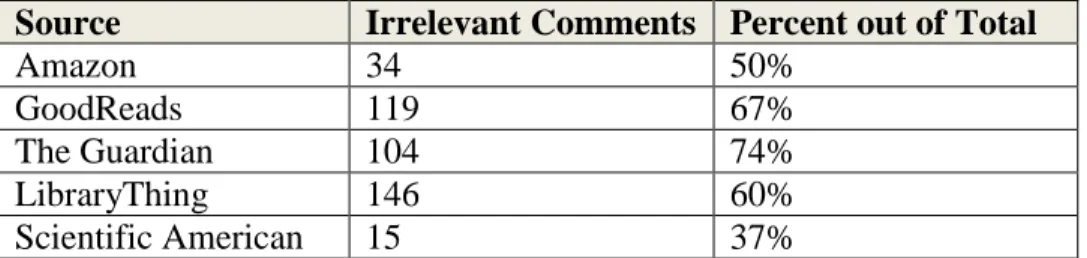
were not retained for analysis. Table 2 displays the number of comments excised by mutual agreement from each source sample.
Table 2: Discarded Comments
Source Irrelevant Comments Percent out of Total
Amazon 34 50%
GoodReads 119 67%
The Guardian 104 74%
LibraryThing 146 60%
Scientific American 15 37%
The sample was coded over several days, with the coders referencing identical spreadsheets. As specified in the Guidelines, one segment could be assigned to several codes, but coders were advised to choose fewer rather than more codes if unsure. Following Marra, Moore, and Klimczak’s (2004) lead, each coder’s progress was
transparent; several check-ins helped each to stay consistent in her application of the definitions, and uncertainties and differences in code assignment were reviewed as opportunity permitted. The streamlined definitions, explicit examples of what to code in that category, quick reference bookmark, training sessions, and check-ins facilitated intercoder agreement. The findings and analysis follow.
Findings and Discussion
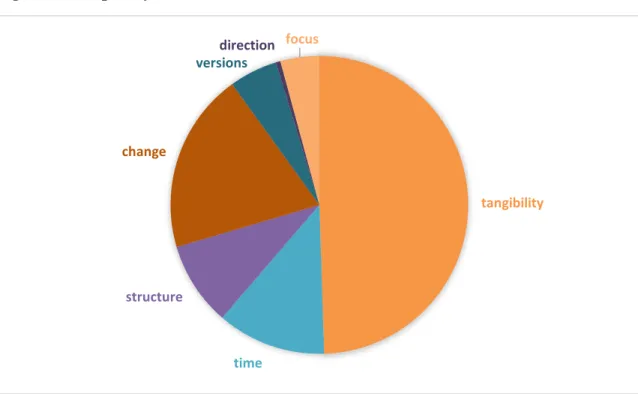
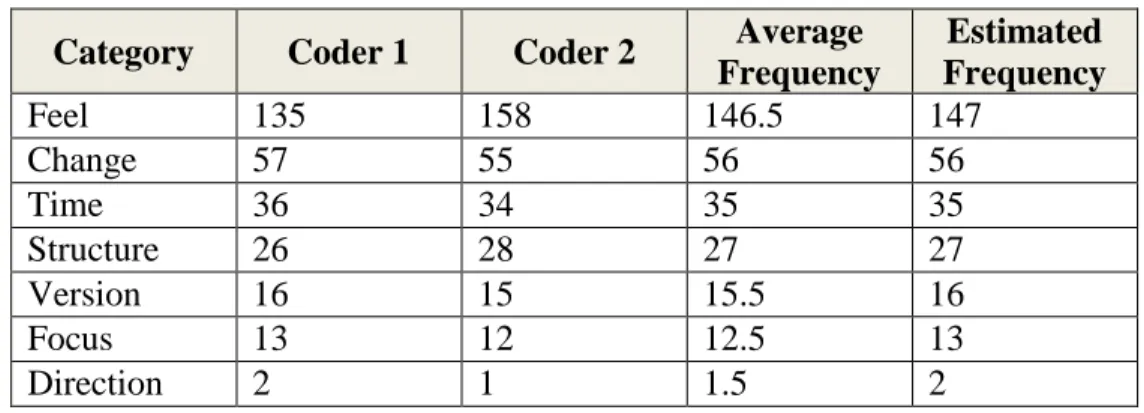
digital rights management. Figure 1 presents an overview of the characteristics, which are discussed7 in detail below.
Figure 1: Frequency of Characteristics Overall
Tangible vs. Intangible
By far the most frequent comparison between paper and digital books was
tangibility, appearing in 147 comments or 58% of the responses. This was expected as these attributes are readily apparent and the first ones readers encounter. The lack of physical space and weight were the most frequent advantages associated with e-books. “LOTS of ‘books’ for the weight and size of ONE,” a commenter wrote on The
Guardian, with another adding that “the Kindle holds 3,500 books. I don’t have room in
7 As mentioned in the Methods section, the sex of the commenters is ambiguous due to the usernames and
lack of verified demographic information about the population. References to sex in the discussion is only for narrative purposes.
tangibility
time
structure
change
versions
my whole house for 3,500 books!” (Amazon). For this reason many readers expressed a
preference for e-books when traveling; 28 comments addressed travel specifically, and 43 discussed its portability in general. As one shared on LibraryThing, “the idea of traveling with hundreds or even thousands of books taking up the space in my luggage of a
magazine” particularly appealed to him.
The lightweight e-reader was also easier to hold than some print books, although one person favored paperbacks for being even lighter in weight than e-readers—“I fall asleep reading and being hit in the face by a falling paperback is bad enough”
(GoodReads). Far more, however, found the e-reader light and comfortable to hold, with 25 comments specifically referencing its weight and 12 the ability to hold the e-reader comfortably with one hand. Those with difficulty holding physical books especially appreciated the digital option. “Arthritis makes it hard to hold a book sometimes,” one admitted (LibraryThing); “some of the really big books that I love… I just can’t any
more. But my e-books are all the same lovely portable size, no matter how many words they have.” Nine additional comments echoed this, making it clear that the uniformity of
size and weight, no matter the book, appealed to many readers.
Alternatively, many commenters appreciated that reading print engaged multiple senses, including touch, smell, and sound. “I prefer the feel of a book,” one person wrote, “the heft of it in my hands, the way the paper feels as I turn the pages, the smell of the ink, paper and glue” (LibraryThing). Smell, in fact, was a recurring theme that appeared in 24 comments, with 75% favorable toward the “musty” (LibraryThing), “spicy”
sound of the turning paper. For one reader in particular, these qualities were nonnegotiable:
There would be no enjoyment for me in reading without the whole ambient experience—the feel of the book in my hands, the sound of the paper rustling, the smell that tells whether the book is old or new or somewhere in between … what pleasure would I find in holding a little slab of metal and plastic when I’m trying to get engrossed in Dickens or The Iliad or The Count of Monte Cristo? Not a lot (GoodReads).
The “little slab of metal and plastic” was similarly off-putting to another reader who found that “e-books just seem so…cold…unfeeling. Just another computer file”
(LibraryThing). As 31 preferred the feel of the analog book over the digital, it seems the
feel of the book in hand was an important element of the reading experience, and one which could influence a reader’s decision to use or eschew digital books.
For those who preferred paper books, the ambient experience was a strong factor as they appreciated the textural, multisensory engagement that comes with interacting with a physical object. For those who preferred digital books, it was the spaceless and weightless attributes they favored for practical reasons. Accordingly, there was little compromise on this component. Seventeen people did not intend to try e-books or had tried and disliked them, and 21 expressed reluctance to go back to reading paper.
Static vs. Dynamic
The next most frequent comparison between paper and digital books was change, appearing in 58 comments, or 23% of the responses. Users often mentioned adapting the text display to their needs—indeed, 27 wrote of increasing the font size, and others wrote of adjusting the line spacing, changing the color and contrast, and switching the
appears in a written work,” one reader attested on GoodReads, with another saying the
same for his Kindle (GoodReads). Eighteen appreciated e-readers’ built-in dictionaries, another feature of the dynamic display. “Where would I touch the page to get a dictionary definition?” one asked (Amazon), objecting to print, and another even admitted to finding “myself trying to push a button, or read a definition of a word, while reading a paperback book” (Amazon). One reader thought that digital textbooks could be enhanced by
“animation or short clips” (LibraryThing) which, if embedded in the text, would be
particular to the digital format just like the built-in dictionary. Readers seemed to
appreciate that the display on their digital interfaces was not limited to a fixed format like printed books and took advantage of its dynamic features.
Accordingly, the fixed nature of print was generally considered a negative aspect when compared with the ability to manipulate the text for personal needs; it was
considered an asset, however, when it came to the information itself. An issue that surfaced in the LibraryThing discussion was the possibility of manipulation by outside
forces. Seven comments made reference to change by publishers, governments, and other external agencies; these were noted as a sub-category. “Let’s assume fifty years from now that print truly is gone,” one asked; “how will the new reader know that his or her
copy of Moby-Dick is the same as when Melville released it. Perhaps within that time, the Powers That Be decided that it needed an up-grade to appeal to a younger generation, so they ‘dumbed’ it down” (LibraryThing). Another echoed this, observing that the digital medium allows for undetectable censorship: “What the e-reader format allows is for the type of behavior (or worse) to happen without it being in the complete open…if,