Hunter H. Janes. #Precision: An Exploration of the Utility of User-Generated Metadata for the Creation of Precise Microblog Query-Expansion Systems. A Master’s Paper for the M.S. in I.S. degree. April, 2013. 34 pages. Advisor: Jaime Arguello
Twitter research provides a unique opportunity to answer fundamental questions regarding the best methods for the large-scale retrieval of extremely sparse documents. This study examines the utility of user-generated metadata expansion candidate terms for the creation of precise microblog search engines. Several search engines were created utilizing different genres of candidate expansion terms, confidence thresholds, and document parameters to explore this issue. This study demonstrates that user-generated metadata has utility for the precise retrieval of terse queries with high levels of associated conversation, such as movie awards or current events, but performs poorly on textually rich queries with lower levels of perceived conversation.
Headings:
Search Algorithms
Web Search Engines
Querying (Computer Science)
Precision (Information Retrieval)
#PRECISION:
AN EXPLORATION OF THE UTILITY OF USER-GENERATED METADATA FOR THE CREATION OF PRECISE MICROBLOG QUERY-EXPANSION SYSTEMS
By
Hunter H. Janes
A Master’s paper submitted to the faculty of the School of Information and Library Science of the University of North Carolina at Chapel Hill in partial fulfillment of the
requirements for the degree of Master of Science in Information Science.
Chapel Hill, North Carolina April 2013
Approved by
Table of Contents
Introduction ... 2
Literature Review ... 3
Methodology ... 10
Experimental Results ... 15
Discussion ... 19
Future work ... 25
Conclusion ... 27
Introduction
Twitter is the world’s most popular microblogging platform. With over 500 million new
messages being created on the service each day and almost 1.6 billion queries issued to
its search-engine every twenty-four hours (Dugan 2012; Twitter Search Team 2011),
Twitter research provides a unique opportunity to answer fundamental questions
regarding the best methods for the large-scale retrieval of extremely sparse documents.
This master’s paper examines the structure of Twitter microblogs to determine which
genre of term presents the most potential utility. A particular focus of this paper is the
performance of user-generated metadata in the retrieval of microblogs. This paper
specifically focuses on the usage of these terms for query-expansion. Several
search-engines were created which utilized candidate expansion terms from various genres of
terms, as well as different term confidence thresholds and feedback document
parameters.
Potential limitations to the generalizability of this study are discussed at length
below. The evaluation metric utilized for this experiment was precision, which was
selected as it was assumed to best simulate the heuristic evaluation of a user. Precision
was measured at five, fifteen, and thirty retrieved messages. Unexpanded queries were
Literature Review
Microblogs share many of the features of a traditional blog—informality, interactivity,
high frequency of update, and a standardized template platform—however, Microblogs
are distinct as their entries are much shorter and thus considerably sparer. This textual
sparseness lends microblogs their “micro” aspect. This scarcity of textual representation
has led to a unique array of technical approaches to microblog information retrieval. The
critical intervention of this master’s paper is to ascertain which genre of pseudo-relevance
expansion term best aids precision at N. Before discussing the specific motivation for
this line of research, time will be spent discussing key issues in microblog research. A
particular focus will be paid to how an evidence-based understanding of term quality and
genre can complement a number of microblog retrieval approaches. The specific
microblog investigated by this paper is Twitter.
Twitter is a microblog platform that allows users to post an unlimited number of
entries, known as “tweets”, which have a maximum character limit of 140 characters.
Twitter has become one of the most prolifically used microblogging platforms on the
internet. In February 2012 Twitter had 500 million registered users that posted roughly
340 million tweets daily (Dugan 2012). In October of 2012 Twitter CEO Dick Costolo
reevaluated this number by saying that the company estimates that the company sees
which are two years old and likely to be quite short of current volumes, roughly 1.6
billion queries are put to Twitter search each day (Twitter Search Team, 2011). Making
sense of this deluge of textually sparse documents has proven to be a fertile area for
inquiry.
The microblogging environment presents a unique set of challenges and is distinct
from traditional blog or indexed document retrieval. The lack of textual context and girth
dramatically changes the methods of retrieval and, occasionally, the object of evaluation
(Efron 2011). Scholarly approaches to microblog retrieval have largely focused on two
complimentary research streams to overcome these textual limitations: the exploitation of
structural information (Kalmanovich and Kurland 2009; Vieweg et al. 2010), and query
expansion (Meij, Weerkamp, and De Rijke 2012). Exploiting structural information has
seen wide array usage. It has been used to geo-locate messages (Vieweg et al. 2010),
harvest Hashtags (Efron 2010), and analyze rebroadcast patterns to overcome the anemic
amplitude of the original information signal. Other approaches have used temporal
information to identify tweet-bursts to identify tweets with high expansion potential:
For many queries, the relevant tweets are concentrated in temporal bursts in the past and that identifying these bursts and favoring tweets published during those time periods can improve retrieval. (Willis et al 2012, 1)
Some of the more successful approaches have attempted to make use of almost all
available structural and temporal information when expanding a query:
Query expansion on microblog data can be done in a dynamic fashion (taking time into account) and should include specific terms like usernames, hashtags, and links. (Massoudi et al 2011)
However, most query expansion research has focused heavily on using outside textual
from semantically related messages as a form of document expansion. Methods which
attempt to dramatically expand queries using outside signals are technically interesting,
but have shown themselves to be difficult to implement with precision:
Indeed, there are many queries for which state-of-the-art PF [pseudo-relevance frequency] expansion methods yield retrieval performance that is substantially inferior to that of using the original query with no expansion—the performance robustness problem. (Kalmanovich and Kurland 2009, 646)
The performance robustness problem arises from the tendency of expanded content to
introduce an untenable amount of “query drift” (Kalmanovich and Kurland 2009). This
drift exhibits itself as the phenomenon in which results with relevancy for a different
query task than the original begin to be returned to the users. Outside and open-source
document databases such as Wikipedia (Elsas et al. 2008) have proven to be favorites
amongst researchers hoping to dramatically expand the content of microblog documents.
Until the performance robustness problem can be convincingly addressed, using outside
signals for query expansion will remain a promising though ultimately unreliable method.
Microblogs are known to be noisy (Kelly 2009). Each microblog platforms has an
unique method for winnowing results, though none appear to be effective at reducing the
volume of unwanted messages. Twitter is notoriously noisy and is a system with a
massive volume of new information passing through it every day. Due to its 500 million
daily tweets and 1.5 billion new daily queries, it could be argued that the desire to
winnow information is the driver behind a majority of Twitter studies. Methods for
winnowing the amount of information and maximizing quality of information are often
massive, rapid, and time sensitive environment of most microblogging services,
following a particular conversation across time is not a solved problem.
If one limits oneself to a review of research to which has been done specifically to
improve ad hoc retrieval methods on the Twitter platform, the most common practice has
proven to be the harvesting of structural information from large volumes of tweets. This
approach has been popular as Twitter’s application programming interface (API) has
made harvesting large numbers of messages a de minimis task. Several well established
information retrieval researchers have attempted to exploit structural information from
Twitter to overcome its textual deficiencies. These methodologies have largely been
concerned with using the structure of individual tweets to gain quality information for
query expansion (Kalmanovich, 2012; Vieweg et al, 2011; Meij et al, 2011). Most of this
work has dealt with simple term frequency and mutual information. There has been
significantly less work done specifically exploring the potential of Hashtag mining, the
exploitation of user-created metadata, for conversational monitoring and query
expansion. This seems to be due to the difficulty of exploiting Hashtag information for
ad hoc retrieval.
In this work, we explore the use of hashtags for query expansion on the Twitter
microblogging platform. Hashtags have seen wide acceptance on Twitter and have been
adopted into the formal design of the system and are thus worthy of a focused discussion.
Hashtags have their roots in a design implemented by creator Jarkko Oikarinen for
Internet Relay Chat (IRC). Oikarinen’s design placed a hash mark in front of a noun to
denote IRC conversational channels. Hashtags were later introduced to the Twitter
message: “how do you feel about using # (pound) for groups. As in #barcamp [msg]?”1
Twitter has since adopted this method for creating publically findable conversations. The
Twitter Hashtag is a form of user-generated metadata consisting of a Hashtag (#)
followed by a string of alphanumeric characters, and has thus not diverged noticeably
from Oikarinen’s original design and intention. Hashtags provide a unique opportunity to
utilize user-generated metadata to assist in information retrieval. Even if they prove to be
completely detrimental to informational retrieval efforts, which the experimental section
of this paper refutes, they are used with such frequency that they must be dealt with by
any Twitter search engine.
A highly influential work for the development of the methodology of this master’s
paper was Miles Efron’s 2010 work Hashtag Retrieval in a Microblogging Environment,
which outlined the motivation for harvesting Hashtags in the following manner:
“Finding useful Hashtags offers benefits that are particular to the microblog setting:
Tags to follow: A user may wish to find Hashtags that he or she can track on an ongoing basis.
Result display: If users are searching for tweets, people, or posted URLs, returned units of retrieval could be grouped into clusters by their
associated Hashtags.
Query expansion: Hashtags provide leverage for query expansion during relevance feedback.” (787)
This paper focuses exclusively on Efron’s third criteria, but may have implications for
both the first and second. Once an experimentally derived expansion threshold is
discovered for Hashtags, then their pragmatic application will likely be greatly increased
to the remaining criteria. There is a documented research corpus detailing the use of
structural information to provide information for pseudo-relevance feedback for Twitter
query expansion. As mentioned in previous pages, this approach has been popular
largely due to the ease by which Twitter’s application programming interface (API) can
be queried to harvest large volumes of tweets. However, it should be noted that the
harvesting of tweets is not completely open. There are various free and paid levels of
access for registered Twitter developers. Twitter has recently revisited its harvesting
policies and has shown a demonstrated tendency to limit high-fidelity access to paying
researchers in recent years.
By exploiting forms of structural information such as user-created metadata, it
may be possible to ameliorate some of the more detrimental aspects of query expansion
methods such as pronounced query drift. Though query drift does assert itself through the
use of Hashtag information, as was discovered during the analysis phase of this project,
this effect can be accounted for by aggressively limiting the Hashtags used for expansion.
Several previous approaches have used offline machine learning to identify clusters of
semantically related Hashtags (Kalmanovich et al. 2009). Several of the more successful
attempts have used various methods of bootstrapping to identify additional Hashtags to
cluster (Lee, Croft, and Allan 2008). There have also been attempts to use simple term
frequency (Cui et al. 2012) as a proxy of influential Hashtags and conversations. These
efforts have been met with varying levels of success.
There has not been a prolonged inquiry into not only what genre of expansion terms
make for the highest precision, but also what feedback document threshold provides the
best mine of candidate expansion information. The addition of an investigation of what
level of tag retrieval query drift begins to occur may make the approach of this master’s
expansion candidates can be explored. Furthermore, these methods can serve as basis for
future projects which can use textual or structural information to combat the major
problems faced by microblog retrieval. By preforming basic scientific research into this
fundamental unit of investigation better results in future experiments might be obtained.
The experimental design of this paper makes use of several feedback document levels
and confidence thresholds to begin to address the robustness problem faced by microblog
retrieval. This ultimate goal of this paper is to begin to move towards an optimal
methodology for avoiding the problem of performance robustness by exploiting different
Methodology
Experimentation was performed on the 2011 Twitter corpus provided to the the Text
Retrieval Conference (TREC) Microblog track. Through the manipulation of various
tunable parameters, it was hoped that the best genre of candidate expansion term for
query expansion could be determined. The genres of candidate terms in this corpus were
Hashtags, Non-Hashtags, and a combination of both genres. A secondary goal of this
analysis was to determine which feedback document level yielded the best results.
Finally, each pool of expansion candidates was subjected to a severe reduction in number
of expansion terms to test for query drift. The intended outcome of this experiment was
to allow a researcher to confidently know which terms to utilize for query expansion, and
which feedback document level yielded optimal results. The metric of evaluation was
precision at five, fifteen, and thirty. Corpus indexing, pseudo relevance feedback, and
retrieval evaluations were performed using the utilities contained in the Indri toolkit,
which is a tunable search engine tool developed in cooperation between the University of
Massachusetts and Carnegie Mellon University as part of the Lemur Project. Textual
manipulation and generic term filtering were performed using a regular expression scripts
and a programmable text editing software solution.
Indri was installed in a university-run Linux-based computing cluster consisting
Carolina at Chapel Hill, 2013).This computing framework allowed for rapid testing,
evaluation, and assessment. As stated above, the corpus used was a subset of the 2011
Twitter corpus provided by the Text Retrieval Conference (TREC) Microblog track. This
corpus subset consisted of roughly five million unique tweets collected during a period
spanning January 23rd- February 8th 2011. The full experimental corpus consisted of 16
million unique tweets, but this researcher was unable to gain access to the full corpus due
to both logistic and privacy issues. Provided with this corpus were 110 queries, covering
a wide array of topics, and a full set of National Institute of Standards (NIST)
evaluations. These evaluations were performed in a binary relevant/irrelevant manner by
professional trained assessors.
After acquiring access to Indri, a digital copy of the corpus, and the Linux
computing cluster, the five million tweets were modified using regular expression
scripting. This was done to ensure that the preceding Hashtag symbol (#) was not
removed by Indri during the indexing, stemming, or querying stage of the experiment.
This purpose-built regular expression script transformed the symbolic Hashtag into a
natural language Hashtag: i.e. the Hashtag #Syria was transformed to the term
HASHSyria. A stop word list was obtained and utilized by this researcher to prevent the
substitution of stop words for more meaningful terms during query expansion. The stop
word list used was provided by The Journal of Machine Learning research, which is an
academic journal produced and managed by the MIT Press. Once the text of the corpus
was correctly transformed, and reliable stop word obtained, it was indexed using the
IndriBuildIndex utility into an inverted index. The results of the indexing were then
This index was next mined for candidate query expansion terms. This was done in
multiple passes in which the top thousand terms from twenty-five, fifty, one hundred, and
one thousand feedback documents were selected. The feedback documents were selected
algorithmically by the Indri system, and represented the most confident documents
produced by the baseline retrieval algorithm. All tunable parameters were set to their
default Indri parameters: μ smoothing parameter (0) and weighting (.5). This ensured
that both expansion terms and original query terms were given equal weight. These
parameters were left untuned as the experimental design was intended to test only the best
genre of expansion term and the feedback document level, and the tuning of additional
expansion criteria was outside the scope of this project. The corpus was then queried
using the four previously mentioned document parameters using the IndriRunQuery
utility. This process resulted in the following useable expansion term counts displayed in
the below figure.
Usable Terms Obtained From Expansion Harvest Number of Feedback
Documents
Hashtags Retrieved
Non-Hashtags Retrieved
Total Terms Retrieved
25 506 16298 16804
50 981 31405 32386
100 1863 56371 58234
1000 3177 103772 106949
This retrieval of Hashtag terms closely followed Heap’s Law as that the rate of additional
Thus, retrieving Hashtags from a large feedback document corpus would likely not yield
significantly more candidate terms than a much smaller feedback documents number.
This has implications for computational efficiency and will be discussed in the discussion
section.
Once harvested, potential query expansion terms were sorted into query term
pools consisting of Hashtags, non-Hashtag terms, and mixed bag of expansion terms. Of
these pools, the first two (Hashtag only and non-Hashtag) were mutually exclusive pools
that contained no term overlap. This was accomplished using another purpose built
regular expression script.
From these pools the top twenty candidate expansion terms for each of the 110
queries were selected. These terms were then ranked in accordance to their assigned
expansion weights. Each set of twenty expansion terms were then used as expansion
terms for each query. As a means for adjusting for potential query drift, a separate query
pool was created for each genre which made use of the most confident candidate
expansion term. The most confident expansion terms was determined by the candidate
term with the highest weight. This resulted in twenty-five unique queries: three separate
queries for each of the four document expansion parameter pools, twelve queries based
on the most confident expansion term for each document and genre pair, and baseline
non-expanded query. These twenty-five queries were performed on the previously
indexed corpus. The output of these queries was stored on the Linux cluster for use and
The results of the queries were evaluated using the Indri TRECEval utility and the
provided TREC Qrels evaluation file. The metrics used for this experiment were
precision at five, fifteen, and thirty. These precision levels were set to simulate several
possible uses of the system by the user. The precision of each query was the measured at
all three precision levels. The precision of each query pool at each precision level was
then compared and the results analyzed. After this comparison was performed, the nature
of the individual 110 queries were examined. This provided the researcher with not only
data about how well the genres of candidate terms preformed overall, but also how well
Experimental Results
The results of the query expansion were evaluated for best performance at the precision
levels of 5, 15, and 30 to simulate potential user interaction with a retrieval system. These
were next evaluated to examine which expansion method and which feedback-document
parameter gave the most precise results. This was then used to determine what expansion
method and feedback document level was the best method for each precision level, as
well as what method would be the best expansion method overall. The results are given in
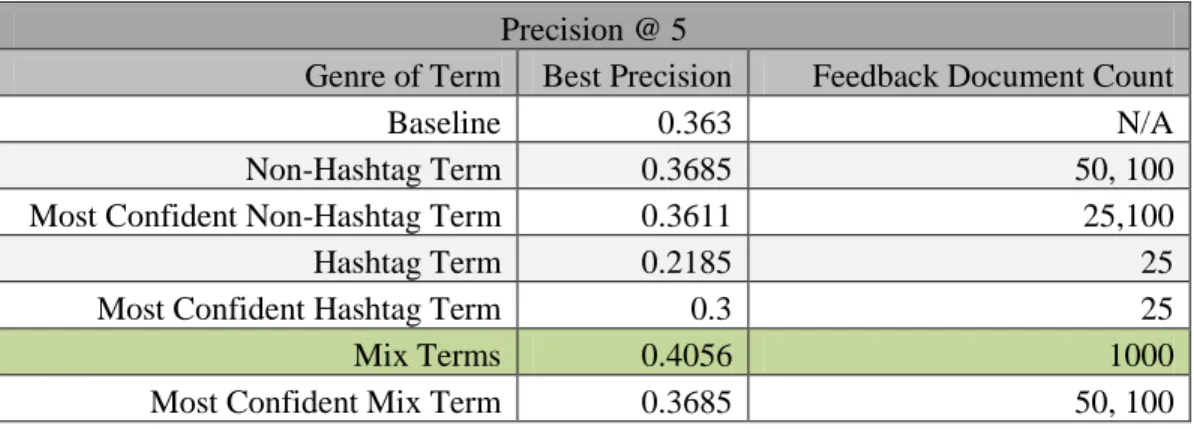
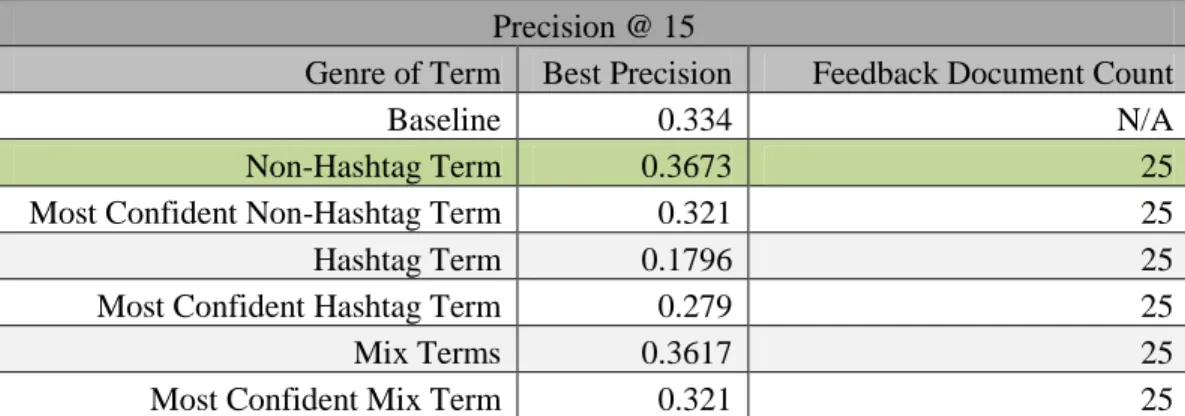
figures 1-A, 1-B, and 1-C below. The highest achieved precision is highlighted in green.
Figure 1-A
Precision @ 5
Genre of Term Best Precision Feedback Document Count
Baseline 0.363 N/A
Non-Hashtag Term 0.3685 50, 100
Most Confident Non-Hashtag Term 0.3611 25,100
Hashtag Term 0.2185 25
Most Confident Hashtag Term 0.3 25
Mix Terms 0.4056 1000
Figure 1-B
Precision @ 15
Genre of Term Best Precision Feedback Document Count
Baseline 0.334 N/A
Non-Hashtag Term 0.3673 25
Most Confident Non-Hashtag Term 0.321 25
Hashtag Term 0.1796 25
Most Confident Hashtag Term 0.279 25
Mix Terms 0.3617 25
Most Confident Mix Term 0.321 25
Figure 1-C
Precision @ 15
Genre of Term Best Precision Feedback Document Count
Baseline 0.288 N/A
Non-Hashtag Term 0.3235 25
Most Confident Non-Hashtag Term 0.2799 25
Hashtag Term 0.1636 25
Most Confident Hashtag Term 0.241 25
Mix Terms 0.3123 25
Most Confident Mix Term 0.2799 25
With the notable exception of the mixed terms with a feedback document count of 1,000,
the best results were achieved from methods with used terms with only twenty-five
feedback documents. The only methods to show any performance above baseline as the
precision evaluation levels of fifteen and thirty where methods which made use of no
more than twenty-five feedback documents. The most consistently stable feedback
methods, as measured by performance above the baseline, where the mixed term and
non-Hashtag term methods. These did not exhibit the marked tendency towards relevancy
deterioration exhibited by the purely hashtag-based methods. The highest precision
and a thousand feedback documents. This solution was not very robust, as it performed
poorly on all precision levels. This suggests that sever query drift was introduced into the
retrieval using this method. Using this corpus, and only this corpus, it can be said that the
safest method of retrieval is to use twenty-five feedback documents and non-Hashtag
term candidate expansion. The applicability of this methodology to a search engine on
“wild” Twitter is suspect, as is discussed at length below.
It was observed during the experiment that hashtags exhibited rapid ranked
relevancy decay when compared to non-hashtag terms. That is to say that a hashtag at
rank N>1 is more likely than a non-hashtag to produce a non-relevant result in this
particular microblog corpus. The standard method of expansion, in which the twenty
terms most confident expansion candidates were utilized, produced poor results for pure
hashtag retrieval. This is likely due to the relevant scarcity of hashtags in this corpus, and
thus selecting twenty hashtags from a scare supply forces one to utilize candidate
expansion terms with very low confidence values. Severely limiting the number of
hashtags used in a query, through limiting the scope of hashtags used to the single most
confident hashtag in the set, yielded markedly better results. Hashtags were the only
genre of candidate term to benefit from reducing the expansion to the single most
confident term. This is strongly suggestive that the proper usage of Hashtags would be to
use a small number of extremely confident candidate terms during query expansion. It
would appear that Hashtags make for fragile expansion terms, but have the ability to
produce relevant results when treated with the proper care.
Moving away from conjecture and back to the results of the performed
feedback documents and using non-hashtag query expansion terms. This approach proved
to be the most consistent at the most levels of precision, and did not fall victim to the
robustness problem at the same rate as hashtags. This leads to the conclusion that if one
were to build a system to handle ad hoc style retrieval for Twitter, then they would want
to discredit hashtag terms. As stated above this is likely due to the fact that hashtags
appear in very low frequencies in returns for ad hoc style queries. This is despite the fact
that they appear in very high frequency on Twitter in its naturalistic setting. This brings
Discussion
The observed variation in the performances of the expanded queries may be partly due to
the way that TREC constructed test queries, which seemed to be more aligned with
traditional ad hoc search engine searching than with searches performed naturalistically
on Twitter. This likely led to the deep variation between queries which worked well for
hashtag only retrieval and queries which worked well for non-hashtag retrieval.
A specific example of this variation can be found in query #60 (“Fishing
Guidebooks”) which, when the feedback document parameter was set to 25, had a
precision at five of .8667 when non-hashtag candidate terms were used. This same query
did not break the >.5 precision level when using the hashtag candidate system. This may
be due to the nature of the query. “Fishing Guidebooks” is an extremely specific query,
and is thus likely not to spawn a large volume of Twitter conversation due its lack of
broad and general cultural interest. Conversely, a topic with a fair amount of assumed
general interest and spontaneous conversation, such as query #88 (“Kings Speech
Awards”), yielded a perfect retrieval score of P@5 = 1.0 followed by P@15 = .933, and
P@30= .8 when using the hashtag only retrieval system. For the same query, the
non-hashtag query system’s highest retrieval score for that query was P@5 = .8. This suggests
that hashtags may be highly reliable for tasks which center on queries with high levels of
that treat Twitter, a platform built to facilitate extemporaneous conversations, as if it were
a traditional document retrieval system. This currently remains an open question, until
future work can more thoroughly investigate this topic.
Queries such as “Phone Hacking British Politicians” (#8) and “Dog Whisperer
Cesar Millan’s Techniques” (#33) are much better suited to expected user behavior for an
ad hoc retrieval system for indexed documents such as Google or Yahoo. They appear to
be much too large and much too specific for microblog usage. Query #33 is so large that
it takes up almost a full 30% of the maximum size of the document, 140 characters,
which is its unit of retrieval. The likelihood of any particular microblog document
satisfying such a large and specific query is very low, and thus there is a strong chance
that the precision of such retrieval would be quite poor no matter what system is utilized.
A much more naturalistic query list and corpus might yield results that not only have
higher precision, but are more generalizable to the actual system in question. It is telling
that no system utilized had a precision that an average user would likely find acceptable.
Hashtags may prove to be a method for retrieving these more general interest and
conversational queries.
Twitter searches tend to be, much like their unit of retrieval, quite spare, broad,
and conversational. The top trending searches at the time of this writing (3/21/2013 9:38
PM EST) are as follows: #PAX, #E3ChloeBoston, #WhyISmile, #ImSoUsedToHearing,
A&T, #teaching2030, Martin Brodeur, Louisville, NCAA Tournament. It should be noted
that no search exceeds two terms and that fully 55% of the top searches are for
not to only search using extremely sparse queries, but to query for conversations in which
to take part.
It is also interesting to observe that a large number of the hashtags in the Twitter’s
top searches are parlour tags. These repurposed hashtags, which function very much like
Victorian parlour games, serve no notable informational purpose apart from simply
participating in an ongoing quasi-game of interpretation and appropriation of the meaning
of the hashtag. For example a search for #WhyISmile produces tweets such as:
“#WhyISmile my zygomatic muscle is working properly”, “#WhyISmile smile because it
reminded me of someone that I like (⌒_⌒)”, and “#WhyISmile to hide my emotions
and feelings”. If a search engine is too be built for Twitter, these parlor tags need to be
dealt with in a rigorous and systematic manner. After all, these make for some of the
most popular searches to pass through Twitter’s search engine.
During the harvesting phase of the experiment Hashtags followed Heap’s Law:
Thus, the return on computing investment from harvesting Hashtags from 1000
documents instead of 100 documents is quite low. In the chart displaying this behavior
below, special attention should be paid to the X-axis as the movement from 100 to 1000
documents is a tenfold increase in document pool size for only a 58% increase in number
It would therefore likely be a poor use of computational resources to attempt to harvest
Hashtags from a large feedback document pool. This diminishing return on investment
was not as steep for other genres of candidate expansion terms. This implies that a system
which can successfully make use of Hashtags would have the added benefit of being able
to mine less feedback documents than other systems, thus saving on computing power
and time.
A thorough study of general Twitter usage will need to be undertaken to
determine the generalizability of these findings. The goal of such a study would be to
determine both the nature and structure of Twitter queries and usage. This would allow
for the construction of a corpus for testing retrieval systems in a more naturalistic setting.
Confounding the effort to create a more naturalistic retrieval corpus is the observation
that Twitter is a duel-purpose system. Twitter serves both as a microblogging platform
and a social network. It is distinctly different from other social networks, such as
Facebook, in that users do not typically “follow” the uses that they know in their offline
0 500 1000 1500 2000 2500 3000 3500
Twenty-Five Fifty One Hundred One Thousand
Hashtags Retrieved
lives. Twitter users often follow a wide number of accounts that span a variety of
interests and genres of information. New Twitter users must engage in a complex
network building process to discover users that post things of interest. Users often end up
manually constructing a network by following a recursive path of discovery of interesting
microbloggers from the tweets of microbloggers they are already interested in. Users are
not only searching for relevant tweets, but they are also searching for relevant users. A
truly comprehensive Twitter search engine would need to address not only the nature of
Twitter search, but incorporate the social aspirations of its users into its design.
Returning to the specific inquiry of this paper, it is interesting to consider how a
more naturalistic query corpus would respond to hashtag-only retrieval. As discussed
earlier, the TREC corpus contains queries which may be unrealistic in both content and
length. In addition to changing the construction of test queries and recognizing the nature
of Twitter as a social network, there may need to be a reconsideration of current
relevancy evaluation methods. Evaluating rather something is relevant to a conversation
is quite different from evaluating rather a tweet is relevant to a specific query. As Tweet
are units of conversation, and not simply micro-documents, they do not have the same
binary (ir)relevancy of documents traditional utilized in ad hoc searches. Tweet relevancy
likely operates on a much fuzzier logic. Relevancy is an elusive target, as Twitter users
are constantly appropriating, redirecting, adding to, and subverting conversations. How
exactly this should be taken into account when performing relevancy judgments is
beyond the scope of this paper.
Ultimately, the best solution may be to bifurcate the construction and optimization
while another would be created to handle the conversational and social core of Twitter.
This would ensure that both engines would be optimal for two potential usages of Twitter
Future work
The observation that hashtags perform well for general interest and conversational
Twitter queries may prove to be of use to future investigations. A potential extension of
this paper might be the creation of a metric to determine the relative volume of
conversation surrounding specific queries, and thus ascertain rather a query is a “safe”
candidate for hashtag expansion. Such an approach might function through the
exploitation of structural and temporal elements of Twitter: retweet volume and
frequency of query-related tweets. This expands upon recent research into tweet “bursts”
to identify candidate expansion tweets (Willis et al, 2012). Queries with high levels of
conversation may prove to be, if the findings of this paper prove to be generalizable, ideal
candidates for hashtag-based query expansion. Filtering queries by the amount of
conversation would help to ensure that queries ill-suited to such forms of expansion
would be spared high-levels of unnecessary query drift.
An additional area for future work is in the area of relevancy evaluation and
corpus construction. Dealing with the ambiguity of conversational relevancy and the
construction of naturalistic queries are areas with deep potential for improving the field
of microblog retrieval. These research streams would require a sustained look at nature of
As was mentioned in the discussion section, it may prove fruitful to construct a
bifurcated query expansion system for Twitter. Such a system would seperate ad hoc
queries from queries intended to discover interesting conversations or users. This would
allow for the focused tuning for the performance of two unique user tasks, without
sacrificing the unique expansion strengths of the retrieved corpora of either approach.
Due to its reliance on the recognition of the nature of a query, and need for reliable
relevancy assessment, this dual approach might be best undertaken once the previously
Conclusion
It is the finding of this paper that non-hashtag terms are optimal for ad hoc style
microblog retrieval. This recommendation is offered with some reservations as there is
suggestive evidence that the task of ad hoc retrieval is not representative of the most
popular Twitter searches. The task of conversational discovery may be a more realistic
usage for a Twitter search engine, and in such cases it is the recommendation of this
researcher that a mixture of properly scoped hashtags and non-hashtags be employed.
Such a system would have the advantage of both user-created metadata and the numerical
robustness of non-hashtag terms. Statistical modeling has revealed that Hashtags, when
an appropriate confidence threshold is utilized, have the ability to offer relevant results at
computationally insignificant costs due to their tendency to follow Heap’s Law.
Furthermore, it was revealed that Hashtags perform at much higher relevance levels when
their confidence threshold is severely limited.
A complicating factor is the likely need for the development of new modes of
relevance judgment. As microblog queries may be best viewed as mechanisms to discover
conversations, and not simply a novel method for accessing very small documents, then
perhaps other evaluation measures should be developed for relevancy judgments. The
introduction of fuzzy logic or a relaxation of the standards of relevance might need to be
considered by National Institute of Standards (NIST). How exactly NIST might
It is thus the recommendation of this author that any system which attempts to
utilize Twitter data for query expansion should carefully bifurcate its development
efforts. This will ensure that optimization efforts which attempt to utilize candidate
Works Cited
Balog, Krisztian, Leif Azzopardi, and Maarten De Rijke. 2006. “Formal Models for Expert Finding in Enterprise Corpora.” Proceedings of the 29th Annual
International ACM SIGIR Conference on Research and Development in Information Retrieval: 43–50. http://dl.acm.org/citation.cfm?id=1148181.
Balog, Krisztian, Maarten De Rijke, and Wouter Weerkamp. 2008. “Bloggers as Experts: Feed Distillation Using Expert Retrieval Models.” Proceedings of the 31st Annual International ACM SIGIR Conference on Research and Development in Information Retrieval: 753–754.
Boyd, Danah. 2009. “Twitter: ‘Pointless Babble’ or Peripheral Awareness + Social Grooming.” http://www.zephoria.org/thoughts/
archives/2009/08/16/twitter_pointle.html.
Carter, Simon, M Tsagkias, and W Weerkamp. 2011. “Twitter Hashtags: Joint Translation and Clustering”: 1–3. http://journal.webscience.org/529/.
Celik, Ilknur, Fabian Abel, and GJ Houben. 2011. “Learning Semantic Relationships Between Entities in Twitter.” Web Engineering: 167–181.
http://www.springerlink.com/index/5673031T47304276.pdf.
Craswell, Nick, David Hawking, Anne-Marie Vercoustre, and Peter Wilkins. 2001. “P@noptic Expert: Searching for Experts Not Just for Documents.” Ausweb Poster Proceedings, Queensland, Australia. http://es.csiro.au/pubs/craswell_ausweb01.pdf.
Croft, Bruce, Donald Metzler, and Trevor Strohman. 2010. Search Engines: Information Retrieval in Action. Addison-Wesley.
Cui, Anqi, Min Zhang, Yiqun Liu, Shaoping Ma, and Kuo Zhang. 2012. “Discover Breaking Events with Popular Hashtags in Twitter.” Proceedings of the 21st ACM International Conference on Information and Knowledge Management - CIKM ’12: 1794. doi:10.1145/2396761.2398519.
Dugan, Lauren. 2012. “Twitter To Surpass 500 Million Registered Users On Wednesday.” Media Bistro, February 21.
http://www.mediabistro.com/alltwitter/500-million-registered-users_b18842.
D’Orazio, Dante. 2012. “Instagram Cuts Off Twitter Cards Integration, Further Souring Relationship.” The Verge, December 5.
http://www.theverge.com/2012/12/5/3730876/instagram-cuts-off-twitter-cards-integration-further-souring-relationship.
Efron, Miles. 2010. “Hashtag Retrieval in a Microblogging Environment.” Proceeding of the 33rd International ACM SIGIR Conference on Research and Development in Information Retrieval - SIGIR ’10: 787. doi:10.1145/1835449.1835616.
http://portal.acm.org/citation.cfm?doid=1835449.1835616.
———. 2011. “Information Search and Retrieval in Microblogs.” Journal of the American Society for Information Science and Technology 62 (6) (June 16): 996– 1008. doi:10.1002/asi.21512. http://doi.wiley.com/10.1002/asi.21512.
Elsas, Jonathan, Jaime Arguello, Jamie Callan, and Jaime G Carbonell. 2007. “Retrieval and Feedback Models for Blog Distillation Retrieval and Feedback Models for Blog Distillation.” Computer Science Department Paper 282.
http://repository.cmu.edu/compsci/282/.
Elsas, Jonathan, Jaime Arguello, Jamie Callan, and Jaime G. Carbonell. 2008. “Retrieval and Feedback Models for Blog Feed Search.” Proceedings of the 31st Annual International ACM SIGIR Conference on Research and Development in Information Retrieval - SIGIR ’08: 347. doi:10.1145/1390334.1390394.
http://portal.acm.org/citation.cfm?doid=1390334.1390394.
Holt, R. (2013, March 21). Twitter in numbers. The Telegraph. Retrieved from
http://www.telegraph.co.uk/technology/twitter/9945505/Twitter-in-numbers.html
Hearst, Marti A. 1999. “The Use of Categories and Clusters for Organizing Retrieval Results.” In Natural Language Information Retrieval, 333–373. Kluwer Academic Publishers.
Hearst, Marti A., Matthew Hurst, and Susan T. Dumais. 2008. “What Should Blog Search Look Like?” Proceeding of the 2008 ACM Workshop on Search in Social Media - SSM ’08: 95–98. doi:10.1145/1458583.1458599.
http://portal.acm.org/citation.cfm?doid=1458583.1458599.
Kalmanovich, Inna Gelfer, and Oren Kurland. 2009. “Cluster-based Query Expansion.” Proceedings of the 32nd International ACM SIGIR Conference on Research and Development in Information Retrieval - SIGIR ’09: 646.
doi:10.1145/1571941.1572058.
http://portal.acm.org/citation.cfm?doid=1571941.1572058.
Kelly, R. 2009. Twitter Study Reveals Interesting Results About Usage. San Antonio, TX. http://www.pearanalytics.com/blog/wp-content/uploads/2010/05/Twitter- Study-August-2009.pdf.
Lee, Kyung Soon, W. Bruce Croft, and James Allan. 2008. “A Cluster-based Resampling Method for Pseudo-relevance Feedback.” Proceedings of the 31st Annual
International ACM SIGIR Conference on Research and Development in Information Retrieval - SIGIR ’08: 235. doi:10.1145/1390334.1390376.
http://portal.acm.org/citation.cfm?doid=1390334.1390376.
Meij, Edgar, Wouter Weerkamp, and Maarten de Rijke. 2012. “Adding Semantics to Microblog Posts.” Proceedings of the Fifth ACM International Conference on Web Search and Data Mining - WSDM ’12: 563. doi:10.1145/2124295.2124364. http://dl.acm.org/citation.cfm?doid=2124295.2124364.
Mishne, Gilad. 2006. “Information Access Challenges in the Blogspace.” The International Workshop on Intelligent Information Access (IIIA 2006).
http://citeseerx.ist.psu.edu/viewdoc/download?doi=10.1.1.103.9533&rep=rep1&typ e=pdf.
Mishne, Gilad, and Maarten De Rijke. 2006. “A Study of Blog Search.” Advances in Information Retrieval: 289–301.
http://www.springerlink.com/index/j1254g6h75747725.pdf.
Nagmoti, Rinkesh, Ankur Teredesai, and Martine De Cock. 2010. “Ranking Approaches for Microblog Search”: 153–157. https://biblio.ugent.be/publication/1108169.
K. Massoudi, M. Tsagkias, M. de Rijke, and W. Weerkamp. Incorporating query
expansion and quality indicators in searching microblog posts. In Proceedings of the 33rd European conference on Advances in informationretrieval, ECIR `11, pages 362{367. Springer-Verlag, 2011.
Sankaranarayanan, J, H Samet, B E Teitler, M D Lieberman, and J Sperling. 2009. “Twitterstand: News in Tweets.” In Proceedings of the 17th ACM SIGSPATIAL International Conference on Advances in Geographic Information Systems, 42–51. ACM.
Streams, Kimber. 2012. “Twitter Takes on Third-party Developers with Strict New Rules.” The Verge, August 23.
http://www.theverge.com/2012/8/23/3263481/twitter-api-third-party-developers.
Twitter Search Team. (2011, May 31). The engineering behind twitter’s new search experience. Retrieved from http://engineering.twitter.com/2011/05/engineering-behind-twitters-new-search.html
Tsur, Oren, Adi Littman, and Ari Rappoport. 2012. “Scalable Multi Stage Clustering of Tagged Micro-messages.” Proceedings of the 21st International Conference Companion on World Wide Web - WWW ’12 Companion: 621–622.
doi:10.1145/2187980.2188157.
http://dl.acm.org/citation.cfm?doid=2187980.2188157.
The University of North Carolina at Chapel Hill. (2013, February 27). Getting started on killdevil. Retrieved from http://help.unc.edu/help/getting-started-on-killdevi
Vieweg, Sarah, AL Hughes, Kate Starbird, and Leysia Palen. 2010. “Microblogging During Two Natural Hazards Events: What Twitter May Contribute to Situational Awareness.” Proceedings of the 28th …: 1079–1088.
http://dl.acm.org/citation.cfm?id=1753486.
Wang, Tian. 2012. “Search for a New Perspective.” Twitter Blog, November 15. http://blog.twitter.com/2012/11/search-for-new-perspective.html.
Weng, Jianshu, Ee-Peng Lim, Qi He, and Cane Wing-Ki Leung. 2010. “What Do People Want in Microblogs? Measuring Interestingness of Hashtags in Twitter.” 2010 IEEE International Conference on Data Mining (December): 1121–1126.
doi:10.1109/ICDM.2010.34.
http://ieeexplore.ieee.org/lpdocs/epic03/wrapper.htm?arnumber=5694095.
Whiting, Stewart, I Klampanos, and J Jose. 2012. “Temporal Pseudo-relevance Feedback in Microblog Retrieval.” Advances in Information Retrieval: 522–526.
http://www.springerlink.com/index/L4791425176141T3.pdf.