Acknowledgements
First and foremost, I would like to thank my incredible professor, advisor, and friend Dr. Anna Bardone-Cone for her guidance and support not only in the writing of this thesis, but also over the four years that I have been a student at UNC. I am so grateful for all of the lessons and opportunities that she has given me, all of which have helped me to grow as a psychologist. Working with her has been the most fulfilling part of my undergraduate career and her passion for this field continues to inspire me every day.
I extend an enormous thank you to the Bardone-Cone Research Lab for their hard work in collecting the data used in this thesis as part of the Peers and Body Image Study. I am
fortunate to have been a member of this research lab for three years and I cannot say that there is a more hard working or dedicated group than this group of graduate and undergraduate students.
I would also like to thank my thesis committee, Dr. Elizabeth Pungello and Dr. Steve Buzinski, for their participation in my defense and for their insightful comments and feedback on my work.
Abstract
The purpose of this study was to examine the relationship between family pressure to be thin, parental expectations of perfectionism, and their interaction on disordered eating attitudes and
behaviors in a college-aged female sample. At Time 1, a sample of 441 undergraduate women completed the study measures through an online survey and 237 women of these women completed the measures again one year later. As hypothesized, the results indicated that concurrently, family pressure to be thin and parental expectations of perfectionism were each significantly positively associated with broad eating pathology, dietary restraint, binge eating, and body dissatisfaction. Additionally, the interaction of family pressure to be thin and parental expectations of perfectionism was found to be a significant indicator of current levels of broad eating pathology and body dissatisfaction, but not of disordered eating attitudes and behaviors one year later. These findings support the dual pathway model proposed by Stice (1994) and suggest that families are one of the critical sociocultural pressures that influence women’s body
Family Pressure to be Thin and Parental Expectations of Perfectionism in Relation to Disordered Eating and Body Dissatisfaction in Young Adult Women
In order to examine how the development of an eating disorder can be influenced from early on in life, it is important to examine parental and family factors. Growing up in a family environment that puts a substantial amount of pressure on its members to be thin as well as one that relays high expectations of perfection can have lasting effects on family members’ self-worth, body image, and disordered eating behaviors (Agras, Bryson, Hammer, & Kraemer, 2007; Davies, Liao, Campbell, & Tchanturia, 2009; Salafia & Gondoli, 2011; Srinivasagam, Kaye, Plotnicov, Greeno, Weltzin, & Rao, 1995; Tremblay & Lariviere, 2009). Although there is a large and growing body of research studying media pressure and peer pressure on disordered eating, less research has focused on how the family environment itself exerts pressure to be thin and/or perfect and thereby impacts disordered eating. In the current study, we examine the relationship between family pressure to be thin, parental expectations of perfectionism, and their interaction on body image and disordered eating in a sample of college-aged women.
Family Pressure to be Thin
(2007) found that increased parental concerns and direct interventions about their daughters’ weight and shape were associated with an increase in daughters’ body preoccupation in an 11-year longitudinal study. This preoccupation was, in turn, associated with a higher prevalence of bulimic eating behaviors. Finally, Tremblay and Lariviere (2009) found that negative comments about the child’s weight made by parents were one of the most important predictors of
disordered eating in a sample of over 1,000 children and adolescents. Such comments included telling the child they should exercise, lose weight, or that they were too heavy. These studies provide preliminary evidence for the effect of parents’ influence via pressure to be thin on disordered eating, especially for bulimic symptomatology.
One model that could explain the relationship between family pressure to be thin and disordered eating is the dual pathway model presented by Stice (1994). This model proposes that family, peer, and media pressures lead to a higher internalization of the thin ideal stereotype, which leads to increased body dissatisfaction. This dissatisfaction, in turn, increases the likelihood of disordered eating (Stice, 2002).
Thus, it appears that families, specifically parents, pressuring their child to be thin
the need to additionally examine disordered eating and its associated risk factors among young adult women.
Parental Expectations of Perfectionism
Perfectionism as a trait can be defined as, “the holding of and striving for unrealistically high standards” (Hewitt, Mittelstaedt, & Wollert, 1989, p. 133) and this perfectionism is often tied to being thin (Miller-Day & Marks, 2006). A large body of research has studied the risk factor of perfectionism and its ties to eating disorders (Bardone-Cone, Wonderlich, Frost, Bulik, Mitchell, Uppala, & Simonich 2007; Holston & Cashwell, 2000; Soenens, 2008). However, less research has focused specifically on what has been conceptualized as a parent-driven expectation of perfectionism. Because perfectionism has been identified as a risk factor for disordered eating, it is important to study the role of high parental standards of perfectionism in relation to eating pathology.
Parental expectations of perfectionism have been linked to children’s levels of perfectionism (Damian, Stoeber, Negru, and Băban, 2013) as well as to eating disorder
psychopathology (Davies et al., 2009; Srinivasagam et al., 1995). Damien et al. (2013) found that parental expectations of perfectionism were positively correlated with both self-oriented
without a history of anorexia even after a year of being recovered (i.e. a year of being at a normal weight, not binging, purging, or restricting, having regular menses, and off medication). These studies provide preliminary evidence for the influence of parental expectations of perfectionism on eating disorder psychopathology, both in the short term and in the long term.
One model that might account for the relationship between parental expectations of perfectionism and disordered eating is the social expectations model (Flett, Hewitt, Oliver, & Macdonald, 2002). This model states that a child or adolescent whose parents have high
expectations of perfectionism often bases their self-worth on their parents’ approval. If and when they fail to meet their parents’ expectations, children and adolescents may internalize those expectations and their associated negative self-evaluation, thereby increasing their own chances of developing perfectionism (Damian et al., 2013). This perfectionism is, in turn, associated with disordered eating behavior and attitudes (Bardone-Cone et al., 2007; Holston & Cashwell, 2000; Soenens, 2008).
Current Study
(Berg, Frazier, & Sherr, 2009), highlighting the need to further study disordered eating and its correlates and predictors among this population.
Given that both variables (i.e. family pressure to be thin and parental expectations of perfectionism) have been associated with eating disorders in the literature, it is important to consider how they may combine to increase risk. While each construct on its own shows some association with disordered eating, would individuals with high family pressure to be thin and high parental expectations of perfectionism be most at risk? By examining a novel interactive relationship between these two risk factors in a population of college women, a group known to be at risk for eating pathology, we extend research on parental influence beyond childhood or adolescence into young adulthood.
We tested the following hypotheses: (1) Family pressure to be thin will be positively associated with disordered eating symptoms and body dissatisfaction. (2) Parental expectations of perfectionism will be positively associated with disordered eating symptoms and body dissatisfaction. (3) Using cross-sectional data, family pressure to be thin and parental
expectations of perfectionism will interact such that women who feel pressure from their family to be thin and who feel that their parents expect them to be perfect will report the highest levels of disordered eating and body dissatisfaction. (4) Using longitudinal data, this interactive model of family pressure to be thin and parental expectations of perfectionism will also prospectively predict disordered eating and body dissatisfaction one year later.
Method Participants
data. Most of these women identified as Caucasian (73.2%), 9.1% as Black, 8.0% as Latina, 5.0% as Asian, 0.2% as Pacific Islander, 4.3% as biracial/biethnic, and 0.2% as other
races/ethnicities. Highest parental education was used as a proxy for socioeconomic status and ranged from 7 to 21 years (M = 17.01 years, SD = 2.67). Of the 441 Time 1 participants, 352 women agreed to be contacted for a follow-up research study and 237 total participants completed the Time 2 survey (i.e. 67.3% of those that agreed to be recontacted; 53.7% of the initial sample). According to the demographics reported at Time 1 by these 237 participants, the women that completed both Time 1 and Time 2 ranged in age from 17 to 24 years with a mean of 18.70 years (SD = 1.02). Most identified as Caucasian (69.1%), 7.6% as Black, 11.4% as Latina, 5.5% as Asian, and 6.4% as multiple races/ethnicities. Highest parental education ranged from 7 to 21 years (M = 17.13 years, SD = 2.71).
Procedure
Participants were recruited through introductory level psychology courses and were emailed a link to view the online consent form and survey at Time 1. Research assistants contacted each participant to highlight important aspects of the consent form and answer any questions about participation in the study. After electronic consent was received, participants were directed to the survey. Questionnaires in the survey were presented in a fixed order and took 45 minutes to one hour to complete, with participants receiving course credit after completing the survey. One year later, participants that agreed to be contacted for follow-up research were asked to complete the Time 2 survey. Again, participants were emailed a link to the consent form and survey, were called by a research assistant to go over the consent form and answer any questions, and were directed to the survey after giving electronic consent.
complete. Compensation for completing the survey at Time 2 was the participant’s choice of a five-dollar gift card to a retail store or coffee shop.
Measures
Demographics. Demographic data for age, parents’ highest levels of education attained, and race/ethnicity were collected via a set of questions created for this study.
Family pressure to be thin. Pressure from family members to be thin was assessed with the Family Pressure subscale of the Sociocultural Attitudes Towards Appearance Questionnaire (SATAQ-4; Schaefer et al., 2014), which is a four-item self-report measure. Each item is rated on a 5-point scale (1 = Definitely Disagree, 5 = Definitely Agree) with higher total summed scores indicating greater pressure from family members to be thin. Example items include: “I feel pressure from family members to look thinner” and “Family members encourage me to decrease my level of body fat.” This subscale has shown good reliability in a female college sample (e.g., coefficient alpha of .85; Thompson et al., 2011) as well as good construct validity as indicated by its .51 correlation with the Eating Disorder Examination-Questionnaire (EDE-Q;
Fairburn & Beglin, 1994). In the current study, coefficient alpha was .85 at Time 1.
indicated by its .43 correlation with the Burns’ Perfectionism Scale (Frost et al., 1990). In the current study, coefficient alpha was .80 at Time 1.
Disordered eating. Disordered eating was measured in a variety of ways to assess different possible presentations of eating disorder symptomatology. Broad eating pathology was assessed with the Eating Attitudes Test-26 (EAT-26; Garner, Olmsted, Bohr, & Garfinkel, 1982), which consists of 26 items rated on a six-point scale (1 = Never, 6 = Always) with higher scores indicating greater eating pathology. A sample item is: “Am preoccupied with a desire to be thinner.” Items responded to with 1, 2, or 3 are scored as “0” and items responded to with 4, 5, or 6 are scored as “1,” “2,” or “3,” respectively. The 26 items are summed to create a total score, with a total score of 20 or higher indicating a probable eating disorder (King, 1991). Other studies have found this measure to have good reliability in a female college sample (e.g.,
coefficient alpha of .83; Garner et al., 1982) as well as good construct validity as indicated by its .97 correlation with the original Eating Attitudes Test (EAT-40; Garner et al., 1982). In the
current study, coefficient alpha was .90 at Time 1 and .87 at Time 2.
Dietary restraint was assessed with the Restraint subscale of the Eating Disorder Examination-Questionnaire (EDE-Q; Fairburn & Beglin, 1994). This self-report measure consists of five items asking about whether certain restrictive behaviors have occurred over the last four weeks; for example, “On how many of the past 28 days have you been deliberately trying to limit the amount of food you eat to influence your shape or weight (whether or not you
have succeeded)?” Each item is rated on a seven-point scale (0 = No Days to 6 = Every Day) and the total subscale score is the average of the five items, with higher scores indicating greater
dietary restraint. Other studies have found this measure to have good reliability in a female
& Weissman, 2013) and convergent validity with the Restraint subscale of the interview version of the Eating Disorder Examination (Fairburn & Beglin, 1994). In the current study, coefficient alpha was .81 at Time 1 and .85 at Time 2.
The bulimic symptom of objective binge eating was assessed with the Eating Disorder Examination-Questionnaire (EDE-Q; Fairburn & Beglin, 1994). In particular, participants were asked on how many of the past 28 days they “ate what other people would regard as an unusually
large amount of food given the circumstances” and “on how many of these times did you have a
sense of loss of control over your eating.” This assessment of frequency of binge eating has
previously been administered to a female, undergraduate sample (Luce, Crowther, & Pole, 2008)
and shows convergent validity with the Bulimia Test – Revised (r = .84; Bardone-Cone & Boyd, 2007).
Body dissatisfaction. Body dissatisfaction was measured with the Weight Concern and Shape Concern subscales of the Eating Disorder Examination-Questionnaire (EDE-Q; Fairburn & Beglin, 1994). These 12 items are rated on a seven-point scale (0 = No days to 6 = Everyday
or 0 = Not at All to 6= Markedly) and focus on the past 28 days. These questions ask about weight and shape dissatisfaction as well as how weight and shape influence a person’s
self-worth, for example, “Has your weight influence how you think about (judge) yourself as a
person?” The items from these two subscales were averaged as a measure of overall body
dissatisfaction. Other studies have found this measure to have good reliability in a female college sample (e.g., coefficient alpha of .90 for Shape concern and of .87 for Weight concern; Arriaza & Mann, 2001) and convergent validity with the Eating Disorder Examination Shape Concern
Data Analytic Plan
We conducted descriptive analyses to obtain means and standard deviations for the study variables. These included the independent variables of family pressure to be thin (i.e., Family Pressure subscale of the SATAQ-4) and parental expectations of perfectionism (i.e., Parental Expectations subscale of the MPS), and the dependent variables of disordered eating (i.e., EAT-26 scores, Restraint subscale of the EDE-Q, and binge eating frequency reported on the EDE-Q) and body dissatisfaction (i.e., combined Weight Concern and Shape Concern subscales from the EDE-Q).
Hypothesis number one, that family pressure to be thin would be positively associated with disordered eating symptoms and body dissatisfaction, was tested using correlational analyses among Time 1 variables. Hypothesis number two, that parental expectations of perfectionism would be positively associated with disordered eating symptoms and body dissatisfaction, was also tested using correlational analyses among the Time 1 variables.
Hypothesis number three that, using cross-sectional data, family pressure to be thin and parental expectations of perfectionism would interact to identify concurrent levels of disordered eating and body dissatisfaction was tested using hierarchical multiple regression analyses following the guidelines prescribed by Cohen, Cohen, West, and Aiken (2003). In Step 1, the Time 1 independent variables (i.e., family pressure to be thin and parental expectations of perfectionism) were entered simultaneously. In Step 2, the two-way interaction between the Time 1 independent variables (i.e., family pressure to be thin x parental expectations of
Hypothesis number four, that using longitudinal data, this interactive model of family pressure to be thin and parental expectations of perfectionism would also prospectively predict disordered eating and body dissatisfaction one year later was also tested using hierarchical multiple regression analyses where in Step 1, the Time 1 independent variables (i.e., family pressure to be thin and parental expectations of perfectionism) were entered simultaneously, and in Step 2, the two-way interaction between the Time 1 independent variables (i.e., family
pressure to be thin x parental expectations of perfectionism) was entered. Separate regression analyses were run for each of the dependent variables at Time 2 and significant interactions were graphed to determine the nature of the interactions.
Results Attrition Analyses
The completers (n = 237), that is, those who participated in both Time 1 and Time 2 of the study, did not differ significantly from the noncompleters (n = 204), that is, those who only completed Time 1 of the study, on Time 1 reports of age, highest parental education, family pressure to be thin, parental expectations of perfectionism, broad eating pathology as reported on the EAT-26, dietary restraint on the EDE-Q, binge eating frequency on the EDE-Q, or body dissatisfaction on the EDE-Q (ps > .11). Groups did differ, however, in race/ethnicity. Completers had significantly fewer Caucasian non-Hispanic women (69.1%) and more racial/ethnic minorities (30.9%) than the non-completers (77.9% Caucasian and 22.1% racial/ethnic minorities), χ2 (1, N = 440) = 4.39, p = .040.
Descriptive Statistics
frequency as reported on the EDE-Q at Time 1 (60 objective binge eating episodes reported, with the next highest report being 25); that person was removed for all Time 1 analyses involving binge eating.
Correlational Hypotheses
As hypothesized, family pressure to be thin was significantly positively associated with broad eating pathology, dietary restraint, binge eating frequency, and body dissatisfaction at Time 1, with correlations ranging from .22 to 48. Of these four dependent variables, family pressure to be thin had the strongest bivariate relation with body dissatisfaction.
Parental expectations of perfectionism were also significantly positively associated with broad eating pathology, dietary restraint, binge eating frequency, and body dissatisfaction at Time 1, with correlations ranging from .13 to 24. Of these four dependent variables, parental expectations of perfectionism had the strongest bivariate relation with broad eating pathology, although the majority of the correlations were in the low .20s.
Of note, there was a pattern of family pressure to be thin having stronger correlations than parental expectations of perfectionism with disordered eating attitudes and behaviors. Family Pressure to be Thin x Parental Expectations of Perfectionism Interactions: Cross-sectional Analyses
For the hypotheses related to the interaction of family pressure to be thin and parental expectations of perfectionism identifying levels of the dependent variables at Time 1, four hierarchical multiple regressions were performed, the results of which are displayed in Table 2.
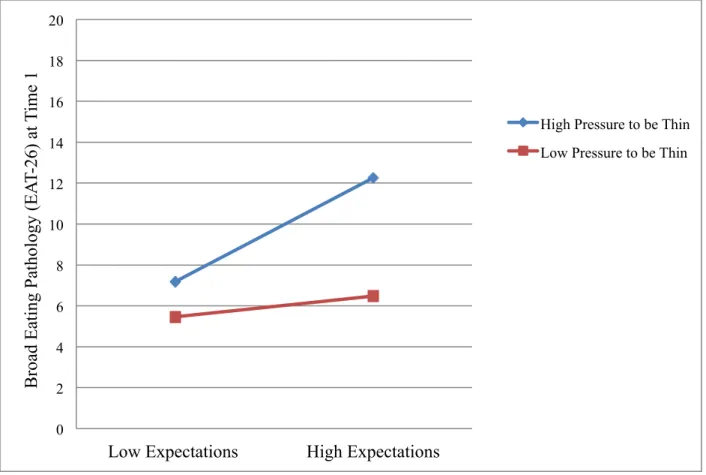
hypothesized, those who felt pressure from their family to be thin and had high parental expectations of perfectionism reported the most eating pathology (see Figure 1; in all figures, high and low levels of the independent variables are defined as one standard deviation above and below the mean, respectively). The lowest EAT-26 scores were reported by those who had low levels of pressure from their family to be thin and who did not report that their parents had high expectations of perfectionism. Interestingly, those who did feel pressure from their family to be thin but reported low parental expectations of perfectionism had EAT-26 scores that were comparable to those who did not have pressure from their family to be thin.
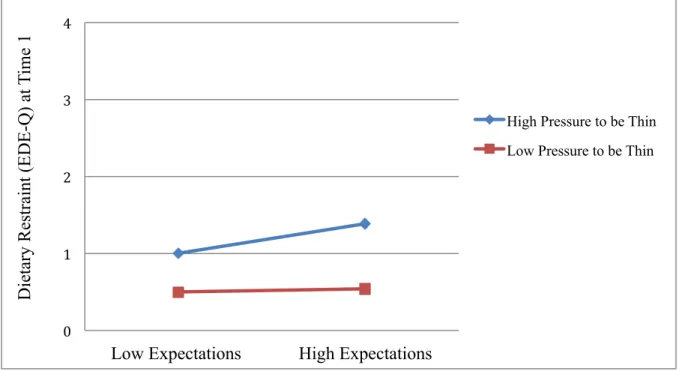
Dietary restraint. The interaction of family pressure to be thin and parental expectations of perfectionism was marginally significant in identifying levels of dietary restraint as reported on the EDE-Q at Time 1, t(1, 427) = 1.86, β = .09, p = .064, ΔR2 = .01. The nature of this trend was such that those who had high pressure from their family to be thin as well as high
expectations of perfectionism from their parents tended to report the most dietary restraint (see Figure 2).
Binge eating frequency. The interaction of family pressure to be thin and parental expectations of perfectionism was not significant in identifying binge eating frequency as reported on the EDE-Q at Time 1, t(1,421) = 1.01 , β = .05, p = .314, ΔR2 = .002. When examining main effects, it was family pressure to be thin, not parental expectations of perfectionism, that accounted for unique variance in binge eating frequency.
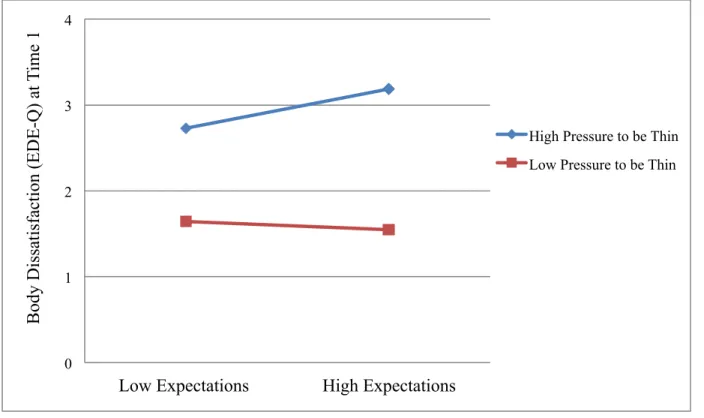
perfectionism reported the most body dissatisfaction (see Figure 3).
Family Pressure to be Thin x Parental Expectations of Perfectionism Interactions: Longitudinal Analyses
Four separate hierarchical multiple regressions were performed to examine the interaction of family pressure to be thin and parental expectations of perfectionism predicting disordered eating and body dissatisfaction one year later, the results of which are displayed in Table 3.
Broad eating pathology. The interaction of family pressure to be thin and parental expectations of perfectionism was not significant in predicting broad eating pathology as reported on the EAT-26 at Time 2, t(1,200) = 1.06, β = .07, p = .290, ΔR2 = .01. When examining main effects, it was family pressure to be thin, not parental expectations of perfectionism, that accounted for unique variance in broad eating pathology at Time 2.
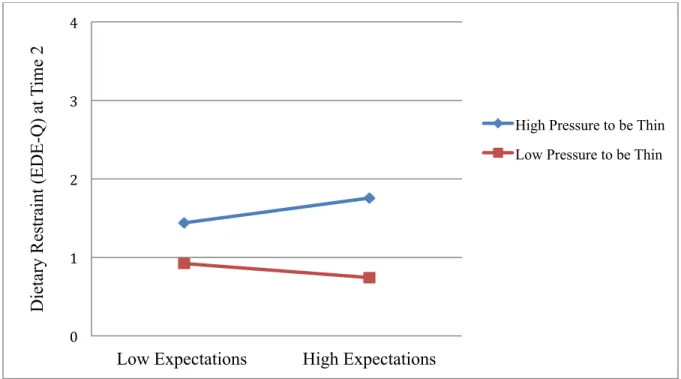
Dietary restraint. The interaction of family pressure to be thin and parental expectations of perfectionism was marginally significant in predicting dietary restraint as reported on the EDE-Q at Time 2, t(1,229) = 1.66, β = .11, p= .099, ΔR2 = .01, such that those who had high pressure from their family to be thin as well as high expectations of perfectionism from their parents tended to report the most dietary restraint after one year (see Figure 4).
Binge eating frequency. The interaction of family pressure to be thin and parental expectations of perfectionism was not significant in predicting binge eating frequency as reported on the EDE-Q at Time 2, t(1,229) = -1.28, β = -.09, p = .203, ΔR2 = .01. Examining main effects, neither family pressure to be thin nor parental expectations of perfectionism accounted for unique variance in binge eating frequency at Time 2.
Body dissatisfaction. The interaction of family pressure to be thin and parental
on the EDE-Q at Time 2, t(1,229) = 1.30, β = .08, p = .195, ΔR2 = .01. When examining main effects, it was family pressure to be thin, not parental expectations of perfectionism, that accounted for unique variance in body dissatisfaction at Time 2.
Discussion
This study found that familial and parental factors are significantly associated with disordered eating and body dissatisfaction in young adult women. Concurrently, family pressure to be thin and parental expectations of perfectionism were each found to be significantly
positively associated with various measures of disordered eating including broad eating
pathology, dietary restraint, and binge eating frequency. In addition, both family pressure to be thin and parental expectations of perfectionism were significantly positively associated with body dissatisfaction. Looking at the patterns of correlations separately for family pressure to be thin and parental expectations of perfectionism, it was family pressure to be thin that had the stronger associations with disordered eating and body dissatisfaction. This is not surprising given that family pressure to be thin is a more direct way for families to influence eating and body image than parental expectations of perfectionism, a broader factor.
The current study also found that the interaction of family pressure to be thin and parental expectations of perfectionism was a significant indicator of current levels of broad eating
who did not feel pressure from their family to be thin. Additionally, even when parents expect high levels of perfectionism, if these expectations do not extend to women’s bodies in some way – for example if there is not a substantial amount of pressure on the women of the family to be thin – these expectations are not as linked to an increase in women’s eating pathology as when the high expectations exist in conjunction with pressure to be thin from the family.
Family pressure to be thin also interacted with parental expectations of perfectionism to significantly identify levels of current body dissatisfaction. As predicted, those who felt
substantial pressure from their family to be thin and reported high expectations of perfectionism from their parents reported more body dissatisfaction than the other groups. This interactive effect showed a trend in levels of young women’s dietary restraint suggesting that those high in family pressure and high in expectations of perfectionism tended to report elevated levels of dietary restraint concurrently as well as one year later, although these two associations did not attain conventional levels of statistical significance.
Contrary to the hypotheses of this study, the interaction of family pressure to be thin and parental expectations of perfectionism was not significant in identifying current binge eating frequency or in predicting broad eating pathology, binge eating frequency, or body
dissatisfaction one year later. It may be that binge eating, in particular, is less commonly reported in this age group and sample than other presentations of eating disorder symptomatology,
including broad eating pathology, dietary restraint, and body dissatisfaction. Additionally, although the interaction was significant in identifying current levels of broad eating pathology and body dissatisfaction, this association no longer held true after one year.
Gondoli, 2011; Tremblay & Lariviere, 2009; Young et al., 2004) and body dissatisfaction (Salafia & Gondoli, 2011). This study extends the current literature by examining family influences in an older-aged sample, a population at high risk for engaging in unhealthy eating behaviors, being exposed and vulnerable to sociocultural pressures, and ultimately developing eating disorders, yet a population in which little research regarding family influences exists.
These results are also in line with Stice’s (1994) dual pathway model in that family and parental sociocultural pressures may lead to body dissatisfaction and disordered eating through a greater internalization of the thin ideal. This is especially pertinent to college women who are exposed to a great many sociocultural pressures stemming from peers and media, but also stemming from their own families. As family pressure to be thin and parental expectations of perfectionism increase, it is reasonable to assume that young women feel a greater need to fit into the cultural norm and stereotype of the thin ideal and when they do not match up to that standard, they feel worse about their bodies and may subsequently engage in disordered eating behaviors.
There were several important strengths and limitations to this study. Strengths included the large size of the sample and the combination of cross-sectional and longitudinal data. Additionally, the measures used to assess the independent and dependent variables are
completed Time 2 and those who did not. Therefore, the findings from those who completed Time 2 might not be fully generalizable to the original sample of women.
Despite these limitations, the results of this study have implications for the study and treatment of young adult women. To begin, although most of the research on family influences on eating disorders focuses on children and young adolescents, presumably because of the notion that these age groups are more susceptible to parental influences, this study found that even at the young adult age, perceived pressures from families and parents still have an influence on women’s eating behaviors and body image. At an age where peers and media influences are thought to be the most prominent pressures for women, it is important not to discount the
pressures that families and parents may exert on their female members. In terms of treatment, the results of this study suggest that in order to fully understand and help a young woman with eating pathology or body dissatisfaction, it is important to pinpoint and address any familial pressures contributing to those attitudes and behaviors.
Future directions for this line of research are clear. More research needs to be conducted on the family and parental correlates and/or predictors of eating pathology and body
may replace parental and familial influences across the college years. Future research assessing how each of these pressures affect women from the start of young adulthood to the end of it could pinpoint which type of pressure puts women most at risk for developing eating pathology and related attitudes as they age. Another future research direction involves unpacking the concept of family pressure to be thin and assessing if that pressure is coming specifically from parents or if it is coming from other family members. In addition, research should address the limitations of this study by examining family pressures in ethnically diverse populations as well as extending this field of research to the male gender.
References
Agras, W., Bryson, S., Hammer, L. D., & Kraemer, H. C. (2007). Childhood risk factors for thin body preoccupation and social pressure to be thin. Journal of the American Academy Of Child & Adolescent Psychiatry, 46, 171-178.
Arriaza, C. A., & Mann, T. (2001). Ethnic differences in eating disorder symptoms among
college students: The confounding role of body mass index. Journal of American College Health, 49, 309-315.
Bardone-Cone, A. M., & Boyd, C. A. (2007). Psychometric properties of eating disorder
instruments in Black and White young women: internal consistency, temporal stability,
and validity. Psychological Assessment, 19, 356.
Bardone-Cone, A. M., Wonderlich, S. A., Frost, R. O., Bulik, C. M., Mitchell, J. E., Uppala, S., & Simonich, H. (2007). Perfectionism and eating disorders: Current status and future directions. Clinical Psychology Review, 27, 384-405.
Berg, K. C., Frazier, P., & Sherr, L. (2009). Change in eating disorder attitudes and behavior in college women: Prevalence and predictors. Eating Behaviors, 10, 137-142.
Cohen, J., Cohen, P., West, S. G., & Aiken, L. S. (2003). Applied multiple regression/correlation analysis for the behavioral sciences (3rd ed.). Mahwah, NJ US: Lawrence Erlbaum Associates.
Damian, L. E., Stoeber, J., Negru, O., & Băban, A. (2013). On the development of perfectionism in adolescence: Perceived parental expectations predict longitudinal increases in socially prescribed perfectionism. Personality and Individual Differences, 55, 688-693.
Davies, H., Liao, P. C., Campbell, I. C., & Tchanturia, K. (2009). Multidimensional self reports
Disorders-Studies on Anorexia, Bulimia and Obesity, 14, 84-91.
Fairburn, C. G., & Beglin, S. J. (1994). Assessment of eating disorders: Interview or self‐report
questionnaire?. International Journal of Eating Disorders, 16, 363-370.
Flett, G. L., Hewitt, P. L., Oliver, J. M., & Macdonald, S. (2002). Perfectionism in children and their parents: A developmental analysis. In G. L. Flett & P. L. Hewitt (Eds.),
Perfectionism (pp. 89–132). Washington, DC: American Psychological Association.
Frost, R. O., Marten, P., Lahart, C., & Rosenblate, R. (1990). The dimensions of
perfectionism. Cognitive Therapy and Research, 14, 449-468.
Garner, D. M., Olmsted, M. P., Bohr, Y., & Garfinkel, P. E. (1982). The Eating Attitudes Test: Psychometric features and clinical correlates. Psychological Medicine, 12, 871– 878.
Hewitt, P. L., Mittelstaedt, W., & Wollert, R. (1989). Validation of a measure of perfectionism. Journal of Personality Assessment, 53, 133–144.
Holston, J. I., & Cashwell, C. S. (2000). Family functioning and eating disorders among college women: A model of prediction. Journal of College Counseling, 3, 5-16.
King, M. B. (1991). The natural history of eating pathology in attenders to primary medical care. International Journal of Eating Disorders, 10, 379-387.
Luce, K. H., Crowther, J. H., & Pole, M. (2008). Eating Disorder Examination Questionnaire (EDE-Q): Norms for undergraduate women. International Journal of Eating
Disorders, 41, 273-276.
Rose, J. S., Vaewsorn, A., Rosselli-Navarra, F., Wilson, G. T., & Weissman, R. S. (2013). Test-retest reliability of the eating disorder examination-questionnaire (EDE-Q) in a college sample. Journal of Eating Disorders, 1, 42.
Salafia, E., & Gondoli, D. M. (2011). A 4-year longitudinal investigation of the processes by which parents and peers influence the development of early adolescent girls' bulimic symptoms. The Journal of Early Adolescence, 31, 390-414.
Schaefer, L. M., Burke, N. L., Thompson, J. K., Dedrick, R. F., Heinberg, L. J., Calogero, R. M., Bardone-Cone, A. M., Higgins, M. K., …Swami, V. (in press). Development and validiation of the Sociocultural Attitudes Towards Appearance Questionnaire-4 (SATAQ-4). Psychological Assessment.
Soenens, B., Vansteenkiste, M., Vandereycken, W., Luyten, P., Sierens, E., & Goossens, L. (2008). Perceived parental psychological control and eating-disordered symptoms: Maladaptive perfectionism as a possible intervening variable. Journal of Nervous And Mental Disease, 196, 144-152.
Srinivasagam, N. M., Kaye, W. H., Plotnicov, K. H., Greeno, C., Weltzin, T. E., & Rao, R. (1995). Persistent perfectionism, symmetry, and exactness after long-term recovery from anorexia nervosa. American Journal of Psychiatry, 152, 1630-1634.
Stice, E. (1994). A review of the evidence for a sociocultural model of bulimia nervosa and an exploration of the mechanisms in action. Clinical Psychology Review, 14, 633-661. Stice, E. (2002). Risk and maintenance factors for eating pathology: A meta-analytic
review. Psychological Bulletin, 128, 825-848.
September). Development and validation of the 4th version of the Sociocultural Attitudes Towards Appearance Questionnaire (SATAQ-4). Poster presented at the Annual Eating Disorders Research Society Meeting, Edinburgh, Scotland.
Tremblay, L., & Lariviere, M. (2009). The influence of puberty onset, body mass index, and pressure to be thin on disordered eating behaviors in children and adolescents. Eating Behaviors, 10, 75-83.
Table 1
Correlations, Means, and Standard Deviations of the Independent and Dependent Variables
Note. EAT-26= Eating Attitudes Test-26. EDE-Q= Eating Disorder Examination-Questionnaire. Binge eating frequency refers to the self-report of the number of objective binge eating episodes over the prior 28 days. For all variables, higher values refer to higher levels of the construct. **p < .01. ***p < .001.
1 2 3 4 5 6
1. Family pressure to be thin
M = 9.97 SD = 4.21 2. Parental expectations
of perfectionism .34*** M = 16.06 SD = 4.09 3. Broad eating
pathology (EAT-26)
.29*** .24*** M = 8.27 SD = 9.44 4. Dietary restraint
(EDE-Q)
.35*** .20*** .76*** M = .89
SD = 1.14 5. Binge eating
frequency (EDE-Q)
.22** .13** .38*** .50*** M = 1.72
SD = 3.77 6. Body dissatisfaction
(EDE-Q)
.48*** .21*** .70*** .77*** .43*** M = 2.33
Table 2
Hierarchical Multiple Regression Analyses of the Interaction of Family Pressure to be Thin and Parental Expectations of Perfectionism Identifying Levels of Dependent Variables at Time 1: Cross-sectional Analyses
B SE B β t (dfs) ΔR2
DV = Broad Eating Pathology at Time 1
Step 1 .11***
Family Pressure to be Thin .52 .12 .23*** 4.49 (2,378)
Parental Expectations of Perfectionism .37 .12 .16** 3.16 (2,378)
Step 2 .01*
Family Pressure to be Thin x Parental Expectations of Perfectionism
.06 .03 .12* 2.33 (1,377) DV = Dietary Restraint at Time 1
Step 1 .13***
Family Pressure to be Thin .09 .01 .32*** 6.63 (2,428)
Parental Expectations of Perfectionism .03 .01 .10 1.95 (2,428)
Step 2 .01^
Family Pressure to be Thin x Parental Expectations of Perfectionism
.01 .003 .09^ 1.86 (1,427) DV = Binge Eating Frequency at Time 1
Step 1 .05***
Family Pressure to be Thin .17 .04 .19*** 3.77 (2,422)
Parental Expectations of Perfectionism .06 .05 .07 1.38 (2,422)
Step 2 .002
Family Pressure to be Thin x Parental Expectations of Perfectionism
.01 .01 .05 1.01 (1,421) DV = Body Dissatisfaction at Time 1
Step 1 .22***
Family Pressure to be Thin .17 .02 .45*** 9.95 (2,428)
Parental Expectations of Perfectionism .02 .02 .06 1.24 (2, 428)
Step 2 .01*
Family Pressure to be Thin x Parental Expectations of Perfectionism
Table 3
Hierarchical Multiple Regression Analyses of the Interaction of Family Pressure to be Thin and Parental Expectations of Perfectionism Predicting Levels of Dependent Variables at Time 2: Longitudinal Analyses
B SE B β t (dfs) ΔR2
DV = Broad Eating Pathology at Time 2
Step 1 .11***
Family Pressure to be Thin .56 .13 .30*** 4.22 (2,201)
Parental Expectations of Perfectionism .15 .13 .08 1.12 (2,201)
Step 2 .01
Family Pressure to be Thin x Parental Expectations of Perfectionism
.03 .03 .07 1.06 (1,200) DV = Dietary Restraint at Time 2
Step 1 .11***
Family Pressure to be Thin .10 .02 .32 4.81 (2,230)
Parental Expectations of Perfectionism .01 .02 .03 .50 (2,230)
Step 2 .01^
Family Pressure to be Thin x Parental Expectations of Perfectionism
.01 .004 .11^ 1.66 (1,229) DV = Binge Eating Frequency at Time 2
Step 1 .02
Family Pressure to be Thin .06 .07 .06 .88 (2,230)
Parental Expectations of Perfectionism .11 .07 .11 1.57 (2,230)
Step 2 .01
Family Pressure to be Thin x Parental Expectations of Perfectionism
-.02 .01 -.09 -1.28 (1,229) DV = Body Dissatisfaction at Time 2
Step 1 .18***
Family Pressure to be Thin .16 .02 .42*** 6.60 (2,230)
Parental Expectations of Perfectionism .01 .02 .02 .25 (2,230)
Step 2 .01
Family Pressure to be Thin x Parental Expectations of Perfectionism
.01 .01 .08 1.30 (1,229)
Figure 1. Interaction of family pressure to be thin and parental expectations of perfectionism identifying broad eating pathology on the Eating Attitudes Test-26 at Time 1.
0 2 4 6 8 10 12 14 16 18 20
Low Expectations High Expectations
Broa
d E
at
ing P
at
hol
ogy (E
A
T-26) a
t T
im
e 1
Figure 2. Interaction (trend level) of family pressure to be thin and parental expectations of perfectionism identifying level of dietary restraint on the Restraint subscale of the Eating Disorder Examination-Questionnaire at Time 1.
0" 1" 2" 3" 4"
Low Expectations High Expectations
D
ie
ta
ry Re
st
ra
int
(E
D
E
-Q
) a
t T
im
e 1
!
High Pressure to be Thin
Figure 3. Interaction of family pressure to be thin and parental expectations of perfectionism identifying level of body dissatisfaction on the Weight Concern and Shape Concern subscales of the Eating Disorder Examination-Questionnaire at Time 1.
0 1 2 3 4
Low Expectations High Expectations
Body D
is
sa
ti
sfa
ct
ion (E
D
E
-Q
) a
t T
im
e 1
Figure 4. Interaction (trend level) of family pressure to be thin and parental expectations of perfectionism predicting level of dietary restraint on the Restraint subscale of the Eating Disorder Examination-Questionnaire at Time 2.
0" 1" 2" 3" 4"
Low Expectations High Expectations
D
ie
ta
ry Re
st
ra
int
(E
D
E
-Q
) a
t T
im
e 2
!
High Pressure to be Thin