Nicole J. Kendrot. Academic Library Support for Study Abroad Students. A Master’s Paper for the M.S. in L.S degree. April, 2011. 62 pages. Advisor: Joanne G. Marshall
The purpose of the study was to determine the information needs of study abroad students and the extent to which academic libraries can fulfill those needs. Data were gathered using a web survey and semistructured interviews of students who completed a study abroad program through the University of North Carolina at Chapel Hill. Respondents had a variety of information needs, consulted a wide range of sources, and encountered unique challenges to information seeking before, during and after they studied abroad. The respondents reported that library materials covering travel and country information would be most helpful to them. The respondents also suggested that UNC-CH Libraries collaborate with the Study Abroad Office and that UNC-CH Libraries actively advertise the availability of resources and services for study abroad students through signage, the library web site and promotional materials.
Headings:
Foreign study
by
Nicole J. Kendrot
A Master’s paper submitted to the faculty of the School of Information and Library Science of the University of North Carolina at Chapel Hill
in partial fulfillment of the requirements for the degree of Master of Science in
Library Science.
Chapel Hill, North Carolina April 2011
Approved by
Table of Contents
List of Figures ... 2
List of Tables ... 3
Introduction ... 4
Literature Review ... 6
Library Services in Support of Study Abroad ... 6
Library Collaboration in Support of Study Abroad ... 8
Study Abroad Participant as Library User ... 9
Sense-making & Everyday Life Information Seeking ... 11
Importance of Study ... 12
Methodology ... 13
Study Population ... 13
Study Abroad at UNC-CH ... 14
Recruiting Subjects ... 14
Description of Survey & Interviews ... 16
Distributing Survey ... 18
Scheduling Interviews ... 18
Data Analysis ... 19
Method Advantages & Limitations ... 19
Results ... 21
Response Rate & Participation ... 21
Participant Background ... 21
Interviewee Profiles ... 25
Information Needs ... 26
Sources of Information & Help ... 30
Challenges & Barriers to Information Seeking ... 33
Library Support for Study Abroad ... 38
Discussion ... 44
Conclusion ... 48
References ... 50
Appendix A ... 54
List of Figures
List of Tables
Table 1: Categories and Corresponding Interviewee Codes ... 25
Table 2: Study Abroad-Related Information Needs of Survey Respondents ... 26
Table 3: Interviewees' Needs Before, During & After Study Abroad Experience ... 27
Table 4: Types of Coursework-related Research Conducted by Interviewees ... 29
Table 5: Sources Consulted by Survey Respondents for Study Abroad Information ... 31
Table 6: Survey Respondents' Sources of Help in Finding Study Abroad Information ... 31
Table 7: Sources Consulted by Interviewees Before, During & After Study Abroad ... 31
Table 8: Interviewees' Sources of Help Before, During & After Study Abroad ... 32
Table 9: Survey Respondents' Use of Library Resources for Credit-Bearing Activities .. 38
Table 10: Survey Respondents' Suggestions for Study Abroad Research Tutorial ... 40
Table 11: Survey Respondents' Suggestions for Library Materials for Study Abroad ... 41
Table 12: Survey Respondents' Suggestions for Types of Materials for Study Abroad ... 42
Introduction
In the 2008/2009 academic year, 260,327 students enrolled at U.S. institutions of higher education studied abroad for academic credit (International Institute of Education, 2010). Each year, students leave the comfort of their dorm rooms and the safety of their college campuses in order to spend anywhere from eight weeks to an entire year living and studying in another country. Over the past decade, the numbers of students enrolled in U.S. institutions of higher education studying abroad has been on the rise.
International Institute of Education (IIE) (2010) data suggest that the number of students studying abroad has more than doubled in the past decade.
Study abroad students represent a challenge for academic libraries. This population is entitled to the same access to library resources as any other user
community. Study abroad students complete a portion of their coursework off-campus, which separates them from the rest of their on-campus peers. Although they are distance learners, their time for learning at a distance is only temporary. Before, during and after a study abroad experience, students may face unique challenges as they prepare to travel to, live in, study in, and return home from a foreign country. The Association of College & Research Libraries (ACRL) states that academic libraries must meet the information and research needs of all constituents, wherever they may be (ACRL, 2008). The Access Entitlement Principle “applies equally to all individuals on a main campus, off campus, in distance learning or regional campus programs, or in the absence of any physical
campus” (ACRL, 2008). Academic librarians are charged with providing study abroad students with the same level of access to information as they provide to any other library user. It is clear that academic libraries must fulfill the needs of study abroad students; however, librarians must first determine the information needs and behaviors of study abroad students.
The author hypothesized that students consult a variety of information sources and that those sources will vary throughout the course of the study abroad experience. Students currently study abroad in locations worldwide and those locations can vary greatly in terms of culture, language, and living conditions. The author hypothesized that the location of study abroad experience will have an effect on the challenges and barriers that students face. This research study found that the types of information and the ways of going about finding information vary greatly by individual. Respondents’ information sources vary throughout their experience and are dependent on the type of information they are seeking. Research in LIS suggests that study abroad students are sometimes unaware of the services that they can take advantage of while abroad (Kutner, 2009). The author hypothesized that study abroad participants may be unaware of the extent to which academic libraries can fulfill their needs. This research study found that while many students were aware of their access to library services and resources while studying abroad, a number of students were not aware that these resources were available to them.
Literature Review Library Services in Support of Study Abroad
Until recently, there has been little focus on library support for study abroad in LIS literature. The earliest article to address library support of study abroad was written in 1985 following the author’s return from a trip to Japan (Engeldinger, 1985). The author offered criteria for librarians to consider when deciding whether to provide bibliographic instruction (BI) for study abroad participants (Engeldinger, 1985).
Despite this stance, Engeldinger left the question open and stated that more consideration was warranted (Engeldinger, 1985).
In 2009, Connell elaborated on the context of the academic library’s role in providing services for study abroad participants. Offering a short history and the current state of study abroad in the U.S., Connell (2009) states that library access and services are necessary for students to fully benefit from study abroad. Connell (2009) compares study abroad participants to distance learners but concludes that due to the temporary nature of the study abroad experience, the two groups are different. Ultimately, Connell (2009) suggests avenues for ways that libraries can get involved to increase student success.
Three recent articles provide case studies of the implementation of library services for study abroad or internationally located students (Wang & Tremblay, 2009; Cohen, 2010; Connell, 2009). Wang and Tremblay (2009) discuss how they assessed the needs of Long Island University’s Global Campus and then tailored their services based on those assessments. They considered the different features and contexts that each of the four overseas locations exhibited and then provided specific services and resources based on those circumstances (Wang & Tremblay, 2009). Cohen (2010) describes how librarians developed a Skype-based reference service for study abroad students and offers a list of lessons that they learned. White (2009) describes librarian involvement with study abroad programs and offers questions for librarians to consider when implementing services for study abroad programs.
the researchers used to assess the needs of their users or whether the researchers used other methods for determining the most community-appropriate services to implement. Library Collaboration in Support of Study Abroad
While Engeldinger (1985) was an early pioneer in turning attention to library services in support of study abroad, Brogan (1990) was an early pioneer in promoting cross-institutional collaboration in support of study abroad. Brogan (1990) outlined current trends in international education that related to academic librarianship, including foreign language instruction, study abroad, internationalizing the curriculum, foreign students and scholars, technical assistance and international developments. Brogan (1990) suggested big picture ways that ACRL and the American Library Association can team together to address the emerging trends. This represents the first move towards increasing focus on collaboration across offices and departments in librarianship and education for support of study abroad.
Love and Edwards (2009), Kutner (2010), and Hammond (2009) have also addressed innovative ways for libraries to collaborate with other offices and institutions. Love and Edwards (2009) discuss outreach in libraries and how liaisons can branch out to offices across campus. The needs of students are changing and strategic partnerships help to address those needs (Love & Edwards, 2009). Kutner (2010) discusses how, in light of the advent of service learning projects during study abroad experiences, librarians must also consider that study abroad students are not only information users, but that they are information producers. Kutner (2010) provides a case study describing how
with other institutions in order to better support study abroad students. Through creating Memorandums of Understanding, libraries and overseas institutions can work together to fulfill the information needs of study abroad students (Hammond, 2009).
Study Abroad Participant as Library User
LIS literature has addressed the issue of library services for study abroad students and ways that libraries can collaborate in order to provide services to study abroad students, but there have been few articles that have linked the information needs of study abroad students with the provision of library services and support. There have only been three that focus specifically on study abroad students as library users, as opposed to focusing on services provided to study abroad students (Lindell, 2008; Kutner, 2009; White et al., 2009;).
Lindell (2008) examined the ways that Association of Research Libraries (ARL) institutions provide support to study abroad students. This study collected survey
responses from 53 ARL institutions regarding which services and resources are provided to participants, how support is staffed and administered, how services are delivered and whether collections are physical or online (Lindell, 2008). Results of the survey
suggested that ARL institutions do not have particular initiatives aimed at study abroad participants, but provide them with the same level of service as they do distance learners (Lindell, 2008). ARL data suggest that institutions are unsure if study abroad students know that the services offered to distance learners apply to them, but anecdotal evidence suggests that students who are aware find library support useful (Lindell, 2008).
Costa Rica and the accompanying article describes the methodology and instruments used (Kutner, 2009). Kutner (2009) assessed the frequency of library use and other factors of students both at their home institution and during their study abroad
experience. The results suggest that students exhibited a level of uncertainty regarding their access to their home institutions’ library services during their study abroad
experiences (Kutner, 2009). The author suggests that widespread promotion and greater communication of library resources and services for students abroad will reduce
uncertainty and increase confidence in the use of the library while off campus (Kutner, 2009).
In addition to providing case studies regarding library services for study abroad students, White et al. (2009) provide a theoretical framework for the information seeking behavior of study abroad students. This theoretical model draws heavily from the
building off of this framework and by using Dervin’s (1992) sense-making theory and Savolainen’s (1995) everyday life information seeking perspective in order to identify the information needs of study abroad students.
Sense-making & Everyday Life Information Seeking
Dervin states that we need to “make-sense” of the world and one’s need to make sense implies that some kind of gap has occurred (Dervin, 1992). When sense-making is applied to information, the term “information need” suggests that there exists a gap which can be filled by something that the person calls “information” (Dervin, 1992, p.156). Case (2007) offers the following definition for Dervin’s sense-making paradigm: "a search for information starts with questions directed at making sense of the situation; communication is central to the process of 'bridging the gap' to reach some kind of information or help desired" (p. 75). In the sense-making model, the strategies employed by the information seekers are shaped by their conceptualization of the gap in knowledge and the bridge, and by the answers, ideas, and resources obtained along the way (Case, 2007, p. 75). Sense-making attempts to uncover the problems that people experience in life and how they face and solve those problems (Case, 2007, p. 158).
Complementing the sense-making paradigm is Reijo Savolainen’s model of Everyday Life Information Seeking (ELIS) (Savaolainen & Kari, 1995; Savolainen, 2005). Savolainen describes everyday life information seeking as taking Dervin’s sense-making paradigm a step further toward addressing the more substantial issues of
concerning language courses may serve both professional ends and leisure-time hobbies (Savolainen, 1995; Savolainen & Kari, 2005). In the current study, the ELIS perspective was used as a basis for analyzing data collected from study abroad students. Study abroad students are living and working as students simultaneously, which blurs line between their roles as students versus their roles as non-students.
Importance of Study
The nature of study abroad in the United States has changed in the past two decades. More students are studying abroad, they are doing so for shorter durations and they are increasingly traveling to non-traditional locations. In an age where study abroad is on the rise and budgets are shrinking, it is important for libraries to be aware of their users’ information needs in order to effectively and efficiently provide the resources and services to their users.
LIS literature has focused on providing distance services to users; however, there are distinct differences between distance learners and study abroad participants. The information needs and behaviors of study abroad students have not been discussed in professional literature until recently. When study abroad students have been discussed in literature, those studies have focused on the services that are provided to study abroad students. The existing research does not succeed in answering the critical question: What are the information needs and behaviors of study abroad participants and how can
behaviors of study abroad students with the provision of academic library services and support.
Given the current nature of study abroad, Engeldinger (1985) may not be completely correct in stating that some study abroad students will not need any form of bibliographic instruction; however, he makes a crucial argument: librarians must assess the needs of study abroad students and the conditions in which they are working in order to better serve the students.
Methodology
The current study adopted a mixed methods approach, collecting both qualitative and quantitative data so that the strength of the study was stronger than if only one form of data was collected (Creswell, 2009). The University of North Carolina at Chapel Hill (UNC-CH) Institutional Review Board approved a confidential online survey and
interview methodology with study abroad students from UNC-CH. Survey methodology included recruiting subjects, designing the questionnaire and interview script, data collection, and data analysis.
Study Population
this study was students enrolled at UNC-CH who studied abroad during the Spring, Summer or Fall 2010 sessions.
Study Abroad at UNC-CH
The UNC-CH Study Abroad Program (2011) offers over 300 programs in 70 countries to sophomores, juniors, seniors and graduate students enrolled at UNC-CH. Undergraduate students who participate in programs that have been officially approved by the UNC Study Abroad Office and the Summer School receive academic credit for their participation. Students can earn 12-18 credits per semester and those credits can be used to fulfill elective, general college, foreign language or major/minor requirements (UNC-CH Study Abroad Office, 2011).
Recruiting Subjects
participants studied abroad, where they studied abroad and what type of study abroad program they completed.
In order to conduct interviews with as broad of a group of students as possible, the researcher identified 15 different types of study abroad students to interview. The
researcher analyzed questionnaire responses as they were submitted and contacted potential interview respondents on a rolling basis. The researcher completed this process on a rolling basis, rather than waiting until the questionnaire had closed, due to time constraints. An initial invitation email was sent to each potential interview participant. One follow-up email was sent to potential interview participants who did not respond to the initial invitation email. Both emails told the participant that they had been chosen and why they were chosen for a follow-up interview.
As stated above, potential interview participants were chosen based on their answers to the questionnaire. The researcher aimed to conduct an interview with at least one student who fell into the following categories:
• Studied Abroad During Spring 2010 Session • Studied Abroad During Summer 2010 Session
• Studied Abroad During Fall 2010 Session
• Studied Abroad in Africa
• Studied Abroad in Asia
• Studied Abroad in Australia/Oceania
• Studied Abroad in Europe
• Studied Abroad in North America
• Studied Abroad in Scandinavia
• Studied Abroad in the UK/Ireland
• Participated in a Faculty-Led Program • Participated in an Internship Program
• Participated in a Service Learning Program
The researcher chose these categories in order to gather qualitative data from as broad of a selection of study abroad students as possible. The categories represent the different time periods, regions, and types of programs that students complete study abroad programs. The researcher compared the category list with survey responses as respondents completed the web-based questionnaire. Those respondents who fell into categories for which no interviews had been conducted were invited to participate in a follow-up interview. Interviews were conducted over the course of the 18 days that the survey was open.
Description of Survey & Interviews
questions determined the number of questions that they would ultimately answer. All respondents were given the option to answer the four open-ended questions. Four optional questions at the end of the survey solicited respondents to volunteer to be considered for the follow-up interviews.
The questionnaire aimed to obtain a general overview of the types of information that study abroad students need and use. Using existing studies and surveys as models, questions in the final instrument were developed specifically for this study. Question categories included information needs and use, library use while abroad, library support of study abroad and demographics.
way that would prevent the researcher to collect accurate data. Estimated time for the interviews was between 20 and 30 minutes.
The researcher consulted Professor Joanne Marshall and Kim Vassiliadis, UNC-CH Libraries’ Instructional Services & Technology Librarian, for help in designing survey questions and the interview script before data collection began.
Distributing Survey
The survey was programmed and administered using Qualtrics survey software (Smith, 1997). Family Educational Rights & Privacy Act (FERPA) regulations prevented the Study Abroad Office from providing names of study abroad students to the
researcher. Due to this constraint, the Study Abroad Office sent survey invitations via email to potential participants on the researcher’s behalf. An anonymous survey link was inserted into the invitation email. After the initial email was sent, the researcher received emails from potential respondents indicating that there was an error with the survey link. The researcher had the Study Abroad Office send out a follow-up email with a corrected link one hour later. An email reminder was sent to the initial group of potential survey respondents after one week. Invitation emails clearly stated that the survey would close after being open for 18 days.
Scheduling Interviews
When the researcher identified potential interview participants, she invited them via email to participate in an interview and suggested two to three potential times to meet. Interviewees responded with their preferred time and the researcher scheduled a group study room in the R.B. House Undergraduate Library at UNC-CH for all but one
the group study room, the researcher emailed the interviewee to confirm date, time and location of the interview. The researcher sent an email reminder to interviewees on the day before the scheduled interview. One follow-up invitation email was sent to potential interviewees who did not respond to the initial invitation.
Data Analysis
Quantitative data for multiple-choice questions was automatically generated by Qualtrics software. The researcher analyzed and categorized qualitative data from the open-ended questions into appropriate topics, such as types of information for study abroad tutorials, ways the library can promote services, and study abroad destinations. Interviewee Codes were assigned at the time that the researcher contacted potential interviewees to invite them to participate in a follow-up interview. Not every potential interviewee completed an interview, which accounts for gaps in the alphabetical sequencing of interviewee codes.
Interviews were recorded using a digital audio recorder and the researcher took notes during the interview sessions. Audio recordings were transcribed after each session. Transcripts of interviews and interview notes were analyzed, coded and categorized into appropriate topics and themes, such as types of information consulted, barriers and challenges encountered, and information needs.
Method Advantages & Limitations
conditions and yield highly similar measurements each time” (Case, 2007, p.183). Comparing results from the questionnaire and the interviews for similar trends ensured the reliability of data that was collected. Validity is “the extent that the measurement procedures accurately reflect the concept we are studying” (Case, 2007, p.183). The questionnaire asked the types and sources of information that students need. Asking close-ended questions with only a certain number of potential answers can pose a problem for validity, as the choices offered may not fully address the full range of sources and needs. In order to address this, semistructured interviews were conducted and subjects had the opportunity to speak about their information seeking process, the needs they felt and the ways that they went about filling those needs. The semistructured approach gave subjects the opportunity to discuss sources and needs that were not listed as choices on the web-based questionnaire.
Using email allowed the survey to be sent to a large number of people, with very little cost for distribution. While online surveys have the potential to produce higher response rates, they may also produce lower response rates, as some respondents view them as impersonal (Case, 2007). This study followed Wildemuth’s (2009) suggestions for increasing response rate by contacting respondents multiple times throughout the survey data collection period and collaborating with a third party, the UNC-CH Study Abroad Office. In email surveys, bias can be created if respondents take the
The major limitations to this study were lack of time and limited resources. A disadvantage to the interview method is that data analysis can be time consuming. Due to time constraints, only 11 interviews were conducted. Certain decisions had to be made in order for the research study to be completed on schedule. Limiting the sample size and the length of the interviews made collecting data more manageable. Given more time, the researcher would have conducted more interviews and extended the length of the interviews. Given the limitations on data collection this study is considered to be exploratory in nature. The results cannot be generalized to the greater population of study abroad students; however the study does provide useful data on the information needs and behaviors of study abroad students.
Results Response Rate & Participation
The web-based survey was sent to 1144 students who studied abroad during the Spring 2010, Summer 2010 and Fall 2010 sessions. One hundred forty-nine of 1144 potential respondents participated in the survey, yielding a response rate of 13%. A total of 113 survey respondents volunteered for a follow-up interview. The researcher
contacted 19 survey respondents to participate in a follow-up interview. Eleven of 19 were successfully scheduled. Of the unsuccessful interviews, one student was still abroad and unable to meet for an interview. Seven respondents did not respond to the
researcher’s attempts to schedule an interview. Interviews lasted between 20 and 45 minutes.
A majority of respondents (94%, n=137) participated in faculty-led study abroad programs, followed by six respondents (4%) participating in an internship, and three respondents (2%) participating in a service learning program. Of 148 respondents, 50 respondents (34%) studied abroad during the Spring 2010 session, 51 (34%) studied abroad during the Summer 2010 session and 47 (32%) studied abroad during the Fall 2010 session. When asked their status as a student during their study abroad semester, a majority of respondents indicated that they were Juniors (62%), followed by sophomores (19%), seniors (14%), masters or professional students (2%), and freshmen (1%) (Figure 1). Three respondents indicated “other” as their student status. One respondent indicated that they were a rising sophomore, one respondent indicated that they studied abroad once as a junior and once as a senior, and one respondent indicated that they studied abroad as a senior, but had also studied abroad during two separate summer sessions.
Figure 1. Student Status of Survey Respondents.
As shown in Figure 2, the majority of students studied in Europe (44%), followed by Latin America (18%), Asia (12%), UK & Ireland (11%), Australia/Oceania (5%),
Junior 62% Sophomore
19% Senior
14% Masters, Professional or
PhD 2%
Other 2%
Africa (5%), multiple regions (3%), the Middle East (1%) and Scandinavia (1%). No (0%) respondents reported that they studied abroad in North America.
One hundred twenty eight respondents indicated the city and/or country in which they completed their study abroad program. Survey respondents studied abroad in 62 cities in 44 countries. Some respondents did not indicate which city they studied in and some respondents indicated that they studied abroad in more than one city or country. The top five countries that respondents studied abroad in were Spain (n=19), Italy (n=14), France (n=12), Great Britain (n=12), China (n=10), and Ecuador (n=9). The top five cities that respondents studied in were Seville, Spain (n=13), London, England (n=9), Florence Italy (n=9), Paris, France (n=6), Quito, Ecuador (n=5), Buenos Aires, Argentina (n=4), Hong Kong, People’s Republic of China (n=4), Havana, Cuba (n=4) and
Montpellier, France (n=4).
Figure 2. Study Abroad Destination Region of Survey Respondents.
Europe 44%
Latin America 18% Asia
12% United Kingdom and Ireland
11% Africa
5% Australia/ Oceania
5%
Multiple Regions
The researcher intended to survey only students who studied abroad as
undergraduate students; however, survey data collected suggest that three respondents studied abroad as graduate students (Figure 1). The researcher also intended to only survey students who were enrolled at UNC-CH during their study abroad program. The UNC-CH Study Abroad Office provided the researcher with a data report outlining characteristics of the students that were sent study invitation emails. The data report indicates that 53 non-UNC-CH students who participated in UNC-CH Study Abroad Programs were included in the survey sample (M. Nielsen, personal communication, February 16, 2011). Answers to open-ended questions confirm that some respondents were not enrolled at UNC-CH at the time of their study abroad experience. For example, when asked why they did not use UNC Libraries’ resources to complete coursework during their study abroad experience, one respondent answered: “I attend University of South Carolina.” Since this study is meant was meant to aid librarians in providing services to study abroad students in general, the data collected from these respondents has been included in the final analysis.
point in time whether or not they would receive credit. Because of the complexities of this credit approval process, these responses were included in the final analysis. Interviewee Profiles
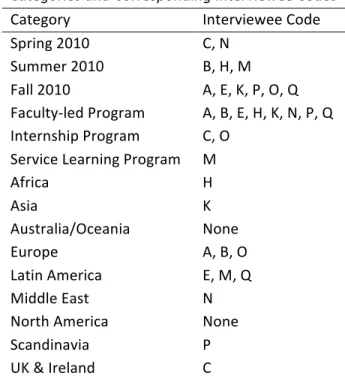
Interviews were conducted with students who fit into all but two of the pre-determined interview selection categories (Table 1). Interviews were conducted with students who studied abroad during Spring 2010, Summer 2010, and Fall 2010 (Table 1). As Table 1 shows, interviews were conducted with students who studied abroad in
Africa, Asia, Europe, Latin America, the Middle East, Scandinavia and the UK.
Table 1
Categories and Corresponding Interviewee Codes
Category Interviewee Code
Spring 2010 C, N
Summer 2010 B, H, M
Fall 2010 A, E, K, P, O, Q Faculty‐led Program A, B, E, H, K, N, P, Q Internship Program C, O
Service Learning Program M
Africa H
Asia K
Australia/Oceania None
Europe A, B, O
Latin America E, M, Q
Middle East N
North America None
Scandinavia P
UK & Ireland C
Eight interviewees completed faculty-led study abroad programs (Table 1). Two interviewees completed internships while they were abroad (Table 1). Internship
(Table 1). This student, who studied abroad during the summer session, completed faculty-led coursework in addition to her service learning project.
Information Needs
As shown in Table 2, which displays results from 149 survey respondents, the top information needs of study abroad students were information about the program (97%), travel information (97%), information about country traveled to (90%,), financial information (85%) and research for academic credit (67%).
Table 2
Study Abroad‐Related Information Needs of Survey Respondents
Information needs before studying abroad.
All interviewees indicated that they needed information about their study abroad program before going abroad (Table 3). The information needs included: general
information about studying abroad; information about their specific study abroad program; finding former students who participated in their program; packing and pre-departure logistical information; and information about the coursework they would be
Information Need Responses %
Information about my study abroad program (e.g., Semester at Sea, UNC in Sevilla)
145 97%
Travel information (e.g., visas, trip planning) 144 97%
Information about the country I traveled to (e.g. history, culture) 134 90% Finance or money information (e.g., exchange rates, currency) 127 85% Research for academic credit (e.g., coursework, seminars, internships,
service learning)
100 67%
Current events and news in my study abroad host country 93 62% Travelers’ health or wellness information (e.g., vaccinations needed,
illness abroad)
92 62%
Domestic life (e.g., figuring out where to live) 68 46%
Language skills (e.g., translators, language learning software) 61 41% Work or career (e.g., job openings, internships available) 13 9% Searched for an expert of some kind (e.g., medial doctor) 10 7%
completing. Interviewees had expended different levels of effort for finding information at this stage depending on their particular situation and level of interest.
Interviewee E: I was really bad about doing research before, because it was really difficult to access.
Interviewee N: Well, obviously, I was really excited and I needed to know [as much] information [as] possible.
Interviewee O: So I think [finding visa information] was my biggest concern. Um, as far as housing or locations or things of that nature – I tended to be pretty oblivious to all of that. I just hoped that everything worked out, and I was lucky that it did. But the visa was the big one.
Table 3
Interviewees' Needs Before, During & After Study Abroad Experience
Information Need Before During After
Study Abroad Program Information
All Q A, H, M, O, P, Q
Travel Information A, B, C, K, O, P, Q A, B, K, N, Q, P K Country Information B, C, E, H, K, M, N, P C, H, P None
Financial Information H, K, O None None
Research for Academic Credit
None A, B, C, E, K, M,
N, O, P, Q
None
Host Country News & Events A, E, M B, C B, C, E, H, K, M, N, P
Travel Health Information K None None
Domestic Life B, C, H, M, N, P, Q B, C, K, O, P A, B, K, N, O, P
Language Skills B, H, M B, C, E, P, E, N None
Work or Career P None None
Search For Expert None O None
Students who searched for travel information discussed searching for general travel information and visa information.
Interviewee C: Honestly, my biggest concern going over there, I think, was very narrow-minded and I was just concerned about getting from the airport into [my host city], where I needed to be and what the transportation system was like and trying to navigate trains, because I hadn’t had to do that before.
worried. But, visa and housing were the biggest questions I wasn’t really sure about. I didn’t really know anything about it beforehand.
Interviewees also needed information about the countries and cities they would be going to study abroad. They searched for information about the history, culture, weather, and location of their study abroad location.
Interviewee C: Google Maps was definitely my first source for trying to
understand geographically what [my host city] looked like. I was a big Fodor’s fan. I had that book and a couple other guide books that I would look through once and a while… I found it really helpful when sources would group, um, neighborhoods and talk about different areas of the city. What made each little niche stand out.
Students who were travelling to areas where there were current world news events happening mentioned that they searched for news before leaving. Interviewees A, E and M mentioned looking into current events, including civil strife and drug violence
occurring in their host countries.
Information needs while studying abroad.
Interviewees most frequently cited travel information, research for academic work, domestic life, and language skills as types of information they needed while studying abroad (Table 3). Interviewees who required travel information were looking for information about travelling in-country and to other locations. Interviewee Q
indicated that he still needed information about the visa process, as his questions had not been answered before departing. Interviewee K needed visa information about travelling to another country from her host country. Interviewees indicated needing information for their coursework, although this varied by student and the type of coursework that they were completing. All but one interviewee needed to find information to complete
Several interviewees mentioned needing information about the language of their host country while they were abroad (Table 3). These interviewees traveled to both non-English and non-English speaking countries. Interviewees E and B travelled to Spanish-speaking countries and indicated that they needed information about local idioms and slang. Interviewee C, who studied abroad in an English-speaking country, needed information about slangs and idioms in order to function in the workplace:
Interview C: And in slang – just the casual terms that they used. I had to – I would have to stop them in conversation and say, “What? What does that mean? Tell me what you’re trying to say!” [laughs] And then things would be fine.
Domestic life and “getting around” was another information need mentioned by interviewees (Table 3). Interviewee C discussed searching for information about restaurants, what to do, and where to do things while in her study abroad city.
Interviewee K indicated that she asked one of her study abroad professors for general day-to-day information, because the professor had lived extensively in both the United States and in her study abroad country.
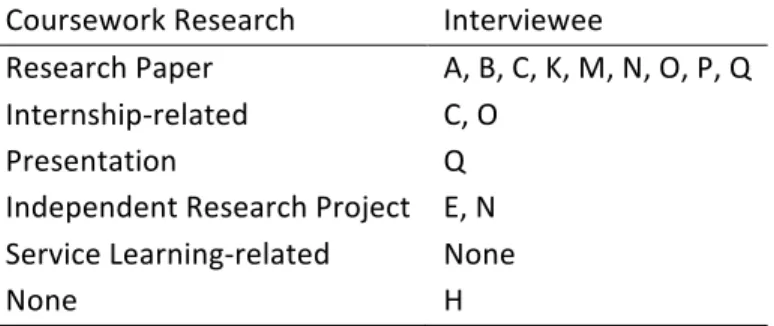
Table 4
Types of Coursework‐related Research Conducted by Interviewees
Coursework Research Interviewee
Research Paper A, B, C, K, M, N, O, P, Q Internship‐related C, O
Presentation Q
Independent Research Project E, N Service Learning‐related None
None H
Information needs after returning from abroad.
(Table 3). Students who required program information were looking for information about course credit transfers, which was often a complex and time consuming process:
Interviewee A: I had questions about, um, how to get the credit transferred. And, um, I was kind of put on, like, a goose chase, or goose hunt or whatever, to get the right forms and the paperwork to go through the bureaucracy of getting it
transferred, but, um, it eventually all worked out.
Interviewee Q: Well, I guess the question about course approvals still came up, because I just had the tentative approval while I was gone and I actually had to go through the process to get them approved here. And I found out that I to wait, basically, until they got my grades. I don’t think that they’ve gotten them yet.
Interviewees who indicated that they were looking for information about current events in their host country were looking at the news and were keeping in touch with people that they had met while abroad (Table 3). Interviewees who were looking for information about domestic life were searching for information about culture shock and about getting involved once they were back on campus (Table 3).
Sources of Information & Help
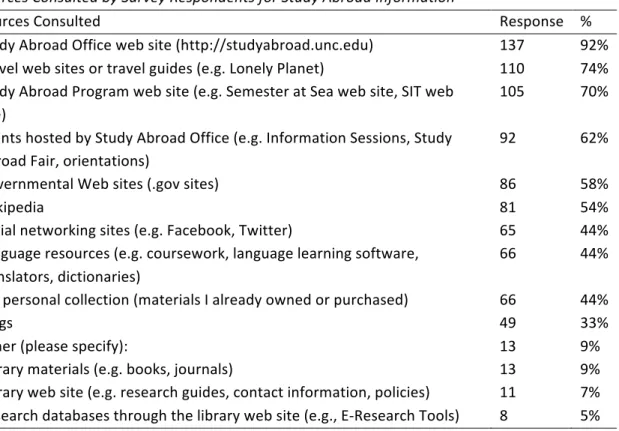
One hundred forty-nine survey respondents indicated their top sources of
Table 5
Sources Consulted by Survey Respondents for Study Abroad Information
Sources Consulted Response %
Study Abroad Office web site (http://studyabroad.unc.edu) 137 92% Travel web sites or travel guides (e.g. Lonely Planet) 110 74% Study Abroad Program web site (e.g. Semester at Sea web site, SIT web site) 105 70% Events hosted by Study Abroad Office (e.g. Information Sessions, Study Abroad Fair, orientations) 92 62%
Governmental Web sites (.gov sites) 86 58%
Wikipedia 81 54%
Social networking sites (e.g. Facebook, Twitter) 65 44%
Language resources (e.g. coursework, language learning software, translators, dictionaries)
66 44%
My personal collection (materials I already owned or purchased) 66 44%
Blogs 49 33%
Other (please specify): 13 9%
Library materials (e.g. books, journals) 13 9%
Library web site (e.g. research guides, contact information, policies) 11 7% Research databases through the library web site (e.g., E‐Research Tools) 8 5%
Table 6
Survey Respondents’ Sources of Help in Finding Study Abroad‐Related Information
Answer Responses %
Study Abroad Office Advisors 122 82%
Former or current study abroad students 110 74%
Friends or Family 94 63%
Classmates 81 54%
Course Instructors (e.g. professors, TAs) 62 42%
People from host country 46 31%
Other (please specify): 4 3%
Tandem language partner or tutor 5 3% Librarians (e.g., reference desk, online chat) 0 0%
Information sources and help before studying abroad.
programs (Table 7). Before going abroad, interviewees most often mentioned receiving help in finding and acquiring information from Study Abroad Office advisors and friends or family (Table 8).
Table 7
Sources Consulted by Interviewees Before, During & After Study Abroad
Sources Consulted Before During After
Study Abroad Office Web Site K, H, M None H, K
Travel Web Sites & Travel Guides K, H, C, B, N, O B, P None Study Abroad Program Web Site H, P, C, M None None Events Hosted by Study Abroad Office B, M, K, A, N None None
Governmental Web Sites Q, P, A K, M, E, O None
Wikipedia None O None
Social networking sites N C K, P, A, B, C, E,
M
Language Resources H K, O, B, E None
Personal Collection B, C None None
Blogs C, N A, C C
Library Materials (e.g. books, journals) E, H N, E, B, P None Library Web Site (e.g. research guides,
contact information, policies)
None P None
Research Databases Through Library Web Site (e.g., E‐Research Tools)
H K, P, A, C, E, N None
News & Media E K, A, C H, B, C, M
Freely Accessible Web Sites (e.g. Google searches)
K, N, P, C O, Q, M O, P, C
Study Abroad Office (e.g. as general source)
P, Q, O, B Q A, P
Materials Provided by Program E, H, Q, M, N, O,
H, O, P, B, E, M O, H
UNC web site (e.g. http://unc.edu) None None H, P, M
Information sources and help while studying abroad.
time, interviewees only mentioned receiving help from friends or family, course instructors, and on-site program directors or staff (Table 8).
Table 8
Interviewees’ Sources of Help Before, During and After Study Abroad
Answer Before During After
Study Abroad Office Advisors O, M, Q, N Q M, H, Q
Former or current study abroad students
P, N None B
Friends or Family P, C, A, B, M O, M O, P
Classmates None None None
Course Instructors (e.g. professors, TAs)
B K, O, C, E, M M, Q, A
People from host country P H, B, C, M, N, E, P K, P, B, A, C, E, M
On‐site Program Directors None M, N, H None
Tandem language partner or tutor
None None None
Librarians (e.g., reference desk, online chat)
None None None
Information sources and help after returning from abroad.
After returning from their study abroad experience, interviewees most often consulted the Study Abroad Office, social networking sites, news and media, and the UNC web site for information (Table 7). Interviewees consulted Study Abroad Office advisors, course instructors, and people from their host country at this time (Table 8). Challenges & Barriers to Information Seeking
Challenges and barriers before studying abroad. Limited time between acceptance and departure.
Timing, miscommunication and complexity intertwined for several of the
made worse due to the limited amount of time there was between being accepted and departure. Interviewee Q noted that the timing of the information that the program was supposed to provide was problematic. He said that they were “cutting it close” with giving him enough time to schedule his flight. Interviewee O noted that the information was there, but it just took a lot of time to get to it all.
Miscommunication between students, programs and institutions.
Several students experienced miscommunication between the host institutions, the university and themselves. Interviewee Q explained how there was a discrepancy
between the courses that his host institution said were offered and the courses that were actually offered once he arrived. This miscommunication set off a chain of events that carried throughout all stages of his study abroad experience. Two months after returning to the United States, he is still attempting to straighten out his course credit. Interviewee M explained a miscommunication between her program and her host institution, which caused her to arrive a day late to her host country and miss her institution’s orientation.
Complexity of visa process.
The complex visa process was a challenge for several students. Interviewee B noted that this complex process was made more difficult by the fact that there was no cohesive place to look for information. She said that she was given differing information and that she searched on government web sites and the UNC-CH Study Abroad Office to find this information. Interviewee O noted that the process for visas was complex, highly dependent on timing and required a lot of documents, forms and meeting with the
Lack of information.
Students noted that they felt like they did not receive enough information about certain aspects of their study abroad experience. Interviewee N, who had hoped to connect with a student from a previous semester, was unable to get information about previous program participants from the Study Abroad Office. She resorted to using Facebook to track down a previous participant from a neighboring institution. This interviewee wishes there had been a stronger resource with information about students who had previously studied abroad:
Interviewee N: When I asked my advisor, they just mentioned - She just
mentioned that there was a guy who went from UNC and, like, I was like the first girl to go through this program. But they didn’t really – I don’t know why they didn’t – They didn’t give me his contact [information] or, you know, like
encourage me to really meet up with him. And he’s in my class this semester and they [sic] were like – “Oh, you were the one who went before me.” But it would have been nice if I would have met up with him before I went.
Interviewees E and B mentioned lack of information about idioms and language dialects as being a challenge. These interviewees felt like they did not find enough of this information before they left, which would have prepared them for their time in country. Information provided by programs was less than satisfactory for a couple of the students. Study abroad students are heavily dependent on information provided by their respective programs, especially for logistical information, such as arrival dates.
Interviewees M and Q noted that they received vague and incomplete information. Challenges and barriers to information seeking while studying abroad. Access to materials and resources.
mentioned that government restrictions on Internet access prevented her from using Facebook and from searching for travel blogs. She had wanted to use these resources, but was prevented from doing so, since she did not purchase a proxy server that would allow her to surpass the restrictions.
Students also mentioned that the local resources available were limited and those limitations affected how they searched for information. Interviewee P said that she was only able to access online articles through her host institution while she was on campus or within the city’s limits. Since she lived outside of the city, she had to either download the articles to her computer before leaving campus or she used UNC-CH Libraries’ resources from off campus. Interviewee A used UNC-CH resources instead of local resources, because UNC-CH offered her greater access to materials.
Assumptions about access to UNC-CH Resources.
Several interviewees assumed that they wouldn’t be able to access library resources while they were abroad. Interviewee O mentioned how he wasn’t sure he would be able to use UNC-CH Libraries’ resources because of his location:
Interviewee O: But to be honest, you might know better than I do. I’m not even sure if I would have been able to [access UNC Libraries’ resources]. I don’t think it ever came up. Certain web sites will block access depending on your region. Like Hulu, you can’t access from Europe because you’re not in the U.S. and vice versa. There are a lot of French web sites that you can’t access in the U.S., because you’re not in France.
Lack of information need & information seeking.
During their study abroad experience, several students noted that they didn’t feel a need to find things. Interviewee P noted that her host institution made it very clear that they were available as an information source for students, but she didn’t have a need to utilize that resource. Interviewee A noted that at this point, she really didn’t go to anyone for outside help in finding information: “I didn’t really ask or anything. I just, I didn’t ask.” Interviewee C mentioned that she didn’t ask certain questions, because she wasn’t sure that her questions could have been answered. She didn’t elaborate on what those questions would have been.
Challenges and barriers to information seeking after returning. Life getting in the way.
Several students mentioned that once they got back, life got in the way of their information seeking. Interviewee E watched Spanish television and listened to Spanish radio in order to feel like she was still there. However, she noted that she got busy and wasn’t able to keep up with that as much as she would like. Interviewee O, who
Disconnect between self and others.
Interviewee P mentioned that she had tried to keep in touch with people she had met while abroad, but that the technology took away the “humanness” and that she didn’t like that mode of communication for that reason. Interviewee N wanted to feel
connections to her study abroad location, but felt that there was a lack of human connections once she returned. She wanted to find ways to be involved and stay connected with her study abroad location, but was unable to find them.
Library Support for Study Abroad
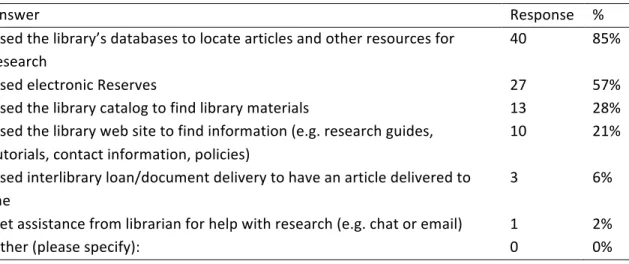
Table 9 indicates that of 148 survey respondents, the majority of study abroad students (68%) did not use library resources for credit-bearing activities while abroad. Those who used library resources most often used databases to locate articles (85%) and electronic Reserves (57%) (Table 9). Of the 100 respondents who did not use UNC-CH Libraries’ resource, half indicated their work not requiring outside research. Others used local or host institution libraries (39%), did not know that UNC-CH library resources was an option (39%) or responded “other” (12%). A majority of respondents who answered “other” (n=9) indicated that Internet access was not readily available.
Table 9
Survey Respondents’ Use of Library Resources for Credit‐Bearing Activities
Answer Response %
Used the library’s databases to locate articles and other resources for research
40 85%
Used electronic Reserves 27 57%
Used the library catalog to find library materials 13 28% Used the library web site to find information (e.g. research guides,
tutorials, contact information, policies)
10 21%
Used interlibrary loan/document delivery to have an article delivered to me
3 6%
Get assistance from librarian for help with research (e.g. chat or email) 1 2%
Library materials for study abroad students.
UNC-CH Libraries provides resources that are useful for study abroad students, including Study Abroad Research Tutorials and a robust collection of travel guides. Of 149 survey respondents, a majority (77%, n=114) indicated that they have not used the Study Abroad Research Tutorials to find study abroad-related information. The majority of respondents who used the Study Abroad Research Tutorials indicated that the Getting to Know… section was most useful (79%), followed by Accessing UNC Resources
Abroad (18%) and Conducting Research in… (1%). Table 10 provides an overview of
survey respondents’ suggestions for information that would be most helpful in a tutorial. Ninety-six survey participants responded to this question and some respondents indicated more than one type of information that would be helpful.
Domestic life included daily life, housing, safety, what to expect, and staying connected with UNC while away. Requested language resources include information about
language barriers, online dictionaries, idioms and materials in foreign languages. Several responses suggested that there should be no tutorial. Some felt that the current tutorials were sufficient; others felt that there is too much variation across study abroad programs in order to create an effective tutorial.
Table 10
Survey Respondents’ Suggestions for Study Abroad Research Tutorial
Topic # of Suggestions
Study Abroad Program Information 24
Travel information 31
Country Information 62
Financial Information 13
Library Resources 22
News & Media 6
Traveller's Health Information 9
Domestic Life 24
Language Resources 7
Jobs & Internships 1
UNC-CH Libraries has a robust collection of travel guides. The UNC-CH
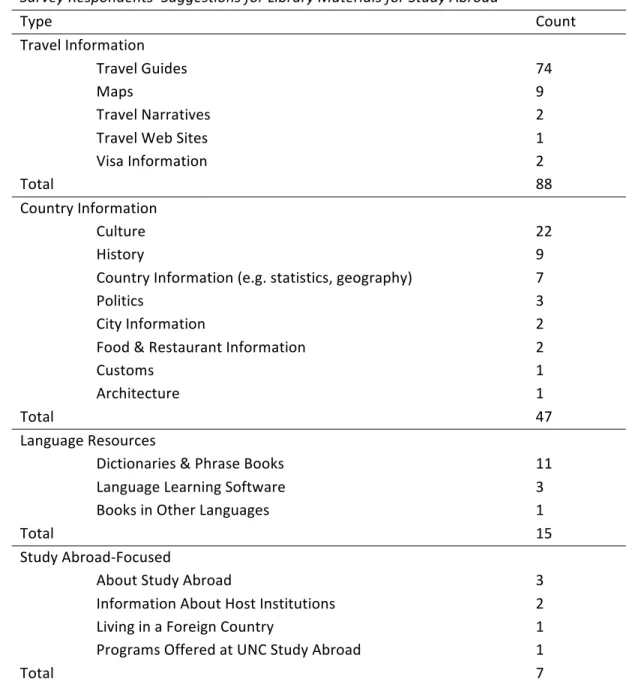
collection includes current guides for regions, countries, and cities all over the world. Of 149 survey respondents, the majority (97%) indicated that they had not used travel guides held by UNC-CH Libraries. Table 11 displays results from 120 survey respondents’ suggestions for types of library materials they felt would be helpful for study abroad students. As Table 11 indicates, the majority of suggestions were for travel information (n=88), followed by country information (n=47), language resources (n=15), and study abroad-focused material (n=7). Travel guides were the most suggested item, with 74 respondents suggesting that these would be helpful items for the library to collect.
Table 11
Survey Respondents’ Suggestions for Library Materials for Study Abroad
Type Count
Travel Information
Travel Guides 74
Maps 9
Travel Narratives 2
Travel Web Sites 1
Visa Information 2
Total 88
Country Information
Culture 22
History 9
Country Information (e.g. statistics, geography) 7
Politics 3
City Information 2
Food & Restaurant Information 2
Customs 1
Architecture 1
Total 47
Language Resources
Dictionaries & Phrase Books 11
Language Learning Software 3
Books in Other Languages 1
Total 15
Study Abroad‐Focused
About Study Abroad 3
Information About Host Institutions 2
Living in a Foreign Country 1
Programs Offered at UNC Study Abroad 1
Total 7
While some survey respondents suggested types of information, some respondents suggested types of materials that UNC-CH Libraries could provide for study abroad students (Table 12). Respondents suggested that the library provide materials that are accessible online, that students would be able to access while abroad, brochures and pamplets, magazines, online journals and documentaries and videos (Table 12).
Table 12
Survey Respondents' Suggestions for Types of Materials for Study Abroad
Types of Materials
Online Materials Accessible While Abroad 12 Brochures & Pamphlets 7
Magazines 2
Online Journals 2
Documentaries & Videos 1
Interviewees were asked what resources that the library could provide that would help study abroad students. Responses collected reflect the survey responses. Some suggestions offered by interviewees include:
Interviewee C: I think having access to the resources online was really helpful. If I wouldn’t have had that, I wouldn’t have been able to write the papers that I needed to write. Um, I think it might be helpful if we had a place where students’ blogs were accessible. Like, the students that had been on this program
previously… A lot of my fellow students kept blogs while we were there, so if they could be arranged somewhere and I could have access to them and learn from other students’ experiences that would have been really helpful and interesting.
Interviewee E: Definitely just providing resources for language and um, and culture. I mean those are just really critical. And also travel. Oh! That’s another thing. I – Recommendations for travel, because I did travel after the program and a little bit during the program.
Interviewee H: Well, the survey mentioned those travel books, which sounded like a really good idea to me. And just kind of offering, like a, I don’t know – if there’s a small little shelf for study abroad. And just having different information for every different country would be really helpful. Especially just being able to know uh, some background history and culture or if, they could even do, like an online sort of thing for each country, and just give a short, brief overview and give just the main bullet points that you should know.
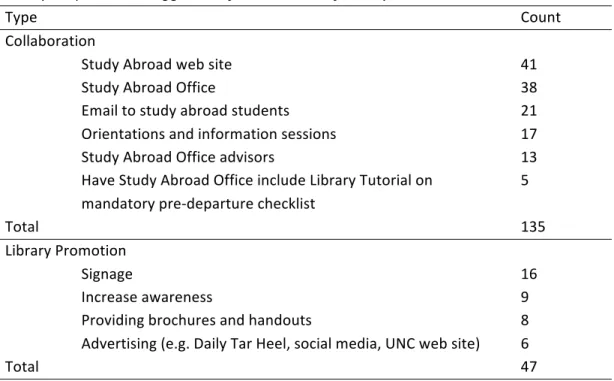
the Study Abroad Office and ways that the library can work independently to promote services and resources (Figure 13).
Table 13
Survey Respondents’ Suggestions for Promotion of Library Resources
Type Count
Collaboration
Study Abroad web site 41
Study Abroad Office 38
Email to study abroad students 21
Orientations and information sessions 17
Study Abroad Office advisors 13
Have Study Abroad Office include Library Tutorial on mandatory pre‐departure checklist
5
Total 135
Library Promotion
Signage 16
Increase awareness 9
Providing brochures and handouts 8
Advertising (e.g. Daily Tar Heel, social media, UNC web site) 6
Total 47
In collaborating with the Study Abroad Office, respondents most often suggested that information about the library be included on the Study Abroad Office web site, followed by the library working with the Study Abroad Office in a general fashion and the library sending emails to study abroad students (Table 13). As indicated in Table 13, the most frequent suggestions for the library independently promoting itself were creating signage, increasing general awareness of library resources and services for study abroad students, and promoting services for study abroad students on the library web site.
Interviewees suggested similar ways for the library to promote its services for study abroad students:
is really real kind of thing.” If the study abroad web site – or at our orientation – if they were like, “The library’s a great source. You should definitely go check it out!” I would have absolutely done that, but since nobody mentioned using the UNC library, I didn’t really.
Interviewee B: To be honest, I wasn’t even really aware of what the libraries had to offer and there wasn’t, um, a whole lot of exposure. So maybe something like a brief informational session where, as part of the study abroad, the libraries were to say, “We have this to offer, if you have any questions.” And I think that would have helped.
Interviewee A: I think maybe, like, integrate it more with the Study Abroad Office. I don’t know if they do that and then the study abroad people just don’t tell you about it, but, um, just kind of like making the line of communication there.
Interviewee C: Somehow just reminding students that they still have access to all of the resources online. I think a lot of people just forgot, since we were off campus. And just keeping in touch with them still. I’m not sure how other people wrote their papers or found different sources for their papers, but I certainly wouldn’t have been able to do so without using the online stuff.
Interviewee H: It can probably just advertise through the Study Abroad Department, since that’s really where most people – or all of the study abroad students – are going to get their information for the most part.
Interviewee M: Well maybe on their – you know, on the main page of their web site. Just maybe a little “Interested in study abroad? Click here.” Or even, I know, because I come here a lot to study, [the library] had a white board right when you walked in and it was like, “Preparing for the GRE? LSAT? Go to such and such.” You know, and for me, interested, I was like, “Oh, wow, I’m really interested; I’m going to go there.” So you know, just whiteboard, you know. In all of the computers here, they have a screensaver or backdrop and just advertising it through that. And then again, using the study abroad office as a resource, where the study abroad office they can send people to the web site for UNC Libraries.
Discussion
The findings of this study directly tie in with the previous studies that have been conducted on library support for study abroad students. Wang and Tremblay (2009) assessed the needs of Long Island University’s Global Campus and tailored their services based on those needs. With a better understanding of the information needs and
intimately involved with study abroad programs. This may not be possible for every academic librarian, but study results suggest that students were unaware of library resources, that students feel that librarians can collaborate with the Study Abroad Office and that students feel as if knowing more about the library beforehand would have been helpful. Knowing that students were unaware of the extent of their access to library services is important, because librarians can now make sure future study abroad students are more aware of the resources available to them. This collaboration and outreach would be in keeping with Love and Edwards’ (2009) suggestion for librarians to reach out to other offices on campus in order to support different populations of students. Library outreach to the Study Abroad Office would achieve two purposes. First, study abroad students would become more aware of library resources that are provided
specifically for study abroad students. Second, students who may not use or interact with the library in other areas of their academic experience would be exposed to library
resources. Libraries must promote their relevancy and resources to their user
communities. Reaching out and promoting library services and resources to study abroad students is just one way of reaching out to the greater user population.
Lindell (2008) noted that results of the ARL survey on library support for study abroad suggested that institutions were unsure if study abroad students knew that services for distance learning were available to them. Interviewees’ comments and survey
found that support to be helpful. Kutner (2009) found that students were unaware of their access to their home library resources while abroad. Students in the current study
suggested that they were comfortable in using library resources from off campus, but there is still room for promotion and the teaching of information literacy skills. Several students noted issues with finding relevant information or navigating through the massive amounts of information that they encountered. By promoting services for study abroad students, librarians can help to increase awareness and reduce uncertainty in finding and using information, as Kutner (2009) suggests.
White et al. (2009) proposed a framework for the information seeking behaviors of study abroad students. The current study investigated the information needs and behaviors of students from this perspective, building off of Dervin’s (1992) sense-making theory and Savolainen’s everyday life information seeking perspective. The study found that study abroad students do have distinct information gaps at different periods
throughout their study abroad experience and that they utilize a variety of bridges to help fill those information gaps. White et al. (2009) suggest that librarians can be that bridge for study abroad students. Results of this study indicate that this is not the case. Students did not consult librarians for information, either for their coursework or for their
everyday life information seeking activities. Interviewee B mentioned talking to a librarian before going abroad, but the librarian mentioned was a family friend of the student. The context of the comment within the interview suggested that the student was asking the librarian for advice as a family friend, not as a librarian.
that students most commonly need and by providing it to them. The current study abroad tutorials cover much of what students suggest that they would like to learn more about, especially in terms of country information. The Study Abroad Tutorials could be
redesigned to include more travel information. For example, students mentioned wanting to find travel blogs and visa information, which can be incorporated into the study abroad tutorials. Students mentioned travel guides as the number one material that they think that the library could provide that would be useful. The Undergraduate Library currently holds over 500 individual travel guides. Five of 149 survey respondents indicated that they had used travel guides from the library. This suggests that students are unaware of these valuable resources. Librarians can work to promote these resources to study abroad students, and to the general user population through signage, word of mouth and other promotional materials.
Working with the Study Abroad Office will be pivotal to reaching out to study abroad students. The Study Abroad Office and the resources that the Office provides are the main sources of information that students consult. Librarians can team up with the Study Abroad Office by getting involved in informational events, providing brochures and other materials to be handed out to students during information fairs and orientations, sending study abroad students emails telling them about resources available to them, and by working with the Study Abroad Office to have library resources promoted on the Study Abroad web site.