Disclosure of drug use during pregnancy among women with
drug-related offences and female partners of people with drug-drug-related
offences
By Kathleen C. Clark
A paper presented to the faculty of The University of North Carolina at Chapel Hill in partial fulfillment of the requirements for the
degree of Master of Science in Public Health in the Department of Maternal and Child Health.
Chapel Hill, N.C. March 2013
Approved by:
1 Introduction
Pregnancy is a period of a woman’s life that can be a joyous occasion. There is excitement with beginning or expanding a family, selecting names, preparing a nursery, and bonding with other women who have experienced pregnancy and childbirth. During this time women often take actions to be as healthy as possible. They do their best to eat the right foods, attend regular medical appointments, and take prenatal vitamins. Many women will change their behaviors, such as quitting smoking and eliminating alcohol; however, there are women, despite their desire to have a healthy baby, who continue to use alcohol and illicit drugs during pregnancy.
In 2009, results published from the 2002-2003 National Survey on Drug Use and Health found that 25.8% of pregnant women had used a substance (illicit drugs, alcohol, or cigarettes) during pregnancy and 4.7% had used illicit drugs (1). In 2010, the
Substance Abuse and Mental Health Services Administration published findings from the 2008-2009 National Survey on Drug Use and Health and found that an average of 4.5% of pregnant women had used illicit drugs in the past month (2).
National data from 2008, suggests that overall 7% of women received no or late prenatal care (3), which suggests the majority of women in the United States receive at least some level of prenatal care. Given that women are likely to receive prenatal care and they are motivated to improve their health during pregnancy, prenatal medical
appointments provide an opportunity to screen women for drug and alcohol use.
2 a substance can be detected. This window is effected by numerous conditions, including type of drug, route, type of biological specimen, sensitivity and specificity of the test being administered, and metabolism rates, which vary between women and are
influenced by such things as body type and food intake near time of using substances (4). Self-report may provide important information about substance use; however, accurate self-report to a medical provider can be impeded due to the stigma associated with drug use during pregnancy and a variety of fears, including involvement with child protective services (5), judgment by providers (5), reporting use to other people (6), and
repercussions from mandatory reporting laws (6).
3 pregnant women using alcohol or drugs (8). In this study 4,865 women were screened using the 4Ps Plus©. Of these, 1435 pregnant women had urinalysis ordered. In the overall study population 1.2% of the women were identified using urinalysis and 37% were identified using the 4P’s Plus©. This finding suggests that verbal screening and assessment may be more likely to identify pregnant women who are using alcohol or drugs as compared to urinalysis.
Universal verbal screening of pregnant women for illicit drugs is recommended by a variety of organizations, including the American Congress of Obstetricians and Gynecologists (ACOG) (6) and the American Society of Addiction Medicine (ASAM) (9). In addition to verbal screening, brief intervention and referral to care is also recommended (10). Screening, using non-biochemical tests, can be effective in
identifying a woman who is using substances only if she is willing to disclose her use. If a woman is identified as using alcohol or drugs during her pregnancy, she is likely to have improved maternal and infant outcomes if she receives appropriate treatment (11).
The primary objective of this paper is to report findings of survey responses that explore the disclosure behaviors of women who have used illicit drugs during pregnancy, experiences with brief interventions, and referral to care during prenatal appointments. A secondary goal is to explore the willingness of women to answer questions about drug use during pregnancy in a self-administered Internet-based survey format.
Background
4 identified, a conversation can be had to determine the extent of the use and if further assessment and referral to treatment is warranted.
Verbal screening for alcohol and drug use can be conducted in healthcare settings. Standardized alcohol and drug use screening tools have been developed and are utilized in primary care, obstetric, and specialty healthcare settings. Some commonly used screening tools include Cut Down, Annoyed, Guilty, Eye-Opener (CAGE) (10); Drug Abuse Screening Test (DAST) (10); and Alcohol, Smoking, Substance Involvement Screening Test (ASSIST) (10). Screening does not provide diagnosis but may indicate if a patient is in need of follow-up, which could include brief intervention, brief treatment, or referral for treatment with a specialist. Screening for alcohol and other drug use has been found to be feasible in a variety of healthcare settings and among diverse
populations (12).
Screening tools have been developed and validated for use with women, in general, and with pregnant women specifically (6, 13). The T-ACE and TWEAK
screening tools were designed to assess alcohol-specific use among pregnant women. The T-ACE screening tool, which is based on CAGE, comprises the following questions:
1. Tolerance: How any drinks does it take to make you feel high? 2. Have people annoyed you by criticizing your drinking?
3. Have you ever felt you out to cut down on your drinking?
4. Eye-opener: Have you ever had a drink first thing in the morning to steady your nerves or get rid of a hangover?
The 4 Ps © screening tool (8) asks about both alcohol and drug use during pregnancy and comprises the following questions:
5 2. Have you had a problem with drugs or alcohol in the Past?
3. Does your Partner have a problem with drugs or alcohol?
4. Do you consider one of your Parents to be an addict or alcoholic?
In 1999 (14) and 2007 (15) surveys were distributed to Fellows of the American College of Obstetricians and Gynecologists regarding screening and opinions about alcohol use during pregnancy. Although most obstetricians and gynecologists, about 92% in both studies, asked about alcohol use at the initial visit, few used a validated screening tool. Both studies indicated the providers needed additional information regarding referral options for patients who need treatment, and providers needed additional education regarding screening techniques and the effects of alcohol use during
pregnancy. In 1999, 30% of the surveyed providers felt prepared to assess alcohol use, and in 2007 this increased to 72%.
6 1997-2002 from 4,088 women, reported 5.5% of women drank alcohol during the last three months of pregnancy (19).
The state of Connecticut received funds from the Centers for Disease Control and Prevention (CDC) to begin PRAMS data collection starting in 2013 (20) and previously collected data similar to PRAMS using the state-sponsored Pregnancy Risk Assessment Tracking System (PRATS). In 2006, the report “Results of the Connecticut PRATS Survey Round 2” was released. Eligible participants in this survey were a random sample of 4,480 mothers who delivered between November 2002 to June 2003 (21). Forty-four percent of the eligible participants responded (n=1982). In this sample, 75.7% of the respondents had a discussion with a health care worker during prenatal appointments about how alcohol use could affect the baby and 64.2% stated they discussed how use of illicit drugs could affect the baby.
Other studies have reported on the prevalence of counseling and health education during prenatal care from the patient’s perspective. Using PRAMS data, Peterson and colleagues reported 73% of the participants received preventative counseling about illegal drug use and 81% received preventative counseling about alcohol use during prenatal appointments (22).
The Screening, Brief Intervention, and Referral to Treatment (SBIRT) model is an evidence-based practice (9) that can be used to identify persons engaging in substance use (screening) and followed with appropriate responses (brief intervention and/or referral to treatment). SBIRT has been shown to be effective in addressing at risk alcohol use (9). The data assessing SBIRT effectiveness in addressing illicit drug use is
7 assessment, and treatment had better birth outcomes than the group who received only a screening. In December 2008 American College of Obstetricians and Gynecologists released a Committee Opinion titled “At-Risk Drinking and Illicit Drug Use: Ethical Issues in Obstetric and Gynecologic Practice” (6). This publication states:
Obstetricians-gynecologists have an ethical obligation to learn and use a protocol of universal screening questions, brief intervention, and referral to treatment in order to provide patients with medical care that is state-of-the-art, comprehensive and effective. (p.1)
SBIRT activities are validated through research findings, endorsed by professional organizations, and financially supported through national resources. SAMHSA is supporting SBIRT implementation through grants, trainings, and national resources. In a July 2012 announcement, three states received 22 million dollars of funding from SAMHSA to expand SBIRT activities (23). In 2008, SAMHSA provided 3.75 million dollars to implement SBIRT training programs for medical residents (24). The Institute for Research, Education & Training in Addictions, received funding from SAMHSA to create a National SBIRT Addiction Technology Transfer Center (N-SBIRT ATTC) (25). The N-SBIRT ATTC provides technical assistance, disseminates
information, and training on SBIRT.
Clinical Experience
8 survey questions. Several patients stated their prenatal providers did ask about alcohol use but did not ask them about illicit drug use. Patients stated they were willing to disclose their drug use but wanted the provider to bring up the topic since they were unsure how to broach the subject. This clinical work and discussions with patients suggest that women are willing to discuss their drug use during pregnancy and that they have a profound desire to address their substance use and mitigate the potential risks to the newborn.
Development of the Pregnancy and Drug Use Questions (PDUQ)
The SBIRT model and the author’s clinical
experience were the main influences on the
development of the core concepts of the Pregnancy and Drug Use Questions (PDUQ) used for this paper. Table 1 presents the three activities associated with the SBIRT model and the corresponding questions in the PDUQ. Development of a question to ask about experience with screening was straightforward. However, development of questions regarding experience with
assessment and referral to treatment activities required additional consideration, because specific types of assessment and referral activities may differ among providers.
9 Assessment can include a variety of activities, such as an in-depth conversation about extent of drug use, collecting information about lifetime history of drug use, discussing readiness and willingness for treatment, and exploring types of treatment available. The author was challenged to develop a question that used terms the participant could understand and would identify whether a medical provider discussed the topic of substance use any further than during screening. Based on clinical experience and
interactions with medical professionals, if a woman discloses drug use during pregnancy, discussion regarding treatment, including a hospital-based detoxification, is common. The author decided that asking the participants if their provider talked to them about treatment options would be an indicator that assessment occurred.
Referral to treatment can include a variety of activities, such as providing a patient with a number to call for treatment or the provider may actively facilitate treatment admission, such as calling a facility and arranging an intake. The author concluded the phrase “help you get into treatment” would be adequate to assess provider referral activities.
The PDUQ asked only about illicit drug use and did not ask about alcohol use. The PRAMS Standard Questions asks about maternal tobacco and alcohol use, but not on illicit drug use (26). The author was specifically interested in illicit drug use and
The author did not ask about alcohol because she wanted the participants to focus on illicit drug use and not include use of alcohol in the responses.
10 about participants experience with housing, education, involvement with the criminal justice system, drug use, sexual partners, HIV status and testing, trauma, and physical health. The survey takes participants approximately two hours to complete. The author and principle investigator, Dr. Kim Blankenship, discussed adding the PDUQ to the SHARRPP survey. Dr. Blankenship supported adding the PDUQ to the index participant follow up one survey and the sex partner baseline survey.
Study Description and Methodology
SHARRPP is a research project funded by the National Institutes of Health (NIH) and the National Institute on Drug Abuse (NIDA). The principle investigator, Dr.
Blankenship is of American University, with research being conducted at the Yale School of Public Health in New Haven, Connecticut. SHARRPP is a three-year longitudinal study with all participants completing quantitative self-administered Internet-based surveys conducted every six months, with a subset completing qualitative interviews. SHARRPP obtained IRB approval through Yale’s Human Research Protection Program.
Three hundred index participants (IP) were recruited beginning in July 2011 from the greater New Haven, Connecticut, area. Inclusion criteria were (a) released from jail or placed on probation in the previous 12 months, (b) controlling charge for the most recent offence was a nonviolent drug-related crime, and (c) over 18 years of age. Release from jail, date of probation initiation, and controlling offence were verified via a liaison at the New Haven Probation and Parole Office and Connecticut’s Offender Inmate Search Website (http://www.ctinmateinfo.state.ct.us/). In addition to recruitment of IP,
11 current sex partners to SHARRPP. At the follow-up one survey (IP1) index participants were offered recruitment coupons that they could give to any person they had unpaid sex with in the past six months. Inclusion criteria for sex partners (SP) were to have a valid recruitment coupon and be over the age of 18. All SP will complete a similar survey and qualitative interview, every six months, for the remainder of the three-year research period.
The PDUQ were developed by the author with review and recommendations from UNC advisor Dr. Sherri Green, Dr. Kim Blankenship, and SHARRPP Project Manager Alana Rosenberg. The PDUQ were added to the IP1 survey and the SP baseline survey (SPBL). Both surveys were programmed and administered using Qualtrics. Participants presented at the SHARRPP office and completed the surveys on a computer. Data
collection for IP1 occurred from 3/2/12 to 8/18/12 and data collection for SPBL occurred from 6/19/12 to 12/3/12. The analysis of the PDUQ was conducted using Qualtrics, Microsoft Access and Excel. Statistical analysis was conducted, as appropriate, given the small sample size. The UNC Office of Human Research Ethics deemed the secondary data analysis conducted for this masters theses exempt from further IRB review.
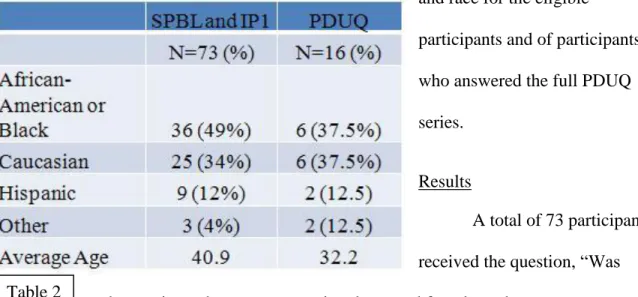
Demographics
Participants who were eligible for responding to the PDUQ were those who presented to take the IP1 or SPBL survey and identified as female. A total of 73
12 and race for the eligible
participants and of participants who answered the full PDUQ series.
Results
A total of 73 participants received the question, “Was there a time when you were using drugs and found out that you were pregnant?” Of the 73 participants, 16 answered yes, 54 answered no, and 3 declined to answer. The average age when participants most recently used drugs during a pregnancy was 25, with an age range from 14 to 36. Of the 16 participants who answered the entire PDUQ series, 14 had been incarcerated at least once.
Screening and Prenatal Care
Of the 16 participants, 11 (68.8%) indicated they received prenatal care during the most recent pregnancy when they were using drugs. Of those 11 participants, 8 (72.7%) indicated they were asked about drug use during their prenatal care appointments.
Drug Use
The most common drugs used during pregnancy were crack, marijuana, and heroin. In this study, 11 participants (68.7%) indicated crack use, 8 (50%) indicated marijuana use, and 5 (31.3%) indicated heroin use. The other
13 illicit drugs reported were prescription opiates (3 participants) and cocaine (1 participant). Please see Figure 2 for a list of all drugs that were asked about in the PDUQ. Nine of the participants indicated polysubstance use and 7 indicated monosubstance use. Of the 16 participants, 3 (18.8%) reported injecting drugs around the time they became pregnant.
Drug Treatment
Participants were asked about drug treatment at the time they learned they were pregnant and their subsequent treatment engagement. Of the 16 participants, 3 were in drug treatment at the time they learned they were
pregnant. Of the remaining 13 participants, 4 entered treatment and 9 did not. Of the 4 participants that started treatment after they were aware of the pregnancy, all entered within the first month of awareness: 2 entered within one to two weeks, and 2 entered within two to four weeks. As for the reason they entered treatment, all 4 participants indicated: “I wanted to stop using drugs for the health of the baby.” In this multiple choice question, 2 participants also answered: “I was able to get into treatment more easily or quickly because I was pregnant”; and 1 participant answered: “I was worried my other children would be taken from me if I didn’t enter treatment.”
14 For the 9 participants who did not enter treatment, the most common reason was that they wanted to stop using on their own or simply did not want to enter drug
treatment. Of those 9 participants, 2 responded they did not enter treatment because they did not want people to know they had used drugs during the pregnancy. None of these participants indicated that knowledge of where to get treatment, affording treatment, finding treatment close to them, or a treatment center waiting list had been a reason to not enter treatment.
Prenatal Care and Disclosure
A total of 11 participants received prenatal care and 5 did not. Of the 11
participants who did, 8 (72.2%) were asked about drug use as part of their prenatal care. Of the 8 participants who were asked, 7 disclosed they were using drugs. Of the 3 participants who were not asked, 1 self-disclosed and 2 did not.
15 SBIRT
Of the 8 participants who were screened, 7 disclosed they were using illicit drugs. Of these 7 participants, 6 indicated the provider talked to them about treatment options. Of these 6 participants, 4 indicated the provider helped them obtain treatment.
Willingness to Answer Questions
All questions had a response option of “I do not want to answer,” and this
response option is referred to as “declined.” A participant was deemed willing to answer a question if she did not decline to answer a question. There were a total of 216 responses to the PDUQ series. Of these 216 responses, there were five questions that participants declined to answer. The final question in the PDUQ is “Would you be interested in being contacted by one of the research staff to participate in another research study related to drug use during pregnancy?” Of the 16 participants, 13 responded yes, 1 responded no, and 2 declined to answer this question.
Discussions, Significant, and Limitations
16 Having a history of illicit drug use or having a partner who uses illicit drugs are risk factors for illicit drug use during pregnancy. Asking women about her history of using illicit drugs or alcohol is a common question on screening tools that are used to help detect drug use during pregnancy (6, 12, 13), which implies that women with these histories may be at more risk of using drugs during pregnancy. The 4 Ps © screen tool asks if their partner has a problem with drugs or alcohol (8). One study of 1,226 women, those whose stated their partner used marijuana, cocaine, opiates or heavy alcohol use (defined as “two or more drinks per day”) were almost five times more likely to use drugs or alcohol during their pregnancy, as compared to women who did not report their partner engaged in these behaviors (27).
A review of drug use in pregnancy from 1996 to 1998 (28) found the most common illicit drug used during pregnancy was marijuana (75%), followed by cocaine (10%). In the PDUQ sample, the most prevalent drug used was crack (68.7%; n=11), followed by marijuana (50%; n=8), then heroin (31.3%; n=5).
The majority of participants disclosed their use of drugs to their prenatal providers and women who were asked about illicit drug use were more likely to disclose their use, compared to the participants who were not asked. This finding suggests that women are more likely to disclose their illicit drug use if they are asked, compared to self-reporting without provider inquiry. This finding also suggests that verbal screening may be helpful in identifying pregnant women who are using illicit drugs during pregnancy.
To assess for illicit drug use during pregnancy we can ask the woman, test
17 Meconium testing of the infant is not invasive and does provide evidence of drug
exposure in the last two trimesters of pregnancy. However, if we wait for the infant to be born, the opportunity for intervention during the pregnancy has been missed. Maternal biological drug testing has its limitations as well. There is a risk of false positives due to drug metabolizing rates. Additionally, women might engage in behaviors to reduce or eliminate the risk of drug detection by abstaining from use for a period of time prior to a potential test, using another person’s urine, or diluting a urine sample.
Although there is potential for a woman to deny her use of drugs, honest
disclosure is the most accurate and cost-effective way to determine her use of drugs and to assure early and effective intervention for the health of mother and baby. There are many reasons why women do not disclose; however, there are conditions that can foster a positive patient-provider relationship and establish an environment of trust, which may increase the likelihood of her disclosing. A respectful environment includes providers who are nonjudgmental, protect patient confidentiality, and are empathetic and caring (29).
18 An exploratory question was included in the PDUQ series to investigate
participant’s willingness to attend a qualitative interview to discuss drug use during pregnancy. This question did not mention any additional compensation for participant’s time. A total of 13 participants (81%) indicated they were interested in being contacted about participating in a qualitative interview about drug use during pregnancy. Without knowing who would be conducting the interview and without explicit knowledge of monetary compensation, the majority of participants appear willing to engage in a dialogue about this topic.
Of the 16 participants who reported using during pregnancy, 7 (43.8%) entered or were in substance use disorder treatment during the pregnancy. Two common responses to why women entered treatment were reasons related to their concern over their current pregnancy and other children. This finding continues to support the notion that pregnancy increases women’s motivation to engage with substance use disorder treatment (30, 31). For the participants who did not enter treatment, the availability, affordability, and access to treatment was not indicated, which suggests in this urban population, logistics of entering treatment was not a barrier to care. Instead, the reasons women provided were internal (not wanting to enter treatment, wanting to stop using on their own) as opposed external.
The Stages of Change model states people move through different stages before adopting behavior change (32). These stages are precontemplation, contemplation, preparation, action, and maintenance (33). The stages can be used to identify appropriate interventions (34), for example:
19 detrimental, however, with individuals in precontemplation or contemplation stages.” (34, p. 1106)
Considering that people in different stages respond more favorably to stage-matched interventions, a variety of interventions should be available that are appropriate for women in different stages. For example, pregnant women who are using illicit drugs may be in the contemplation stage and may be weighing the benefits and consequences of change. Pregnant women not yet at the contemplative stage (precontemplative) and not willing to consider treatment referral may benefit from education at their prenatal visits. Prenatal provides can offer information about the risks of alcohol and other drug use during pregnancy as wells as from information about non treatment community supports and treatment options available to them should they choose to seek assistance in the future. Because women usually attend prenatal appointments several times over the course of the pregnancy, a provider can assess which stage she is in, at that time, and respond with appropriate interventions.
The SBIRT model includes the following activities: screening, assessment, and referral to care. Of the 7 participants that were screened and disclosed drug use, 6
20 Limitations
There are several limitations regarding this study. First, the number of participants who answered the PDUQ series is small, which limited the types of analysis that could be conducted, and the findings cannot be generalized beyond this sample. This limitation could be overcome by gathering data for a longer period of time and seeking out
opportunities to include the PDUQ into other studies that have enrolled a larger number of women representative of broader populations.
Second, the years that women were using drugs during pregnancy ranged from 1980 to 2011. Given the twenty-year time span, we are unlikely to assess changes in drug trends over this period. In the previous decade, the use of illicit prescription opiates has significantly increased, and it is unlikely that this trend would be captured in our data. If more participants were recruited, we could then stratify years and assess for possible changes in drug trends. Also, the SBIRT model has been researched since the 1980s and implementation began in the 1990s (36), therefore some of the providers the participants interacted with may not have utilized or even aware of this model.
Third, the study is prone to recall bias and social desirability bias. Some women were required to recall events that occurred 22 years ago. For those participants, recalling details about events occurring over 20 years ago may be more challenging, as opposed to others who recalled drug use during a pregnancy as recent as 2011. Additionally,
21 Fourth, this study sample was women in the greater New Haven population who had histories of incarceration and/or probation or were sexual partners of people with these histories. Because of characteristics of this specific sample, results may not mirror findings reported in studies conducted among the general US population.
Lessons Learned
The development of the PDUQ was time sensitive, due to having to coordinate inclusion of the questions in the SHARRPP IP FU1 and SPBL surveys. The author devoted time to researching which questions should be asked and the content of the questions. A more thorough review of the literature and a concrete application of theories would have been beneficial to the process of developing the PDUQ.
The number of participants who received the PDUQ series was less than
anticipated. SHARRPP attempted to recruit 100 sex partners; however, at the time of data analysis only 49 had presented to take the SPBL. Three-hundred and four IP completed the IP baseline survey and, of those, only two-thirds presented for the IP1 survey. If the PDUQ had been included in the index participant baseline survey and if sex partner recruitment had been more successful, there would have been a greater number of participants who received the PDUQ.
Next Steps
As mentioned elsewhere in this paper, women appear willing to answer questions about past drug use during pregnancies. Given the need for improved surveillance
22 Much could be learned from these participants about their personal experience and from feedback regarding the PDUQ. At this time, the author has not contacted any of the participants to schedule a qualitative interview. Considering that the clinical
environment and provider-patient relationship influences women’s disclosure behavior, qualitative data could be collected on how, exactly, disclosure behavior is influenced.
The participating women were willing to answer questions about drug use during previous pregnancies; however, we did not assess the willingness to answer questions about current drug use and pregnancy. The purpose of screening for drug use during pregnancy is to identify women who are currently pregnant and using drugs; therefore, assessing the willingness of pregnant women to disclose illicit drug use during current pregnancy using a self-administered instrument is a topic that deserves attention.
Given the strong support and growing body of evidence for the use of the SBIRT model, there is an opportunity to assess implementation efforts. Chart reviews could be conducted to identify how many women were screened and how many were exposed to all three SBIRT activities. For women who screened positive and did not receive an assessment and referral to treatment, we could investigate gaps in the system and identify ways to increase assessment and referral activities.
Observations
23 the barriers to addressing this important health issue and including illicit drug use when asking questions about alcohol and nicotine?
While there are a plethora of potential barriers, one of the most significant is that drug use during pregnancy is viewed not only as a health issue but also a legal issue due to potential legal ramifications. Furthermore, there is a wider range of policies on illicit drug use during pregnancy, across the US. Some states are approaching the issue utilizing the criminal justice and legal system while others utilize the healthcare and substance use disorder treatment system (37). When the legal system is utilized, of particular concern is that there is opportunity for racial discrimination in applying the law. One study that enrolled 715 pregnant women in Pinellas County, Florida between January and June 1989, found that rates of illicit drug use were similar between black and white women; however, black women were reported to health authorities 10 times more frequently than white women (38). Laws and policies, about mandatory reporting to health authorities or law enforcement, have the potential to create a rift in the provider-patient relationship: the provider may not ask and the patient may not disclose both concerned about legal implications regarding illicit drug use during pregnancy. Women might also avoid prenatal care out of fear of incarceration or losing custody of other children. These scenarios result in adverse maternal and fetal outcomes where opportunities to enter substance abuse treatment and obtain adequate prenatal care have been missed.
24 the treatment of substance use disorder. Considering that persons with substance use disorder have similar treatment adherence and response to treatment as other diseases such as asthma, diabetes, and hypertension (40); the author questions the reasoning behind state laws and mandatory reporting policies that target pregnant women with substance use disorder, which may result in criminal prosecution and incarceration.
Two additional potential barriers worth noting are lack of provider education (14, 15) and lack of accessible appropriate treatment options for pregnant women who are using illicit drugs. Lack of knowledge and training may create a barrier because providers may not know how to effectively screen pregnant women and what actions should be taken if a verbal screen is positive. If a provider does want to refer to treatment or if a woman wants to enter treatment, there is not always appropriate treatment available for pregnant women in the local area. This creates a challenge for the provider, as they may be reluctant to screen if they know there are no local, or even regional, resources. While there is the possibility a woman could relocate for treatment, this may not be practical or even feasible given her financial and family situation.
Conclusion
25 appropriate. Given these conditions, public health efforts should continue to identify ways to improve adoption and implementation of the SBIRT model by continuing to conduct research on this topic and should support the implementation of tools, practices, and policies that foster women’s willingness to disclose drug and alcohol use during pregnancy. With that said, public health efforts should also continue to assess practices and policies that create barriers to both patients and providers to effectively address illicit drug use during pregnancy.
References
1. Havens JR, Simmons LA, Shannon LM, Hansen WF. Factors associated with substance use during pregnancy: results from a national sample. Drug Alcohol Depend. 2009 Jan 1;99(1-3):89-95. PubMed PMID: 18778900. Epub 2008/09/10. eng.
2. Substance Abuse and Mental Health Services Administration. Results from the 2009 National Survey on Drug Use and Health: Volume I. Summary of National Findings (Office of Applied Studies, NSDUH Series H-38A, HHS Publication No. SMA 10-4856Findings). Rockville, MD, 2010.
3. Osterman MJ, Martin JA, Mathews TJ, Hamilton BE. Expanded data from the new birth certificate, 2008. National vital statistics reports : from the Centers for Disease Control and Prevention, National Center for Health Statistics, National Vital Statistics System. 2011 Jul 27;59(7):1-28. PubMed PMID: 21848043. Epub 2011/08/19. eng.
4. Substance Abuse and Mental Health Services Administration. Clinical Drug Testing in Primary Care. Technical Assistance Publication (TAP) 32. Rockville, MD: Substance Abuse and Mental Health Services Administration: 2012.
5. Roberts SC, Nuru-Jeter A. Women's perspectives on screening for alcohol and drug use in prenatal care. Women's health issues : official publication of the Jacobs Institute of Women's Health. 2010 May-Jun;20(3):193-200. PubMed PMID: 20457407. Pubmed Central PMCID: PMC2869475. Epub 2010/05/12. eng.
6. ACOG Committee Opinion No. 422: at-risk drinking and illicit drug use: ethical issues in obstetric and gynecologic practice. Obstet Gynecol. 2008 Dec;112(6):1449-60. PubMed PMID: 19037056. Epub 2008/11/28. eng.
7. Horrigan TJ, Piazza N. The substance abuse subtle screening inventory minimizes the need for toxicology screening of prenatal patients. J Subst Abuse Treat. 1999 Oct;17(3):243-7. PubMed PMID: 10531631. Epub 1999/10/26. eng.
8. Chasnoff IJ, McGourty RF, Bailey GW, Hutchins E, Lightfoot SO, Pawson LL, et al. The 4P's Plus screen for substance use in pregnancy: clinical application and outcomes. J Perinatol. 2005
Jun;25(6):368-74. PubMed PMID: 15703775. Epub 2005/02/11. eng.
9. American Society of Addiction Medicine. Public Policy Statement on Women, Alcohol and Other Drugs, and Pregnancy Chevy Chase, MD: [Publisher unknown]; 2011 [cited 2013 Feb 28]. Available from: http://www.asam.org/advocacy/find-a-policy-statement/view-policy-statement/public-policy-statements/2011/12/15/women-alcohol-and-other-drugs-and-pregnancy.
27 and Mental Health Service Administration, DHHS; 2011 [cited 2013 Feb 28]. Available from:
http://www.samhsa.gov/prevention/SBIRT/SBIRTwhitepaper.pdf.
11. Goler NC, Armstrong MA, Taillac CJ, Osejo VM. Substance abuse treatment linked with prenatal visits improves perinatal outcomes: a new standard. J Perinatol. 2008 Sep;28(9):597-603. PubMed PMID: 18580882. Epub 2008/06/27. eng.
12. Madras BK, Compton WM, Avula D, Stegbauer T, Stein JB, Clark HW. Screening, brief
interventions, referral to treatment (SBIRT) for illicit drug and alcohol use at multiple healthcare sites: comparison at intake and 6 months later. Drug Alcohol Depend. 2009 Jan 1;99(1-3):280-95. PubMed PMID: 18929451. Pubmed Central PMCID: PMC2760304. Epub 2008/10/22. eng.
13. Chang G. Alcohol-screening instruments for pregnant women. Alcohol research & health : the journal of the National Institute on Alcohol Abuse and Alcoholism. 2001;25(3):204-9. PubMed PMID: 11810959. Epub 2002/01/29. eng.
14. Diekman ST, Floyd RL, Decoufle P, Schulkin J, Ebrahim SH, Sokol RJ. A survey of obstetrician-gynecologists on their patients' alcohol use during pregnancy. Obstet Gynecol. 2000 May;95(5):756-63. PubMed PMID: 10775743. Epub 2000/04/25. eng.
15. Anderson BL, Dang EP, Floyd RL, Sokol R, Mahoney J, Schulkin J. Knowledge, opinions, and practice patterns of obstetrician-gynecologists regarding their patients' use of alcohol. J Addict Med. 2010 Jun;4(2):114-21. PubMed PMID: 21769028. Epub 2011/07/20. eng.
16. Cheng D, Kettinger L, Uduhiri K, Hurt L. Alcohol consumption during pregnancy: prevalence and provider assessment. Obstet Gynecol. 2011 Feb;117(2 Pt 1):212-7. PubMed PMID: 21252732. Epub 2011/01/22. eng.
17. Centers for Disease Control and Prevention. PRAMS [Internet]. Atlanta (GA) [updated November 8, 2012; cited 2013 February 20]. Available from: http://www.cdc.gov/prams/
18. Ethen MK, Ramadhani TA, Scheuerle AE, Canfield MA, Wyszynski DF, Druschel CM, et al. Alcohol consumption by women before and during pregnancy. Matern Child Health J. 2009 Mar;13(2):274-85. PubMed PMID: 18317893. Epub 2008/03/05. eng.
19. Whitehead N, Lipscomb L. Patterns of alcohol use before and during pregnancy and the risk of small-for-gestational-age birth. Am J Epidemiol. 2003 Oct 1;158(7):654-62. PubMed PMID: 14507601. Epub 2003/09/26. eng.
28 unknown [updated 2013 Jan 4; cited 2013 February 20]. Available from:
http://ct.gov/dph/cwp/view.asp?a=3138&q=492780&dphNav_GID=2120.
21. Health CDoP. Results of the Connecticut Pregnancy Risk Assessment Tracking System (PRATS) Survey Round 2 [Internet]. Hartford (CT): Connecticut Department of Public Health; 2006 [cited 2013 Feb 28]. Available from: http://www.ct.gov/dph/lib/dph/family_health/prats_round_2_report.pdf.
22. Petersen R, Connelly A, Martin SL, Kupper LL. Preventive counseling during prenatal care: Pregnancy Risk Assessment Monitoring System (PRAMS). Am J Prev Med. 2001 May;20(4):245-50. PubMed PMID: 11331111. Epub 2001/05/02. eng.
23. Policy OotNDC. Obama administration officials announce $22 Million expansion of innovative health program aimed at detecting and intervening in drug addiction early [Internet]. Washington (DC): Office of the National Drug Control Policy; 2012 [cited 2013 Feb 28]. Available from:
http://www.whitehouse.gov/ondcp/news-releases-remarks/22-million-dollar-grant-medicalizing-drug-prevention.
24. The Substance Abuse and Mental Health Services Administration. SAMHSA to Provide $3.75 Million to Train Medical Residents in SBIRT Techniques Rockville (MD): The Substance Abuse and Mental Health Services Administration; 2008 [updated 2008 Apr 8; cited 2013 Feb 28]. Available from: http://www.samhsa.gov/newsroom/advisories/0803041505.aspx.
25. Institute for Research ETiA. National SBIRT ATTC [Internet]. Institute for Research, Education & Training in Addictions Date Unknown [cited 2013 Feb 28]. Available from: http://ireta.org/node/559.
26. Centers for Disease Control and Prevention. PRAMS Phase 6 (2009) Standard Questions [Internet]. Atlanta (GA): Centers for Disease Control and Prevention; 2008 [cited 2013 Feb 28]. Available from: http://www.cdc.gov/prams/PDF/Phase6_StandardQuestions.pdf.
27. Bresnahan K, Zuckerman B, Cabral H. Psychosocial correlates of drug and heavy alcohol use among pregnant women at risk for drug use. Obstet Gynecol. 1992 Dec;80(6):976-80. PubMed PMID: 1448267. Epub 1992/12/01. eng.
28. Ebrahim SH, Gfroerer J. Pregnancy-related substance use in the United States during 1996-1998. Obstet Gynecol. 2003 Feb;101(2):374-9. PubMed PMID: 12576263. Epub 2003/02/11. eng.
29. Vermont Child Health Improvement Program. Screening for Substance Abuse During Pregnancy [Internet]. Burlington (VT): Vermont Child Health Improvement Program; 2009 [cited 2013 Feb 28]. Available from:
29 30. Jessup MA, Humphreys JC, Brindis CD, Lee KA. Extrinsic barriers to substance abuse treatment among pregnant drug dependent women. J Drug Issues. 2003 April 1, 2003;33(2):285-304.
31. Mitchell MM, Severtson SG, Latimer WW. Pregnancy and race/ethnicity as predictors of
motivation for drug treatment. The American journal of drug and alcohol abuse. 2008;34(4):397-404. PubMed PMID: 18584569. Pubmed Central PMCID: PMC2714164. Epub 2008/06/28. eng.
32. Prochaska JO, Velicer WF. The transtheoretical model of health behavior change. American journal of health promotion : AJHP. 1997 Sep-Oct;12(1):38-48. PubMed PMID: 10170434. Epub 1997/08/05. eng.
33. Prochaska JO, DiClemente CC. Stages and processes of self-change of smoking: toward an integrative model of change. Journal of consulting and clinical psychology. 1983 Jun;51(3):390-5. PubMed PMID: 6863699. Epub 1983/06/01. eng.
34. Prochaska JO, DiClemente CC, Norcross JC. In search of how people change. Applications to addictive behaviors. The American psychologist. 1992 Sep;47(9):1102-14. PubMed PMID: 1329589. Epub 1992/09/01. eng.
35. Substance Abuse and Mental Health Services Administration-Health Resources and Services Administration Center for Integrated Health Solutions. SBIRT: Screening, Brief Intervention, and Referral to Treatment [Internet]. Washington (DC): Substance Abuse and Mental Health Services Administration-Health Resources and Services Administration Center for Integrated Health Solutions; Date Unknown [cited 2013 Feb 28]. Available from: http://www.integration.samhsa.gov/clinical-practice/sbirt
36. Babor TF, McRee BG, Kassebaum PA, Grimaldi PL, Ahmed K, Bray J. Screening, Brief
Intervention, and Referral to Treatment (SBIRT): toward a public health approach to the management of substance abuse. Substance abuse : official publication of the Association for Medical Education and Research in Substance Abuse. 2007;28(3):7-30. PubMed PMID: 18077300. Epub 2007/12/14. eng.
37. Lester BM, Andreozzi L, Appiah L. Substance use during pregnancy: time for policy to catch up with research. Harm reduction journal. 2004 Apr 20;1(1):5. PubMed PMID: 15169566. Pubmed Central PMCID: PMC419718. Epub 2004/06/01. Eng.
38. Chasnoff IJ, Landress HJ, Barrett ME. The Prevalence of Illicit-Drug or Alcohol Use during Pregnancy and Discrepancies in Mandatory Reporting in Pinellas County, Florida. New England Journal of Medicine. 1990;322(17):1202-6. PubMed PMID: 2325711.