A Report on an Evaluation of the Occupational Health Nurse Role in Finnish Occupational Health
Kirsti Herlin
A Master's Paper submitted to the faculty of the University Of North Carolina at Chapel Hill in partial fulfillment of the requirements for the
degree of Public Health in the Public Health Leadership Program.
2003
t
'
ABSTRACT !
Occupational health legislation in Finland specifies the physician and nurse as the responsible professionals in planning, implementing, and evaluating occupational health services. However, the distinction of the significance of each profession or role has received limited attention. Obviously physicians have medical responsibility but what about the other aspects? This paper provides insight to the role of occupational health nurses in occupational health service delivery within the Finnish system, Material from current Finnish healthcare legislation and research in occupational health as well as results from a project by a task group at Mehilainen Corporation is used to characterize the nurse's role, Also the
four-field model, a new model for occupational health service delivery, is
L
presented and used in the evaluation of the occupational health nurserole. The four-field model presents occupational health services as either preventive or curative where the targets of occupational health
interventions are either the individual workers or the workplace/organization.
The findings are consistent with the unofficially existing perception that nurses are key players in the production and marketing of
occupational health services. Surprisingly though, activities and
individual worker instead of the work, workplace, or work environment, a pre-requisite of current legislation.
ACKNOWLEDGMENTS
Completing my studies from Finland has been a challenge and would not have succeeded without Dr Bonnie Rogers' patient guidance throughout my studies and most significantly with this paper. Also the positive attitude and support from Judy Ostendorf have kept me going in moments of doubt.
I would also like to thank Kimmo Rasanen and the Research and Product Development task group at Mehilainen for their innovative approach in developing the four-field model of occupational heath services.
CONTENTS
ABSTRACT ... ii
ACKNOWLEDGMENTS ... iv
LIST OF FIGURES ... vii
CHAPTER 1. INTRODUCTION ... 1
CHAPTER 2. OCCUPATIONAL HEALTH IN FINLAND ... 4
The Conceptual Environment ... 5
Legislation ... 8
The Occupational Health Care Act... ... 9
The Government Decree on the Principles of Good Occupational Health Care Practice ... 1 0 The Government Decree on Medical Examinations ... 11
The Occupational Safety and Health Act ... 11
The Sickness Insurance Act... ... 12
Governmental Organizations ... 12
Professional Organizations ... 13
The Contextual Environment ... 14
Population ... 14
Economy ... 15
The Structural Organization of Occupational Health ... 16
Good Occupational Health Practice ... 19
Evaluation in Occupational Health ... 22
CHAPTER 3. THE FOUR-FIELD MODEL FOR OCCUPATIONAL HEALTH SERVICES ... 24
Individuals/Workers ... 29
Individuals/Workers: Prevention ... 30
p
L
t; i
Individuals/Workers: Treatment ... 30
Workplace/Organization ... : ... 32
Workplace/Organization: Prevention ... 32
Workplace/Organization: Treatment ... 35
CHAPTER 4. EVALUATION OF OCCUPATIONAL HEALTH NURSE ROLES ... 36
Project on Nursing Activities ... 38
Results ... 39
Results vs. National Data ... 46
Discussion ...
.48
CHAPTER
5.
FUTURE VISIONS ...52
Strengths of the Occupational Health Nurse Role ... 54
Challenges for the Future ... 56
References ...
58
Appendix A ...
60
L
L
f
t
I
LIST OF FIGURES
Figure 2.1. External factors influencing occupational health nursing in Finland ... 6
Figure 2.2. Occupational health service models ... 17
Figure 3.1. The four-field model for interventions in occupational health .26
Figure 3.1.1. The four-field model for interventions in occupational health ... 33
Figure 3.1.2. The four-field model for interventions in occupational health
... 34
Figure 4.1. The distribution in percentages of the number of prevention and treatment interventions by occupational health nurses ... .40
Figure 4.2. The distribution in percentages of the proceeds for prevention and treatment interventions by occupational health nurses ... .41
Figure 4.3. The distribution in percentages of the occupational health nursing interventions according to the four-field model. ... .43
Figure 4.4. The distribution in percentages of the proceeds of occupational health nursing interventions according to the four-field model ... .44
Figure 4.5. The distribution of occupational health nursing interventions according to the four-field model. ... .45
Figure 4.6. A comparison of occupational health intervention data
according to the four-field model ... .47
f
L
L
i
}-f
~
i
p
I
CHAPTER 1 INTRODUCTION
The evolution of occupational health nursing from basic clinical nursing interventions in industrial settings to a comprehensive science involving workers, nurses, physicians, psychologists, physical therapists, ergonomists, industrial hygienists, safety personnel, management,
corporate leaders, and others is an ongoing process. Though grounded in medical and nursing science, occupational health is influenced by cultural, political, and socio-economic factors as well as the concept and
perception of work, which has evolved from the physical aspect of
providing for food, housing, and the needs of daily living to include social, spiritual, and intellectual aspects. The transformation in job tasks
performed by workers from physically strenuous work environments to automation and mechanically repetitive job tasks, static postures as well as increased intellectual and educational demands challenges
occupational health professionals to continuously analyze and evaluate the effectiveness of their methods.
What is the nurse's role in the production of quality services meeting the requirements in this era where traditional professions have decreased and an increasing number of workers are in occupations requiring high levels of expertise and education? The occupational health
L
'-
~-I
f
Finnish occupational health nurse who worked at the Arabia Ceramics factory from 1937 to 1970. "Looking back at my past work experiences I have to say that they were extremely variable and rewarding. My co-workers were great. It is a fact, though, that people need holistic care. Their basic needs cannot change a lot. These needs are still physical, psychological, and spiritual. We, occupational health nurses, have to grow to keep up with the standards and requirements of our work" (Hara & Jousilehto, 1998, p. 147).
Here based on years of experience is a summary of what
occupational health is all about and not least of all is the demand to keep up with the changing times without forgetting the target of all our activities: the worker as a holistic being and his/her physical and psychosocial work environment.
In this paper occupational health nursing is presented in the context of the Finnish occupational health care system. The presentation is based on material from various Finnish professional publications, research papers, and current legislation. The four-field model where occupational health services are presented as either preventive or curative and the targets of occupational health interventions are either the individual
workers or the workplace/organization as a "vhole is introduced and used ·
to analyze occupational health and the occupational health nurse's role in the service delivery process.
L
Lr-I
!
!I
I
CHAPTER2
OCCUPATIONAL HEALTH IN FINLAND
The status and acceptance of occupational health in Finland is based on its legal background. Multi-professional teams provide
occupational health in accordance with the requirements of the original Occupational Health Care Act of 1978, which was renewed in 2001, stipulating that the basic requirement in occupational health is the
utilization of multi-professional knowledge and methods which are founded on scientific or well-established facts. The obligation for all employers to provide occupational health services for their employees and a definition of the contents of occupational health services is also included in the Act (Taskinen, 2001).
In the 1990s occupational health targeted 90% of the wage-earning workforce (Kauppinen et al. 2000). With the support of legal justification occupational health has gained a valued status in the Finnish work life. The trends and developments in occupational health are the result of multi-professional cooperation between occupational health professionals, corporate and governmental organizations as well as labor
unions. One of the most significant
factois
influencing occupational healthis the aging workforce and its financial impact on the national economy in rapidly rising health care and retirement costs. In 1999 the average age of the workforce was 39.6 years and 26% of the working-aged population
L
'
r
'
I
L
t-was not participating in work life due to unemployment or early retirement (Kauppinen et al. 2000). Therefore the purpose of new legislation is to shift the focus in occupational health from curative health care to preventive occupational health care and the promotion of workability.
The Conceptual Environment
In Finland, the conceptual environment of occupational health reflects interactions and relationships between political, social, and
economic factors. Occupational health is determined and defined by legal statutes and decrees. The principle of collective caring provides the justification and need for legislation in occupational health. In a Nordic welfare state, such as Finland, the emphasis on private and public quality of life becomes a collective issue and caring for human resources, such as a well functioning, productive and supportive work life, healthy and safe work environment and job security, provides the economic foundation (Rantanen in Tyo vuonna 2005, 1999). An example of this can be seen in occupational health legislation where employers are mandated, at their own expense, to provide for the health and well-being of their workforce
regardless of the type of industry or number of employees in the ' t
I
workplace/organization.
legislation
•
Occupational Health Care Act•
Government Decree on Good Occupational Health Care Practice•
Government Decree on Medical Examinations in work that presents a special risk of illness•
Occupational Safety and Health Act•
Sickness Insurance ActThe Social Insurance Institution International Professional
of Finland Organizations
Occupational
Universities and labor Unions and
Educational Institutes
Health Nursing
Employer Interest GroupsInsurance Companies Rehabilitation
Institutes
Governmental Organizations Professional Organizations
•
•
•
Ministry of Social Affairs and
•
The Finnish Institute ofHealth Occupational Health
Ministry of Labor
•
The Finnish Association Ministry of Education of Occupational HealthNurses
Figure 2.1. External factors influencing occupational health nursing in
Legislation, the most significant element in the conceptual environment, and which will be discussed in more detail, provides the justification for occupational health and outlines the responsibilities of workers, employers, and occupational health professionals. Also the economy of occupational health is mainly regulated by legislation through decrees on financial and reimbursement responsibilities for all
stakeholders from the individual worker to governmental organizations. As described by Husman and Lamberg in Evaluation in
Occupational Health Practice (1999), the Ministry of Social Affairs and Health, a governmental organization, regulates and controls the appropriate content, good occupational health practice, quality
improvement, and outcome evaluation of occupational health. The Ministry of Labor influences occupational health both directly through legislation for the health care industry and indirectly through legislation which affects work and the working population in general. Labor unions ensure the worker perspective and employer interest groups provide the employer focus in occupational health issues.
Professional knowledge and expertise is provided by the Finnish Institute of Occupational Health, a professional organization, through extensive research and education programs within the field of
occupational and environmental health. The Finnish Association of
Occupational Health Nurses, also a professional organization, which as a trade union has a dual role in the promotion of professional and
b
L
!
'
'-I
r
I
!
educational advancement as well as employment and salary related issues, represents the nursing perspective in occupational health.
The Social Insurance Institution controls and regulates the appropriate use of reimbursement funds and will be discussed in more detail as a factor in economic variables of the contextual environment. Insurance companies and rehabilitation institutes can function either as occupational health partners, clients, or financing entities.
Within the Finnish Government, the Ministry of Education is
responsible for developing educational, science, cultural, sport, and youth policies as well as international cooperation in these fields. The
importance of cooperation and the need to exchange ideas with
international professional organizations is increasing with the demands for a multinational perspective in occupational health which arises from global organizations and corporations.
Legislation
The most significant legislation impacting the role of occupational health nurses is discussed in this paper. These are the Occupational Health Care Act (1383/2001 ), the Government Decree on the Principles of Good Occupational Health Care Practice, which stipulate the content of occupational health care and the qualifications of professionals and
Safety and Health Act (738/2002) and the Sickness Insurance Act (364/1963). These laws define the content and scope of occupational health nursing as well as determine the qualifications and responsibilities of all occupational health professionals including nurses.
The Occupational Health Care Act
The purpose of the Occupational Health Care Act is to promote: 1) the prevention of work-related illnesses and accidents; 2) the healthiness and safety of the work and the working
environment;
3) the health, working capacity, and functional capacity of employees at the different stages of their working careers; and
4) the functioning of the workplace community.
The law also specifies cooperation between the employer, the employee, and the occupational health care provider as a requirement to achieve these goals and that the employer "shall arrange occupational health care at his own expense in order to prevent and control health risks and problems related to work and working conditions and to protect and promote the safety, working capacity and health of his employees" (Occupational Health Care Act 1383/2001).
The production of occupational health requires cooperation between occupational health professionals and specialists. The Act
specifies occupational health nurses and occupational health physicians as professionals responsible for the scope and professional content of occupational health services. The participation of occupational health experts such as physical therapists and psychologists in occupational health service production is based on the needs assessment of
occupational health professionals. The scope of interventions and actions is outlined in the occupational health action plan for each
organization/workplace.
In addition to outlining the responsible parties for occupational health, the law defines the content of occupational health, knowledge, and skill requirements of occupational health professionals, responsibilities of the employees, confidentiality issues, documentation, and sanctions for
non-compliance.
1:--The Government Decree on the Principles of Good Occupational Health Care Practice
The aims and methods of occupational health care are summarized in Section 2 of the Government Decree on the Principles of Good
Occupational Health Care Practice (1484/2001). "Good occupational
health care practice entails a high standard of professional behavior, the
Occupational Health Care Act. Occupational health care shall be provided on a continuing basis and shall include workplace needs assessment, operational planning, effective health care provision, monitoring and assessment, and continuous quality improvement."
The Government Decree on Medical Examinations
The Government Decree on Medical Examinations (1485/2001) provides the scope of application for medical examinations, defines special risk of illness, outlines the procedures for assessing and
investigating special risks of illness and the need for medical examinations as well as the aims of medical examinations. A list of examples is included in the annex of this decree.
The Occupational Safety and Health Act
The main focus of the Occupational Safety and Health Act (738/2002) is on employer and employee responsibilities. Chapter 1, Section 1 states that the objectives of this Act are to "improve the working environment and working conditions in order to maintain the working capacity of employees as well as to prevent occupational accidents and diseases and eiiminate other hazards from work and the working
environment to the physical and mental health of employees".
professionals are independent/neutral experts in the workplace and the
r
i'
occupational safety committees have representation of both employer and employee interest groups. Cooperation between occupational health professionals and safety committees is mandatory. For example the annual occupational health action plans at each workplace have to be approved and signed by the safety committee. A prerequisite for the re-imbursement of occupational health expenses is the safety committee's approval of the annual occupational health report, which is a summary of realized occupational health interventions.
The Sickness Insurance Act
I
The Sickness Insurance Act (364/1963) includes provisions for
r
l
compensations on the costs of occupational health care as well as other health care services. Employers can have part of their occupational health
expenses reimbursed by filing a claim with the Social Insurance Institution. i
f
In the claim, they must classify the expenses and related operational data into occupational health services and regular medical services. The
reimbursement covers 50% of necessary and reasonable expenses. The Social Insurance Institution annually redefines the determination of necessary and reasonable.
Governmental Organizations
L
responsibilities of the Ministry of Social Affairs and Health [The Ministry of Social Affairs and Health web pages, November 2003].
The management of employment and issues related to working life in cooperation with employers and employees is the responsibility of the Ministry of Labor. The labor administration seeks to improve the
functioning of the labor market and to promote the development of work organizations [The Ministry of Labor web pages, November 2003].
The Ministry of Education is responsible for the development of educational programs and policies. Such tasks as program evaluation and the development of issue statements and proposals are performed by the expert councils and boards attached to the Ministry [The Ministry of Education web pages, November 2003].
Professional Organizations
The Finnish Institute of Occupational Health, a research and specialist organization, provides research-based occupational health programs and publications. Educational programs and publications for the occupational health community and the Finnish workforce promote the practical application of the most current information in occupational health [The Finnish Institute of Occupational Health web pages, November 2003].
occupational health nurses as well as the employment and salary related interests of its members. The Association focuses on such issues as the promotion of health care services for the working population and
international collaboration for the development of occupational health nursing [The Finnish Association of Occupational Health Nurses web pages, November 2003].
The Contextual Environment
External environmental influences in occupational health are reflected in the conceptual and the contextual aspects of occupational health. In addition to the significant impact of legislation on the conceptual environment such factors as population trends and characteristics,
economic variables, the structural organization of occupational health services, occupational health practices, and evaluation procedures are important components in the contextual environment of occupational health.
Population
The aging workforce and resulting demands on occupational health
has served as a catalyst for several important adjustments to the content
of occupational health care. What started as work related accident and illness prevention and care has evolved into a multi-professional service product focusing on the promotion of individual work ability and health as
f
'
L
Iwell as the promotion of well-functioning work organizations. In addition to the general changes in the political, social, and economical work
environment occupational health was significantly influenced by increased demands for standardized interventions and quality control from both occupational health care providers and their clients. The variable
performances in quantity and quality within the occupational health care provider networks initiated the concept of Good Occupational Health Practice (GOHP) in Finland during the latter 1990s (Husman & Lamberg, 1999, Kauppinen et al2000). With the GOHP concept a new objective for occupational health, the maintenance and promotion of work ability, was introduced.
Economy
The compensation plan for occupational health was revised in 1995 to reflect the shifting emphasis from curative to preventive interventions. This meant that occupational health services were divided into two classes, reimbursement class 1 (prevention) and reimbursement class 2 (medical/curative care) replacing the pre-existing compensation of a lump sum for all health care expenses. The compensation is based on a
reimbursement claim, which is filed by employers within six months of the end of their fiscal year. In addition to occupational health expenses paid by the employer the claim includes the occupational health plan and data on realized occupational health activities for the year in question.
f
Occupational health nurses play a significant role in this reimbursement process.
In 1997 the Social Insurance Institution of Finland approved 1.3 billion FIM (approximately 220 million USD) in occupational health
expenses and the total compensation to employers was the equivalent of 100 million USD. The average occupational health care expense per employee was 150 USD per year (890 FIM) (Kauppinen et al.2000, p. 229). Recently published data show that the total expenses for 2000 were 285 M€ (over 300 million USD) and compensations 129M€ (approximately 140 million USD) [The Social Insurance Institution of Finland web pages, May 2003]. The average municipal health care costs in 1997 for primary health care per person for the general population was approximately 300 USD (1819 FIM) (Uusitalo et al. 2000, p. 280). In light of these figures it is obvious that employer sponsored occupational health contributes
significantly to the overall health and well-being of the Finnish population.
The Structural Organization of Occupational Health
There are four models for organizing occupational health services in Finland. These are, as shown in Figure 2.2: the Municipal Model, Company Owned Mode!, Joint Ownership Mode!, and Private Medica! Center Model. In the Municipal Model the occupational health care unit
L
l
I
'L
1. The Municipal Model
Self employed
Farmers Occupational health care
unit within the community health center Private or public companies
I
Entrepreneurs2. The Company Owned Model
Company L_._
L - ' - - - ' - - - ' ' ' Occupational health care unit
3. The Joint Ownership Model
Company Occupational health care unit Company
4. The Private Medical Center Model
Entrepreneurs and self-employed
Occupational health care unit. independent or within a medical center
Corporation Corporate departments
l---L
Figure 2.2. Occupational health service models f
functions within the municipally operated and publicly funded community health center. Each community has the legal responsibility to provide occupational health services to all employers within their jurisdiction. In the Company Owned Model a company arranges their own occupational health care by providing the facilities, usually located within the company, and employing the necessary occupational health professionals for service delivery. In the Joint Ownership Model several companies agree to jointly arrange and provide occupational health services. The occupational health care unit in the Private Medical Center Model functions either
independently or is integrated within a private medical center and client companies buy occupational health services and expertise as needed and required by legislation.
As stated earlier in this paper, Finnish legislation mandates
occupational health for all companies with salaried employees. However, new legislation also includes provisions for self-employed/entrepreneurs and farmers. Though not mandatory, preventive occupational health is strongly recommended for all working populations regardless of their employment status. The compensation plan for self-employed,
entrepreneurs, and farmers is limited to preventive occupational health interventions without the inclusion of medical care. Municipal occupational health care providers are required to provide all occupational health
According to a survey ordered by the Ministry of Social Affairs and Health in 2001 the municipal occupational health units targeted 61% of the companies followed by private medical centers, which targeted 33% of the companies. The remaining 6% of the companies utilized either joint-owned or their own occupational health clinics. However, over 87% of the client companies, including farms, in municipal clinics employed less than 10 workers (Rasanen, 2002). As a result of the growing worker population, requirements of the new legislation, and growing occupational health service needs from employers and workers occupational health providers are faced with the challenges of growth and development. At present, this trend seems to favor private providers in increasing company and
individual clientele figures (Rasanen, 2002).
Good Occupational Health Practice
Occupational health legislation has ensured a 90 % coverage for the workforce in Finland (Husman & Lamberg 1999). However, the
variation in the quality of occupational health services created the need for focusing on the perspective of the occupational health service clients and the overall quality of occupational health services. The National Advisory B... 1o.l "~r.-l
f.-.r
... 0"C"p~+·,onal V Y ~.. I I I I ... 1-loa!+h 1>1 I - " I ~., ... ¥ ... ,,·,...,s ... <onn tho l=innish 1 .... 0.1 ... I t1 I l l 0 0 f'oun,-.il of - I''"'" S+<>to ...jointly recognized this need. As a result the Council of State enacted a Governmental Ordinance on Good Occupational Health Practice in 1995 (Husman & Lamberg 1999). One of the main goals for GOHP is to set
;__
standards of performance and minimize the differences within occupational health services (Kauppinen et al. 2000). The practical implementation of the new objectives, a well functioning work organization, the maintenance and promotion of work ability and
continuous quality improvement, and evaluation of the effectiveness of occupational health has acted as a catalyst for a multidisciplinary and comprehensive approach.
The implications for occupational health are outlined in the Governmental Decree on Good Occupational Health Care Practice (1484/2001). For example in Section 3 on planning: "In planning the content of occupational health care, use shall be made of methods suitable for assessing health risks and problems and of multidisciplinary information on the relationships between work and health, managing these relationships and promoting health". Section 5 on methods: "Occupational health care professionals and experts shall use methods which are
scientifically or empirically the best and are appropriate and reliable. The methods shall also be effective and efficacious". Section 15 on assessing and monitoring the quality and efficacy: ''The quality of occupational health care shall be assessed by monitoring 1) the impact of the measures taken on the working environment and workplace community 2) employee exposure, accidents and occupational diseases 3) health, working
capacity and sickness absences 4) the working methods of occupational
;
~-L
health care 5) implementation of the aims and suggestions for action and 6) customer satisfaction".
The publication of Good Occupational Health Practice, A Guide for Planning and Follow-up of Occupational Health Services by The Ministry of Social Affairs and Health and The Finnish Institute of Occupational Health in 1997 provided a tool for standardized actions and evaluation in occupational health. Good occupational health practice was equated with quality assurance and defined as efficacious and productive, accessible, functional and effective activities and interventions based on scientific knowledge (Rasanen, 2002).
Comprehensive and functional data collection, records keeping and information technology programs were perceived as integral in the
production of reports and data for the evaluation of occupational health service production and organizational work force management as well as being a key component in the provision quality occupational health
services (Rasanen, 2002). In a survey by Rasanen in 2000 almost all (94%) occupational health units had access to a computerized
data/records program. The guide on GOHP together with advanced technology in data collection have provided the much needed tools for
occupational bealth care providers to comply with the requirements of quality assurance, improvement, and evaluation.
Client companies differ in their expectations on occupational health. Some are willing to invest on health regardless of legislation and
I
r
~:
~-expenses, others need and expect clear evidence of the economic
benefits and invest only in activities that are legally mandated. Evaluation is a joint effort by the occupational health service provider and client organization. The goals of the evaluation process are 1) to determine the needs of the client organization, 2) to prioritize interventions on the basis of available human and financial resources of both the service provider and client and 3) to utilize the information for continuous improvement (Taskinen, 2001).
Evaluation in Occupational Health
As stated by Kaj Husman in Good Occupational Health Practice "Good occupational health practice includes a systematic plan of action and the follow-up and evaluation of the quality and outcome of the action" (Taskinen, 2001, p. 17). The goal of a healthy worker in a healthy
environment can be defined as a healthier worker in a healthier workplace. The latter statement implies change, which is a key issue in occupational health. Occupational health services are the sum of resources aimed at affecting change in a group of people, workers, or the environment in which these people work. Evaluation in this process needs to account for variables in the process, inputs and outputs of the service production, and the actual changes resulting from planned actions.
The Ministry of Social Affairs and Health and The Social Insurance Institute have collected national data from occupational health units to
r
.
L
f
f
I
+--;
f
!
evaluate the inputs, outputs, and productivity of occupational health. However, joint evaluation by the occupational health service provider and client organization on the quality and effectiveness of occupational health interventions based on comparative data on realized activities and those outlined in the plan of action have been limited due to the lack of
standardized documentation (Husman & Lamberg, 1999, Taskinen, 2001). The relationship between the change in health and costs incurred has not been thoroughly studied. Most surveys and available data focus on productivity or the actual costs of providing services. Studies on the effectiveness and efficacy of occupational health interventions are
hindered by inadequate knowledge on the relations between services and methods in occupational health and the actual changes, which occur in the workplace or in an individual's health status (Taskinen, 2001)
Until recently occupational health providers and professionals as well as occupational health clients have been satisfied with complying with legislative requirements. However, an increasing need to determine the effectiveness and impact of occupational health interventions is created by legislation and occupational health service providers as well as the
employers. The need to create a concrete data collection system, which
includes the client perspective for the evaluation of occupational health
service production, created the four-field model.
L
f
CHAPTER3
THE FOUR-FIELD MODEL FOR OCCUPATIONAL HEALTH SERVICES
The development of occupational health from individual risk factor centered and corrective measure focused activities into a comprehensive proactive process requires renewed approaches in the provision and evaluation of occupational health services. New legislation, as well as client companies and organizations, challenge both the content of services and evaluation methods of occupational health. The Health Care Service Unit at Mehilainen formed a product development task group (see
Appendix A for list of participants) in the beginning of 2002 to research and develop programs in compliance with current legislation. Based on personal experiences of the members in this product development task group, the majority of occupational health clients have limited
understanding of the contents, requirements, and responsibilities of occupational health as outlined in legislation. Stemming from its history of problem and risk factor oriented interventions the success of occupational health is perceived as effective and accessible medical care for the
working population. Thus the paradigm shift from reactive to proactive actions is largely the responsibility of occupational health professionals. The four-field model, originally presented by Kimmo Rasanen (2002), occupational health area director at Mehilanen Kuopio and developed further by the task group, is a new way of presenting occupational health
L
L
f
I
r
L
\
interventions. The model provides a frameset for the provision and evaluation of occupational health services.
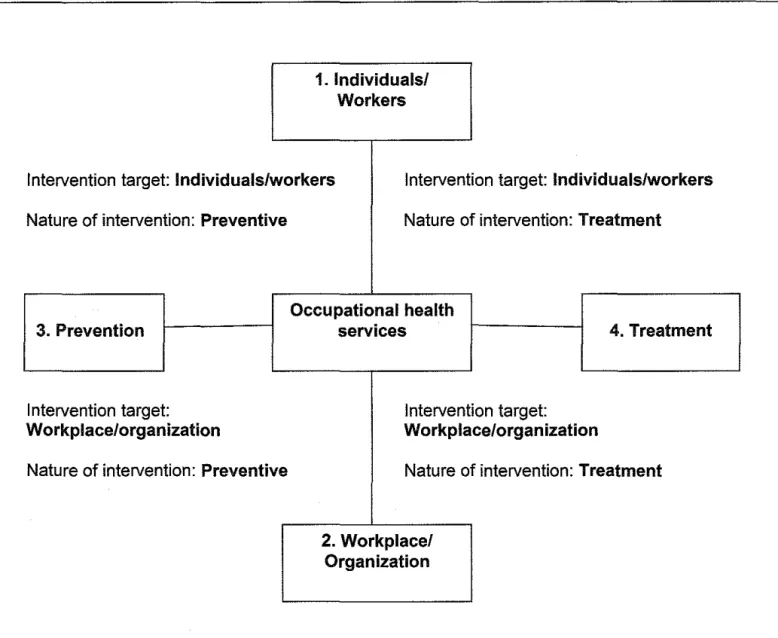
Occupational health services in the four-field model are presented as a series of services, interventions, and products, which are curative (also referred to as treatment in the model and this paper) and/or preventive in nature and target individuals and/or the
workplace/organization (Figure 3.1 ). The main advantage of this model is the inclusion and emphasis of both the work environment and the
individual worker as targets of occupational health interventions instead of the traditional classification into preventive and medical interventions
The foundation of current legislation is based on a broad holistic
I
without target specification.approach to work and the requirement for occupational health has been
l
justified as a multidisciplinary support system for both individual andorganizational health and well-being. Shifting emphasis from supporting and promoting the health and work ability of individual workers to the inclusion of the health and well-being of the organization and workplace will require changes in perspectives for both occupational health
professionals and the client organizations. This broader approach will
t
enable organizations and companies to specify their occupational health
1. Individuals/ Workers
Intervention target: Individuals/workers Intervention target: Individuals/workers Nature of intervention: Preventive
3. Prevention
Intervention target:
Workplace/organization
Nature of intervention: Preventive
Nature of intervention: Treatment
Occupational health services
Intervention target:
Workplace/organization
4. Treatment
Nature of intervention: Treatment
2. Workplace/ Organization
Figure 3.1. The four-field model for interventions in occupational health
L
t
I
According to research data on material from occupational health units representing all four occupational health service models in 2000 the average number of worksite visits annually per 100 individual clients ranged from 2.0 to 4.4 for occupational health nurses and from 0.5 to 1.6 for occupational health physicians and individual clinic visits from 52 to 219 for nurses and for physicians from 117 to 183 (Rasanen 2002). As shown by these data, a shift in activities by both nurses and physicians from medical clinics or service units out to the workplaces needs to take place in order to provide holistic health maintenance programs for workers and workplaces.
As mandated by occupational health legislation the employer is legally responsible for the well-being and functionality of the work environment, and the utilization of multi-professional know-how in
occupational health is recommended. The broad definition of the concept of a healthy worker in a healthy work environment has resulted in the need to re-evaluate occupational health programs targeting the workplace, work environment, and organization as a whole. The participation of
Throughout the history of occupational health interventions
targeting individual clients have played a major role. From its very origin
!
r
when nurses were employed by industry to care for sick or injured workersindustrial/occupational health care has targeted individual clients and their well being (Rogers, 1994; Hara, 1998) The responsibilities of employers and occupational health care providers toward individual workers are clearly defined in Section 1 of Chapter 1 in the Occupational health Care Act (1383/2001) as the promotion of"the health, working capacity and functional capacity of employees at different stages of their working careers". This broad definition of individual health includes a
I
comprehensive approach to health where both health promotion and illness prevention are key issues. As summarized by Rogers (1994) "Both health promotion and illness prevention/health protection are considered complimentary processes aimed at enhancing or altering
person-environment interactions" (p. 284). All three levels of prevention, primary, secondary, and tertiary are utilized. Primary prevention includes protective actions, which are implemented in the risk reduction of disease. The secondary prevention level includes interventions where the progress of already existing diseases/illnesses can be halted and resulting disability minimized. Finaily tertiary prevention measures focus on individual
rehabilitation and restoration of the level of functioning to a maximum level
The purpose of the four-field model is to act as a tool in the
education of both occupational health professionals, specialists, and client
organizations or companies on the scope and possibilities of occupational
health interventions and as a map for occupational health product
development and evaluation. Additionally this model enhances the
possibilities of matching client needs with available services. For example,
if the main goal for a client company is to lower worker absenteeism,
service products from each field, which match this need, can be prioritized
and presented visually to the client. These could include same day sick
appointments to the physician or nurse (individual/treatment), work
community stress assessments (work environment/preventive and
treatment), and individual work ability evaluations (individual/preventive).
In describing the four-field model four elements are included: 1)
lndividualsNVorkers and 2) Workplace/ Organization, as the main
categories describing the target of interventions, and the nature of the
interventions is presented as 3) Prevention and 4) Treatment.
Individuals/Workers
As stated in the Occupational Health Care Act one of the goals for
occupational health is the promotion of the health, working capacity, and
functional capacity of workers/employees at the different stages of their
working careers. The workforce is composed of individual workers with
their demographic characteristics, individual health status indicators,
L
r
I
I
r--l ;
-{
f •
perceptions of health, work, and workability, and individual work practice behaviors (Rogers, 1994). All these impact the need for occupational health interventions promoting health and workability of the
individuals/workers in the workplace/organization.
Individuals/Workers: Prevention
The goal of preventive occupational health care aimed at
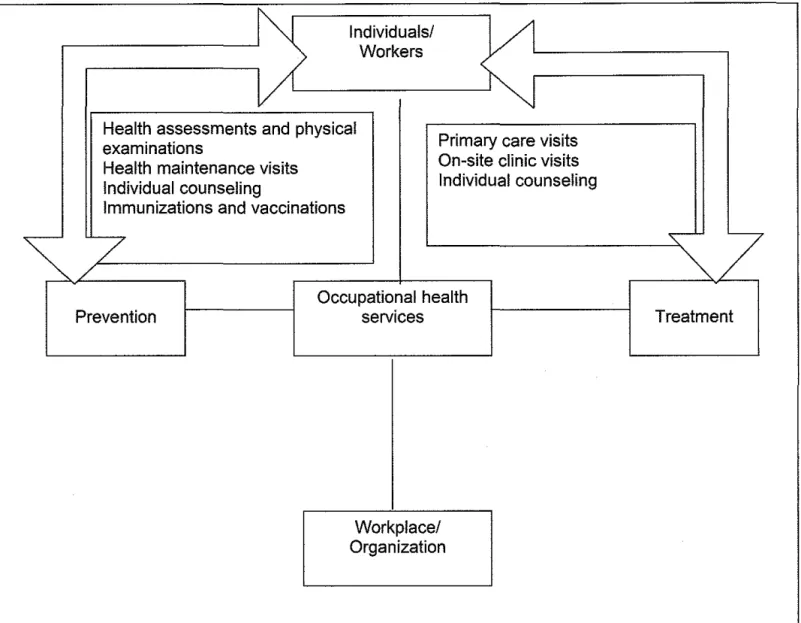
individuals is to maintain and enhance the workability and health status of workers throughout their work lifecycle. These actions are aimed at health promotion, risk reduction, and early detection of disease and can be categorized into primary or secondary prevention. Methods include such interventions as health assessments and screenings, health maintenance visits focusing on workability, and individual counseling and education (Figure 3.1.1 ). The possibilities of occupational health to instigate changes in individual health behaviors are enhanced by employer commitment to health and wellness. It is the role of occupational health professionals to facilitate and emphasize activities and interventions, which promote worker health.
individuaisfVii'orkers: Treatment
The inclusion of individual medical care in occupational health service contracts is voluntary and at the discretion of the employer.
I
!L
1
r
Primary care visits and on-site clinic visits include medical care provided by occupational health nurses. A survey by the Ministry of Social Affairs and Health and the Finnish Institute of Occupational Health in 1998 showed that medical care was included in occupational health in 58% to 80% of Finnish companies. The lowest percentage was in companies employing less than 20 employees and the highest percentage in companies with more than 100 employees. In addition, results showed that the efficacy of medical care in promoting work ability was rated· as extremely good by 24% and quite good by 67% of the management representatives at the companies which participated in the survey (Peltomaki et al., 1999). Since providing medical care is voluntary,
occupational health service providers emphasize easy access to medical care as a method to control and even reduce employee absences and sick days. The change, increase or decrease, in absences and sick leave days has been used as an outcome measure of occupational health. In 1999 the average annual number ofsick leave days in the Finnish work force was 8 days (Kauppinen et al., 2000). This meant an increase of 5% from the years 1995-1998 (Kauppinen et al., 2000). Especially since working conditions have been found to affect sickness absenteeism more than lifestyle factors (Kauppinen et ai., 2000), appropriate and timeiy individual care by occupational health professionals can impact absenteeism from work. Individual treatment and medical care includes medical treatment, examinations, crisis interventions, and individual rehabilitation programs
b
t---~
l
f-~
l
,_
which are realized as needed during individual primary care visits, on-site clinic visits, and individual counseling contacts (Figure 3.1.1 ).
Workplace/Organization
The work environment and the leadership and management culture within an organization present the core of a "functioning workplace
community". The inclusion of worker health and safety and the recognition of the importance of a safe and risk free work environment in the company culture and management philosophy together with management
commitment to occupational health provide a solid foundation for the promotion of the "healthiness and safety of the work and work
environment".
Workplace/Organization: Prevention
Activities, which target the work organization, work community, and working conditions promote the health of a workplace at the organizational level. Examples of occupational health interventions are work-site visits and surveys, participation in safety committee meetings, participation in planning and development task groups for work environment programs, counseling and education, and other work environment related programs (Figure 3.1.2). The goal of these interventions is to act as a catalyst for a proactive approach to the health and well-being of the workplace.
L
l
L
L
Individuals/
Vl
Workers
Health assessments and physical
Primary care visits examinations
Health maintenance visits On-site clinic visits
Individual counseling Individual counseling
Immunizations and vaccinations
~/7
~~7
Occupational health
Prevention services Treatment
I
Workplace/ Organization
L
L
I
r-Individuals/ Workers
Occupational health
Prevention services Treatment
\
Work-site visits and surveys Return to work programs~
Cooperation with safety Conflict management programs
committees Crisis intervention
-
~Planning and development Early retirement abatementCounseling and education programs
Miscellaneous activities
C>
Organization Workplace/I<J
Workplace/Organization: Treatment
Most treatment, curative, and rehabilitation interventions are reactive in nature. When organizational health promotion measures are inadequate or have failed, the health status of a work environment suffers and curative interventions are needed. Examples of these are return to work programs focusing on the work environment, conflict management programs, early retirement abatement programs, crisis interventions, and substance abuse management programs at the organizational level (Figure 3.1.2). The role of occupational health service providers in
rehabilitation programs is significant. The occupational health nurse acts as the liaison between rehabilitation institutes and workplaces. At the organizational level the activities focus on work modification, supervisor and work group support and education, cooperation with rehabilitation institutes, and program evaluation.
f
'
~-L
I
~-!
CHAPTER4
EVALUATION OF OCCUPATIONAL HEALTH NURSE ROLES
Regardless of the long history of occupational health in Finland, its legislative justification, wide social acceptance, well educated and trained occupational health professionals and specialists, and financial
implications on national economy and health care costs, finding data on the effectiveness or efficacy of occupational health interventions is difficult. Even the more concrete concept of productivity in occupational health nursing has failed to attract the attention of researchers. The Social Welfare and Health Care Service Review 2000 by the National Research and Development Center for Welfare and Health describes the state of and changes in Finnish social and health services in the 1990s. The first national Barometer of Maintenance of Work Ability by the Finnish Institute of Occupational Health and the Ministry of Social Affairs and Health published in 1999, collected information from 991 workplaces on the prevalence, resources, content, implementation, and benefits of work ability maintenance programs. A survey, also by the Finnish Institute of Occupational Health and the Ministry of Social Affairs and Health, on the structure, input, and output of occupational health services in Finland in
' 2000 combined information from the years 1992, 1995, 1997, and 2000 to
r
b
L
L
units, the occupational health training status of occupational health
professionals and experts, the utilization of services, and the participation L of occupational health personnel in occupational health interventions such
as work site visit, clinic visits, and health assessments. The data do not provide conclusions on outcomes or quality of services provided.
The annual data collected by the Social Insurance Institution provide statistical information on the number and size of companies seeking reimbursements, the model for occupational health service production and number of occupational health personnel providing services, and the number of interventions and money spent on occupational health interventions such as work-site visits, health
I
screenings, and primary care visits.
Shifting emphasis in occupational health from the individual worker to integrating health into work processes requires new ideas and products from the occupational health delivery system. In order to create something new there should exist sufficient information on processes that are to be changed. Also for the purpose of evaluating new programs and
interventions basic data are needed for further statistical analysis. None of the studies above provide answers to such questions as: What is the mostlieast profitable occupationai heaith intervention? How much time is spent on each intervention? Are there other significant differences, in addition to pricing, in the work of physicians and nurses within
F
'
!
work environment vary greatly? What do the client organizations want to
spend their money on? Finding answers to some of these basic questions
L
and the need for product development in occupational health wereprecipitating factors in the product development project at Mehilainen. One focus point in this project was the nurse's role in the provision of
occupational health. Regardless of the need for extensive analysis, the focus is on basic issues, such as time spent on various interventions and target groups and the actual contribution of occupational health nurses in service production.
Project on Nursing Activities
This project is not a scientific study but rather a review of
administrative data collected from the client (individual and organization) management and billing files at Mehilainen Occupational Health Services. The data consisted of all billed occupational health interventions by nurses and physicians during 2002 in Mehilainen Occupational Health Services. Information was assembled from the annual activities of 97 occupational health nurses and 84 occupational health physicians for 2,600 client
companies/organizations and 71,100 workers/individuals. The evaluation
l
is based on the categories of the four-field modei. In addition thefrom the national study from 2000 and published in 2002 by Kimma Rasanen.
Results
Data were available for 97 occupational health nurses. Two occupational health nurse educators were excluded from this evaluation because of their special job profile as educators without participation in preventive or primary care/treatment.
Nursing activities were evaluated in the context of the four-field model (Figures 3.1.1 and 3.1.2). The majority of the occupational health nursing activities and income resulted from preventive interventions as a whole. Further analysis of the target group for these interventions will follow later in this paper. The data show that 66% of nursing activities were preventive (Figure 4.1) and provided 72% of the income (Figure 4.2). The relatively limited nursing interventions and income resulting from interventions categorized as treatment by occupational health nurses are evidenced by the 16% contribution to the overall nursing proceeds (Figure 4.2) and 34% share of the number of all nursing interventions (Figure 4.1).
Leased nursing, where the occupational health nurse functions at the occupational health clinic within the client organization, that is the Company Owned Model (described in Chapter 2), provided 12% of the proceeds. However, further analysis of the nature of these interventions is not possible due to the activity occurring within the client organization and
!::=
I-b
r
'-1
r
ll
;
t
r-Prevention
L
"
Individuals/ Workers
34%
I
- - - --·--1
Workplace/ Organization
Treatment
Figure 4.1. The distribution in percentages of the number of prevention and treatment interventions by occupational health nurses
Mehilainen Uusimaa N=95 (Herlin, 2003)
'
b
t--
f--;
l_
.
t
I
•t
Prevention
72%
Individuals/ Workers
Workplace/ Organization
Treatment
Figure 4.2. The distribution in percentages of the proceeds for prevention and treatment interventions by occupational health nurses
'VI h"' .. . ' ' . •• "5 " ' 1· 200"'
1 e i1a1nen uus1maa I'll=,.- \nei li1, .,1.
L
;--L
I
r
j
'
'
therefore is not included in the more detailed analysis of occupational health nursing interventions.
The data, when evaluated according to the four-field model as presented in Figure 4.3 show that the majority of nursing interventions targeted the individual worker. Of these 56% were preventive interventions and 36% treatment interventions. The proportion of nursing activities targeting the workplace/organization was only 8% and none of the
activities were curative in nature. Interestingly, the 8% accounted for 21% of the income from all nursing interventions and the 36% for treatment interventions accounted for only 23% of the income (Figure 4.4).
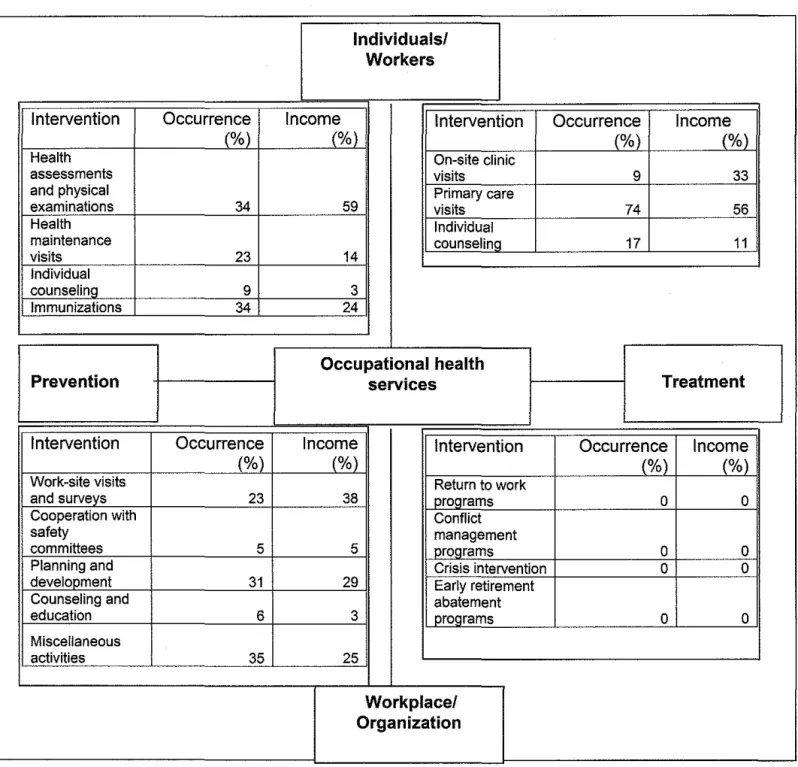
For a more detailed picture on the distribution of nursing activities in occupational health service production, the major nursing interventions are listed according to the four-field model (Figure 4.5). The occurrence as well as the income percentages of each activity are shown.
Health assessments and physical examinations were the most profitable, accounting for 59% of the income, and accounting for 34% of the preventive nursing interventions targeting individual workers. The participation of occupational health nurses in the promotion of public health is evidenced by the fact that 34% of preventive nursing
interventions in this category consist of immunizations and vaccinations.
L
k
f-!
I
r
Prevention
I
I
56%
Target:
individual
D
PreventionIIII!ITreatment
Individuals/ Workers
8%
Workplace/ Organization
36% Treatment
Figure 4.3. The distribution in percentages of the occupational health nursing interventions according to the four-field model
Mehilainen Uusimaa N=95 (Herlin, 2003).
I
1Prevention
D
PreventionIIIli! Treatment
Target: individual
Individuals/ Workers
21%
Workplace/ Organization
23% Treatment
Figure 4.4. The distribution in percentages of the proceeds of occupational health nursing interventions according to the four-field model
Mehilainen Uusimaa N=95 (Herlin, 2003).
b
L
L
Intervention Health assessments and physical examinations Health maintenance visits Individual counseling Immunizations Prevention Intervention Work-site visits and surveys Cooperation with safety committees Planning and develooment Counseling and education Miscellaneous activities Individuals/ Workers
Occurrence Income Intervention Occurrence Income
(%) (%) (%) (%)
On-site clinic
visits 9 33
34 59 visits Primary care 74 56
Individual
counsel ina 17 11
23 14
9 3
34 24
Occupational health
services Treatment
Occurrence Income Intervention Occurrence Income
(%) (%) (%) (%)
Return to work
23 38 programs 0 0
Conflict
5 5 management programs 0 0
Crisis intervention 0 0
31 29 Early retirement
abatement
6 3 programs 0 0
35 25
Workplace/ Organization
Figure 4.5. The distribution of occupational health nursing interventions according to the four-field model
Work-site visits and surveys provided 38% of the income for prevention targeting the workplace/organization. However participation in program planning and development occurred more often with 31% for planning and development and 23% for work-site visits and surveys.
The expected result for treatment interventions targeting
individuals/workers was relatively high accounting for 74% of the primary care visits. However, the profitability of on-site nursing with 33% of the income resulting from 9% of the treatment interventions provided new information.
Results vs. National Data
Can the results of the review on nursing intervention data at Mehilainen be compared with available national data? Figure 4.6 depicts some results from this project and the results of a national survey in 2000 by Kimmo Rasanen. The data are presented according to the four-field model. As shown in Figure 4.6 only limited data were comparable. For example the national data specified only work-site visits as a preventive intervention targeting the workplace/organization where the Mehilainen data included work-site visits and surveys, cooperation with safety committees, planning and development, counseling and education, and miscellaneous activities. Thus the value of this project is mainly
informative as to the content of nursing interventions and the resulting income of nursing activities in a private medical center.
L
L
F r
J
I
Individuals/ Workers
Intervention Mehilainen National survey Intervention Mehilainen National survey
Occurrence (%) Occurrence (o/~) Occurrence (%) Occurrence (o/~) _
Health care Primary care
visits 23 30 visits 15 53
Occupational health services
Prevention Treatment
Intervention
Work-site visits
Mehilainen National survey Intervention Mehilainen National survey
Occurrence (%) Occurrence (% ) Occurrence (%) Occurrence (% )
Treatment
1.2 3.1 proqrams 0
Workplace/ Organization
Figure 4.6. A comparison of occupational health intervention data according to the four-field model
Note. The numbers represent the frequency of each intervention per 100 individual clients utilizing the occupational health services.
The data are from the review of the administrative data on nursing
interventions at Mehilainen Uusimaa (Heriin, 2003) and Rasanen, K. (Ed.). (2002). Tyoterveyshuolto Suomessa vuonna 2000 -1990 -luvun
kehitystrendit [Occupational health in Finland in 2000-
1990-development trends]. Finnish Institute of Occupational Health. Ministry of Social affairs and Health. Helsinki.
0
r
Discussion
The objective of this project was to evaluate the nurse's role in the provision of occupational health. This analysis was performed in a private medical center setting. This means that the occupational health nurses are located off-site and contact either from or to the client organization or individual client requires some extra effort compared to on-site clinics where clients can just "drop in" on the way to lunch. The four-field model was used to facilitate the evaluation according to the target of each activity. Data show that most of occupational health nursing is geared toward individual clients. This can be seen as a reflection from the origins in health care where the client is an individual patient. Shifting focus from the individual to a more holistic approach which includes the environment, and in occupational health the work environment, is not detectable to the extent that current legislation would lead us to believe.
The fact that occupational health nurses spend most of their time working with individual clients (92% of all interventions) shows that the changes in the reimbursement policy by the Social Insurance Institution where worksite and work environment programs receive higher
reimbursement percentages (60% instead of 50%) are well justified. In
addition to education, financial support provides the extra motivation to
shift the focus of occupational health nursing interventions from the nurse's office to the workplaces. Even though the data suggest that preventive interventions in the workplace play a minor role in all
!
occupational health interventions, the income from these activities is almost the same as the income for primary care. This means that primary care visits are often less time consuming and more frequent than the more comprehensive worksite visits. On the other hand the frequency and
income for preventive interventions which target the individual are equally significant.
As depicted in this project, the variety of interventions is greatest in interventions which target the workplace/organization but less practiced. Occupational health nurse participation is highest in worksite visits and meetings. The data in this category support the conclusion above that worksite visits provide a larger portion of the income than their frequency might suggest.
In preventive interventions, which target the individual, the health assessments and physical/medical examinations are a substantial income source (56%) though the occurrence is 35%. On the other hand, health maintenance visits have a higher occurrence than income percentage. This means that the nurse spends less time per visit on health
maintenance than on health assessments and physicals.
In primary care, on-site clinic visits provide the most interesting data. With an occurrence of only 9% this activity provides 33% of the income in the treatment interventions category. This activity is not
significantly marketed to client companies or organizations. It is requested by the client companies and perceived by them as the most effective and
t
l--time saving method of providing primary care for their employees. However, occupational health care providers consider on-site visits as cumbersome due to travel time and limited equipment and space at the work-site. Based on the results in this project occupational health care providers should re-evaluate the possibilities of increasing on-site nursing visits.
The overlapping of occupational health nursing and public health nursing is substantiated by the results of this review. The active
participation of occupational health nurses in adult immunization and vaccination programs is an example of this.
This project has explored the nurse's role in occupational health service production in a private medical center setting. As a part of an
analysis on data requirements for on-going evaluation process
t
l development at Mehilainen, this project provides insight on the frequencyof and income from various occupational health nursing interventions. Internal service production data analysis is one of the integral components on the road to a comprehensive joint follow-up evaluation process by the client and service provider. The availability of valuable data in our
recordkeeping, and patient management and billing program was realized as a result of this project and several parameters have been identified for further analysis to develop an evaluation product which combines both the client and the provider perspectives. Regardless of the occasional
record keeping and data collection, the value of this model as a potential tool for standardized evaluation and development in the complex
processes of multi-professional occupational health has been recognized. The significance of the nurse's role in preventive occupational health service production was substantiated by the results of this review and has resulted in re-evaluating the importance of teamwork and professional roles in the provision of occupational health services. The active joint participation of the core members, physician and nurse, in the multidisciplinary team is a prerequisite for successful client-oriented programs.
Another important need for future development arises from the relatively limited frequency of interventions targeting the workplace or work environment, a need recognized by professional and national authorities. The results of the project confirm the need for legislative guidance for activities by occupational health authorities, health care providers, and employers in order to achieve changes, which promote the overall holistic health at workplaces and the work ability of individual workers.
l
t
'