Le Zhang. iRODS/HIVE integration: A Metadata Annotation System in DFC Data Grid. A Master’s Paper for the M.S. in I.S degree. April, 2014. 29 pages. Advisor: Jane
Greenberg
The DataNet Federation Consortium (DFC) developed data grid for multidisciplinary research. The demand for findability in metadata management is growing in response to the growth in scale of DFC data grid. HIVE project is being integrated into iRODS, in DFC data grid to provide a service to take advantage of open vocabularies. This paper reports on the iRODS/HIVE integration. First, the architecture and core components of iRODS/HIVE integration are discussed. Next, this paper reports on the process of installing iRODS/HIVE demo on local machine for HIVE user. The future work for iRODS/HIVE integration will be integrating automatic keywords extraction (KEA++ and MAUI) to support term suggestion, and providing rating feature for the suggested terms.
IRODS/HIVE INTEGRATION: A METADATA ANNOTATION SYSTEM IN DFC DATA GRID
by Le Zhang
A Master’s paper submitted to the faculty of the School of Information and Library Science of the University of North Carolina at Chapel Hill
in partial fulfillment of the requirements for the degree of Master of Science in
Information Science.
Chapel Hill, North Carolina April 2014
Approved by
Table of Contents
Table of Figures ... 2
1 Introduction ... 3
2 Literature Review... 4
2.1 DataNet Federation Consortium (DFC) ... 4
2.2 The Integrated Rule-Oriented Data System (iRODS) ... 5
2.3 Semantic Web ... 6
2.4 Linked Data ... 7
2.5 HIVE ... 8
2.6 SKOS ... 10
3 iRODS/HIVE integration System ... 10
3.1 The architecture of HIVE System ... 10
3.1.1 HIVE System on Renaissance Computing Institute (RENCI) Server (2011)10 3.1.2 HIVE System integrated with iRODS (2013) ... 11
3.2 Steps to install HIVE System with iRODS Demo on local machine ... 17
Step 1: Creating a HIVE area... 17
Step 2: Setting up your HIVE area ... 17
Step 3: Import vocabulary ... 20
Step 4: HIVE wrapper configuration ... 23
4 Future Work ... 25
5 Acknowledgement ... 25
Table of Figures
Figure 1 Architecture of HIVE System (2011) ... 11
Figure 2 Sysem model of iRODS/HIVE integration ... 13
Figure 3 Technical architecture of HIVE ... 13
Figure 4 HIVE Concept Browser in iDrop Web ... 14
Figure 5 Attribute-Value-Unite (AVU) metadata in iRODS/HIVE integration ... 15
Figure 6 HIVE Metadata Search in iDrop Web ... 16
Figure 7 Folder structure of HIVE area before vocabulary imported ... 18
Figure 8 hive.properties file ... 19
Figure 9 uat.properties ... 20
Figure 10 adminVocabulary Tool ... 21
Figure 11 Flags in adminVocabulary Tool (https://code.google.com/p/hive-mrc/wiki/ImportingVocabularies)... 21
Figure 12 Command Used to Import UAT ... 22
Figure 13 Folder Structure of HIVE Area after Importing uat ... 23
1
Introduction
Metadata, the data about data content and used to record the information about data, has been growing central part of semantic web. Semantic Web is the vision of Berners-Lee. “Semantic Web” is the idea of adding formal metadata that describes the content,
content and/or structure of a web resource (Marshall, 2003). Accurate metadata describe the data precisely, benefiting not only data managing and cataloging, but also semantic web and knowledge discovery. Over the decades of years, communities in different domains, including social science, physical, and so forth, have been put effort on developing discipline-specific vocabularies, to best describe the document, information objects in the specific field. However, the proliferation of discipline-specific metadata schemes has also contributed to establishing artificial barriers to data discovery and reuse across disciplines (Willis et al. 2012). The challenge of metadata management became how to break up the barriers to enable multidisciplinary, interdisciplinary, and
transdisciplinary in metadata, in order to support the understanding of science (Willis et al. 2012). As better quality and availability as well as support for multi-database
searching are likely to increase the use of controlled vocabularies (Fidel, 1992), platforms integrated with highly qualified and easily accessible domain vocabularies will facilitate the interoperability and interdisciplinary in cross-boundary scientific research.
The DataNet Federation Consortium (DFC) is developing data grids for
are hosted by DFC, including ocean observations, hydrologic science, engineering education and archives, plant genome sequences, and social science research. HIVE technology takes advantage of multiple disciplinary-specific vocabularies in DFC to support interoperability among the datasets for scientific data sharing. Vocabularies in HIVE are encoded as Simple Knowledge Organization Systems (SKOS), which are presented in RDF files and indexed as the vocabularies are imported. HIVE allows users to tag documents and document collections with terms from imported vocabularies as metadata. Indexed vocabularies enable the search of documents and document collections based on the tagged terms.
This master’s paper has two objectives:
Objective 1 is, describe the architecture of HIVE and implementation of HIVE system;
Objective 2 is, list the steps for installing HIVE on your local machine.
2
Literature Review
2.1
DataNet Federation Consortium (DFC)
The DataNet Federation Consortium (DFC) is one part of DataOne Projects under
the National Science Foundation DataNet initiative. As long-term sustainability mechanisms are need today to deal with data usage, DFC provides a new approach for implementing data management infrastructure that transcends technology based on sustainability models (Moore et al. 2012). A second-generation data grid, Rule-Oriented Data System (iRODS) is used by DFC to provide “the stable data virtual system, based
distributed heterogeneous resource”. The encapsulation of accessing data, executing
analysis, and managing result is required by Federation, thus terms are needed to describe the contents of the three parts, thus requires the ability to manage domain vocabularies. The DFC offers an opportunity to investigate and prototype findability and
interoperability solutions across deployed research infrastructure (Conway et al. 2013). HIVE fits this needs by providing approach to manage multiple domain vocabularies based on iRODS facilitating the findability and interoperability.
2.2
The Integrated Rule-Oriented Data System (iRODS)
The Integrated Rule-Oriented Data System (iRODS) is a state-of-the-art software that supports collaborative research, and, more broadly, management, sharing,
publication, and long-term preservation of data that are distributed (book). iRODS is developed and supported by the Data Intensive Cyber Environments (DICE) group of the University of North Carolina at Chapel Hill and the University of California San Diego. iRODS major features includes (book):
1. Data Grid Architecture based on a client/server model that controls interactions with distributed storage and compute resources.
2. A Metadata Catalog managed in a database system for maintaining the attributes of data, and state information generated by remote operations.
3. A Rule System for enforcing and executing adaptive Rules
Micro-service can be considered as the building block of iRODS, and it is explained as “small, well-defined procedures/functions that perform a certain task” (Rajasekar
chained by rules to implement large-scale functionalities, and will be executed in particular circumstance or particular event occurs. The Rules and micro-services are targeted towards data management requirements of various applications, thus the Rule Engine of iRODS providing a simple, flexible mechanism for implementing application-specific processing (Hedges et al. 2009). Then the information generated by micro-services will be stored in metadata catalog (iCAT).
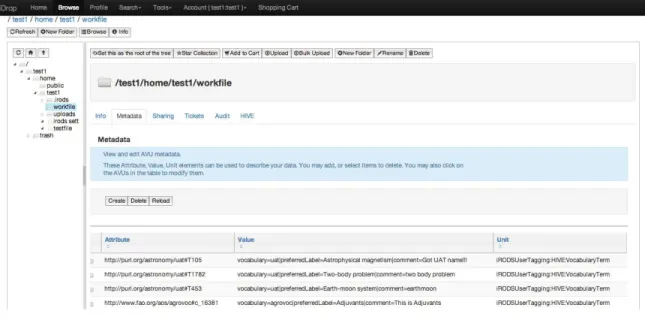
iRODS implements the data management framework required to support policy-based data management (Rajasekar et al. 2010). Both user defined metadata and system-defined (automatic) metadata are in iRODS, aiding to annotate, locate and manage files and collections. The concept of “policy-based data management” enables iRODS iCAT to manage and query user-defined metadata (Conway et al. 2013). The user-defined metadata are stored in Attribute-Value-Unit (AVU) format in iRODS that can be associated with data object and collection object, and the AVUs are stored actually as a triple in database.
2.3
Semantic Web
(Collins et al. 1969). In 1970s, Collins (1972) proposed the spreading-activation theory of semantic processing, acting as a extend theory of Quillian’s semantic memory search (Collins el al. 1969). However, the term “Semantic Web” was coined by Tim Berners-Lee in 2001, for the meaning “web of data that can be processing by machine”. Semantic web aims at providing standards for presenting data that could be easily accessed and understood by all kinds of machines, software agents (Feigenbaum et al. 2007). W3C gives out two aspects that semantic web is about:
1. Semantic web is about common formats for integration and combination of data drawn from diverse sources, where on the original Web mainly concentrated on the interchange of documents
2. Semantic web is also about language for recording how the data relates to real world objects
In order to implementing the two points mentioned by W3C, various semantic web technologies are coming up and developed, including Resource Description Framework (RDF), Web Ontology Language (OWL) and Simple Knowledge Organization System (SKOS). Among all the semantic technologies, RDF is the fundamental standard of Semantic Web. The format of input vocabulary for HIVE is also RDF, used to describe the terms and relationships between terms in one vocabulary.
2.4
Linked Data
linked to other external data sets. Linked data enables data from different source to be connected and queried (Berners-Lee et al. 2009). Berners-Lee (2006) also outlined four rules for Linked data:
1. Use URIs as names for things
2. Use HTTP URIs so that people can look up those names.
3. When someone looks up a URI, provide useful information, using the standards (RDF, SPARQL)
4. Include links to other URIs so that they can discover more things.
As Linked Data are designed to presenting and connecting data for semantic web, open, shared semantics introduce new capabilities that ought to be explored with scientific data, thus aid addressing the challenges of findability and interoperability in data and metadata management (Conway et al. 2013). HIVE enhanced data findability by defining standard vocabularies used in one community and enhanced data interoperability by providing a way to translate between the vocabularies used in different communities (Conway et al. 2013).
2.5
HIVE
Hive was launched by the Metadata Research Center, School of Information and Library Science, University of North Carolina at Chapel HIll (MRC/UNC-CH), in collaboration with the National Evolutionary Synthesis Center (NESCent)
Organization System (SKOS)-encoded controlled vocabularies (Greenberg et al 2011). The HIVE system supported (Greenberg et al. 2013):
1. Two machine learning algorithms, Keyphrase Extraction Algorithm (KEA) and Maui.
2. Downloading/term selection for multiple SKOSed concepts in SKOS-Resource Description Framework/eXtensible Markup Language (RDF/XML), SKOS-N Triples, Dublin Core/XML, Metadata Object Description Schema (MODS)/XML, and Machine Readable Cataloging (MARC/XML)
3. A service used by both information professionals and researchers, even via the demonstrative status of HIVE.
(https://code.renci.org/gf/project/irodshive/scmgit/?action=AccessInfo) and GitHub (https://github.com/DICE-UNC/irods-hive).
2.6
SKOS
According to W3C, SKOS is an area of work developing specifications and
standards to support the use of knowledge organization systems (KOS) such as thesauri, classification schemes, subject heading systems and taxonomies within the framework of the Semantic Web (http://www.w3.org/2004/02/skos/intro). It provides a standard way to present knowledge organization system using Resource Description Framework (RDF) which is a machine readable language. As a system supports the dynamic integration of linked data vocabularies encoded in SKOS (Greenberg et al. 2013). HIVE import takes the SKOS vocabularies, and populates a Sesame/Elmo triple store. Users can also view SKOS encoded term in HIVE system.
3
iRODS/HIVE integration System
3.1
The architecture of HIVE System
3.1.1 HIVE System on Renaissance Computing Institute (RENCI) Server
(2011)
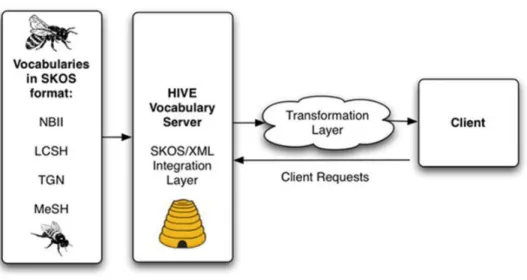
server supports the two services: browsing terms, and automatic metadata generation based on KEA++ algorithm. This HIVE System is hosted on RENCI Server
(http://hive.renci.org:8080/home.html).
Figure 1 Architecture of HIVE System (2011)
3.1.2 HIVE System integrated with iRODS (2013)
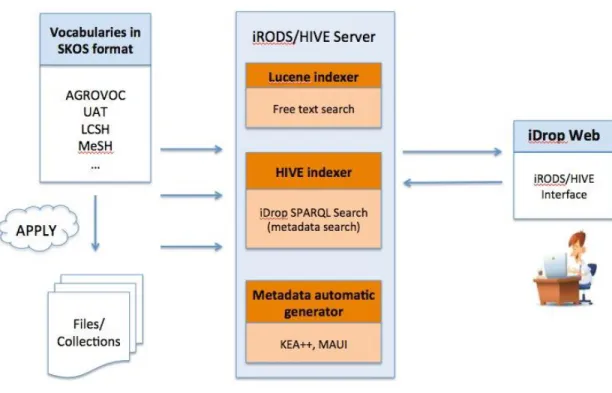
The DFC has demonstrated iRODS/HIVE integration using a working system that implements three primary system components. These are (Conway et al. 2013):
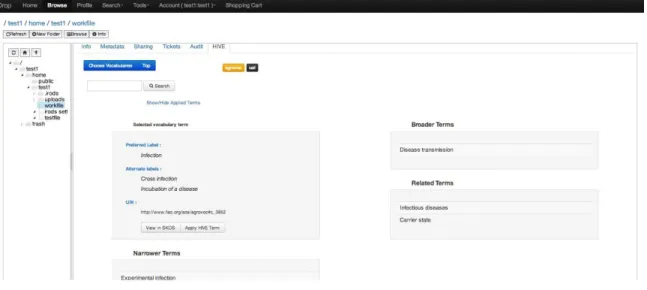
1) Interface integration to allow navigating and searching vocabularies stored in HIVE, and applying selected terms to the DFC grid;
2) Indexing services to extract vocabulary metadata that was stored in the DFC grid, in order to populate a triple store with vocabulary and DFC metadata;
In addition to the automatic metadata generation feature, iRODS/HIVE integration adds new feature that allows users to apply terms from multiple vocabularies to
file/collection as metadata, as well as to conduct search against the applied metadata in order to find the files/collections.
Figure 2 Sysem model of iRODS/HIVE integration
Figure 4 HIVE Concept Browser in iDrop Web
Figure 5 Attribute-Value-Unite (AVU) metadata in iRODS/HIVE integration
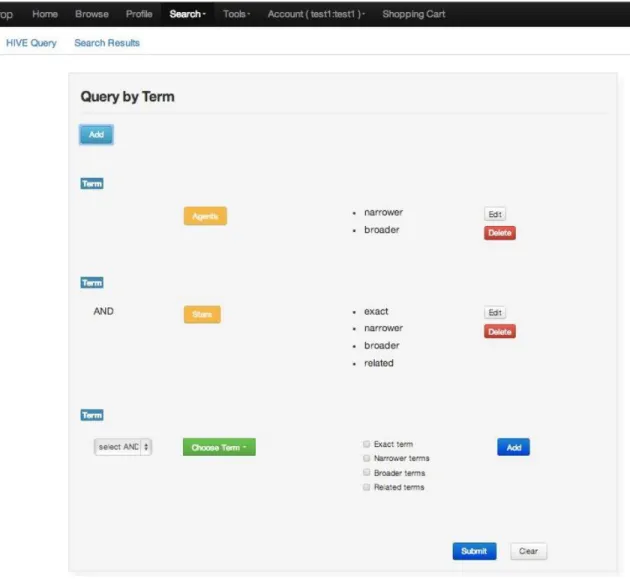
Figure 6 HIVE Metadata Search in iDrop Web
iRODS/HIVE integration will also support automatic term suggestion for document and collection utilizing KEA++ and MAUI algorithm. These machine learning algorithms are trained with a sample set of documents indexed by a human working with a
document. Though the current iRODS/HIVE integration system does not support the automatic term suggestion feature, this feature is still under development, and will be released with HIVE in the future.
3.2
Steps to install HIVE System with iRODS Demo on local machine
iRODS/HIVE demo (http://centos6.irods.renci.org:8080/idrop-web2) can not only be accessed through RENCI VPN (https://vpn.renci.org/dana/home/index.cgi), but can run locally as a web application once users download the source code from GitHub (https://github.com/DICE-UNC/irods-hive). In local machine, HIVE is a collection of subfolders for each vocabulary in your HIVE system. When importing a vocabulary, a bunch of small databases and triple stores that associated with that vocabulary will be created automatically. In order to find RDF file for vocabularies, and to create databases and triple stores correctly, user need to edit a “{vocabularyname}.properties” file at the
top level of hive collection. Another top level file, “hive.properties” is also needed to be edit, to point to {vocabularyname}.properties and tells HIVE what sub-directories exist.
Step 1: Creating a HIVE area
Creating a directory as HIVE area in local machine. This directory will hold files, sub-directories, and databases generated by HIVE.
Step 2: Setting up your HIVE area
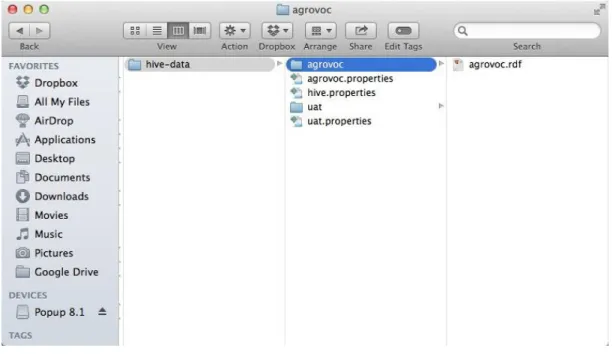
After creating the HIVE directory, you need to set up your HIVE area. Figure 7 shows the general structure of HIVE working directory before the vocabularies are ‘imported’. Your HIVE area contains properties files, sub-folder for each vocabulary, as
sub-directory named with the vocabulary name. For example, agrovoc.rdf should be put under a directory named “agrovoc”, and uat.rdf should be put under a directory named “uat”.
Figure 7 Folder structure of HIVE area before vocabulary imported
Also, you can look at the file and directory structure on GitHub. Find the hive-core/hive-code project and copy the test-data-template directory to a temporary area for playing around (https://github.com/DICE-UNC/irods-hive/tree/master/hive-code/hive-core/test-data-template).
After viewing the general structure of HIVE area, the following two paragraphs will tell you how to edit the properties file.
1) Editing hive.properties file
{vocabularyname}” for each vocabulary in each line and also add “hive.tagger = dummy” in the end of hive.properties. Figure 8 is an example of hive.properties with
agrovoc and uat as the vocabularies that HIVE will import. The hive.properties template is also available on GitHub (https://github.com/DICE-UNC/irods-hive/blob/master/hive-code/hive-core/test-data-template/hive.properties)
Figure 8 hive.properties file
2) Editing {vocabularyname}.properties file
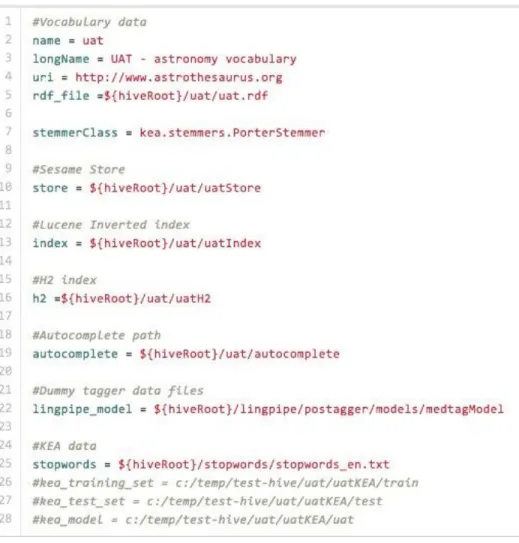
Then {vocabularyname}.properties is needed for each of the vocabulary. It contains information about this vocabulary including the name of the vocabulary, URI of the vocabulary, and path pointed to the RDF file. This properties file also sets up a bunch of paths to the files and indexes such as Lucene index, h2 index, etc, which will be
generated by the HIVE imported tool. The template of {vocabularyname}.properties also can be found on irods-hive GitHub online repository.
Figure 9 uat.properties
In this template, ${hiveRoot} is supposed to be the absolute path to your HIVE directory. To make HIVE working properly, you need to replace all ${hiveRoot} with absolute path of HIVE directory so that it can be read as a “Java” path with the “/” character.
Step 3: Import vocabulary
Figure 10 adminVocabulary Tool
AdminVocabularies takes these parameters:
1. Path to HIVE lib directory
The HIVE lib directory is the directory that contains the jar file of hive-core. The hive-core.jar (or hive-core-1.0-SNAPSHOT.jar) is in the {path to directory with
downloaded irodshive code}/ code/core/lib by default. If you cannot find hive-core.jar (or hive-core-1.0-SNAPSHOT.jar) file, you can also manually build the jar file for hive-core, then use the path to the directory contains the new built hive-core.jar.
2. Path to HIVE area
3. Name of the vocabulary
4. The indexes, databases and machine learning algorithms that will be used for this
vocabulary
AdminVocabulary tool uses flag to indicate the indexes, databases, and machine learning algorithms that will be used. Figure 11 shows the meaning of flags:
The following takes uat as an example. I downloaded the code of irodshive project and put under my local directory “/Users/zhangle/grails/workspace/”, then path to the
directory contains hive-core.jar file is “/Users/zhangle/grails/workspace/irodshive/hive-code/hive-core/lib”. My HIVE area is “/Users/zhangle/temp/hive-data”, where
hive.properties and uat.properties file locate. The vocabulary name is uat. I would like to initialize Sesame index, Lucene index, H2 database and autocomplete. In this situation, the command to use the adminVocabulary tool would be
Figure 12 Command Used to Import UAT
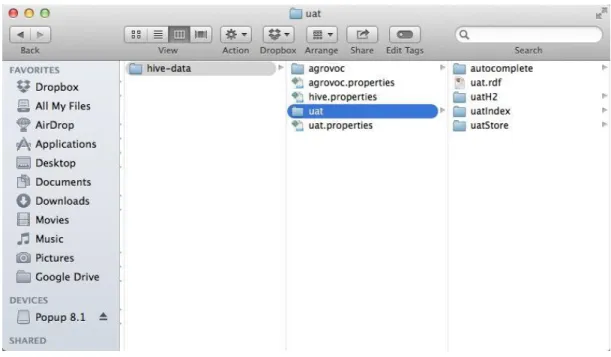
After imported uat by running the adminVocabulary tool, uat vocabulary is imported to your HIVE system. Once running your HIVE, you could browse terms in uat and apply uat terms to files/collections.
As mentioned in step 1 and step 2, HIVE area is a directory that holds files, sub-directories, and databases generated by HIVE. The sub-folders and databases are
Figure 13 Folder Structure of HIVE Area after Importing uat
Step 4: HIVE wrapper configuration
iRODS/HIVE integration provides a wrapper around previous HIVE code,
facilitating the process of putting HIVE into your application. The wrapper service is a project called jargon-hive (https://github.com/DICE-UNC/irods-hive/tree/master/hive-master/jargon-hive), which is under hive-master directory. The wrapper consists of two main parts, “hive container” and “vocabulary service”. “hive container” is a wrapper
class that defines methods including initializing the SKOSServer, reading the hive configuration files, etc., providing an easy way to start and shutdown the service of your iRODS/HIVE application. The other part, “vocabulary service”, wraps up the code of hive-core project, results in higher level classes that provides easy way to use the services, such as free-text searching, etc.
iRODS/HIVE system with Groovy. The example of configuration file in Groovy (resources.groovy) can be found on the GitHub online repository
(https://github.com/DICE-UNC/idrop/blob/hive/idrop-web/grails-app/conf/spring/resources.groovy). In this configuration file, your point to the local HIVE area, and give that configuration to the “hive container”, and then reference the
“vocabulary service” that “hive container” provides (Figure 14). The place holder
${application.config.hive.config.location} is supposed to be the path to your hive.properties file.
If you finished these four steps, the iRODS/HIVE system will work in local, with the vocabularies imported. Vocabulary terms then will show in HIVE and can be used to markup the files/collections as metadata, and also user can conduct metadata search to find the files/collection associated with specific metadata via SPARQL query.
4
Future Work
This paper provided an overview of HIVE system integrated with iRODS, and a guide of iRODS/HIVE installation in local machine. The first phase of iRODS/HIVE integration has successfully demonstrated a service for providing interoperability and interdisciplinary for researchers and curators, by support the functionality of annotating files/collection is DFC grid with SKOS-encoded vocabularies. This phase integrated SPARQL query to allow user search the files/collections that associated with specific metadata. This feature is supported by the batch indexing mode underneath, which
populating a triple store when AVUs are generated. A wrapper around previous hive-core code is also developed to provide easy interfaces to iRODS/HIVE integration.
In phase two of iRODS/HIVE integration development, automatic keywords extraction algorithms, KEA++ and MAUI, will be added. This will allow the metadata suggestion when users upload files to iRODS system. In addition to automatic term extraction, iRODS/HIVE will also add a feature that allows users to rate the suggested terms based on appropriateness. This feature will gradually improve the machine learning algorithms, resulting in more accurate suggested terms. The automatic keywords
extraction and suggested term rating will be added to iRODS/HIVE iDrop web interface in next phase.
5
Acknowledgement
6
References
Willis, C., Greenberg, J., & White, H. (2012). Analysis and synthesis of metadata goal for scientific data. Journal of the American Society for Information Science and Technology, 63(8), 1505-1520.
Moore, R.W., et al, (2012). DataNet Federation Consortium Vision and Rationale [Project Proposal]:
http://datafed.org/dev/wpcontent/uploads/2012/04/DFCproposal.pdf.
Marshall, C.C. and F.M. Shipman. Which semantic web? In Proceedings of the fourteenth ACM conference on Hypertext and hypermedia. 2003. Nottingham, UK: ACM Press.
Rajasekar, A., Moore, R., & Wan, M. (2009). Event Processing in Policy Oriented Data Grids. In AAAI Spring Symposium: Intelligent Event Processing (pp. 61-66).
Moore, R. W., & Rajsekar, A. (2010, July). Irods: Data sharing technology integrating
communities of practice. In Geoscience and Remote Sensing Symposium (IGARSS),
2010 IEEE International (pp. 1984-1987). IEEE
B. (2010). iRODS primer: integrated rule-oriented data system.Synthesis Lectures on
Information Concepts, Retrieval, and Services, 2(1), 1-143.
Quillian, M. R. (1967). Word concepts: A theory and simulation of some basic semantic capabilities. Behavioral science, 12(5), 410-430
Collins, A. M., & Quillian, M. R. (1969). Retrieval time from semantic memory. Journal of verbal learning and verbal behavior, 8(2), 240-247.
Berners-Lee, T., Hendler, J., & Lassila, O. (2001). The semantic web. Scientific american, 284(5), 28-37
Feigenbaum, L., Herman, I., Hongsermeier, T., Neumann, E., & Stephens, S. (2007). The
semantic web in action. Scientific American, 297(6), 90-97.
Greenberg, J., Losee, R., Agüera, J. R. P., Scherle, R., White, H., & Willis, C. (2011). HIVE: Helping interdisciplinary vocabulary engineering. Bulletin of the American Society for Information Science and Technology, 37(4), 23-26