Ju Shua Tan. Social Bot in Social Media: Detections and Impacts of Social Bot on Twitter Users. A Master's paper for the M.S. in I.S. degree. April, 2018. 107 pages. Advisor: Bradley M. Hemminger
A social bot is a computer algorithm that automatically produces content and interacts with humans on social media, trying to emulate and possibly alter their behavior. Social bots have inhabited social media platforms for the past few years. Although the initial intention of social bot might be benign, existence of social bot can also bring negative implication to society. For example, in the aftermath of Boston marathon bombing, a lot of tweets has been retweeted without people verifying its accuracy. Therefore, social bot might have the tendency to spread fake news and incite chaos in public. For example, after the Parkland, Florida school shooting, Russian propaganda bots are trying to seize on divisive issues online to sow discord in the United States.
This study describes a questionnaire survey of Twitter users about their Twitter usage, ways to detect social bots on Twitter, sentiments towards social bots, as well as how the users protect themselves against harmful social bots. The survey also uses an
experimental approach where participants upload a screenshot of a social bot. The result of the survey shows that Twitter bots bring more harms than benefits to Twitter users. However, the advancement of social bots has been so great that it has been hard for human to identify real Twitter users from fake Twitter users. That’s why it is very important for the computing community to engage in finding advanced methods to automatically detect social bots, or to discriminate between humans and bots. Until that process can be fully automated, we need to continue educating more Twitter users about ways to protect themselves against harmful social bots.
SOCIAL BOT IN SOCIAL MEDIA:
DETECTIONS AND IMPACTS OF SOCIAL BOT ON TWITTER USERS
by Ju Shua Tan
A Master's paper submitted to the faculty of the School of Information and Library Science of the University of North Carolina at Chapel Hill
in partial fulfillment of the requirements for the degree of Master of Science in
Information Science.
Chapel Hill, North Carolina April, 2018
Approved by:
1
Table of Contents
Introduction……… ……...2
Research Problem……….…………..5
Literature Review………..…… 7
Methods………. 34
Results……….……….. 40
Discussion……….… 69
Conclusion………. 80
References...………....81
Appendix A……… 86
Appendix B……… 87
Appendix C……… 88
Appendix D……… 96
2
Introduction
Along with the advancement of modern Internet technology and smartphone usage, we have seen the rapid development of popular social network sites such as Twitter, Facebook, Instagram, Snapchat, Vine, Tumblr and etc. People are using these popular social media sites to be able to communicate with their friends and network as well as sharing about their personal stories, interests, opinions and beliefs to the whole world. One of the most popular social media that this paper will dive deeper into is Twitter.
Twitter is an online news and social networking service on which users post and interact with messages known as "tweets". Users are restricted to only use 140 characters for each tweet. Since released publicly in 2006, Twitter has experienced initial rapid growth to rise as a mainstream social outlet for the discussion of a variety of topics through microblogging interactions. As billions of tweets are being posted every day, including by the most powerful man in the world, President Donald Trump, Twitter has gained so much interest and attention from the whole world. As Twitter has evolved from a simple microblogging social media interface into a mainstream source of
communication for the discussion of current events, politics, consumer goods/services, it has become increasingly enticing for parties to manipulate the system by creating
3
personal gain and for influence manipulation (Clark, Williams, Jones, Galbraith, Danforth, & Dodds, 2016).
Bots have been around since the early days of computers. These automated software that tries to emulate a real human who is posting contents like tweets on social media are known as social bots. One particularly popular medium for social bots is Twitter. Twitter bots are automated agents that operate in Twitter using fake accounts. Although people may straight away dismiss Twitter bots as inherently bad, they are often benign, or even useful, but some are created to harm, by tampering with, manipulating, and deceiving social media users (Ferrara, Varol, Davis, Menczer & Flammini, 2016). Often times they try to spread fake news or influence political opinions. Fake news and the way it spreads on social media is emerging as one of the greatest threats to modern society. In recent times, fake news has been used to manipulate stock markets, make people choose dangerous health-care options, and manipulate elections, including 2016 presidential election in the U.S (Bessi & Ferrara, 2017). It is thus very important for us to understand more about the existence of social bots and try to find ways to automatically detect them.
Recently being widely debated in the news, after the Parkland, Florida school shooting, we have read a lot about how Russian propaganda bots are trying to seize on divisive issues online to sow discord in the United States. This is just one of the most recent examples of how social bots can wade into our everyday lives. There are many ways that social bot can enter into a Twitter feed and impact the way how normal Twitter users interact with the bot. Often time, Twitter users do not realize that they are
4
5
Research Problem
Most of the researches that I have found are focusing on the methodologies on how to identify social bots among tweets. Even though this topic is trending in the news right now, few researches have actually studied the social impact of social bots by conducting an online survey among Twitter users. As the current events about Russian bots continue to unfold in the country right now, this topic has been increasingly popular due to the mass media attention that it received. Therefore, in this master’s paper, the main research question that I want to explore are:
How do social bots impact online social media ecosystems and our society?
This is a very important question to research because social bots impact all aspects of our social lives as technology have changed the way we interact with other people. I have also decided to use survey questionnaire method to explore these four specific research questions below:
Specific Research Questions:
6
RQ2. By doing literature review to identify methods used by other researchers, what are the ways that we detect social bots in Twitter? By incorporating some experimental questions in my survey, I want to see whether my participants are able to detect social bots because one of the question in my survey asked them to provide a screenshot of what they perceived to be a social bot. If my participants do not have a lot of knowledge about social bots, I hope that my survey can raise their awareness about social bots in Twitter and better protect themselves against the negative impact of Twitter bots.
RQ3. Through the survey questionnaire to Twitter users, what are the positive and negative impacts of social bots on social media users?
RQ4. By doing a literature review, and understanding why social bots exist,
identifying and incorporating users’ needs and desires, what are the general best practices for automatic detection of social bots in Twitter?
7
Literature Review
In my literature review, there are four sections that I think are very important to understand how social bots work from multiple perspectives. The first section will explore multiple ways we can detect social bots. The second section will identify the impact of social bots in our society, especially in politics since social bots have a large impact in influencing presidential election results. The third section will be explaining about the intricacies of the design of social bots and how social bots operate. Finally, for narrative summary of our literature review, we will propose several standards for social bot use.
Social Bot Detection
An area of intense research in artificial intelligence area is the detection of social bots. As Twitter users, there can be many interactions with social bots that we do not even realize. To assist human users in identifying who they are interacting with, Chu et al. focused on the classification of human, bot and cyborg accounts on Twitter. The researchers first conducted a set of large-scale measurements with a collection of over 500,000 accounts. The researchers observed the difference among human, bot and cyborg in terms of tweeting behavior, tweet content, and account properties. Based on the
8
following four parts: (1) an entropy-based component, (2) a machine-learning-based component, (3) an account properties component, and (4) a decision maker. (Chu, Gianvecchio, Wang, & Jajodia, 2010).
A lot of the times, there were no differences in the perceptions of source
credibility, communication competence, or interactional intentions between the bot and human Twitter agents. Therefore it is not unusual that we sometimes question whether is that a bot running the social media feed. Edwards et al. suggested that people will
respond to a computer in a similar manner as they would to a human if the computer conforms to their expectations of an appropriate interaction (Edwards, Spence, & Shelton, 2014).
9
served over one million requests via Davis et al.’s website and APIs (Davis, Varol, Ferrara, Flammini, & Menczer, 2016).
Gilani et al. comparatively analyzed the usage and impact of bots and humans on Twitter, by collecting a large-scale Twitter dataset and define various metrics based on tweet metadata. Using a human annotation task the researchers assigned ‘bot’ and
‘human’ ground truth labels to the dataset, and compare the annotations against an online bot detection tool for evaluation. The researchers then asked a series of questions to discern important behavioral characteristics of bots and humans using metrics within and among four popularity groups. From the comparative analysis the researchers drew differences and interesting similarities between the two entities (Gilani, Farahbakhsh, Tyson, Wang & Crowcroft, 2017).
Fake followers are those Twitter accounts specifically created to inflate the number of followers of a target account. Therefore, we would also consider fake followers as another kind of a social bot. Cresci et al. contributed along different dimensions for this problem. First, they reviewed some of the most relevant existing features and rules for anomalous Twitter accounts detection. Second, the researchers created a baseline dataset of verified human and fake follower accounts. Then, they exploited the baseline dataset to train a set of machine-learning classifiers built over the reviewed rules and features in revealing fake followers (Cresci, Di Pietro, Petrocchi, Spognardi & Tesconi, 2015).
10
services. Larsson & Hallvard discussed empirical results regarding the uses of Twitter for news sharing. Specifically, they presented a comparative analysis of links emanating from the service at hand to a series of media outlets in Sweden and Norway. They then problematized the assumption that online communication involves two or more humans by directing attention to more or less automated 'bot' accounts. They then made
conclusion that automated accounts need to be dealt with more explicitly by researchers as well as practitioners interested in the popularity of online news as expressed through social media activity (Larsson & Hallvard, 2015).
Ratkiewicz et al. studied astroturf political campaigns on microblogging
platforms: politically-motivated individuals and organizations that use multiple centrally-controlled accounts to create the appearance of widespread support for a candidate or opinion. The researchers described a machine learning framework that combines
topological, content-based and crowdsourced features of information diffusion networks on Twitter to detect the early stages of viral spreading of political misinformation (Ratkiewicz, Conover, Meiss, Gonçalves, Flammini, & Menczer, 2011).
Another technique, "Analysis Based Detection Techniques (ABDT)” is a novel technique to detect fast flux service network (FFSN) based Social Bots on social media based on presented information on user's profile. It uses geographically-dispersed set of proxy hosts to locate the position of the mothership in an abstract and dimensional space and built similarity graph (clustering) for each URL presented to validation checking for each user (Tyagi & Aghila, 2012).
11
bots, help-wanted-alert bots) to the malevolent (e.g., spamming messages,
advertisements, or radical opinions). Existing detection algorithms typically leverage metadata (time between tweets, number of followers, etc.) to identify robotic accounts. Clark et al. presented a powerful classification scheme that exclusively uses the natural language text from organic users to provide a criterion for identifying accounts posting automated messages (Clark, Williams, Jones, Galbraith, Danforth & Dodds, 2016).
To understand social bot behavior on end hosts, Ji et al. collected the source code, builders and execution traces of existing social bot to examine three state-of-the-art detection approaches over their collected traces. The researchers then used a new detection approach with nine new features and two new correlation mechanisms. This approach was proved to detect existing social bots with significant results (Ji, He, Jiang, Cao & Li, 2016).
Due to the development of social networks in the Internet such as Facebook, Twitter and Instagram, the programs that provide automatic users’ actions imitation are able to obtain wide circulation. Common usage of these programs causes informational noise. Drevs & Svodtsev considered a possibility of fuzzy logic mathematical apparatus application for the recognition of these programs’ activity in social networks (Drevs & Svodtsev, 2016).
Through different machine learning techniques, researchers have now begun to investigate ways to detect these types of malicious accounts automatically. To
12
of different types of social media accounts (ex. bot versus real account) via visualization. To help select better feature combinations, the researchers tried to visualize which features may be more effective for classification using self-organizing maps (Kaya, Conley & Varol, 2016).
From politicians and nation states to terrorist groups, numerous organizations reportedly conduct explicit campaigns to influence opinions on social media, posing a risk to freedom of expression. Thus, there is a need to identify and eliminate "influence bots"-realistic, automated identities that illicitly shape discussions on sites like Twitter and Facebook-before they get too influential. In response to this problem, Defense Advanced Research Projects Agency (DARPA) held a four-week competition in
February and March 2015, in which multiple teams supported by DARPA’s Social Media in Strategic Communications (SMISC) program competed to identify a set of influence bots on Twitter serving as ground truth on a specific topic. From this competition, Subrahmanian et al. learned that bot detection is a semiautomated process that builds on four broad techniques: inconsistency detection and behavioral modeling, text analysis, network analysis, and machine learning (Subrahmanian, Azaria, Durst, Kagan, Galstyan, Lerman & Menczer, 2016).
The popularity of social media platforms such as Twitter has led to the
proliferation of automated bots, creating both opportunities and challenges in information dissemination, user engagements, and quality of services. Past works on profiling bots had been focused largely on malicious bots, and assume that these bots should be
13
consumption, and spam bots. To facilitate comprehensive analyses of bots and how they
compare to human accounts, the researchers developed a systematic profiling framework that includes a rich set of features and classifier bank. They conducted extensive
experiments to evaluate the performances of different classifiers under varying time windows, identify the key features of bots, and infer about bots in a larger Twitter population (Oentaryo, Murdopo, Prasetyo & Lim, 2016).
14
Influence of Social Bots in Politics
Over the last several years political actors worldwide have begun harnessing the digital power of social bots — software programs designed to mimic human social media users on platforms like Facebook, Twitter, and Reddit. Increasingly, politicians,
militaries, and government-contracted firms use these automated actors in online attempts to manipulate public opinion and disrupt organizational communication. Politicized social bots — here ‘political bots’ — are used to massively boost politicians’ follower levels on social media sites in attempts to generate false impressions of popularity. They are programmed to actively and automatically flood news streams with spam during political crises, elections, and conflicts in order to interrupt the efforts of activists and political dissidents who publicize and organize online. They are used by regimes to send out sophisticated computational propaganda. Woolley conducted a content analysis of available media articles on political bots in order to build an event dataset of global political bot deployment that coded for usage, capability, and history. This information was then analyzed, generating a global outline of this phenomenon (Woolley, 2016).
After the broad overview, now we are going to explore the impact of social bots on very specific political events in different countries all across the world. Let us start with US first, especially with the highly contested 2016 presidential election. By leveraging state-of-the-art social bot detection algorithms, Bessi & Ferrara uncovered a large fraction of user population that may not be human, accounting for a significant portion of generated content. The researchers inferred political partisanships from
15
network embeddedness of the bots. The researchers’ findings suggested that the presence of social media bots can indeed negatively affect democratic political discussion rather than improving it, which in turn can potentially alter public opinion and endanger the integrity of the Presidential election (Bessi & Ferrara, 2016).
This same presidential election had also been associated with the problem of fake news for a long time, and we are very interested in finding out if the fake news have actually increased the support for Trump and depress Hillary Clinton’s support on
Election Day. The massive spread of fake news has been identified as a major global risk and has been alleged to influence elections and threaten democracies. Shao et al.
analyzed 14 million messages spreading 400 thousand claims on Twitter during and following the 2016 U.S. presidential campaign and election. They found evidence that social bots indeed played a key role in the spread of fake news. Accounts that actively spread misinformation are significantly more likely to be bots. Automated accounts are particularly active in the early spreading phases of viral claims, and tend to target influential users. Humans are vulnerable to this manipulation, retweeting bots who post false news (Shao, Ciampaglia, Varol, Flammini, & Menczer, 2017).
The same problem of social bots influencing the result of the presidential election does not only occur in the US, but also in France. Similar disinformation campaigns have been coordinated by means of bots, social media accounts controlled by computer scripts that try to disguise themselves as legitimate human users. Ferrara described one such operation occurred in the run up to the 2017 French presidential election. Ferrara
16
leveraging a mix of machine learning and cognitive behavioral modeling techniques, the researchers separated humans from bots, and then studied the activities of the two groups taken independently, as well as their interplay. However, unlike the US presidential election, the disinformation campaign in France did not succeed and Macron still won the French presidential seat. The reasons of the scarce success of this campaign: the users who engaged with MacronLeaks are mostly foreigners with a preexisting interest in alt-right topics and alternative news media, rather than French users with diverse political views. (Ferrara, 2017).
Besides US and France, the next country that we will be focusing on is UK. Murthy et al. analyzed a high-stakes political environment, the UK general election of May 2015, asking human volunteers to tweet from purpose-made Twitter accounts-half of which had bots attached-during three events: the last Prime Minister's Question Time before Parliament was dissolved (#PMQs), the first leadership interviews of the campaign (#BattleForNumber10), and the BBC Question Time broadcast of the same evening (#BBCQT). Based on previous work, the researchers initially expected was that their intervention would make a significant difference to the evolving network, but they found that the bots they used had very little effect on the conversation network at all. There were economic, social, and temporal factors that impact how a user of bots can influence political conversations (Murthy, Powell, Tinati, Anstead, Carr, Halford & Weal, 2016).
17
Duh et al. showed that there were significant differences in collective behavior between population of bots and population of humans as detected from their Twitter activity. Using a large dataset of tweets they have collected during the UK EU referendum campaign, the researchers separated users into population of bots and population of humans based on the length of sequences of their high-frequency tweeting activity. The result showed that while pairwise correlations between users are weak they co-exist with collective correlated states, however the statistics of correlations and co-spiking
probability differ in both populations (Duh, Rupnik & Korošak, 2017).
Our next country will be closer to us, which is Mexico. Social bots can also affect online communication among humans. Suárez-Serrato et al..studied this phenomenon by focusing on #YaMeCanse, the most active protest hashtag in the history of Twitter in Mexico. Accounts using the hashtag are classified using the BotOrNot bot detection tool. Their preliminary analysis suggests that bots played a critical role in disrupting online communication about the protest movement (Suárez-Serrato, Roberts, Davis, & Menczer, 2016).
18
researchers found that, rather than providing a neutral representation of government activity on Wikipedia, WikiEdits bots and the attendant discourses of the journalists that reflect the work of such bots constructed a partial vision of government contributions to Wikipedia as negative by default. This has an impact on the public discourse about government's' role in the development of public information, a consequence that is distinct from the current discourses that characterize transparency bots (Ford, Dubois & Puschmann, 2016).
Impact of Social Bots
After going through all the negative political impact being brought by the social bots, let us now explore some of the bright side of the impact of social bots in other areas, such as tackling harassment. Munger conducted an experiment which examined the impact of group norm promotion and social sanctioning on racist online harassment. Racist online harassment de-mobilizes the minorities it targets, and the open, unopposed expression of racism in a public forum can legitimize racist viewpoints and prime
19
Geiger also explored the role of social bots to tackle the problem of harassment, but with a different method. Geiger introduced and discussed bot-based collective blocklists (or blockbots) in Twitter, which have been developed by volunteers to combat harassment in the social networking site. Blockbots support the curation of a shared blocklist of accounts, where subscribers to a blockbot will not receive any notifications or messages from accounts on the blocklist. Blockbots support counterpublic communities, helping people moderate their own experiences of a site. Blockbots also helps raising issues about networked publics and platform governance. Such projects involve a more reflective, intentional, transparent, collaborative, and decentralized way of using algorithmic systems to respond to issues of platform governance like harassment. The author argued that blockbots are not just technical solutions but social ones as well, a notable exception to common technologically determinist solutions that often push responsibility for issues like harassment to the individual user (Geiger, 2016).
After looking at the positive impact of social bots in overcoming harassment, we will be looking at how social bots can help academia. Haustein et al. presented
20
tweet counts in research evaluation and assessment (Haustein, Bowman, Holmberg, Tsou, Sugimoto & Lariviere, 2016).
Social media has also become a place for discussion and debate on controversial topics, and thus provides an opportunity to influence public opinion. This possibility has given rise to a specific behavior known as trolling. A troll is an individual who shares inflammatory, extraneous or off-topic messages in social media, with the primary intent of provoking readers into an emotional response or otherwise disrupting on-topic discussion. The analysis of trolling is based on public discussion stakeholder, including positively engaged faith-holders, negatively engaged hateholders, and fakeholders. Trolls can be considered as either hateholders (humans) or fakeholders (bots or cyborgs). Paavola et al. continued the work of sentiment analysis with automatic detection of bots, which facilitates the analysis of fakeholder communication's impact. The automatic bot detection feature is implemented in the sentiment analysis tool in order to remove the noise in a discussion (Paavola, Helo, Sartonen & Huhtinen, 2016).
Cha et al. came up with three statistics to measure the ‘influence’ of a Twitter account. The following are the three metrics:
● Indegree: The number of followers a user has. Represents the user's popularity. ● Retweets: The number of times a user's tweets have been retweeted. Represents
the content value of the user's tweets.
● Mentions: The number of times the user has been mentioned by other users. Represents the user's name value (Cha et al., 2010).
21
as following count, follower count, retweets, unique mentions, list memberships, how many of the account's followers are spam/dead accounts and how influential the account's retweeters are.
Systems that classify influential users in social networks have been used
frequently and are referenced in scientific papers and in the media as an ideal standard of evaluation of influence in the Twitter social network. Messias et al. considered such systems of evaluation to be complex and subjective, and therefore suspected that they are vulnerable and easy to manipulate. Based on this, the researchers created simple robots capable of interacting by means of Twitter accounts, and the researchers measured how influent they were. Even with this automatic and predictive behavior, the bots received significant influence score in two systems that measure influence: Klout and Twitalyzer. The results showed that it is possible to become influential through simple strategies. This suggests that the systems do not have ideal means to measure and classify influence (Messias, Schmidt, Oliveira & Benevenuto, 2013).
22
Forest algorithm produces the best classifier, when used in conjunction with one of the better feature ranking algorithms (Wald, Khoshgoftaar, Napolitano & Sumner, 2013).
Wagner et al. studied data from the Social Bot Challenge 2011 - an experiment conducted by the Web Ecology Project during 2011 - in which three teams implemented a number of social bots that aimed to influence user behavior on Twitter. Using this data, the researchers aimed to develop models to (i) identify susceptible users among a set of targets and (ii) predict users’ level of susceptibility. The researchers explored the predictiveness of three different groups of features (network, behavioral and linguistic features) for these tasks. The results suggest that susceptible users tend to use Twitter for a conversational purpose and tend to be more open and social since they communicate with many different users, use more social words and show more affection than non-susceptible users (Wagner, Mitter, Körner & Strohmaier, 2012).
Today's social bots are sophisticated and sometimes menacing. Indeed, their presence can endanger online ecosystems as well as our society. Social bots have
populate all the techno-social systems: they are often benign, or even useful, but some are created to harm, by tampering with, manipulating, and deceiving social media users. Social bots have been used to infiltrate political discourse, manipulate the stock market, steal personal information, and spread misinformation. The detection of social bots is therefore an important research endeavor (Ferrara, Varol, Davis, Menczer & Flammini, 2016).
23
without a choice may not be entirely culpable, but in the case of free enterprise there is always a choice. The Bot Ethics procedure serves as a starting point and guide for ethics-related discussion among various participants in a social media community, as they evaluate the actions of social bots (de Lima Salge & Berente, 2017).
Design of Social Bots
After exploring more about the positive and negative impacts of social bots in our daily lives, let’s discover more into the technical aspects as how social bots are designed.
The security implications of social bots are evident in consideration of the fact that data sharing and propagation functionality are well integrated with social media sites. Existing social bots primarily use Really Simple Syndication and OSN (online social network) application program interface to communicate with OSN servers. Researchers have profiled their behaviors well and have proposed various mechanisms to defend against them. He et al. predicted that a web test automation rootkit (WTAR) is a prospective approach for designing malicious social bots. After the researchers
24
mechanisms in order to defend against WTAR-based social bots (He, Zhang, Wu & Li 2016).
Since impersonation bots are trying to pretend to be someone else, impersonation bots are smart enough that they are able to generate output in one, or possibly, multiple modalities. Furthermore, rapidly advancing areas of machine learning and artificial intelligence could lead to frighteningly powerful new multi-modal social bots. Although most commonly known bots are one dimensional (i.e., chatterbot), and far from deceiving serious interrogators, however, using recent advances in machine learning, it is possible to unleash incredibly powerful, human-like armies of social bots, in potentially well-coordinated campaigns of deception and influence (Adams, 2017).
25
How Social Bots Operate
In this section, we are exploring many literature about how social bots operate in general, to understand in depth what makes social bot so dangerous to social media users. Therefore we will be looking at some researches that were not dealing with Twitter bots but with other kind of social bots, such as Wikipedia bots and news bots.
Political actors are now deploying software programs called social bots that use social networking services such as Facebook or Twitter to communicate with users and manipulate their behavior, creating profound issues for Internet security. Current approaches in bot control continue to fail because social media platforms supply communication resources that allow bots to escape detection and enact influence. Bots become agents by harnessing profile settings, popularity measures, and automated
conversation tools, along with vast amounts of user data that social media platforms make available. Guilbeault developed an ecological approach to thinking about bots that
focuses on how social media environments propel bots into agency. This habitat-based model used bots to expose ripe targets of intervention and innovation at the level of interface design. It also situated bots in the context of platform providers with a vested interest in interface design, revealing a range of new political problems. Most important, it invited a hybrid ethics, wherein humans and bots act together to solve problems in bot security and Internet ethics more broadly (Guilbeault, 2016).
Development of a social bot with sophisticated human-like behavior faces three main challenges:
26
● (2) Leaving a trace of human-like metadata in social networks.
● (3) Creating an adequate (often balanced) network of friends or followers to spread information.
While the first challenge is a rather open issue in science and even the more in practice, Grimme et al. found that the second aspect can be handled to a certain extent by imitating human actions in social networks sticking to normal human temporal and behavioral patterns. This includes performing activities in a typical day–night cycle, carefully measured actions at the social media platform, as well as variability in actions and timing. Thus, at Twitter, a bot should pause between actions to simulate phases of inactivity (sleep or work), limit posting and Retweeting activities to a realistic, human-like level, and also vary these pauses and limits (Grimme, Preuss, Adam & Trautmann, 2017).
27
just by reiterating a simple activity of “social probing”. In a second phase of the
experiment the researchers sent friendship suggestions from their bot to a pool of users, providing random suggestions to some and thoughtful recommendations to others. As evidence that an untrustworthy user can be very influent if popular enough, the researchers found that people more aware of the presence of the bot have been more inclined to follow its suggestions. (Aiello, Deplano, Schifanella & Ruffo, 2014).
In the early days of online social media, over one decade ago, creating a bot was not a simple task: a skilled programmer would need to sift through various platforms’ documentation to create a software capable of automatically interfacing with the platform and operate functions in a human-like manner. However these days, the landscape has completely changed: indeed, it has become increasingly simpler to deploy social bots, so that, in some cases, no coding skills are required to setup accounts that perform simple automated activities: tech blogs often post tutorials and ready-to-go tools for this
purposes. Various source codes for sophisticated social media bots can be found online as well, ready to be customized and optimized by the more technically-savvy users. Finally, a very recent trend is that of providing Bot-As-A-Service (BaaS): companies like
RoboLike1 provide “Easy-to-use Instagram/Twitter auto bots” performing certain automatic activities for a monthly price. Advanced conversational bots powered by sophisticated Artificial Intelligence are provided by companies like ChatBots.io that allow anyone to “Add a bot to services like Twitter, Hubot, Facebook, Skype, Twilio, and more” (Ferrara, 2017).
28
subjected to a cursory inspection. They achieved this goal by having the bots generate content using simple natural language processing rules as well as ‘recycling’ popular content from other Twitter users. They also had the bots tweet at irregular intervals, but with frequencies set according to a circadian pattern. Finally, the researchers used some Twitter users’ tendency to reciprocate friendships to ensure that the bots were followed by a large number of accounts while themselves following only a few; a
following/follower ratio much smaller than one is unusual in typical twitter bots. The full botnet consisted of 39 algorithmically driven Twitter accounts (Mønsted, Sapieżyński, Ferrara, & Lehmann, 2017).
Alperin et al. presented a new methodology---the Twitter bot survey---that bridges the gap between social media research and web surveys. The methodology uses the Twitter APIs to identify a target population and then uses the API to deliver a
29
Besides Twitter bots, let’s us look at an example of a Wikipedia bot to compare how they work similarly or differently from a Twitter bot. Bots on Wikipedia are computer scripts that automatically handle repetitive and mundane tasks to develop, improve, and maintain the encyclopedia. They are easy to identify because they operate from dedicated user accounts that have been flagged and officially approved. Approval requires that the bot follows Wikipedia’s bot policy. Although in quantitatively different ways, bots on Wikipedia behave and interact as unpredictably and as inefficiently as the humans. The disagreements likely arise from the bottom-up organization of the
community, whereby human editors individually create and run bots, without a formal mechanism for coordination with other bot owners. Tsvetkova et al. found that most of the disagreement occurs between bots that specialize in creating and modifying links between different language editions of the encyclopedia. The lack of coordination may be due to different language editions having slightly different naming rules and conventions (Tsvetkova, García-Gavilanes, Floridi & Yasseri, 2017).
30
and process information of socialbots running on hosts. These features can be used by someone to design approaches to identifying socialbots on a host. The researchers’ proposed detection approach can effectively distinguish between a socialbot and a benign application on end hosts (He, Li, Cao, Ji & Guo, 2017).
Another type of common social bots is called news bot. So-called "robot"
journalism represents a shift towards the automation of journalistic tasks related to news reporting, writing, curation, and even data analysis. Lokot et al. studied the use of "news bots"-automated accounts that participate in news and information dissemination on social networks. Such bots present an intriguing development opportunity for news organizations and journalists. In particular, the researchers analyzed a sample of existing news bot accounts on Twitter to understand how news bots are currently being used and to examine how using automation and algorithms may change the modern media
environment. Based on their analysis, they proposed a typology of news bots in the form of a design and editorial decision space that can guide designers in defining the intent, utility, and functionality of future bots. The proposed design space highlights the limits of news bots (e.g., automated commentary and opinion, algorithmic transparency and
accountability) and areas where news bots may enable innovation, such as niche and local news (Lokot & Diakopoulos, 2016).
Finally, another way that social bots can operate fraudulently is by phishing. Phishing is the attempt to obtain sensitive information such as usernames, passwords, and credit card details (and money), often for malicious reasons, by disguising as a
31
and thus endanger corporate network security. Current literature mostly focuses on traditional phishing methods (through e-mail, phone calls, and USB sticks). However, Shafahi et al. took it one step further by addressing the serious organizational threats and security risks caused by phishing through online social media, specifically through Twitter. In their experimental development, the researchers created and deployed eight social bots on Twitter, each associated with one specific subject. For a period of four weeks, each bot published tweets about its subject and followed people with similar interests. In the final two weeks, their experiment showed that 437 unique users could have been phished, 33 of which visited their website through the network of an
organization. The phisher now has a direct link to the organization’s network, allowing him to spread malware and/or gather sensitive information. The risks are mitigated when the organization’s cyber security infrastructure is up-to-date, but even in this scenario, zero-day attacks might be used to infiltrate the company (Shafahi, Kempers &
Afsarmanesh, 2016).
Standard for Social Bot Use and Narrative Summary
32
should have three components: bots should clearly be labeled as such, they should not contact other users without consent, and information collected by them should only be used for disclosed purposes (Marechal, 2016).
33
34
Methods
This section of the paper describes the method which was used in the proposed research. It first identifies and describes the survey questionnaire method, including a discussion of why this method is particularly appropriate for this research. It then explains the sampling method and the rationale behind it. It describes the data collection procedures for the study and the sampling method being chosen. The final part of this section is the result of the survey together with the visualization of the result so that it can be easily interpreted by the readers of this paper.
Survey Questionnaire
35
beliefs, facilitating research into the Twitter users’ perceptions of the social bots. Finally, it is easy to preserve anonymity and confidentiality with surveys (Colton & Covert, 2007). This is especially important when Twitter users might fear that if their answers to questions might be tracked back to their private activities in Twitter.
Intended Participants
The desired sample would be frequent users of Twitter. For this study, “active” twitter users will be considered to be users who read or post on Twitter at least once a week. The survey was anonymous, to ease the mind of my participants about exposing their privacy. I recruited 26 participants primarily by distributing links through listserv to SILS students. The cover letter together with the link to the Qualtrics survey were sent to all SILS Master’s students first. After that, I also asked Ms. Lara Bailey, the SILS
Graduate Student Coordinator to forward my recruitment cover letter email to all SILS undergraduate and PhD students. I also shared the survey link on my Facebook page to invite my friends to fill it out. The reason to have two recruitment methods was to have a more diverse background, country and culture of the Twitter users that I recruited for the survey. Their population would mainly be college students, grad school students or working adults.
Designing the Survey Instrument
36
required the participant to upload a screenshot of a social bot, the second question was asking them to explain why they thought that screenshot was a social bot and the last question was asking them to provide concerns and questions if they had any after completing the survey.
37
was asking them about questions or concerns that they had after completing the survey. The complete survey questions are included in Appendix C of this paper.
The survey was set up in Qualtrics and was administered to any Twitter users online. The participants were informed about the purpose of the survey and my motivation for conducting this research through a cover letter that is included in Appendix A and Appendix B. The cover letter for email recruitment through SILS listserv were a little bit longer than the cover letter for Facebook recruitment because I also had to include my personal introduction and formal closing to the email cover letter. I tried to make my audience to get interested in participating in my survey by talking about the impact of my research in my cover letter to hopefully maximize survey response rate. After getting all the results for my survey, I used Excel and the statistical tools provided by Qualtrics for data analysis, since they were easier to use.
My sampling method would be convenience sample. Convenience sampling is a nonprobability sampling strategy where participants are selected based on their
accessibility and/or proximity to the research (Bornstein et al, 2013). One of the most common examples of convenience sampling within SILS is the use of student volunteers as study participants. First, the survey will be distributed by listserv to SILS students. However, the drawback of convenience sampling is that all the participants would have similar ad-hoc demographics background, since they will have similar age and are all studying the same subjects in the same school in the United States. Convenience
38
diversify my convenience sample, I have decided to also draw samples from my Facebook friends, which had a wider range of age, gender, nationality and ethnicity. Personally, I do not use Twitter on a regular basis, and that is why I shared the survey link on my Facebook page. The survey result was collected online through Qualtrics. This method is easier, less time-consuming and the least expensive to implement.
Since this was an online survey, we could include skip logic into the design of the survey so not everyone will answer the same questions based on their previous response. However, I did not include this in my online survey because all participants should have the same set of questions to answer. The full survey questions can be found in the appendix.
Survey Administration
Before I started my survey administration, I had to obtain prior approval from my advisor, Dr. Bradley Hemminger and the campus IRB. Once I had obtained the approval from both of them, I started to send out my Qualtrics survey through SILS Masters Students Listserv. I have included my cover letter in the body of my email, followed by the link to the Qualtrics survey. This is the first wave of my survey distribution. My second wave of survey distribution was to ask SILS Graduate Student Services
39
letter on my personal Facebook page. Informally, I also occasionally talked to my friend and casually ask them to fill out my online survey.
Ethics
40
Results
1. Demographics
Since I could not keep track of the number of recruitment email that I have sent out (they are in Listserv), I was unable to accurately calculate the response rate of my online survey. We will look at each attribute of the demographics individually. Table 1 shows the distribution of the age group among our participants.
Age
Group Number of Participants Percentages
21-25 15 47%
26-30 10 31%
31-35 6 19%
36-40 1 3%
Grand
Total 32 100%
Table 1: Age group distribution among participants
41
went down. Similarly, the gender of the participants were not that uniformly distributed (Figure 1).
Figure 1: Gender distribution among participants
42
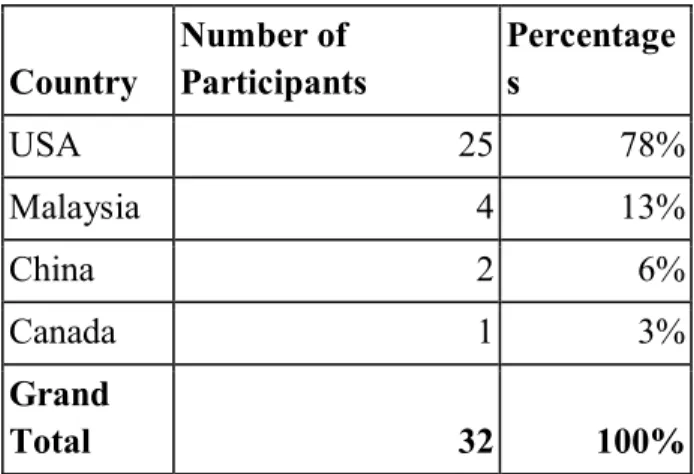
Country Number of Participants Percentages
USA 25 78%
Malaysia 4 13%
China 2 6%
Canada 1 3%
Grand
Total 32 100%
Table 2: Distributions of the country of participants
Not surprisingly, we had the majority of the participants come from US (78%), followed by Malaysia (13%), China (6%) and Canada (3%). The next question asked the
43
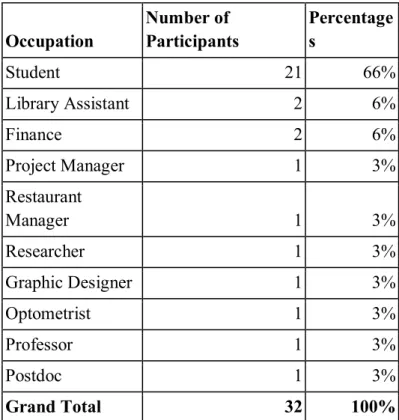
Occupation Number of Participants Percentages
Student 21 66%
Library Assistant 2 6%
Finance 2 6%
Project Manager 1 3% Restaurant
Manager 1 3%
Researcher 1 3%
Graphic Designer 1 3%
Optometrist 1 3%
Professor 1 3%
Postdoc 1 3%
Grand Total 32 100%
Table 3: Distributions of the Occupations of the participants
Therefore, we can conclude that out of the 32 people who completed the survey, their demographics were mostly biased towards young female students in their 20s. Therefore, the result of the rest of this survey questionnaires mostly reflect the viewpoint of this particular demographic group.
2. Twitter Usage
44
Figure 2: Frequency distribution of Twitter usage among participants
45
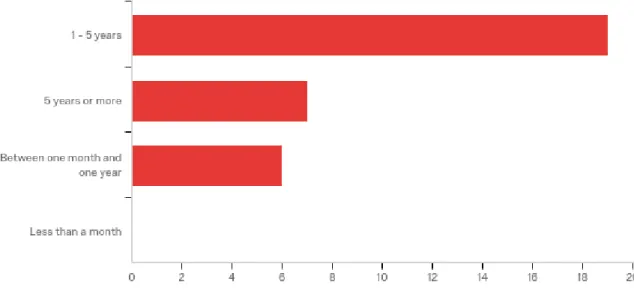
Figure 3: The duration of how long participants had been using Twitter
46
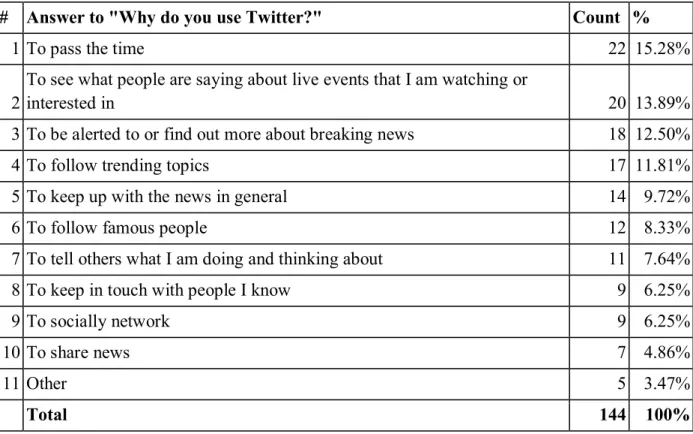
# Answer to "Why do you use Twitter?" Count %
1 To pass the time 22 15.28%
2 To see what people are saying about live events that I am watching or interested in 20 13.89% 3 To be alerted to or find out more about breaking news 18 12.50% 4 To follow trending topics 17 11.81% 5 To keep up with the news in general 14 9.72% 6 To follow famous people 12 8.33% 7 To tell others what I am doing and thinking about 11 7.64% 8 To keep in touch with people I know 9 6.25%
9 To socially network 9 6.25%
10 To share news 7 4.86%
11 Other 5 3.47%
Total 144 100%
48
Figure 4: The distribution of the reasons our participants used Twitter
The next question about Twitter usage was nested button table with Likert scale for the user to enter how frequently they did some of the specific activities on Twitter. Those activities were:
a) Post new tweets b) Comment on tweets c) Re-tweet
d) Follow other Twitter accounts e) Post images
f) Like other tweets
The majority of the participant posted new tweets monthly (17%). Most of them also commented on tweets weekly (30%) and re-tweet weekly (30%). When it comes to following other Twitter accounts, most of them did it monthly (46%). Most of our participants seldom post images (50%). The majority of our participants liked other tweets daily (46%). When asked about who did they follow on Twitter,
Most of them follow their friends (19%). When the participants answered that they follow “Other” people on Twitter, they gave answers such as “News media”, “Artists and
scholars”, “Companies/Brands”, “People in my field”, “Teachers”, “Writers”, “Journalists” and “Musicians”.
49
# Answer to "Who do you follow on Twitter?" Count %
1 Friends 26 19.26%
2 Celebrities 22 16.30%
3 People who share similar interests 20 14.81%
4 Politicians 17 12.59%
5 Co-workers 15 11.11%
6 Family 12 8.89%
7 Other 12 8.89%
8 Sports athletes 11 8.15%
Total 135 100%
50
Figure 5: The distribution of Twitter accounts that our participants followed
51
# Answer to "Who follow you in Twitter?" Count %
1 Friends 28 30.77%
2 People who share similar interests 21 23.08%
3 Family 17 18.68%
4 Co-workers 16 17.58%
5 Other 5 5.49%
6 Celebrities 2 2.20% 7 Politicians 2 2.20% 8 Sports athletes 0 0.00%
Total 91 100%
52
Figure 6: The distribution of Twitter accounts that followed our participants
3. Experience with Social Bots on Twitter
Now that we have already have a pretty decent understanding of how our
53
Twitter?” Most of them had an uncertain attitude about this question, with the majority of the participants answered “Possibly” (38%), followed by “Definitely yes” (23%),
“Probably yes” (19%), “Probably not” (12%) and “Definitely not” (8%) (Figure 7).
Figure 7: Breakdown of the prior experience of the participants having seen social
bots on Twitter
Therefore, we can see that for participants who were more certain about their previous encounters with social bots, the majority of them knew that they have definitely seen it somewhere before.
54
had to answer this question. It was not fair for me to ask someone who had never seen social bots before to come out with a screenshot of a social bot to complete this survey. Also, I did not want my participants to drop out from my survey halfway because they refused to spend extra time to actually login to their own Twitter account and do some homework to identify social bots in order to complete my survey questionnaire. In this question, I asked the participants to upload a screenshot of what they think might be an example of social bot on Twitter. For the answers for this question, I received 10 uploads, which was 31% response rate among the participants who have completed this survey. When I opened each of the 10 screenshots and looked at them, they were all coming from very different categories, ranging from @CBTS_Stream, @Angry American,
@PoetryBot, @Tawasi, @Magic Realism Bot, @We Didn’t Start It, @Anti-Resistance Nate Dog, @FREEDOM NOW and @BBC News (World). Among the characteristics of the tweets common among most of the screenshots are they used many hashtags in their tweets, having the word “Bot” as its username, tweet with only a URL and nothing else, and fake news. All the 10 screenshots are included in the Appendix D from Figure 14 to Figure 23.
To follow up on the question that ask for a screenshot of social bots, I asked the participants to use their own opinion and words to explain why they thought the
screenshot is a social bot. The complete answers to this question are listed in Appendix E. I have also highlighted some of the answers in Appendix E that I think were very
insightful about ways that we can detect social bots. Some of main points that they shared from the highlighted comments are:
55
b) Lots of hashtags
c) Using handle that a person would never choose
d) The tweet does not contribute to the ongoing conversation e) Often retweet content
f) Text doesn’t read like a human wrote it g) Call itself a bot
4. Perceptions towards social bots on Twitter and Protections against
Harmful Twitter Bots
56
Figure 8: Perceptions of participants toward social bots
The next question made an attempt to dive deeper into the previous question. I started by asking a question from the positive side, by asking participants “What are some advantages of social bots to you on Twitter?”. The majority of them responded that social bots bring “Entertainment” (26%) and “Self-promotion” (26%). There were also participants that replied “Other” and wrote “Comedy accounts where it is known that the account is a bot” and “occasionally bots exists to spread encouragement and joy”.
57
# Answer to "What are some advantages of social bots to you on Twitter?" Count %
1 Entertainment 9 25.71%
2 Self-promotion 9 25.71%
3 Automation 8 22.86%
4 Other 5 14.29%
6 Interactive 4 11.43%
5 Self-protection 0 0.00%
Total 35 100%
Table 7: Advantages of social bots to participants on Twitter
Figure 9: Advantages of social bots to participants on Twitter
58
tremendously to 116 choice count. The most popular choices for the disadvantages of social bots were “Spreading malicious contents” (17%), “Spreading fake news” (17%) and “Create the business of paying for Twitter followers” (13%). All the other
disadvantages are summarized in Table 8 and Figure 10.
# Answer to "What are some disadvantages of social bots to you on Twitter?" Count %
1 Spreading malicious contents 20 17.24%
2 Spreading fake news 20 17.24%
3 Create the business of paying for Twitter followers 15 12.93% 4 Promote hatred and hate speech 14 12.07%
5 Increase polarization 13 11.21%
6 Gaining unfair popularity 10 8.62%
7 Spreading influence 8 6.90%
8 Identity theft 8 6.90%
9 Privacy infringement 5 4.31%
10 Other 3 2.59%
Total 116 100%
Table 8: Breakdown of “What are some disadvantages of social bots to you on
59
Figure 10: Disadvantages of social bots to participants on Twitter
60
bots. To do that, I asked the question “How do you identify fake Twitter accounts?” This question is very similar to the question right after the participants had attached their screenshot of a social bot on Twitter. These two questions differed only by the format of the question being asked: the previous one was a free flow text question, while this question is a multiple choice checkbox question. Another difference was the scope of the question being asked, whereas the previous question specifically asked the participants about why they perceived the tweet in the screenshot as being posted by a social bot, while this question was a more general way of asking the question. The reason I had the free flow question appeared before the multiple choice checkbox question was to really measure how much knowledge our participants had about social bots prior to reading all the answer choices presented in this question. The answer choices also served another important role: to educate the participants about some of the ways they could identify social bots using some techniques that they did not previously known. When analyzing the result, this question had a total of 106 choice count, meaning that on average, each participant had 3 ways to identify fake Twitter accounts. At the top of the results, we had a tie here: “Tweet large sequences that are often promotional and repetitive” and
61
# Answers to "How do you identify fake Twitter accounts?" Choice Count Percentage
1 Tweet large sequences that are often promotional and repetitive 17 16% 2 Content of post sounds more machine generated than by a person 17 16% 3 Have a disproportionate follower and following count 13 12% 4 Username sounds fake 12 11% 5 Biography text is not properly written 11 10% 6 Very spectacular photos with attractive men or women 8 8% 7 The lack of a verified account blue checkmark 7 7%
8 Twitter Counter 4 4%
9 Inactive for a long time 4 4% 10 Detect them by using automated tools e.g. BotOrNot 4 4%
11 Twitter Audit etc. 4 4%
12 Tendency to be politically motivated, reply often to celebrity posts 1 1% 13 Tweets contain more links than messages 1 1% 14 No photo; or seem to have been created recently 1 1% 15 No personalization of the account (no banner photo, or generic profile photo) 1 1%
16 Other 1 1%
Grand Total 106 100%
63
Figure 11: “How do you identify fake Twitter accounts?” answer distributions by
participants
The next question was a very simple and direct question, yet it brought us a very important revelation regarding our users’ behavior when using Twitter. When asked “Do you protect yourself from harmful Twitter bots?”, only 10 out of 24 (42%) of our
participants protect themselves against harmful Twitter bots, as opposed to the majority of them, 14 out of 24 (58%) of them taking no action at all to protect themselves against harmful social bots. This was an alarming discovery!
To dig deeper into what were the ways that our participants protected themselves against harmful social bots, I asked the next question “What action(s) do you do to protect yourself against harmful Twitter bots?”. Table 10 shows the breakdown of the answer choices:
# Answer for “What action(s) do you do to protect yourself against harmful Twitter bots?” Count %
1 Block certain people from following me on Twitter 11 25.58%
2 None 10 23.26%
3 Reporting spam on Twitter 9 20.93% 4 Get rid of followers on Twitter 7 16.28% 5 Enable Twitter's "Protect my tweets" option 4 9.30%
6 Other 2 4.65%
Total 43 100%
Table 10: Actions that the participants took to protect themselves against harmful
64
However, there are some inconsistencies in the answer to this question as opposed to the answer to the previous question. In the previous question, we had only 10
participants who took any actions to protect themselves against social bots, but in this question, we had 11 participants “block certain people from following me on Twitter”. I then looked at the individual survey responses and found one anomaly. One participant answered “No” for the previous question to indicate that she did not protect herself from harmful Twitter bots, but in this question, she chose “Block certain people from
65
Figure 12: "What action(s) do you do to protect yourself against harmful Twitter
bots?" answer distributions by participants
Finally, the last question on my survey was just for the participants to write down any comments or questions if they had any after finishing my survey. I had only 2
responses for this question. The first one was:
It was a little difficult for me to find a bot tweet on demand for an earlier question.
However, the second one was a much more insightful comment:
I check for bots regularly, but I don't know anyone else who does. I just don't want them
66
wish more people were vigilant about them. I've considered starting to report them to
Twitter rather than just blocking them from my stuff.
From reading this comment, I wish more Twitter users can behave just like this
participant, who was well aware of the detrimental impacts that Twitter bots can bring into Twittersphere and even took it one step further than blocking bots but also to report them to Twitter so that Twitter can take the appropriate action against these social bots.
The methods and procedures for data analysis
First, I performed quantitative data analysis on the survey result to use descriptive statistics on my subject population as a whole. I predicted that the age group to be
skewed to the left instead of perfectly normal since Twitter users are usually young people instead of the older generation. I also did a descriptive statistics (mean, median, and mode) on the age of the participants and how long they have been using Twitter.
Then, I downloaded the Excel spreadsheet being generated by Qualtrics Data & Analysis tab to see the details of each participant’s answers. However, looking for answers for 20 questions (20 columns) and 32 participants (32 rows) could be pretty tedious. I found it easier if I can aggregate the data so that readers can see the
67
the same country before aggregating the data into a pivot table. The same case happened to the Occupation question.
Creating many pivot tables has become more of a hassle when I came down to the questions which allowed the participants to pick more than one answer. Qualtrics csv file will automatically concatenate the multiple answers selected by the same participant with comma. Thus, when I tried to separate each of the answer choices, I need to use Excel Data tab Text to Column function to delimit the cell into multiple columns separated by commas. This proves to be too much hassle if I continue to do my data analysis in Excel.
Therefore, I explored the Report tab in Qualtrics and discovered that this is a very powerful tab which provided me with visualizations of the answers for each question. By default, Qualtrics will generate a horizontal bar chart for the answers of each question with multiple choices. If I thought that a bar chart is not the most appropriate way to visualize the data in a question, I would edit the visualization to create something like a pie chart. From these visualizations, I could easily identify the top patterns and trends of my participants in answering various questions about social bots.
For the qualitative parts where the participant’s provided free text answer, I coded their answers into 7 specific categories of their statement type when writing my paper. I also highlighted those 7 categories of answers which are insightful when analyzing the text included in Appendix E. Furthermore, I also analyzed the screenshot and coded what I can find from the screenshot and find the unifying theme across every screenshot that I got. Was there a particular Twitter account that is well known to be bot? Using grounded theory, I aggregated the common themes that I coded about how my participants
68
measured the sentiment of my participants toward social bots, by analyzing the final questions about the positive and negative impacts of social bots for them.
69
Discussion
Demographics
As mentioned in the result section, the sampling of our survey participants were not diverse. Since I was using a convenience sampling method to get participants with the least amount of time and the least cost, those samples end to be highly skewed towards female students in the United States. Compared to the larger demographics of Twitter users out there, this sample was definitely not a realistic representation of the Twitter users’ population. Since my sample were largely graduate students at SILS, this was a much more highly educated group of Twitter users, compared to the general public out there. However, according to Pew Research Center, younger Americans are more likely than older Americans to be on Twitter. Twitter is also somewhat more popular among the highly educated: 29% of internet users with college degrees use Twitter, compared with 20% of those with high school degrees or less (Greenwood, Perrin, Duggan, 2016). Therefore, the credibility of the sample sizes seemed to be increasing back.
Sample Size
70
my survey. This sample of 32 participants was the result of the four waves of my survey distributions. It would be too time consuming for me to individually message each of my friends to take the survey for me, thus I didn’t do that at a large scale.
Besides low sample size, another problem with my sample size was that the sample size at the beginning of the survey was different from the sample size at the end of the survey. This survey had 32 participants in total. However, when we got to the question “Do you protect yourself from harmful Twitter bots?”, our sample size dropped down to only 24 participants. I then tried to find out what happened to those 8 people in my sample size, and it turned out that those people drop out halfway during the survey and did not complete the survey. I then faced with a dilemma: Should I eliminate the survey responses of those 8 participants who only provided partial response to my survey? After discussing with my advisor, I decided to retain the number of the sample size to 32 participants in total, but made it clear in questions in the result section when the number of participants dropped to only 24 people. This is because I had a low sample size and thus any decrease in my sample size to my already meager sample size would be detrimental to the credibility of my research.
71
RQ1. By looking at existing research in this area, why do social bots appear in
Twitter?
There are many reasons why social bots appear in Twitter. The first reason is popularity. Some celebrities and politicians are buying fake accounts on Twitter in order to look more popular. To boost the number of followers, they might also buy fake Twitter followers so that they appear much more popular even without the original organic Twitter followers. Having a high number of followers and retweets has become the currency of social media. It helps people get jobs and endorsements, and users are more likely to engage with content that looks more popular. The social media platform's algorithms use the numbers to determine whether to promote the message to more users. Bots like Twitter Money Bot is a really glorious software that applies these Twitter Marketing methods “automatically” so that a Twitter account can increase their twitter followers easily on Twitter