Sharif University of Technology
Scientia IranicaTransactions B: Mechanical Engineering http://scientiairanica.sharif.edu
Nonlinear free vibration analysis of functionally graded
plate resting on elastic foundation in thermal
environment using higher-order shear deformation
theory
S. Parida
and S.C. Mohanty
Department of Mechanical Engineering, NIT Rourkela, Rourkela, 769008, India.
Received 24 April 2017; received in revised form 4 September 2017; accepted 5 March 2018
KEYWORDS Functionally graded plate;
Green-Lagrange nonlinearity; Elastic foundation; Thermal environment; Simple power law distribution.
Abstract. This paper deals with nonlinear vibration analysis of a functionally graded plate resting on Pasternak elastic foundation in a thermal environment. A mathematical model is developed based on a higher-order shear deformation theory using Green-Lagrange type nonlinearity. The model includes all the nonlinear terms to obtain a general form and to present the original exure of the plate. The material properties are considered as temperature dependent and graded along thickness direction following a simple power law distribution in terms of volume fraction of the constituents. The compression/traction free condition is employed to obtain a simplied model with seven parameters instead of nine parameters. The plate model has been discretized into C0eight-noded quadratic elements with seven degrees of freedom per node. The governing equation of the functionally graded plate has been derived using Hamilton's principle and solved by a direct iterative method. The present model is validated by comparing the obtained results with those published in the literature. The eects of volume fraction index, aspect ratio, thickness ratio, support conditions, elastic foundation modulus, and temperature on the nonlinear frequencies of the functionally graded plates are discussed. It has been found that the intermediate material property does not necessarily give intermediate nonlinear frequency.
© 2019 Sharif University of Technology. All rights reserved.
1. Introduction
The Functionally Graded Material (FGM), well known as the high-performance heat-resistant material, was proposed in 1984 by a group of material scientists of Sendai area in Japan. FGM is microscopically inhomogeneous composite material composed of
ce-*. Corresponding author.
E-mail addresses: [email protected] (S. Parida); [email protected] (S.C. Mohanty)
doi: 10.24200/sci.2018.20227
ramic (the high-temperature side with good thermal resistance) and metal (the low-temperature side with superior fracture toughness), in which the material properties vary along the thickness direction obeying simple power law distribution that depends on the volume fraction of the constituent materials. Flat FGM plate subjected to an external load supported on the elastic foundation is a commonly used structure found in petrochemical, marine, aerospace, biomechanics as well as various mechanical, electrical, nuclear, and civil engineering. These structures are likely to undergo large amplitude vibration; thereby, their geometric
nonlinear vibration analysis has gained considerable attention of the researchers since the last few decades. Akhavan et al. [1,2] obtained the exact solu-tion for the buckling load and frequencies of Mindlin plate supported on an elastic foundation subjected to uniform and linearly distributed in-plane loading. The analysis procedure includes the rst-order shear deformation theory for the plate-foundation interaction model. Baferani et al. [3] employed an analytical approach to vibration analysis of an FGM rectangular plate resting on Pasternak elastic foundation using Hamilton's principle for the Levy type boundary con-ditions. They considered the displacement eld based on the third-order shear deformation theory. Bodaghi and Saidi [4] achieved an exact analytical solution for the buckling of the FGM plate using classical plate theory and derived the governing equations based on the exact neutral surface position. Chien and Chen [5] studied the nonlinear vibration of the laminated plate resting on a nonlinear Winkler-type elastic foundation. Galerkin method and the Runge-Kutta method were employed to calculate the frequency ratio of an initially stressed laminated plate. Governing equations were derived using the variational principle. Duc et al. [6] calculated the numerical results of nonlinear thermal dynamic response and nonlinear vibration of thick FGM plates using a third-order shear deformation theory and stress function by the Runge-kutta method. Gajendar [7] employed a modied Galerkin method to derive a nonlinear dierential equation in terms of ellip-tic function. Kiani et al. [8] presented a thermoelasellip-tic free vibration analysis of an FGM doubly curved panel using analytical hybrid Laplace-Fourier transformation based on the rst-order shear deformation theory. Further, the analysis of the FGM doubly curved panel resting on the Pasternak-type elastic foundation was carried out by Kiani et al. [9]. Shen et al. [10] and Shen and Wang [11] presented a nonlinear vibration analysis of an FGM doubly curved panel resting on the elastic foundation in thermal environment based on the higher-order shear deformation theory and von Karman strain-displacement relationship, considering the micromechanics model like Voigt and Mori-Tanaka micromechanics model. Shen and Wang [12] presented the nonlinear vibration of the FGM cylindrical plate containing piezoelectric layers resting on the elastic foundation in a thermal environment based on the higher-order shear deformation theory. Huang et al. [13] presented an exact three-dimensional elasticity solution for the bending behavior of the FGM thick plate resting on Winkler-Pasternak elastic foundation using a state-space method in order to express the equations to condense rst-order dierential equations. Dehghan and Baradaran [14] proposed a coupled FE-DQ for 3D analysis of the thick rectangular plate resting on the elastic foundation and discretized the
plate geometry into 2D nite-element mesh. Qin and Diao [15] developed Hybrid-Tretz (HT) p-element for nonlinear analysis of Reissner-Mindlin plate resting on elastic foundation. Duc and Cong [16] investigated the nonlinear post-buckling behavior of symmetric S-FGM plate resting on elastic foundation and sub-jected to thermo-mechanical loads using the Galerkin method. The model was developed in the framework of Reddy's third-order shear deformation plate theory and von-Karman type nonlinear equations. Fallah et al. [17] studied the free vibration analysis of moderately thick functionally graded plates supported on Winkler foundation using an extended Kantorovich method along with an innite power series solution. Further, they presented nonlinear free vibration analysis of functionally graded beam resting on nonlinear elas-tic foundation using Galerkin one-parameter solution with von-Karman's strain displacement relation [18]. Taczala et al. [19] investigated the geometric nonlinear free vibration of the thick FGM plate in the thermal environment that is supported on a two-parameter foundation using FSDT and von Karman nonlinearity. Yang et al. [20] obtained the theoretical solution for a rectangular plate resting on elastic foundation with free edges by a reciprocal theorem method. Sundararajan et al. [21] employed von-Karman nonlinearity-based FSDT formulation to carry out the vibration analysis of the FGM plate in the thermal environment. Huang and Shen [22] presented the nonlinear vibration anal-ysis of the FGM plate by incorporating HSDT that includes von-Karman-type nonlinearity. The nonlinear equations were solved by the improved perturbation technique. Civalek [23] employed the Discrete Singular Convolution (DSC), such as the Regularized Shanon's Kernel (RSK) and Lagrange Delta (LD) kernel, and a Harmonic Dierential Quadrature (HDQ) method in order to derive the governing nonlinear partial dieren-tial equation of the plate on Winkler-Pasternak elastic foundation. Qin [24] presented the nonlinear analysis of Reissner plate resting on an elastic foundation by the boundary element method. Singha and Daripa [25] investigated the large amplitude exural vibration of a composite plate subjected to periodic in-plane load employing HSDT with von-Karman nonlinearity. Thi and Duc [26] investigated the nonlinear stability of an FGM spherical shell on the elastic foundation in the thermal environment using FSDT and Galerkin method. Tornabene et al. [27] investigated the statics and dynamics of laminated doubly curved shells resting on Winkler-Pasternak elastic foundation using FSDT in conjunction with generalized dierential quadrature. Tornabene et al. [28] proposed a 2D higher-order equiv-alent single-layer theory to determine the free vibration of doubly curved laminated composite shells with dierent curvatures. Szekrenyes [29,30] introduced the theorem of autocontinuity to attain continuity
between the laminated and delaminated portions and proposed the method of four equivalent single layers for modeling a delaminated orthotropic composite plate using second- and third-order laminated plate theories. According to the above review, it is clear that many studies have already been reported on the non-linear vibration behavior of FGM plates on elastic foundation using von-Karman-type nonlinear strain in the framework of FSDT and HSDT mid-plane kinematics that solely considers the transverse dis-placement. Based on this author's knowledge, no study has been carried out in open literature on geometric nonlinear free vibration behavior of the FGM plate resting on the two-parameter elastic foundation based on HSDT mid-plane kinematics and Green-Lagrange nonlinearity, considering moderately large displacements and rotations, including temperature-dependent material properties, due to the nonlinear temperature rise. Hence, the present study aims to predict an accurate geometric nonlinear analysis by developing a mathematical model that includes the Green-Lagrange nonlinear strains in the framework of HSDT. Based on HSDT, a modied displacement eld with C0 continuity has been employed that satises
the traction-free boundary condition. The Green-Lagrange nonlinearity includes all nonlinear higher-order terms that have been incorporated to attain the original exure and enhance the exibility of the plate (general case) structure resting on the two-parameter elastic foundation in the thermal environment. The governing equations are obtained through Hamilton's principle, and the preferred nonlinear responses are computed by the direct iterative method. The plate has been discretized using an eight-noded quadratic serendipity element with seven degrees of freedom per node. The model has been validated by comparing it with results available in the literature. The eects of various parameters such as volume fraction index, aspect ratio, thickness ratio, foundation modulus (Kw,
Ks), temperature, and dierent boundary conditions
on frequency parameters are discussed in detail.
2. Material property of FGM
Consider an FGM plate with geometric dimensions of length a, width b, and thickness h resting on a two-parameter elastic foundation (a combination of an uncoupled spring layer and a shear layer at its top), as shown in Figure 1.
According to the power law distribution, the volume fraction of the ceramic constituent (top) can be written as follows:
Vc= zh+ 0:5
n
; (1)
where z is the thickness co-ordinate ( h=2 z h=2), and n is the power law index (0 n 1)
Figure 1. A functionally graded material plate resting on Pasternak foundation.
Figure 2. Variation of ceramic volume fraction, Vc, through the dimensionless thickness (Z=h).
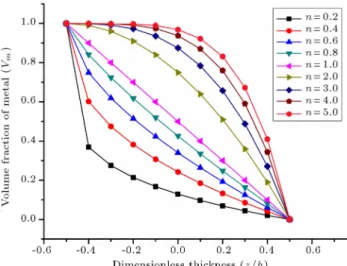
Figure 3. Variation of metal volume fraction, Vm, through the dimensionless thickness (Z=h).
responsible for generating an innite number of varying compositions between two phases. The eect of power law index on the volume fraction of ceramic and metal is shown in Figures 2 and 3.
The eective properties such as Young's modulus, Eef, Poisson's ratio, ef, thermal expansion coecient,
are temperature dependent and are expressed in a non-linear function of temperature [31] as per the rule of mixture (Voigt rule).
Pef = Pb(T ) + [Pt(T ) Pb(T )]
z h+
1 2
n
; (2) where Pt and Pb are the properties of constituents at
the top and the bottom of the plate. In this paper, metal is at the bottom (z = h=2), and ceramic is at the top (z = +h=2).
Pm(T ) and Pc(T )
= P0(P 1T 1+ 1 + P1T + P2T2+ P3T3); (3)
where P0, P 1, P1, P2, and P3 are the coecients
of temperature T (in K) and are unique for the constituent materials. The temperature-dependent material properties (E, , , k) can be obtained through Eqs. (4)-(7):
E(z; T )=Em(T )+[Ec(T ) Em(T )]
z h+
1 2
n ; (4)
(z; T )=m(T )+[c(T ) m(T )]
z h+
1 2
n
; (5)
(z; T ) = m(T ) + [c(T ) m(T )]
z h+
1 2
n
; (6)
k(z; T ) = km(T ) + [kc(T ) km(T )]
z h+
1 2
n ; (7) where subscripts m and c refer to metal and ceramic constituents, respectively.
3. Theoretical formulation 3.1. Displacement eld
The displacement eld considering HSDT is assumed, as given in [29,30,32]:
u(x; y; z) = u0(x; y) + zy(x; y) + z2#x(x; y)
+ z3
x(x; y);
v(x; y; z) = v0(x; y) zx(x; y) + z2#y(x; y)
+ z3
y(x; y);
w(x; y; z) = w0(x; y); (8)
where u, v, and w represent the displacements of the point along the (x; y; z) coordinates. u0, v0, w0and x,
ydenote the in-plane displacements and the rotations
of transverse normal to the midplane about x and y axes, respectively. Functions #x, #y, xand y are the
higher-order terms in Taylor series expansion dened in the mid-plane of the plate.
A modied displacement model can be derived by implementing the assumption of zero transverse shear stress (xz; yz) across the interface (the traction-free
condition). Hence, the shear strain is considered zero and is presented as follows:
xz = @u@z +@w@x = y+2z#x+3z2 x+@w@x0 = 0;
yz=@v@z+@w@y= x+2z#y+3z2 y+@w@y0=0: (9)
By simplifying Eq. (8), the displacement model can be modied. Further, to obtain C0 continuity, two new
variables x and y are introduced by using a relation
given in Appendix (Eq. (A.1)).
The modied displacement model with C0
conti-nuity is presented as follows: u = u0+ zy c1z3(y+ x);
v = v0 zx c1z3( x+ y);
w = w0; (10)
where c1 = 4=3h2 and u, v, w, x, y, x, and y are
considered as eld variables for structural deformation. 3.2. Nonlinear temperature rise
The temperature distribution along the thickness di-rection can be obtained by solving a one-dimensional steady-state heat transfer equation. The steady-state heat conduction equation for the temperature through the thickness is given by:
d dz
k(z; T )dTdz
= 0: (11)
Further, Eq. (11) can be solved by imposing the boundary condition of T = Tmat z = h=2 and T = Tc
at z = h=2.
The variation of temperature in an FGM plate through the thickness is expressed as follows:
T (z) = Tm (Tc Tm) z
R
h=2
(1=k(z; T )) dz
h=2R
h=2(1=k(z; T )) dz
: (12)
The solution to the above equation as obtained by using polynomial series is as follows:
T (z) = Tm+TP
z h+
1 2
kcm
(n + 1)km
z h+
1 2
n+1
+ k2cm
(2n + 1)k2 m
z h+
1 2
k3 cm
(3n + 1)k3 m z h+ 1 2 3n+1
+(4n + 1)kk4cm 4
m z h+ 1 2 4n+1 k5 cm
(5n + 1)k5 m z h+ 1 2 5n+1 ; (13) where:
P = 1 (n + 1)kkcm
m +
k2 cm
(2n + 1)k2 m
k3 cm
(3n + 1)k3 m
+ kcm4
(4n + 1)k4 m
k5 cm
(5n + 1)k5
m; (14)
and:
kcm= kc km:
3.3. Nonlinear formulation
The strain developed in the FGM plate is the sum of linear and nonlinear strains. The nonlinear strain presents the Green-Lagrange strain displacement rela-tion associated with moderately large displacements, and rotations include all the eld variables as shown in relations given below:
f"g = f"Lg + f"NLg: (15)
The above equation can be presented in the form of linear and nonlinear parts:
8 > > > > < > > > > : "xx "yy xy xz yz 9 > > > > = > > > > ; = 8 > > > > < > > > > : u;x v;y
u;y+ v;x
u;z+ w;x
v;z+ w;y
9 > > > > = > > > > ; + 8 > > > > > > > > > > > > < > > > > > > > > > > > > : 1 2
(u;x)2+ (v;x)2+ (w;x)2 1
2
(u;y)2+ (v;y)2+ (w;y)2
f(u;x)(u;y) + (v;x)(v;y) + (w;x)(w;y)g
f(u;x)(u;z) + (v;x)(v;z) + (w;x)(w;z)g
f(u;y)(u;z) + (v;y)(v;z) + (w;y)(w;z)g
9 > > > > > > > > > > > > = > > > > > > > > > > > > ; : (16)
By substituting Eq. (10) in Eq. (16), the strain dis-placement relation of the plate can be expressed as follows:
f"Lg =
8 > > > > < > > > > : "0 1 "0 2 "0 6 "0 5 "0 4 9 > > > > = > > > > ; + z 8 > > > > < > > > > : 1 1 1 2 1 6 1 5 1 4 9 > > > > = > > > > ;
+ z2
8 > > > > < > > > > : 2 1 2 2 2 6 2 5 2 4 9 > > > > = > > > > ;
+ z3
8 > > > > < > > > > : 3 1 3 2 3 6 3 5 3 4 9 > > > > = > > > > ; ;
f"NLg =12
8 > > > > < > > > > : "nl0 1 "nl0 2 "nl0 6 "nl0 5 "nl0 4 9 > > > > = > > > > ;
+z2 8 > > > > < > > > > : nl1 1 nl1 2 nl1 6 nl1 5 nl1 4 9 > > > > = > > > > ;
+z2 2 8 > > > > < > > > > : nl2 1 nl2 2 nl2 6 nl2 5 nl2 4 9 > > > > = > > > > ;
+z3 2 8 > > > > < > > > > : nl3 1 nl3 2 nl3 6 nl3 5 nl3 4 9 > > > > = > > > > ;
+z24 8 > > > > < > > > > : nl4 1 nl4 2 nl4 6 nl4 5 nl4 4 9 > > > > = > > > > ;
+z25 8 > > > > < > > > > : nl5 1 nl5 2 nl5 6 nl5 5 nl5 4 9 > > > > = > > > > ;
+z26 8 > > > > < > > > > : nl6 1 nl6 2 nl6 6 nl6 5 nl6 4 9 > > > > = > > > > ; : (17)
The individual strain terms are described in Ap-pendix (Eq. (A.2)).
f"Lg =
"0
1; "02; "06; "05; "04; 11; 12; 16; 15; 14;
2
1; 22; 26; 25; 24; 31; 32; 36; 35; 34
; (18)
and:
f"NLg = 12
8 > > > > > > < > > > > > > : "nl0
1 ; "nl02 ; "nl06 ; "nl05 ; "nl04 ; nl11 ;
nl1
2 ; nl16 ; nl15 ; nl14 ; nl21 ; nl22 ;
nl2
6 ; nl25 ; nl24 ; nl31 ; nl32 ; nl36 ;
nl3
5 ; nl34 ; nl41 ; nl42 ; nl46 ; nl45 ;
nl4
4 ; nl51 ; nl52 ; nl56 ; nl55 ; nl54 ;
nl6
1 ; nl62 ; nl66 ; nl65 ; nl64
9 > > > > > > = > > > > > > ; : (19)
f"Lg and f"NLg are the mid-plane linear and nonlinear
strain terms. Superscripts 0, 1 and nl0, nl1 denote membrane and bending terms; 2-3 and nl2 nl6 represent higher-order terms, respectively.
3.4. Thermo-elastic constitutive relations The constitutive equation for the FGM plate subjected to thermal load is presented as follows:
fg = Qf" Tg; (20) where fg and f"g are the stress and strain vectors, [ Q] is the transformed reduced elastic stiness matrix, T is the increment of the temperature of the ceramic interface over reference temperature T0, and is the
coecient of the thermal expansion.
Further, Eq. (20) can be expanded and rewritten as follows:
8 > > > > < > > > > :
xx
yy
xy
xz
yz
9 > > > > = > > > > ;
= 2 6 6 6 6 4
Q11 Q12 0 0 0
Q21 Q22 0 0 0
0 0 Q66 0 0
0 0 0 Q44 0
0 0 0 0 Q55
3 7 7 7 7 5
0 B B B B @
8 > > > > < > > > > :
"xx
"yy
xy
xz
yz
9 > > > > = > > > > ;
8 > > > > < > > > > : 1 1 0 0 0
9 > > > > = > > > > ;
(z; T )T 1 C C C C
A; (21)
where:
Q11= Q22=1 (z; T )E(z; T ) 2;
Q12= Q21=(z; T )E(z; T )1 (z; T )2 ;
Q44= Q55= Q66= 2(1 + (z; T ))E(z; T ) ;
and T is the temperature change for a stress-free state, E(z; T ) is the modulus, and (z; T ) is the coecient of the thermal expansion.
4. FEM model
For the present analysis, the model is discretized using an eight-noded isoparametric quadratic element with seven degrees of freedom associated with each node for the nite element modeling. The eld variables at any arbitrary point are related to the nodal eld variables via shape functions Ni. The relation is presented below
as in the study of Cook et al. [33]: feg =ue
0; v0e; w0e; xe; ye; ex; ey ;
and:
fg =X8
i=1
Ne
i(; )feg; (22)
where ue
0, ve0, we0, xe, ey, xe, ye are the eld
variables/degrees of freedom, Ne
i(; ) are the shape
functions, and , are the natural coordinates.
5. The energy equations 5.1. Strain energy
The strain energy of the plate can be expressed as follows:
U =12 Z
V
f"gTfgdV: (23)
The vectors of the strain component are:
fg = Qf"g; (24) f"g =
BL+12BNL
fge: (25)
By substituting the strain and stress vectors from Eq. (24) and (25) in Eq. (23), the expression can be rewritten as follows:
U =12 Z
A
f"gT Qf"gdxdy
=1 2
Z
A
("L+ "NL)T Q("L+ "NL)dA: (26)
The Eq. (26) can be further modied as follows:
Us=12
Z
A
f"LgT[P1]f"Lg +21f"LgT[P2]f"NLg
+12f"NLgT[P3]f"Lg
+1
4f"NLgT[P4]f"NLg
dA; (27)
P1= 8
X
i=1 h=2
Z
h=2
[HL]T Q[HL]dz;
P2= 8
X
i=1 h=2
Z
h=2
[HL]T Q[HNL]dz;
P3= 8
X
i=1 h=2
Z
h=2
[HNL]T Q[HL]dz;
P4= 8
X
i=1 h=2
Z
h=2
[HNL]T Q[HNL]dz; (28)
where [HL] and [HNL] are the thickness matrices given
in Appendix (Eq. (A.2)), and [P1], [P2], [P3] and [P4]
are the modied reduced elastic stiness matrices as expressed in Eq. (28).
The total strain energy (Utotal) can be expressed
as follows:
Utotal= (Us+ Uef): (29)
Us=12
fgtrfB
Lgtr[P1]fBLgfg
+12fgtrfB
Lgtr[P2]fBNLgfg
+12fgtrfB
NLgtr[P3]fBLgfg
+1
4fgtrfBNLgtr[P4]fBNLgfg
: (30) The strain energy due to elastic foundation (Uef) is:
Uef=12 a
Z
0 b
Z
0
"
kww2+ks @w@x
2 +
@w
@y 2!#
dxdy; (31) where kwand ksare the Winkler and shear/Pasternak
moduli.
5.2. Kinetic energy
The kinetic energy of an FGM plate is expressed as in the study of Cook et al. [33]:
T =12
h=2
Z
h=2
h( _u)2+ ( _v)2+ ( _w)2idA
=12n_otr[M]n_o: (32) The mass matrix for the FGM plate resting on the elastic foundation is presented as follows:
[M]=
a
Z
0 b
Z
0
[N]tr[I][N]dxdy = 1
Z
1 1
Z
1
[N]tr[I][N]dd;
where [I] and [N] are the inertia and shape function matrix, respectively, as shown in Appendix (Eq. (A.3)). 5.3. Work done due to thermal load
Due to thermal load as well as non-uniform temper-ature rise along the tempertemper-ature-dependent material properties, thermal stress tends to undergo geometric distortion. Due to a change in geometry, thermal stress is developed with a signicant eect on the vibration characteristics. To calculate the solution based on the current transformed state of the structure, the second Piola-Kirchho stress has been considered in the direct iterative method of Green Lagrange-type nonlinearity. In this respect, it is required to calculate the geometric matrix due to the deformed geometry of the structure caused by thermal stress.
The stress developed due to the thermal eect can be presented as follows:
8 < :
N M P
9 = ;=
2 6 4
h=2
Z
h=2
Qf(z;T)g(1;z;z3)T dz
3 7 5 ;
(33)
where:
N M P tr=NT ;MT ;PT tr;
are the in-plane thermal forces, moments, and higher-order terms, respectively.
The work done due to the resultant thermal force is the resultant work carried out by thermal force viz. WT expressed as in the study of Cook et al. [33]:
WT = h=2
Z
h=2
f"Ggtr[S]f"GgdA;
f"Gg = [H][Ag][@] = [BG]fg: (34)
Further, Eq. (34) can be rewritten as follows: WT =12
Z
A
fgtr[B
G]tr[S][BG]fgdA; (35)
where f"Gg is the geometric strain vector, [BG] is
the product form of a dierential operator, and the corresponding matrices [H], [Ag], [@], [S] are described,
as shown in Eqs. (A.4), (A.5), (A.6), and (A.7) in the Appendix. The elemental geometric stiness matrix [KG] for geometric distortion due to thermal load can
be expressed as follows:
[KG] = a
Z
0 b
Z
0
[BG]tr[S][BG]dxdy
=
1
Z
1 1
Z
1
[BG]tr[S][BG]dd: (36)
6. The governing equation
The governing equations are obtained using Hamilton's principle:
t
Z
0
Ldt = 0;
L = = [T (Us+ Uf+ WT)]: (37)
By substituting Eqs. (30), (31), (32), and (35) in Eq. (37), the nal form of the governing equation for nonlinear vibration can be presented as follows:
[M]no+
[KL] [KG]+12[KNL1]+13[KNL2]
fg
= 0: (38)
The global stiness matrix is composed of linear sti-ness matrix [KL], global geometric stiness matrix
[KG], and nonlinear global coupled stiness matrices
[KNL1] and [KNL2] that linearly and quadratically
[KL] = 1
Z
1 1
Z
1
[BL]tr[P1][BL]jJj dd;
[KNL1] =12 1
Z
1 1
Z
1
([BL]tr[P2][BNL]
+ [BNL]tr[P3][BL]) jJj dd;
[KNL2] = 14 1
Z
1 1
Z
1
([BNL]tr[P4][BNL])jJjdd;
[KG] = 1
Z
1 1
Z
1
([BG]tr[S][BG])jJjdd: (39)
In terms of eigenvalue and eigenvector form, Eq. (38) can be written as follows:
(([KL] [KG]+[KNL1]+[KNL2]) !2[M])=0;
(40) where ! and are the natural frequency and its corresponding eigenvector, respectively.
7. Methodology
Eq. (41) can be solved using the direct iteration method, and the step-wise procedure is stated below:
Step 1. Evaluate the elemental stiness and mass matrices using general nite element procedures;
Step 2. Calculate the global stiness and mass matrix by assembling the elemental matrices; Step 3. Solve linear eigenvalue using the global stiness and mass matrix:
([K] !2[M])fg = f0g;
Extract the linear eigenvalue and its corresponding eigenvector using a standard extraction algorithm; Step 4. Scale up the amplitude ratio (Wmax=h)
by the desired value and the ratio of maximum deection of plate Wmax to the thickness of plate h
and normalize the mode shape vector;
Step 5. Obtain the nonlinear stiness matrices [KNL1] and [KNL2] using the scaled-up eigenvector
(mode shape) by a numerical integration technique; Step 6. Solve the nonlinear eigenvalue equation untill the relative convergence criterion is 0.1%:
j!i !i 1j
!i 0:1%:
where i denotes the iteration number.
8. Validation
In order to validate the present method, the numerical results of Si3N4/SUS304 FGM plate are compared with
the published results of the given literature. Table 1 shows the comparison of natural frequency parameters of a square Si3N4/SUS304 FGM plate of side 0.2 m and
side-thickness ratio a=h = 8 subjected to three dierent thermal conditions along ceramic surface Tc = 300 K,
Table 1. Comparison of natural frequency parameters for Si3N4/SUS304 square plate in thermal environment: a = b = 0:2 m, and h = 0:025 m (TD: Temperature Dependent; TI: Temperature Independent).
Temperature Source Volume fraction index (n)
Ceramic n = 0:5 n = 1 n = 2 Metal Tc= Tm= 300 K Present 12.5081 8.7169 7.6081 6.7374 5.4108 Huang and Shen [22] 12.495 8.675 7.555 6.777 5.405 Tc= 400 K, Present 12.3429 8.5815 7.4810 6.6154 5.2908 Tm= 300 K (TD) Huang and Shen [22] 12.397 8.615 7.474 6.693 5.311 Tc= 400 K, Present 12.3781 8.6010 7.4953 6.6258 5.2946 Tm= 300 K (TI) Huang and Shen [22] 12.382 8.641 7.514 6.728 5.335 Tc= 600 K, Present 12.0487 8.3147 7.2199 6.3558 5.0149 Tm= 300 K (TD) Huang and Shen [22] 11.984 8.269 7.171 6.398 4.971 Tc= 600 K, Present 12.1125 8.3628 7.2628 6.3947 5.0518 Tm= 300 K (TI) Huang and Shen [22] 12.213 8.425 7.305 6.523 5.104
400 K, and 600 K. The reference temperature is T0=
Tm= 300 K. The calculated frequency parameter (!)
is compared with the results reported by Huang and Shen [22]. The comparison shows good agreement. The volume fraction index n = 0 corresponds to ceramic and n = 8 corresponds to metal.
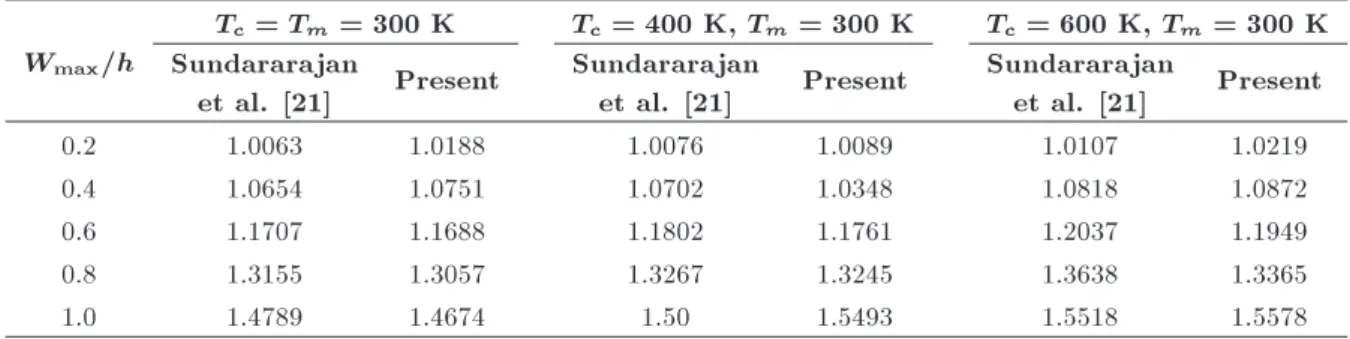
Table 2 shows the comparison of the non-dimensional natural frequency of simply supported square isotropic plate (n = 0) and values given by Baferani et al. [3]. Very good agreement can be observed for all boundary conditions. Table 3 presents the comparison of nonlinear frequency ratio of the
simply supported FGM plate and the values given in Sundararajan et al. [21]. The volume fraction of the FGM plate (n = 1) and side-thickness ratio a=h = 10. The comparison shows very good agreement. Hence, the present formulation can be trusted.
9. Results and discussion
A square Si3N4/SUS304 FGM plate composed of silicon
nitride (ceramic) and steel (metal) supported on the elastic foundation has been considered for the paramet-ric study. The side of the plate is 1 m and thickness is
Table 2. Comparison of non-dimensional natural frequency, !, for homogeneous isotropic SSSS, SSSC, SCSC, and SSSF plates, n = 0.
Foundation parameters Method Boundary conditions
Kw Ks SSSS SSSC SCSC SSSF
0
0 PresentBaferani et al. [3] 19.735019.7374 23.659423.6428 28.995028.9441 11.676511.6898
100 PresentBaferani et al. [3] 48.547348.6149 51.252951.3175 54.616554.6742 37.101537.1519
1000 Present 140.1819 142.4385 144.8770 110.4241 Baferani et al. [3] 141.8730 144.24 146.7191 111.7454
100
0 Present 22.1254 25.6867 30.6717 15.3732
Baferani et al. [3] 22.1261 25.6706 30.6229 15.3834
100 Present 49.5661 52.2199 55.5237 38.4263
Baferani et al. [3] 49.6327 52.2827 55.5811 38.4742 1000 Present 140.5379 142.7889 145.2219 110.8759
Baferani et al. [3] 142.2250 144.5466 147.0595 112.1920
1000
0 PresentBaferani et al. [3] 37.274437.2763 39.492839.4834 42.902442.8686 33.707833.7139
100 PresentBaferani et al.[3] 57.936357.9945 60.222460.2781 63.109363.1603 48.748748.7878
1000 PresentBaferani et al. [3] 143.7040145.3545 145.9058147.6268 148.2876150.0881 114.8621116.1336
Table 3. Comparison study of the nonlinear frequency ratio of a simply supported FGM plate at ambient temperature: a=b = 1, a=h = 10, and n = 1.
Wmax=h
Tc= Tm= 300 K Tc= 400 K, Tm = 300 K Tc= 600 K, Tm= 300 K Sundararajan
et al. [21] Present
Sundararajan
et al. [21] Present
Sundararajan
et al. [21] Present
0.2 1.0063 1.0188 1.0076 1.0089 1.0107 1.0219
0.4 1.0654 1.0751 1.0702 1.0348 1.0818 1.0872
0.6 1.1707 1.1688 1.1802 1.1761 1.2037 1.1949
0.8 1.3155 1.3057 1.3267 1.3245 1.3638 1.3365
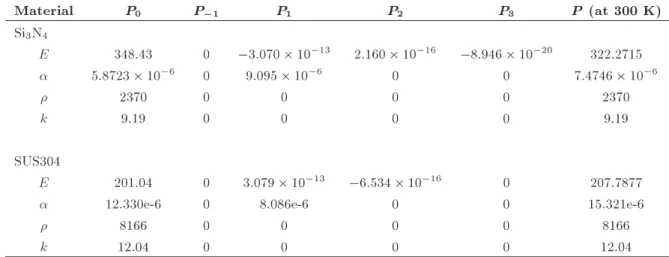
Table 4. Temperature-dependent material properties of elastic modulus, E (GPa), Poisson's ratio, , coecient of thermal expansion, (1=K), density, (kg/m3), and thermal conductivity, k, (W/mK) of ceramic and metal.
Material P0 P 1 P1 P2 P3 P (at 300 K)
Si3N4
E 348.43 0 3:070 10 13 2:160 10 16 8:946 10 20 322.2715
5:8723 10 6 0 9:095 10 6 0 0 7:4746 10 6
2370 0 0 0 0 2370
k 9.19 0 0 0 0 9.19
SUS304
E 201.04 0 3:079 10 13 6:534 10 16 0 207.7877
12.330e-6 0 8.086e-6 0 0 15.321e-6
8166 0 0 0 0 8166
k 12.04 0 0 0 0 12.04
0.05 m. The Poisson's ratio, , is assumed to be 0.28. The two-parameter (Pasternak) elastic foundation has been considered. The material properties of ceramic and metal are shown in Table 4. The Poisson's ratio is taken as = 0:28.
Non-dimensional frequency (!) as given in De-hghan and Baradaran [14] is:
! = !b22 r
h
D; D =
Eh3
12(1 2):
Non-dimensional elastic coecients of Winkler and Pasternak are:
Kw= kwa 4
D ; Ks= ksa2
D :
9.1. Eect of volume fraction index (n)
Figure 4 shows the eect of volume fraction index (n) on the frequency parameter of an FGM plate with
Figure 4. Variation of nonlinear frequency parameter for dierent volume fraction indexes (n).
a side-thickness ratio (a=h = 40), elastic foundation modulus coecient Kw = Ks = 100, and the
tem-perature along the ceramic side (Tc = 400 K) with a
change in amplitude ratio. The linear and nonlinear frequencies decrease with an increase in the volume fraction index. With an increase in the value of volume fraction index, the ceramic content decreases, thereby decreasing the stiness. Hence, the frequency parameter decreases.
9.2. Eect of aspect ratio (a=b) and side-thickness ratio (a=h)
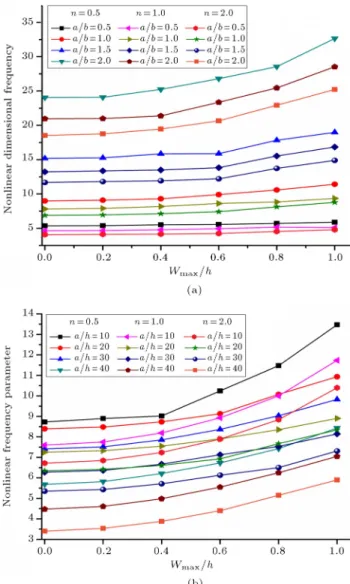
Figure 5(a) shows the eect of aspect ratio on the nonlinear frequency parameter of the FGM plate with volume fraction index n = 0:5, 1, and 2, side-thickness ratio a=h = 20, the elastic foundation modulus co-ecient Kw = Ks = 100, and the temperature in
ceramic side Tc = 400 K with a change in amplitude
ratio. The amplitude ratio (Wmax=h) presents the
degree of nonlinearity. Wmax presents the maximum
transverse displacement with h, the thickness of the element. When Wmax=h = 0, it provides a complete
linear condition and, with a simultaneous increase in amplitude, the nonlinearity increases. Hence, it is observed that, with an increase in aspect ratio, both the linear and nonlinear frequency parameters increase. Figure 5(b) shows the eect of side-thickness ratio (a=h) on the frequency parameter of the FGM plate (a=h = 30, Kw = 10, Ks = 10, and T = 100 K)
with an increase in amplitude ratio. Both the linear and nonlinear frequency parameters decrease with an increase in the side-thickness ratio.
9.3. Eect of Winkler modulus (Kw) and
Pasternak/shear modulus (Ks)
Figure 6 presents the inuence of foundation modulus (Kw, Ks) on the nonlinear frequency parameter of
Figure 5. (a) Variation of nonlinear frequency parameter with varying aspect ratios. (b) Variation of nonlinear frequency parameter with varying side-thickness ratio.
T = 100 K) with a change in amplitude ratio. In Figure 6(a) the frequency parameter increases with an increase in the values of Wmax=h and Kw by keeping
the shear modulus coecient as constant, Ks= 10. In
Figure 6(b) the frequency parameter increases with an increase in the values of Ks and Wmax=h by keeping
the Winkler modulus coecient as constant, Kw= 10.
The frequency parameter for an FGM plate is higher if the plate rests on the elastic foundation. A small change in frequency parameter is noticed with the rise in Winkler modulus coecient, whereas a signicant change is noticed when the plate is supported on Pasternak/shear elastic foundation.
Figure 7 shows the eect of the elastic foundation modulus with Winkler modulus coecient (Kw) and
shear layer modulus coecient (Ks) on the frequency
parameter of the FGM plate with volume fraction index (n = 1), the side-thickness ratio (a=h = 30; 40), and temperature rise (T = 100 K). The reference
Figure 6. (a) Variation of the nonlinear frequency parameter for dierent Winkler modulus coecients (Kw) with changes in the amplitude ratio. (b) Variation of nonlinear frequency parameter for dierent shear modulus coecient (Ks) with change in amplitude ratio.
temperature is considered as 300 K along the metal side (Tm= 300 K). The plate supported on the elastic
foundation has a higher frequency parameter than the plate without foundation. The shear layer modulus has a more signicant eect on the fundamental frequency parameter than the Winkler modulus. The linear and nonlinear frequency parameters increase with an increase in Winkler modulus and, also, increases with an increase in shear layer modulus.
9.4. Eect of change in temperature
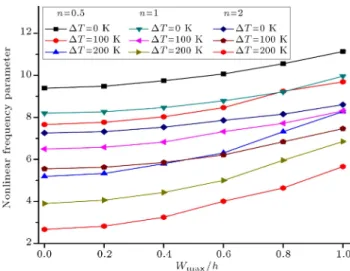
Figure 8 shows the variation of nonlinear frequency pa-rameter with a change in nonlinear temperature along the ceramic side of the FGM plate with side-thickness ratio (a=h = 30) for dierent compositions (n = 0:5, 1 and 2). The two-parameter elastic foundation modulus consists of Winkler modulus coecient Kw = 50 and
shear modulus coecient Ks= 50. The linear and
Figure 7. Nonlinear frequency parameter versus amplitude ratio with the varying elastic foundation modulus, Kw, Ks, at dierent side-thickness ratios.
Figure 8. Nonlinear frequency parameter versus amplitude ratio with varying temperature rises.
in temperature rise (T ). At higher temperatures, the Young's modulus of the plate weakens and, thus, reduces the corresponding frequency and degrades the strength of the material, as shown in Figure 9. 9.5. Eect of boundary conditions
Figure 10 shows the eect of varying boundary condi-tions on frequency parameter for the FGM plate with dierent compositions n = 0:5, 1, 2, side-thickness ratio a=h = 20, elastic foundation modulus coecient Kw = Ks = 100, and the temperature at ceramic
side Tc = 400 K with a change in amplitude ratio.
The FGM plate with all sides clamped has higher linear and nonlinear frequency parameters followed by SCSC (simply clamped-simply supported-clamped) and SSSS (all sides are simply supported).
Figure 9. Variation of modulus of elasticity with changes in temperature increment and volume fraction index with varying dimensionless thicknesses.
Figure 10. Variation of nonlinear frequency parameter with changes in boundary conditions.
The frequency increases with an increase in the number of clamped sides.
10. Conclusion
In this study, a numerical method was employed to obtain the nonlinear frequency parameters using modied HSDT with C0 continuity. By
consider-ing Green-Lagrange nonlinearity, a general case was developed that includes all the nonlinear terms and predicts the original exure of the plate. The nonlinear analysis showed hardening type nonlinear behavior that depends on the level of amplitude. The number of iterations involved to obtain the convergence of solution increases with increases in the amplitude ratio. It was found that the intermediate material prop-erty did not necessarily give intermediate nonlinear
frequency. The conclusions drawn from the outcomes are:
a. The shear layer modulus coecient has a greater eect on the fundamental frequency parameter than Winkler modulus coecient does. The linear and nonlinear frequency parameters of the FGM plate increased with an increase in Winkler coecient and Pasternak/shear coecient;
b. The linear and nonlinear frequency parameters of the FGM plate resting on the elastic foundation increase with an increase in the aspect ratio and decrease with an increase in side-thickness ratio;
c. The nonlinear fundamental frequency of the FGM plate resting on elastic foundation decreases with an increase in volume fraction index and in tem-perature along the ceramic surface;
d. The nonlinear fundamental frequency increases with an increase in the number of clamped sides and decreases with an increase in the number of simply supported sides.
References
1. Akhavan, H., Hashemi, S.H., Taher, H.R.D., Alibei-gloo, A., and Vahabi, S. \Exact solutions for rectan-gular Mindlin plates under in-plane loads resting on Pasternak elastic foundation. Part I: Buckling analy-sis", Comput. Mater. Sci., 44, pp. 968-978 (2009).
2. Akhavan, H., Hashemi, S.H., Taher, H.R.D., Alibei-gloo, A., and Vahabi, S. \Exact solutions for rectan-gular Mindlin plates under in-plane loads resting on Pasternak elastic foundation. Part II: Frequency anal-ysis", Comput. Mater. Sci., 44, pp. 951-961 (2009).
3. Baferani, A.H., Saidi, A.R., and Ehteshami, H. \Accu-rate solution for free vibration analysis of functionally graded thick rectangular plates resting on elastic foun-dation", Compos. Struct., 93, pp. 1842-1853 (2011).
4. Bodaghi, M. and Saidi, A.R. \Stability analysis of functionally graded rectangular plates under nonlin-early varying in-plane loading resting on elastic foun-dation", Arch. Appl. Mech., 81, pp. 765-780 (2011).
5. Chien, R.-D. and Chen, C.-S. \Nonlinear vibration of laminated plates on a nonlinear elastic foundation", Compos. Struct., 70, pp. 90-99 (2005).
6. Duc, N.D., Bich, D.H., and Cong, P.H. \Nonlinear thermal dynamic response of shear deformable FGM plates on elastic foundations", J. Therm. Stress., 39, pp. 278-297 (2016).
7. Gajendar, N. \Large amplitude vibration of plates on elastic foundations", Int. J. Non-Linear Mech., 2, pp. 163-172 (1967).
8. Kiani, Y., Shakeri, M., and Eslami, M.R. \Thermoe-lastic free vibration and dynamic behaviour of an FGM doubly curved panel via the analytical hybrid Laplace-Fourier transformation", Acta Mech., 223, pp. 1199-1218 (2012).
9. Kiani, Y., Akbarzadeh, A.H., Chen, Z.T., and Es-lami, M.R. \Static and dynamic analysis of an FGM doubly curved panel resting on the Pasternak-type elastic foundation", Compos. Struct., 94, pp. 2474-2484 (2012).
10. Shen, H., Chen, X., Licheng, G., Wu, L., and Huang, X.-L. \Nonlinear vibration of FGM doubly curved panel resting on elastic foundations in thermal environ-ments", Aerosp. Sci. Technol., 47, pp. 434-446 (2015).
11. Shen, H.S. and Wang, Z.X. \Nonlinear vibration of hybrid laminated plates resting on elastic foundations in thermal environments", Appl. Math. Model., 36, pp. 6275-6290 (2012).
12. Shen, H.S. and Wang, H. \Nonlinear vibration of shear deformable FGM cylindrical panels resting on elastic foundations in thermal environments", Compos. Part B Eng., 60, pp. 167-177 (2014).
13. Huang, Z.Y., Lu, C.F., and Chen, W.Q. \Benchmark solutions for functionally graded thick plates resting on Winkler-Pasternak elastic foundations", Compos. Struct., 85, pp. 95-104 (2008).
14. Dehghan, M. and Baradaran, G.H. \Buckling and free vibration analysis of thick rectangular plates resting on elastic foundation using mixed nite element and dif-ferential quadrature method", Appl. Math. Comput., 218, pp. 2772-2784 (2011).
15. Qin, Q.H. and Diao, S. \Nonlinear analysis of thick plates on an elastic foundation by HT FE with p-extension capabilities", Int. J. Solid Struct., 33, pp. 4583-4604 (1996).
16. Duc, N.D. and Cong, P.H. \Nonlinear postbuckling of symmetric S-FGM plates resting on elastic foundations using higher order shear deformation plate theory in thermal environments", Compos. Struct., 100, pp. 566-574 (2013).
17. Fallah, A., Aghdam, M.M., and Kargarnovin, M.H. \Free vibration analysis of moderately thick function-ally graded plates on elastic foundation using the extended Kantorovich method", Arch. Appl. Mech., 83, pp. 177-191 (2013).
18. Fallah, A. and Aghdam, M.M. \Nonlinear free vibra-tion and post-buckling analysis of funcvibra-tionally graded beams on nonlinear elastic foundation", Eur. J. Mech. A/Solids., 30, pp. 571-583 (2011).
19. Tacza la, M., Buczkowski, R., and Kleiber, M. \Non-linear free vibration of pre- and post-buckled FGM plates on two-parameter foundation in the thermal environment", Compos. Struct., 137, pp. 85-92 (2016).
20. Yang, Z., Yuan-yuan, G., and Fangin, B. \Solution for a rectangular plate on elastic foundation with free edges using reciprocal theorem method", Math. Eterna., 2, pp. 335-343 (2012).
21. Sundararajan, N., Prakash, T., and Ganapathi, M. \Nonlinear free exural vibrations of functionally graded rectangular and skew plates under thermal environments", Finite Elem. Anal. Des., 42, pp. 152-168 (2005).
22. Huang, X.-L. and Shen, H.-S. \Nonlinear vibration and dynamic response of functionally graded plates in thermal environments", Int. J. Solids Struct., 41, pp. 2403-2427 (2004).
23. Civalek, O. \Nonlinear analysis of thin rectangular plates on Winkler-Pasternak elastic foundations by DSC-HDQ methods", Appl. Math. Model., 31, pp. 606-624 (2007).
24. Qin, Q.H. \Nonlinear analysis of reissner plates on an elastic foundation by the bem", Int. J. Solids Struct., 30, pp. 3101-3111 (1993).
25. Singha, M.K. and Daripa, R. \Nonlinear vibration and dynamic stability analysis of composite plates", J. Sound Vib., 328, pp. 541-554 (2009).
26. Thi, V.T.A. and Duc, N.D. \Nonlinear response of a shear deformable S- FGM shallow spherical shell with ceramic-metal- ceramic layers resting on an elastic foundation in a thermal environment", Mech. Adv. Mater. Struct., 23, pp. 926-934 (2016).
27. Tornabene, F., Fantuzzi, N., Viola, E., and Reddy, J.N. \Winkler-Pasternak foundation eect on the static and dynamic analyses of laminated doubly-curved and degenerate shells and panels", Compos. Part B Eng., 57, pp. 269-296 (2014).
28. Tornabene, F., Viola, E., and Fantuzzi, N. \General higher-order equivalent single layer theory for free vibrations of doubly-curved laminated composite shells and panels", Compos. Struct., 104, pp. 94-117 (2013).
29. Szekrenyes, A. \Nonsingular crack modelling in or-thotropic plates by four equivalent single layers", Eur. J. Mech. - A/Solids., 55, pp. 73-99 (2016a).
30. Szekrenyes, A. \Semi-layerwise analysis of laminated plates with nonsingular delamination-The theorem of autocontinuity", Appl. Math. Model., 40(2), pp. 1344-1371 (2016b).
31. Touloukin, Y.S., Thermophysical Properties of High Temperature Solid Materials, MacMillan, New York (1967).
32. Petyt, M., Introduction to Finite Element Vibration Analysis, Cambridge University Press, 2nd Ed. (2010).
33. Cook, R.D., Malkus, D.S., Plesha, M.E., and Witt, R.J., Concepts and Applications of Finite Element Analysis, Fourth Edn., John Wiley & Sons (Asia), Pvt. Ltd. (2002).
Appendix
c1= 3h42; x=@w@x0; y =@w@y0: (A.1)
Strain terms:
f"Lg =
8 > > > > < > > > > : "0 1 "0 2 "0 6 "0 5 "0 4 9 > > > > = > > > > ; + z 8 > > > > < > > > > : 1 1 1 2 1 6 1 5 1 4 9 > > > > = > > > > ;
+ z2
8 > > > > < > > > > : 2 1 2 2 2 6 2 5 2 4 9 > > > > = > > > > ;
+ z3
8 > > > > < > > > > : 3 1 3 2 3 6 3 5 3 4 9 > > > > = > > > > ; ;
f"NLg =12
8 > > > > < > > > > : "nl0 1 "nl0 2 "nl0 6 "nl0 5 "nl0 4 9 > > > > = > > > > ;
+z2 8 > > > > < > > > > : nl1 1 nl1 2 nl1 6 nl1 5 nl1 4 9 > > > > = > > > > ;
+z22 8 > > > > < > > > > : nl2 1 nl2 2 nl2 6 nl2 5 nl2 4 9 > > > > = > > > > ;
+z23 8 > > > > < > > > > : nl3 1 nl3 2 nl3 6 nl3 5 nl3 4 9 > > > > = > > > > ;
+z24 8 > > > > < > > > > : nl4 1 nl4 2 nl4 6 nl4 5 nl4 4 9 > > > > = > > > > ;
+z5 2 8 > > > > < > > > > : nl5 1 nl5 2 nl5 6 nl5 5 nl5 4 9 > > > > = > > > > ;
+z6 2 8 > > > > < > > > > : nl6 1 nl6 2 nl6 6 nl6 5 nl6 4 9 > > > > = > > > > ; : (A.2)
Linear strain terms:
8 > > > > < > > > > : "0 1 "0 2 "0 6 "0 5 "0 4 9 > > > > = > > > > ; = 8 > > > > > > > > > > > > > < > > > > > > > > > > > > > : @u0 @x @v0 @y @u0
@y +@v@x0
y+@w@x0
x+@w@y0
9 > > > > > > > > > > > > > = > > > > > > > > > > > > > ; ; 8 > > > > < > > > > : 1 1 1 2 1 6 1 5 1 4 9 > > > > = > > > > ; = 8 > > > > > > > > > > > > > < > > > > > > > > > > > > > : @y @x @x @y @x
@x +@@yy
0 0 9 > > > > > > > > > > > > > = > > > > > > > > > > > > > ; ; 8 > > > > < > > > > : 2 1 2 2 2 6 2 5 2 4 9 > > > > = > > > > ;
= c2
8 > > > > < > > > > : 0 0 0 y+ x
x+ y
9 > > > > = > > > > ; ; 8 > > > > < > > > > : 3 1 3 2 3 6 3 5 3 4 9 > > > > = > > > > ;
= c1
8 > > > > > > > > > > > > > < > > > > > > > > > > > > > : @y
@x @@xx @x
@y @@yy @y
@y +@@xx @@yx @@xy
0 0 9 > > > > > > > > > > > > > = > > > > > > > > > > > > > ; ;
c2= 3c1: (A.2.1)
Non-linear strain terms: "nl0
1 = [(u0;x)2+ (v0;x)2+ (w0;x)2];
"nl0
2 = [(u0;y)2+ (v0;y)2+ (w0;y)2];
"nl0
6 = [2u0;xu0;y+ 2v0;xv0;y+ 2w0;xw0;y];
"nl0
5 = [2yu0;x 2xv0;x];
"nl0
4 = [2yu0;y 2xv0;y];
nl1
1 = [2u0;xy;x 2v0;xx;x];
nl1
2 = [2u0;yy;y 2v0;yx;y];
nl1
6 = [2u0;xy;y+2u0;yy;x 2v0;xx;y 2v0;yx;x];
nl1
5 = [2y;xy+ 2x;xx];
nl1
4 = [2y;yy+ 2x;yx];
nl2
1 = [(y;x)2+ (x;x)2];
nl2
2 = [(y;y)2+ (x;y)2];
nl2
6 = [2y;xy;y+ 2x;xx;y];
nl2
5 = [ 6c1yu0;x 6c1xu0;x+ 6c1xv0;x
6c1yv0;x];
nl2
4 = [ 6c1yu0;y 6c1xu0;y+ 6c1xv0;y
6c1yv0;y];
nl3
1 = [ 2c1u0;xy;x 2c1u0;xx;x+ 2c1v0;xx;x
2c1v0;xy;x];
nl3
2 = [ 2c1u0;yy;y 2c1u0;yx;y+ 2c1v0;yx;y
2c1v0;yy;y];
nl3
6 = [ 2c1u0;xy;y 2c1u0;xx;y 2c1u0;yy;x
2c1u0;yx;x+ 2c1v0;xx;y 2c1v0;xy;y
+ 2c1v0;yx;x 2c1v0;yy;x];
nl3
5 = [ 8c1y;xy 8c1x;xx 2c1x;xy
+ 2c1y;xx 6c1y;xx 6c1x;xy];
nl3
4 = [ 8c1y;yy 8c1x;yx 2c1x;yy
+ 2c1y;yx 6c1y;yx+ 6c1x;yy];
nl4
1 = [ 2c1(y;x)2 2c1(x;x)2 2c1y;xx;x
+ 2c1x;xy;x];
nl4
2 = [ 2c1(y;y)2 2c1(x;y)2 2c1y;yx;y
+ 2c1x;yy;y];
nl4
6 = [ 4c1y;yy;x 2c1y;yx;x 4x;xx;y
+ 2c1x;xy;y 2c1x;yy;x+ 2c1x;yy;x];
nl4
5 = 0; nl44 = 0; nl51 = 0;
nl5
2 = 0; nl56 = 0;
nl5
5 = [6c21x;xx 6c21y;xx 6c21x;xy
+ 6c2
1y;xy+ 6c21y;xy+ 6c21x;xy
+ 6c2
1y;xx+ 6c21x;xx];
nl5
4 = [6c21y;yy+ 6c21x;yy+ 6c21y;yx
+ 6c2
1x;yx+ 6c21x;yx 6c21y;yx
6c2
1x;yy+ 6c21y;yy];
nl6
1 = [c21(y;x)2+ c21(x;x)2+ c21(x;x)2+ c21(y;x)2
+ 2c2
1y;xx;x 2c21x;xy;x];
nl6
2 = [c21(y;y)2+ c21(x;y)2+ c21(x;y)2+ c21(y;y)2
+ 2c2
1y;yx;y 2c21x;yy;y];
nl6
6 = [2c21y;xy;y+ 2c21y;xx;y+ 2c21x;xy;y
+ 2c2
1x;xx;y+ 2c21x;xx;y 2c21x;xy;y
2c2
1y;xx;y+ 2c21y;xy;y];
nl6
5 = 0; nl64 = 0: (A.2.2)
The linear [HL] and nonlinear [HNL] thickness matrices
are calculated by Eq. (A.2.3) as shown in Box I. Inertia Matrix [I]:
[I]1;1= I0; [I]2;2= I0; [I]3;3= I0;
[I]4;4= c21 I6; [I]4;7= c1 J4;
[I]5;5= c21 I6; [I]5;6= c1 J4;
[I]6;5= c1 J4; [I]6;6= K2;
HL=
2 6 6 6 6 4
1 0 0 0 0 z 0 0 0 0 z2 0 0 0 0 z3 0 0 0 0
0 1 0 0 0 0 z 0 0 0 0 z2 0 0 0 0 z3 0 0 0
0 0 1 0 0 0 0 z 0 0 0 0 z2 0 0 0 0 z3 0 0
0 0 0 1 0 0 0 0 z 0 0 0 0 z2 0 0 0 0 z3 0
0 0 0 0 1 0 0 0 0 z 0 0 0 0 z2 0 0 0 0 z3
3 7 7 7 7 5;
HNL=
2 6 6 6 6 4
1 0 0 0 0 z 0 0 0 0 z2 0 0 0 0 z3 0 0 0 0 z4 0 0
0 1 0 0 0 0 z 0 0 0 0 z2 0 0 0 0 z3 0 0 0 0 z4 0
0 0 1 0 0 0 0 z 0 0 0 0 z2 0 0 0 0 z3 0 0 0 0 z4
0 0 0 1 0 0 0 0 z 0 0 0 0 z2 0 0 0 0 z3 0 0 0 0
0 0 0 0 1 0 0 0 0 z 0 0 0 0 z2 0 0 0 0 z3 0 0 0
0 0 z5 0 0 0 0 z6 0 0 0 0
0 0 0 z5 0 0 0 0 z6 0 0 0
0 0 0 0 z5 0 0 0 0 z6 0 0
z4 0 0 0 0 z5 0 0 0 0 z6 0
0 z4 0 0 0 0 z5 0 0 0 0 z6
3 7 7 7 7
5: (A.2.3)
Box I
where:
Ii= h=2
Z
h=2
zidz; (i = 0; 2; 4; 6);
c1= 3h42; K2= I2 2c1J4+ c21I6;
J4= I4 c1I6:
The work done due to nonlinear temperature rise WT:
WT = h=2
Z
h=2
f"Ggtr[S] f"Gg ; (A.4)
where:
f"Gg = 12
2 6 6 6 6 4
u2
;x+ v2;x+ w2;x ;
u2
;y+ v2;y+ w2;y ;
2 fu;xu;y+ v;xv;y+ w;xw;yg
3 7 7 7 7 5;
or:
f"Gg = [H] [Ag] [@] = [BG] fg ;
[H]= 2
41 0 0 c1z
3 0 0 z c
1z3
0 1 0 0 c1z3 z c1z3 0
0 0 1 0 0 0 0 3 5;
[Ag]=
2
4 fufu;x;y+ v+ v;x;y+ w+ w;y;xgg fu;xu;y+v;xv;y+w;xw;yg
3
5 ; [@]= 2 6 6 6 6 6 6 4
u;x
u;y
v;x
v;y
w;x
w;y
3 7 7 7 7 7 7 5 ;
[S] = 2 6 6 6 6 6 6 4
NT
x NxyT 0 0 0 0
NT
xy NyT 0 0 0 0
0 0 NT
x NxyT 0 0
0 0 NT
xy NyT 0 0
0 0 0 0 NT x NxyT
0 0 0 0 NT xy NyT
3 7 7 7 7 7 7 5 :
Terms of [Ag] matrix:
[Ag]1;1 = u;x; [Ag]1;3= v;x; [Ag]1;5 = w;x;
[Ag]2;2 = u;y; [Ag]2;4= v;y; [Ag]2;6= w;y;
[Ag]3;1 = u;y; [Ag]3;2= u;x; [Ag]3;3 = v;y;
[Ag]3;4 = v;x; [Ag]3;5= w;y; [Ag]3;6 = w;x;
[Ag]4;1 = y; [Ag]4;3= x; [Ag]4;17 = v;x;
[Ag]4;18=u;x; [Ag]5;2 = y; [Ag]5;4= x;
[Ag]5;17= v;y; [Ag]5;18= u;y;
[Ag]6;1 = y;x; [Ag]6;3 = x;x;
[Ag]6;11= v;x; [Ag]6;13 = u;x;
[Ag]7;2 = y;y; [Ag]7;4= x;y;
[Ag]7;12= v;y; [Ag]7;14= u;y;
[Ag]8;3 = x;y; [Ag]8;4= x;x;
[Ag]8;11 = v;y; [Ag]8;12= v;x;
[Ag]8;13 = u;y; [Ag]8;14 = u;x;
[Ag]9;11 = x; [Ag]9;13= y;
[Ag]9;17 = x;x; [Ag]9;18 = y;x;
[Ag]10;12 = x; [Ag]10;14= y;
[Ag]10;17 = x;y; [Ag]10;18 = y;y;
[Ag]11;11 = x;x; [Ag]11;13 = y;x;
[A]12;12 = x;y; [A]12;14 = y;y;
[A]13;11 = x;y; [A]13;12= x;x;
[A]13;13 = y;y; [Ag]13;14= y;x;
[Ag]14;1 = c2 y c2 x;
[A]14;3 = c2 x c2 y;
[A]14;15 = c2 u;x; [A]14;16= c2 v;x;
[Ag]14;17 = c2 v;x; [Ag]14;18 = c2 u;x;
[A]15;2 = c2 y c2 x;
[A]15;4 = c2 x c2 y;
[A]15;15 = c2 u;y; [Ag]15;16= c2 v;y;
[Ag]15;17 = c2 v;y; [A]15;18= c2 u;y;
[A]16;1 = c1 x;x c1 y;x;
[Ag]16;3 = c1 x;x c1 y;x;
[Ag]16;7 = c1 u;x; [Ag]16;9= c1 v;x;
[Ag]16;11 = c1 v;x; [Ag]16;13= c1 u;x;
[Ag]17;2 = c1 y;y c1 x;y;
[Ag]17;4 = c1 y;y+ c1 x;y;
[Ag]17;8 = c1 u;y; [Ag]17;10= c1 v;y;
[Ag]17;12 = c1 v;y; [Ag]17;14= c2 u;y;
[Ag]18;1 = c1 y;y c1 x;y;
[Ag]18;2 = c1 y;x c1 x;x;
[Ag]18;3 = c1 x;y c1 y;y;
[Ag]18;4 = c1 x;x c1 y;x;
[Ag]18;7 = c1 u;y; [Ag]18;8 = c1 u;x;
[Ag]18;9 = c1 v;y; [Ag]18;10= c1 v;x;
[Ag]18;11 = c1 v;y; [Ag]18;12= c1 v;x;
[Ag]18;13 = c1 u;y; [Ag]18;14= c1 u;x;
[Ag]19;7 = c1 y; [Ag]19;9= c1 x;
[Ag]19;11 = 4 c1 x c2 y;
[Ag]19;13 = 4 c1 y c2 x;
[Ag]19;15 = c2 y;x; [Ag]19;16= c2 x;x;
[Ag]19;17 = 4 c1 x;x+ c1 y;x;
[Ag]19;18 = 4 c1 y;x c1 x;x;
[Ag]20;8 = c1 y; [Ag]20;10= c1 x;
[Ag]20;12 = 4 c1 x+ c2 y;
[Ag]20;14 = 4 c1 y c2 x;
[Ag]20;15 = c2 y;y; [Ag]20;16= c2 x;y;
[Ag]20;17 = 4 c1 x;y+ c1 y;y;
[Ag]20;18 = 4 c1 y;y c1 x;y;
[Ag]21;7 = c1 y;x; [Ag]21;9 = c1 x;x;
[Ag]21;11 = c1 y;x 2c1 x;x;
[Ag]22;8= c1 y;y; [Ag]22;10= c1 x;y;
[Ag]22;12= 2c1 x;y+ c1 y;y;
[Ag]22;14= 2c1 y;y c1 x;y;
[Ag]23;7= c1 y;y; [Ag]23;8= c1 y;x;
[Ag]23;9= c1 x;y; [Ag]23;10= c1 x;x;
[Ag]23;11= 2c1 x;y+ c1 y;y;
[Ag]23;12= 2c1 x;x+ c1 y;x;
[Ag]23;13= 2c1 y;y c1 x;y;
[Ag]23;14= 2c1 y;x c1 x;x;
[Ag]29;7= c2c1 y+ c2c1 x;
[Ag]29;9= c2c1 x+ c2c1 y;
[Ag]29;11= c2c1 x c2c1 y;
[Ag]29;13= c2c1 y+ c2c1 x;
[Ag]29;15= c2c1 y;x+ c2c1 x;x;
[Ag]29;16= c2c1 x;x+ c2c1 y;x;
[Ag]29;17= c2c1 x;x c2c1 y;x;
[Ag]29;18= c2c1 y;x+ c2c1 x;x;
[Ag]30;8= c2c1 y+ c2c1 x;
[Ag]30;10= c2c1 x+ c2c1 y;
[Ag]30;12= c2c1 x c2c1 y;
[Ag]30;14= c2c1 y+ c2c1 x;
[Ag]30;15= c2c1 y;y+ c2c1 x;y;
[Ag]30;16= c2c1 x;y+ c2c1 y;y;
[Ag]30;17= c2c1 x;y c2c1 y;y;
[Ag]30;18= c2c1 y;y+ c2c1 x;y;
[Ag]31;7= c21 x;x+ c21 y;x;
[Ag]31;9= c21 y;x c21 x;x;
[Ag]31;11= c21 y;x+ c21 x;x;
[Ag]31;13= c21 x;x+ c21 y;x;
[Ag]32;8= c21 x;y+ c21 y;y;
[Ag]32;10= c21 y;y c21 x;y;
[Ag]32;12= c21 y;y+ c21 x;y;
[Ag]32;14= c21 x;y+ c21 y;y;
[Ag]33;7= c21 x;y+ c21 y;y;
[Ag]33;8= c21 x;x+ c21 y;x;
[Ag]33;9= c21 y;y c21 y;x;
[Ag]33;10= c21 y;x c21 x;x;
[Ag]33;11= c21 y;y+ c21 x;y;
[Ag]33;12= c21 y;x+ c21 x;x;
[Ag]33;14= c21 x;y+ c21 y;y: (A.5)
Terms of [BG] matrix:
[BG]1;1 = @=@x; [BG]2;2= @=@y;
[BG]3;1 = @=@y; [BG]3;2= @=@x;
[BG]4;3 = @=@x; [BG]4;7= 1;
[BG]5;3 = @=@y; [BG]5;6= 1;
[BG]6;7 = @=@x; [BG]7;6= @=@y;
[BG]8;6 = @=@x; [BG]8;7= @=@y;
[BG]14;4 = c2; [BG]14;7= c2;
[BG]15;5 = c2; [BG]15;6= c2;
[BG]16;4 = c1@=@x; [BG]16;7 = c1@=@x;
[BG]17;5 = c1@=@y; [BG]17;6= c1@=@y;
[BG]18;4 = c1@=@y; [BG]18;5= c1@=@x;
[BG]18;6 = c1@=@x; [BG]18;7 = c1@=@y:
(A.6) Terms of [@] matrix:
[@]1;1 = @=@x; [@]2;1= @=@y;
[@]3;2 = @=@x; [@]4;2= @=@y;
[@]5;3 = @=@x; [@]6;3= @=@y;
[@]7;4 = @=@x; [@]8;4= @=@y;
[@]9;5 = @=@x; [@]10;5= @=@y;
[@]13;7 = @=@x; [@]14;7= @=@y;
[@]15;4 = 1; [@]16;5 = 1;
[@]17;6 = 1; [@]18;7 = 1: (A.7)
Biographies
Smita Parida completed her BTech in Mechanical Engineering from IGIT, Sarang in 2011 and Master degree in CAD/CAM in 2012 from Central Tool Room and Training Centre, Bhubaneswar. Currently, she is pursuing her PhD from National Institute of Technol-ogy, Rourkela, India. Her research interests include the
areas of solid mechanics, functionally graded materials, nite element modeling, and nonlinear analysis. Sukesh Chandra Mohanty received his BSc degree in Mechanical Engineering from UCE(VSSUT) Burla and MTech degree in Mechanical Engineering from IIT (Banaras Hindu University), India. He received his PhD degree from National Institute of Technology (NIT), Rourkela, India. Currently, he is an Associate Professor at the Department of Mechanical Engineering at NIT, Rourkela, India. His research interests include the stability of structures, vibration control, and gear dynamics. He is a member of Institution of Engineers, India.