R E V I E W
Open Access
Transposable elements and their potential role in
complex lung disorder
Muralidharan Sargurupremraj
*and Matthias Wjst
Abstract
Transposable elements (TEs) are a class of mobile genetic elements (MGEs) that were long regarded as junk DNA, which make up approximately 45% of the genome. Although most of these elements are rendered inactive by mutations and other gene silencing mechanisms, TEs such as long interspersed nuclear elements (LINEs) are still active and translocate within the genome. During transposition, they may create lesions in the genome, thereby acting as epigenetic modifiers. Approximately 65 disease-causing LINE insertion events have been reported thus far; however, any possible role of TEs in complex disorders is not well established. Chronic obstructive pulmonary disease (COPD) is one such complex disease that is primarily caused by cigarette smoking. Although the exact molecular mechanism underlying COPD remains unclear, oxidative stress is thought to be the main factor in the pathogenesis of COPD. In this review, we explore the potential role of oxidative stress in epigenetic activation of TEs such as LINEs and the subsequent cascade of molecular damage. Recent advancements in sequencing and computation have eased the identification of mobile elements. Therefore, a comparative study on the activity of these elements and markers for genome instability would give more insight on the relationship between MGEs and complex disorder such as COPD.
Keywords:COPD, Chronic obstructive pulmonary disease, Transposons, Hypomethylation, Genome instability, NGS, Next generation sequencing
A) Transposable elements and their mobility
Transposable elements (TEs) account for nearly half (approximately 45%) of the human genome, which is in contrast to the functional genes that constitute a smaller proportion (approximately 5%) of the human genome [1]. Based on the mechanism of transposition, TEs are classified as class 2 elements or DNA transposons (‘cut and paste’ mechanism of DNA intermediates) and class 1 elements or retrotransposons (‘copy and paste’ me-chanism of RNA intermediates) [1,2]. Of these, retro-transposons are the most important TEs because they can amplify and increase the host genome size. This ability to move enables class 1 elements to strongly affect genome evolution. Retrotransposons are further subdivided into long terminal repeat (LTR) elements and non-LTR elements.
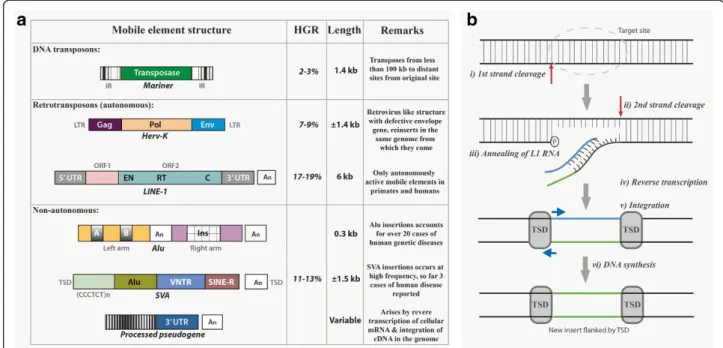
Long interspersed nuclear elements (LINEs) are non-LTR elements that lack non-LTRs at their ends. Most LINEs belong to the LINE-1 (or L1) family and are the only TEs capable of transposing autonomously, which cons-titute approximately 17% of the human genome [1,3]. Although majority of L1s are rendered inactive as mo-lecular fossils by 5′truncations and inversions [4], there are still approximately 80–100 active retrotransposition-competent L1s (RC-L1s). An active L1 is approxi-mately 6 kb in length, containing a 5′-UTR, 2 open reading frames (ORF1 and ORF2) and a 3′-UTR with the characteristic poly (A) tail (Figure 1a) [3,5]. L1 elements either have cis or trans preference [6]. Pro-teins coded by L1s with cis preference (ORF1p and ORF2p) act on other L1 RNAs to aid nuclear import and integration into the genome (Figures 1b, 2a) [7]. Proteins coded by L1s with trans preference assists in the translocation of other non-autonomous elements such as short interspersed nuclear elements (SINEs) (Figure 1a) [6].
* Correspondence:[email protected]
Molecular genetics of lung diseases group, Comprehensive Pneumology Center (CPC), Institute of Lung Biology and Disease (ILBD), Helmholtz Zentrum München, GmbH, Ingolstadter, Landstrasse 1, D-85764, Neuherberg, Munich, Germany
B) Transposition and genome instability
Genome integrity is a crucial determinant in passing down genetic information from one generation to an-other. TE-associated genetic alterations such as aberrant mRNA splicing, introduction of premature stop codon and transcriptional disruptions threaten this integrity. Double-stranded breaks (DSBs) generated by TEs [8] produce tracts of non-allelic sequences that can derange major homology-based repair system (homologous re-combination repair, HRR). This in turn can result in large-scale insertion/deletions (INDELS), inversions and chromosomal rearrangements through non-allelic hom-ologous recombination (NAHR) [9]. Thus far, more than 25 insertion-mediated disorders have been reported [10]. Furthermore, TEs play a crucial role in the genesis of structural variations such as microsatellites repeats [11]. For instance, before integration, L1s and SINEs undergo 3′ extension to generate a 3′-A-rich tail [3,5], which directs further integration of TEs [12]. These newly in-tegrated retrotransposons can readily mutate to pro-microsatellite sequences and turn in to highly unstable structures by processes such as polymerase slippage [13], resulting in microsatellite instability (MSI). Such an as-sociation has been reported in microsatellite-initiating mobile elements (mini-me) of dipteran taxa [14] that
carry pro-microsatellite sequences. After the insertion of mini-me into the genome, slippage-associated mutation introduces variation in these loci to generate micro-satellites. The mechanism observed in dipteran genomes seems to be common among eukaryotes where elements with cryptic repeats tend to decay into microsatellites through insertion-mediated mutations [14].
Microsatellites exhibit high mutation rate compared to point mutations, which makes them a potent regulator of gene expression [15]. MSI, a type of genomic ins-tability, is a modulator in several malignant and benign diseases caused by the instability in tandem repeats (2–6 bp) of microsatellites [16]. MSI is studied by amp-lifying microsatellites that are proximal to a putative gene and examining the shift in electrophoretic pattern caused by the addition or deletion of repetitive units [17]. Genetic studies on MSI have already shown its im-plications as acquired mutations in benign lung condi-tions [18] and as a potential marker for asthma, chronic obstructive pulmonary disease (COPD) and idiopathic pulmonary fibrosis [17,19,20]. Epithelial cells lining the trachea, bronchi and bronchioles of the lungs are prone to such mutations [21]. These mutations can persist even after smoking cessation, possibly explaining the non-intractable inflammation condition in ex-smokers.
Figure 1a) List of mobile elements, structure and its distribution in the human genome.Reference sequence (HGR) and their structure along with examples (Italicized) Abbreviations: IR (Inverted repeats); LTR (Long Terminal Repeat); Gag (Group-specific antigen); Pol (Polymerase); Env (Envelope protein); UTR (Untranslated region); EN (Endonuclease); RT (Reverse transcriptase); C (Cysteine–rich domain); ORF (Open reading frame); An(Poly (A) tail); A & B (Sequences of RNA pol III promoter); Ins (Insertional sequence); TSD (Target site duplication); VNTR (Variable
Studies on bronchial epithelium of smokers [22] further validate this theory of epithelium cells as the prime cells of MSI activity. Furthermore, MSI is significantly associ-ated with exacerbation frequency in patients with COPD [23]. COPD exacerbation is caused by the acute worsen-ing of respiratory symptoms along with physiological de-teriorations. Because its frequency is related to disease severity [24], the possible role of MSI in regulating this frequency should be an interesting avenue to study.
C) Transposable elements and complex lung disorder
COPD is a complex lung disorder and is the leading cause of morbidity and mortality. The 2011 WHO es-timates indicate that 64 million people have COPD; moreover, COPD is reported to cause 3 million deaths worldwide, making it the fifth leading cause of death worldwide [25]. COPD manifests as co-occurrence of conditions such as chronic bronchitis (inflammation of the bronchi) and emphysema (alveolar wall destruction)
[26]. Cigarette smoking is the most common cause of COPD and is associated with inflammation, high cell turnover and oxidative stress, leading to proteolytic damage of the lungs. Nearly all smokers develop inflam-mation, but only a fraction (10%–15%) develop COPD and even fewer (1%–3%) develop lung cancer [21]. This peculiar distribution urges one to postulate that acquired (somatic) mutations may be a prerequisite in the pa-thobiology of COPD. Estimates show that genetic alte-rations accounts for up to 50% of COPD cases [27]. Marked variability in the development of airflow ob-struction among smokers [28], familial aggregation of pulmonary function in monozygotic and dizygotic twins [29], and differences in clinical outcome compared with controls in first-degree relatives [30] are some of the facts that support the claim of genetic factors in COPD development. In addition, linkage and candidate gene association studies have identified an array of genetic determinants in the pathogenesis of COPD [26]. Al-though there are reports on genomic instability events
in complex disorders such as COPD and cancer [15,31], the association of these events with TE activity remains obscure. Therefore, it is possible that TEs such as L1s may play a vital role in disease phenotype by introdu-cing somatic mutations and thereby affecting genome integrity.
TEs can be acquired as somatic mutations over a life-time; presence of L1 activity in tumour cells but not in the surrounding healthy cells supports this hypothesis [32]. Propagation of TEs in the somatic line is facilitated by their expansion in germ cells or in the embryonic stage. In addition, retrotransposition events occurring in germ cells greatly increase the chance of TE propagation to further generations [33]. For instance, family studies on ocular disease show that mothers of patients exhibit both somatic and germline mosaicism for L1 insertion in the disease gene, suggesting the possibility of retro-transposition during embryogenesis [34]. Retrotrans-position events occurring during developmental stages can create somatic mosaicism. Kano et al. (2009) studied such occurrences where L1 RNA was found in embry-onic cells and adult tissues such as the lung [35]. Further quantitative analysis showed that frequency of retro-transposition was higher in somatic tissues as in repro-ductive cells. A recent study supports this claim because in this study, the level of L1 RNA in the oesophagus and lung was same as that in HeLa cells [36]. Ever increasing results from molecular studies on transgenic models em-phasise the risk of such genetic alterations in the devel-opment of organs. It is possible that active L1-mediated retrotransposition can disrupt the genes that regulate lung growth in early life, resulting in developmental de-formity. This may further lead to lung damage by host machinery (protease/anti-protease imbalance) or by en-vironmental factors (cigarette smoking, pollutants). For instance, it is already known that epigenetic changes during lung development play a vital role in the develop-ment of bronchopulmonary dysplasia (BPD) [37] and that any associated lower lung functions can ultimately result in the development of COPD [38].
D) Epigenetics of transposable elements
The study of heritable non-coding variations is a hot topic, particularly in cancer biology. DNA methylation is one such epigenetic regulator that plays a decisive role in developmental biology and pathobiology by processes such as X-chromosome inactivation and retrotrans-cription silencing [39]. Approximately one-third of the DNA methylation occurs in mobile elements such as Alu and L1s [40], thus making them inactive and surro-gate markers of global methylation analysis. These sites can be hypomethylated by environmental influences, leading to genome instability and altered gene expres-sion [41]. Reports on the association between global
hypomethylation and genomic instability [20] suggest that L1s that are hypomethylated in airway epithelial cells are associated with higher levels of microsatellite instability. A recent study supports this hypothesis by showing the association between hypomethylation of L1 elements and faster rate of decline in lung function mea-sures such as FEV1 and FVC [42]. Because lung function tests are a major determining factor for diagnosing lung disorders and measuring their severity, the impact of hypomethylation on lung function is intriguing. Other environmental factors such as wood smoke exposure may also contribute in this type of association [43]. Environmental factors are a known source of oxida-tive stress, and any associated epigenetic alterations at the microsatellite level manifests as acquired muta-tions, resulting in MSI incidence [44]. Such instability events have already been studied in COPD patients by examining the by-product of oxidant-DNA damage [8-hydroxydeoxyguanosine (8-OHdG) marker] [31].
E) Oxidative stress and hypomethylation
In recent years, there has been an interest in studying the effects of oxidative stress on epigenetic gene regula-tion by DNA methylaregula-tion. Oxidative stress caused by oxidant/anti-oxidant imbalance plays a central role in the pathogenesis of COPD [45]. Oxidant release results in the inactivation of anti-proteases, neutrophil seques-tration and gene expression of pro-inflammatory cyto-kines. Cigarette smoke is an exogenous source of such oxidants that contain a high proportion of free radicals, both in tar and gaseous phase. The smoke interacts with the epithelial lining fluid to form cigarette smoke con-densate, which in turn produces more reactive oxygen species [46]. In addition, under stress, inflammatory cells (neutrophils and macrophages) can act as endogenous source of oxidants, which in turn damage the compo-nents of lung matrix (emphysema) by proteolytic clea-vage [45].
with increased oxidative stress exhibited hypomethy-lation of L1 elements [54]. Similarly, global methyhypomethy-lation analysis on lung adenocarcinoma samples showed hy-pomethylation of L1s that resulted in increased mobility and subsequent gene disruption [20]. Oxidative stress-induced demethylation can be a result of environmental factors such as smoke exposure, ageing, UV radiation and lifestyle factors. For instance, prenatal exposure to tobacco smoke is significantly associated with global (L1s and Alu) demethylation in adulthood [55]. In ad-dition, cigarette smoking along with the inhalation of traffic particles decreases the methylation of L1 in blood DNA [56]. All these studies point to oxidative stress and its role in the methylation pattern of TEs. Under oxidative stress, these sites can undergo hypo-methylation, resulting in the activation and transpo-sition of L1s (Figure 2a); this can lead to deleterious structural alterations in the genome (mutant cells) [41] followed by a cascade of signalling events (Figure 2b). Such events can bring in cell death and/or inflammatory response with a continuous cycle of inflammation leading to continued decline of lung function. All these studies clearly suggest that these are not isolated events in the development of COPD and that oxidative stress mediated epigenetic changes plays a central role in the pathogenesis.
F) Identification of transposable element activity in the genome
Marked variability in the distribution of active TEs between individuals is a direct consequence of their ac-tivity in somatic tissues and low selection pressure en-countered by these elements. It enables them to evolve rapidly at different sites that make their identification in the genome arduous. Over the last 2 decades, new ap-proaches have been applied for identifying mobile ele-ments. Earlier studies mostly used previous knowledge of mutant genes in characterizing the mobile elements by cloning and sequencing [11,57], which was further refined by the advent of tools such as PCR [58]. The sheer complexity and vast distribution of these elements makes their identification a mammoth task, with massive data pouring in from new applications such as next-generation sequencing (NGS).
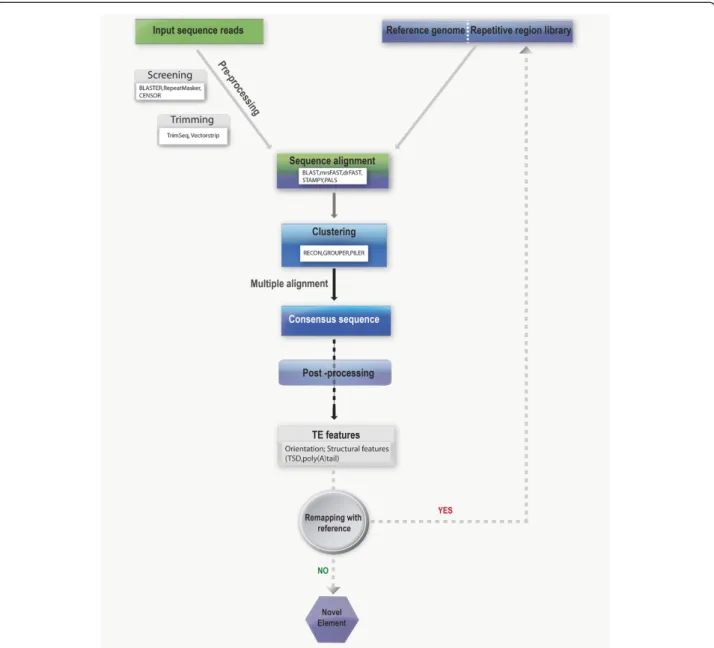
A few of these methods such asde novodiscovery and homology-based methods are briefly discussed. The al-gorithm for detecting inserts inde novo method usually involves reading shotgun sequence reads and matching the repeat sequences, followed by clustering the matched pairs to give a consensus sequence of a TE family [59]. Unlike thede novosequencing method, homology-based approach uses previous knowledge of TE sequences, such as sequence similarity, in identifying similar class TEs with a low copy number. Figure 3 discusses the
main theme of computational study in repetitive ele-ments; putative L1 insertions are identified by compar-ing clusters of consensus alignment from the same sequence reads. A sequence pair read that is aligned to the reference genome is concordant; hence, discordant alignment that does not match paired-end expectations could represent novel structural variant (SV) sites [60]. Recent studies enhanced the sensitivity and specificity of this procedure by using refined versions of the algorithm that targets the diploid nature of the genome [61]. As a valuable addition to the sequence paired-end read align-ment, Ewing et al. (2010) used the orientation and struc-tural characteristics of the reads to identify 1016 novel L1 insertions [62].
Research interest in SVs has increased exponentially over the past decade, and with the advent of screening technologies, approximately 5000 insertions have been reported thus far [63]. Because most reported inser-tions are scattered across other databases leading to redundancy, a compiled non-redundant list is emi-nent. Database of Retrotransposition Insertion Poly-morphism (DbRIP) represents a comprehensive list of human genome variations (SINE, Alu and LINE). Da-ta from published journals are collected and compiled into a non-redundant list of RIPs. The design of the database is based on simple genome browser style with graphical visualization of RIP for easy navigation and information retrieval. Classification of reported RIPs is based on class, family and subfamily, inclu-ding data on the size of insertion, chromosomal po-sition, disease association and PCR conditions with expected amplicon sizes and reference(s). Such a tool, with effective documentation, gives a much clearer picture of RIPs in the line of SNPs and CNVs. Now, with the advent of next-generation platform and or-ganized data, it is possible to study the role of these elements in shaping the genome structure and their functional impact.
G) Summary and concluding remarks
At least 4 principal mechanisms, inflammation, prote-ase-anti-protease imbalance, oxidative stress and apop-tosis, have been identified in the pathogenesis of COPD. Of these, the oxidative stress plays a pivotal role in COPD pathogenesis because it directly injures the res-piratory tract and regulates other mechanisms.
attributed to the translocation of these active mobile ele-ments. Studies on lung barrier epithelial cells have proven the effect of airway inflammation and oxidative stress on genome instability. Upon exposure to cigarette smoke, barrier epithelial cells undergo epigenetic alte-rations that can trigger mobile elements such as L1s, thereby influencing multiple molecular pathways that enhance inflammatory signals. Novel L1 sites can be
identified by performing whole genome analysis of epi-thelial cell DNA from smokers (COPD), ex-smokers (no COPD) and healthy controls against a reference genome. Such new L1 insertions can be compared against the profiles of microsatellite markers in patient samples to study the relationship between mobile genetic elements and genome instability and their potential role in a com-plex disorder such as COPD.
Abbreviations
TEs:Transposable elements; MGEs: Mobile genetic elements; LINEs: Long interspersed nuclear elements; DSBs: Double strand breaks; HRR: Homologous recombination repair; NAHR: Nonallelic homologous recombination; MSI: Microsatellite instability; BPD: Bronchopulmonary dysplasia; COPD: Chronic obstructive pulmonary disease; FEV1: Forced expiratory volume in 1 second; FVC: Forced vital capacity; RIP: Retrotransposon insertion polymorphism; CNVs: Copy number variants.
Competing interests
The authors declare that they have no competing interests.
Authors’contributions
MW is responsible for suggestions and final revision of the draft. MS is responsible for the concept and design of the paper, preparation of the draft and take full responsibility for the final version of this manuscript. Both authors read and approved the final manuscript.
Acknowledgements
Graduate school of Comprehensive Pneumology Center (CPC), Munich, Germany. Dr. Pablo Reviriego, Cardiff University, UK.
Mr. Mark Screen, University of Helsinki, Finland.
Received: 19 August 2013 Accepted: 2 October 2013 Published: 5 October 2013
References
1. Lander ES, Linton LM, Birren B, Nusbaum C, Zody MC, Baldwin J, Devon K, Dewar K, Doyle M, FitzHugh W, Funke R, Gage D, Harris K, Heaford A, Howland J, Kann L, Lehoczky J, LeVine R, McEwan P, McKernan K, Meldrim J, Mesirov JP, Miranda C, Morris W, Naylor J, Raymond C, Rosetti M, Santos R, Sheridan A, Sougnez C,et al:Initial sequencing and analysis of the human genome.Nature2001,409:860–921.
2. Belancio VP, Roy-Engel AM, Deininger PL:All y'all need to know 'bout retroelements in cancer.Semin Cancer Biol2010,20:200–210. 3. Beck CR, Garcia-Perez JL, Badge RM, Moran JV:LINE-1 elements in
structural variation and disease.Annual review of genomics and human genetics2011,12:187–215.
4. Ostertag EM, Kazazian HH:Twin priming: a proposed mechanism for the creation of inversions in L1 retrotransposition.Genome Res2001,
11:2059–2065.
5. Ostertag EM, Kazazian HH Jr:Biology of mammalian L1 retrotransposons.
Annual review of genetics2001,35:501–538.
6. Wei W, Gilbert N, Ooi SL, Lawler JF, Ostertag EM, Kazazian HH, Boeke JD, Moran JV:Human L1 retrotransposition: cis preference versus trans complementation.Mol Cell Biol2001,21:1429–1439.
7. Cost GJ, Feng Q, Jacquier A, Boeke JD:Human L1 element target-primed reverse transcription in vitro.EMBO J2002,21:5899–5910.
8. Gasior SL, Wakeman TP, Xu B, Deininger PL:The human LINE-1 retrotransposon creates DNA double-strand breaks.Journal of molecular biology2006,357:1383–1393.
9. Gilbert N, Lutz-Prigge S, Moran JV:Genomic deletions created upon LINE-1 retrotransposition.Cell2002,110:315–325.
10. Callinan PA, Batzer MA:Retrotransposable elements and human disease.
Genome and Disease2006,1:104–115.
11. Arcot SS, Fontius JJ, Deininger PL, Batzer MA:Identification and analysis of a‘young‘polymorphic Alu element.Biochimica et Biophysica Acta (BBA)-Gene Structure and Expression1995,1263:99–102.
12. Nadir E, Margalit H, Gallily T, Ben-Sasson SA:Microsatellite spreading in the human genome: evolutionary mechanisms and structural implications.
Proc Natl Acad Sci USA1996,93:6470–6475.
13. Hebert ML, Wells RD:Roles of Double-strand Breaks, Nicks, and Gaps in Stimulating Deletions of CTG.CAG Repeats by Intramolecular DNA Repair.Journal of molecular biology2005,353:961–979.
14. Wilder J, Hollocher H:Mobile elements and the genesis of microsatellites in dipterans.Mol Biol Evol2001,18:384–392.
15. Wooster R, Cleton-Jansen AM, Collins N, Mangion J, Cornelis RS, Cooper CS, Gusterson BA, Ponder BA, von Deimling A, Wiestler OD:Instability of short tandem repeats (microsatellites) in human cancers.Nat Genet1994,
6:152–156.
16. Charlesworth B, Sniegowski P, Stephan W:The evolutionary dynamics of repetitive DNA in eukaryotes.Nature1994,371:215–220.
17. Siafakas NM, Tzortzaki EG, Sourvinos G, Bouros D, Tzanakis N, Kafatos A, Spandidos D:Microsatellite DNA instability in COPD.CHEST Journal1999,
116:47–51.
18. Samara KD, Tzortzaki EG, Neofytou E, Karatzanis AD, Lambiri I, Tzanakis N, Siafakas NM:Somatic DNA alterations in lung epithelial barrier cells in COPD patients.Pulmonary pharmacology & therapeutics2010,23:208–214. 19. Zervou MI, Tzortzaki EG, Makris D, Gaga M, Zervas E, Economidou E,
Tsoumakidou M, Tzanakis N, Milic-Emili J, Siafakas NM:Differences in microsatellite DNA level between asthma and chronic obstructive pulmonary disease.Eur Respir J2006,28:472–478.
20. Rabinovich EI, Kapetanaki MG, Steinfeld I, Gibson KF, Pandit KV, Yu G, Yakhini Z, Kaminski N:Global methylation patterns in idiopathic pulmonary fibrosis.PLoS One2012,7:e33770.
21. Anderson GP, Bozinovski S:Acquired somatic mutations in the molecular pathogenesis of COPD.Trends in pharmacological sciences2003,24:71–76. 22. Wistuba II, Mao L, Gazdar AF:Smoking molecular damage in bronchial
epithelium.Oncogene2002,21:7298–7306.
23. Makris D, Tzanakis N, Damianaki A, Ntaoukakis E, Neofytou E, Zervou M, Siafakas NM, Tzortzaki EG:Microsatellite DNA instability and COPD exacerbations.Eur Respir J2008,32:612–618.
24. Makris D, Moschandreas J, Damianaki A, Ntaoukakis E, Siafakas NM, Milic EJ, Tzanakis N:Exacerbations and lung function decline in COPD: new insights in current and ex-smokers.Respiratory medicine2007,
101:1305–1312.
25. World Health Organization:Factsheet No.315; 2012. [http://www.who.int/ mediacentre/factsheets/fs315/en/index.html]
26. Silverman EK:Progress in chronic obstructive pulmonary disease genetics.Proc Am Thorac Soc2006,3:405–408.
27. Coultas DB, Hanis CL, Howard CA, Skipper BJ, Samet JM:Heritability of ventilatory function in smoking and nonsmoking New Mexico Hispanics.
Am J Respir Crit Care Med1991,144:770–775.
28. Burrows B, Knudson RJ, Cline MG, Lebowitz MD:Quantitative relationships between cigarette smoking and ventilatory function.The American review of respiratory disease1977,115:195–205.
29. Redline S, Tishler PV, Rosner B, Lewitter FI, Vandenburgh M, Weiss ST, Speizer FE:Genotypic and phenotypic similarities in pulmonary function among family members of adult monozygotic and dizygotic twins.
Am J Epidemiol1989,129:827–836.
30. Khoury MJ, Beaty TH, Tockman MS, Self SG, Cohen BH:Familial aggregation in chronic obstructive pulmonary disease: use of the loglinear model to analyze intermediate environmental and genetic risk factors.Genet Epidemiol1985,2:155–166.
31. Tzortzaki EG, Dimakou K, Neofytou E, Tsikritsaki K, Samara K, Avgousti M, Amargianitakis V, Gousiou A, Menikou S, Siafakas NM:Oxidative DNA damage and somatic mutations: a link to the molecular pathogenesis of chronic inflammatory airway diseases.Chest2012,
141:1243–1250.
32. Miki Y, Nishisho I, Horii A, Miyoshi Y, Utsunomiya J, Kinzler KW, Vogelstein B, Nakamura Y:Disruption of the APC gene by a retrotransposal insertion of L1 sequence in a colon cancer.Cancer Res1992,52:643–645.
33. Ostertag EM, DeBerardinis RJ, Goodier JL, Zhang Y, Yang N, Gerton GL, Kazazian HH:A mouse model of human L1 retrotransposition.Nature genetics2002,32:655–660.
34. van den Hurk JA, Meij IC, Seleme MC, Kano H, Nikopoulos K, Hoefsloot LH, Sistermans EA, de Wijs IJ, Mukhopadhyay A, Plomp AS, de Jong PT, Kazazian HH, Cremers FP:L1 retrotransposition can occur early in human embryonic development.Hum Mol Genet2007,16:1587–1592.
35. Kano H, Godoy I, Courtney C, Vetter MR, Gerton GL, Ostertag EM, Kazazian HHJ:L1 retrotransposition occurs mainly in embryogenesis and creates somatic mosaicism.Genes Dev2009,23:1303–1312.
36. Belancio VP, Roy-Engel AM, Pochampally RR, Deininger P:Somatic expression of LINE-1 elements in human tissues.Nucleic Acids Res2010,
38:3909–3922.
37. Merritt TA, Gadzinowski J, Mazela J, Adamczak AM:Epigenetic influences in the development of bronchopulmonary dysplasia.Archives of Perinatal Medicine2011,17:17–22.
39. Issa J-P:Opinion: CpG island methylator phenotype in cancer.Nat Rev Cancer2004,4:988–993.
40. Kochanek S, Renz D, Doerfler W:DNA methylation in the Alu sequences of diploid and haploid primary human cells.The EMBO journal1993,
12:1141–1151.
41. Wilson AS, Power BE, Molloy PL:DNA hypomethylation and human diseases.Biochim Biophys Acta2007,1775:138–162.
42. Lange NE, Sordillo J, Tarantini L, Bollati V, Sparrow D, Vokonas P, Zanobetti A, Schwartz J, Baccarelli A, Litonjua AA:Alu and LINE-1 methylation and lung function in the normative ageing study.BMJ Open2012,2:e001231. 43. Sood A, Petersen H, Blanchette CM, Meek P, Picchi MA, Belinsky SA, Tesfaigzi
Y:Wood smoke exposure and gene promoter methylation are associated with increased risk for COPD in smokers.American journal of respiratory and critical care medicine2010,182:1098–1104.
44. Tzortzaki EG, Siafakas NM:A hypothesis for the initiation of COPD.
Eur Respir J2009,34:310–315.
45. Cantin A, Crystal RG:Oxidants, antioxidants and the pathogenesis of emphysema.Eur J Respir Dis Suppl1985,139:7–17.
46. Chow CK:Cigarette smoking and oxidative damage in the lung.Ann NY Acad Sci1993,686:289–298.
47. Devasagayam TP, Steenken S, Obendorf MS, Schulz WA, Sies H:
Formation of 8-hydroxy(deoxy)guanosine and generation of strand breaks at guanine residues in DNA by singlet oxygen.Biochemistry
1991,30:6283–6289.
48. Misiaszek R, Crean C, Joffe A, Geacintov NE, Shafirovich V:Oxidative DNA damage associated with combination of guanine and superoxide radicals and repair mechanisms via radical trapping.J Biol Chem2004,
279:32106–32115.
49. Franco R, Schoneveld O, Georgakilas AG, Panayiotidis MI:Oxidative stress, DNA methylation and carcinogenesis.Cancer Lett2008,266:6–11. 50. Turk PW, Laayoun A, Smith SS, Weitzman SA:DNA adduct
8-hydroxyl-2'-deoxyguanosine (8-hydroxyguanine) affects function of human DNA methyltransferase.Carcinogenesis1995,16:1253–1255.
51. Kuchino Y, Mori F, Kasai H, Inoue H, Iwai S, Miura K, Ohtsuka E, Nishimura S:
Misreading of DNA templates containing 8-hydroxydeoxyguanosine at the modified base and at adjacent residues.Nature1987,327:77–79. 52. Dmitriev SE, Andreev DE, Terenin IM, Olovnikov IA, Prassolov VS, Merrick WC,
Shatsky IN:Efficient translation initiation directed by the 900-nucleotide -long and GC-rich 5' untranslated region of the human retrotransposon LINE-1 mRNA is strictly cap dependent rather than internal ribosome entry site mediated.Mol Cell Biol2007,27:4685–4697.
53. Rogozin IB, Kochetov AV, Kondrashov FA, Koonin EV, Milanesi L:Presence of ATG triplets in 5' untranslated regions of eukaryotic cDNAs correlates with a 'weak' context of the start codon.Bioinformatics2001,17:890–900. 54. Patchsung M, Boonla C, Amnattrakul P, Dissayabutra T, Mutirangura A,
Tosukhowong P:Long interspersed nuclear element-1 hypomethylation and oxidative stress: correlation and bladder cancer diagnostic potential.
PLoS One2012,7:e37009.
55. Flom JD, Ferris JS, Liao Y, Tehranifar P, Richards CB, Cho YH, Gonzalez K, Santella RM, Terry MB:Prenatal smoke exposure and genomic DNA methylation in a multiethnic birth cohort.Cancer Epidemiol Biomarkers Prev2011,20:2518–2523.
56. Baccarelli A, Wright RO, Bollati V, Tarantini L, Litonjua AA, Suh HH, Zanobetti A, Sparrow D, Vokonas PS, Schwartz J:Rapid DNA methylation changes after exposure to traffic particles.Am J Respir Crit Care Med2009,179:572–578.
57. Kazazian HH, Wong C, Youssoufian H, Scott AF, Phillips DG, Antonarakis SE:
Haemophilia A resulting from de novo insertion of L1 sequences represents a novel mechanism for mutation in man.Nature1988,
332:164–166.
58. Miki Y, Katagiri T, Kasumi F, Yoshimoto T, Nakamura Y:Mutation analysis in the BRCA2 gene in primary breast cancers.Nat Genet1996,13:245–247. 59. Li R, Ye J, Li S, Wang J, Han Y, Ye C, Yang H, Yu J, Wong GK:ReAS:
recovery of ancestral sequences for transposable elements from the unassembled reads of a whole genome shotgun.PLoS Comput Biol
2005,1:e43.
60. Hormozdiari F, Alkan C, Eichler EE, Sahinalp SC:Combinatorial algorithms for structural variation detection in high-throughput sequenced genomes.Genome Res2009,19:1270–1278.
61. Hormozdiari F, Hajirasouliha I, Dao P, Hach F, Yorukoglu D, Alkan C, Eichler EE, Sahinalp SC:Next-generation VariationHunter: combinatorial algorithms for transposon insertion discovery.
Bioinformatics2010,26:i350–i357.
62. Ewing AD, Kazazian HH:High-throughput sequencing reveals extensive variation in human-specific L1 content in individual human genomes.
Genome Res2010,20:1262–1270.
63. Liang P, Tang W:Database documentation of retrotransposon insertion polymorphisms.Front Biosci (Elite Ed)2012,4:1542–1555.
doi:10.1186/1465-9921-14-99
Cite this article as:Sargurupremraj and Wjst:Transposable elements and their potential role in complex lung disorder.Respiratory Research 201314:99.
Submit your next manuscript to BioMed Central and take full advantage of:
• Convenient online submission
• Thorough peer review
• No space constraints or color figure charges
• Immediate publication on acceptance
• Inclusion in PubMed, CAS, Scopus and Google Scholar
• Research which is freely available for redistribution