Screening Tool
User’s Guide
Contents
Introduction 1
About the PsyCheck Screening Tool 2
DesCription 2
statistiCal properties 2
General Mental Health screen 2
self reporting Questionnaire (srQ) 4
Administration and scoring 5
seCtion 1: General Mental HealtH sCreen 6
seCtion 2: suiCiDe/self-HarM risk assessMent 7
previous attempts 7
suicidal ideation 9
Mental health factors 10
protective factors 10
risk factors for harm to others 11
responding to potential self-harm using the PsyCheck
suicide/self-Harm risk assessment 12
seCtion 3: self reportinG Questionnaire (srQ) 14
PsyCheck Screening Tool 17
Sample contingency plan 21
list of figures and tables
figure 1: roC curves for srQ original scoring, srQ amended scoring and GHQ 3
figure 2: Decision tree 5
table 1: risk levels and response to suicidality 13
introduction
Comorbid mental health issues are often overlooked during routine drug and alcohol assessment unless specifically investigated. Routine screening of mental health problems among AOD treatment clients is essential to increase detection and, thus, intervention for both disorders. This approach results in improved outcomes for clients.
Screening is designed as a ‘first-pass’ indicator of a potential problem. Screening questionnaires (self-report and/or clinician-administered) do not take the place of a comprehensive clinical or diagnostic assessment. The information collected will, however, provide valuable information for the clinician, both in alerting them to the likely presence of disorders and as the first step in the routine detection and treatment of comorbid disorders.
The PsyCheck Screening Tool and PsyCheck Screening Tool User’s Guide are designed to assist clinicians in routine screening of mental health problems among drug and alcohol treatment clients. This type of screening is known as ‘opportunistic’ screening because the clinician takes the opportunity to screen for mental health problems when a client presents for another (AOD) issue. Opportunistic screening is most effective when the screening is universal (that is, all presenting clients are screened), even when a mental health problem is not obvious or seems unlikely. This way, there will be a greater rate of detection of previously undetected symptoms.
The PsyCheck Screening Tool is designed to be used in conjunction with the PsyCheck Clinical Treatment Guidelines.
about the
PsyCheck
screening tool
Description
The PsyCheck Screening Tool is a mental health screening instrument designed for use by clinicians who are not mental health specialists. It detects the likely presence of mental health symptoms that are often seen, and can feasibly be addressed, within specialist AOD treatment services. It is not designed to be a diagnostic assessment and will not yield information about specific disorders. It is designed to detect potential mental health problems that may be missed if not specifically investigated by the clinician or raised by the client. For this reason, it is important that all clients are given the Screening Tool if possible, even if they do not appear to have a mental health problem. The PsyCheck Screening Tool is appropriate for all clients of AOD treatment services who are not in an active phase of withdrawal from drugs or alcohol. It can be administered at any stage with existing clients of the service, provided they are not intoxicated at the time of completing the questions. New clients should also be screened using the PsyCheck, once they are stabilised in treatment.
The PsyCheck Screening Tool has three sections:
• a General Mental Health Screen, including history of treatment
• Suicide/Self-Harm Risk Assessment
• the Self Reporting Questionnaire (SRQ), that assesses current symptoms
Statistical properties
The PsyCheck Screening Tool has been validated for use among clients engaged with drug and alcohol treatment services (Lee & Jenner, in prep.). A group of 120 newly engaged but stabilised clients of a large AOD treatment service were asked to complete:
• the PsyCheck Mental Health Screen for AOD clients
• the General Health Questionnaire (GHQ)
• a comprehensive diagnostic interview, CIDI-auto version 2.1 (WHO, 1997) General Mental Health Screen
Scores on the PsyCheck General Mental Health Screen were compared with scores on the diagnostic interview (CIDI-auto). In particular, the question was asked: ‘Have you ever seen a doctor or psychiatrist for emotional problems or problems with your “nerves”/anxieties/worries?’ Agreement with this question was significantly correlated with the presence of an affective or anxiety disorder in the previous month (Spearman’s rho=0.456, p<0.01). In addition, the question ‘Have you ever been given medication for emotional problems or problems with your “nerves”/anxieties/worries?’ was also predictive of a current affective or anxiety disorder within the last month (Spearman’s rho=0.414, p<0.01). These results suggest that this section of the PsyCheck Screening Tool could be used as an initial indicator of mental health status. Self Reporting Questionnaire
The Self Reporting Questionnaire (Beusenberg & Orley, 1994) was compared to the General Health Questionnaire (Goldberg & Williams, 1988) and found to be superior in detecting mental health
symptoms among this population when compared to the CIDI comprehensive diagnostic interview. The original SRQ was compared to a modified version in which for every ‘yes’ answer the respondent is asked to indicate if this symptom occured when they were not using alcohol or other drugs. The original 4-point GHQ was also modified to a dichotomous (yes/no) scale for better comparison with the SRQ.
Receiver operating characteristic (ROC) curves were used to identify best predictor of non-psychotic mental health problems and the optimum ‘cut-off’ score for clients responding to the SRQ.
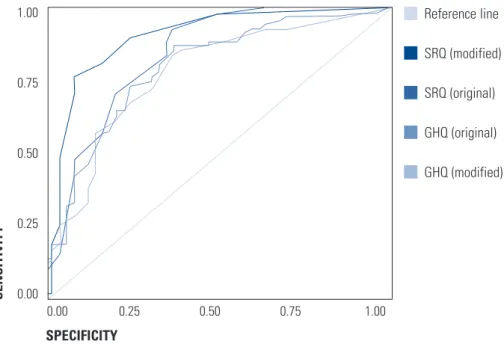
The ROC curves in the analysis were constructed by identifying two groups of respondants: those who were negative for a diagnosis of a non-psychotic mental health disorder according to the CIDI (n=49) and those who were positive (n=68). A series of tables was created to measure the true positive (sensitivity) and false positive (specificity) rates for each set of scores on the SRQ. Figure 1 shows the ROC curves relevant to this analysis.
Figure 1: ROC curves for SRQ original scoring, SRQ amended scoring and GHQ
Sen Sitivity Specificity 1.00 0.75 0.50 0.25 0.00 0.00 0.25 0.50 0.75 1.00 reference line srQ (modified) srQ (original) GHQ (original) GHQ (modified)
The greater the area under the ROC curve, the better the screening tool is at correctly distinguishing between the two groups: those screening positive to non-psychotic mental health disorder and those screening negative.
The area under the curve for the modified SRQ score was 0.839 (std error 0.039), with sensitivity=0.809 and specificity=0.837. These results indicate that the SRQ (modified) is able to identify individuals with a non-psychotic mental health problem with a high degree of sensitivity and specificity. An analysis was also undertaken to identify the optimum cut-off for the SRQ that would indicate the potential presence of a mental heath problem.
The results suggested that a cut-off score of 5 on the SRQ (modified) was most appropriate for identifying true cases of mental health problems within an alcohol or other drug using population, given their high propensity to experience somatic symptoms, which could potentially inflate scores on this questionnaire.
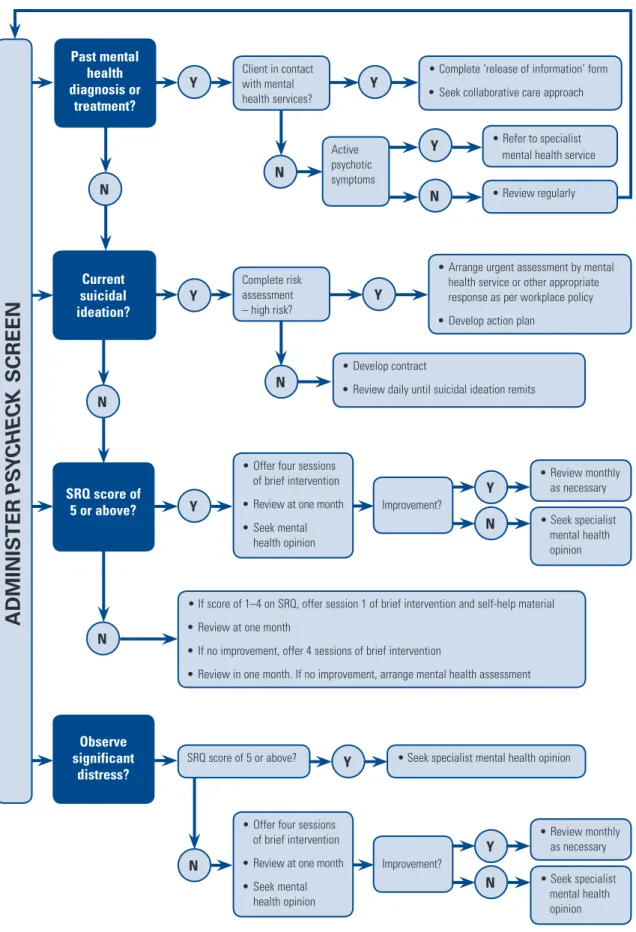
Figure 2: Decision tree past mental health diagnosis or treatment?
A
DMI
n
IS
T
e
R
Ps
yChe
C
k
S
CR
een
Client in contact with mental health services? current suicidal ideation? SRQ score of 5 or above? Observe significant distress?• Complete ‘release of information’ form • seek collaborative care approach
Complete risk assessment – high risk?
• offer four sessions of brief intervention • review at one month • seek mental
health opinion
• if score of 1–4 on srQ, offer session 1 of brief intervention and self-help material • review at one month
• if no improvement, offer 4 sessions of brief intervention
• review in one month. if no improvement, arrange mental health assessment
• arrange urgent assessment by mental health service or other appropriate response as per workplace policy • Develop action plan
active psychotic symptoms
• refer to specialist mental health service • review regularly improvement? • seek specialist mental health opinion • review monthly as necessary
srQ score of 5 or above? y • seek specialist mental health opinion • Develop contract
• review daily until suicidal ideation remits
n n n y n y n y y n y y y n n
• offer four sessions of brief intervention • review at one month • seek mental health opinion improvement? • seek specialist mental health opinion • review monthly as necessary n y current suicidal ideation?
Administration and scoring
The decision tree in Figure 2 outlines clinical pathways from screening to intervention, using the
PsyCheck Screening Tool and the PsyCheck Clinical Treatment Guidelines. It may be used to assist in interpreting the PsyCheck Screening Tool.
The PsyCheck Screening Tool can be used at any point in the assessment and treatment of a client presenting to AOD services. It can be readily incorporated into the regular assessments conducted at entry to services and should also be re-administered throughout treatment, whenever other reviews of progress are conducted. The SRQ can be self- or clinician-administered, while the other sections are best administered by the clinician. You may not need to go through all the questions if you already have some of the information (for example hospitalisation, past history). Scoring is outlined in the PsyCheck
Screening Tool itself as well as in this User’s Guide.
PsyCheck Screening Tool
Tips for general administration and scoring
Administration
• apart from the srQ, there is no need to go through all of the questions with the client if this information has already been recorded from a previous recent assessment.
• suicidality should be monitored over time. scoring
• the final page of the PsyCheck screening tool contains the scoring aid.
• information about the client’s past history of mental health problems is used on the scoring page. • all other information is useful as supporting and additional information and is not involved in the
Section 1: General Mental Health Screen
Section 1 of the PsyCheck Screening Tool has five questions designed to identify clients who have been previously diagnosed or treated for mental health problems. These questions are an excellent indicator of the presence of specific disorders.
If the person is currently in contact with mental health services or another health provider (e.g. general practitioner) who is managing their mental health symptoms, seek permission from the client to contact the appropriate health professional and discuss the client’s treatment. Refer to the PsyCheck Clinical Treatment Guidelines for the section on When and how to refer to mental health services. Question 4 in Section 1 of the PsyCheck Screening Tool asks for the name and contact details of any mental health workers or other health professionals that the client is currently seeing.
Question 5 in Section 1 of the PsyCheck Screening Tool is a prompt for the presence of suicidal ideation: ‘Has the thought of ending your life ever been on your mind?’ If the client answers ‘Yes’, conduct a full Suicide/Self-Harm Risk Assessment as indicated in Section 2 of the PsyCheck Screening Tool.
Section 1: General Mental Health Screen Tips for administration and scoring
Administration
the clinician administers this section in which there are five questions designed to identify whether the client has been previously diagnosed or treated for mental health problems and/or has suicide ideation.
• explain the questions in this section to the client and what you hope to achieve in asking them.
[Prompt: the questions are about the client’s mental, physical and emotional health; you understand that these may be sensitive issues but that these are standard screening questions that all clients are asked; the purpose of the questions is to give the clinician a clearer idea of what has been happening in the client’s life; working through these questions will help the clinician and the client to find ways to work together to relieve any distress the client may be experiencing.]
• administer Questions 1–4.
• if the client answers ‘Yes’ to Question 4 (i.e. is currently in contact with mental health services or other health providers in relation to mental health symptoms), seek the client’s permission to contact the appropriate health professional.
scoring
• this section is not formally scored, but will assist in providing further information about the client’s mental health history and give an indication of the potential for future problems (and need for monitoring), even if the srQ does not detect a current mental health problem.
• for this section, indicate whether the client has a past history (registers ‘Yes’ to any of the relevant questions).
Section 2: Suicide/Self-Harm Risk Assessment
If the client answered ‘Yes’ to suicide ideation in the previous section, a full Suicide/Self-Harm Risk Assessment is required. Before undertaking a Suicide/Self-Harm Risk Assessment, refer to the section in this guide Responding to potential self-harm, which provides more information about conducting a risk assessment and developing appropriate responses.
The Decision tree (Figure 2) shows that clients considered to be at high risk of harm (to themselves or
others) must be given an appropriate intervention immediately. There is no standardised risk assessment that can confidently predict a person who is at risk for suicide according to a designated cut-off score. The PsyCheck Screening Tool’s format is designed to assist in making an accurate clinical judgement. Health services often have their own policies and guidelines for risk assessment and management. The guidelines offered here are designed to complement and not to replace those currently in use.
A client is at high risk of self-harm if some of the following are true:
• a history of repeated attempts at self-harm • a recent attempt at self-harm
• a clear plan of action and access to lethal means
• a close friend or family member who has attempted or completed suicide • Concurrent depression and/or hopelessness
• Concurrent untreated psychotic symptoms
• significant losses and/or stressors in the recent past
• recent discharge from hospital or separation from a trusted practitioner
Previous attempts
The first factor to check is the client’s personal history of suicide attempts or self-harm. This is the single best predictor of suicide attempts. If there has been a history, what is the frequency and recency of attempts? How lethal are the means that the person used? For example, the use of a firearm is likely to be more lethal than, say, an overdose of prescription drugs, since it is more likely to do fatal damage and to do so with little or no time for others to intervene.
Also ask about history of attempted or completed suicide by a close friend or family member of the client. This may act as a trigger or make suicide seem like a viable option in intolerable circumstances for the client.
Section 2: Suicide/Self-Harm Risk Assessment – previous attempts Tips for administration and scoring
Administration
Consider potential lethality and recency of attempts. recent multiple attempts by moderately lethal means or any previous attempts of high potential lethality represent high risk. More recent and lethal attempts by family or friends represent higher risk.
Client’s personal history of suicide attempts or self-harm: • Have you ever tried to harm yourself in the past?
• if so, how long ago? What were the circumstances? [Prompt: What did the person do? How lethal was the attempt? What was the outcome?]
• Have you tried to harm yourself more than once? [Prompt about dates and any help received]
History of attempted or completed suicide by people close to the client:
• Have any members of your family or group of close friends ever tried to harm themselves? • if so, how long ago? What were the circumstances? What were your thoughts about this? scoring
• on the final summary page, state whether the risk assessment has been completed and whether any action has been taken either following the organisation’s policies and procedures or as outlined in the section Responding to potential self-harm (see page 14)
• to do this:
- consider the clinical implications of the number of ‘high’, ‘moderate’ and ‘low’ risks identified - weigh up the importance of the protective factors
- make a clinical judgement about the client’s overall level of risk
• the suggested response page is a guide. if there are other workplace standard practices, follow those. • even if a client scores at ‘low’ risk, continue to re-assess as needed should the client’s mental state,
Suicidal ideation
There are four areas of assessment for suicidal ideation (thinking).
• Intent: does the person express intent to harm themselves?
• Plan: does the person have a clear and detailed plan about how they will harm themselves? They might indicate when, where and how.
• Means: does the person have the means to carry out the self-harm? Do they own a gun, have
they stored medication with which to overdose?
• Lethality: how lethal is the means of self-harm they are planning?
Also keep in mind questions such as:
• Has the client experienced a significant loss recently, such as a relationship breakdown, loss of a job or a bankruptcy?
• Has the client experienced a loss of perceived support, including a recent discharge from hospital or separation from a trusted clinician?
• Are there any other current life stressors that the client feels unable to cope with? Section 2: Suicide/Self-Harm Risk Assessment – suicidal ideation Tips for administration and scoring
Administration
Consider how the suicidal ideation has been communicated. non-disclosure may not indicate low risk. Communication of plans and intentions are indicative of high risk. Consider non-direct or non-verbal expressions of suicidal ideation such as depressive body language, ‘goodbyes’, drawing up of wills, unexplained termination of treatment relationships etc.
intent:
• Have you ever had thoughts of killing yourself? [Prompt: How often? When was the last time you had these thoughts?]
• Have your thoughts ever included harming others as well as yourself? [Prompt: Have you thought about when and where you would do this?]
plan:
• Do you have a plan? [Prompt for specifics: What do you think you might do?]
• Have you ever acted on these thoughts? Means:
• Have you ever taken any steps towards doing this? [Prompt for the specifics: Has the person taken all necessary steps to implement it?]
lethality:
• use clinical judgement to decide on the lethality of the plan: that is, how likely it is to result in death scoring
Mental health factors
Certain mental health problems (such as depressed mood and hopelessness, certain personality disorders, and the psychotic disorders such as schizophrenia and bipolar disorder) are associated with a higher than usual risk of self-harm.
Section 2: Suicide/Self-harm Risk Assessment – mental health factors Tips for administration and scoring
Administration
assess for history of and current mental health symptoms, especially depression and psychotic conditions. History of or current depression:
• Have you been feeling depressed for several days at a time? [Prompt: How long have you felt like this?]
Mental health disorder or symptoms:
• Have you ever been diagnosed with a mental health problem? • How much are you bothered by the symptoms?
scoring
• see scoring tips for suicide/self-Harm risk assessment section on page 9.
Protective factors
Many people who have experienced suicidal thoughts are able to identify factors that prevented them from acting upon their thoughts, such as their connectedness to significant others. Close family or friendship supports act as a protective factor for clients at risk. It is not just the availability of support that is important but also the client’s perception of the quality of support and whether they feel able to make use of it.
Other protective factors may include:
• having a meaningful role at school, work or in the family
• a stable lifestyle (in terms of relationships, financial support, housing, work etc.)
• an ability to generate a range of options for solving problems rather than relying only on escape and avoidance
• having some flexibility and adaptability in personality – clients that have this protective factor are less at risk of harm than those with a very rigid personality
Section 2: Suicide/Self-Harm Risk Assessment – protective factors Tips for administration and scoring
Administration
possible protective factors include social supports, ability or inclination to make use of support where available, family involvement, work or school relationships, stability of lifestyle, and adaptability and flexibility in personality style. remember that, for this section, it is positive for people to have ‘many’.
Coping skills and resources:
• What has stopped you from acting on your thoughts so far?
• What help could make it easier to cope with your problems at the moment? family, friendships and other support networks:
• Do you have friend(s) you see regularly? Do you see your family on a regular basis? • Do you feel supported by the people in your life?
• Have you thought about the effect your death would have on your family and friends? stable lifestyle:
• Do you feel settled at the moment or does your life seem a bit chaotic? • Do you have a day-to-day routine?
• Have you been following this routine lately? Communication skills/ability to make use of supports:
• When you are feeling a bit stressed, are you able to talk about your feelings with the other people in your life?
• are you likely to do this? scoring
• see scoring tips for suicide/self-Harm risk assessment section on page 9.
Risk factors for harm to others
Check risk for harm to others following a similar process. A history of violence or aggression towards others indicates a risk for future harm.
Other factors associated with harm to others are: • being male
• being under 35 years of age • having a criminal history
• having a history of using weapons
• having a history of child abuse or mistreatment by others Current factors to assess include:
• verbal intent to harm others • paranoid thoughts about others
• preoccupation with violent images and thoughts • access to lethal means
• high levels of anger, frustration or agitation • a lack of problem-solving skills
A client poses a high risk of harm to others if some of the following are true:
• previous history of violence or aggression • previous use of weapons
• Criminal history • Male
• under 35 years
• Childhood abuse or maltreatment • role instability
• paranoid thoughts about others • increasing anger, frustration or agitation
Responding to potential self-harm using the PsyCheck Suicide/Self-Harm Risk Assessment
Managing risks
If there is no risk:
• Monitor the client as required. Check at regular intervals, especially if there are potential triggers in the future, or there is as history of self-harm.
If the risk is considered to be low: • Monitor the client closely.
• Agree on a verbal or written contract to maintain safety and develop a contingency plan that includes support numbers for out-of-hours counselling services.
• Ask for a commitment from the client to follow a contingency plan in the event that their suicidal thoughts become more prominent.
If the risk is considered moderate:
• Refer the client for further assessment with a mental health service or other service that offers inpatient facilities in the event of a suicide or self-harm attempt.
• Agree on a written contract to maintain safety, and a written contingency plan with the client, listing supports to be contacted if feelings escalate.
• Request the client’s permission to contact their family and/or an emergency mental health service if necessary.
• Consult a supervisor for a second opinion.
If the client is considered to pose a high risk of harm to self or others:
• Make an immediate referral to a place of safety such as a hospital mental health service or emergency mental health team.
• Call an ambulance or police if necessary.
• Contact the appropriate person in your service who has designated authority or powers under the Mental Health Act or relevant legislation for advice and support.
• Inform a supervisor or a senior colleague.
It is a clinician’s duty to warn and protect others if credible threats are made against them. This duty overrides the client’s right to confidentiality. However, in many instances it is reasonable to inform the client that you need to break confidentiality because of concerns about them.
Using a contingency plan
A ‘contingency’ plan can be made with clients to give them clear directions for what to do when their suicidality is escalating. Contingency plans work best if they provide a number of alternatives to suicide/ self-harm that have been generated by both the client and the clinician. The client should agree to try these alternatives before resorting to self-harm. The earlier they implement this plan, the less likely they are to harm themselves. Contingency plans should include contact numbers for sources of support within and outside of business hours. A Sample contingency plan is provided at the back of this guide if a written plan is required, however, often a verbal agreement is sufficient.
A contingency plan should include the following to be most useful:
• a number of behavioural alternatives to suicide/self-harm formulated by clinician and client • an agreement that these alternatives will be followed before instituting suicidal or self-harm plans • a statement concerning the time period over which the agreement applies
• a formal statement of treatment goals for resolving the suicidal ideation and the responsibilities of each signatory. (Although this document seeks to provide alternatives to self-harm and is not a ‘suicide contract’ per se, it may also include a formal statement where the client makes a commitment not to attempt suicide or self harm.)
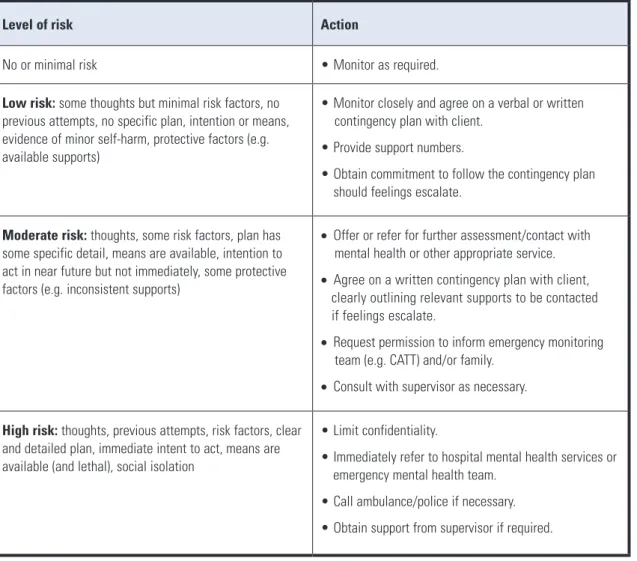
Table 1: Risk levels and response to suicidality
Level of risk Action
no or minimal risk • Monitor as required.
Low risk: some thoughts but minimal risk factors, no previous attempts, no specific plan, intention or means, evidence of minor self-harm, protective factors (e.g. available supports)
• Monitor closely and agree on a verbal or written contingency plan with client.
• provide support numbers.
• obtain commitment to follow the contingency plan should feelings escalate.
Moderate risk: thoughts, some risk factors, plan has some specific detail, means are available, intention to act in near future but not immediately, some protective factors (e.g. inconsistent supports)
• offer or refer for further assessment/contact with mental health or other appropriate service.
• agree on a written contingency plan with client, clearly outlining relevant supports to be contacted if feelings escalate.
• request permission to inform emergency monitoring team (e.g. Catt) and/or family.
• Consult with supervisor as necessary.
High risk: thoughts, previous attempts, risk factors, clear and detailed plan, immediate intent to act, means are available (and lethal), social isolation
• limit confidentiality.
• immediately refer to hospital mental health services or emergency mental health team.
• Call ambulance/police if necessary. • obtain support from supervisor if required.
Section 3: Self Reporting Questionnaire (SRQ)
The SRQ was developed by the World Health Organization to screen for symptoms of the more common mental health problems, such as anxiety and depression, among clients in primary care settings. There are 20 questions related to common symptoms of depression, anxiety and somatic complaints (such as sleep problems, headaches and digestive problems).
The client is first asked to tick any symptoms that they have experienced in the past 30 days. Second, for every ‘Yes’ answer, the client is asked to tick whether they have experienced that problem when they were not using alcohol or other drugs. The clinician then counts the total number of ticks in the circles and places the score at the bottom of the page.
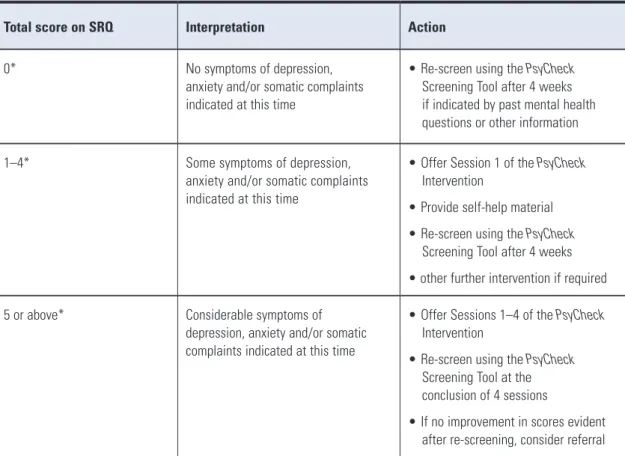
The clinician should interpret scores on Section 3: Self Reporting Questionnaire of the PsyCheck
Screening Tool as indicated in Table 2. The PsyCheck Screening Tool is the basis of a stepped care model in which the treatment response is determined by the initial PsyCheck Screening Tool score. Table 2 below outlines the ‘stepped’ responses recommended and the PsyCheck Clinical Treatment Guidelines outline the specific intervention.
Table 2: Interpretation of the SRQ score
total score on SRQ interpretation Action
0* no symptoms of depression, anxiety and/or somatic complaints indicated at this time
• re-screen using the PsyCheck screening tool after 4 weeks if indicated by past mental health questions or other information 1–4* some symptoms of depression,
anxiety and/or somatic complaints indicated at this time
• offer session 1 of the PsyCheck intervention
• provide self-help material • re-screen using the PsyCheck screening tool after 4 weeks • other further intervention if required 5 or above* Considerable symptoms of
depression, anxiety and/or somatic complaints indicated at this time
• offer sessions 1–4 of the PsyCheck intervention
• re-screen using the PsyCheck screening tool at the conclusion of 4 sessions
• if no improvement in scores evident after re-screening, consider referral
Section 3: Self Reporting Questionnaire (SRQ) Tips for administration and scoring
Administration
this section can be administered by the clinician or can be given to the client to complete. • first, the client indicates which symptoms they have experienced in the past 30 days.
• they then look back over their ‘Yes’ responses and tick the circle only if they have had that symptom in the last 30 days and it has occurred while they were not under the influence of drugs or alcohol and not withdrawing.
• if they have not had a long abstinence period in the last 30 days, you may ask them to think back to the month before that to see if they can recall having the symptom without alcohol or drug use or withdrawal being involved.
• if the client is to complete the srQ themselves, provide clear instructions on how to answer the questions to enhance the accuracy of responses.
Additional contingencies for use
sometimes a client may not score a clinically significant 5 or above on the srQ. it is still important that you pay attention to the difference between the symptoms experienced with and without drug/alcohol use as these symptoms may be distressing to the client.
if a client has ticked most symptoms in the squares but not the circles, this may be clinically relevant and should be discussed during clinical supervision.
scoring
• this measure will assist in determining whether to undertake the PsyCheck intervention.
• add up the number of ticks in the circles alone. for example, if the client had ticked ‘Yes’ to 15 of the symptoms, but only ticked 3 of the circles, their score would be 3.
the
PsyCheck
screening tool
Clients name: DoB:
service: ur:
Mental health services assessment required? no Yes
suicide/self-harm risk (please circle): High Moderate low
Date: screen completed by:
Clinician use only
Complete this section when all components of the PsyCheck have been administered. Summary
section 1 past history of mental health problems no Yes section 2 suicide risk completed and action taken no Yes
section 3 srQ score 0 1–4 5+
interpretation/score – SRQ
score of 0* on the srQ no symptoms of depression, anxiety and/or somatic complaints indicated at this time. Action: re-screen using the PsyCheck screening tool after 4 weeks if indicated by past mental health questions or other information. otherwise monitor as required.
score of 1–4* on the srQ some symptoms of depression, anxiety and/or somatic complaints indicated at this time. Action: Give the first session of the PsyCheck intervention and screen again in 4 weeks. score of 5+* on the srQ Considerable symptoms of depression, anxiety and/or somatic complaints
indicated at this time.
Action: offer sessions 1–4 of the PsyCheck intervention. re-screen using the PsyCheck screening tool at the conclusion of four sessions.
if no improvement in scores evident after re-screening, consider referral.
Clinician to administer this section
the following questions are about your emotional wellbeing. Your answers will help me get a clearer idea of what has been happening in your life and suggest possible ways that we might work together to relieve any distress you may be experiencing. We ask these questions of everybody, and they include questions about mental, physical and emotional health.
1. Have you ever seen a doctor or psychiatrist for emotional problems
or problems with your ‘nerves’/anxieties/worries? no Yes Details
2. Have you ever been given medication for emotional problems or problems with your ‘nerves’/anxieties/worries? no, never
Yes, in the past but not currently Medication(s): Yes, currently Medication(s):
3. Have you ever been hospitalised for emotional problems or problems with your
‘nerves’/anxieties/worries? no Yes
Details
4. Do you have a current mental health worker, psychiatrist, psychologist, general practitioner or other health provider? if ‘no’, go to Question 5.
psychiatrist psychologist
name: name:
Contact details: Contact details:
role: role:
Mental health worker General practitioner
name: name:
Contact details: Contact details:
role: role:
Other – specify: Other – specify:
name: name:
Contact details: Contact details:
role: role:
5. Has the thought of ending your life ever been on your mind? no Yes if ‘no’, go to section 3 Has that happened recently? no Yes if ‘Yes’, go to section 2
seCtion 1:
seCtion 2:
risk assessment
Clinician to administer this section
if the person says ‘Yes’ to recently thinking about ending their life (Question 5), complete the suicide/self-harm risk assessment below. specific questions and prompts and further guidance can be found in the PsyCheck user’s Guide. risk factor low risk Moderate risk High risk
1. previous attempts: Consider lethality and recency of attempts. Very recent attempt(s) with moderate lethality and previous attempts at high lethality both represent high risk. recent and lethal attempts of family or friends represent higher risk.
History of harm to self previous low lethality Moderate lethality High lethality, frequent History of harm in family
members or close friends previous low lethality Moderate lethality High lethality, frequent 2. suicidal ideation: Consider how the suicidal ideation has been communicated; non-disclosure
may not indicate low risk. Communication of plans and intentions are indicative of high risk. Consider non-direct and non-verbal expressions of suicidal ideation here such as drawing up of wills, depressive body language, ‘goodbyes’, unexpected termination of therapy and relationships etc. also consider homicidal ideation or murder/suicide ideation.
intent no intent no immediate intent immediate intent plan Vague plan Viable plan Detailed plan
Means no means Means available Means already obtained lethality Minor self-harm planned overdose, firearms, hanging, jumping, behaviours, serious cutting, intervention unlikely intervention likely intervention possible
3. Mental health factors: assess for history and current mental health symptoms, including depression and psychosis. History of current lowered or enduring lowered mood Depression diagnosis depression unchanged mood
Mental health disorder few or no symptoms pronounced Multiple symptoms or symptoms or well-managed clinical signs with no management significant illness
4. protective factors: these include social support, ability or decision to use support, family involvement, stable lifestyle, adaptability and flexibility in personality style etc.
Coping skills and resources Many some few family/friendships/networks Many some few stable lifestyle High Moderate low ability to use supports High Moderate low
seCtion 3:
self reporting Questionnaire
Client or clinician to complete this section
first: please tick the ‘yes’ box if you have had this symptom in the last 30 days.
Second: look back over the questions you have ticked. for every one you answered ‘yes’, please put a tick in the circle if you had that problem at a time when you were not using alcohol or other drugs.
1. Do you often have headaches? no Yes
2. is your appetite poor? no Yes
3. Do you sleep badly? no Yes
4. are you easily frightened? no Yes
5. Do your hands shake? no Yes
6. Do you feel nervous? no Yes
7. is your digestion poor? no Yes
8. Do you have trouble thinking clearly? no Yes
9. Do you feel unhappy? no Yes
10. Do you cry more than usual? no Yes
11. Do you find it difficult to enjoy your daily activities? no Yes 12. Do you find it difficult to make decisions? no Yes
13. is your daily work suffering? no Yes
14. are you unable to play a useful part in life? no Yes 15. Have you lost interest in things? no Yes 16. Do you feel that you are a worthless person? no Yes 17. Has the thought of ending your life been on your mind? no Yes 18. Do you feel tired all the time? no Yes 19. Do you have uncomfortable feelings in the stomach? no Yes
20. are you easily tired? no Yes
sample contingency plan
This safety plan is agreed between
Anna Watson
[client’s name] andSam Johnson
[clinician’s name]on
20th April 2005
[date].Alternatives to harming myself include:
•
Contacting my sister or my friend Jacinta to talk it over
•
Contacting the after-hours service at Lifeline (phone number:__________)
•
Contacting Sam to make an appointment to see him (phone number:__________)
•
Playing music that makes me feel more hopeful
•
Distracting myself by going for a walk
I, Anna, agree to try these strategies and not to attempt to harm myself for a week from
20th April
to 27th April
. I agree to go to thePrincess Margaret Hospital emergency department
or call 000 (ambulance) if my feelings become unbearable.
Client’s signature: Clinician’s signature: