206
Effect of (Extension and Shorten)
Exercises and Motor Pattern show
vie using Mobile Techniques on
Development Level of Performance
and Accuracy of High and Forward
Jump shot in Handball
Abdul Jabbar Shnain Aloa Al Janaby
Faculty of Education for Girls- Department of Physical Education, University of Kufa, Iraq
Article Info
Received: March 20, 2014 Accepted: April 21, 2014
Published online: September 01, 2014
ABSTRACT
207
Keywords: Extension and shorten exercises, motor pattern, mobile techniques, high and forward
jump shot, handball.
1. Introduction
In recent years, communications and information techniques have been developed and assisted to change life nature and form of institutions in which including teaching institution, last decade showed that training and teaching approaches depended principally on computer using.Many studies have showed that physical education used electronic teaching to improve motor learning of sport skill. However, through present decade is developed electronic learning conception and has started to use new technologies such as (Internet), today shows the ability of using mobile system as a new teaching technology basically different from the other technologies in learning.
At the beginning of current decade has used a new term in learning especially Europe countries, it is called (Mobile Learning). Many uses of the electronic teaching in recent years have resulted in improve of motor skilllearning, mobile technique itself is a good tool to learning. Some of studies and articles were exposed in Arab countries talking about this term in which we can use it as a method to develop teaching systems through employing its services and bring benefits or using it as a source of recent teaching sources (Dya, 2002; Waffa, 2007).
Mobile learning is undoubtedly resultingin the new teaching revolution;with about 200 million users from all over the world, today, it is forming a communicative, social and economic limited to teach as well as providing a feedback to the learners in physical education. It isactually at the peak of the digital industrial compulsion, revolution and every kind of new revolution consequently gives rise to new problem. The unique characteristics of the mobile such as its 24- houravailability,simple working, secrecy of its users, easy holding, display the motor skills of different sport activities and etc. have welcomed many experts throughout the world. Mobile can be used to achieve the successful in fastness and quality of teaching (Moras, 2009).
The performance of high jumpshot and forward jump shot have always been principle handball skills. There are numerous factors, which areresponsible for the performance of these skills. To performin handball game not only depends on physiological,psychological, sociological and scientific training factorsbut also requires good physique, body composition,endurance, flexibility and good reaction to any givensituation as well as good performance mastery. To achieve requires of handball has to be chosen a best training and teaching programs and use the best methods (Anilet al., 2012).
208
The aim ofthis study was to know effect of (extension and shorten) exercises and motor pattern show vie using mobile techniques on development level of performance and accuracy of high and forward jump shot in handball. The present study answer many of questions, for example, can we using mobile devises as a teaching toolon helping to get a feedback through motor skills show in sport games? Is this type of teaching lead to fast learning? Will mobile using on teaching of motor skill learning being new teaching method and then merge advanced techniques of communication to sport learning?.
2. Methodology
Nature of the problem which needs to solve it determines methodology of the study that will use by researcher in purpose of achieve study aim. Because of nature of current study is experimental, so researcher used experimental research design method due to it is suitable to achieve aim of the study.
2.1 Subject:
Twenty four students females from a second class of faculty of Education for Girls-Department of Physical Education\ University of Kufa (age= 20.1, ±0.6years, stature= 155.11,±0.35cm, mass= 55.48, ±5.39 kg) were randomly assigned intwo groups (control and experiment), each group included 12 students. Then, researcher achieved homogeneous for subject of the study in high, weight, and age.
(Table 1)
Shows homogeneous of subject
Variables Mean SD Median skewness coefficient
Height 155.11 0.35 155 0.038
Weight 55.48 5.39 56 -0.289
Age 20.1 0.6 20 0.500
Table (1) showed that skewness coefficient is taking place between (± 1) and this means subject of the study is homogenous. To make sure that subject is equal, researcher depended on pre physical and skill tests as shown in table (2).
(Table 2) Shows equal of subject
Variables Experimental
group
Control group T test Significant
Mean SD Mean SD
Accuracy of forward jump shot 2.40 0.45 3 0.60 2.02 No S
Accuracy of high jump shot 2.55 1.5 2.90 0.87 1.4 No S
Performance of forward jump shot 50.3 0.5 55.66 3.12 2.54 No S
Performance of high jump shot 55.58 0.5 58.26 0.58 0.88 No S
Coordination test (eyes and legs) 8.85 0.60 9.02 0.33 0.18 No S
Agility (shuttle run) 10.12 0.42 9.94 0.28 1.82 No S
Stable forward jump 163 0.28 161.59 3.3 0.68 No S
Transition speed 5.58 0.68 5.28 0.43 2.11 No S
209
Table (2) showed no significant differences between two groups in level of performance, achievement, and physical and motor tests for study subject.
2.2 Physical and motor tests:
2.2.1 Physical tests:
Physical tests included following: 1. Legs muscles ability (Stable forward jump). 2. Transition speed (30 m run).
2.2.2 Motor tests:
Motor tests included following: 1. Coordination test (Eyes and legs). 2. Agility (Shuttle run 4 x 10m).
2.2.3 High and forward jump shot tests: Included following:
1. Accuracy of high and forward jump shot test.
2. Performance level test. This test was evaluated by specific form which was displayed to number of experts in handball and motor learning in purpose to estimate performance stages.
2.3 Prepare a teaching film of high and forward jump shot in handball:
First:
1. Researcher used CD of Daego world competition 2011of strength games, the end of long jump, and then we stored the film in chosen site in the computer.
2. We can open the film by using Core L Videos Studio x 4 program which is available on import media file.
3. Choose the film from site which is available on computer; open the film from singl trim clip. 4. Open the move and then cut some of desire attempts through press enter on the left arch at the beginning of attempt and press on the wright arch at end of attempt [ ], then we choose ok and from the page of program choose save trimmed video will display desire attempt of move. 5. Press wright click on the chosen part and choose (Location on computer) after that chose the location of save the selected attempts and press copy.
210 Second:
1. Change shot skill video to Quintic Biomechanics - 903 .v. 14program.
2. Through program change skill to various speed display (25%, 50%) of normal movement. It is enabling the learners to watch the bath of skill several times and parts of skill exhaustively and thus identify to method of performance and motor series of skill to get the mental perception of skill.
Third:
High and forward jump shot skill video section has been moved to the mobile phones for research sample through Bluetooth service.
Fourth:
1. Researcher met the subject and explain the aim of study and important of pattern display of motor path for the high and forward jump shot skill with three speeds through using mobile. 2. We displayed forward jump shot skill and then high jump shot skill in front of subject by Data show and explain structure of two skills and show the important points during performance. 3. Explain how to conduct teaching units and contribute seriously to the test because of its beneficial for the future of the learning process, has been answered all the questions by the researcher, and directed by members of the experimental research sample.
2.4 Statistical analysis:
Researcher used following statistical:
Percentage, relative importance, amount of development, percentage of development, mean, standard deviation, mode, skewness coefficient, correlation coefficient, independent T test, and trace size.
3. Results and Discussion
Depended on natural of study in terms of the aims, purposes, subject, approach, tools, and apparatuses which was available, and relayed on books, experts opinions, results which was extracted by researcher through tests, and statistical analysis,researcher attained following results.
(Table 3)
Shows differences between pre and post-tests of control group in study variables
Variables Pre-tests Post-tests T test Significant
Mean SD Mean SD
Accuracy of forward jump shot 3 0.84 3.6 0.66 1.30 No S
Accuracy of high jump shot 2.90 0.69 3.15 0.73 1.86 No S
Performance of forward jump shot 55.16 3.12 72.3 2.58 3.75 S
Performance of high jump shot 58.26 5.72 70.33 3.17 3.77 S
Coordination test (eyes and legs) 9.94 0.33 6.58 1.27 3.18 S
Agility (shuttle run) 166.59 3.3 165 0.66 1.22 No S
Stable forward jump 9.94 0.28 8.14 1.50 2.56 No S
Transition speed 5.58 0.43 5.02 0.18 3.94 S
211
There are no significant differences between pre and post-tests of control group in accuracy of forward jump shot, accuracy of high jump shot, agility (shuttle run), and stable forward jump but significant differences in performance of forward jump shot, performance of high jump shot, coordination test (eyes and legs), and transition speed. Table (4) shows amount of development and percentage of development in accuracy of forward jump shot, accuracy of high jump shot, performance of forward jump shot, performance of high jump shot, coordination test (eyes and legs), agility (shuttle run), stable forward jump, and transition speed for the control group.
(Table 4)
Shows amount of development and percentage of development in post-tests of control group in study variables
Variable Measure
unit
Pre-test mean
Post-test mean
Different between medians
Percentage of development
Accuracy of forward jump shot Degree 3 3.6 0.6 %16.66
Accuracy of high jump shot Degree 2.90 3.15 0.25 %7.79
Performance of forward jump shot Degree 55.16 72.3 17.17 %23.74
Performance of high jump shot Degree 58.26 70.33 12.07 %17.16
Coordination test (eyes and legs) Sec 9.94 6.58 3.36- %5.21
Agility (shuttle run) Cm 166.59 165 1.59 %0.96
Stable forward jump Sec 9.94 8.14 1.8 %2.2
Transition speed Sec 5.58 5.02 0.56- %11.12
(Table 5)
Shows differences between pre and post-tests of experimental group in study variables
Variables Pre-tests Post-tests T test Significant
Mean SD Mean SD
Accuracy of forward jump shot 2.40 0.45 7.25 0.45 13.12 S
Accuracy of high jump shot 2.55 1.02 6.75 0.88 12.72 S
Performance of forward jump shot 50.30 3.12 77.5 4.5 9.04 S
Performance of high jump shot 55.58 5.33 75.66 3.12 10.06 S
Coordination test (eyes and legs) 8.85 0.60 7.02 1.83- 5.17 S
Agility (shuttle run) 163 0.28 175 7.5 7.23 S
Stable forward jump 10.12 0.42 8.06 2.5 6.06 S
Transition speed 5.58 0.68 4.88 1.13 5.58 S
Tabulate T value = 3.11, significant level (0.01) and freedom degree= 11
212 (Table 6)
Shows amount of development and percentage of development in post-tests of experimental group in study variables
Variable Measure
unit
Pre-test mean
Post-test mean
Different between medians
Percentage of development
Accuracy of forward jump shot Degree 2.40 7.25 5.12 %70.62
Accuracy of high jump shot Degree 2.55 6.75 2.55 %37.77
Performance of forward jump shot Degree 50.30 77.5 27.2 %35.5
Performance of high jump shot Degree 55.58 75.66 20.08 %35.4
Coordination test (eyes and legs) Sec 8.85 7.02 1.83 %26.06
Agility (shuttle run) Cm 163 175 12 % 6.85
Stable forward jump Sec 10.12 8.06 -2.06 %14.45
Transition speed Sec 5.58 4.88 -0.7 %14.43
Table (6) shows amount of development and percentage of development for post-tests in accuracy of forward jump shot, accuracy of high jump shot, performance of forward jump shot, performance of high jump shot, coordination test (eyes and legs),agility (shuttle run), stable forward jump, and transition speed for the experimental group.
(Table 7)
Shows differences between experimental and control groups in post-tests in study variables
Variables Experimental
group
Control group T test Significant
Mean SD Mean SD
Accuracy of forward jump shot 7.25 0.45 3.6 0.66 9.51 S
Accuracy of high jump shot 6.75 0.88 3.15 0.73 14.28 S
Performance of forward jump shot 77.5 4.5 72.3 2.58 12.66 S
Performance of high jump shot 75.66 3.12 70.33 3.17 4.66 S
Coordination test (eyes and legs) 7.02 1.83- 6.58 1.27 11.66 S
Agility (shuttle run) 8.06 2.5 8.14 1.50 6.78 S
Stable forward jump 175 7.5 165 0.66 12.25 S
Transition speed 4.88 1.13- 5.02 0.18 11.65 S
Tabulate T value = 2.82, significant level (0.01) and freedom degree= 22
213 (Table 8)
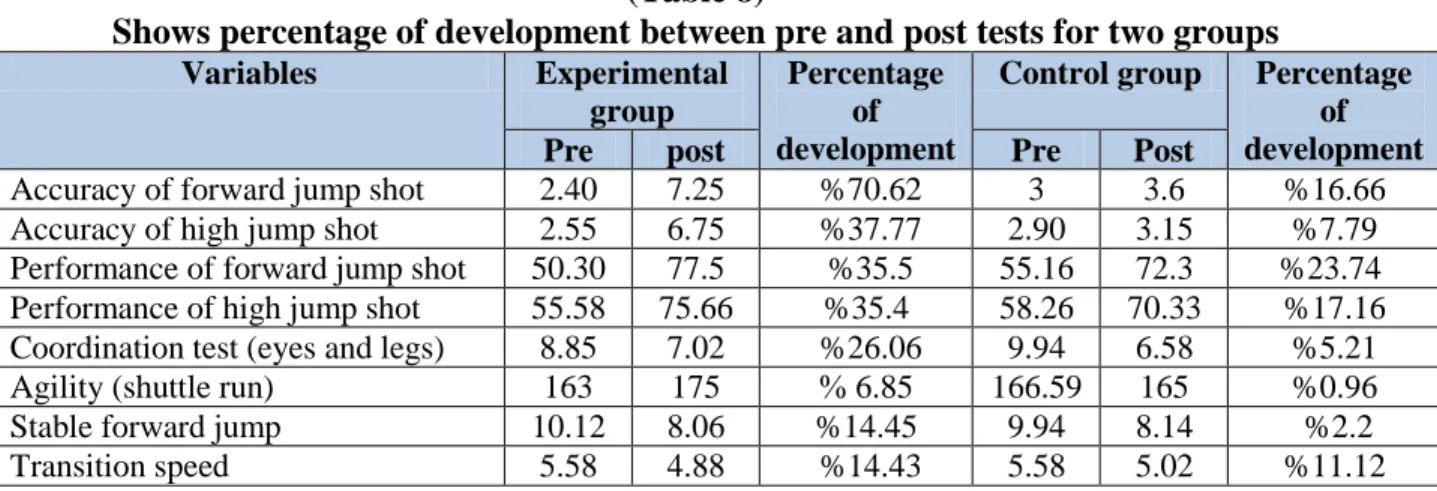
Shows percentage of development between pre and post tests for two groups
Variables Experimental
group
Percentage of development
Control group Percentage of development
Pre post Pre Post
Accuracy of forward jump shot 2.40 7.25 %70.62 3 3.6 %16.66
Accuracy of high jump shot 2.55 6.75 %37.77 2.90 3.15 %7.79
Performance of forward jump shot 50.30 77.5 %35.5 55.16 72.3 %23.74
Performance of high jump shot 55.58 75.66 %35.4 58.26 70.33 %17.16
Coordination test (eyes and legs) 8.85 7.02 %26.06 9.94 6.58 %5.21
Agility (shuttle run) 163 175 % 6.85 166.59 165 %0.96
Stable forward jump 10.12 8.06 %14.45 9.94 8.14 %2.2
Transition speed 5.58 4.88 %14.43 5.58 5.02 %11.12
Table (8) showed a percentage of development among pre and post-tests for two groups in accuracy of forward jump shot, accuracy of high jump shot, performance of forward jump shot, performance of high jump shot, coordination test (eyes and legs), agility (shuttle run), stable forward jump, and transition speed. Results appeared to be in favor of experimental group in all variables of the study, the percentage of development of control group ranged from 0.96% to 32.74% whereas experimental group ranged from 6.85% to 70.62%. To know the trace size of program in experimental group, we extracted trace size for the achievement level in long jump and physical and motor variables as shown in following table:
(Table 9)
Shows trace size for training and teaching program on the study variables.
Table (9) showed that a large trace for training and teaching program on accuracy of forward jump shot, accuracy of high jump shot, performance of forward jump shot, performance of high jump shot, coordination test (eyes and legs), agility (shuttle run), stable forward jump, and transition speed. Different results were appeared in control group some of them were significant and others were no significant, researcher attributes the reason of these results into the display and explain method and wrongs correction immediately when was occurred as well as using varied exercises led to effect on develop of performance of forward jump shot, performance of high jump shot, coordination test (eyes and legs), and transition speed.
N Variable T test Correlation coefficient Trace size
1 Accuracy of forward jump shot 13.12 0.88 Large trace
Accuracy of high jump shot 12.72 0.83 Large trace
Performance of forward jump shot 9.04 . 0.84 Large trace
Performance of high jump shot 10.06 0.82 Large trace
2 Coordination test (eyes and legs) 5.17 0.76 Large trace
3 Agility (shuttle run) 7.23 0.81 Large trace
4 Stable forward jump 6.06 0.94 Large trace
214
Shmid et al. (2000) saw that attempts repetitions are the key of important performance in which make an unexpected movements to expected movements. Gentile (1984) agreed with present data, the performance depends on the teacher ability to display the practical pattern and skills explain simply to the learners in terms of the position of body parts during motor skill performance.Sward (1997) said that physical capacities such as (strength, speed, endurance, flexibility, and speed strengthare easy to improve and develop them through varied physical exercises. No significant in some of variables of current study because the exercises which used to develop accuracy of forward jump shot, accuracy of high jump shot, agility (shuttle run), and stable forward jump didn’t enough to improve these variables.
Results of experimental group were significant in all variables due to effect of training program with extension and shorten on physical and motor capacities. Salnoni et al. (2009) showed that extension and shorten exercises are one of the types of exercises which are effective and ideal to improve muscle ability and speed of legs, torso, and arms muscles. There was a large changeable in accuracy of forward jump shot and accuracy of high jump shot because of feedback that subject received it by mobile through display pattern and correct the wrongs and thus attain to good level in performance level of both skills. Yarub (2010) confirm that information provides to the learner about his motor performance during skill learning is the most important variables on motor learning.
4. Conclusion
215 References
Anil R. Waghmare, Anil K. Bondade, Anil D. Surdi, (2012). Study of Flexibility, Agility and Reaction Time in Handball Players, Indian Medical Gazette, 23-31.
Chin et al., (1995). Physiological profiles and sport specificfitness of Asian elite sqash players. British J SportsMedicine.29 : 158-164.
Dya Hassan. (2002). Effect of feedback on learner comprehensive to achieve the best performance in sport lessons, Thirteen Conference of Physical Education faculties in Iraq, Dyalla University, 124-135.
Gentile A.M. (1984).Working model of skill acquisition with Application toteaching. New Delhi,355-386.
Moras, K.W., (2009). Mobile important: A review of current assessment techniques and potential assessment questions. Motor Learning Journal, 5(2): 10-18.
Mory Ann, (2010).Physiological profile ofelite junior handball players in Assia,J of Sport Science, 67-78.
Salnoniet al., (2009).Knowledge of trainingand motor learning.Areview and critical, USA, Suranfor print, 126-137.
Shmidet R.A. Craig A. Wrisberg, (2000). Motor learning and performance.(2):63-64. Sward,A., (1997).Plyometric in the middle distances, Coaches Review,97(3): 68-89.
Waffa Mustafa. (2007). Teaching approaches and achieve an electronic immunity “Future filmed”, Third yearly conference, Open learning center-AinShamis university, 46-58. Wissam W.B. et al., (2011).Extension and shorten exercises findings in competitive junior tennis
players. Clinicsin Sports Medicine. 4(2) : 406-419.