THERMALLY-RESPONSIVE POLY(ESTER URETHANE)S
Benjamin Franklin Pierce
A dissertation submitted to the faculty of the University of North Carolina at Chapel Hill in partial fulfillment of the requirements for the degree of Doctor of Philosophy in the Department
of Chemistry.
Chapel Hill 2008
Approved by
Advisor: Dr. Valerie V. Sheares Ashby
Reader: Dr. Wei You
© 2008
ABSTRACT
BENJAMIN F. PIERCE: THERMALLY-RESPONSIVE POLY(ESTER URETHANE)S (Under the direction of Dr. Valerie V. Sheares Ashby)
DEDICATION
TABLE OF CONTENTS
LIST OF TABLES... ix
LIST OF FIGURES ... x
LIST OF ABBREVIATIONS... xii
LIST OF SYMBOLS ... xiv
Chapter I LITERATURE REVIEW OF CURRENT SHAPE-MEMORY POLYMERS AND THEIR BIOMEDICAL APPLICATIONS ... 1
1.1 Thermally-Responsive Shape-Memory Polymers ... 2
1.2 Early Shape-Memory Materials... 3
1.2.1 Shape-Memory Metals... 3
1.2.2 Heat-Shrinkable Polymers ... 4
1.3 Current Biomedical SMPs ... 4
1.3.1 Thermoplastic SMPs... 4
1.3.2 Thermoset SMPs... 11
1.4 Limitations of Current Biomedical SMPs... 14
1.5 Dissertation Organization ... 17
1.6 References... 18
2.2 Experimental Section... 26
2.2.1 Materials ... 26
2.2.2 Characterization ... 26
2.2.3 Polyester Synthesis ... 28
2.3 Results and Discussion ... 32
2.3.1 Polyester Prepolymers ... 32
2.3.2 Poly(ester urethane) Synthesis... 37
2.3.2.1 Molecular Weight Analysis ... 38
2.3.2.2 Thermal Analysis ... 39
2.3.2.3 Mechanical Analysis... 40
2.3.2.4 Surface and Bulk Characterization ... 42
2.3.2.5 Degradation Studies... 45
2.3.2.5 Cytotoxicity Studies... 47
2.4 General Conclusions ... 49
2.5 Acknowledgements... 49
2.6 References... 49
III DEGRADABLE THERMOSET SHAPE-MEMORY ELASTOMERS BASED ON POLY(1,4-CYCLOHEXANEDIMETHANOL 1,4-CYCLOHEXANEDICARBOXYLATE)... 54
3.1 Introduction... 55
3.2 Experimental Section... 55
3.2.1 Materials ... 55
3.2.2 Characterization ... 55
3.2.4 Elastomer Synthesis ... 59
3.3 Results and Discussion ... 61
3.3.1 Polyester Prepolymer Structure and Thermal Properties... 61
3.3.2 Prepolymer Endcapping... 64
3.3.3 Elastomer Formation... 66
3.3.4 Shape-Memory Packaging... 68
3.3.5 Shape-Memory Recovery ... 71
3.3.6 Potential as Biomedical Devices... 72
3.3.7 Necessity of Extraction Step... 73
3.4 General Conclusions ... 75
3.5 Acknowledgements... 75
3.6 References... 75
IV SHAPE-MEMORY SURFACES AND THEIR BIOMEDICAL APPLICATIONS ... 77
4.1 Introduction... 78
4.2 Experimental Section... 80
4.2.1 Materials ... 80
4.2.2 Characterization ... 80
4.3 Results and Discussion ... 82
4.3.1 Drug Delivery SSP... 82
4.3.2 Degradation Studies... 84
4.3.3 Creating SSPs with PRINTTM Technology... 85
4.6 References... 89
V GENERAL CONCLUSIONS AND FUTURE RESEARCH DIRECTIONS... 91
5.1 General Conclusions ... 92
5.2 Research Directions ... 93
5.3 Acknowledegments... 94
Appendix A: AMINE-FUNCTIONALIZED POLYESTERS... 95
Appendix B: SUPPLEMENTAL MATERIALS FOR CHAPTER 2 ... 110
Appendix C: SUPPLEMENTAL MATERIALS FOR CHAPTER 3 ... 129
Appendix D: SUPPLEMENTAL MATERIALS FOR CHAPTER 4... 169
LIST OF TABLES
Table
2.1 Polyester prepolymers synthesized at 130 °C (P1-P4)
or 160 °C (P5-P7), 20 mmHg, and 24 h...33 2.2 Thermal and mechanical data for poly(ester urethane)s
synthesized at 80 °C in DMAc for 2 h...38 3.1 Polyester prepolymers synthesized at 130 °C,
20 – 0.1 mmHg, and 48 h...61 3.2 Thermal data for SMP1 – SMP6...66 3.3 σmax (MPa) values, Rf (%) values, and Rr (%) values
for five shape-memory cycles for SMP6 packaged at
49 °C and recovered at 64 °C...71 3.4 Thermal uptake, solvent uptake, and soluble fraction
LIST OF FIGURES
Figure
1.1 Representation of a shape-memory device ...2
1.2 Shape-memory cycle for a biomedical SMP (scale bar = 5 mm) ...3
1.3 Representation of delocalized (top) and localized (bottom) shape changes ...16
2.1 1H NMR (top) and13C NMR (bottom) spectra of P5 (4,5-dimethylcyclohex-4-ene cis-1,2-dicarboxylic anhydride-1,8-octanediol) prepolymer ...35
2.2 Storage modulus (E’) and tan δ plotted versus temperature for PEU1B ...40
2.3 Tensile stress (MPa) plotted versus strain (%) for PEU3 ...42
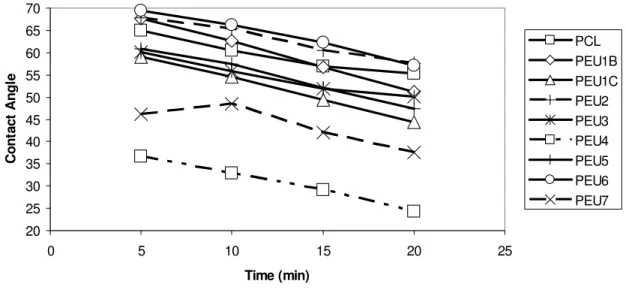
2.4 Contact angles of all polymer samples and poly(caprolactone) versus time ...43
2.5 Mass loss (%) plotted versus time (d) for PEU1A, PEU2, and PEU4...46
2.6 Autoclave-sterilized PEU2 (left); autoclave-sterilized PEU3 (middle); ethanol-sterilized PEU3 (right); darker portions of image(s) are the polymer sample(s) ...48
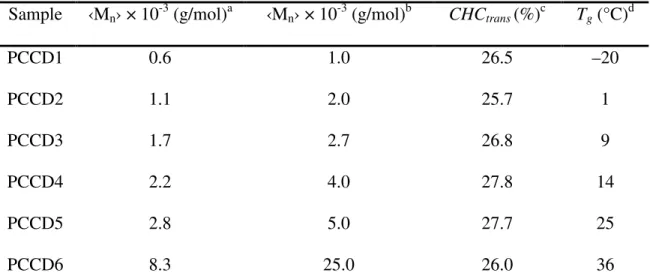
3.1 1H NMR spectrum (above) and 13C NMR spectrum (below) of PCCD5, representative of all PCCD prepolymers...63
3.2 FTIR spectrum for PCCD3, representative of all PCCD prepolymers...64
3.3 1H NMR spectrum of a hydroxyl-terminated prepolymer (a:cis; b:trans) (top), conversion NMR of an endcapping reaction (middle), and methacrylate-terminated prepolymer (c’: cis-conformation; c”: trans-confromation) (bottom) ...65
3.4 Glass transition temperatures and tan δFWHM values for SMP1 – SMP6 ...67
3.5 Tan δ curves for SMP4 and SMP4* (SMP4 tan δFWHM = 55 °C; SMP4* tan δFWHM = 50 °C)..………..68 3.6 Strain at break (%) and tan δ values plotted
3.7 The recovery process for SMP6 at 64 °C (total time: 6 sec; scale bar = 5mm)...72
3.8 Tan δmax (top), tan δFWHM values (middle), and E”max values for SMP1-SMP6 and ExSMP1 – ExSMP6 ...74
4.1 Representation of delocalized (top) and localized (bottom) shape changes ...78
4.2 SEM images of nonporous and porous samples of SMP5...83
4.3 Drug release profile for minocycline-infused SMP5 at pH = 5 and pH = 7 for 10 d...83
4.4 Degradation profiles for SMP5(mass loss (%) vs. time (d))...85
4.5 Methods for creating SSPs using PRINTTM technology ...86
4.6 Temporary 200 × 36 nm features (middle) were imprinted on the original permanent polymer surface (left) and then thermally “erased” (right); scale bar is 3 µm ...88
4.7 Temporary 3 µm × 3 µm × 3 µm cubes (middle) were imprinted on a permanent hexnut-patterned surface with similar feature sizes (left), which were recovered upon the application of heat (right); scale bar is 10 µm ...88
A1 1H NMR spectra of Diol 1 (top), Diol 2(middle), and Diol 3 (bottom) ...103
A2 13C NMR spectra for Diol 1(top), Diol 2 (middle), and Diol 3 (bottom)...104
A3 1H NMR spectra of polymers PE1 (top), PE2 (middle), and PE3(bottom) ...106
LIST OF ABBREVIATIONS
AA Adipic acid BD 1,4-Butanediol
CDM 1,4-Cyclohexanedimethanol CHC 1,4-Cyclohexanedicarboxylic acid DEG Diethylene glycol
DMA Dynamic Mechanical Analysis DMAc N,N-Dimethylacetamide
DSC Differential scanning calorimetry ExSMP Extracted shape-memory polymer FTIR Fourier transform infrared spectroscopy GPC Gel permeation chromatography
HMA Trans-β-hydromuconic acid
HPLC High performance liquid chromatography MEM Minimum Elution Medium
MDI 4,4’-Methylenebis(phenyl isocyanate) NMR Nuclear Magnetic Resonance
OD 1,8-Octanediol
PCCD Poly(1,4-cyclohexanedimethanol 1,4-cyclohexanedicarboxylate) PDI Polydispersity index
PEU Poly(ester urethane)
PTMO Poly(tetramethylene oxide)
SMP Thermoresponsive shape-memory polymer Sn(Oct)2 Stannous 2-ethylhexanoate
SSP Surface-switching polymer TDI 2,4-Toluene diisocyanate TEG Tetraethylene glycol
TGA Thermogravimetric analysis THF Tetrahydrofuran
LIST OF SYMBOLS
Tg Glass transition temperature
E” Loss modulus
Tm Melting temperature
‹Mn› Number-average molecular weight
Qs Percent soluble fraction
E’ Storage modulus
Rf Strain fixity rate
Rr Strain recovery rate
ζ Swelling ratio
ε Tensile strain
σ Tensile stress
Ttrans Transition temperature
Chapter I
1.1Thermally-Responsive Shape-Memory Polymers
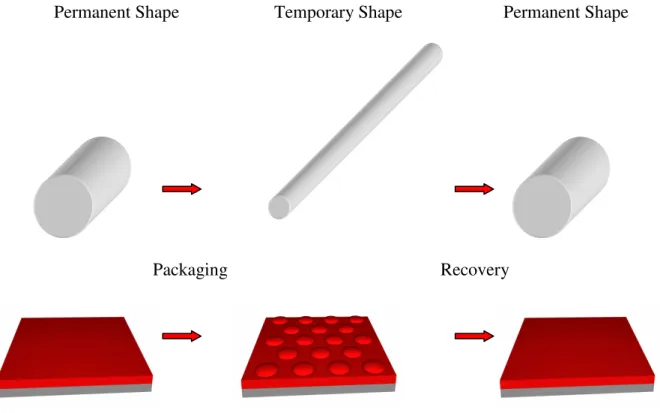
Thermoresponsive shape-memory polymers (SMPs) are able to recover a previously determined permanent shape after being fixed (packaged or programmed) in a temporary state.1 These materials are packaged by cooling a stressed system below the transition temperature (Ttrans), which freezes the material in the temporary state (Figure 1.1). The
original, permanent shape can be recovered after heating the system above Ttrans.
Semicrystalline elastomers utilize the melting temperature as the transition temperature (Tm =
Ttrans), and the transition temperature for amorphous SMPs is the glass transition temperature
(Tg = Ttrans).
Permanent Shape Temporary Shape Permanent Shape
Packaging Recovery
Figure 1.1 Representation of a shape-memory device
rate (Rf) and strain recovery rate (Rr), which quantify the ability to be packaged and
recovered, respectively. Typically, multiple cyclical tests are used to measure the shape-memory properties of materials.
Figure 1.2 Shape-memory cycle for a biomedical SMP (scale bar = 5 mm)
This review discusses the current state of thermoresponsive shape-memory polymers and their biomedical applications. Section 1.2 discusses the first shape-memory systems; Section 1.3 discusses the current state of biomedical SMPs; Section 1.4 discusses their limitations; and Section 1.5 outlines the dissertation chapters.
1.2Early Shape-Memory Materials
1.2.1 Shape-Memory Metals
Typically, shape-memory metals are not suitable as biomedical devices because they are toxic.1,4,5 Some exceptions include nickel-titanium alloys, which have been used as dental materials and artificial heart components.6-8 However, these alloys are not elastic (ε
more elastic shape-memory materials, the shape-memory capabilities of polymers were studied.
1.2.2 Heat-Shrinkable Polymers
The first thermally-responsive shape-memory polymers were crosslinked polyethylene systems known as heat-shrinkable polymers.9 Although heat-shrinkable polymers are useful for protecting electrical wires and in insulation applications, they are less suitable for biomedical applications. Heat-shrinkable polymers possess Ttrans values that
range from 110 – 130 °C, which are too high to induce safe transitions in vivo.2,9,10 Moreover, they exhibit only ~70 % recovery,9 which is insufficient for biomedical SMPs that must completely recover under the resistance of adjacent tissues and organs.11,12
1.3 Current Biomedical SMPs
Thermoplastic and thermoset elastomers are much more suitable for biomedical applications than the initial shape-memory materials. These SMPs are more biocompatible than shape-memory metals; possess more suitable Ttrans values than heat-shrinkable
polymers; and demonstrate good recovery properties. Furthermore, several thermoplastic and thermoset SMPs are degradable and eliminate the need for additional surgeries following device implantation. Section 1.3.1 describes several examples of thermoplastic SMPs and Section 1.3.2 describes several examples of thermoset SMPs. All the SMPs described here are degradable and nontoxic.
1.3.1 Thermoplastic SMPs
polyurethane elastomers are typically on the order of several hundred percent or higher. For example, both Seppälä and Hilborn synthesized amorphous poly(ester urethane)s with high elasticity (ε > 1000 %).14,15
Thermoplastic polyurethanes are synthesized using a high molecular weight prepolymer, diisocyanate, and chain extender. A number of studies have examined the impact of the soft segment,16-23 diisocyanate,17,24-27 and chain extender28-35 on the final elastomer properties. These reagents may be reacted in a two-step process, where chain extension occurs after the soft segments has been endcapped with an excess of diisocyanate, or a one-step process, where the chain extender and soft segment diol react with diisocyanate. All the thermoplastic polyurethanes described here were prepared using the two-step process.
Hayashi et al. prepared several semicrystalline thermoplastic SMPs by chain extending 4,4’-methylenebis(phenyl isocyanate)-endcapped poly(ethylene adipate) prepolymers with 1,4-butanediol (Scheme 1; all Schemes show most basic endcapped prepolymers [2/1 diisocyanate/diol]).36 Although these materials were semicrystalline, the Tg
(-5 – 48 °C) was used as the Ttrans. These materials were highly elastic (εmax = 150 – 300 % at
Tg + 20 °C); however, these materials exhibited “cyclic hardening”, where the shape-memory
HO O O O O O H n
OCN CH2 NCO
+ 60 °C 40 min O O O O O O m O O HN H2C
OCN
5 mol % excess
HO
OH
Thermoplastic SMP
2
Scheme 1. Thermoplastic SMP prepared by Hayashi et al.
Kim et al. prepared semicrystalline poly(ε-caprolactone)-based thermoplastic
urethanes using 4,4’-methylenebis(phenyl isocyanate) (MDI) and 1,4-butanediol with Tm =
44 – 50 °C (Scheme 2).37 These materials were highly elastic (ε > 1000 %) but also exhibited
OCN CH2 NCO
+
1-19 mol % excess
60 °C 90 min O O O n O NH CH2 OCN 2 HO OH
0-18 mol % excess
Thermoplastic SMP O H O O n 2
Scheme 2. Thermoplastic SMPs prepared by Kim et al.
Jing et al. investigated the use of poly(ε-caprolactone) soft segments as well but used
2,4-toluene diisocyanate (TDI) as the diisocyanate (Scheme 3).38 These semicrystalline poly(ester urethane)s displayed excellent shape-memory properties (Tm = 50 – 62 °C and Rr =
94 – 100%). These systems are exemplary examples of thermoplastic biomedical SMPs because they were degradable, highly elastic (εmax = 300 %), and able to recover at 37 °C
OCN CH3 + 65 °C 15 min toluene O O O n O HN H3C
2 HO OH Thermoplastic SMP O H O O n 2 NCO OCN
Scheme 3. Thermoplastic SMP prepared by Jing et al.
aliphatic polyurethanes have been used as wound dressing (TecoflexTM; G = 42 MPa and εmax
= 580 – 800 %, Scheme 4).17
O H
n
OCN CH2 NCO
+
H2N
NH2 Biomer HO O O O
NH CH2 NCO
O n
HN H2C
OCN
O H
n
OCN CH2 NCO
+ HO OH HO O O O
NH CH2 NCO
O n
HN H2C
A different approach to synthesizing thermoplastic SMPs is the ring opening polymerization of lactides, lactones, and cyclic carbonates. Zini and Scandola prepared amorphous (L-lactide-glycolide-trimethylene carbonate) terpolymers with Tg = 12 – 42 °C
and Rr = 89 – 95 % at ε = 100 % (Scheme 5).39 Similar to thermoplastic polyurethanes, the
recovery of these materials was highly dependent on chain entanglement and was affected by chain slippage.
Scheme 5. The synthesis of thermoplastic SMP terpolymers by Zini and Scandola
Langer prepared a novel class of semicrystalline SMPs with two melting temperatures that avoided the drawbacks of typical thermoplastic SMPs (Scheme 6).3 These systems were based on physically crosslinked oligo(ε-caprolactone)diol and oligo(p-dioxanone)diol
segments, where the oligo(p-dioxanone)diol segments possessed a higher melting temperature (~80 °C) than the oligo(ε-caprolactone)diol segments (~40 °C). Using the
at ε = 200 %). The degradation rates displayed predictable linear kinetics that were changed
using different ratios of oligo(ε-caprolactone)diol and oligo(p-dioxanone)diol.
HO OH + O O O O O O n
O H O
O n O HO OH O O + 2 2 + 80 °C Thermoplastic SMP OCN NCO H
Scheme 6. Thermoplastic SMP prepared by Langer et al.
1.3.2 Thermoset SMPs
Langer provided an excellent system that avoided the general drawbacks of thermoplastic SMPs; however, by chemically crosslinking SMPs, chain slipping and disentanglements are completely avoided. A common method for synthesizing biomedical
The first account of degradable thermoset biomedical SMPs was the preparation of oligo(ε-caprolactone) prepolymers that were photocured using methacryloyl chloride
endcappers (Scheme 7).40 These semicrystalline SMPs (Tm = 41 – 51 °C); possessed
excellent recovery properties (Rr > 99 %); and they did not exhibit cyclic hardening.
O H O O O O H n n O HO OH O O + Dibutyltin oxide 130 °C O Cl TEA O O n O O O O hv Thermoset SMP 2
Lendlein also synthesized amorphous SMPs based on oligo[(L-lactide)-ran-glycolide]
prepolymers with Tg = 55 °C; εmax = 195 % at 80 °C; Rf > 96 %; and almost quantitative Rr
values (Scheme 8).41 Because of their morphology, there was interest in these materials as rapidly degrading implants. Although no degradation was observed in 5 weeks under physiological conditions (pH = 7 and 37 °C), these systems exhibited 83 % mass loss after 5 days at pH=7 and 70 °C.
O O O O O O O O + HO H R O O O O R H OH m n Dibutyltin Oxide 130 °C 36 h - 72 h
O O H R O O O O R H O O m n O Cl TEA HO OH
Similar amorphous systems were synthesized by crosslinking star oligo[(rac-lactide)-co-glycolide] soft segments with 2,2,4-trimethylhexanediisocyanate (Ttrans = 36 °C - 59 °C;
Scheme 9).42 The degradation profiles of these systems displayed an induction period of approximately 60 d followed by rapid mass loss in pH 7.0 aqueous phosphate buffer at 37 °C. O O O O O O O O + Dibutyltin Oxide 130 °C 129 h
H2C
R
OH
OH
HO
+
R = OH and H
Three- and Four-armed Prepolymers
OCN
NCO
Thermoplastic SMP
Scheme 9. Thermoset SMP prepared by Lendlein et al.14
1.4 Limitations of Current Biomedical SMPs
= 98 – 99.5 %; Rr = 98 – 99 %).3 However, semicrystalline materials often exhibit drawbacks
such as low resiliency, swelling, and deformation upon degradation. Furthermore, semicrystalline implants often possess non-linear biodegradation profiles due to the autocatalysis of acidic by-products trapped in the core of the devices. This can lead to an unpredictable burst of acidic residues from the materials.43 Although they generally exhibit superior shape-memory properties, current thermoset biomedical SMPs are either semicrystalline40 or degrade slowly at physiological conditions.41,42
Permanent Shape Temporary Shape Permanent Shape
Packaging Recovery
The previous sections described the current state of biomedical SMPs, their properties, and their ability to change shape in vivo. Although several SMPs have demonstrated good shape-memory properties, there are still areas that need to be addressed, such as degradation rates, elasticity, and the possibility of delocalized shape changes. The following chapters describe in detail efforts to produce materials that are:
1) amorphous 2) rapidly degrading 3) highly elastic 4) mechanically robust 5) thermally-responsive
6) suitable as shape-memory devices
7) able to undergo localized changes in shape 8) biocompatible
1.5 Dissertation Organization
directions. Supplemental data for Chapters II through IV is presented in the appendices. Chapter II has been published in Macromolecules145 and the material in Chapters III and IV will be submitted for publication. The material discussed in Chapter IV will also be filed for a patent application.
1.6 References
1) Lendlein, A.; Kelch, S. Angew. Chem. Int. Ed. 2002, 41, 2034.
2) Yakacki, C.M.; Shandas, R.; Lanning, C.; Rech, B.; Eckstein, A.; Gall, K. Biomaterials 2007, 28, 2255.
3) Lendlein, A.; Langer, R. Science 2002, 296, 1673.
4) Otsuka, K.; Wayman, C.M. Shape Memory Materials Cambridge University Press: Cambridge, 1998.
5) Chang, L.C.; Read, T.A. Trans. AIME 1951, 189, 47.
6) Robertson, S.W.; Ritchie, R.O. J. Biomed. Mater. Res., Part B. 2007, 84, 26.
7) Epple, M.; Choi, J.; Mueller, D. Eur. Pat. Appl. 2003, 20030319.
8) Wang, F.E. Intersoc. Energy Convers. Eng. Conf. Proc., 9th
1974, 748.
9) Morshedian, J.; Khonakdar, H.A.; Mehrabzadeh, M.; Eslami, H. Adv. Polym. Tech.
2003, 22, 112.
10) Khonakdar, H.A.; Morshedian, J.; Wagenknecht, U.; Jafari, S.H. Polymer 2003, 44,
4301.
11) Liu, Y.; Gall, K.; Dunn, M.L.; Greenberg, A.R.; Diani, J. Inter. J. Of Plasticity 2006,
22, 279.
12) Liu, Y.; Gall, K.; Dunn, M.L.; McCluskey, P. Smart Mat. And Structures 2003, 12,
947.
13) Cooper, S.L.; Tobolsky, A.V. J. Appl. Polym. Sci. 1966, 10, 1837.
14) Seppälä, J.V.; Kylma, J. Macromolecules 1997, 30, 2876.
16) Oertel, G. Polyurethane Handbook; Hanser Publishers: Munich, 1985.
17) Lamda, N.M.K.; Woodhouse, K.A.; Cooper, S.L. Polyurethanes in Biomedical Applications; CRC Press: Boca Raton, 1998.
18) Nyilas, E. 3,562,352, US Patent, 1970.
19) Ward, R.S. http://www.devicelink.com/mddi/archive/00/04/011.html “Thermoplastic Silicone-Urethane Copolymers: A New Class of Biomedical Elastomers” Medical Device Link, January 19, 2008.
20) Kim, B.K.; Yang, J.S.; Yoo, S.M.; Lee, J.S. Colloid Polym. Sci. 2003, 281, 461.
21) Renke-Gluszko, M.; Fray, M.E. Biomaterials 2004, 25, 5191.
22) Kurt, P.; Wynne, K.J. Macromolecules 2007, 40, 9537.
23) Wynne, K.J.; Makal, U.; Kurt, P.; Gamble, L. Langmuir 2007, 23, 10573.
24) Lee, D.; Tsai, H. J. of App. Poly. Sci. 2000, 75, 167.
25) Pinchuk, L. J. Biomater. Sci., Polym. Ed. 1994, 6, 225.
26) Dunaif, C.B.; Stubenbord, W.T.; Conway, H. Surg., Gyn. Obst. 1963, 117, 454.
27) Schoental, R. Nature 1968, 219, 1162.
28) Goddard, R.J.; Cooper, S.L. J. Polym. Sci.; Polym. Phys. 1994, 32, 1557.
29) Okkema, A.Z.; Visser, S.A.; Cooper, S.L. J. Biomed. Mater. Res. 1991, 25, 1371.
30) Yang, C.Z.; Grasel, T.G.; Bell, J.L.; Register, R.A. J. Polym. Sci: Polym. Phys. 1991,
29, 581.
31) Sheth, J.P.; Aneja, A.; Wilkes, G.L.; Yilgor, E.; Atilla, G.E.; Yilgor, I.; Beyer, F.L. Polymer 2004, 45, 6919.
32) Das, S.; Yilgor, I.; Yilgor, E.; Wilkes, G.L. Polymer 2008, 49, 174.
33) Das. S.; Yilgor, I.; Yilgor, E.; Inci, B.; Tezgel, O.; Beyer, F.L.; Wilkes, G.L. Polymer
2007, 48, 290.
35) Sheth, J.P.; Klinedinst, D.B.; Pechar, T.W.; Wilkes, G.L.; Yilgor, E.; Yilgor, I. Macromolecules 2005, 38, 10074.
36) Takahashi, T.; Hayashi, N.; Hayashi, S. J. Appl. Polym. Sci. 1996, 60, 1061.
37) Kim, B.K.; Lee, S.Y. Polymer 1996, 37, 5781.
38) Ping, P.; Wang, W.; Chen, X.; Jing, X. Biomacromolecules 2005, 6, 587.
39) Zini, E.; Scandola, M. Biomacromolecules 2007, 8, 3661.
40) Lendlein, A.; Schmidt, A.M.; Langer, R. Proc. Nat. Acad. Sci. 2001, 98, 842.
41) Choi, N.; Lendlein, A. Soft Matter 2007, 3, 901.
42) Alteheld, A.; Feng, Y.; Kelch, S.; Lendlein, A. Angew. Chem. 2005, 44, 1188.
43) Tangpasuthadol, V.; Pendharkar, S.M.; Peterson, R.C.; Kohn, J. Biomaterials 2000,
21, 2379.
44) Lee, K.Y.; Mooney, D.J. Chem. Rev. 2001, 101, 1869.
45) Petka, W.A.; Harden, J.L.; McGrath, K.P.; Wirtz, D.; Tirrell, D.A. Science 1998, 281,
Chapter II
THERMOPLASTIC POLY(ESTER URETHANE)S WITH NOVEL SOFT SEGMENTS
Reproduced in part with permission from:
2.1 Introduction
display at least one of the following features: 1) a non-linear biodegradation profile 2) low elasticity or 3) unnecessary chain extension. Materials that possess the inherent attributes of PEUs, such as biocompatibility and biodegradability, along with hydrophilicity, more predictable biodegradation profiles, high elasticity, and facile synthetic procedures are very promising.
Recently, we reported the preparation of completely amorphous, degradable, elastomeric poly(ester ether)s.46 The ether linkages ensured that the thermoset materials were hydrophilic and possessed very low glass transition temperatures, while the ester linkages ensured that the materials were degradable. Because of the high degree of hydrophilicity, these materials rapidly degraded and displayed linear degradation profiles. We have also reported the preparation of amorphous polyesters which were comprised of unsaturated cyclic moieties synthesized using Diels-Alder chemistry.47 These monomers were designed to easily change the hydrophilicity/hydrophobicity of the resulting polyester as well as to incorporate different functional groups. The cyclic monomers ensured that the polyesters were amorphous.
poly(ester urethane)s. Second, using 4,4’-methylenebis(phenylisocyanate) as the monodisperse hard segment gave the PEUs high elastic properties. Finally, these materials were synthesized using a simple one-step polymerization method, excluding the use of any chain extension.
HO O
O OH
+ HO OH
Sn(Oct)2
130 °C, 20 Torr 24 h
m m = 2 or 4
HO O O O O OH
m m n
m = 2 (P1) or 4 (P2)
HO O
O OH
+ HO OH
Sn(Oct)2
130 °C, 20 Torr 24h
m m = 2 or 4
HO O O O O OH m mn
m = 2 (P3) or 4 (P4)
O
O O + HO OH
8
Sn(Oct)2
160 °C, 20 Torr 24h
HO O
O O
O O
H
8 8 n
P5
O
O O + HO O H
m m = 2 or 4
Sn(Oct)2
160 °C, 20 Torr 24h
HO O
O O
O
OH
m m n
m = 2 (P6) or 4 (P7)
2.2 Experimental Section
2.2.1 Materials
All reagents were purchased from Aldrich and used as received unless otherwise noted. Toluene and N,N-dimethylacetamide (DMAc) were dried over calcium hydride, distilled before use, and stored on 4 Å molecular sieves. Diethylene glycol was ≥ 99.0%
pure and tetraethylene glycol was ≥ 99.5% pure. Trans-β-hydromuconic acid (HMA) was
purchased from TCI and recrystallized from water prior to use. 1,8-Octanediol (OD) was recrystallized from tetrahydrofuran. A film of poly(caprolactone) was formed thermally for contact angle measurements. 1,4-Butanediol (BD) was vacuum distilled and stored on 4 Å molecular sieves. 4,5-Dimethylcyclohex-4-ene cis-1,2-dicarboxylic anhydride was synthesized according to the literature.47
2.2.2 Characterization
acquired on a PerkinElmer Spectrum BX. Elemental analysis was performed by Atlantic Microlab, Inc in Norcross, GA. Contact Angle measurements were performed using a CAM 200 Optical Angle Meter. Five frames were captured at a frame interval of 300 seconds. X-Ray Photoelectron Spectroscopy data were taken using a Riber LAS-3000 with MgKα
excitation (1254eV). Energy calibration was established by referencing to adventitious Carbon (C1s line at 284.5eV binding energy). The takeoff angle was ~75 ° from surface, and the x-ray incidence angle was ~20 ° and the x-ray source to analyzer ~55 °. The base pressure in the analysis chamber was in the 10-10 torr range.
Mechanical analysis was conducted on an Instron 5566 at a crosshead speed of 10 mm/min at 25 °C. The Young’s modulus (G) was calculated using the initial linear portion of the stress/strain curve (0 – 5 % strain). Each measurement was performed on three separate samples. The value was reported as the average of the three measurements. Dynamic mechanical analysis was performed using a PerkinElmer Pyris Diamond DMA. The measurements were taken with the tension mode with a frequency of 1 hertz from –100 °C to 100 °C. The glass transition temperatures were recorded as the maximum of the loss modulus.
Elastomer films (0.15 g) were placed in 0.01 M pH 7.4 phosphate buffer saline solutions at 37 °C. The films were removed from the buffer solution at the prescribed intervals, and dried under vacuum for 24 h before their mass was measured. Each measurement was performed on three separate samples. All error bars represent a 50 % confidence interval. Mass loss (ML) was calculated according to the following equation,
where mi and mt represent the initial mass and mass at time t. Kinetic analyses of degradation were calculated according to zero-order kinetics.
Elastomer films (0.15 g) were placed in 0.01 M pH 7.4 phosphate buffer saline solutions at 37 °C. At the prescribed intervals, the swollen network was removed from the buffer solution, blotted dry, and the mass was recorded. Each measurement was performed on three separate samples. The water uptake (WU) was calculated according to the following equation, 100 × − = d d s m m m WU
where ms and md represent the swollen and dry mass, respectively. The value was reported as the average of three measurements. All error bars represent a 50 % confidence interval.
Minimum Essential Medium (MEM) elution tests were performed according to the ISO 10993-5 standard by Micromed Laboratories in Petaluma, CA. Samples were extracted for 24 h at 37 °C and pH = 7.4 in minimal essential medium. Extracts were placed on cell monolayers for 48 h at 37 °C and pH = 7.4. L929 mouse fibroblast cells from the ATCC cell line were used. At the conclusion of 48 h, the cells were examined and cytotoxicity was scored on a 0 to 4 scale, 0 being the least cytotoxic. Cell growth and incubation were performed by the University of North Carolina Comprehensive Cancer Center Tissure Culture Facility. Samples were either autoclaved or chemically treated and then separately incubated in the presence of rabbit endothelial vascular cells (REVC) for one week. Imaging was taken with a Zeiss Axiovert 200 Inverted Microscope.
2.2.3 Polyester Syntheses
contents of the flask were then placed under an argon atmosphere. The mixture was stirred at 130 °C using magnetic stirring, until a homogeneous melt was formed. Stannous 2-ethylhexanoate (1.0 mol %) was added to the melt. The mixture was stirred for 1 h and the pressure was reduced to 20 mmHg for 23 h, for a total time of 24 h. The polymerization was terminated by precipitating the polymer in cold diethyl ether (–78 °C). Reactions were performed on a 10 – 25 g scale.
Poly(diethylene glycol hydromuconate). 1H NMR: δ (ppm) = 5.67 (m, 2H), 4.21 (t,
4H, J = 4.8 Hz), 3.71 (t, –CH2CH2OH end group, J = 4.3 Hz), 3.67 (t, 4H, J = 4.8 Hz), 3.57 (t, –CH2CH2OH end group, J = 4.3 Hz), 3.10 (dd, 4H, J = 1.6, 3.8 Hz). 13C NMR: δ (ppm) = 171.36 (CO2), 125.81 (–CH2CH=CHCH2–), 68.90 (–CO2CH2CH2O–), 63.60 (– CO2CH2CH2O–), 37.53 (–CO2CH2CH=CHCH2–). Anal. Calcd for C124H178O63: C, 55.65; H, 6.66; O, 37.7. Found: C, 55.31; H, 6.70; O, 38.00.
Poly(tetraethylene glycol hydromuconate). 1H NMR: δ (ppm) = 5.66 (m, 2H), 4.21 (t,
4H, J = 4.9 Hz), 3.67 (t, –CH2CH2OH end group, J = 4.9 Hz), 3.63 (s, 12H), 3.58 (t, – CH2CH2OH end group, J = 4.8 Hz), 3.09 (dd, 4H, J = 1.5, 3.9 Hz). 13C NMR: δ (ppm) = 171.42 (CO2), 125.82 (–CH2CH=CHCH2–), 70.47 (–CO2CH2CH2OCH2CH2–), 68.95 (– CO2CH2CH2O–), 63.71 (–OCH2CH2OH end group), 37.56 (–CO2CH2CH=CHCH2–). Anal. Calcd for C92H150O47: C, 55.03; H, 7.48; O, 37.49. Found: C, 54.83; H, 7.53; O, 37.95.
Poly(diethylene glycol adipate). 1H NMR: δ (ppm) = 4.20 (t, 4H, J = 4.8 Hz), 3.71 (t,
CO2CH2CH2CH2–). Anal. Calcd for C134H218O68: C, 55.18; H, 7.48; O, 37.34. Found: C, 54.52; H, 7.56; O, 37.04.
Poly(tetraethylene glycol adipate). 1H NMR: δ (ppm) = 4.16 (t, 4H, J = 4.9 Hz), 3.63
(t, –CH2CH2OH end group, J = 4.8 Hz), 3.59 (s, 12H), 3.54 (t, –CH2CH2OH end group, J = 4.8 Hz), 2.29 (t, 4H, J = 5.7 Hz), 1.60 (m, 4H). 13C NMR: δ (ppm) = 173.06 (CO2), 72.32 (– CH2CH2OH end group), 70.34 (–OCH2CH2O–), 68.95 (–OCH2CH2CO2–), 63.26 (– OCH2CH2CO2–), 61.49 (–CH2CH2OH end group), 33.55 (–CO2CH2CH2CH2–), 24.08 (– CO2CH2CH2CH2–). Anal. Calcd for C78H138O40: C, 54.61; H, 8.05; O, 37.34. Found: C, 54.09; H, 8.10; O, 37.93.
4,5-Dimethylcyclohex-4-ene cis-1,2-dicarboxylic anhydride Polymerizations. A 25-mL round bottom was charged with the anhydride and a stoichiometric excess of diol, targeting molecular weights of 5,000 g/mol. The contents of the flask were then placed under an argon atmosphere. The mixture was stirred at 160 °C using magnetic stirring, until a homogeneous melt was formed. Stannous 2-ethylhexanoate (1.0 mol %) was added to the melt. The mixture was stirred for 1 h and the pressure was reduced to 20 mmHg. The reaction was allowed to proceed at 20 mmHg for 23 h, for a total time of 24 h. The polymerization was terminated by precipitating the polymer in cold diethyl ether (–78 °C). Reactions were performed on a 10 – 25 g scale.
CH2CH2CH2OH end group), 31.87 (–CH2C(CH3)=C(CH3)CH2–), 29.12 (– CO2CH2CH2CH2CH2–), 28.50 (–CO2CH2CH2CH2–), 25.80 (–CO2CH2CH2CH2), 18.87 (– C(CH3)=C(CH3)–). Anal. Calcd for C152H242O34: C, 69.89; H, 9.35; O, 20.84. Found: C, 69.45; H, 9.36; O, 21.16.
Poly(diethylene glycol 4,5-dimethylcyclohex-4-ene cis-1,2-dicarboxylate). 1H NMR: δ (ppm) = 4.21 (m, 4H), 3.71 (t, –CH2CH2OH end group, J = 3.6 Hz), 3.64 (m, 4H), 3.56 (t, – CH2CH2OH end group, J = 4.6 Hz), 3.01 (t, 2H, J = 5.1 Hz), 2.44 (dd, 2H, J = 4.7, 15.7 Hz), 2.24 (d, 2H, J = 15.7 Hz), 1.60 (s, 6H). 13C NMR: δ (ppm) = 173.19 (CO2), 123.80 (–
CH2C(CH3)=C(CH3)CH2–), 68.89 (–CO2CH2CH2O–), 63.45 (–CO2CH2CH2O–), 40.27 (– CO2CHCHCO2–), 31.70 (–CH2C(CH3)=C(CH3)CH2–), 18.87 (–CH2C(CH3)=C(CH3)CH2–). Anal. Calcd for C130H190O48: C, 61.95; H, 7.54; O, 30.5. Found: C, 61.62; H, 7.77; O, 30.8.
Poly(tetraethylene glycol 4,5-dimethylcyclohex-4-ene cis-1,2-dicarboxylate). 1H
NMR: δ (ppm) = 4.20 (m, 4H), 3.69 (t, –CH2CH2OH end group, J = 4.1 Hz), 3.62 (m, 12H),
3.00 (m, 2H), 2.42 (dd, 2H, J = 4.7, 15.9 Hz), 2.22 (dd, 2H, J = 4.0, 15.6 Hz), 1.59 (s, 6H). 13C NMR:
δ (ppm) = 173.17 (CO2), 123.76 (–CH2C(CH3)=C(CH3)CH2–), 70.50 (– CO2CH2CH2OCH2–), 68.99 (–CO2CH2CH2O–), 63.52 (–CH2CH2OH), 40.23 (– CO2CHCHCO2–), 31.67 (–CH2C(CH3)=C(CH3)CH2–), 18.83 (–C(CH3)=C(CH3)–). Anal. Calcd for C100H162O41: C, 59.46; H, 8.03; O, 32.5. Found: C, 58.95, H, 8.16; O, 32.89.
Poly(ester urethane) syntheses. A typical poly(ester urethane) synthesis with 20 or
was weighed and added to the 100-mL flask. DMAc (5 mL) was added to the flask. The prepolymer solution was added dropwise to the reaction flask with constant stirring. The reaction was heated at 80 °C for 2 h. The reaction was precipitated at 0 °C water and dried at 70 °C for 2 d. Films were solution cast from DMAc and dried at 50 °C for 1 d and then at 80 °C in a vacuum oven for 4 d.
Poly(ester urethane) with 40 wt % hard segment polymerization. The reaction which utilized 40 wt % MDI required chain extender and was monitored by FTIR (disappearance of strong isocyanate signal at 2270 cm-1). This reaction was terminated by 1-butanol near the completion of the reaction. No gelation occurred during any of the poly(ester urethane) syntheses.
2.3 Results and Discussion
2.3.1 Polyester Prepolymers
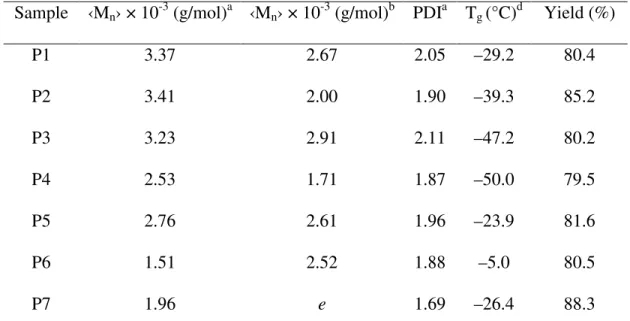
Seven polyester prepolymers were prepared for this study (Scheme 1). The first and second polymers were derived from trans-β-hydromuconic acid (HMA) and a calculated
Table 2.1 Polyester prepolymers synthesized at 130 °C (P1-P4) or 160 °C (P5-P7), 20
mmHg, and 24 h
Sample ‹Mn› × 10-3 (g/mol)a ‹Mn› × 10-3 (g/mol)b PDIa Tg (°C)d Yield (%)
P1 3.37 2.67 2.05 –29.2 80.4
P2 3.41 2.00 1.90 –39.3 85.2
P3 3.23 2.91 2.11 –47.2 80.2
P4 2.53 1.71 1.87 –50.0 79.5
P5 2.76 2.61 1.96 –23.9 81.6
P6 1.51 2.52 1.88 –5.0 80.5
P7 1.96 e 1.69 –26.4 88.3
aBased on GPC analysis. bBased on NMR analysis. cBased on TGA analysis. dBased on DSC analysis. eEndgroup signals not discernable in 1H NMR spectrum.
clearly discernable in the 1H NMR spectrum of P6, however, which resulted in a higher estimation of ‹Mn› by NMR analysis. The 1H NMR spectrum of P5 displayed the most discernable endgroup signals (δ = 3.62 ppm), which are also present in the 13C NMR
spectrum (δ = 62.9 and 32.7 ppm) (Figure 2.1). Hydroxyl endgroup signals for TEG-based
polymers were either absent or difficult to visualize using 1H NMR analyses, yet the signals were quite evident in the 13C NMR spectra (δ = 63.5 ppm). The endgroup signals for the
Figure 2.1 1H NMR (top) and13C NMR (bottom) spectra of P5
All glass transition temperatures were significantly below 0 °C, with the AA-based polymers (P3 and P4) having the lowest values (–47.2 and –50.0 °C). As expected, each DEG-based polymer had a higher glass transition temperature than its corresponding TEG-based polymer [Tg (P1) > Tg (P2); Tg (P3) > Tg (P4); and Tg (P6) > Tg (P7)]. While the Tg of P6 (– 5 °C) was higher than expected, it was also reproducible. Seppälä et al. demonstrated that glass transition temperatures of amorphous PEUs are dictated by the thermal transitions of their prepolymers.33 By using 1,6-hexamethylene diisocyanate as the hard segment, a number of poly(ester urethane)s were synthesized that possessed a relatively narrow range of glass transition temperatures higher (5 – 15 °C) than their prepolymers. In this work, every prepolymer possessed a relatively low glass transition temperature (Tg = –50.0 – –5.0 °C). This ensures that the resulting poly(ester urethane)s have glass transition temperatures below body temperature (37 °C), meaning that the PEUs are elastomeric at physiological conditions.
R =
or
or
O R' O
O R
O
O R' O
O
NH CH2 NH
R' = O O O O or or n m O
2.3.2 Poly(ester urethane) Synthesis
A one-step method where an aromatic diisocyanate,
Table 2.2 Thermal and mechanical data for poly(ester urethane)s synthesized at 80 °C in
DMAc for 2 h
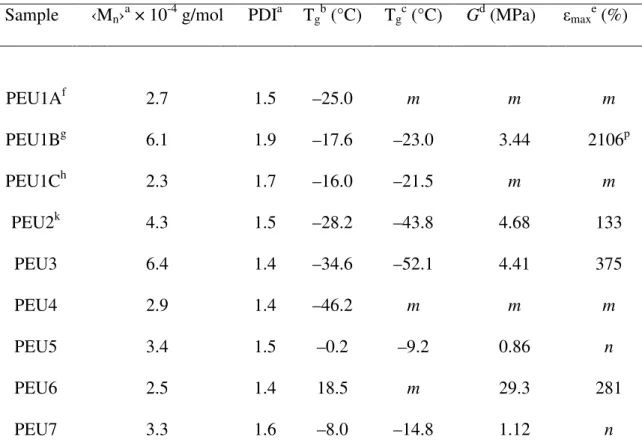
Sample ‹Mn›a × 10-4 g/mol PDIa Tgb (°C) Tgc (°C) Gd (MPa) εmaxe (%)
PEU1Af 2.7 1.5 –25.0 m m m
PEU1Bg 6.1 1.9 –17.6 –23.0 3.44 2106p
PEU1Ch 2.3 1.7 –16.0 –21.5 m m
PEU2k 4.3 1.5 –28.2 –43.8 4.68 133
PEU3 6.4 1.4 –34.6 –52.1 4.41 375
PEU4 2.9 1.4 –46.2 m m m
PEU5 3.4 1.5 –0.2 –9.2 0.86 n
PEU6 2.5 1.4 18.5 m 29.3 281
PEU7 3.3 1.6 –8.0 –14.8 1.12 n
aBased on GPC analysis. bBased on DSC analysis. cBased on DMA analysis. dYoung’s modulus. eUltimate strain. f10 wt %; g20 wt %; and h40 wt % MDI. kNumber denotes which prepolymer is used as soft segment (P2 is prepolymer for PEU2); PEU2-PEU7contain 20 wt % MDI. mCould not determine using DMA analysis or Instron analyis. nMechanically failed. p50 mm/min.
2.3.2.1 Molecular Weight Analysis
not be due to differences in molecular weight. The polydispersity of each sample was lower than the theoretical value (PDI = 2.0). This is most likely due to these polymers being highly soluble in DMAc, the solvent used in the polymerization conditions. Upon precipitation, the lower molecular weight chains remained soluble in the good solvent, which resulted in lower PDI values.
2.3.2.2 Thermal Analysis
2.3.2.3 Mechanical Analysis
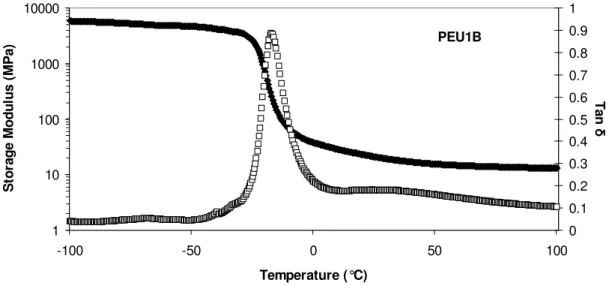
All PEUs showed a distinct decrease in storage modulus near the glass transition temperature. The storage moduli then formed a rubbery plateau in the 101 MPa range at temperatures above the glass transition as shown in Figure 2.2, which is the DMA data generated for PEU1B (HMA-diethylene glycol prepolymer/20 wt % hard segment). The glass transition for PEU1B is clearly visible from the sharp decline in E’ and the peak in tan
δ. The glass transition temperatures were measured as the maximum value of the loss
modulus (not shown), which is –23.0 °C for PEU1B.
1 10 100 1000 10000
-100 -50 0 50 100
Temperature (°C) S to ra g e M o d u lu s ( M P a ) 0 0.1 0.2 0.3 0.4 0.5 0.6 0.7 0.8 0.9 1 T a n δ PEU1B
Figure 2.2 Storage modulus (E’) and tan δ plotted versus temperature for PEU1B
hard segment) and PEU4 (adipic acid-tetraethylene glycol prepolymer) were too soft for DMA analysis, while PEU6 (4,5-dimethylcyclohex-4-ene cis-1,2-dicarboxylic anhydride-diethylene glycol prepolymer) was too brittle for DMA analysis. It seems that a PEU containing 20 wt % hard segment displayed optimum mechanical properties because PEU1B (20 wt %) had sufficient mechanical properties for DMA analysis but both PEU1A (10 wt %) and PEU1C (40 wt %) were unsuitable for DMA analysis. The DMA analyses also supported the evidence that these materials are completely amorphous, as semicrystalline polyurethanes display changes in storage modulus and tan δ at higher temperatures.45 The
DMA data for these poly(ester urethane)s showed no such transitions at higher temperatures. Instron analysis measured the mechanical properties using isothermal analysis. The Young’s moduli of the measurable materials ranged from 0.86 MPa (PEU5) to 29.3 MPa (PEU6). PEU1B has remarkable elasticity with a high ultimate strain (ε max = 2106 %). This material did not break at a crosshead speed of either 10 mm/min or 30 mm/min and retained its original shape in a matter of seconds following those trials. This material broke only after increasing the crosshead speed to 50 mm/min. Both Seppälä33 and Hilborn52 synthesized amorphous poly(ester urethane)s with high elasticity (ε >1000%). PEU2, PEU3, and PEU6
had ultimate strains ranging from ε max = 133 – 281 %, which are similar to the ultimate strain of pure elastin (ε max = 200 %).42 PEU1A, PEU1C, and PEU4 were too soft for Instron
PEU1B (ε max = 2106 %) had superior elasticity and PEU6 (G = 29.3 MPa) had a superior Young’s modulus. Poly(ester urethane) samples PEU1B, PEU2, PEU3, and PEU6 had excellent mechanical properties and are promising for use in biomedical applications.
0 0.5 1 1.5 2 2.5 3
0 50 100 150 200 250 300 350 400 450
Strain (%) T e n s il e S tr e s s ( M P a ) PEU3
Figure 2.3 Tensile stress (MPa) plotted versus strain (%) for PEU3
2.3.2.4 Surface and Bulk Characterization
20 25 30 35 40 45 50 55 60 65 70
0 5 10 15 20 25
Time (min) C o n ta c t A n g le PCL PEU1B PEU1C PEU2 PEU3 PEU4 PEU5 PEU6 PEU7
Figure 2.4 Contact angles of all polymer samples and poly(caprolactone) versus time
For the purpose of clarity, the PEUs are divided into two groups: those that derive from poly(ester ether) prepolymers (PEU1B, PEU1C, PEU2, PEU3, and PEU4) and those that derive from the polyesters bearing cyclic moieties (PEU5, PEU6, and PEU7). The contact angles differ as such: [PEU2 (most hydrophobic) > PEU1B > PEU3 > PEU1C > PEU4 (most hydrophilic)] and [PEU6 (most hydrophobic) > PEU5 > PEU7 (most hydrophilic)]. Most of these materials were hydrophobic, as they were in the same range as PCL (θ5min = 65 °). All contact angles decrease as time increases due to the droplets
surface properties differ from the bulk properties. The components for all of these materials include hydrophilic soft segments and hydrophobic aromatic hard segments,41 and the relative amounts of each may differ at the polymer surface and in the bulk when wet. Previous studies have shown that copolymers or polymer blends often exhibit the surface segregation phenomenon, a process in which lower energy constituents adsorb preferentially at the surface in order to lower the overall surface free energy.54-60 Other studies have confirmed that polyurethanes exhibit surface restructuring upon contact with water.61,62
proportional.64 Because of this, it is still not yet determined whether the second class of materials exhibit the surface segregation phenomenon as well as whether it is the soft segment cyclic moieties or the thermal properties that most affect the surface properties of PEU5, PEU6, and PEU7.
2.3.2.5 Degradation Studies
As these poly(ester urethane)s differ in terms of thermal properties, mechanical properties, and hydrophilicity, they degraded at different rates in an in vitro degradation study. Samples were left in a phosphate buffer medium (pH = 7.4) at 37 °C for six weeks, and the medium was changed weekly. Three PEUs (PEU1A, PEU2, and PEU4) degraded within that time period (Figure 2.5).
dominated by surface and interfacial reactions until the equilibration of water penetration and absorption leads to bulk degradation processes. This “induction” period is present for all samples, thus the discrepancy in the profile of PEU4 during the first 7 d is more likely due to the low mechanical properties of the hydrophilic surface (4.5 % mass lost by simply washing a 0.15 g sample with H2O). Because both zero-order or first-order rate laws do not apply for the entire span of the experiment for PEU4, zero-order rate laws were applied to each profile following the first week (0.31, 0.13, and 0.19 % mass lost/day for PEU1A, PEU2, and PEU4 respectively). The rate of PEU1A may be explained by its relatively lower content of hydrophobic hard segment. The % mass lost for PEU2 and PEU4 was measured after 100 days were 12.2 % and 29.9 % respectively, which correlate well with what the zero-order kinetic analyses predicted (13.3 % and 35.5%). None of these materials displayed a ‘burst effect’, which is prevalent in many poly(ester urethane)s.33,37 PEU2 is an extremely promising material as it possesses good mechanical properties (E = 4.68 MPa, γmax = 133 %)
and a linear degradation profile. PEU1A, PEU2, and PEU4 are among the fastest degrading poly(ester urethane)s recorded to date.
0 5 10 15 20 25 30
0 5 10 15 20 25 30 35 40 45
2.3.2.5 Cytotoxicity Studies
Studies have shown that aromatic-based materials, if treated under harsh, basic conditions, can produce aromatic amines, which are highly toxic. There has been contradictory evidence disputing whether or not this 1) happens in the human body and 2) if the amounts are at toxic levels.1 The alternative to this possibility is the use of an aliphatic isocyanate, as aliphatic amines are less detrimental in biological environments. However, by using an aliphatic diisocyanate, there is loss in mechanical and thermal properties. Our studies have shown that aliphatic diisocyanates are unsuitable for our one-step method of preparing amorphous poly(ester urethane) thermoplastic elastomers with high mechanical integrity.
The second method was used only for samples PEU2, PEU3, and PEU7 and was designed to test how these materials responded under different sterilization methods. PEU2 and PEU7 were autoclaved; PEU3 was partitioned into two samples: one was chemically treated (ethanol) and the other was autoclaved. They were then separately incubated in the presence of rabbit endothelial vascular cells (REVC) for 1 week. PEU7 could not be tested because autoclaving proved too harsh of a sterilization method making this sample unsuitable for handling. This was not surprising as PEU7 had a relatively low modulus, even at 37 °C (Table 2.2). The autoclave-sterilized PEU2, autoclave-sterilized PEU3, and ethanol-sterilized PEU3 are all non-toxic, as shown in Figure 2.6. The figure clearly shows that autoclaving methods of sterilization are not detrimental to those samples with sufficient moduli. There are no signs of either sterilization method inducing any cytotoxic response from the materials, as there was zero cell death. This test demonstrated that two poly(ester urethane)s, PEU2 and PEU3, show no cytotoxicity, even after 1 week of incubation with the REVC cells. These initial cytotoxicity tests indicate that these materials are promising for biomedical purposes; however, further testing is required for these materials to ascertain whether they are biocompatible.
Figure 2.6 Autoclave-sterilized PEU2 (left); autoclave-sterilized PEU3 (middle);
2.4 General Conclusions
A one-step method has been used to prepare versatile degradable, amorphous poly(ester urethane) thermoplastic elastomers with novel soft segments without the use of a chain extender. These materials show a wide range of mechanical properties, including highly elastic materials (εmax = 2106 %). These materials displayed a surface segregation phenomenon when in contact with aqueous solutions. Three poly(ester urethane)s, PEU1A, PEU2, and PEU4 showed appreciable degradation at 37 °C during the 6-week study and possessed relatively fast degradation rates. Studies on PEU2 and PEU3 showed that different methods of sterilization do not induce cytotoxic behavior in these materials. Current efforts are being made towards synthesizing amorphous degradable thermoplastic poly(ester urethane)s with shape-memory properties.
2.5 Acknowledgements
The authors would like to thank Matthew R. Cottle for assistance with the DMA measurements as well as Nick Shalosky for help with the cell culture studies, Steve Oglesbee for help with the cell imaging, and Fred Stevie and Chris Penley for assistance with the XPS analyses. This research was funded by the National Science Foundation (Department of Materials Research) under grant 0418499.
2.6 References
1) Lamda, N.M.K.; Woodhouse, K.A.; Cooper, S.L. Polyurethanes in Biomedical Applications; CRC Press: Boca Raton, 1998.
2) Moehle, R.T.; Farnworth, C.L.; Hibdon, D.; Patterson, R.C. U.S. Patent 20060200111, 2006.
3) Sridharan, S. U.S. Patent 2004197501, 2004.
5) Yabushita, Y.; Takatsuka, M.; Koyama, M.; Sakai, S. JP 05285217, 1993. 6) Ikada, Y.; Inoe, H. JP 05076590, 1993.
7) (a) Karakelle, M.; Solomon, D.D. CA 2017951, 1990. (b) Karakelle, M.; Solomon, D.D. CA 2017952, 1990.
8) Takahashi, A.; Hatake, H. JP 02220666, 1990. 9) McGary, C.W.; Solomon, D.D. EP 184465, 1986. 10) Chinn, J.A. WO 2002049689, 2002.
11) Wheatley, D.J. WO 2006000763, 2006.
12) Chinn, J.A.; Frautschi, J.R.; Phillips, R.E. U.S. Patent 6,702,851, 2004. 13) Mackay, T.G.; Wheatley, D.J.; Bernacca, G.M.; Fisher, A.C.; Hindle, C.S.
Biomaterials, 1996, 17, 1857.
14) Wheatley, D.J.; Raco, L.; Bernacca, G.M.; Sim, I.; Belcher, P.R.; Boyd, J.S. European Journal of Cardio-Thoracic Surgery 2000, 17, 440.
15) Martin, D.J. WO 2006024068, 2006.
16) Wang, H.; Jin, X.; Wu, H.; Yin, B.; Jin, Y. CN 1883747, 2006. 17) Tokunaga, N. JP 2005238597, 2005.
18) Ochiai, S.; Tokunaga, N. JP 2005034205, 2005. 19) Tanaka, M.; Ishii, N. JP 2004357826, 2004. 20) Kuroki, H. JP 05031334, 1993.
21) Nakajima, Y.; Naito, H.; Sato, H. JP 2006325675, 2006.
22) Bishop, S.M.; Griffiths, B.; Shaw, H.L.; Adams, S.M. WO 2004098668, 2004. 23) Kurokawa, M.; Nakamura, H. JP 2004049921, 2004.
24) Lock, P.M. GB 2102012, 1983.
27) Bruining, M.J.; Pijpers, A.P.; Kingshott, P.; Koole, L.H. Biomaterials, 2002, 23,
1213.
28) Lloyd, A.W.; Faragher, R.G.A.; Denyer, S.P. Biomaterials, 2001, 22, 769.
29) Williams, D.F. Sadhana, 2003, 28, 563.
30) Hiltunen, K.; Härkönen, M.; Seppälä, J.V.; Väänänen, T. Macromolecules 1996, 29,
8677.
31) Hiltunen, K.; Seppälä, J.V.; Härkönen, M. J. Appl. Polym. Sci. 1997, 63, 1091.
32) Hiltunen, K.; Seppälä, J.V.; Härkönen, M. Macromolecules 1997, 30, 373.
33) Seppälä, J.V.; Kylma, J. Macromolecules, 1997, 30, 2876.
34) Kylmä, J.; Härkönen, M.; Seppälä, J.V. J. Appl. Polym. Sci. 1997, 63, 1865.
35) Rich, J.; Tuominen, J.; Kylmä, J.; Seppälä, J.; Nazhat, S.N.; Tanner, K.E. J. Biomedical Materials Research 2002, 63, 346.
36) Tuominen, J.; Kylmä, J.; Kapanen, A.; Venelampi, O.; Itävaara, M.; Seppälä, J. Biomacromolecules 2002, 3, 445.
37) Hiltunen, K.; Tuominen, J.; Seppälä, J. Polymer International 1998, 47, 186.
38) Hiljanen-Vainio, M.; Heino, M.; Seppälä, J. Polymer 1998, 39, 865.
39) Helminen, A.; Kylmä, J.; Tuominen, J.; Seppälä, J. Polymer Engineering and Science
2000, 40, 2000.
40) Tangpasuthadol, V.; Pendharkar, S.M.; Peterson, R.C.; Kohn, J. Biomaterials 2000,
21, 2379.
41) Prasath, R.A.; Nanjundan, S.; Pakula, T.; Klapper, M. J. Appl. Polym. Sci. 2006, 100,
1720.
42) Spina, M.; Friso, A.; Ewins, A.R.; Parker, K.H.; Winlove, C.P. Biopolymers 1999, 49,
255.
43) Marcos-Fernández, A.; Abraham, G.A.; Valentín, J.L.; San Román, J. Polymer 2006,
47, 785.
44) Sheth, J.P.; Klinedinst, D.B.; Wilkes, G.L.; Yilgor, I.; Yilgor, E. Polymer 2005, 46,
45) Sheth, J.P.; Klinedinst, D.B.; Pechar, T.W.; Wilkes, G.L.; Yilgor, E.; Yilgor, I. Macromolecules 2005, 38, 10074.
46) Olson, D.A.; Gratton, S.E.A.; DeSimone, J.M.; Sheares, V.V. J.Am. Chem. Soc.
2006,128, 13625.
47) Brown, A.H.; Sheares, V.V. Macromolecules 2007, 40, 4848.
48) Saad, G.R.; Lee, Y.J.; Seliger, H. Macromol. Biosci. 2001, 1, 91.
49) Lendlein, A.; Langer, R. Science 2002, 296, 1673.
50) Lendlein, A.; Kelch, S. Angew. Chem. Int. Ed. 2002, 41, 2034.
51) Gall, K.; Yakachi, C.M.; Liu, Y.; Shandas, R.; Willett, N.; Anseth, K.S. Journal of Biomedical Materials Research, Part A 2005, 73, 339.
52) Asplund, J.O.B.; Bowden, T.; Mathisen, T.; Hilborn, J. Biomacromolecules 2007, 8,
905.
53) Tan, H.; Xie, X.; Li, J.; Zhong, Y.; Fu, Q. Polymer 2004, 45, 1495.
54) Koberstein, J.T. MRS Bulletin 1996, 21, 19.
55) Bhatia, Q.S.; Pan, D.H.; Koberstein, J.T. Macromolecules 1998, 21, 2166.
56) Makal, U.; Uslu, N.; Wynne, K.J. Langmuir 2007, 23, 209.
57) Owen, M.J.; Kendrick, T.C. Macromolecules 1970, 3, 458.
58) Castner, D.G.; Ratner, B.D.; Hoffman, A.S. Journ. Biomater. Sci., Polym. Edn. 1990,
1, 191.
59) Tingey, K.G., Andrade, J.D. Langmuir 1991, 7, 2471.
60) Senshu, K.; Kobayashi, M.; Ikawa, N.; Yamashita, S.; Hirao, A.; Nakahama, S. Langmuir 1999, 15, 1763.
61) Clarke, M.L; Wang, J.; Chen, Z. Anal. Chem. 2003, 75, 3275.
62) Schoonover, J.R.; Steckle Jr., W.P.; Cox, J.D.; Johnston, C.T.; Wang, Y.; Gillikin, A.M.; Palmer, R.A. Spectrochimica Acta Part A, 2007, 67, 208.
64) Fryer, D.S.; Peters, R.D.; Kim, E.J.; Tomaszewski, J.E.; de Pablo, J.J.; Nealey, P.F.; White, C.C.; Wu, W. Macromolecules 2001, 34, 5627.
65) McMahon, W.; Birdsall, H.A.; Johnson, G.R.; Camilli, C.T. J. Chem. Eng. Data
1959, 4, 57.
Chapter III
DEGRADABLE THERMOSET SHAPE-MEMORY ELASTOMERS BASED ON
POLY(CYCLOHEXANEDIMETHANOL
3.1 Introduction
The thermoplastic polyurethane elastomers presented in Chapter II were promising for degradable in vivo applications, but their thermal properties were insufficient (Tg < 18 °C)
for use as biomedical SMPs. In order to prepare optimized SMPs, prepolymers with increased thermal properties were designed and tested as soft segments. Herein we describe the synthesis and characterization of degradable thermoset SMPs with glass transition temperatures ranging from 54 – 140 °C that were based on photocurable poly(1,4-cyclohexanedimethanol 1,4-cyclohexanedicarboxylate) (PCCD) prepolymers. The synthesis and characterization of the PCCD prepolymers as well as the elastomers are discussed, and their potential as biomedical SMPs is demonstrated.
3.2 Experimental Section
3.2.1 Materials
All materials were purchased from Aldrich unless otherwise noted.
1,4-Cyclohexanedimethanol (CDM; 99%) was a 17.2/82.8 molar ratio of cis/trans isomers, and 1,4-cyclohexanedicarboxylic acid (CDC; 99%) was a 76.3/23.7 molar ratio of cis/trans isomers as measured by 1H NMR. 2,2-Diethoxyacetophenone (98%) was purchased from Acros Organics. Methylene chloride was distilled before use and stored on 4 Å molecular sieves.
3.2.2 Characterization
1H and 13C NMR spectra were acquired in deuterated chloroform on a Bruker 400
measurements were taken at 35 °C with tetrahydrofuran as the mobile phase on four columns (Waters Styragel HR5, HR4, HR2, and HR0.5). Photochemical curing was accomplished using a UV oven chamber (ECL-500) that was purged with N2 for 10 min prior to irradiation. Thermogravimetric analysis was performed on a PerkinElmer Pyris 1 thermal gravimetric analyzer (TGA) with a heating rate of 10 °C/min in a N2 atmosphere. Glass transition temperatures of the prepolymers were measured with a Seiko 220C differential scanning calorimeter (DSC), using a heating rate of 10 °C/min and a cooling rate of 10 °C/min in a N2 atmosphere. Glass transition temperatures were determined as the inflection point of the endotherm on the 2nd heating step. FTIR spectra were acquired on a PerkinElmer Spectrum BX. Mechanical analysis was conducted on an Instron 5566 at a crosshead speed at 10 mm/min at 25 °C or with an Instron SFL 3119-506 Heatwave Temperature Controlled Chamber for measurements at higher temperatures. The Young’s modulus (G) was calculated using the initial linear portion of the stress/strain curve (0 – 5% strain). Dynamic mechanical analysis was performed using a PerkinElmer Pyris Diamond dynamic mechanical analyzer (DMA). The measurements were taken using the tension mode with a frequency of 1 Hz from –100 °C to 100 °C.
Sol-Gel analysis was conducted by swelling a 0.25 g elastomer film in diethyl ether for 24 h at 25 °C followed by methylene chloride for 24 h at 25 °C. After 24 h, the samples were weighed to calculate the change in weight from swelling according to the equation
100 24 × − = i i h m m m ζ
100 × − = i f i s m m m Q
where mi and mf represent the initial and final mass, respectively. The measurements were performed in triplicate. Fully extracted films were prepared by drying the extracted films in a vacuum oven at 100 – 110 °C for several days, until a constant weight was achieved.
Shape-Memory Characterization. Samples were clamped in the Instron and heated
using a thermal chamber. The measurements were performed only after the temperature had reached equilibrium. The packaging and reformation studies were performed by elongating the samples to σ = 200 % at T = Tg – 5 °C. The samples were then allowed to cool to room
temperature and measured in length. Reformation was accomplished by submerging the samples in a water bath set to 64 °C, and complete reformation occurred after 6 s. Strain fixity rates were calculated using the equation
m u f n n R σ
σ ( )
)
( =
where σu(n) represents the strain in the stress-free state after having it packaged and σm is the
maximum strain. Strain recovery rates were calculated using the equation
) 1 ( ) ( ) ( ) ( − − − = n n n n R p m p m r σ σ σ σ
where σp(n) is the elongation of the sample at the beginning of the nth cycle. All reported
values were averages of at least three measurements.
line were used. At the conclusion of 48 h, the cells were examined and cytotoxicity was scored on a 0 to 4 scale, 0 being the least cytotoxic.
3.2.3 Prepolymer Synthesis
Hydroxyl-endcapped prepolymers were synthesized according to the following procedure. A 500-mL round bottom flask was charged with 1,4-cyclohexanedicarboxylic acid and a stoichiometric excess of 1,4-cyclohexanedimethanol. The flask was purged with N2, and the contents were heated to 130 °C and stirred until a homogeneous melt formed. Stannous 2-ethylhexanoate (Sn(Oct)2; 1.0 mol%) was added to the melt. The mixture stirred for 1 h, and the pressure was reduced to 20 mmHg. The reaction was allowed to proceed at 20 mmHg for 24 h, at which point the pressure was reduced to 0.1 mmHg. The reaction was allowed to proceed for 24 h. The resulting prepolymer was stored at 100 °C at 0.1 mmHg. Reactions were performed on a 25 – 50 g scale.
Poly(1,4-cyclohexanedimethanol 1,4-cyclohexanedicarboxylate) (PCCD). 1H NMR: δ (ppm) = 3.97 (d, 4H, J = 6.9 Hz), 3.88 (d, 4H, J = 6.3 Hz), 3.52 (d, cis–CH2OH endgroups, J = 7.0 Hz), 3.40 (d, trans–CH2OH endgroups, J = 6.3 Hz), 2.45 (s, 2H), 2.26 (s, 2H), 2.04 (d, 4H, J = 7.8 Hz), 1.86 (t, 4H, J = 8.2 Hz), 1.78 (d, 4H, J = 6.9 Hz), 1.67 (s, 4H), 1.59 – 1.49 (m, 12H), 1.42 (d, 4H, J = 9.3 Hz), 0.99 (t, 4H, J = 11.1 Hz). 13C NMR: δ (ppm) =
3.2.4 Elastomer Synthesis
Elastomer Synthesis Using 2-Isocyanatoethyl Methacrylate. Colorless elastomers
were prepared according to the following procedure. A 500-mL round bottom flask was charged with a calculated amount of hydroxyl-endcapped prepolymer (2 – 25 g). The flask was evacuated and then purged with N2 three times. A condenser was attached to the flask, and 50 mL of CH2Cl2 were added. The solution refluxed under N2, and stirred until the prepolymer completely dissolved. 2-Isocyanatoethyl methacrylate (4.2 mol equiv, according to the ‹Mn› of the prepolymer as determined by 1H NMR) was added to the flask along with 0.01 wt % Sn(Oct)2. The contents were refluxed for 1 h, and the solvent was removed under reduced pressure. The methacrylate-endcapped prepolymers were purified by precipitating the contents in cold methanol (–78 °C) and removing the methanol under reduced pressure. Elastomers were fabricated by first adding 0.5 wt % 2,2-diethoxyacetophenone to the purified prepolymer. To ensure that the resulting films were homogeneous, the contents were thoroughly stirred at room temperature after initiator addition. Films were prepared by pouring the prepolymer liquid into 5 cm × 5 cm teflon molds and irradiating them with 30 mW/cm2 UV irradiation (365 nm) for 10 min. The cured films were dried in a vacuum oven at 80 °C for 5 d.
Elastomer Synthesis Using Methacryloyl Chloride. Colorless elastomers were
Triethylamine (4.2 mol equiv, according to the ‹Mn› of the prepolymer as determined by the GPC or NMR) was added to the flask and stirred for 5 min. After the contents were cooled to 0 °C using an ice bath, methacryloyl chloride (4.2 mol equiv, according to the ‹Mn› of the prepolymer as determined by the GPC or NMR) was added slowly, and the contents stirred overnight. The contents were washed twice with 1M HCl, NaHCO3 (3%), deionized H2O, brine, and finally dried with MgSO4. The solution was filtered and the solvent was removed under reduced pressure. The residue was precipitated in cold methanol (–78 °C). The curing procedure was identical to the method used for the elastomers prepared using 2-isocyanatoethyl methacrylate.
Sn(Oct)2
130 °C 20 - 0.1 Torr 48 h + O OH O HO O O NCO
CH2Cl2, reflux, 1h Sn(Oct)2
hv, 10 min
Shape-Memory Elastomer HO OH O O O O O O n HO O O O O O H n O HN O O O NH O O