Received 12 Mar 2016|Accepted 1 Sep 2016|Published 7 Oct 2016
Experimental creation of quantum Zeno subspaces
by repeated multi-spin projections in diamond
N. Kalb
1,2, J. Cramer
1,2, D.J. Twitchen
3, M. Markham
3, R. Hanson
1,2& T.H. Taminiau
1,2Repeated observations inhibit the coherent evolution of quantum states through the quantum Zeno effect. In multi-qubit systems this effect provides opportunities to control complex quantum states. Here, we experimentally demonstrate that repeatedly projecting joint observables of multiple spins creates quantum Zeno subspaces and simultaneously suppresses the dephasing caused by a quasi-static environment. We encode up to two logical qubits in these subspaces and show that the enhancement of the dephasing time with increasing number of projections follows a scaling law that is independent of the number of spins involved. These results provide experimental insight into the interplay between frequent multi-spin measurements and slowly varying noise and pave the way for tailoring the dynamics of multi-qubit systems through repeated projections.
DOI: 10.1038/ncomms13111 OPEN
1QuTech, Delft University of Technology, P.O. Box 5046, Delft 2600 GA, The Netherlands.2Kavli Institute of Nanoscience, Delft University of Technology, P.O. Box 5046, Delft 2600 GA, The Netherlands.3Element Six Innovation, Fermi Avenue, Harwell Oxford, Didcot, Oxfordshire OX11 0QR, UK.
T
he quantum Zeno effect restricts the evolution of repeatedly observed quantum systems. For a two-dimen-sional system the state simply is frozen in one oftwo eigenstates of the measurement operator1–10. In
multi-dimensional systems; however, Zeno subspaces are formed that can contain complex quantum states and dynamics: repeated observations create a barrier that blocks coherent evolution between subspaces, but leaves coherences and dynamics within
those subspaces intact11. Analogous effects can also be
realized through coherent control pulses or strong driving
fields that decouple transitions between the subspaces12–19.
Pioneering experiments have highlighted that the non-trivial dynamics in Zeno subspaces can be used to prepare exotic
quantum states20–24. However, the opportunities to tailor the
dynamics of multi-qubit systems by restricting coherent evolution have remained unexplored.
Here we show that repeated multi-spin projections on individually controlled spins create quantum Zeno subspaces that can encode multiple logical qubits while suppressing dephasing caused by the environment. We realize these repeated projections for up to three nuclear spins in diamond using the optical transition of a nearby electron spin. We then encode up to two logical qubits—including entangled states of logical qubits— and show that increasing the frequency of the projections supresses the dephasing of quantum states. Finally, we theore-tically derive and experimentally verify a scaling law that shows that the increase in dephasing time is independent of the number of spins involved.
Results
Experimental system and sequence. Our system consists of three
13C spins (I¼½) surrounding a single nitrogen vacancy (NV)
centre (|0iNV:ms¼0 and |1iNV:ms¼ 1) in diamond (see
Supplementary Note 1). The natural evolution of the 13C spins
is dominated by dephasing due to the slowly fluctuating
surrounding bath of 13C spins (dephasing times T
2¼12.4(9),
8.2(7) and 21(1) ms for spin 1, 2 and 3, respectively)25.
Because the fluctuations are quasi-static, the Hamiltonian in a
given experiment is H¼Pki¼1Dis^z;i=2, with k the number of
spins and the detuning Di for spin i drawn from a Gaussian
distribution withs¼pffiffiffi2=T2. We denote the Pauli operators as
^
sx,s^y,^sz and the identity as^I.
The quantum Zeno effect arises when an observable O^ is
projected (super-operator MðO^Þ). Here we consider dichotomic
observables with eigenvalues±1. A projection leaves the system’s
density matrix (rs) in block-diagonal form with respect to the
projectorsP ¼ ð^I O^Þ=2 (ref. 11):
M O^ rs¼PþrsP y
þþPrsPy ¼
rsþO^r sO^y
2 : ð1Þ
Repeatedly projecting observable O^ thus inhibits coherent
evolution between the two eigenspaces of O^. We choose joint
multi-spin observables of the form O^¼^sk
x , which
anti-commute with all terms in the Hamiltonian H, so that
rapid projections ideally result in the effective Zeno
Hamiltonian HZeno¼PHPy ¼0 (ref. 11). Applying these
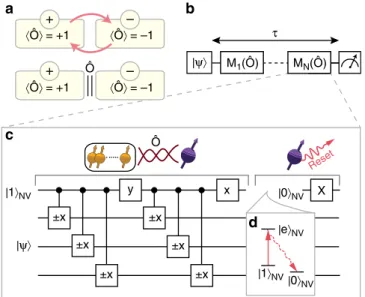
projections therefore suppresses dephasing for each nuclear spin, but leaves quantum states and driven dynamics inside the two subspaces untouched (Fig. 1a).
To investigate quantum Zeno subspaces we use the following experimental sequence (Fig. 1b). We first initialize the nuclear
spins in the desired state and prepare the electron spin in |1iNV.
Crucially, leaving the electron in |1iNV creates a different
frequency shift for each of the three 13C spins that suppresses
resonant flip-flop interactions among the 13C spins during
idle time26. We then apply a total of N projections that are
equally distributed in time. Finally, the nuclear spin state is read out using the electron spin as an ancilla (refs 27–32). Here we consider the case of an even number of projections. The results
for an odd number of projectionsNgive rise to additional effects
at long evolution times due to the time-correlations in the noise and are discussed in Supplementary Fig. 1. The total evolution
timetis defined from the end of the initialization to the start of
the read-out. We subtract the time that control operations are applied to the nuclear spins (averaged over all spins), as
dephasing might be suppressed during driving (for a
comparison see Supplementary Fig. 2).
We experimentally realize repeated multi-spin projections on
the 13C spins by using the NV electron spin as an ancilla spin
(Fig. 1c). First, we entangle the NV electron spin state with the
projections on the eigenspaces of O^(hO^i ¼ þ1 or 1), so that
the combined state is ajhO^i ¼ þ1ij0i
NVþbjhO^i ¼ 1ij1iNV (refs 25,33). Second, we apply an optical excitation that is
resonant only if the electron-spin state is |1iNV(‘reset’)25, which
projects the quantum state and re-initializes the NV electron spin
in |0iNV through optical pumping (Fig. 1d). Note that it is not
a b
MN
|ψ〉
|ψ〉
τ
c
y
±x ±x
x X
Reset
|1〉NV |0〉NV
d +
+ 〈Oˆ〉 = +1
ˆ ˆ
ˆ ˆ
ˆ
ˆ ˆ
O
O
〈O〉 = +1
〈O〉 = –1
〈O〉 = –1
M1(O) MN(O) –
–
|e〉NV
|0〉NV |1〉NV
±x ±x
±x ±x
Figure 1 | Concept and experimental sequence.(a) Quantum Zeno subspaces. The state space of a quantum system is divided into two subspaces (yellow boxes) of an observableO. Plus and minus signs indicate^
eigenvalues of the associated operator. Coherent transitions between the two subspaces occur while the system is unperturbed (top, red arrows) but are strongly inhibited ifO^is repeatedly projected (bottom). (b) Experimental sequence. After initialization in |ci,Nequidistantly distributed projectionsM(O) (see equation (1)) are applied during a total^ evolution timetand the state of the system is read out. (c) Realization of MðO^¼^sx^sxs^xÞfor three nuclear spins. First, the state of the nuclear spins (yellow) is entangled with the ancilla electron-spin state (purple). Second, the electron spin is projected and reinitialized in |1iNV(see alsod) through a long 30ms optical pumping pulse to |0iNVand a subsequent microwave
p-pulse (X). Such a long laser excitation pulse ensures that the NV is projected. Thexandygates arep/2 rotations around theXandYaxes, respectively. Controlled gates indicate that the direction is determined by the electron spin28. See Supplementary Fig. 3 for pulse sequences for projections on one and two spins. (d) Relevant electron spin levels for optical re-pumping through selective resonant excitation of |1iNVto |eiNV. We prepare the nuclear spin states in thehOi ¼ þ^ 1 subspace and associate
required to extract or record the outcome of the optical measurement. To mitigate extra dephasing caused by the stochastic nature of the optical re-initialization (time constant
of B1ms), we use13C spins with a NV-13C hyperfine coupling
that is small compared with the inverse of the time constant for
re-initialization (all couplings are below 2p50 kHz)34,35. In
addition, we design the gate sequence, so that |0iNVis associated
with the subspace of the initial nuclear state: ideally the electron spin is never optically excited and the projection constitutes a null measurement.
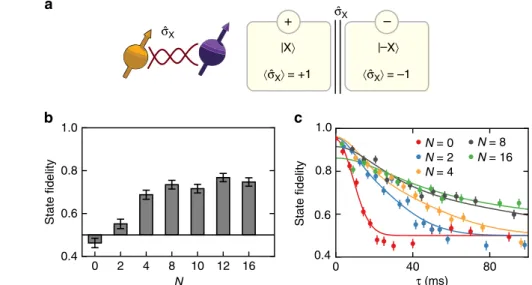
Quantum Zeno effect for a single spin. To illustrate the quan-tum Zeno effect and to benchmark our system, we first consider a
single13C spin and study the dephasing of the superposition state
Xi
j ðj i þ0 j iÞ1 =pffiffiffi2forO^¼^sx(Fig. 2a). We initialize the13C
spin in |Xiwith an initial state fidelity of 0.95(2) and apply up to
N¼16 projections. For a fixed total evolution time of 40 ms, we
observe a significant increase of the state fidelity with an increasing number of projections (Fig. 2b). The complete time traces show that the dephasing time increases as more projections are applied (Fig. 2c); the superposition state is protected by the quantum Zeno effect. In this example, however, the Zeno subspaces contain just a single state and therefore cannot encode general quantum states.
Preserving a logical qubit via quantum Zeno subspaces. We next investigate Zeno subspaces that can contain an arbitrary two-dimensional quantum state, that is, a complete logical
quantum bit, by performing joint projections on two 13C spins.
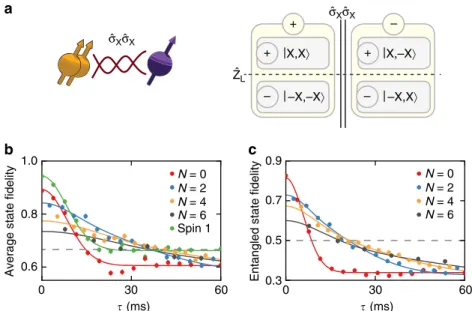
We set the joint-observable O^¼s^x^sx, so that the
four-dimen-sional state space is divided into two coherent two-level subspaces (Fig. 3a). In these subspaces a logical qubit, which can hold an
arbitrary quantum state, can be defined as jciL¼aj0iLþbj1iL,
with j i0 L¼jX;Xi and j i1L¼ j X;Xi, and with logical
operators Z^L¼^sx^I and X^L¼s^zs^z. Note that logical qubit
superposition states are generally entangled states of the two13C
spins.
We characterize the storage of arbitrary quantum states
by preparing all six logical basis states j i0L;j i1 L;
0 j iLj i1 L
=p2ffiffiffi;j i0Lij i1L=pffiffiffi2g and averaging the final
logical state fidelities36 (Fig. 3b). The logical qubit
without projections shows the same decay as a single 13C spin,
but with a slightly reduced initial fidelity (F¼0.89(1)) due to the
overhead of creating the entangled states |ciL. Applying
projections of the joint-observable ^sx^sx strongly suppresses the
dephasing by the environment, while preserving the logical qubit states. As a result, the average state fidelity for the logical qubit
surpasses the best 13C nuclear spin used, while still remaining
above the threshold of 2/3 for the storage of quantum states37.
This result demonstrates the suppression of the dephasing of a complete logical qubit through the quantum Zeno effect.
Interestingly, preserving the logical qubit does not actually require the coherence of the second spin to be maintained, as
follows from the logical operator Z^L¼s^x^I. To show that the
complete two-spin state is preserved, including entanglement between the two nuclear spins, we measure the average state fidelity with the ideal two-spin state for the four entangled initial states as a function of time (Fig. 3c). The duration for which
genuine entanglement persists (two-spin state fidelity 40.5) is
extended for N¼2, 4 and 6 projections compared with the case
without any projections, indicating that the barrier introduced by the projections inhibits dephasing for any two-spin state within the Zeno subspace.
Quantum Zeno subspaces with two logical qubits. Realizing Zeno subspaces with even more dimensions enables the exploration of complex states of multiple logical qubits within the
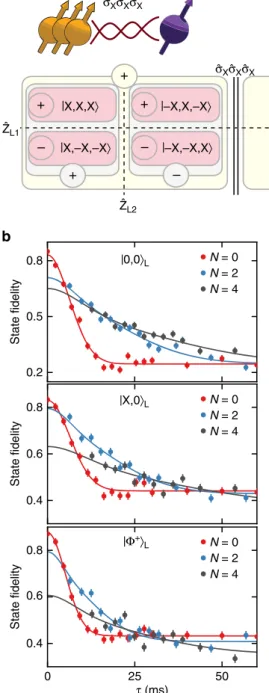
subspaces. We include a third nuclear spin and setO^¼^sx^sxs^xto
create a protected four-dimensional subspace, which can host
two logical qubits defined by the logical operators Z^L1¼^sx^Is^x;
^
XL1¼^I^szs^z and Z^L2¼^Is^x^sx;X^L2¼^sz^I^sz (Fig. 4a). Each pure
state within thehO^i ¼ þ1 subspace can be expressed in terms of
the logical two-qubit states:
ajX;X;XiþbjX;X;XiþgjX;X;Xi
þdjX;X;Xi¼a0;0iLþb0;1iLþg1;0iLþd1;1iL: ð2Þ
To investigate the inhibition of dephasing of the two logical qubits by repeated projections we prepare three different logical
a
c b
1.0 1.0
N = 0 N = 8
N = 16
N = 2
N = 4
0.8 0.8
State fidelity 0.6 State fidelity 0.6
0.4 0.4
0 2 4 8 10 0 40
τ (ms) 80
N
12 16
|X〉 |–X〉
σX
σX
+ –
〈σX〉 = +1 〈σX〉 = –1
ˆ
ˆ
ˆ ˆ
Figure 2 | Quantum Zeno effect for a single-spin superposition state.(a) Quantum Zeno subspaces for a single nuclear spin (spin 1) andO^¼^sx. Each eigenspace of^sxconsists of one state (|Xior |Xi) with the respective eigenvalue indicated by the circled þ/ signs. (b) State fidelity for |Xiafter
states: the logical eigenstate state |0,0iL, the logical superposition
state jX;0iL¼ ðj0;0iLþj1;0iLÞ=pffiffiffi2 and the entangled logical
stateFþiL¼j0;0iLþj1;1iL=pffiffiffi2. Preserving this set of states
requires repeated projections of the three-spin operator ^sx^sxs^x,
since they are not eigenstates of a single two-spin operator. The logical state fidelities for all three states show a clear
prolongation of the decay times for N¼2 and 4 three-spin
projections (Fig. 4b). Moreover, for a range of evolution times, the absolute logical state fidelities are increased despite the initial loss of fidelity due to the complexity of the experimental sequence
(33 two-qubit gates for N¼4, which in total require 1,276
refocusing pulses on the electron spin). These results confirm that the introduced three-spin projections inhibit dephasing of the individual spins while preserving the two logical qubits in a quantum Zeno subspace.
Scaling law for the suppression of dephasing. To gain a detailed quantitative understanding of the quantum Zeno effect for multi-spin projections, we derive a complete analytical description for the evolution. We model the projections as instantaneous and the noise as a quasi-static Gaussian frequency detuning, independent for each nuclear spin. We find an analytic solution for the decay of the expectation value of
observables that are sensitive to dephasing (for Nprojections
and total evolution timet):
A
2Nþ1
X
Nþ1
l¼0
Nþ1
l
e
tNl T
2;eff 2
withtNl¼t
2l
Nþ1t: ð3Þ
HereAr1 is the initial amplitude determined by experimental
fidelities and 1=T
2;eff ¼
ffiffiffiffiffiffiffiffiffiffiffiffiffiffiffiffiffiffiffiffiffiffiffiffiffiffiffiffiffi Pk
i¼1ð1=T2;iÞ2
q
is an effective joint decay rate of all involved spins. This result is valid for any system size, that is, number of spins, and number of projections
N(both even and odd). A detailed derivation of equation (3) is
given in Supplementary Note 2.
We fit all experimental data in Figs 2–4 withA,T
2;eff and an
offset, to account for the fact that two out of six cardinal states are insensitive to dephasing, as free parameters. We find good agreement with the experimentally obtained dephasing curves (see Supplementary Table 1 for all fit values). To analyse the increase of the decay time with increasing number of projections, we compile the extracted values from all experiments with an even number of projections and with 1–3 nuclear spins in Fig. 5. The results reveal a scaling law that is independent of the number of spins involved, in good quantitative agreement with our theoretical model.
Discussion
In conclusion, we have observed that repeatedly projecting joint-observables of multi-spin systems creates quantum Zeno subspaces that can hold complex quantum states, and that these Zeno subspaces are resilient to environmental dephasing. While suppression of dephasing may also be achieved through
alternative techniques such as coherent refocusing17–19, our
results provide direct experimental insight into the physics of repeated multi-spin measurements and Zeno subspaces in low-frequency noise environments. The results are also of practical relevance in the context of quantum error correction and detection codes, in which errors are detected through
repeated measurements of joint observables25,38,39. Moreover, the
a
b c
1.0 0.9
0.7
0.5
0.3
Average state fidelity Entangled state fidelity
0.8
0.6
0 30
N = 0
N = 2
N = 4
N = 6
N = 0
N = 2
N = 4
N = 6 Spin 1
(ms)
60 0 30
(ms)
60
⎮X,X〉 σXσX
⎮X,–X〉
⎮–X,–X〉 ⎮–X,X〉 ˆ ˆ
σˆ ˆXσX
+
+
– –
+ –
ˆ ZL
Figure 3 | Storing a logical quantum bit by repeated two-spin projections.(a) Schematic representation: the four-dimensional state-space of two13C spins (spin 1 and 2) is divided into two subspaces by repetitively projectingO^¼^sxs^xthrough entanglement with the ancilla spin. We define a logical quantum bit with logical operatorZ^L¼s^x^I(dashed line) and associate^sxinZ^Lwith the spin with the longest coherence time (spin 1). (b) Storing a logical quantum bit. The average logical state fidelity for the six logical input states, for example,ð1þ h^ZLiÞ=2 for |0iL, as a function of time and for a varying number of projectionsN. To compare the results to the best possible decay for a single nuclear spin, we compare to the individual decay of spin 1 and eliminate potential systematic detunings by measuring
ffiffiffiffiffiffiffiffiffiffiffiffiffiffiffiffiffiffiffiffiffiffiffiffiffiffiffi
^
sx h i2þ ^sy
2 q
(instead of^sxors^y). The dashed horizontal line is the classical limit of 2/3 (ref. 37). (c) Preserving two-spin entangled states. The two-spin state fidelity, averaged over the four entangled input states, indicates that general two-spin states in the subspace are preserved. Above the dashed horizontal line (F¼0.5) the state is entangled. ForN¼2, 4 and 6 projections, entanglement is preserved longer than without projections. Solid lines are fits to equation (3) with the initial amplitudeA, an offset and the effective dephasing timeT
demonstrated methods pave the way for investigating the effect of repeated measurements in various noise environments, for example, non-Markovian noise, and for exploring and
engineering complex dynamics of multi-qubit systems under
tailored decoherence40–43.
Data availability. The data that support the findings of this study are available from the corresponding author upon request.
References
1. Misra, B. & Sudarshan, E. C. G. The Zeno’s paradox in quantum theory.J.
Math. Phys.18,756–763 (1977).
2. Itano, W. M.et al.Quantum Zeno effect.Phys. Rev. A41,2295–2300 (1990). 3. Wolters, J.et al.Quantum Zeno phenomenon on a single solid-state spin.Phys.
Rev. A88,020101(R) (2013).
4. Kakuyanagi, K.et al.Observation of quantum Zeno effect in a superconducting flux qubit.New J. Phys.17,063035 (2015).
5. Peise, J.et al.Interaction-free measurements by quantum Zeno stabilization of ultracold atoms.Nat. Commun.6,6811 (2015).
6. Slichter, D. H.et al.Quantum Zeno effect in the strong measurement regime of circuit quantum electrodynamics.New J. Phys.18,053031 (2016).
7. Patil, Y. S.et al.Measurement-induced localization of an ultracold lattice gas.
Phys. Rev. Lett.115,140402 (2015).
8. Wilkinson, S.et al.Experimental evidence for non-exponential decay in quantum tunnelling.Nature387,575–577 (1997).
9. Fischer, M. C.et al.Observation of the quantum Zeno and anti-Zeno effects in an unstable system.Phys. Rev. Lett.87,040402 (2001).
10. Kondo, Y.et al.Using the quantum Zeno effect for suppression of decoherence.
New J. Phys.18,013033 (2016).
11. Facchi, P. & Pascazio, S. Quantum Zeno subspaces.Phys. Rev. Lett.89,080401 (2002).
12. Facchi, P.et al.Unification of dynamical decoupling and the quantum Zeno effect.Phys. Rev. A69,032314 (2004).
13. Viola, L. & Lloyd, S. Dynamical suppression of decoherence in two-state quantum systems.Phys. Rev. A58,2733 (1998).
14. Dhar, D.et al.Preserving quantum states using inverting pulses: a super-Zeno effect.Phys. Rev. Lett.96,100405 (2006).
15. Zheng, W.et al.Experimental demonstration of the quantum Zeno effect in NMR with entanglement-based measurements.Phys. Rev. A87,032112 (2013). 16. Singh, H.et al.Experimental protection against evolution of states in a subspace via a super-Zeno scheme on a NMR quantum information processor.Phys. Rev. A90,052329 (2014).
17. Zhong, M.et al.Optically addressable nuclear spins in a solid with a six-hour coherence time.Nature517,177–180 (2015).
a
b
|0,0〉L
|X,0〉L
|Φ+〉 L
|X,X,X〉 |–X,X,–X〉
|–X,–X,X〉 |X,–X,–X〉
ZˆL1
ZˆL2
ˆ ˆ ˆ ˆ
ˆ ˆ
σXσXσX
σXσXσX
0.8
0.5
0.2
0.8
0.6
0.4
0.8
0.6
0.4
0 25
τ (ms)
50
State fidelity
State fidelity
State fidelity
N = 0
N = 2
N = 4
N = 0
N = 2
N = 4
N = 0
N = 2
N = 4
+
+
+ +
– –
–
Figure 4 | Two logical qubits in a quantum Zeno subspace.(a) Schematic representation for three nuclear spins (spins 1–3) andO^¼^sx^sxs^x. Two four-dimensional subspaces are created (yellow box). For simplicity we only show the positive subspace, which contains states of the form
ajX;X;Xi þbjX;X;Xi þgjX;X;XiþdjX;X;Xi. Within this subspace two logical qubits are defined by the logical operatorsZ^L1¼s^x^I^sx,
^
XL1¼^I^sz^szandZ^L2¼^I^sx^sx,^XL2¼s^z^I^sz(blue and red boxes). (b) Logical state fidelities for three logical states: eigenstate |0,0iL, superposition state |X,0iL, and the entangled state |FþiL. The results show that repeated projections of the three-spin operatorO^¼s^x^sx^sxpreserve the two logical qubits while inhibiting dephasing. Solid lines are fits to equation (3). The fidelities decay to different values for largetbecause |FþiLand |X,0iLare eigenstates of operators of the form^I^sz^szor one of its permutations, whose expectation values are unaffected by dephasing. Error bars are 1 s.d.
6
5
4
Nor
maliz
ed deca
y time
3
2
1
0 4 8
N
12 16
18. Maurer, P. C.et al.Room-temperature quantum bit memory exceeding one second.Science336,1283–1286 (2012).
19. de Lange, G.et al.Universal dynamical decoupling of a single solid-state spin from a spin bath.Science330,60–63 (2010).
20. Leghtas, Z.et al.Confining the state of light to a quantum manifold by engineered two-photon loss.Science347,853–857 (2015).
21. Bretheau, L.et al.Quantum dynamics of an electromagnetic mode that cannot contain N photons.Science348,776–779 (2015).
22. Signoles, A.et al.Confined quantum Zeno dynamics of a watched atomic arrow.Nat. Phys10,715–719 (2014).
23. Barontini, G.et al.Deterministic generation of multiparticle entanglement by quantum Zeno dynamics.Science349,1317–1321 (2015).
24. Schaefer, F.et al.Experimental realization of quantum zeno dynamics.
Nat. Commun.5,3194 (2014).
25. Cramer, J.et al.Repeated quantum error correction on a continuously encoded qubit by real-time feedback.Nat. Commun.7,11526 (2016).
26. Bloembergen, N. On the interaction of nuclear spins in a crystalline lattice.
Physica15,386–426 (1949).
27. Robledo, L.et al.High-fidelity projective read-out of a solid-state spin quantum register.Nature477,574–578 (2011).
28. Taminiau, T. H.et al.Universal control and error correction in multi-qubit spin registers in diamond.Nat. Nanotechnol.9,171–176 (2014).
29. Waldherr, G.et al.Quantum error correction in a solid-state hybrid spin register.Nature506,204–207 (2014).
30. Dre´au, A.et al.Single-shot readout of multiple nuclear spin qubits in diamond under ambient conditions.Phys. Rev. Lett.110,060502 (2013).
31. Jiang, L.et al.Repetitive readout of a single electronic spin via quantum logic with nuclear spin ancillae.Science326,267–272 (2009).
32. Neumann, P.et al.Single-shot readout of a single nuclear spin.Science329,
542–544 (2010).
33. Pfaff, W.et al.Demonstration of entanglement-by-measurement of solid-state qubits.Nat. Phys.9,29–33 (2013).
34. Blok, M. S.et al.Towards quantum networks of single spins: analysis of a quantum memory with an optical interface in diamond.Faraday Discuss.184,
173–182 (2015).
35. Reiserer, A. A.et al.Robust quantum-network memory using decoherence-protected subspaces of nuclear spins.Phys. Rev. X6,021040 (2016). 36. van Enk, S. J.et al.Experimental procedures for entanglement verification.
Phys. Rev. A75,052318 (2007).
37. Massar, S. & Popescu, S. Optimal extraction of information from finite quantum ensembles.Phys. Rev. Lett.74,1259–1263 (1995).
38. Terhal, B. Quantum error correction for quantum memories.Rev. Mod. Phys. 87,307–346 (2015).
39. Paz-Silva, G. A.et al.Zeno effect for quantum computation and control.Phys.
Rev. Lett.108,080501 (2012).
40. Barreiro, J. T.et al.An open-system quantum simulator with trapped ions.
Nature470,486–491 (2011).
41. Zanardi, P. & Campos Venuti, L. Coherent quantum dynamics in steady-state manifold of strongly dissipative systems.Phys. Rev. Lett.113,240406 (2014).
42. Burgarth, J. T.et al.Exponential rise of dynamical complexity in quantum computing through projections.Nat. Commun.5,5173 (2014).
43. Alvarez, G.et al.Zeno and anti-Zeno polarization control of spin ensembles by induced dephasing.Phys. Rev. Lett.105,160401 (2010).
Acknowledgements
We thank M. Bakker for experimental assistance and P.C. Humphreys, V.V. Dobrovitski and S.B. van Dam for critically reading the manuscript. We acknowledge support from the Dutch Organization for Fundamental Research on Matter (FOM), the Netherlands Organization for Scientific Research (NWO), and the European Research Council through a Starting Grant. T.H.T. is supported by an NWO VENI grant.
Author contributions
N.K. and T.H.T. devised the experiment. N.K., J.C. and T.H.T. prepared and char-acterized the experimental apparatus. D.J.T. and M.M. grew the diamond substrate. N.K. collected and analysed the data with the help of R.H. and T.H.T. N.K. and T.H.T. wrote the manuscript with input from all authors.
Additional information
Supplementary Informationaccompanies this paper at http://www.nature.com/ naturecommunications
Competing financial interests:The authors declare no competing financial interests.
Reprints and permissioninformation is available online at http://npg.nature.com/ reprintsandpermissions/
How to cite this article:Kalb, N.et al.Experimental creation of quantum Zeno subspaces by repeated multi-spin projections in diamond.Nat. Commun.7,13111 doi: 10.1038/ncomms13111 (2016).
This work is licensed under a Creative Commons Attribution 4.0 International License. The images or other third party material in this article are included in the article’s Creative Commons license, unless indicated otherwise in the credit line; if the material is not included under the Creative Commons license, users will need to obtain permission from the license holder to reproduce the material. To view a copy of this license, visit http://creativecommons.org/licenses/by/4.0/