1
Financialization: An Introduction
*Philip Mader† Daniel Mertens‡ Natascha van der Zwan§
This version: April, 2019.
Abstract
Financialization has become the go-to term for scholarship that studies the vastly expanded role of finance in contemporary politics, economy and society. The growth of financialization studies reflects the evident need for an analytical vocabulary that can capture these key empirical developments in contemporary capitalism. Since the 1990s, a variety of divergent conceptualizations of financialization have been offered, allowing financialization studies to prosper in a transdisciplinary way. Tracing the evolution of the field’s broad themes and reviewing its key definitions, we articulate what unites the diverse financialization scholarship and touch upon recent debates regarding the concept’s continued value. We suggest that three principles may guide conceptualizations of financialization going forward: being limited, mechanism-oriented, and contextual. Finally, we introduce and review the contributions to six parts of the Handbook of Financialization and conclude with a brief outlook for the field.
* Pre-print of Chapter 1 in The Routledge International Handbook of Financialization. Suggested citation: Mader, P., Mertens, D. and Van der Zwan, N., 2020. Financialization: An Introduction. In P. Mader, D. Mertens and N. van der Zwan (eds.) The Routledge International Handbook of Financialization (pp. 1-16). Abingdon: Routledge.
† Institute of Development Studies, Brighton, U.K. E-mail: [email protected] ‡ Osnabrück University, Germany. E-mail: [email protected]
2
Introduction
1In countries across Asia, variations on a parable are told. A group of blind men encounter an elephant and, having never “seen” one before, one boldly reaches out, feels the elephant’s leg, and
tells the others that it is very much like a tree. A second touches its side, and reports that the elephant is, in fact, quite like a wall; a third touches the trunk and finds it is a big snake; another touches the tail (a rope); another its tusk (a spear); and so on. Depending on the variant, the parable ends either with the blind men disagreeing about the nature of the beast, perhaps even coming to blows over it, or with them wisely conferring on what they have learned, understanding that each was only partially correct, and recognizing that only together could they fully comprehend the beast.
At times, in the financialization literature, one might have been reminded of this parable;
certainly not in the sense of scholars being blind or ignorant of others’ perspectives, but in the sense
of very different approaches having led to divergent claims about the nature of financialization. This has involved tendencies to regard financialization as primarily, or essentially, one particular thing: as the increasing power of financial interests over politics, as the growing dominance of
financial logics or ‘shareholder value’, as changes in the spatial organization of the global economy,
as the reconfiguration of society and the class system, or as the mutation of culture and how we relate to ourselves. Yet these are not mutually exclusive, and only together give the whole picture. Arguably, the existence of many different approaches within financialization scholarship has
also been central to the term’s wide reception and uptake in recent years, particularly since the
2007-8 Great Financial Crisis. Financialization has become the go-to term among a growing field of scholarship that studies the vastly expanded role played by finance in contemporary politics, economy and society. The concept of financialization itself has also expanded, evolving from a rather niche term used by critical scholars into one that increasingly informs research across and beyond the social sciences and humanities. We aim for this book to advance financialization studies, whose constitution as a field this volume documents, by bringing into conversation a wide range of perspectives from across disciplines and schools, in order to better understand the nature of the beast – and, to an extent, to make sure we are still talking about the same beast. As the contributions to this Handbook make clear, to work in a transdisciplinary way first requires an understanding of the specific contributions that particular (other) disciplines can make.
For this book (see Appendix for list of contributions), we have sought to reflect the breadth and depth of the financialization field, not just by including contributions from a wide range of
3
disciplines (see especially Parts A and B) – except, alas, mainstream economics, which remains as ignorant of financialization as it remains at a loss for convincing explanations of financial crises2–
but also by distinguishing different sets of perspectives on financialization. These include more structural and spatial ones (Part C), more agency-oriented and political ones (Part D), and more technological and cultural ones (Part E). With this, the Handbook invites readers to look over and across established horizons. And, in a world in which finance is often, by the public as well as some scholars, still largely equated with Anglo-America and with the financial system narrowly defined, we endeavor for the Handbook to reflect the highly spatially and segmentally variegated financializations that different institutions, people and societies are entangled with. Participants in
financialization include not just bankers, investors and wealth managers in “high finance” and on
Wall Street, but also microcredit borrowers and welfare recipients in the global South, mid-sized
cities’ municipal authorities, state-owned enterprises, multinational corporations and
philanthropic organizations, who are all connected through a branching web of financial claims. While aiming to broaden horizons, we also hope for this volume to help more clearly situate and delineate financialization and define its boundaries. This means to check a potentially harmful
tendency toward the term being applied loosely, with “financialization” increasingly – to
exaggerate only somewhat – being seen anywhere and everywhere there has lately been social, economic, political or cultural change. Simply to diagnose ever-more “financializations of”
particular things and “financializations in” particular places risks devaluing the core conceptual
currency of financialization studies. This is why we must take up the challenge brought by Brett
Christophers (2015), to articulate more clearly “the limits to financialization.” We would argue that
to maintain its value, financialization studies must more clearly than ever distinguish – connect yet contrast clearly –its objects of interest from the other ‘elephants in the room,’ which include but
are not limited to: commodification, marketization, globalization, neoliberalization, privatization, digitalization and precarization. In other words, financialization scholars must recognize and
highlight financialization as but one ‘tendency among tendencies’ in the transformation of
capitalist societies,3 which has both causes and effects in other contemporaneous processes (see e.g.
Davis and Walsh, 2017).
Our aim for this introduction is to offer a broad map on which financialization studies can be plotted across the academic disciplines that have contributed to it, showing its emergence and growth (Section 1), and then providing an overview of the commonly proposed definitions of financialization and clarifying our own position on them (Section 2). Our chapter ends with an
2 For possible beginnings, see Lagoarde-Segot (2017).
4
outline of the various contributions to this volume (Section 3), followed by a brief outlook for the field (Section 4).
1 Financialization: a brief history of the field
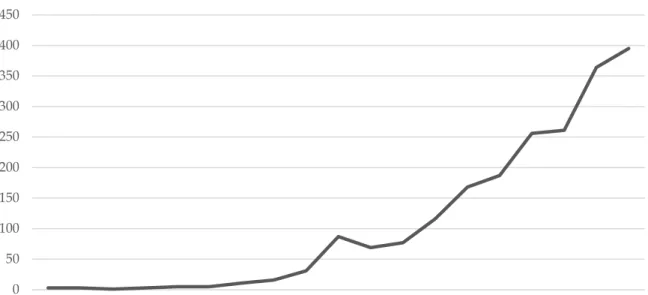
The enormous popularity of the concept of financialization has led to an outpouring of publications over the past decade. Since 2010, the number of annually published journal articles on financialization has more than quadrupled, to almost 400 (Web of Science, 2019; see also Figure 1.1). Book publications, while smaller in number, have followed a similar trend: while only a handful of books existed in the early years of the 21st century, now more than a dozen books on financialization are published each year (WorldCat, 2019).4 Financialization has also entered public
discourse through the works of people like academic-turned-politician Yanis Varoufakis (2011) and journalists Rana Faroohar (2016) and Nicholas Shaxson (2018). They have taken the social-scientific concept and placed it center stage in their own popular narratives of ‘finance capitalism’. Should
these trends continue, financialization –that “wonky but apt moniker picked up by academics”
(Faroohar, 2016: 6) – could very well enter mainstream vocabularies.
Figure 1.1: Journal Articles with Topic Financialization
The speed and scale at which financialization scholarship has grown over the past decade invites us to take stock of its development. According to John Bellamy Foster, the origins of the
4A search on Worldcat.org for books with either “financialization” or “financialisation” in their title results in 775 hits. After filtering out double entries and other erroneous results, 145 titles remained.
0 50 100 150 200 250 300 350 400 450
5
term, which first appeared in the early 1990s, are “obscure” (Foster 2007: 1).5 Many diagnoses of
financialization in this period drew parallels to an earlier period of economic and political
domination by ‘finance capital’ and rentier classes around the turn of the 20th century, written about by Hilferding, Lenin, Kalecki and Keynes. They also sought to highlight the differences and explain why the end of the post-war ‘Golden Age’ of capitalism had given rise to financial
expansion. The earliest figurations of the research enterprise, such as in the works of Harry Magdoff and Paul Sweezy (1987), explained the increasingly central role of finance and particularly debt as a response to the stagnation that ended the post-World War II American boom, and argued
that America was becoming a “casino society.” However, contrary to what many of their
contemporary Keynesians thought, their Marxian perspective suggested that the growth of financial markets was not undermining or replacing the production of goods and (non-financial) services, and rather increasingly becoming a prerequisite for it.
Exemplary for the subsequent manifestations of financialization scholarship is the collection
Financialization at Work by Ismail Erturk and co-editors (2008), whose selection of contributions
reveals the grounding of the concept in the history of economic thought. Erturk et al. took cues from John Maynard Keynes, early 20th century economic historian and philosopher R.H. Tawney, and corporate governance theorists (and F.D. Roosevelt advisors) Adolph Berle and Gardiner Means, as well as their agency-theoretical critics Michael Jensen and Eugene Fama, whose works fueled the neoliberal counterrevolution in economics. The contributions of financialization scholars leading into the mid-noughties reflected the different perspectives on financialization that characterized the scholarship from its very beginning: the critical accounting approach of the Manchester School, represented for instance by Julie Froud and collaborators (2000); the
Regulationist approach exemplified by Robert Boyer’s (2000) work; the heterodox economics of
Engelbert Stockhammer (2004) and Gerald Epstein (2005); the corporate governance perspectives
of William Lazonick and Mary O’Sullivan (2000); and the cultural economy approaches of Randy
Martin (2002) and Paul Langley (2004), to give some examples.6 Some of the most influential
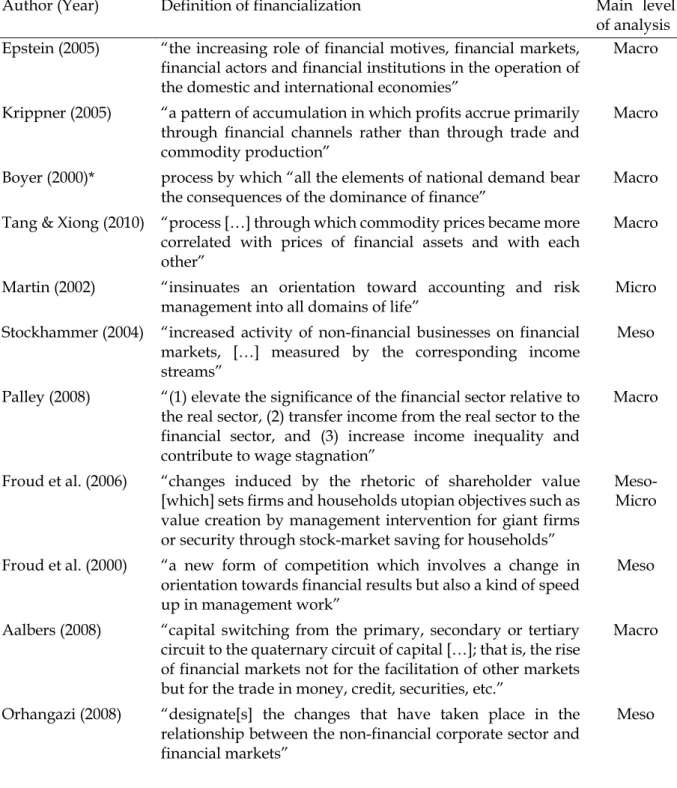
conceptualizations of the term originated in this early scholarship, including the widely-employed definitions offered by Epstein (2005), Krippner (2005) and Stockhammer (2004; see also the next section of this chapter).
The scholarship on financialization entered a new phase in the years following the Great Financial Crisis, as the events of 2007-2008 served as a wake-up call, or reminder of the destructive scale and power of financial systems, prompting a much wider scholarly reckoning with finance
5 Foster traces the early usage of the term to the near-simultaneous writing of Italian political economist and historian Giovanni Arrighi (1994) as well as Republican-leaning American political commentator Kevin Phillips.
6
and an increased usage of the term financialization. Moving away from public corporations and
“financial markets” in the abstract, scholars scrutinized a host of financial actors – including but
not limited to institutional investors and investment vehicles – and a host of different markets –
bond markets, commodity markets, housing markets, welfare markets, and so on (see e.g. Aalbers, 2008; Dixon and Sorsa, 2009; Fichtner, 2013; Finlayson, 2009; Gospel et al., 2014, Montgomerie, 2009). Finally, scholars also became more attuned to the variegated nature of the financialization process, focusing on places beyond Anglo-America (e.g. Engelen and Konings, 2010; French et al., 2011). This led to the now-commonplace understanding that financialization cannot be reduced
simpliciter to a global isomorphism towards Anglo-American finance capitalism but needs to be
understood in relation to national/local contexts on the one hand and the global capitalist system on the other, even as the latter undeniably bears the historical legacy of U.S. hegemony (Konings, 2011). Illustrative in this regard are the works by Daniela Gabor (2010) on Eastern Europe, Lena Rethel (2010), Iain Hardie (2012) and Bruno Bonizzi (2013) on emerging economies, and the wide geographical reach of the FESSUD project (cf. FESSUD Studies in Financial Systems, 2013).
This trend of broadening the scope of financialization studies has continued into the contemporary period, in which scholars have had to deal with the resilience of finance and financialization post-crisis; what one might call the “strange non-death” of financialization (cf.
Crouch, 2011). In recent years, we have gained a more thorough understanding of the driving forces of continued financialization, not least thanks to a growing scholarship on the role of the
state and other “non-financial” actors (e.g. Nölke et al., 2013; Van der Zwan, 2017). The scholarship
has highlighted the inflections of finance with areas such as the food system (Clapp and Isakson, 2018), the environment (Bayliss, 2014; Ouma, Johnson and Bigger, 2018), national treasuries (Fastenrath, Schwan and Trampusch, 2017; Lagna, 2016) and international development (Mader, 2015; Mawdsley, 2018; Storm, 2018): often not merely as an intrusion, but also as a tool wielded by some players within these arenas. Noteworthy are also the ways in which scholars are exploring the boundaries of the concept by tackling theoretically and empirically complex manifestations, such as offshore finance, shadow banking and other frontlines of financial engineering (Ban and Gabor, 2016; Botzem and Dobusch, 2017).
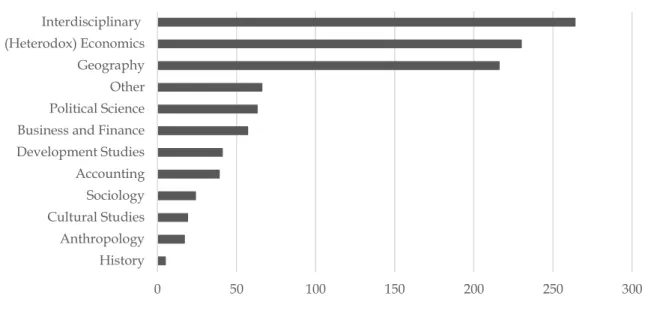
The growth of the financialization scholarship coincided with its diffusion across academic disciplines. While (heterodox) economics and geography together account for the largest share of published articles on financialization, other fields – such as anthropology, accounting studies, development studies, political science and sociology – also have a clear presence in the scholarship (see Figure 1.2). The broad appeal of the concept might be explained by the subject’s sheer
7
Competition & Change or Socio-Economic Review for this scholarship also signals how financialization defies disciplinary boundaries.
Figure 1.2:Articles with topic financialization by discipline
Over time, however, we can also observe a growing concern for the continued usefulness, or value, of the concept, driven by diagnoses of the dilution of the term as a result of its diffusion (cf. Christophers, 2015; Aalbers, 2019). In other words, the spread of the financialization concept across disciplinary boundaries brings risks. One such risk is conceptual dilution: if the adoption of the concept in different academic fields requires a more generic understanding of what financialization means, then the concept could atrophy to become a meme (an object passed on by mere imitation) without meaning. Another, opposite, risk is that of solidification, if one standardized definition becomes the norm for scholarship on financialization in a particular sub-field or school of thought. A too rigid understanding of financialization leads to the blind-men problem and failure to recognize or account for new mutations of finance.
Ultimately, the growth of financialization studies reflects the need for an analytical vocabulary that captures key empirical developments in contemporary capitalism. Yet, the growth of financialization studies simultaneously warrants a more critical question: if rooted in such disparate academic fields and approaches, what unites this body of scholarship? While impossible to do justice to the variety within the scholarship, we can identify three shared affinities. First, financialization scholars depart from an understanding of finance as not subservient to the productive economy but as an autonomous realm that increasingly influences and even dominates other realms of society. Financialization scholars recognize and seek to understand and explain this emancipation of finance. Second, they almost uniformly assess this development as a negative one. Their point of departure is critique, not acceptance, of the empirical developments they
0 50 100 150 200 250 300
8
analyze, which they often link to other socio-economic and political developments, such as rising inequality, macroeconomic instability, social precarity, and loss of democratic accountability. Third and finally, financialization scholars study finance not only, or even primarily, as an economic issue. Unlike those who work in mainstream finance traditions, financialization scholars, including those departing from (heterodox) economics, connect changes in finance with other shifts in politics, economics, social relations and culture, and articulate these as causes and consequences. It is precisely this recognition of finance as part of a socially-created world that has enabled financialization scholarship to proceed in “explicit opposition to the Panglossian view of modern
mainstream economics that financial markets, warts and all, provide the best possible mode of
social regulation” (Storm, 2018: 304). The embedding of finance within society, epistemologically
as well as politically, is cardinal to financialization studies’ power of critique.
2 Defining financialization
Defining what financialization actually is has been a key concern for both proponents and
critics of the term. Repeatedly designated as ‘too broad’ or ‘too vague,’ definitional issues have
followed the financialization concept from its inception. What has contributed to this concern is the very success of definitions that have proven to be sufficiently encompassing to allow different
approaches to tie in. This is particularly true for Gerald Epstein’s seminal and deliberately broad
notion that “financialization means the increasing role of financial motives, financial markets,
financial actors and financial institutions in the operation of the domestic and international
economies” (Epstein 2005: 3). Arguably, some of its building blocks raise definitional issues
themselves, but Epstein’s formulation certainly facilitated the consolidation of the field by
providing a definitional handle that suited a wide range of research endeavors. In comparison, the similarly oft-quoted definition of financialization as “a pattern of accumulation in which profits
accrue primarily through financial channels rather than through trade and commodity
production” provided by Greta Krippner (2005: 174), was much more specific and attuned to
particular empirical material. It triggered a debate over the relative weight of financial profits – or
‘profit financialization’ – in the economy and within non-financial firms (see e.g. Nölke and Perry,
2007; Van Treeck, 2008; Christophers, 2018). Other definitions also signal specific theoretical traditions, as for instance with a Marxist understanding of financialization as the “increasing
incorporation of IBC [interest-bearing capital] into the circuits of capital” (Fine, 2013: 62; contra
9
Table 1: Main definitions of financialization
Author (Year) Definition of financialization Main level
of analysis Epstein (2005) “the increasing role of financial motives, financial markets,
financial actors and financial institutions in the operation of the domestic and international economies”
Macro
Krippner (2005) “a pattern of accumulation in which profits accrue primarily
through financial channels rather than through trade and
commodity production”
Macro
Boyer (2000)* process by which “all the elements of national demand bear
the consequences of the dominance of finance” Macro
Tang & Xiong (2010) “process […] through which commodity prices became more
correlated with prices of financial assets and with each
other”
Macro
Martin (2002) “insinuates an orientation toward accounting and risk
management into all domains of life”
Micro
Stockhammer (2004) “increased activity of non-financial businesses on financial
markets, […] measured by the corresponding income streams”
Meso
Palley (2008) “(1) elevate the significance of the financial sector relative to the real sector, (2) transfer income from the real sector to the financial sector, and (3) increase income inequality and
contribute to wage stagnation”
Macro
Froud et al. (2006) “changes induced by the rhetoric of shareholder value [which] sets firms and households utopian objectives such as value creation by management intervention for giant firms or security through stock-market saving for households”
Meso-Micro
Froud et al. (2000) “a new form of competition which involves a change in orientation towards financial results but also a kind of speed
up in management work”
Meso
Aalbers (2008) “capital switching from the primary, secondary or tertiary circuit to the quaternary circuit of capital […]; that is, the rise of financial markets not for the facilitation of other markets
but for the trade in money, credit, securities, etc.”
Macro
Orhangazi (2008) “designate[s] the changes that have taken place in the
relationship between the non-financial corporate sector and
financial markets”
Meso
Notes: Selection based on articles carrying ‘financialization’ or ‘financialisation’ in title, and Google Scholar citations > 500, last accessed 14 Feb 2019; *derived, no explicit definition of financialization given and does not carry ‘financialization’ in title.
10
engage with a state/market-dichotomy in processes of financialization; meso-level analyses, which put (mostly non-financial) corporations center stage and examine issues of ownership and control as well as changing corporate relations with financial markets; and micro-level approaches, which highlight how (mostly) non-elite actors are implicated in a ‘financialization of daily life’, zooming
in on financial practices and rationalities in, for instance, saving and borrowing. This threefold heuristic helps to organize definitional issues and approaches, even though the borders between the levels of analysis are not always rigid.
Concerns about the definitional trade-off between breadth and depth – producing either a vague notion of financialization or a plethora of fine-tuned definitions – are evident in three types
of critiques. The first is prominently articulated by Ewald Engelen’s (2008) warning of conceptual
stretching (Sartori, 1970), which enabled scholarship to produce a vast amount of ‘financialization
of’ accounts, albeit through frequently neglecting the conceptual value added as well as questions
of historical specificity. The second point of critique emerges from scholars’ distinct treatment of
financialization, sometimes as explanandum (what is to be explained), sometimes as explanans (the explanation) and sometimes as intervening mechanism between cause and effect – a point most forcefully made by Manuel Aalbers. According to Aalbers (2019: x), the imprecision of concepts like financialization stems from the very empirical complexities they aim to analytically make sense
of: “While this may initially create more confusion, it also reflects an, often implicit,
acknowledgement that we do not live in a closed system in which causations are linear, one-dimensional, and single-scalar.” A third set of critiques takes issue with the simplistic transfer of
conceptualizations based on Anglo-American capitalism to other parts of the world. While few would deny the power of the Anglosphere, expressed in part through the location of dominant financial centers, the universalization of the Anglophone trajectory towards financialization simply does not do justice to empirical developments elsewhere. This concern for contextualization mainly informs scholarship aimed at identifying variegated trajectories of financialization among both advanced and emerging or developing economies (e.g. Engelen and Konings, 2010; Lapavitsas and Powell, 2013; Karwowski and Stockhammer, 2017; Mertens, 2017).
Reflecting these critiques, we refrain from offering yet another novel definition or conceptualization of financialization. Instead, we argue that to be most valuable, definitions or conceptualizations of financialization that are adopted or proposed by scholars should follow particular principles. They should be: 1) limiting, in the sense of helping us recognize what is financialization and what is not; 2) mechanism-oriented, in the sense of clarifying the linkage of cause and effect; and 3) contextual, in the sense of making clear what contexts they claim validity for.
Limiting conceptualizations will make explicit how the empirical phenomena under study relate
11
such as marketization or commodification, which is important for counteracting the risk of conceptual stretching and dilution. Mechanism-oriented articulations of financialization link effects to causes, bearing in mind Aalbers’ (2019) injunction to recognize causation as often non-linear, multi-dimensional, and multi-scalar. An orientation to mechanisms produces research that moves beyond description, association or correlation, and instead counteracts unfounded assertions that
certain things (places, sectors, domains of life, and so on) are, or have become, ‘more financialized,’
by forcing a clarification of how and why this happened. Finally, contextualization means more than just to acknowledge the fact that financialization takes different forms in different places, and that what is true for Anglo-America is not true everywhere. Insightful research compares the “apples and oranges” (Locke and Thelen, 1995) of financialization, thus taking accounting for the difference
in meaning that financialization may have across time and space, while clarifying what roots disparate financial phenomena have in common.
Lastly, moving beyond concepts and definition, we argue that financialization researchers must work with an eye to clarifying the significance of their findings, from an academic perspective
as well as, above all, from a wider societal perspective. This means to answer clearly the ‘so what?’
question: what does it mean, in the bigger picture, to recognize and understand a particular facet of financialization? How is it significant, also for those outside the academy, including policymakers?7 It means to be clear about what part of the whole – the elephant, as it were –one’s
own research comprises, and what it says about the whole.
3 Organization of the Handbook
The 40 contributions to this Handbook (see Appendix) are individual pieces of the multifaceted whole of financialization studies. As parts of a pluralistic endeavor to grapple with financialization, the contributions to this volume differ in terms of their conceptualization of finance and money, the nature of state-economy relations, and even the ontological and epistemological foundations of the subject matter. As outlined above, this plurality is both a blessing and a challenge for financialization scholarship – and this is especially true for any effort to give orientation to those approaching financialization studies from the outside, as scholars or
students entering the field. The six sections of the Handbook thus articulate different ‘ways of
seeing’ financialization, beginning with Part (A), foundational questions about finance and
financialization; (B) different methodological and epistemological approaches; (C) perspectives that emphasize the structural and spatial dimensions; (D) perspectives that emphasize agency, actors and politics; (E) perspectives that examine the technological and cultural manifestations of
12
financialization; and, finally, (F) questioning how stable or unstable financialized societies and financialization itself are.
Part A takes the questions raised by this introduction forward and shows how scholarly understandings of finance and financialization have evolved over time in different disciplinary traditions. Brett Christophers and Ben Fine (2) shed light on the useful and problematic parts of financialization-as-concept, with a conversation focused on a key theme of classical and Marxist political economy – value, and how it is created – in the historical transformation of capitalism. They foreground the accumulation dimension, whereas Christoph Deutschmann (3) discusses the sociological underpinnings of where value comes from. He asks about the tensions between financialization and the entrepreneurship that capitalism needs in order to sustain, which raises
the question: is finance more ‘parasitic’ than constitutive, in its relationship with capitalist
societies?8 The complex interactions between the ‘financial’ and the ‘real’ economy also figure in
critical business studies, which adopted the concept of financialization early. Ismail Erturk (4)
introduces the ‘primacy of shareholder value’ as a linchpin of this debate, focusing on the factors
that shape non-financial corporations in contemporary capitalism. Shareholder value was welcomed by many in the economics profession as a potential driver of greater efficiency among firms; but as Sheila Dow (5) reminds readers, the promised benefits of shareholder value require a naively benign, liberal, view of how the financial sector works. From a Post-Keynesian perspective, the fundamental uncertainties and instabilities that finance produces need to be the starting points for any economic story of financialization. Wrapping up Part A, Paul Langley (6) focuses on the reworking of life itself by finance, revealing the power relations that emerge when financial logics and techniques reshape cultures and subjectivities, pushing us to consider the transformative impact of finance on everyday human lives and even ‘more-than-human life.’
How can one study such a thing as financialization? The contributions to Part B showcase the methodological diversity of the scholarship and the types of findings that particular analytical tools can generate. To some extent, these chapters also reveal the difficulties of accurately taxonomizing the beast as rooted in different tools, conceptual lenses and empirical-analytical strategies. Ève Chiapello (7), for instance, illustrates the strengths of “a socio-technical angle,” directing our view toward the sociological study of the instruments and dispositifs at work in finance. This “means
looking into the actual operations performed by the ‘workers’ of financialization,” which comprise
a wide variety of organizational actors. Similarly, Hadas Weiss’ (8) introduction to the anthropological study of financialization emphasizes the agents and agencies that ground finance in lived human lives, highlighting how ethnographic fieldwork helps illuminate the contribution of professional and non-professional financial practices to financialization. It is often through such
13
lenses that feminist and gender studies reveal, as Signe Predmore (9) shows, how financialization not only reflects masculine hegemony but also produces distinctly gendered (and colored) distributional effects. Yet seminal progress in the study of financialization here also stems from analyses that link micro- and macro-level dynamics through a focus on the interstices of production and reproduction. This is equally true for approaches in political science that analyze the politics of financial regulation, the financial industry’s power and the diffusion of pro-finance sentiments among both elite and non-elite actors. Stefano Pagliari and Kevin Young (10) highlight these political mechanisms, making the case for financialization studies to open itself up to large-n empirical tests that also move beyond the Anglo-American focus of much of the literature. Dimitris Sotiropoulos
and Ariane Hillig (11) introduce heterodox economic approaches to financialization, and,
juxtaposing Post-Keynesian and Marxist approaches, advocate for a more historical approach to financialization, in contrast with the partial analyses that (even non-mainstream) economists have traditionally foregrounded. Mareike Beck and Samuel Knafo (12) conclude Part B with a complementary argument: that historiography has proven an important tool in coming to terms with the processes we now recognize as financialization, but that a more radical approach is needed to adequately historicize the social practices of finance. Their illustrative analysis of the emergence of liability management in the United States closes the loop with the “actual operations” of finance
that Chiapello foregrounded.
Both Part A and Part B thus set the stage by introducing the lenses and tools that the contributions to the subsequent sections apply. Part C – Structures, Spaces and Sites of Financialization – centers on, broadly-speaking, structural views of financialization, with chapters that highlight the macro-economic and -political drivers; they map and explain the commonalities and differences produced through a finance that is increasingly global, but still far from amorphous or placeless. Part C begins with contributions from Post-Keynesian and critical macroeconomics that present evidence on how financialization is not only spatially refracted, but also fundamentally shaped by the imbalances of global economic and political structure. Engelbert
Stockhammer and Karsten Köhler (13) employ the concept of macroeconomic demand regimes to
14
monetary and production relations, they argue, makes for a specific form of financialization that differs from the dynamics observable in advanced capitalist economies. These findings inherently raise questions about the role of the state and varying state capacity in shaping processes of financialization. As Yingyao Wang (16) demonstrates with reference to original evidence from the Chinese case, an emerging scholarship is exposing how states have actively provided the institutional infrastructure that undergirds processes of financialization. State transformations, legal reforms and jurisdictional specificities also loom large in three critical domains, analyzed in economic geography, that give more insight into the structural and spatial dimensions of financialization. Firstly, exposing the key importance of residential and commercial real estate in different stages of financialization, Manuel Aalbers, Rodrigo Fernandez and Gertjan Wijburg (17) shed light onto the urban underpinnings of debt-driven accumulation regimes. Secondly, Sarah Bracking
(18) reflects on the role played by finance in changing nature-society relations and, incidentally, examining a range of issues from carbon policies to weather management, offers conceptual clarity to distinguish financialization from commodification. Thirdly, Rodrigo Fernandez and Reijer
Hendrikse (19) examine offshore financial circuits, where “the world’s dominant capital stocks and
flows are today habitually routed and deposited”, which showcase the intricate interweaving of territoriality and state sovereignty with financial power.
The complementary counterpart to these structurally-spatially focused contributions follows, in Part D, with chapters that foreground the actors, power relations and political processes at work
in the ‘rise of finance.’ To begin, Benjamin Braun and Daniela Gabor (20) zoom in on the role of central
banks, examining their infrastructural power and increasing “infrastructural entanglement” with
15
financial institutions and foreign aid with private foundations for impact investing, thus deepening global financial integration. At the other end of these financial flows, often, are households that, over the past decades, have become increasingly dependent on the financial services of different forms, as Felipe Gonzalez (25) reflects with the case of micro-credit among poorer households. His chapter revisits the interactions between these and consumer financial service providers, which include payday lenders, microfinance institutions and department stores. As Lena Lavinas’ chapter (26) shows, this financialization of poorer households in the Global South has been intimately linked with a continuing transformation of welfare systems that has effectively “collateralized”
social policy as the basis for new credit relationships.
In debates over actors and power, however, the agency of labor, both organized in trade unions and more widely, as a social class, has remained notably absent. Only a few contributions on the impact of financialization on labor in the firm context (see e.g. Appelbaum and Batt, 2014; Gospel, Pendleton and Vitols, 2014) have sought to move beyond laborers as mere passive victims of financialization, driven into financial traps and subordinated power positions. We sought to deepen and further encourage financialization research to fill this gap by studying the much more complex and multifaceted role of labor, via the Essay Forum, which features contributions from Paul
Thompson and Jean Cushen, Kavita Datta and Vincent Guermond, Lisa Adkins, and Michael McCarthy
(27). They conclude Part D with four short essays that discuss wage stagnation, migrant labor,
workers’ savings and the household as a site of financialization.
16
not assume the same position in the hierarchical financial system as a middle-class homeowner or a subprime borrower; different households are required to work and manage their respective positions in the financial system. As Jeanne Lazarus (32) explains, financial literacy education, as one of the most common policy responses to financialization, has also served financialization by individualizing financial problems and seeking to re-make households and individuals as financial subjects who can behave and perform adequately. Neither are policymakers free from having to adapt their behaviors to financialized reality: as Laura Deruytter and Sebastian Möller (33) show, in producing public policy, local authorities engage in increasingly financialized practices as they manage municipal debts in accordance with the precepts of ever-more sophisticated financial norms and instruments.
Despite many differences in approach, one commonality among many contributions is an implicit search for political contestation or pushback against the expansion of finance. Financialization scholars generally agree that the processes examined here are unstable and have harmful distributional consequences; but it is less obvious where counter-movements or countervailing policies exist and where they should come from. Part F therefore is devoted to exploring the instabilities, discontents and possibilities of challenging and undoing financialization. First, Olivier Godechot (34) opens with a discussion of the link between financialization and rising inequality. The exploding incomes of financial professionals and the rise of within-firm inequality, he argues, are the key drivers of growing inequality; and inequality, in turn, has also reinforced financialization. Andreas Nölke (35) illuminates how financialization has posed challenges to the legitimacy and viability of democratic rule: ‘too big to fail’ financial
institutions, the increasingly networked character of finance, and its growing technical complexity have negatively affected the input and output dimensions of democratic legitimacy, contributing to the slow-burning crisis of Western democracies. In a similar vein, Gerald Epstein (36) argues that finance, particularly in the Anglo-American context, has gained power over modern societies in inverse proportion to how much it contributes to their well-being; these societies are, he alleges,
dominated by a “Bankers’ Club” that holds a commanding position within the polity. With
recourse to Keynes and Minsky, and using examples from India, Sunanda Sen (37) highlights the ingrained economic instabilities that financialization produces, especially through corporate investment decisions and commodity speculation, and hitting small producers and consumers the most. Opening the discussion on the possibility of reforms and pushback, Beat Weber’s chapter (38)
17
post-crisis regulatory efforts have not aimed at tackling financialization; rather, macro-prudential regulation aims to stabilize and revive finance-led growth. In contrast, finally, to the generally pessimistic tone of these chapters, the last chapter explores collective strategies of resistance.
Christina Laskaridis, Nathan Legrand and Eric Toussaint (40) review a long history of struggles against illegitimate debts, using this to highlight strategies for effectively challenging the power of creditors. With history thus in support, financialization appears less inevitable, and possible futures open.
4 Conclusion
The possible futures for financialization will also determine the future directions of financialization studies. The tendency of capital to find spatial-temporal fixes (Harvey 2007[1982]) will most likely feed back on the phenomenon under scrutiny and on the extent to which scholars will have to adjust the concepts and tools displayed in this Handbook. And if financialization has effects that are social causes for resisting it, as some of the final chapters suggest, financialization studies will study these. For now, the need to push the geographical borders of financialization studies is undiminished, with more countries integrating ever more deeply into the global financial system. This will provide a further test for how well established concepts, often developed to capture the realities of Anglo-America or the wider global North, travel across time and institutional contexts. We would expect to see a greater emphasis on the role of both ideas and interests in shaping the politics of (de)financialization, moving beyond the simple dichotomy of expansion or reversal, and exposing the contradictions and uncertainties inherent in the evolution of contemporary finance.
Certainly, we can contend that the financialization literature has grown more attuned to the many complexities and ambivalences, thereby not any longer seeing a nail everywhere because of the hammer that financialization-as-concept is. This is even more important as scholarship approaches the technical issues arising within rapidly evolving financial markets, clustering around new tendencies such as digital monies or fintech innovations. The key challenges for the field, however, ultimately do not look so different from those over a decade ago when Ewald Engelen (2008: 118) noted:
[i]f the financialization community […] embarked upon a constructive conversation between the different research communities that have crystallized around different empirical concepts and different causal mechanisms, the future may well hold great successes in store for the concept of financialization.
18
shape it. As for how much future financialization, as well as the study of it has, the next financial crisis will tell.
Bibliography
Aalbers, M., 2008. The Financialization of Home and Mortgage Markets. Competition and Change, 12(2), pp. 148-166.
Aalbers, M., 2019. Financialization. In: D. Richardson, N. Castree, M.F. Goodchild, A.L. Kobayashi and R. Marston (eds.) The International Encyclopedia of Geography: People, the Earth, Environment,
and Technology. Oxford: Wiley.
Andreu, M., 2018. A Responsibility to Profit? Social Impact Bonds as a Form of “Humanitarian
Finance”. New Political Science, 40(4), pp. 708-726.
Appelbaum, E., and Batt, R., 2014. Private Equity at Work: When Wall Street Manages Main Street.
New York: Russel Sage.
Arrighi, G., 1994. The Long Twentieth Century. Money, Power, and the Origins of Our Times. New York: Verso.
Ban, C. and Gabor, D., 2016. The Political Economy of Shadow Banking. Review of International Political Economy, 23(6), pp. 901-914.
Bayliss, K., 2014. The Financialization of Water. Review of Radical Political Economics, 46(3), pp. 292-307.
Bezemer, D. and Hudson, M., 2016. Finance Is Not the Economy: Reviving the Conceptual Distinction. Journal of Economic Issues, 50(3), pp. 745-768.
Bonizzi, B., 2013. Financialization in developing and emerging countries: a survey. International Journal of Political Economy, 42(4), pp.83-107.
Botzem, S. and Dobusch, L., 2017. Financialization as strategy: Accounting for inter-organizational value creation in the European real estate industry. Accounting, Organizations and Society, 59, pp. 31-43.
Boyer, R., 2000. Is a Finance-led growth regime a viable alternative to Fordism? A preliminary analysis. Economy and Society, 29(1), pp. 111-145.
Callon, M., Millo, Y. and Muniesa, F., (eds.) 2007. Market devices. Oxford: Blackwell.
Christophers, B., 2015. The Limits to Financialization. Dialogues in Human Geography, 5(2), pp. 183-200.
Christophers, B., 2018. Financialisation as Monopoly Profit: The Case of US Banking. Antipode
(online first).
19
Crouch, C., 2011. The Strange Non-Death of Neoliberalism. Cambridge: Polity.
Davis, A. and Walsh, C., 2017. Distinguishing Financialization from Neoliberalism. Theory, Culture & Society, 34(5-6), pp. 27-51.
Dixon, A. and Sorsa, V., 2009. Institutional change and the financialisation of pensions in Europe.
Competition & Change, 13(4), pp. 347-367.
Epstein, G., 2005. Introduction: Financialization and the world economy. In idem, ed.,
Financialization and the World Economy. Cheltenham: Edward Elgar, pp. 3-16.
Engelen, E., 2008. The Case for Financialization. Competition and Change, 12(2), pp. 111-119.
Engelen, E. and Konings, M., 2010. Financial Capitalims Resurgent: Comparative Institutionalism and the Challenges of Financialization. In G. Morgan, J.L. Campbell, C. Crouch, O.K. Pedersen and R. Whitley (eds.), The Oxford Handbook of Comparative Institutional Analysis. Oxford: Oxford University Press, pp. 601–624.
Erturk, I., Froud, J., Johal, S., Leaver, A. and Williams, K., (eds.) 2008. Financialization at Work. Key
Texts and Commentary. Abingdon: Routledge.
Fastenrath, F., Schwan, M. and Trampusch, C., 2017. Where states and markets meet: the financialisation of sovereign debt management. New political economy, 22(3), pp. 273-293. Faroohar, R., 2016. Makers and Takers: The Rise of Finance and the Fall of American Business. New York:
Crown Business.
FESSUD Studies in Financial Systems, 2013, http://fessud.eu/studies-in-financial-systems/. Last accessed: March 1, 2019.
Fichtner, J., 2013. Hedge Funds: Agents of Change for Financialization. Critical Perspectives on International Business, 9(4), pp. 358-376.
Fine, B., 2013. Financialization from a Marxist Perspective. International Journal of Political Economy, 42(4), pp. 47–66.
Finlayson, A., 2009. Financialisation, financial literacy and asset-based welfare. The British Journal of Politics and International Relations, 11(3), pp. 400-421.
Foster, J., 2007. The Financialization of Capitalism. In: Monthly Review,58(11), pp. 1-12.
French, S., Leyshon, A. and Wainwright, T., 2011. Financializing space, spacing financialization.
Progress in human geography, 35(6), pp. 798-819.
Froud, J., Haslam, C., Johal, S. and Williams, K., 2000. Shareholder value and Financialization: consultancy promises, management moves. Economy & Society, 29(1), pp. 80-110.
Froud, J., Johal, S., Leaver, A. and Williams, K., 2006. Financialization and Strategy. Narrative and
Numbers. London: Routledge.
Gabor, D., 2010. Central Banking and Financialization: A Romanian Account of How Eastern Europe
20
Gospel, H., Pendleton, A., and Vitols, S. (eds.) 2014. Financialization, New Investment Funds, and
Labour. An International Comparison. Oxford: Oxford University Press.
Hardie, I., 2012. Financialization and Government Borrowing Capacity in Emerging Markets. Houndmills: Palgrave Macmillan.
Harvey, D., 2007/1982. The limits to capital. London: Verso.
Karwowski, E. and Stockhammer, E., 2017. Financialisation in emerging economies: a systematic overview and comparison with Anglo-Saxon economies. Economic and Political Studies, 5(1), pp.60-86.
Knorr Cetina, K. and Preda, A., 2005. The Sociology of Financial Markets. Oxford: Oxford University Press.
Konings, M., 2011. The Development of American Finance. New York: Cambridge University Press. Krippner, G., 2005. The financialization of the American economy. Socio-Economic Review 3(2), pp.
173-208.
Lagna, A., 2016. Derivatives and the Financialisation of the Italian State. New Political Economy, 21(2), pp. 167-186.
Lapavitsas, C., 2011. Theorizing financialization. Work, Employment & Society, 24(4), pp. 611-624. Lapavitsas, C. and Powell, J., 2013. Financialisation Varied: A Comparative Analysis of Advanced
Economies. Cambridge Journal of Regions, Economy and Society, 6, pp. 359-379.
Lagoarde-Segot, T., 2017. Financialization: Towards a new research agenda. International Review of Financial Analysis, 51, pp. 113-123.
Langley, P., 2004. In the eye of the ‘perfect storm’: the final salary pensions crisis and the
financialisation of Anglo-American capitalism. New Political Economy, 9(4), pp. 539-558.
Lazonick, W. and O’Sullivan, M., 2000. Maximizing Shareholder Value. A New Ideology for
Corporate Governance. Economy and Society, 29(1), pp. 13-35.
Locke, R. and Thelen, K., 1995. Apples and Oranges Revisited: Contextualized Comparisons and the Study of Comparative Labor Politics. Politics & Society 23(3), pp. 337-367.
Mader, P., 2015. The Political Economy of Microfinance. London: Palgrave Macmillan.
Magdoff, H. and Sweezy, P., 1987. Stagnation and the Financial Explosion. New York: Monthly Review Press.
Martin, R., 2002. Financialization of Daily Life. Philadelphia: Temple University Press.
Mawdsley, E., 2018. Development geography II: financialization. Progress in Human Geography,
42(2), pp. 264-274.
Mertens, D., 2017. Putting ‘merchants of debt’ in their place: the political economy of retail banking
21
Montgomerie, J., 2009. The pursuit of (past) happiness? Middle-class indebtedness and American financialisation. New Political Economy, 14(1), pp.1-24.
Nölke, A. and Perry, J., 2007. The Power of Transnational Private Governance: Financialization and the IASB. Business and Politics, 9(3), pp. 1-25.
Nölke, A., Heires, M. and Bieling, H.-J., 2013.Editorial: The Politics of Financialization. Competition & Change, 17(3), pp. 209–218.
Orhangazi, Ö., 2008. Financialisation and capital accumulation in the non-financial corporate sector: A theoretical and empirical investigation on the US economy: 1973–2003 Cambridge Journal of Economics, 32(6), pp. 863–886.
Ouma, S., Johnson, L. and Bigger, P., 2018. Rethinking the financialization of ‘nature’. Environment
and Planning A: Economy and Space, 50(3), pp.500-511.
Palley, T.I., 2008. Financialization: What It Is and Why It Matters. In Hein, E., Niechoj, T., Spahn, H.-P., and Truger, A., (eds.) Finance-Led Capitalism: Macroeconomic Effects of Changes in the Financial
Sector. Marburg: Metropolis, pp. 29-60.
Rethel, L., 2010. Financialisation and the Malaysian Political Economy. Globalizations, 7(4), pp. 489–
506.
Rosenman, E., 2019. The geographies of social finance: Poverty regulation through the ‘invisible
heart’ of markets. Progress in Human Geography, 43(1), pp. 141-162.
Sartori, G., 1970. Concept Misformation in Comparative Politics. The American Political Science Review, 64(4), pp. 1033-1053.
Shaxson, N., 2018. The Finance Curse: How Global Finance is Making Us All Poorer. London: The Bodley Head.
Sotiropoulos, D.P., Milios, J. and Lapatsioras, S., 2013. A Political Economy of Contemporary Capitalism
and its Crisis: Demystifying Finance. London/New York: Routledge.
Stockhammer, E., 2004. Financialisation and the slowdown of accumulation. Cambridge Journal of Economics, 28(5), pp. 719–741.
Storm, S., 2018. Financialization and economic development: a debate on the social efficiency of modern finance. Development and Change, 49(2), pp. 302-329.
Tang, K., and Xiong, W., 2010. Index Investment and the Financialization of Commodities. NBER
Working Paper No. 16385.
Van der Zwan, N., 2014. Making Sense of Financialization. Socio-Economic Review, 12(1), pp. 99-129. Van der Zwan, N., 2017. Financialisation and the Pension System: Lessons from the United States
and the Netherlands. Journal of Modern European History, 15(4), pp. 554-578.
Van Treeck, T. (2009): The political economy debate on ‘financialization’ – a macroeconomic
22
Varoufakis, Y., 2011. The Global Minotaur: America, the True Origins of the Financial Crisis and the
Future of the World Economy. London: Economic Controversies.
Web of Science, 2019. Social Science Citation Index. Philadelphia: Clarivate Analytics.
Appendix: List of contributions to the Handbook
1.
Financialization: An IntroductionPhilip Mader, Daniel Mertens & Natascha van der Zwan
Part A – Finance and Financialization: Taking Stock
2.
The Value of Financialization and the Financialization of ValueBrett Christophers & Ben Fine
3.
Entrepreneurship, Finance and Social Stratification. The Socio-Economic Background ofFinancialization
Christoph Deutschmann
4.
Shareholder Primacy and Corporate FinancializationIsmail Erturk
5.
Financialization, Money and the StateSheila Dow
6.
The Financialization of LifePaul Langley
Part B – Approaches to Studying Financialization
7.
Financialization as a Socio-technical ProcessÈve Chiapello
8.
The Anthropological Study of FinancializationHadas Weiss
9.
How Financialization is Reproduced PoliticallyStefano Pagliari & Kevin Young
10.
Feminist and Gender Studies Approaches to Financialization Signe Predmore11.
Financialization in Heterodox Economics23
12.
Financialization and the Uses of History Mareike Beck & Samuel KnafoPart C – Structures, Spaces and Sites of Financialization
13.
Financialization and Demand Regimes in Advanced EconomiesEngelbert Stockhammer & Karsten Köhler
14.
Economic Development and Variegated Financialization in Emerging EconomiesEwa Karwowski
15.
Subordinate Financialization in Emerging Capitalist Economies Bruno Bonizzi, Annina Kaltenbrunner & Jeff Powell16.
Financialization and State TransformationsYingyao Wang
17.
The Financialization of Real EstateManuel Aalbers, Rodrigo Fernandez & Gertjan Wijburg
18.
Financialization and the Environmental FrontierSarah Bracking
19.
Offshore FinanceRodrigo Fernandez & Reijer Hendrikse
Part D – Actors, Agency, and Politics of Financialization
20.
Central Banking, Shadow Banking, and Infrastructural PowerBenjamin Braun & Daniela Gabor
21.
Securities Exchanges: Subjects and Agents of FinancializationJohannes Petry
22.
The Rise of Institutional InvestorsJan Fichtner
23.
Trusts and FinancializationBrooke Harrington
24.
Impact Investing, Social Enterprise and Global DevelopmentDennis Stolz & Karen Lai
25.
Micro-credit and the Financialization of Low-Income HouseholdsFelipe González
26.
The Collateralization of Social Policy by Financial Markets in the Global South24
27.
Essay Forum: Labor in FinancializationPaul Thompson & Jean Cushen, Kavita Datta & Vincent Guermond, Lisa Adkins, and Michael McCarthy
Part E – Techniques, Technologies, and Cultures of Financialization
28.
Culture and Financialization: Four ApproachesMax Haiven
29.
The Calculative and Regulatory Consequences of Risk ManagementNathan Coombs & Arjen van der Heide
30.
‘A Machine for Living’: The Cultural Economy of Financial SubjectivityRob Aitken
31.
Indebtedness and Financialization in Everyday Life Johnna Montgomerie32.
Financial Literacy Education: A Questionable Answer to the Financialization of Everyday LifeJeanne Lazarus
33.
Cultures of Debt Management Enter City HallLaura Deruytter & Sebastian Möller
Part F – Instabilities, Insecurities, and the Discontents of Financialization
34.
Financialization and the Increase in InequalityOlivier Godechot
35.
Financialization and the Crisis of DemocracyAndreas Nölke
36.
The Bankers' Club and the Power of FinanceGerald Epstein
37.
Financialization, Speculation and InstabilitySunanda Sen
38.
Reforming Money to Fix Financialization?Beat Weber
39.
Macro-prudential Regulation Post-crisis and the Resilience of FinancializationMatthias Thiemann