THE GLOBAL INFORMATION
INFRASTRUCTURE
Lecturer:
Kovalenko Tatyana Nikolayevna
associate professor of
Course structure
•
Lectures – 8 hours
•
Practical training – 4 hours
Rating
Studies
Marks
For 1 class
Total
Lectures
5
20
Practical training
10
20
Laboratory works
pass
20
60
60
execution
20
Definitions of the Information
Infrastructure
The concept of information infrastructure (II) was introduced in the early 1990s, first as a political initiative (Gore, 1993 & Bangemann, 1994), later as a more specific concept in the Information Systems (IS) research.
The notion of information infrastructures, introduced in the 1990s and refined during the following decade. It changed the perspective from organizations to networks and from systems to infrastructures, allowing for a global and emergent perspective on information systems.
“Technological and non-technological elements that are linked” (Hanseth and Monteiro, 1996).
“All of the people, processes, procedures, tools, facilities, and technology which supports the creation, use,
transport, storage, and destruction of information” (Pironti, 2006)
“The technological and human components, networks, systems, and processes that contribute to the
functioning of the health information system” (Braa et al., 2007).
“The set of organizational practices, technical infrastructure and social norms that collectively provide for
the smooth operation of scientific work at a distance (Edwards et al., 2007).
“A shared, evolving, heterogeneous installed base of IT capabilities developed on open and standardized
Examples of the Information
Infrastructure
Internet,
network mass media, distance education, health systems, corporate systems,
Social networks (FaceBook, LinkedIn, MySpace)
Science Citation Index - introduced by Institute for Scientific Information 1961 and included information
from abt 600 magazines (nowadays more than 16 000 information sources).
STN (Scientific and Technical Network) by Thomson Scientific – European database, includes more than 10
million documents on different scinces: physics, biophysics, chemistry, technologies, medicine, etc.
Scopus by Elsevier – bibliographic and reviewing database, tracks publications of more than 18 000
The concept of the Global
Information Infrastructure
Quick development of new information and communication technologies (ICT) enables to create such
information infrastructure of global nature. Global Information Infrastructure should ensure full access to all types of information, their processing and exchange by anyone, anytime and anywhere. Information infrastructure should offer variety of services enabling creation of variouse applications (such as tele-working, tele-shopping, tele-medicine, tele-voting, distance learning, etc.).
While the convergence of telecommunications and computing is a prerequisite for the global information
infrastructure to emerge, the essence of the information future is considered by some to be the mixing of previously separate types of information (e.g. text, video, audio) into a totally new paradigm. In fact, real and very significant standardization challenges are posed by each of the three component terms
encompassed in the GII.
Global – Global standards are required for the information and infrastructure components of the GII. The
globalization of business, the ease of information access and the ease of personal mobility require removal of restrictive national or regional ways of doing business.
Information – The purpose of the global infrastructure is to enable users to globally manage the creation,
storage, delivery and use of information. Adequate global standards for the representation and secure context specific access to or exchange of information independently of the location of the information provider and information user are needed to realize the benefits of the GII.
Infrastructure – The technological convergence and interconnection of telecommunications equipment,
The concept of the Global
Information Infrastructure
Traditionally the three sectors have involved quite distinct „types‟ of market actors, customer terminals and related transmission methods for „input‟ to such terminals. Up until recently such categories could essentially identify the appropriate regulatory framework. That is:
The telecommunications industry is based on wired or wireless point-to-point telecommunication
infrastructure for interactive two-way communication. This is run by vertically integrated licensed public telecommunication operators whose obligations involve neutrality and non-discrimination as concerns content and nature of communications. The industry is generally regulated by specific ministries and/or agencies, under specific telecommunications legislation. Primary concerns are universal service and network access (both to and for customers).
The broadcasting industry‟s prime concern, and obligations relate to the content of point-to-multipoint one
way communications. These are carried over wired (cable) or wireless (terrestrial or satellite) dedicated broadcasting networks to „receive only‟ television terminals. Both public and private broadcasters are generally subject to specific broadcasting legislation and regulations, again carried out by separate
ministerial departments and/or responsible agencies. The main focus is on content (culture, pluralism and diversity, censorship of indecent material) but scarcity of spectrum has been viewed as an important constraint.
The conventional computing industry consists of hardware and software producers and service providers.
„Inputs‟ or services to the end customer are by way of purchased software applications, services and CD-ROMs introduced into personal computer terminals (although networked computers and the Internet itself have been in existence for many years, such networks have essentially been available only to closed or very limited user groups, and not to „the public‟ so that the computing sector has not been treated as a networked industry from a policy point of view). Apart from the application of general rules concerning fair trading/competition, consumer protection and intellectual property, the computing industry has been
The concept of the Global
Information Infrastructure
The concept of the Global
Information Infrastructure
The global information infrastructure (GII) is the developing communications framework intended to eventually connect all telecommunications and computer networks world-wide.
Sometimes called a network of networks, the GII would eventually make all electronically stored or transmitted information accessible from anywhere on the planet.
The Internet is considered the de facto global information infrastructure right now. However, for the GII to evolve as envisioned, either the Internet or its successor must deal with challenging issues such as security, privacy, hardware and software compatibility, translation, rights to information, identity
management, digital rights management (DRM), competition, and governance. Over 50 countries across the world are working, independently or collaboratively, to resolve these issues.
The GII was proposed by Vice President Al Gore in a 1994 speech to the ITU World Telecommunication Development Conference in Buenos Aires, Argentina. It is a vehicle for ensuring that all citizens of the world benefit from information and telecommunications technologies. The GII recognizes that these
The concept of the Global
Information Infrastructure
The following levels of information infrastructure, according to the area of its activity, can be specified:
Global Information Infrastructure (GII), Regional Information Infrastructure (RII), National Information Infrastructure (NII).
Global Information Infrastructure comprises regional and national information infrastructures.
All National Information Infrastructures in one world region (e.g. Europe) form the appropriate Regional Information Infrastructure (e.g. European Information Infrastructure).
All Regional Information Infrastructures form the Global Information Infrastructure. Similar regional initiatives to GII are found in most industrial regions of the globe:
The concept of the Global
Information Infrastructure
Information infrastructures must be mutually compatible. Use of ICT (Information and Communication
Technology) standardization (mutually harmonized) at international, regional and national levels ensures compatibility of these information infrastructures (at mentioned above levels).
Global Information Infrastructure should be based on interworking and interoperation of existing and future telecommunications networks. It involves the necessity to elaborate interface standards allowing
interconnections between networks of different types.
Other problems concerning creation of the universal Global Information Infrastructure are: exchange of different format information and an appropriate protection of information within Global Information Infrastructure.
It involves the necessity to elaborate and use appropriate regulations (e.g. for electronic transactions,
GII Standardization Efforts
ITU standardization activities are carried out through its three Sectors:
Telecommunication Standardization (ITU-T), Radiocommunication (ITU-R),
Development (ITU-D).
ITU-T Study Group 13 has been appointed Lead Study Group for overall project management, responsible not only for developing its own sets of Recommendations, but for coordinating input from other study groups and a wide range of external organizations.
In developing the ITU Recommendations which will serve to underpin the GII, the ITU is concentrating on four main areas:
the development of standards to foster interoperability;
the allocation of sufficient radio frequency spectrum to the new mobile services which will form integral
parts of the infrastructure;
the provision of policy and technical assistance to developing nations;
the establishment of an ongoing, impartial forum where government and industry representatives can
formulate the strategies needed to turn the dream of a GII into a reality as quickly as possible.
GII Standardization Efforts
Recognizing the importance of impartial, globally accepted standards as building blocks of the GII, the ITU has initiated a project-based approach to GII standardization and has agreed on the principles and framework architecture of the GII.
ITU-T takes an evolutionary approach to GII. The work is organised in three phases, similar to those of ETSI:
Common definition phase for Programmes 1 and 2 Standardisation Programme 1:
GII based on existing narrowband services and capabilities (PSTN, mobile N-ISDN, IN, CATV, private networks, etc.). This programme should focus on the specification of interfaces between the CATV networks and telecom networks and on the contribution of the information and storage platform to GII
Standardisation Programme 2:
GII including broadband services and capabilities (in particular ATM transport capabilities and Distributed Processing Environment while interworking with GII based on standardisation programme l). This should include enhancement of the current IN concept for supporting the provision of GII services in a flexible way as well as development of video and high speed data applications within the context of GII.
GII Standardization Efforts
ITU-T Recommendations of Y series were developed for realization of Global Information Infrastructure conception.
The following Recommendations have been approved:
Y.100 General overview of the Global Information Infrastructure standards development Y.101 Global Information Infrastructure terminology: Terms and definitions
Y.110 Global Information Infrastructure principles and framework architecture Y.120 Global Information Infrastructure scenario methodology
Y.130 Information communication architecture
Y.140 Global Information Infrastructure (GII): Reference points for interconnection framework
Y.140.1 Guideline for attributes and requirements for interconnection between public telecommunication
network operators and service providers involved in provision of telecommunication services
Organization of the GII Recommendations
General Y.100–Y.199
Services, applications and middleware Y.200–Y.299
Network aspects Y.300–Y.399
Interfaces and protocols Y.400–Y.499
Numbering, addressing and naming Y.500–Y.599
Operation, administration and maintenance Y.600–Y.699
Security Y.700–Y.799
Definition of the Global
Information Infrastructure
Proposed worldwide infrastructure of governmental and non-governmental telecommunications and information technology networks. Its objective is faster and greater economic
growth through dissemination of information and remote collaboration (www.businessdictionary.com)
A collection of networks, end user equipment, information, and human resources which can be used to access valuable information, communicate with each other, work, learn, receive entertainment from it, at any time and from any place, with affordable cost on a global scale (ITU-T recommendation Y.101).
The goals of the Global
Information Infrastructure (GII)
The GII will be an infrastructure which facilitates the development, implementation and
interoperability of existing and future information services and applications within and across
the telecommunications, information technology, consumer electronics and content provision
industries.
This infrastructure will consist of interactive, broadcast and other multimedia delivery
mechanisms coupled with capabilities for individuals to securely share, use and manage
information, anytime and anywhere, with security and privacy protection, and with levels of
acceptable cost and quality.
The GII will provide for interoperability between a multiplicity of applications and different
platforms through a seamless federation of interconnected computers and communications
capabilities incorporating line-fed (e.g. copper pair, fibre, coax) and wireless (e.g. satellite
and fixed/mobile terrestrial radio) connectionless or connection-oriented technologies.
The areas of application must remain unrestricted and are practically unlimited. Current areas of
application are expected to include electronic commerce, telemedicine, city information
The goals of the Global
Information Infrastructure (GII)
The GII must be designed to:
enable information providers and users (e.g. individuals, information users, information
providers, and information service providers) to communicate securely with each other any
time and anywhere at acceptable cost and with acceptable quality;
provide a set of communication services;
support a multitude of open applications;
embrace all forms of information (audio, text, data, image, video, etc.), and of information
generation, use and transportation;
operate in a transparent, user-friendly and straightforward way;
provide seamless, interconnected and interoperable communication networks, information
processing equipment, databases and terminals (including TV sets);
enable competition between the players in the information and telecommunications (including
The goals of the Global
Information Infrastructure (GII)
Two predominant factors distinguish a situation for the GII which is likely to be radically different
from previous information infrastructures. These two factors are:
the convergence of technologies in use within telecommunications, computers, consumer
electronics and the move of content provision industries towards digital technology;
the new business opportunities, created by the unbundling of services made possible or
necessary by deregulation, and other commercial and/or open market pressures.
Traditionally, networks have been designed with specific payloads in mind, e.g. voice, video or
data. It is expected that digital networks will become general purpose carriers of streams of
bits. In theory, this will enable any type of digital network to carry any and all types of
information in digital format, such as voice, video or computer data. Moreover, the
The goals of the Global
Information Infrastructure (GII)
The GII must provide an evolutionary approach which allows the integration of current networks
and technologies into an overall infrastructure as well as providing a direction for future
network evolution.
The GII standards must support existing and future telecommunications, information
technologies and entertainment services and applications including interactive, broadcast and
multimedia capabilities, and will incorporate wire-based and radio-based technologies such as
copper pair, fibre, coax, satellite and terrestrial (fixed and mobile) radio.
The GII standards must provide for interoperability and interconnection (both connectionless and
connection oriented), between a multiplicity of applications and different platforms (both
software and hardware).
Typical areas include, for example:
distance learning/electronic libraries;
telemedicine;
teleworking (e.g. home office and "on-the-road" applications);
electronic commerce;
The goals of the Global
Information Infrastructure (GII)
Different types of application may have significantly different Quality of Service requirements, so various QOS aspects are need to be considered
Block Transfer
As a response to a "click" on a home page at a terminal computer, a data block that contains information data and a program file, such as a JAVA applet for full-motion video, may need to be sent all at once. An
Application Data Unit (ADU) is sent by several packets. Block delay is the main concern from the QOS viewpoint.
Stream
Audio and video communications require end-to-end bandwidths in the network (these bandwidths are related to the communications quality). This type of traffic is characterized as a continuous data-transmission stream. In multicasting, stream data traffic may be sent simultaneously from one site to many
destinations. An ADU (Asynchronous Data Unit) is generated constantly or at a certain time interval. End-to-end bandwidth and constancy of propagation time are the main concerns.
Transaction
A transaction type of communication, such as that used for electronic commerce, electronic banking, electronic ordering, etc., generates bi-directional data transmission with small-sized data packets (a few kilobits), and requires low data-transmission latency in the network. An ADU is sent in a single packet. Packet latency is the main concern.
Best-effort
As with the Internet, an ADU is sent without any guarantee of QOS. For example, E-mail is a non-interactive application and mail may reach the destination in a few seconds or even in a few minutes.
GII trends and directions
Networking considerations
The GII will not, initially, require or employ new network capabilities, but will define how a multiplicity of existing capabilities will interwork in the context of a "federation of networks". However, standardization activities related to the GII must permit new network capabilities and
technologies to be introduced.
Telecommunications networks are currently providing voice and data services worldwide with a high level of reliability and defined QOS and are based on different network
technologies (PSTN, ISDN, Mobile, ATM, SDH, etc.) with interworking between them.
Extension of the networks to include broadband capabilities is based on the ATM technology. ATM is also being enhanced to provide not only for connection-oriented network
services but also to meet the requirements of
connectionless network capabilities and services supported by these capabilities.
IP-based networks provide a platform that allows users connected to different network infrastructures to have a common set of applications and to exchange data with an undefined QOS. The IP protocol suite is evolving to include voice, data and video applications with defined QOS.
Additionally, terrestrial radio, cable and satellite networks are providing local broadcast entertainment services and are also evolving to provide interactive voice, data and video services.
GII trends and directions
Information technology considerations
The availability of core technology (IP communications networks, web user interfaces and information
representation, compression and retrieval technologies etc.) together with extensive information user and provider uptake and interest has led to rapid successes and growth in the application of internet/intranets (i.e. IP-based) and World Wide Web browsers/communicators for business and entertainment use. The future information and telecommunications technology landscape will provide user capabilities and
network/management systems and services which are likely to involve the co-existence of many of these web technologies together with associated distributed technologies and architectures (e.g. OSI/ODP, DCE, JAVA, DCOM, ActiveX, CORBA).
No one technology is expected to dominate in the immediate term. Examples of current identified key driver technologies are multicast push technology, security/electronic commerce, internet telephony/audio/video, "internet" management, network computers, intelligent agents, High Definition Television,
nomadicity/mobility, and distributed databases.
The convergence of computing and networking requires tight cooperation and integration between computer systems and networking technologies. The scope of the required levels of cooperation will extend across the entire OSI stack but will be especially important in the mid-to-higher layers. Examples of specific areas of interest include data link protocol for satellite links, closer collaboration between physical layer and
cabling standards, reliable multicast QOS negotiation, co-existence between OSI/CLNP and the IP protocols (IPv4 and IPv6) and migration to IPv6.
GII trends and directions
General considerations
A number of other factors need to be borne in mind when designing standards for GII services and components, such as:
affordability – the cost effectiveness of the resources utilized by an enterprise/organization or user over a
specified period of time;
availability – the measure of the degree of access to a particular resource or set of resources;
cultural elements – the special characteristics of languages and the commonly accepted rules for their use
(especially in written form) which are particular to a society or geographic area.
Examples are: national characters and associated elements (such as hyphens, dashes, and punctuation marks), correct transformation of characters, dates and measures, sorting and searching rules, coding of national items (such as country and currency codes), and keyboard layouts;
interoperability – the ability of two or more systems or applications to exchange information and to
mutually use the information that has been exchanged;
manageability – the ability for any enterprise/organization or user to control how its resources are
deployed and utilized;
minimalism – a methodology or approach which emphasizes the need to enable a resource to function with
a minimum set of options;
performance – the measure of a system or subsystem to execute its functions, e.g. response time,
throughput, number of transactions per second, or speed of video playback;
portability – the ease with which software and data can be transferred from one system to another;
quality – the provision of a level of service consistent with the expectations of the receiver of that service; reliability – the probability that a product or system will perform as required for a specified period of time; scalability – the ability to provide functionality up and down a graduated series of application
Objective
and principles of the GII
The objective of the GII is to ensure that each citizen may eventually gain access to the information society. This can be enabled by the interoperability of networks, information processing systems and applications. These objectives will be served by the following core principles of the GII which will:
promote fair competition; encourage private investment;
define an adaptable regulatory framework; provide open access to networks,
while:
ensuring universal provision of and access to services; promoting equality of opportunity to the citizen;
promoting diversity of content, including cultural and linguistic diversity;
recognizing the necessity of worldwide cooperation with particular attention to less developed countries.
These principles will apply to the GII by means of:
promotion of interconnectivity and interoperability;
developing global markets for networks, services and applications; ensuring privacy and data security;
protecting intellectual property rights;
cooperating in R&D and in the development of new applications;
Features of the users'
viewpoint of the GII
Features of the users'
viewpoint of the GII
The simple enterprise model can be used to identify some of the features required of the GII by users, and also the way in which they will interact with the features. The following list illustrates some of the manners by which GII users might need to interact with the GII:
GII users may need to be able to "see" (i.e. be aware of) only the GII users with whom they are really
interested in forming a relationship. In this context, applications would be "seen“ as components of the sought relationships, without concern for the services supporting these relationships or to other involved GII users;
GII users may need to be able to "see" (i.e. invoke and use) applications without concern for the services
Features of the users'
viewpoint of the GII
GII users may need to be able to "see" (i.e. invoke and use) applications, while at the same time being
concerned with being aware of or choosing some of the: – services that may be supporting the applications; and/or
Conceptual overview of the
GII and its users
Conceptual overview of the GII and its users identifies four basic elements:
the people that create, produce, use and operate information;
the information appliances that are used to store, process, and allow access to information;
the communications infrastructure which transports the information between geographically separated
information appliances;
the information which includes application software such as home shopping systems, games, etc., as well
as video, audio, textual, and graphical information which may be converted from an existing medium into electronic form for use by GII users.
Simple enterprise model
The primary purpose of the enterprise model is to identify interfaces which are likely to be of general commercial importance.
In order to do this, a number of roles are identified which describe a reasonably well-defined business activity which is unlikely to be subdivided between a number of players.
In addition, it should be anticipated that the roles would have a reasonably long existence.
The interfaces surrounding the role must persist for some time in order that customers and suppliers of the role can successfully interact with it.
In addition, many players may choose to take on the same role in which case the role becomes a competitive activity; also, the role needs to be reasonably stable for a successful competitive marketplace to emerge. Each role can be thought of as adding value to the various inputs it buys from suppliers. The role then passes
its output to its customers. These roles can be individually described and then linked to form value chains. The value chains of roles represent the "industries" which produce the end product for the end user. This is
Simple enterprise model
The primary purpose of the enterprise model is to identify interfaces which are likely to be of general commercial importance.
In order to do this, a number of roles are identified which describe a reasonably well-defined business activity which is unlikely to be subdivided between a number of players.
In addition, it should be anticipated that the roles would have a reasonably long existence.
The interfaces surrounding the role must persist for some time in order that customers and suppliers of the role can successfully interact with it.
In addition, many players may choose to take on the same role in which case the role becomes a competitive activity; also, the role needs to be reasonably stable for a successful competitive marketplace to emerge. Each role can be thought of as adding value to the various inputs it buys from suppliers. The role then passes
its output to its customers. These roles can be individually described and then linked to form value chains. The value chains of roles represent the "industries" which produce the end product for the end user. This is
Definition of
enterprise modelling terms
role: The role is a business activity which fits in a value chain. The role is constrained by the smallest scale of business activity which could exist independently in the industry and so a marketplace will exist for every relationship between roles.
value chain, complete value chain, and primary value chain: A "tree" of roles are connected together to make an end-goods/service.
The total set of roles involved in producing an end-goods/service and the way they pass intermediate goods/services between the roles is called the complete value chain.
The set of roles which form the only principle activity of a generally recognized industry which produces the end-goods/service are the primary value chain. All the other roles in the complete value chain will be providing support goods/services for roles in the primary value chain.
structural role: A structural role is a role in the primary value chain of an industry. A structural role will therefore involve a business activity which is directed towards that industry and, in general, only towards that industry and the output goods/services of a structural role will be directed, in general, only to the next structural role in the primary value chain.
infrastructural role: An infrastructural role is not in the primary value chain of the industry which is under consideration, but supplies goods/services for one or more roles to the primary value chain of that
Definition of
enterprise modelling terms
player: A player is an organization, or individual, which undertakes one or more roles. The player can be a commercial company, a government agency, a non-governmental organization, a charity or an individual.
relationship between roles: When intermediate goods/services are passed from one role to the next in a value chain, there is a relationship between the roles. The relationship implies that a marketplace exists which can match players who undertake the role on one side of the relationship with players who
undertake the role on the other side of the relationship. Some players may choose to be integrated and undertake both roles, in which case the relationship is within the players‟ domain.
horizontal relationship: This is the relationship between two adjacent roles which are in the same primary value chain. The roles are therefore in the same industry. A horizontal relationship can also be called a structural relationship.
vertical relationship: This is a relationship between two roles which are not in the same primary value chain. One role will be supplying goods and services in order to provide some of the infrastructure required by the structural role.
Roles and players
The first distinction made in the simple enterprise model is between roles and players.
A role is a reasonably well-defined business activity and will form, along with other roles, a value chain by which goods can be produced for end users.
A player is a defined organization, for example, a company or government body, which undertakes one or more roles.
Structural roles
Structural roles are roles which are all directed towards a particular product or set of products. They normally are set in a chain, called the primary value chain, which starts with the raw materials for the product and ends with the retailing of the product to end users. The information industry has a set of structural roles which form a primary value chain including:
Information ownership role – There is frequently value in owning the source of information;
for example, a gallery owns pictures images of which can be sold.
Provision of information and related content role – This role takes raw information and makes it available
for inclusion in information services and information-based services;
for example, it could provide a library of photographs which could be used by travel agents in describing their services.
Provision of information-based services role – The role builds information and informationbased services
which it makes available to end users.
This includes services which deliver goods or information – for example, a yellow pages service – and also includes services where information is only part of the service – for example, home shopping – where, in addition to the information transactions, physical goods must be delivered to the end user.
End user role – The end user can be either a private individual or a role in another industry which requires
Structural roles
The structural roles are not themselves part of the GII – they require the GII to carry out their role. These roles are undertaking a wide variety of activities which are often referred to, in functional terms, as applications. The main focus of the GII is on the infrastructural roles which supply the full range of support services which
these roles require in order to carry out their activity. By their definition, the structural roles of the GII are only concerned with business activities directly associated with information content and its application, while the infrastructural roles of the GII are concerned with all the activities which allow the structural roles of the GII to create, format, contextualize, store, find, sell, display, etc., their content and its application.
Infrastructural roles
Communication and networking of information – This role provides a general, distributed platform on which information applications and services can be supported. It provides the means by which an application and its users can be distributed without being aware of the nature of the distribution. It will invoke the
application when requests are sent to it, support messaging to and from the application and also between components of an application. It will include capabilities to support directory services, navigation, security, payments, browsing and searching, etc.
Distributed information processing and storage service provision – This role provides a processing platform on which applications can run and can store data. This role will involve the use of an information appliance.
Generic communications service provision – This role provides telecommunications services for the transport of data, voice and video.
Service and application creation support – This role supplies features which facilitate the production of services and applications which can use communication and information networking.
Terminal equipment supply – This role supplies information appliances to end users which can form an integral part of the distributed platform operated by communication and information networking.
These roles are infrastructural from the perspective of the structural roles of the information industry. They form into value chains in both in the way they contribute infrastructural goods and services to the
information industry and also when they supply goods and services to other industries or directly to end users.
Features of relationships
between roles
Features of relationships
between roles
The relationship between the roles is commercial and so there is a customer side and a supplier side to the relationship. In addition, this relationship needs to be supported by brokerage and management services. These enable a customer to find a supplier and a commercial transaction to be negotiated and completed, respectively. This is illustrated in Figure.
The services of the GII should be able to support these relationships.
Example configuration of
structural roles
Since a structural role is defined by a business activity which is part of an industry, it is concerned with
applications of the GII. (Note that applications also have a similar definition to business activity or "virtual job" between end users.) An application is therefore made up of activities and the relationships between activities.
For example, news-on-demand is an example of a typical application as are other on-demand applications such as movie-on-demand, on-demand-library etc.
In the news-on-demand application, users are able to retrieve electronic newspapers which they can browse and read.
In this example, there are the end users whose activity is browsing and reading the news.
The end users retrieve the news form information service providers whose activity is providing the end users with access to the different electronic newspapers in such a way that the end users can browse and read the news. They also charge the end users for the service including any payments for the new content. There are news content providers which can be conventional newspapers, news magazines, or news agencies
which provide the news content to the information service providers.
There are finally the news content creators who are the journalists, photographers, artists, etc. who create the content which can be browsed and read by the end users.
Example configuration of
infrastructural roles
An infrastructural role is defined as a role which supplies goods and services in support of the primary value chain, generally using reusable service components.
This means that the GII infrastructural roles address the service components and their associated systems which supply the information applications. The infrastructural roles are characterized by these service components and systems, and include their ownership and operation.
GII structural model
The structural model is concerned with services and the way GII services are supplied to structural roles. The terms "structural role" and "structural model" should therefore be regarded as separate concepts.
Definition of terms
in the structural model
In order to offer services or supply an application, a role must bring together a number of resources and package them into a service which is applicable to its clients. Each resource brought in, or operated by a role, may well be supplied by another role and therefore be the service of another role. As a role adds value, it can package together services or applications from other roles and either build them into completely new services or applications or simply provide a packaging service.
For example an electronic payments service will use many telecoms services and many processing and storage services, however, these are not apparent to the user of the electronic payments service. On the other hand, a user of telephone banking may well be aware of the freephone telecoms service which has been packaged in to provide the service.
service: In order to pass value up a value chain, a client role requests and invokes service from a supplying role. Service is characterized by the transactions which take place between the roles, and generally the client role will request service for each item of value it requires. Watching a film at the cinema is an
example of purchasing a service. Where a service is offered between roles undertaken by different players, the service will be offered in the context of a contract and must contain sufficient features in order to
ensure that the contract can be fulfilled and verified.
Definition of terms
in the structural model
In the converged GII, the distinction between services and applications is important not just because they reflect the two different commercial arrangements but also because they reflect the fact that the
telecommunications industry has traditionally offered services while the information technology industry hastraditionally offered applications.
application component: An application component is a part of an application. When an application is
distributed across several geographically separated information appliances, the application will be formed into a number of application components. These will interact with each other using the services of the GII. In addition, an application may be split into application components in order to simplify the design of the application and may result in more that one application component of the same application being resident in the same information appliance.
domain: A domain is the collection of segments which are owned and operated by a player and can include segments from more than one role. The extent of a domain is defined by a useful context and one player can have more than one domain; however, a domain should not include more than one service
provisioning platform.
service provisioning platform: A service provisioning platform is the basis for offering a service. It is
Definition of terms
in the structural model
contract: When two related roles are undertaken by different players, a contract is agreed to set the
framework between the two players. In the case when the two players are commercial organizations, then the contract will be a commercial contract. When a relationship between roles involves a contract, the relationship must take on the extra features associated with the contract.
service interface: A service interface is the means by which a service is used by a player. The service interface will have several aspects including the inter-role relationship, information and computational aspects, implementational aspects, and – when the interface is also between players – contract aspects. If the service involved the delivery of any physical goods, this must also be included in the service interface.
service components: Service interfaces can be complex and can be made up from a number of service components which may also be optional in the service interface.
Structure of services and
applications
Users may wish to either use the services of the GII directly or they may wish to operate their own applications and then use the services of the GII in support of these applications. In addition, components of the user's applications can be supplied and supported by the GII.
The services and applications supplied by the GII are built up in the form of service and application
components. These components are them packaged together in order to create the actual service or application delivered to the user. This is illustrated in Figure
Many individual flows are not shown on this diagram as it is indicating the main flows in bringing together the resources required to create infrastructural services.
The GII brings together the resources of the GII, network resources, processing and storage resources, and middleware resources in order to offer services and supply applications to the users.
Structure of services and
applications
The supply of infrastructural services will depend on the level of sophistication developed in the infrastructural roles. In the early days of the GII, these are likely to be relatively simple and users of the GII are likely to buy application components even for basic requirements. However, as the GII develops, these
Types of services of the GII
The range of services which can be offered is wide and can be dynamic as the available resources can be
combined in many different ways. It therefore is appropriate to classify the service components rather than the services. Each service component will be more directly related to the resources required for the service component.
Infrastructural service components are the full set of service components for GII services. Most of these
components are likely to give "high-level" capabilities such as security service components and they often require the use of many other distributed resources. In addition to these more sophisticated service
components, they will include middleware and baseware service components as well.
Middleware service components will, in general, use middleware and baseware. These service components include interworking capabilities.
Baseware service components are divided between network service components, processing and storage service components. In general, network service components will use only network resources while processing and storage service components will use only processing and storage resources.
Application component
Infrastructural service
components
Baseware service components
Baseware service components support the functions which in turn support the higher level service components offered in the middleware service categories. In particular, they support the provisioning of generic
communications service components and distributed information processing and storage service
components. These include all the telecommunications networks and processing and storage platforms. Baseware service components can be categorized into three groups of service components. The first group is
concerned with basic transport information, the second with basic processing and storage, and the third is concerned with the control and management of these basic transport and processing and storage service components.
In defining baseware service components, it has been assumed that a service which requires interconnection of the same network type across different domains is a baseware service. A service which requires
interworking between different network types is a middleware service.
Service component category B1 – Transport of information service components
These service components include:
transport of data from interface to interface (these interfaces must be of the same network type, but may
be of different domains);
transport of messaging required by functions in support of service component category B3. The GII
requires telecommunications service components which will transport data, voice and video globally. These are available today from a variety of telecommunications networks including the PSTN, the narrow-band ISDN, the Internet, X.25 data networks, frame relay data networks, mobile networks, private voice and data networks, CATV networks, broadcast TV distribution networks, terrestrial and satellite broadcast TV networks, duplex satellite networks including VSAT and LEO satellite networks. However, each of the networks can only in part, meet the overall requirements to transport data, voice and video. The
Infrastructural service
components
Service component category B2 – Processing and storage service components
These service components include:
mounting, invoking and handling an application component such that it can react and respond to messages
from other application components;
processing of threads of execution on a processor;
storage of data in a memory device, e.g. RAM, hard disk drive, or magnetic tape storage device.
These service components are normally made available through an Application Programming Interface (API).
Service component category B3 – Control and management of functions supporting service component categories B1 and B2
These service components include:
control of threads of execution on an information appliance; file storage and retrieval operations;
connection, call and session control service components;
Infrastructural service
components
Middleware service components
The middleware part of the GII includes all the capabilities which can combine baseware service components and adds the functionality required to provide the full range of infrastructural service components. Specific middleware service components include the direct mapping of baseware service components. These
baseware service components are also required to support the other middleware service components. These additional middleware service components, which form the main part of the middleware service
components, can be categorized in the following service categories. These are the service components offered by the roles of the GII to users of the GII, i.e. structural roles. All of these service components will have commercial aspects including ways in which they can be bought, ways in which usage is defined and monitored, and probably ways in which performance level can be guaranteed. These belong to four
categories of service.
Service component category M1 – GII service packaging and cooperation service components
Infrastructural service
components
Service component category M2 – Middleware support components
This is the group of services which has the wide variety of service components which are required by the communication and network of information role in order to supply general GII services and include:
human-computer interface service components; registration service components;
authentication service components; security service components;
directory service components; navigation service components;
browsing and searching service components; accounting and billing service components; auditing service components;
revenue sharing service components; service management components.
Service component category M3 – Application/service creation support
The service components supplied by this role enable users to compile and build applications and/or services. More precisely, the service components are normally specific to the platform on which the
application/service will run; this includes the service components offered by the main operating roles, i.e. communication and networking of information, telecommunications service provision, and information processing and storage.
Infrastructural service
components
Service component category M4 – GII interworking service components
These are service components dedicated to internetworking and to support distributed applications across information appliances supporting different baseware service components. In addition, this includes the many translation service components which can translate messages and files created in one format into a different format.
There are several approaches to the definition of interworking service components. The approach adopted by the Object Management Group (OMG) for interworking between different formats of service definition is the use of a common interface definition language (CORBA IDL) to which all other service definition
GII functional model
The functional model is an abstract description of a system and is developed in such a way that it is independent of any implementation of the system. Its purpose includes:
to allow freedom in methods of implementation without affecting the operation of the overall system; to allow large scale functional integration inside one equipment or software module while retaining a
manageable and scaleable description of the equipment or software module;
to allow the dynamic creation of services which can be tailored to the needs of clients.
The use of functional models is finding more widespread use in both the telecommunications and information technology industries and there are many examples of functional models and functional modelling
methodologies. These include:
the information and computational viewpoints of the ODP (open distributed processing) reference model; the use of Service Independent Building blocks (SIBs) in IN;
the layered description of the SDH interface description and the use of functional blocks in the equipment
specifications;
the extensive use of layers of APIs in operating and software support system architecture.
Definition of terms in the
functional model
function: A function is a logical entity which carries out a defined task in response to specified inputs and will generate specified outputs. The definition of a function does not imply any particular implementation but does imply any grouping of functions in an implementation (even if, in practice, there may be few
alternatives in its implementation).
object: In its most abstract terms, an object is a function; however, the two terms have grown up in different environments. Functions tend to be used in the telecommunications environment where they are often implemented directly in hardware, while objects have grown up in the software environment. While strictly they can be regarded as synonymous, the two terms will often be used to reflect this practical distinction.
logical interface, protocol and functional reference point: A logical interface is the full specification of the interactions between two functions including the format of information passed between the two
functions and the computational aspects of each function which determine the response of a function when information is passed to it from the other function.
A protocol and a functional reference point are both logical interfaces. The term "protocol" has grown up in the transactional messaging environment while the term "functional reference point" has grown up in the telecommunications environment. These terms are used in these contexts but are still logical interfaces.
Definition of terms in the
functional model
computation: The computation of a function describes the way in which the function reacts to information which is passed to it. The computation will record the internal state of the function so that when a piece of information is received, a predictable response can be specified. An example of computation specifications in the telecommunications environment are signalling SDL diagrams.
object interface: An object interface is similar to a protocol and functional reference point; however, it is specified from the viewpoint of only one object (or function). In this manner, the way in which any other object (or function) interacts with the object (or function) can be specified once only. Once an object (or function) interface has been specified, it can be publicly declared so that many other objects (or functions) can be designed to be able to interact with it.
Impact of distributed applications
on the functional model
It is possible to define two types of applications:
Locally bounded applications: applications that can be invoked, handled and run completely within one
information appliance and do not require any communications services (e.g. editing of a word processor document on a stand-alone PC);
Distributed applications: applications which have several components which are running on different
information appliances and therefore require cooperation between the information appliances (e.g. cooperative editing of a large publication by many people of several sites).
The applications can be broken down into segments and it is possible to define a number of types of segments:
Segments of a locally bounded application: components of a locally bounded application, which, by
definition, are running on the local information appliance (e.g. the components of a word processor which open, close and save document files to and from a local storage device);
Local segments of a distributed application: components of a distributed application which run on the local
information appliance, (e.g. the components of a word processor which open, close and save document files to and from a remote storage device);
Remote segments of a distributed application: components of a distributed application which run on
remote information appliances or run on a platform which is supporting the provision of communications services between information appliances (e.g. the file server component on a remote information appliance which responds to the requests for remote file operations in response to local requests to open, close, and save, word processor document files).
These define different types of application components which, in the functional model, are collections of application functions.
Domains and service
provisioning platforms
Segments are the basic unit that can be seen in all four models. Each model shows different aspects of segments:
The enterprise model defines the purpose of the segment in a value chain.
The structural model defines the service components supplied by the segment which can contribute to
services.
The functional model defines the functions within a segment.
The implementational model defines the external interfaces to the segment.
In addition, a segment will belong to only one domain of a network operator and form part of only one service provisioning platform.
The relationship between segments, domains, players, and service provisioning platforms is illustrated in
Figure. This shows that any one domain is part of only one service provisioning platform and is owned and operated by only one player; however, it can contain more than one segment. A service provisioning
Relationships between
segments, domains and
Functions and logical
interfaces in the GII
In order to produce a description of the GII which is independent of implementation, it is necessary to describe the functions in the GII and the logical interfaces between them. The following are the basic types of
functions in the GII:
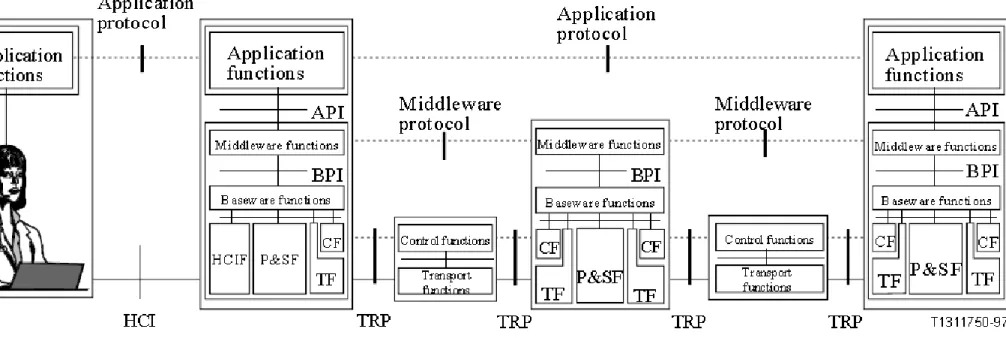
Applications Functions (AF) – The logical entities of applications (these are usually implemented in
software and are normally called application objects).
Middleware Functions (MF) – The logical entities of middleware (these are also usually implemented in
software and are normally called middleware objects).
– Service Control Functions (SCF) – These are the middleware functions which are the logical entities
which allow the building of services from service components and the associated resources and control the interaction of the user with the service (these functions are sometimes associated with session control). –Management Functions (ManF) – These are the middleware functions which are the logical entities which do the management of all the other functions.
Baseware Functions (BF) – The logical entities which allow application and middleware functions to run,
communicate with other functions by interfacing with network functions, and interface to users (these functions are normally associated with operating systems or virtual machines such as a JAVA virtual machine).
– Network Functions (NF) – These are the baseware functions which are the logical entities which support communication between separated locations in the GII and include Transport Functions (TF) and Control Functions (CF).
– Processing and Storage Functions (P&SF) – These are the baseware functions which are the logical entities which execute middleware and application components and store information.
Functions and logical
interfaces in the GII
Each of these can be further subdivided. Subdivisions of network functions will be described further.
In the course of time, many application functions become reusable by other new applications and then are able to migrate to middleware functions. It is this migration which supports the evolution of infrastructural
services was already described.
There are also a number of types of logical interfaces which are associated with logical interfacing between different types of functions. These are:
Application Protocol (AP) – a logical interface between application functions;
Application Programming Interface (API) – a logical interface between application functions and the
middleware functions which support the application functions (baseware functions may also be transparently mapped from the BPI to be available at the API);
Middleware Protocol (MP) – a logical interface between middleware functions;
Basic Programming Interface (BPI) – a logical interface between middleware functions and baseware
functions supports the middleware functions (basic programming interfaces are often called application programming interfaces which reflects the evolution and growth of middleware functionality);
Human-Computer Interface (HCI) – the logical interface between the human user and, principally,
baseware functions; however, it can also include the logical interface between the middleware functions or even applications functions;
Telecommunications Reference Point (TRP) – the logical interface between baseware functions and
Functions and roles
The relationship between functions and the role of the enterprise model for which they perform their function is determined by the needs of the role.
For example, a communication and networking of information role will require many middleware functions in order to have the resources to be able to offer the range of service components associated with this role. However, while a generic communications role will need to have many network functions in order to be able to
offer the service components associated with the role, it may also have some middleware functions in order to provide a slightly wider range of services.
In this way, the description of each role has some flexibility and there may be an overlap in the functionality between different roles.
Example of distribution and
logical interfaces
Network functions and the
network operator's domain
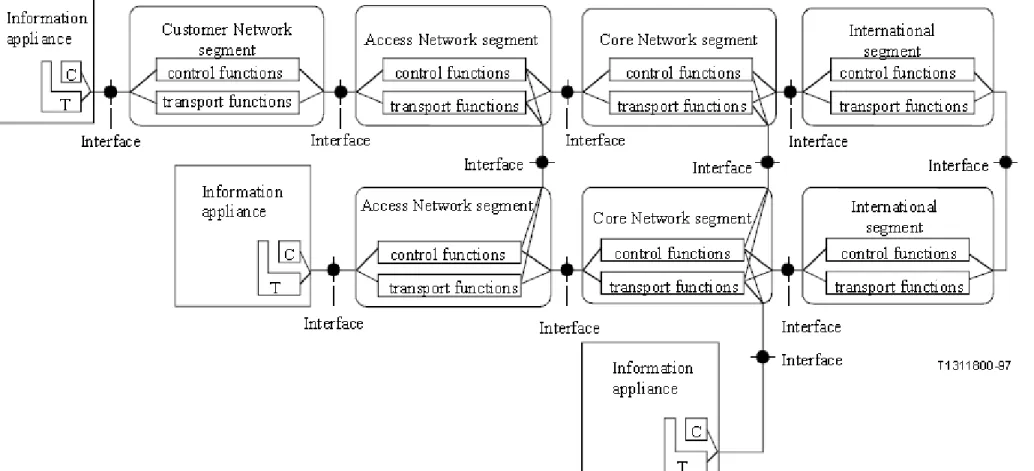
A telecommunications network will generally require at least transport functions and control functions as well as management functions. In addition, a telecommunications network can have additional functions which support enhanced services such as those associated with IN capabilities.
A network operator‟s domain is therefore likely to have:
transport functions – entities enabling the transport of information between distant locations;
control functions – entities enabling information to be successfully routed between the desired end points
as well as base service control functions;
enhanced service provisioning functions – entities enabling enhanced services associated with IN to be
provided and controlled;
management functions – entities required to manage the other functions in the network operator's domain.
Figure shows an example of communications between two sets of applications supporting functions (i.e. middleware and baseware functions) through two cooperating network operators„ domains. The logical interfaces between the functions, in this case reference points, are also illustrated.
Transparency of middleware
and application protocols
Figure shows an example of functions which are interconnected with logical interfaces, the different types of logical interfaces being highlighted:
1, 9 transport telecommunications reference points which can transparently support other logical interfaces
including application protocols, middleware protocols, and even the control protocol between the base functions and the network control functions;
2 a transport telecommunications reference point which enables the network control functions to
communicate with baseware functions, other network control functions and service control functions;
3 a transport telecommunications reference point between transport network functions which should
support all types of protocols transparently;
4 a network control reference point between baseware functions and network control functions which
enables other communications services to be established, but is itself, carried transparently by the transport functions;
5 management reference points – There are many examples of management reference points and where
there is geographical separation, they must be carried transparently by transport functions;
6, 7, 8 middleware protocols which must be carried transparently by the network functions; 10 management protocol – Communications between management functions.
The transparency between middleware protocols and the network functions supporting them is enabled by the basic programming interface while the transparency of application protocols is enabled by the applications programming interface.
GII implementational model
Generally, formal standardization would end with a functional model as this should be sufficient to guarantee interoperability between operator and equipment/software vendors.
There are, however, occasions when it is important to develop an implementational model which describes how the functions of the functional model are implemented in equipment owned by operators. Reasons for developing an implementational model could include:
differentiating and characterizing those interfaces which are important for standardization – for example
interfaces between operators and interfaces between equipment from different vendors – thereby enabling priority to be given to the standardization of the interfaces;
a set of examples to illustrate how system performance can be affected by implementation.