Green precipitates, white does not
NO3-
C2H3O2
-ClO-
ClO4
-Cl
-SO
42-
OH
-CO
32-PO
43- CrO4
2-Group 1: Na+,K+,
NH4+
Group 2: Mg2+,
Ca2+,Ba2+
Transition metal cations, Pb2+, Hg
22+
Mg(OH)2 BaSO4
AgCl PbCl2 Hg2Cl2
The super fun precipitation naming game that is really fun. Make this table. Name each ion. Put the name in the box.
Na+ K+ NH4+ Mg2+ Ca2+ Ba2+ Ag+ Pb2+
Hg22+ NO
3- ClO- Cl- SO42- OH- CO32- PO4
3-Na+ K+ NH4+ Mg2+ Ca2+ Ba2+ Ag+ Pb2+
Hg22+ NO
3-Now cut up the paper so you have fun little squares with stuff On them. Notice how much fun you are having.
Na+ K+ NH4+ Mg2+ Ca2+ Ba2+ Ag+ Pb2+
Hg22+ NO
3- ClO- Cl- SO42- OH- CO32- PO4
3-Na+ K+ NH4+ Mg2+ Ca2+ Ba2+ Ag+ Pb2+
Hg22+ NO
3-Land on a white square, write the ions
Land on a green square, John Travolta and name the compound
Na+ K+ NH4+ Mg2+ Ca2+ Ba2+ Ag+ Pb2+
Hg22+ NO
3-Na+
1
K+
2
NH4+ 3 Mg2+ 4 Ca2+ 5 Ba2+ 6 Ag+ 7 Pb2+ 8 Ba2+ 9 Mg2+ 10 Ag+ 11 K+ 12 Pb2+ 13 Ca2+ 14
Hg22+
15
SO42- NO
3- ClO- Cl- SO42- OH- CO32- PO43- SO42- NO3- OH- PO43- Cl- CO32- Cl
Put the fun pieces of paper into the fun newspaper box. Get a Blank piece of paper and call it the “super fun score sheet for the Super fun precipitation naming game”.
Rules.
One group member picks a fun piece of paper. Another group member picks another one.
1) Two cations (+ and +). Write “dud” on the scoresheet 2) Two anions (- and -). Write “dud” on the scoresheet. 3) A cation and an anion (+ and -). Put the cation next to
the anion. If you land on a white square write, for
example, Na+ (aq) Cl-(aq) on the scoresheet. If you land
on a GREEN SQUARE…. Do John Travolta and write, for example MgCl2(s) AND name the
compound, magnesium chloride.
4) First one to 100 compounds wins a prize. (if they are
Green precipitates, white does not
NO
3-Cl
-SO
42-
OH
-CO
32-PO
43- CrO4
2-Group 1: Na+,K+,
NH4+
Group 2: Mg2+,
Ca2+,Ba2+
Transition metal cations Mg(OH)2 BaSO4 AgCl
name
formula precipitate
name
1)Silver nitrate Potassium carbonate 2)Ammonium carbonate Cobalt(III) chloride 3)Sodium phosphate Barium hydroxide 4)Silver acetate Sodium chloride 5) Copper(II)sulfate Sodium chromate 6)Nickel (II) acetate Potassium phosphate 7)Ammonium chromate barium chloride8) Sodium hydroxide Mercury (II) nitrate
9) Potassium phosphate Barium nitrate
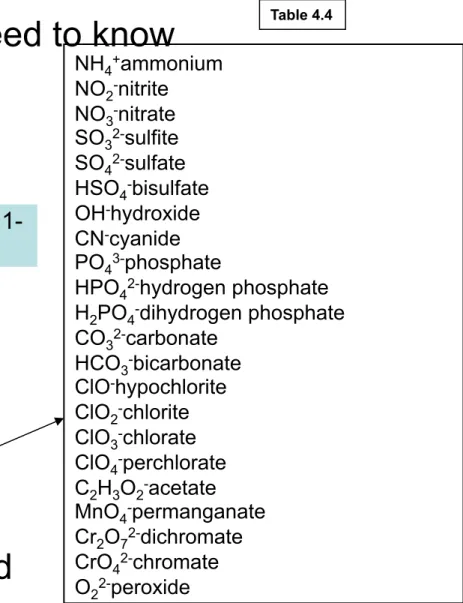
Table 4.4
NH4+ammonium
NO2-nitrite
NO3-nitrate
SO32-sulfite
SO42-sulfate
HSO4-bisulfate
OH-hydroxide
CN-cyanide
PO43-phosphate
HPO42-hydrogen phosphate
H2PO4-dihydrogen phosphate
CO32-carbonate
HCO3-bicarbonate
ClO-hypochlorite
ClO2-chlorite
ClO3-chlorate
ClO4-perchlorate
C2H3O2-acetate
MnO4-permanganate
Cr2O72-dichromate
CrO42-chromate
O22-peroxide
These are the charges you need to know
G1 G2 G3 G6 G7
+1 +2 +3 -2 -1
Na+ Mg2+ Al3+ O2- F1-
K+ Ca2+ S2- Cl1- Ba2+
You only “need to know” the Polyatomic ions that are listed In your super green precipitation table
Fe(NO
3
)
3
(s)
Fe(NO
3
)
3
(s)
-3
Fe(NO
3
)
3
(s)
-3
+3
Fe
3+(aq)+3NO
Co
3
(PO
4
)
2
(s)
Co
3
(PO
4
)
2
(s)
-6
+6
Ca
3
(PO
4
)
2
(s)
-6
+6
3
X
2
=+6
3Co
2+(aq)+2 PO
What ions are produced?
BaCl2(s)⎯ →⎯ Ba2+(aq) + Cl2−(aq)
BaCl2(s)⎯ →⎯ Ba2+(aq) + Cl 2−(aq)
BaCl2(s)⎯ →⎯ Ba2+(aq) + 2Cl−(aq)
Fe NO
(
3)
3(s) ⎯ →⎯ Fe3+(aq)+ NO6−(aq)Fe NO
(
3)3
(s) ⎯ →⎯ Fe3+(aq)+(
NO3−)3
(aq)Fe NO
(
3)3
(s) ⎯ →⎯ Fe3+(aq)+(
NO32−)
(aq)Fe NO
(
3)
3(s) ⎯ →⎯ Fe3+(aq)+ 3NO−3(aq)3+ 1- 1- 1- 2+ 1- 1-
Dissolve each solid in an aqueous solutions. You can ALWAYS Figure out the charge of the cation from the anion. The anion is Given in the super green precipitation table.
1 Fe(NO3)2(s)---> 2 CuCl3(s)--->
3 Cu(CrO4)2(s)---> 4 Na2CrO4(s)---> 5 Cu(CO3)2(s)---> 6 Pb(NO3)2(s)---> 7 Co2(SO4)3(s)---> 8 Ga2O3(s)--->
2K+(aq) + CrO24−(aq) + Ba2+(aq) + 2NO3−(aq) ⎯ →⎯
K2CrO4 (s) and Ba(NO3)2 (s) placed in water:
In each question, two solids are
1) Dissolved in two separate beakers 2) The two solutions are mixed
Write out the first equation that shows how the ions are produced
Then predict the precipitate
Rules for balancing precipitation reactions: 1) Figure out the precipitate--
2) Just write down all the other ions after the precipitate 3) Start with the anion-- is it balanced? If not, chase it
around. Check the ORIGINAL cation…
4) End with the cation-- is it balanced? If not chase it around. Check the ORIGINAL anion
Precipitation Lab
Work in pairs (three max)
Only hand in ONE final lab per pair--put BOTH your names. If There is only one name, only one mark.
You will find a number of small plastic vials labeled with what Is in it, e.g., NaOH
Your task is to find 4 combinations that will produce precipitates
And 1 that will not
AgNO3(s)
KCl(s) Both of these solids are dissolved in two beakers
Ions
KNO3(s)
BaCl2(s) Both of these solids are dissolved in two beakers
Ions
KOH(s)
Fe NO
(
3)
3(s) Both of these solids are dissolved in two beakersIons
AgNO3(s)
BaCl2(s) Both of these solids are dissolved in two beakers
Ions
Na2CO3(s)
Ca NO
(
3)2
(s) Both of these solids are dissolved in two beakersIons
NaCl(s)
KNO3(s) Both of these solids are dissolved in two beakers
Ions
AgNO3(s)
K2CrO4(s) Both of these solids are dissolved in two beakers
Ions
K2CrO4(s)
AgNO3(s) Both of these solids are dissolved in two beakers
Ions
Ba NO
(
3)
2 (s) H2SO4(aq)This is solid
This is an acid and is aqueous Ions
Zach’s Quiz:
Ba NO
(
3)
2 (s)⎯ →⎯Na3PO4(s)⎯ →⎯ Two aqueous solutions
Complete Ionic Equation Net Ionic Equation
NaOH(s)⎯ →⎯
MgCl2(s)⎯ →⎯ Two aqueous solutions
Precipitation Lab
Work in pairs (three max)
Only hand in ONE final lab per pair--put BOTH your names. If There is only one name, only one mark.
You will find a number of small plastic vials labeled with what Is in it, e.g., NaOH
Your task is to find 6 combinations that will produce precipitates
And 2 that will not
Precipitation Lab
CuCl2 AgNO3
1) AgNO3(s) Ag+(aq) +NO
3-(aq)
2) CuCl2(s) Cu2+(aq) + 2Cl-(aq)
3) Ag+(aq) + Cl-(aq) AgCl(s)
QUIZ: Part 2. 10 pts
K2SO4(s) NaNO3(s)
Ba(NO3)2(s) K3PO4(s)
KOH(s)
Fe NO
(
3)
3(s)[3]
[4]
Procedure:
1) Find two vials. Use your super green precipitation table to predict whether or not a precipitate will form or not. 2) If a precipitate is predicted, then put about 1/2 of an inch
of solution in your test tube. Add the other. Record your observations.
3) If the prediction was correct, then do this:
Ba NO
(
3)
2 (s)⎯ →⎯Na3PO4(s)⎯ →⎯ Two aqueous solutions
QUIZ!
Part 1: Multiple choice. Choose the correct
precipitate in each case
1) Ag+ and CrO4
2-a) AgCrO4
b) Ag2CrO4
c) 2AgCrO4
d) Ag(CrO4)2
2) Fe3+ and NO 3
a) 3FeNO3 b) Fe(NO3)3 c) Fe3(NO3) d) FeNO3
3) Ca2+ and CO 3
a) 2CaCO3 b) Ca(CO3)3 c) Ca2(CO3) d) CaCO3
4) Ba2+ and PO 4
3-a) 3BaPO4
b) Ba2PO4
c) 2Ba3PO4
d) Ba3(PO4)2
5) Fe3+ and CO 3
The big review
1. You have 0.056 ml of NH3. The density is 0.87 g/ml. How many molecules of NH3?
2. Balance the following chemical equation. Use any method you want.
3. Balance the following chemical equation.
4. You have 0.004 grams of Zn. How many grams of H2 will be produced?
5. You combine a vial of sodium phosphate with barium chloride. a) Write the chemical formulas of sodium phosphate and barium
chloride.
b) Predict the precipitate (if any)
c) Write the net ionic equation.
C
9H
20+
O
2⎯ →
⎯
CO
2+
H
2O
The big test
1. You have 34 ml of H2O. The density is 0.97 g/ml. How many molecules of H2O?
2. Balance the following chemical equation. Use any method you want.
3. Balance the following chemical equation.
4. You have 26.9 grams of Al. How many grams of Al2S3 will be produced?
5. You combine a vial of sodium carbonate with magnesium nitrate. a) Write the chemical formulas of sodium carbonate and magnesium
nitrate.
b) Predict the precipitate (if any)
c) Write the net ionic equation.