T
HEI
MPACT OFG
RADES ONC
OLLEGEM
AJORC
HOICE, D
ROPOUT,
ANDL
ABORO
UTCOMESRay Wang
A dissertation submitted to the faculty of the University of North Carolina at Chapel Hill in par-tial fulfillment of the requirements for the degree of Doctor of Philosophy in the Department of
Economics.
Chapel Hill 2020
Approved by:
Luca Flabbi
Donna Gilleskie
Andr´es Hincapi´e
Fei Li
c
2020 Ray Wang
ABSTRACT
Ray Wang: The Impact of Grades on College Major Choice, Dropout, and Labor Outcomes. (Under the direction of Luca Flabbi)
I develop a dynamic model of education and labor supply decisions that seeks to explain student
demand elasiticities to the grading standards in their courses, and the high rate of dropout from
STEM majors. The positive correlation in the data between wages and terminal GPA suggests
that firms offer a wage premium to students with higher grades, even after controlling for major.
College students consider these returns to grades when making education decisions: dropout or
major switching can be induced by grade shocks. I estimate a structural model using the NLSY97,
and find that a difference in grades by 1.0 GPA points can impact the net present value of a college
degree by as much as 20 percent at the time of graduation. If STEM and non-STEM course
grading standards were adjusted to be in line with each other, there would be a 4.7 percent increase
in the total number of STEM major graduates, a comparable effect to a $2,200 STEM tuition
subsidy. Finally, a key observation of the model is that due to imperfect sorting across majors and
occupations, large changes in the number of STEM degrees translate into smaller changes in the
ACKNOWLEDGMENTS
There are many people I must thank for their invaluable help in the dissertation process, and in
obtaining a Ph.D. in general.
First, I would like to thank my parents for supporting me and my pursuits. My Ph.D. is a
culmination of three decades of sacrifice, support, and patience on their parts, and I would not
be the person I am today without them. I would also like to thank my extended family for their
encouragement and support. I hope to make you proud.
I must also thank my advisor, Luca Flabbi, for his guidance and feedback during the
disserta-tion process. He had a major role in coalescing my unfocused research interests around my final
dissertation topic. Looking back, I can see how he helped steer me around various pitfalls, and
directed my work towards the most promising areas. His guidance has left an indelible mark on
my dissertation.
The rest of my dissertation committee - Donna Gilleskie, Andr´es Hincapi´e, Fei Li, and Ted
To - also had a key role in my research. They read various early drafts of my research, listened to
countless presentations, and took many hours of their time to offer advice and feedback. The major
improvements that my job market paper underwent, especially over the past year, are entirely due
to the helpful input of everyone on my committee.
I would also like to thank my fellow graduate students, both within the economics program
and without, for their support, feedback, and encouragement. The participants in the applied
mi-croeconomics seminar provided lots of helpful feedback and comments that helped my paper and
presentation immensely. While I cannot thank everyone by name (and for that I apologize), I would
like to express my gratitude in particular to Serge Severenchuk, Serge Korepin, and David Leather.
The two Serge’s have been excellent to me, inviting me to social events, training together, and just
making my time in graduate school much more enjoyable. David has been very supportive and
that was going through the same things I was. Thank you all for your friendship.
I would like to thank everyone at Chapel Hill Gracie Jiu Jitsu and the Carolina Judo Club.
While I may not have done much research on the mats, my time training was time well spent.
Martial arts provided me with a much needed change of pace from graduate research, and helped
me grow as a person. One of the most important lessons I learned was that while careful analysis
certainly has value, there are times when it is best to commit to decisive action. I am particularly
grateful for the patience and guidance of my many instructors: Mazi Heydary, Tim Hufford, Eric
Anderson, Nick Palmisciano, Shawn Madden, and Bill Cabrera.
Lastly, I would like to express my appreciation to everyone else who provided mentorship,
inspiration, and shared in my victories and my defeats. There are far too many to name, but I
would like to acknowledge Teymoor A., Hirohiko A., Kevin K., Aleksandar M., Jacques P., Arya
TABLE OF CONTENTS
LIST OF TABLES . . . ix
LIST OF FIGURES . . . xi
1 The Impact of Grades on College Major Choice, Dropout, and Labor Outcomes . . 1
1.1 Introduction . . . 1
1.2 Data . . . 6
1.2.1 Data Construction . . . 6
1.2.2 Data Descriptives . . . 8
1.3 Model . . . 11
1.3.1 Overview . . . 11
1.3.2 Agent Endowments . . . 12
1.3.3 Labor Market Sector . . . 12
1.3.4 Educational Sector . . . 16
1.3.5 Agent Problem and Model Summary . . . 19
1.4 Identification . . . 21
1.5 Estimation . . . 22
1.5.1 Overview . . . 22
1.5.2 The E-M Algorithm and Sequential Estimation . . . 23
1.6 Estimation Results and Discussion . . . 25
1.6.1 Labor Market . . . 25
1.7 Counterfactual Experiments . . . 45
1.7.1 Changes in the STEM Return on the Labor Market . . . 46
1.7.2 Changing Grading Policies and Major-Specific Subsidies . . . 47
1.8 Conclusion . . . 50
A Appendix . . . 52
A.1 Tables and Figures Appendix . . . 52
A.2 Data Appendix . . . 53
A.2.1 Labor Market Sector Data Construction . . . 54
A.2.2 Educational Sector Data Construction . . . 57
A.2.3 Educational Sector Structural Restrictions . . . 60
A.3 Likelihood Expression and Simulation . . . 64
A.3.1 Ex-Ante Value Function . . . 64
A.3.2 Individual Likelihood . . . 65
A.3.3 Likelihood Simulation . . . 71
A.4 Bootstrap Procedure . . . 72
LIST OF TABLES
1.1 Observed Log-Wage Regression Results . . . 9
1.2 Average SAT/HS GPA and Grade Outcomes, by Major Choice and Year in School . 10 1.3 Labor Market Characteristics by Occupational Sector . . . 10
1.4 Skilled Labor Market Parameter Estimates by Occupational Sector . . . 26
1.5 Unskilled Labor Market Parameter Estimates by Dropout Year . . . 27
1.6 Yearly Occupational Transition Matrix for College Graduates . . . 29
1.7 Yearly Employment Transition Matrix for College Dropouts . . . 30
1.8 Occupational Choice Probabilities for College Graduates, by Years Since Graduation 30 1.9 Occupational Choice Probabilities for All Dropouts, by Time . . . 31
1.10 Relative Net Present Values of Graduation or Dropout by Agent Type, Major, GPA, and College Quality . . . 37
1.11 Estimated Education Parameters, by Major . . . 39
1.12 Graduation Rate by University Type . . . 41
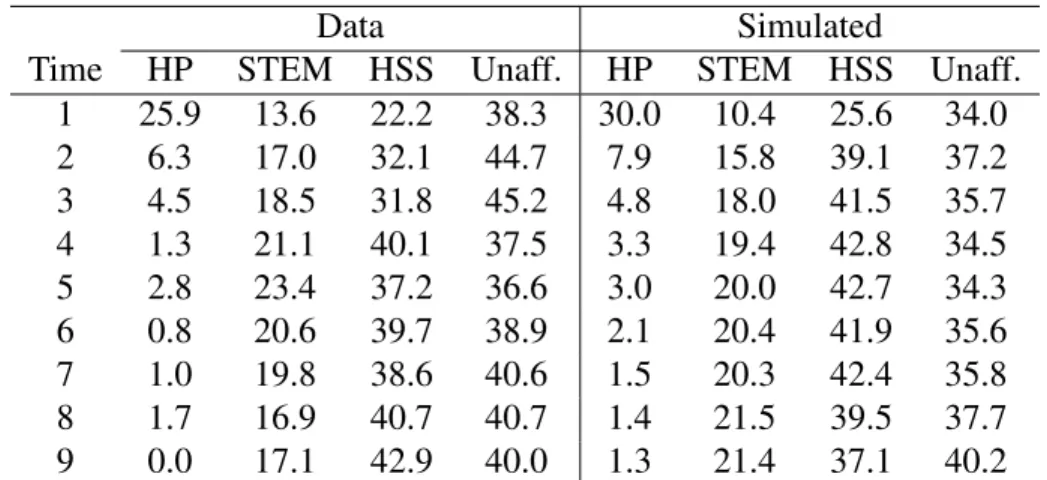
1.13 Choice Probabilities Among Students Still in College . . . 41
1.14 Average SAT/HS GPA and Grade Outcomes of Students, by Major Choice and Time 42 1.15 Average Grade Outcome by Current Period Decision and Next Period Decision . . 42
1.16 Average Grade in First Year, by Major Choice and Eventual College Outcome . . . 43
1.17 Mean Model-Generated Grade Shock andt+ 1Choice . . . 44
1.18 Effect of a 0.10 Log-Wage STEM Major Return Increase on Education and Labor Outcomes . . . 46
1.19 Effects of Changes in Grading Policies on Education and Labor Outcomes . . . 49
A.1 Major Classifications . . . 52
A.3 Occupational Classifications . . . 53
A.4 Characteristics of Students, by Highest Degree Obtained . . . 56
A.5 Average Yearly Earnings Within Three Years of Bachelor’s, by Highest Degree and Major . . . 57
A.6 Mapping Between NLSY97 Numeric Grades and Values Used in Paper . . . 59
A.7 Estimation Sample Construction and Mean Covariates . . . 62
A.8 Total Years of Schooling for Male College Graduates with Transcripts in NLSY97 . 63
A.9 Yearly Labor Choice Transition Matrix for College Graduates, Out-Sample . . . . 73
LIST OF FIGURES
1.1 Wage Profile for College Graduates, by Major and GPA . . . 32
1.2 Wage Profile for College Graduates, by Major and Occupational Sector . . . 32
1.3 Wage Profile for College Dropouts, by Year of Dropout . . . 33
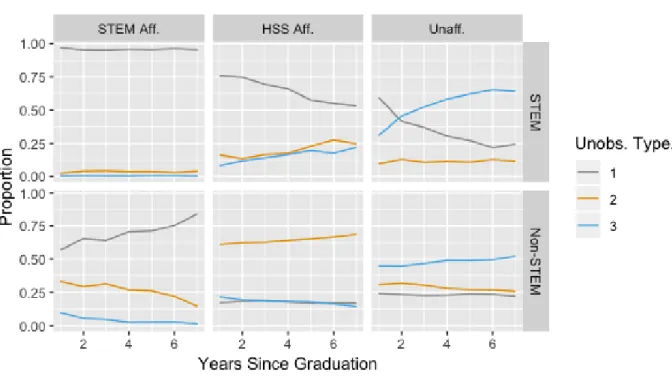
1.4 Type Distribution of Workers Over Time, by Occupational Choice and Major . . . 34
A.1 Wage Profile for College Graduates, by Terminal Major, GPA, and Occupational Sector . . . 54
A.2 Wage Profile for College Graduates, by Terminal GPA and Occupational Sector . . 55
A.3 Wage Profile for Out-Sample, by Major and GPA . . . 75
A.4 Wage Profile for Out-Sample, by Major and Occupational Sector . . . 75
CHAPTER 1
THE IMPACT OF GRADES ON COLLEGE MAJOR CHOICE, DROPOUT, AND LABOR OUTCOMES
1.1 Introduction
A key policy concern in US higher education is the high rate of attrition from college, as well as
the high rate of attrition from STEM majors (Science, Technology, Engineering, and Mathematics).
Only 60 percent of students who started a bachelor’s program in 2008 obtained a degree by 2014,
and only half of the students who started out interested in STEM courses1 persisted through their
sophomore year, instead switching majors or dropping out entirely (Griffith, 2010).2 STEM majors
made up only 18 percent of all bachelor’s degrees awarded in the US in 2016 (NCES, 2019).
This behavior occurs despite the large differences in earnings between STEM majors, non-STEM
majors, and college dropouts: median lifetime earnings in the US are $1.44 million for mathematics
and statistics majors, $0.99 million for English majors, and $0.72 million for college dropouts
(2014 dollars) (Hamilton Project, 2014).3 Policymakers seeking to increase the number of STEM
workers must first understand the underlying mechanism that drives the proportionally low number
of STEM majors.4
What explains the high rate of attrition from STEM majors, and their overall low
representa-tion? One possibility is the grades a student receives in college have an impact on their earnings
post-graduation. The correlation between grades and earnings is well-documented in the literature,
1‘Interest in STEM’ defined as students directly stating an interest in majoring in STEM, or taking at least half of
their first-year courses in STEM.
2There is no significant compensating transition of non-STEM majors to STEM majors: less than 15 percent of
students initially interested in non-STEM eventually graduate with a STEM degree.
3Values are from the American Community Survey, a representative sample of US workers conducted by the US
Census Bureau.
4For example, in 2012 the President’s Council of Advisors in Science and Technology stated a need for one million
with wage regressions estimating a 6-10 percent return to yearly earnings per GPA point (Finnie
et al., 2016; Jones and Jackson, 1990).5 Furthermore, at Duke University, average grades in STEM
courses were lower than those in other majors by ∼ 0.3GPA points, despite students in STEM majors having higher average SAT scores (Arcidiacono et al., 2012). These grading differences
between STEM and non-STEM majors are also observed at other universities such as Princeton
University, Wellesley College, and the University of Michigan (Princeton ODC, 2017; Butcher
et al. 2014; Achen and Courant 2009). Thus, students choosing between STEM and non-STEM
majors may be considering the monetary payoffs both to major, and also to the grades that they
expect to receive in that major.
Perhaps the strongest evidence that students care about grading standards is their responses to
university grade deflation policies. Grade deflation policies are meant to counteract grade
infla-tion, the upward trend in historical grades awarded to students: in 1960, the average grade among
all universities in the US was a 2.4; by 2013, the average was over 3.1 (Rojstaczer and Healy,
2010; Rojstaczer, 2016). Given that grades are a useful source of information both to students
and employers, administrators at universities such as Wellesley and Princeton implemented grade
deflation policies: Wellesley placed a cap on the average grade at introductory courses at a 3.33;
Princeton aimed to have at most 35 percent of grades awarded by each department be A’s or A-’s
(Butcher et al. 2014; Princeton Ad Hoc Comm., 2014).6 These policies did not affect all
depart-ments equally: STEM departdepart-ments were generally already ‘in compliance’, and the affected (i.e.
the ‘policy-treated’) courses or majors were primarily in the humanities and social sciences,
ex-cluding economics. Student response to these policies was strongly negative: ‘treated’ departments
at Wellesley saw a reduction in majors by 30 percent (∼ 8students), and 59 percent of Princeton students surveyed in 2014 reported a ‘negative’ or ‘strong negative’ impact of the grade deflation
policy on their college experience.
5The earnings differences between graduates with high and low GPAs, controlling for field of study, do not
signif-icantly widen or shrink over the life cycle.
6These guidelines allowed for instructor discretion in grading, but in practice were effective in achieving their
To rationalize this strong student response to grades, I propose a dynamic model of educational
and occupational choice where grades show up directly in the expected productivity of workers,
from the perspective of firms. There is evidence that employers use unweighted GPA as one of
the summary statistics of a student’s academic performance (Princeton Ad Hoc Comm., 2014),
and that employers are less likely to interview or hire applicants with low GPAs (Koeppel, 2006;
Piopiunik et al., 2018). There is also evidence that higher grades translate directly into wages:
Khoo and Ost (2018) find that Latin honors, which are awarded for a GPA above a certain numeric
cutoff, command a wage premium. In my model, I allow for a linear log-wage premium associated
with grades and assume that it is constant over experience7; students thus care about the levels of
their grades while in college, since these grades will directly affect lifetime earnings. I am agnostic
about the foundations of the returns to grades (e.g. it may result from employers using grades as
a signal of productivity) and do not explicitly model their origin, although the structure of wage
dynamics that I use is broadly consistent with other findings in the literature, such as Arcidiacono
et al. (2010), which I will discuss in further detail in the model specification section.
My model, based on the dynamic occupational choice framework of Keane and Wolpin (1997),
adds grades to the wage equation for college graduates, and imposes additional structure to the
educational sector. Each year, college students have the option to continue their education by
choosing to focus on STEM or non-STEM, or to drop out. In addition to the preference and wage
shocks standard to these types of dynamic structural models (e.g., Sullivan 2010), students are also
subject to grade shocks: while they know what the distribution of their potential grades is, they
are uncertain about their realized grade. Negative grade shocks can affect a student’s future labor
market earnings, reducing their expected discounted value of graduating and causing them to drop
out instead of trying to graduate with a low GPA. Once students finish their education, they enter
the labor market. I allow the returns to major and grade to vary by occupational sector, since the
literature has found that working in an occupation related to one’s major commands a significant
wage premium (Kinsler and Pavan, 2015; Robst, 2007), and because not all STEM majors work
in STEM occupations, and vice versa. By taking a structural approach, I am also able to account
for unobserved agent heterogeneity in nonpecuniary preferences for occupation and major, as well
as academic ability and labor market productivity, two factors which complicate estimation of the
wage returns to major via reduced-form methods such as instrumental variables (Altonji et al.,
2016). By modeling the decisions of agents through college and into the labor force, I endogenize
the relationship between major and occupation, and am able to distinguish between graduating
with a degree in STEM versus actually working in STEM occupations.
I estimate my model using the National Longitudinal Survey of Youth (1997), which contains
data on both educational decisions (major choice and dropout) and outcomes (grades), as well
as occupational decisions (occupational sector/hours worked) and outcomes (wages). Having
in-formation both pre- and post-graduation is critical to accounting for the selection processes into
major as well as occupation, and allows for structural identification of parameters such as the
re-turns to major and GPA. While I estimate the model using simulated maximum likelihood, I reduce
the computational burden of the estimation by using the sequential E-M algorithm, as outlined in
Arcidiacono and Jones (2003). By using the E-M algorithm, I am able to sequentially estimate
the labor market parameters and then the educational sector parameters while still allowing for
unobserved heterogeneity.
I estimate significant returns to major as well as grades, which vary by occupational sector: in
STEM affiliated occupations, a STEM major (with average grades) commands a 0.29 premium in
log-wages over a non-STEM major; however, for humanities and social-science affiliated
occupa-tions, a non-STEM major has a 0.24 log-wage premium over STEM. I find the returns to grades
are significantly larger when the major and occupation ‘match’: a 1.0 increase in GPA for STEM
majors in STEM occupations corresponds to an increase in log-wages by 0.20, whereas a 1.0
GPA increase for non-STEM majors in humanities and social-science affiliated occupations only
increases log-wages by 0.003 (the converse, at a smaller magnitude, is also true for non-STEM).
Using my estimated parameters, I conduct a series of counterfactual experiments. First, I
look at the impact of an increase in the wage returns to STEM majors, to assess the elasticity
in the literature that STEM courses are graded more stringently than non-STEM courses, I conduct
a series of grading policy counterfactuals, that either deflate non-STEM grades, inflate STEM
grades, or a combination of both. I find that a grading policy that adjusts both STEM grades and
non-STEM grades so that they align (while the grade premium on wages stays constant) increases
the total number of STEM graduates by 4.7 percent relative to baseline, a comparable effect to a
major-specific tuition policy that subsidizes STEM majors by $2,200 yearly and increases tuition
by $660 yearly for non-STEM majors.
Importantly, I find in all of these counterfactuals that the relative increases in STEM major
choice significantly exceed the relative increases in STEM occupation choice: for example, while
the counterfactual grade policy discussed above increased the number of STEM majors by 4.7
percent, the number of STEM workers nine years out increased only by 3.9 percent. The distinction
between STEM majors and STEM workers – which is often glossed over in research that focuses
only on major choice – is an important one, since many educational policies are ultimately more
concerned with the latter rather than the former. For example, while the President’s Council of
Advisors on Science and Technology (2012) cites a ‘need to add to the Americanworkforceover
the next decade approximately 1 million more STEM professionals’, the recommendations are
focused on adding ‘an additional 1 millionSTEM degrees’ (italics mine).
While there is a large literature on major choice and college dropout, most have as their central
mechanism students learning about their own ability over time and making dynamic decisions
as their uncertainty is resolved (Arcidiacono, 2004; Arcidiacono et al., 2016; Stinebrickner and
Stinebrickner, 2013; Stange, 2012). Instead, in my model, students have no uncertainty about their
own ability, only about the grade, preference, and wage shocks in the model. One key difference
of this paper from the existing literature is that, to the best of my knowledge, it is the first to
structurally assess the importance of grading standards themselves on students’ decisions over
major or dropout; grading standards remain fixed in counterfactual analyses in the other papers.
The rest of the paper is organized as follows. Section 2 describes the data as well as the main
stylized moments that motivate the model. Section 3 describes the model. Section 4 discusses
estimation results as well as model goodness of fit along a number of dimensions associated with
student selection, sorting, and dropout while in college. Section 7 contains the results of a series
of counterfactual experiments, including grading policy changes. Section 8 concludes.
1.2 Data
1.2.1 Data Construction
I use the National Longitudinal Survey of Youth, 1997 (NLSY97), coupled with Geocode data,
for estimation. The NLSY97 is a nationally representative sample of 8,984 youths between the
ages of 12 and 16 as of December 31, 1996. The first interview was conducted in 1997, with
annual follow-up interviews until 2011, and biannual interviews afterwards (2013, 2015). Since my
model involves yearly decisions, I only use the data up until 2011. I restrict the estimation sample
to men who attended at least one year of a 4-year college and who have college transcript data
from the Post-Secondary Transcript Study (PSTRAN) part of the NLSY97; the PSTRAN provides
information on a student’s courses taken while in college, as well as the grades he received. I
further restrict the data to students who can be represented as potentially graduating in four years
(if they do not drop out); this sample restriction means that among college graduates, I only include
those who finish in four years or who have four years where they take at least six courses that year,
so that I ‘drop’ the year where they take fewer than six courses. This restriction is primarily
for tractability: modeling an intensive margin of course credits or allowing heterogeneity in the
number of years to graduate would make the model much more complex.8 My final estimation
sample consists of 2,887 observations for 306 men. Details about sample construction and data
classification and cleaning are available in the Data Appendix.
The NLSY97 data contain information on SAT scores and high school GPA, college transcripts
for students in college, and occupational sector and annual wages for students in the labor force.
The Geocode supplement to the NLSY97 provides an IPEDS identifier that allows me to
deter-mine the identity of the college the student attended. I use the 2001 U.S. News & World Report
Best Colleges rankings of universities to classify universities as elite or non-elite, depending on
if they were in the top 50 or not. The IPEDS also reports whether the university is public,
pri-vate religious, pripri-vate non-religious, or for-profit. Lastly, to determine yearly education costs, I
use historical university-published tuition values as collected by Chronicle of Higher Education
(2018), subtracted by the student’s self-reported scholarships, deflated to 1996 dollars using the
BLS ‘College tuition and fees’ index.9
I classify a student as majoring in STEM in a given year if at least half of the courses he
takes are in STEM departments; my classification of STEM majors is given in Table A.1, and
is similar to Arcidiacono et al. (2016). Roughly, ‘STEM’ means natural sciences, engineering,
mathematics. Grades are calculated by taking the average of the reported numeric term grades in
each academic year, or if not reported, by taking an average of grades over all courses taken that
year. I take the student’s highest reported SAT scores, or use their predicted SAT scores given their
Armed Services Vocational Aptitude Battery (CAT-ASVAB) scores, if those are missing; I do not
distinguish between the two measures in estimation. The linear regression that I use to predict SAT
scores is given in Table A.2.
I classify a student as working if he worked on average 20 hours a week for that year, and for
college graduates, I assign him to one of three occupational sectors – STEM affiliated, humanities
and social science (HSS) affiliated, and unaffiliated – using his 2002 Census Occupational
Cate-gory; the mapping is given in Table A.3. I define the three occupation categories based on whether
the occupations directly relate to a student’s coursework and education in the corresponding
ma-jors: ‘STEM affiliated occupations’ are those that require skills directly obtained in a ‘Science,
Technology, Engineering, and Mathematics’ major (e.g., engineers); ‘HSS affiliated occupations’
as those that require coursework in humanities and social sciences (e.g., teachers); and
‘unaffili-ated occupations’ are those that do not clearly require coursework in a particular major, and largely
include ‘blue’ and ‘pink’ collar occupations (e.g. salespeople).10 All working college dropouts are
9I assume all students at a public school are charged the in-state tuition value. While students self-report tuition
values in the NLSY97, I find the data to be unreliable, as a majority of my sample reported receiving financial aid exceeding their reported tuition.
10In other words, if a job posting for a typical job in a given occupation requires a student have a bachelor’s degree
classified as working in a single unskilled sector. Hourly earnings are calculated by taking
re-ported yearly income and weekly hours worked for the year, scaled to an equivalent of 2087 hours
worked over 52 weeks11, and deflated to 1996 dollars.12 I do not consider advanced degrees in
my estimation, so I drop observations for individuals once they start working towards their PhD
or professional degree (DDS, JD, MD), and afterwards. I do not find consistent jumps in earnings
for individuals who obtain a masters degree, across all three occupation types, so I ignore
mas-ters degrees in my wage equation specification and do not drop those observations. Furthermore,
while there is evidence that students that pursue PhDs or professional degrees are stronger
academ-ically, they actually earn less in their first jobs out of college than students that do not eventually
pursue advanced degrees (see Tables A.4 and A.5 and the accompanying discussion in the Data
Appendix), suggesting that my final estimates may actually understate the returns to grades.
Lastly, in the data there are a large number of individuals who have missing data for their
edu-cation outcomes, but that eventually obtain a bachelor’s degree and have labor market observations
(848 observations over 184 men). Since these individuals are observably different from the
indi-viduals for whom I have complete educational and labor data, in particular in the percentage of
them obtaining a STEM degree, I do not use them in my main estimation of the model. However,
I do use these individuals as a part of an out of sample evaluation of goodness of fit of my labor
market parameter estimates.
1.2.2 Data Descriptives
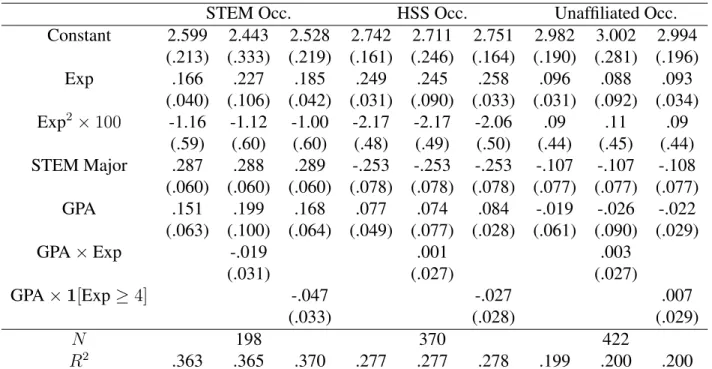
Table 1.1 shows the results of a series of simple wage regressions, split by skilled occupational
sector, controlling for own-sector experience and major, and varying in the form of dependency
on grades. There is a positive and significant coefficient on grades for STEM occupations, a
positive but insignificant coefficient for HSS, and a small and insignificant negative coefficient for
unaffilated, across all three specifications. Notably, when I include the interaction of GPA and
11The 2087 yearly hours value is derived from the US Office of Personnel Management.
12The NLSY97 has automatically-calculated hourly wages, but I found these numbers to be unreliable, e.g. with
Table 1.1: Observed Log-Wage Regression Results
STEM Occ. HSS Occ. Unaffiliated Occ.
Constant 2.599 2.443 2.528 2.742 2.711 2.751 2.982 3.002 2.994
(.213) (.333) (.219) (.161) (.246) (.164) (.190) (.281) (.196)
Exp .166 .227 .185 .249 .245 .258 .096 .088 .093
(.040) (.106) (.042) (.031) (.090) (.033) (.031) (.092) (.034)
Exp2×100 -1.16 -1.12 -1.00 -2.17 -2.17 -2.06 .09 .11 .09
(.59) (.60) (.60) (.48) (.49) (.50) (.44) (.45) (.44)
STEM Major .287 .288 .289 -.253 -.253 -.253 -.107 -.107 -.108
(.060) (.060) (.060) (.078) (.078) (.078) (.077) (.077) (.077)
GPA .151 .199 .168 .077 .074 .084 -.019 -.026 -.022
(.063) (.100) (.064) (.049) (.077) (.028) (.061) (.090) (.029)
GPA×Exp -.019 .001 .003
(.031) (.027) (.027)
GPA×1[Exp≥4] -.047 -.027 .007
(.033) (.028) (.029)
N 198 370 422
R2 .363 .365 .370 .277 .277 .278 .199 .200 .200
Note: Coefficients are for yearly log-earnings, in thousands. Exp. is own-sector experience, not counting other-sector experience, and is measured in years.
experience, I find the coefficient to be very small relative to GPA and insignificant; this finding
suggests that the ‘returns’ to GPA are constant over the experience profile. Lastly, the differences
in the coefficients on majoring in STEM suggest that the return to STEM is heterogeneous in
occupation.
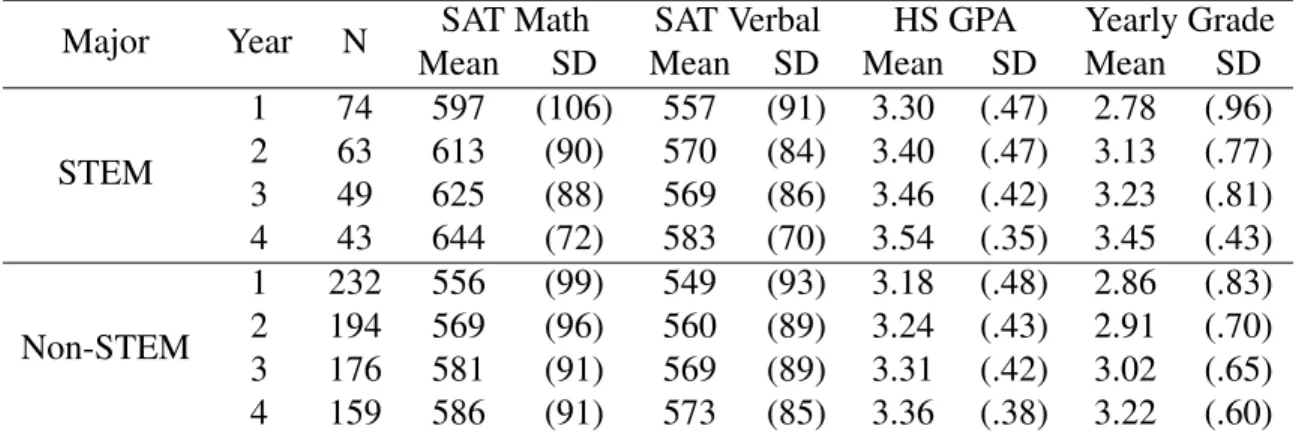
Looking at the characteristics of students who persist in college (Table 1.2), we see that high
school measures of academic ability (SAT scores and high school GPA) and realized college grades
are increasing with tenure for persisters. While the positive trend in high school ability, which
is ‘pre-determined’ prior to college, suggests that students who drop out are less academically
prepared than those who persist, interpreting the increase in realized college grades as evidence of
positive selection on academic ability is complicated by the fact that grading standards may change
by year: courses taken by a student in their fourth year of college may be graded more leniently
than those in their first year. Lastly, there is also evidence of sorting by major: students majoring
Table 1.2: Average SAT/HS GPA and Grade Outcomes, by Major Choice and Year in School
Major Year N SAT Math SAT Verbal HS GPA Yearly Grade
Mean SD Mean SD Mean SD Mean SD
STEM
1 74 597 (106) 557 (91) 3.30 (.47) 2.78 (.96)
2 63 613 (90) 570 (84) 3.40 (.47) 3.13 (.77)
3 49 625 (88) 569 (86) 3.46 (.42) 3.23 (.81)
4 43 644 (72) 583 (70) 3.54 (.35) 3.45 (.43)
Non-STEM
1 232 556 (99) 549 (93) 3.18 (.48) 2.86 (.83)
2 194 569 (96) 560 (89) 3.24 (.43) 2.91 (.70)
3 176 581 (91) 569 (89) 3.31 (.42) 3.02 (.65)
4 159 586 (91) 573 (85) 3.36 (.38) 3.22 (.60)
Note: Yearly grade is the grade received for that year, not cumulative GPA.
Table 1.3: Labor Market Characteristics by Occupational Sector
Occupational Sector: STEM HSS Unaffiliated
Mean SD Mean SD Mean SD
% Workers with STEM Major 62.8 (3.4) 9.6 (1.5) 10.5 (1.5)
Ann. Log-Earnings, STEM Major 3.58 (.35) 3.01 (.39) 2.63 (.41)
Ann. Log-Earnings, Non-STEM Major 2.66 (.46) 3.06 (.55) 2.95 (.57)
N 207 387 445
Note: Annual log-earnings are in thousands of dollars, and are for observed wages 2 years after graduation (there are a large proportion of choices in home production in the first year).
Table 1.3 presents some summary characteristics of workers in each occupational sector.
Re-garding the mapping between major and occupation, there is mixing: some non-STEM majors
work in STEM occupations, and vice versa. Furthermore, although a STEM major earns log-wages
that are on average 0.57 higher in STEM occupations than HSS occupations (and even higher
rel-ative to unaffiliated occupations), approximately 10 percent of the workers in the non-STEM and
unaffiliated sectors have STEM degrees. The reverse is also true for workers in STEM occupations
but with degrees in non-STEM. This statistic suggests the presence of nonpecuniary preferences
for occupation, since the variation in occupational choice is not fully explained by variation in
wages.
My model explains two stylized facts: college GPA is positively correlated with labor market
earnings, and students who persist in college are progressively stronger in pre-college
I include nonpecuniary preferences for occupation in my model; this feature will prove important
when measuring the ‘pass-through’ rate of changes in numbers of STEM majors to changes in
STEM workers, as well as accounting for selection into major and occupation. My model also
replicates a number of other moments of the data, such as the general wage profile and choice
patterns of education and occupation. Finally, when considering policy experiments, I show that
my counterfactual results replicate the negative student choice response to grade deflation policies,
as observed in the literature.
1.3 Model
1.3.1 Overview
I now describe the key characteristics of the model. After graduating from high school and
being accepted to a particular university, agents make yearly decisions over education or labor
alternatives. For those students who have not yet dropped out or graduated, they can either take
courses in STEM or non-STEM majors (subject to a few choice restrictions to be outlined later), or
choose to drop out of college and engage in either unskilled labor or home production. Dropping
out of college is absorbing: there is no re-entry. For agents who have dropped out of college, they
receive wage offers from a single unskilled labor sector, and can choose to work or engage in home
production. For agents who successfully graduate from college, they receive three wage offers from
the three types of skilled occupational sectors (STEM affiliated, HSS affiliated, and unaffiliated),
and can choose to work in any one of the three sectors, or engage in home production. There
is complete labor market separation between graduates and dropouts: graduates do not have the
option to work in the unskilled sector, and dropouts do not have the option to work in any of the
skilled sectors. There is no option for graduate school or further education, and agents have a finite
horizon decision problem ending at some terminal retirement age.
Agents are forward-looking and choose a sequence of actions that yields the highest expected
lifetime utility. Per-period utility derives from wages as well as a flow utility for each
alterna-tive (psychic/nonpecuniary cost or consumption value of working/education). Agents are
uncer-tain over grade shocks, wage shocks, and preference shocks; however, they know perfectly their
perfectly the structural parameters that dictate the grade generating process as well as wage offer
process (i.e. technology).
1.3.2 Agent Endowments
Agents are heterogeneous in both observed and unobserved (to the researcher) dimensions.
Observed characteristics for agent iare denoted by the vector XHS
i and include the agent’s SAT
Math and Verbal scores, as well as their high school GPA. In the style of Heckman and Singer
(1984), I also use a finite mixture approach for agent-specific unobserved heterogeneity: agents
are one of three researcher-unobserved types, and these types differ in the dimensions of academic
ability and preferences, and productivity and preferences by occupational sector. Agents know
their type perfectly. Denote the three types by{θ1, θ2, θ3}with corresponding population
propor-tions {π1, π2, π3}. I do not assume any particular form of correlation between agent observable
characteristics and unobserved type.
1.3.3 Labor Market Sector
The labor market sector consists of two broad types of sectors, the skilled and unskilled sectors,
which are completely separate. Since my dissertation is focused on the margin of major switching
among students who intend to graduate, I further divide the skilled sector into three occupational
types, while treating the unskilled sector as a single ‘occupational type’. College graduates make
their labor decisions over 30 periods following their graduation, up to a terminal period oft = 34; college dropouts can make labor decisions starting as soon as they drop out untilt= 34.13
The skilled sector consists of STEM affiliated, HSS affiliated, or unaffiliated occupational
sec-tors. A college graduate can choose to work in any of these three skilled occupational sectors
j = 1,2,3or engage in home productionj = H, regardless of his major; however, his expected productivity may differ for each sector. Within each of the occupational sectors, firms are identical:
the agent thus makes decisions over occupational sectors for each year. These sectors are
compet-itive between firms, and firms have the same information: thus firms offer the agent his expected
13There is no additional terminal payoff att = 34, e.g. a retirement payoff that depends on some state variables.
productivity given the firm’s information. An agent that works in a particular sectorj receives that particular wage offer, and also accumulates one unit of experience in sectorj.
I assume that log-productivity in skilled occupational sector j can be expressed as the sum of a deterministic component of productivity that depends on the rental rate of labor in that sector,
agent endowments in that sector, a student’s terminal major and GPA, and human capital from
the vector of accumulated work experience; as well as an idiosyncratic productivity shock (i.e. a
period-specific match quality or some fleeting productivity shock that is common to the sector).
I allow all of these components to vary by occupational sector j. In particular, I assume the log-productivity of the worker from the perspective of the firm is shifted by an indicator for whether
the student’s terminal major was in STEM, and linearly with respect to their GPA, with the returns
to GPA allowed to differ by major; these returns to major and GPA do not change with work
experience (see Eqn. 1.1). This specification is consistent with the results of my reduced form
wage regression (Table 1.1) as well as other empirical findings in the literature. Finnie et al.
(2016) find that, after controlling for field of study, there is a log-wage premium for having higher
grades and the time-grade interaction term is not significantly different from zero for most fields of
study.14 Arcidiacono et al. (2010) apply an employer-learning model (i.e., the model of Altonji and
Pierret 2001) to the NLSY79 and find that while underlying productivity, as measured by AFQT
scores, is initially hidden from employers and revealed over time for high school graduates, it is
essentially revealed immediately for college graduates; empirically, this is shown by estimating
the AFQT-experience interaction term to be zero for college graduates. If grades were one useful
predictor of productivity and there was no additional employer learning after an individual starts
working, then one would expect the grade-experience interaction coefficient to be zero as well, as
in my model’s specification. That being said, my model is a partial equilibrium model that focuses
on agent responses to returns on grades and major; I do not take a stand on the precise mechanism
14They obtain a negative estimate of the time-grade interaction for males in engineering (significant at 5 percent
generating the returns to grades and major.15
In the skilled sector, the agent i of type n has an expected log-productivity in sector j that depends on the skill rental rate rj0, his type-specific skill endowment in that sectorrendn,j, an indi-cator for university qualityQi, an indicator for whether his terminal major was in STEMMi, his
unweighted terminal GPAGi(and the interaction with his major), his vector of accumulated
expe-rience in all 3 sectors(x1
it, x2it, x3it)and an i.i.d. productivity shockWijt ∼ N(0, σ2j).16 There is no
correlation between the technology shocks across sectors or across time. The functional form of the
log-productivity is a quadratic in own-sector experience and linear in other-sector experience, with
an additional first-year experience effect. Finally, I impose a constraint that the own-experience
component of log-productivity cannot be decreasing in experience:
χn,jit =
r0j +rendn,j +rjq·Qi +rMj ·Mi+rjG·Gi+rjM G·(Mi×Gi)+ r1j·x1it+r2j ·x2it+rj3·x3it+rjsq·(xjit)2+ronej ·1{xjit >0}+Wijt
, ifxjit≤ − r j j 2rjsq
(1.1)
However, ifxjit >− r
j j
2rsqj , I set the log-wage contribution from the own-sector experience
xjitto be the maximum of the quadratic: for example, for sectorj = 1,
χn,it1 =
r01+rendn,1 +r1q·Qi+r1M ·Mi+r1G·Gi+r1M G·(Mi ×Gi)+ r21·x2it+r31·x3it+r1one·1{x1
it >0} − (r1
1)2
4r1
sq
+Wi1t
, ifx1it >− r
1 1
2r1
sq
(1.2)
The constraint that the experience profile in own-sector cannot be decreasing is added to stabilize
the estimation procedure: the discounted future payoffs are very sensitive to the magnitude of the
quadratic term, which has poor empirical identification.17
15Later, when discussing specific counterfactual policies, I argue that the conclusions of my partial equilibrium
model are likely to be close to reality even in a general equilibrium setting.
16The only relevant characteristic of the university itself in the labor market is its dummy for quality. I observe other
characteristics of the university such as whether it is public/private, which are relevant in the educational decisions but not in the labor market productivity.
There is only one occupational sector available to dropouts: the unskilled sector. The agent’s
log-productivity is a non-decreasing quadratic in unskilled experiencexUit. There is no heterogene-ity in the skill endowments by unobserved type n. Because unskilled workers by definition do not have a college degree, there is no dependency on grades, major, or college quality; however,
I do allow the log-productivity intercept and first-year experience effect to vary if the individual
dropped out or failed out at year four (y = 4) vs. earlier (y < 4).18 The returns to experience outside of the first-year experience effect are constrained to be the same for all dropouts. The
log-productivity specification in the unskilled sectorU is:
χU,yit =r0U,y+r1U ·xUit+rUsq·(xitU)2+roneU ·1[xitU,y >0] +WiU t, ifxUit ≤ −r U sq 2rU
1
(1.3)
χU,yit =r0U,y− (r U
1)2
4rU sq
+roneU ·1[xUit >0] +WiU t, ifxUit >− r U sq 2rU
1
(1.4)
For each skilled occupational alternativej, the agent’s per-period flow utility is a linear function of his wage offerWj(snit)(i.e., the productivity including the shock) multiplied byγp; a nonpecu-niary psychic costγj(snit)which depends on his unobserved typen; his history of choices, college outcomes, and shocks up to and including timet, denoted bysn
it; and a Type I extreme value
pref-erence shockP
ijt(technicallyPijt is included insnit). The per-period utility of occupational sector
alternativej is:
uj(snit) =γ j
(snit) +γp·Wj(sitn) +Pijt, j ∈ {U,1,2,3} (1.5)
γj(sn
it)consists of a constant termγconsn,j which depends on the occupation and agent type, but also
two additional nonpecuniary terms: an ‘entry cost’ γentryj that applies if the agent has no prior experience in the specific occupational sector, a ‘switching cost’ γswitchj that applies if the agent
wage growth. According to the American Community Survey, yearly wages for full-time workers with a college degree peak and start to decrease at around 20-25 years in the workforce (Hamilton Project, 2014).
did not work in sectorj in the prior periodt−1, and a sector-specific shifterγf irstj that applies for the first year out of college (t= 5):
γijtn =γj(snit) =γconsn,j +γentryj ·1[xjit= 0] +γswitchj ·1[di,t−1 6=j] +γf irstj ·1[t= 5], j ∈ {1,2,3}
(1.6)
The entry cost, first year out of college, and switching costs do not vary by unobserved typen. For the unskilled sector, the functional form of the nonpecuniary flows is analogous, but
with-out the first-year with-out of college costs. I also allow the per-period flow utility and switching cost to
vary if the student dropped out/failed out in year 4 (y= 4) vs. otherwise (y <4):
γiU ty =γU,y(snit) =γconsU,y +γentryU ·1[xUit = 0] +γswitchU,y ·1[di,t−1 6=U] (1.7)
Students who drop out or fail out in their fourth year differ from those that drop out earlier in
their level and first-year effect of unskilled wage offers, as well as their per-period flow utility and
nonpecuniary switching costs with unskilled labor; the other parameters are the same. There is no
heterogeneity in the unskilled labor market by typen.
Lastly, if the agent engages in home production, I assume it does not generate any income, and
I normalize the per-period flow utility from home production to zero, so that the per-period flow
utility is given by the Type I extreme value preference shock.
uH(snit) = P
iHt (1.8)
1.3.4 Educational Sector
As is apparent in the wage equations (Eqns. 1.1, 1.2), a student’s performance while in college
as well as his choice of major affects his labor market earnings. Students must therefore take
into account the impact of his uncertain educational outcomes on his later lifetime earnings when
individuals who are observed to attend at least one year of college. Thus, the quality q of the college as well as the type of college (public, private religious, private non-religious, or for-profit)
is fixed for the agent. While in college, agents have up to four alternatives: take a course load
specializing in STEM or non-STEM, or engaging in home production or working in the unskilled
labor market. The latter two options are available at any time while in college, and are considered
dropout: the student is only be able to work in the unskilled sector or engage in home production
for the rest of their lifetime if they drop out.
Agents receive a nonpecuniary flow utility from choosing STEM S or non-STEM N for that year, which varies by his unobserved typen, the type of universitys the student attends (public, private religious, private non-religious, or for-profit), the cost of tuition minus grants/scholarships
ctuit
i , and a Type I extreme value preference shock.19 I also include a switching cost for each major
for every year past the first year. The full functional form of the per-period utility is given by:
uj,s(snit) =γ n,s ijt −γ
p·ctuit
i +Pijt, j ∈ {S, N} (1.9)
where
γijtn,s =γconsn,j +γswitchj ·1{di,t−1 6=j andt≥2}+γs,j, j ∈ {S, N} (1.10)
γijtn,s, j ∈ {S, N}can be thought of as the psychic cost/consumption benefit of attending college and specializing in majorj, which varies through the individual’s type viaγn,j
cons (the type has varying
preferences for major) and university type viaγs,j(majors differ in their consumption values across
different university typess), andP
ijtis a Type I extreme value preference shock. This flow utility
does not change over the four years of college. Note that the flow utility of college does not
depend on the student’s academic ability or grades. The flow utilities for home production and the
unskilled sector are the same as in the labor market. Lastly, if the student successfully graduates
19School quality does not affect the nonpecuniary flow utility of college. The net cost of education is assumed to be
from college, then they receive a one-time nonpecuniary payoffγgradat the start of the next period,
t= 5, which is the same across student typesnand university typess.
After enrolling in a major, the agent receives a single grade that represents the average of all
their grades for that year.20 In each year, after deciding to enroll in STEM or non-STEM, the agent
of type n at university of quality q receives a grade Gn,qijt in major j which depends on his high school characteristicsXHS
i (SAT scores and high school GPA) throughλHSj , the year and quality
of the university throughλqj,t, his type-specific major abilityAn
j, and an idiosyncratic grade shock Giqjt ∼N(0, σqjt2 )which has a variance that depends on the quality of the university, the major, and whether the student is an under- (t= 1,2) or upper-classman (t= 3,4):
Gn,qijt =XiHSλHSj +
4 X
s=1
(1{t=s} ·λqjt) +Anj +Giqjt, j ∈ {S, N}, t∈ {1,2,3,4} (1.11)
Thus, between elite and non-elite universities, grades in the same major have the same returns to
SAT scores and high school GPAλHSj , but the levels of the gradesλqjt as well as the variances of the grade shocksσ2
qjt may differ. To identify the levels of the grade parameters, I normalize the
major-specific ability termAn
j to be zero for typen = 1individuals, for both majors.
Importantly, grades are revealed after the individual chooses a major. The agent must take
expectations over their grade outcomes: he knows all of the parameters in the grade generating
process, so he can perfectly forecast his potential distribution of grades for both majors, but not
the precise outcome. These grade shocks will be a major driver of the decision to switch or drop
majors.
Lastly, I introduce a series of choice restrictions while in college which are meant to capture
some aspects of the ‘switching costs’ between majors. They are:
1. Major declaration at year 3: The student’s choice of major at timet= 4must be the same as his choice of major att= 3, unless he dropped out.
20In reality, students do not face a binary choice between STEM and non-STEM, but rather an intensive choice of
2. STEM major pre-requisite: To choose STEM att = 3, the student must have chosen STEM in at least one of the two prior years,t= 1,2.
3. Deterministic graduation and failout. After four years in college, the student’s unweighted
cumulative GPAGi, the simple average of their four yearly grades, is calculated. IfGi <2.0,
the student fails out of college and can only work in the unskilled sector. Otherwise, he enters
the skilled sector in the next period with his terminal major corresponding to the major choice
att = 4, and terminal GPAGi.
As is shown in the Data Appendix, the first two restrictions are largely borne out by the data; the
largest restriction is actually the condition that students graduate within four years.
1.3.5 Agent Problem and Model Summary
To summarize, the model timing and sequential decision process is as follows:
1. Agentiof typenenters periodtwith his historysnit.
2. Each eligible firm forms a match-specific productivity shock with the individualW
ijtand
sub-mits a wage offer. When in college or in the unskilled workforce, the agent only receives
wage offers for the unskilled sectorj =U. When in the skilled workforce, he observes wage offers for each skilled sectorj ∈ {1,2,3}. Wage offers depend on his college performance, accumulated experience, and the productivity shock. Unskilled productivity shocks are
dis-tributedN(0, σ2
U), and skilled productivity shocks are distributedN(0, σj2), j ∈ {1,2,3}.
3. Preference shocksPijtare also revealed for all employment and education alternatives avail-able to the agent.
4. Each period, The agent evaluates each alternativedit(snit,{Pijt, Wijt}j)in his feasible set, and
its corresponding flow utility u(dit(snit), snit). He chooses the alternative that maximizes his expected discounted lifetime utility at timet.
5. Grades Gn,qijt = Gjit are then revealed if the student chose major j ∈ {N, S}. The agent receives a diploma if he successfully graduated, along with a corresponding graduation flow
6. If the agent has not yet graduated or dropped out, he can continue taking courses by choosing
N orS. Otherwise, he continues receiving wage and preference shocks over his employment alternatives in each period, and makes choices over those employment alternatives.
As is standard in the dynamic discrete choice literature, I assume agents are forward-looking and
choose the sequence of decisions{dit}tthat maximize their expected discounted lifetime utility21:
max
{dit}t
T
X
t=1
E[βt−1X j
{1[dit =j]·uj(snit)}|s n
i,t−1] (1.12)
Note thatuj(snit)includes the wage and preference shocks for individualiat timet. DefineV(snit)
to be the value of lifetime utility at time t, conditional on knowing all state variables. It is given by:
V(snit) = max dit
E[ T
X
τ=t
βτ−tX j
{1[dit =j]·uj(snit)}] (1.13)
where, similarly to before, the expectation is taken prior to unrealized wage, preference, and grade
shocks. We then have the standard recursive Bellman equation at an arbitrary periodt:
V(snit) = max dit
[uj(snit) +βEt[V(sni,t+1)|s
n
it, dit =j]] (1.14)
To solve the dynamic discrete choice problem, the agents solve backwards from the terminal period
T (with the continuation valueV(sn
i,T+1)defined to be zero), taking expectations of the discounted
future values of their occupational choices by integrating over preference and wage shocks. Note
that when I solve the model, I will calculate the ex-ante value functionsEt[V(sni,t+1)|snit, dit =j],
where the expectation is computed by integrating over the wage and preference shocks att+ 1. These value functions are solved back to when the agent is making educational decisions, where
both the value of graduating with a particular major and GPA combination (given the agent’s type)
as well as the values of dropping out of college are defined.
1.4 Identification
In this section I discuss the intuition for identification of the model. The model can be split
into two parts: the labor market and the educational sector. In the labor market, the model strongly
resembles Sullivan (2010) in that there are wage shocks as well as preference shocks, so the
iden-tification arguments are similar. Wages are observed, providing information about all of the wage
parameters(rj)j. It should be noted that the type-specific endowmentrn,j
end and the rental rater j
0
are not separately identified without a normalization: I, instead, estimate their sum, which acts as
a sector-type-specific log-wage intercept.
The wage observations are subject to standard selection bias: wages are only observed for the
agent’s chosen occupation. In a similar manner to the static sample selection case, conditional on
my distributional assumption (log-normal wages), I estimate a selection-corrected wage equation
for each sector by maximizing the joint choice and wage likelihood. In particular, in the final
decision period prior toT, the problem is static, and the selection rules are generated by the non-pecuniary flowsγn
ijtassociated with each occupational sector; for periodst < T, the continuation
values from the dynamic discrete choice model provide the selection rules. This also provides
identification of the discount factor β, since the continuation values (and hence choice behavior) depend directly on the discount factor. The values of the non-pecuniary flow utilitiesγijtn are iden-tified by variation in the agent’s observed choices that are not explained by observables, namely
occupation-specific wages. A strong source of identification of the non-pecuniary flows for each
occupation comes from the choice frequency of home production since, by assumption, home
pro-duction generates no income and has flow utility normalized to zero. Similarly, the rate of change
in frequency of the decision to engage in home production as wages increase over the life-cycle
identifies the relative preference for moneyγp: for example, if as an agent accumulated experience
and potential wages rose, the frequency of home production stayed relatively constant, that would
suggest a small value ofγp.
A similar identification argument applies for the estimation of the education sector’s
for the chosen major, I must jointly estimate the grade equations with the choice likelihoods,
con-sidering the selection rule generated by the agent’s optimization problem over the expected payoffs
of each terminal educational outcome (graduation with a particular grade in a particular major, or
dropping out), in an analagous manner to the labor market case. To separately identify the
unob-served heterogeneity in ability and preferences, I use the model’s assumption that an agent’s choice
of major only depends on ability through their impact on grades.22
Unobserved heterogeneity occurs through the permanent researcher-unobserved types n, and affects grades and wages received, as well as the likelihood of making particular occupational
and educational choices. Students with similar grades and the same major who choose different
occupations and earn different amounts would be predicted to be of differing types, with those
dif-ferences unexplained by major, GPA, and experience identifying the wage and preference
compo-nents of unobserved heterogeneity. Similarly, students who choose non-STEM majors over STEM
majors when their observable SAT scores and high school GPA would predict a strong STEM
performance would be predicted to have strong preferences for non-STEM courses; their actual
performance in their chosen field would identify their academic abilityAnj. The link between labor and educational unobserved heterogeneity within type n is captured by observing both types of outcomes for the same individual.
1.5 Estimation
1.5.1 Overview
I estimate the model via simulated maximum likelihood, where the likelihoods are derived from
the observed choices and outcomes, and the simulations occur when I integrate over unobserved
wage shocks; to do so, I discretize the distribution of the relevant shocks and take an average of the
choice probabilities conditional on the shock. The likelihood expressions as well as the specific
implementation of the integration are discussed in the Appendix. I show that in the case without
unobserved type heterogeneity, the log-likelihood is additively separable, allowing for sequential
estimation; adding unobserved heterogeneity destroys the additive separability, which I restore by
22If an agent derived utility from grades, academic ability would impact flow utility both directly through grades
using the sequential E-M algorithm, as outlined in Arcidiacono and Jones (2003).
While he is in the labor market sector, the agent’s experience, major, and GPA are observed,
with unobserved heterogeneity factoring into the sector-specific productivity endowments as well
as preferences for each alternative. Integrating over the potential wage shocks allows for the
con-struction of the ex-ante value functions, which can then be used to calculate the alternative-specific
value functions in the agent’s decision problem, which in turn are necessary to compute the choice
likelihoods.
1.5.2 The E-M Algorithm and Sequential Estimation
In the case of no unobserved heterogeneity, the model can be sequentially estimated: first
the labor market coefficients, then the educational sector coefficients. When in the labor market,
agents are identical conditional on their terminal major, GPA, and school type: the likelihood no
longer depends on the agent’s choices and outcomes while in college. This can also be seen by
direct inspection of the likelihood contributions for labor observations (in the Appendix): they
do not depend on the grade parameters conditional on the final GPA. Thus, I first estimate the
wage coefficients(rj)j, the components of the non-pecuniary flows for each occupational choice
γijt, and the relative preference for moneyγp. I then solve the agent’s dynamic discrete choice
problem backwards to the time of first entry into the labor market, establishing the terminal payoffs
for each educational outcome. Finally, I estimate the education parameters, namely the grade
coefficientsλHS j andλ
q
jt, the variances of the grade shocksσqjt2 , and the non-pecuniary flows for
the educational alternatives γs
j. As shown in Arcidiacono and Jones (2003), these estimates are
consistent, although statistically less efficient than jointly maximizing the full likelihood. The
main advantage is computational: the maximization problem over the entire parameter space is
now split into two smaller maximization problems over subsets of the parameter space.
The addition of unobserved heterogeneity via unobserved types destroys the additive
separa-bility of the log-likelihoods of observations in the labor and educational markets, since they both
depend on the unobserved typen, and prevents sequential estimation. However, the E-M algorithm allows for sequential estimation.
ΘL and educational parametersΘE, with unobserved types (θn)n and corresponding proportions
(πn)n, the total likelihood expression is given by:
X
n
πnf(θn, xi; Θ) =
X
n
πnfL(θn, xi; ΘL)fE(θn, xi; ΘE,ΘL) (1.15)
wheref(θn, xi; Θ)is the likelihood of a series of observations xi conditional on them being type n, and fL(·), fE(·)are the corresponding expressions for the labor and education likelihood
con-tributions. Instead of maximizing the expression in Eqn. 1.15 directly, the E-M algorithm solves:
ˆ
Θ =argmaxΘX
i
X
n
P(n|xi; ˆΘ,π)ˆ ·ln(f(θn, xi; Θ)) (1.16)
where P(n|xi; ˆΘ,π)ˆ is the posterior probability that individual i is type n, given observations xi. Importantly, with this formulation, f(θn, xi; Θ) can be decomposed into fL(θn, xi; ΘL) · fE(θn, xi; ΘE,ΘL)and the sequential estimator is given by:
˜
ΘL =argmaxΘL X
i
X
n
P(n|xi; ˜Θ,π)˜ ·ln(fL(θn, xi; ΘL)) (1.17)
˜
ΘE =argmaxΘE X
i
X
n
P(n|xi; ˜Θ,π)˜ ·ln(fE(θn, xi; ˜ΘL,ΘE)) (1.18)
whereΘ˜ andπ˜ are the current estimated model parameters and type proportions. The sequential estimation procedure proceeds by using some initial estimates of all of the parameters and type
proportions to calculate the posterior probabilitiesP(n|xi; ˜Θ,π)˜ for each individual, maximizing the labor likelihood component with respect to the labor parametersΘLto obtainΘ˜L, then taking
those estimated labor parameters Θ˜L as given in order to obtain estimates Θ˜Eof the education
parameters. The population proportions are then updated by taking an average of the posterior
˜
π0n=X i
P(n|xi; ˜Θ,π)˜ (1.19)
and then the algorithm repeats until some convergence criterion is met, which I take to be if the
posterior type proportionsπ˜0nbecome sufficiently close between iterations.
1.6 Estimation Results and Discussion
Although in principle the discount factorβ and the relative preference for moneyγp are
iden-tified from the data, the empirical identification is not strong. As a result of examining goodness
of fit at various values, I fixed β = 0.90and γp = 0.045, and estimate the other parameters. In
order for the estimation to be feasible, I discretize the terminal GPA of students to the nearest .2
GPA points, ranging from 2.0 to 4.0, for a total of21×2×2 = 84calculations of ex-ante value functions over both STEM and non-STEM terminal majors and elite/non-elite university quality; I
interpolate between these outcomes to approximate the value function integration over grade
out-comes for students in their fourth year of college. I place a few restrictions on the parameter values
for the labor market: the return to experience in every sector is constrained to be non-negative,
the quadratic term in own-experience is negative, and the entry costs are constrained to be
non-negative.23 However, I do not constrain the returns on GPA to be non-negative: it is possible that
the returns to grades are negative for particular sector-major combinations.
1.6.1 Labor Market
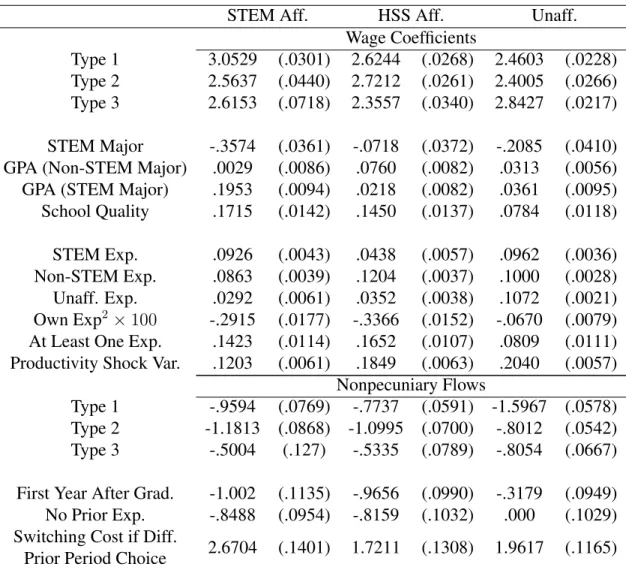
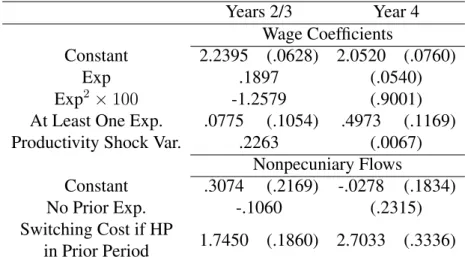
My estimates of the labor market coefficients are given in Table 1.4 for the skilled labor market
and Table 1.5 for the unskilled labor market. First note that the unobserved types of individuals
(θ1, θ2, θ3) each have a comparative productivity advantage for a particular labor sector (STEM,
HSS, unaffiliated, respectively). There is a strong degree of comparative advantage, especially for
type 1 in the STEM affiliated sector over other types, on the order of 0.45 log-wage units. There are
smaller but qualitatively similar productivity advantages for the other two types in their respective
23Given the high degree of persistence in occupation, empirical identification of returns to off-sector experience is
Table 1.4: Skilled Labor Market Parameter Estimates by Occupational Sector
STEM Aff. HSS Aff. Unaff.
Wage Coefficients
Type 1 3.0529 (.0301) 2.6244 (.0268) 2.4603 (.0228)
Type 2 2.5637 (.0440) 2.7212 (.0261) 2.4005 (.0266)
Type 3 2.6153 (.0718) 2.3557 (.0340) 2.8427 (.0217)
STEM Major -.3574 (.0361) -.0718 (.0372) -.2085 (.0410)
GPA (Non-STEM Major) .0029 (.0086) .0760 (.0082) .0313 (.0056)
GPA (STEM Major) .1953 (.0094) .0218 (.0082) .0361 (.0095)
School Quality .1715 (.0142) .1450 (.0137) .0784 (.0118)
STEM Exp. .0926 (.0043) .0438 (.0057) .0962 (.0036)
Non-STEM Exp. .0863 (.0039) .1204 (.0037) .1000 (.0028)
Unaff. Exp. .0292 (.0061) .0352 (.0038) .1072 (.0021)
Own Exp2×100 -.2915 (.0177) -.3366 (.0152) -.0670 (.0079)
At Least One Exp. .1423 (.0114) .1652 (.0107) .0809 (.0111)
Productivity Shock Var. .1203 (.0061) .1849 (.0063) .2040 (.0057) Nonpecuniary Flows
Type 1 -.9594 (.0769) -.7737 (.0591) -1.5967 (.0578)
Type 2 -1.1813 (.0868) -1.0995 (.0700) -.8012 (.0542)
Type 3 -.5004 (.127) -.5335 (.0789) -.8054 (.0667)
First Year After Grad. -1.002 (.1135) -.9656 (.0990) -.3179 (.0949)
No Prior Exp. -.8488 (.0954) -.8159 (.1032) .000 (.1029)
Switching Cost if Diff.
2.6704 (.1401) 1.7211 (.1308) 1.9617 (.1165) Prior Period Choice
Note: Wage coefficients are reported in log-units of yearly thousands of dollars. Bootstrap standard errors are in parentheses.
sectors.
For each occupational sector, the returns to GPA are significantly higher if the major matches
the occupation: a 1.0 increase in GPA for STEM majors working in the STEM sector results in an
increase in wages by 0.195 log-units, while only 0.003 log-units for non-STEM majors working
in the STEM sector. A similar effect occurs for non-STEM majors in HSS occupations, while
in the unaffiliated sector the returns to GPA are similar and small for both majors. Considering
that the average terminal GPA of graduates in my sample is 3.38 for STEM and 3.15 for