Self-Efficacy and Critical Thinking as the Predictors of Autonomous Language Learning in EFL
Contexts
Mania Nosratinia*, Faranak Amiri Hossaini
Islamic Azad University, Central Tehran Branch, Iran
Corresponding Author: Mania Nosratinia, E-mail: [email protected]
ABSTRACT
The thrust of the present study was to systematically investigate the relationship between EFL learners’ Self-Efficacy (SE), Critical Thinking (CT), and their Autonomy (AU). To this end, 196 male and female EFL learners, within the age range of 20 to 30 (Mage= 25) were selected based on convenience sampling strategy. They were asked to fill in three questionnaires, namely Sherer, Maddux, Mercadante, Prentice-Dunn, Jacobs, and Rogers’ SE Scale (1982), Honey’s CT questionnaire (2000), and Zhang and Li’s Learner AU questionnaire (2004). Since the assumptions of normality of distribution were violated for the scores of AU and SE, in order to find out the relationships among the variables, the non-parametric Spearman Rank Order Coefficient of Correlation was conducted. The results revealed that there was a significant and positive correlation between AU and CT, AU and SE, and CT and SE. Furthermore, a regression analysis revealed that SE has the largest β coefficient (β = 0.519, t = 7.65, p = 0.0005). This is to say that SE makes the strongest statistically significant unique contribution to explaining AU. CT turned out to be the second significant predictor of AU scores (β = 0.186, t = 2.75, p = 0.007). The study concludes with a discussion on the obtained results followed by presenting some implications for EFL teachers, learners, and syllabus designers.
Key words: Autonomy, Critical Thinking, Internal Factors, Self-efficac
INTRODUCTION
The driving force behind conducting this study was making a systematic attempt in order to inspect the way autonomy, critical thinking, and self-effica y, as major factors in learn-ing, interact with one another. A further goal of the study was to compare the predictive capacity of critical thinking and self-efficac in terms of predicting autonomy, or autono-mous language learning. Nowadays, the ELT domain is wit-nessing a shift towards highlighting the role of autonomy in language learning (Nosratinia & Zaker, 2014, 2017). Fur-thermore, language learning is now occurring in more dif-ferent circumstances and for a broader variety of objectives than ever before (Benson & Voller, 1997), and EFL learners are expected to be responsible for their own learning (Ku-maravadivelu, 2001).
Influenced by the social constructivism theory of learn-ing, it is now believed that language competence is actively constructed by the individual through an autonomous social and experiential process (Ashton-Hay, 2006; Sprenger & Wadt, 2008). As a result, a great share of ELT studies in re-cent years has been dedicated to inspecting the interaction of learners’ autonomy and other pedagogical and internal fac-tors (Aliweh, 2011; Lightbown & Spada, 2013), also func-tioning as the driving force of the present study. Needless to
Published by Australian International Academic Centre PTY.LTD.
Copyright (c) the author(s). This is an open access article under CC BY license (https://creativecommons.org/licenses/by/4.0/) http://dx.doi.org/10.7575/aiac.ijalel.v.7n.1p.64
say, this inspection would enhance ELT practitioners’ peda-gogical knowledge in addition to providing them with more options and tools for amplifying and encouraging autonomy among EFL learners.
In simple terms, autonomy refers to the ability of learners in directing and managing their own learning and accepting the responsibility of learning since “success in learning, very much depends on learners’ having a responsible attitude” (Scharle & Szabó, 2000, p. 4). From another perspective, Cotterall (1995) defines autonomy as “the extent to which learners demonstrate the ability to use a set of tactics for tak-ing control of their learntak-ing” (p. 195). Finally, Richards and Renandya (2002) define learner autonomy as “a process that enables learners to recognize and assess their own needs, to choose and apply their own learning strategies or styles eventually leading to the effective management of learning” (p. 346). As indicated in the abovementioned definitions, au-tonomy has the capacity for being considered a major factor in language learning, making it reasonable to study how it interacts with other internal factors.
This descriptive study included three variables, i.e. au-tonomy, critical thinking, and self-efficac . It has been stated that the enrichment of autonomy in second language class-es calls for developing learners’ potential for implementing critical reflectio in learning, i.e. being critical thinkers (Ku,
ARTICLE INFO
Conflicts of interest: None Funding: None
Article history
Received: August 12, 2017 Accepted: October 21, 2017 Published: January 05, 2018 Volume: 7 Issue: 1
2009). Critical thinking as a metacognitive internal capacity is “the deliberate determination of whether we should ac-cept, reject or suspend judgments about a claim and of a de-gree of confidence with which we accept or reject it” (Moore & Parker, 2005, p. 4). Chance (1986) defines critical think-ing as “the ability to analyze facts, generate and organize ideas, defend opinions, make comparisons, draw inferences, evaluate arguments and solve problems” (p. 6). Since critical thinking can be subject to instruction (O’ Donnell, Reeve, & Smith, 2012), it is reasonable to inspect if there exists a sig-nificant relationship between autonomy and critical thinking so that autonomous learning can be promoted through criti-cal thinking instruction.
Self-efficac , as the third/last variable of this study, is considered to be in close relation with autonomous behav-ior and action as it interacts with peoples’ judgments about their capabilities in being able to take required action to achieve their desired purpose (Bandura, 1997). Therefore, it is no wonder that numerous studies have favored the role of self-efficacy in L2 learning (Pajares & Urdan, 2006). The concept of self-efficacy is regarded as a part of social cog-nitive theory which was introduced by Albert Bandura in 1977. It is defined as “beliefs in one’s capabilities to orga-nize and execute the courses of action required to produce given attainments” (Bandura, 1997, p. 3). Similar to the previous case (critical thinking), self-efficacy is also subject to instruction and is affected by environmental factors (O’ Donnell, Reeve, & Smith, 2012), making it a potential tool for promoting autonomous learning.
Rooted in the penchant for coming up with new pedagog-ical solutions for developing autonomous EFL learning, this study intended to systematically inspect the way autonomy, critical thinking, and self-effica y interact among EFL learn-ers. To fulfill this purpose, the following research questions were formulated:
Research Question 1: Is there any significant relationship between EFL learners’ autonomy and critical thinking? Research Question 2: Is there any significant relationship
be-tween EFL learners’ autonomy and self-efficacy Research Question 3: Is there any significant relationship
be-tween EFL learners’ critical thinking and self-efficacy Research Question 4: Is there any significant difference
be-tween EFL learners’ critical thinking and self-efficacy in predicting their autonomy?
METHOD Participants
The participants of the present study were 196 undergraduate male and female (161 or % 82 female and 35 or % 18 male) EFL learners, within the age range of 20 to 30 (Mage = 25), studying English Translation, English Literature, and Teach-ing English at Islamic Azad University, Central and south Tehran, and Ale Taha University in Tehran. They were un-dergraduate students who were studying in the fifth to eighth semesters. The sampling strategy for selection of the partic-ipants was convenience sampling. It should be mentioned that the initial number of participants was 321, but 125
in-dividuals were excluded from data analysis as they had pro-vided incomplete answers, bringing the final number to 196 participants.
Instrumentation
In order to fulfill the purpose of the study, the following in-struments were utilized:
• Autonomy Questionnaire • Critical Thinking Questionnaire • Self-Efficacy Scale
Zhang and li’s learner autonomy questionnaire
The English version of Zhang and Li’s (2004) learn-er autonomy questionnaire was used in ordlearn-er to estimate learner’s autonomy. It was designed based on the learning strategies classified by Oxford (1990), Wenden (1998), and O’Malley and Chamot (1990). The questionnaire has two parts. The first part contains 11 items and the second part 10, totally 21 items. The first 11 items have five op-tions in Likert-scale from never to always. The second part of the questionnaire is in multiple-choice format, and the participants choose the closer answer to their beliefs and their attitudes or ideas. Their choices range from A to E (1 to 5 scores), and the participants are required to respond in 30 minutes. All the items of this instrument are direction-al, and, therefore, the range of scores is basically from 21 to 105. The questionnaire has proven to have high validity and reliability (Dafei, 2007; Rezaei, Karbalaei, & Afraz, 2013). The reliability of learner autonomy questionnaire in the present study was estimated to be 0.70, using the Cron-bach’s alpha coefficient
Honey’s critical thinking questionnaire
In order to assess participants’ critical thinking ability, the English version of Honey’s Critical Thinking Questionnaire (2000) was administered. The questionnaire has been de-signed to evaluate the three main skills of comprehension, analysis, and evaluation. This instrument is a Likert-type questionnaire with 30 items, allowing researchers to investi-gate the learners’ ability in note-taking, summarizing, ques-tioning, paraphrasing, researching, inferring, discussing, classifying, outlining, comparing and contrasting, distin-guishing, synthesizing, and inductive and deductive reason-ing.
The participants are asked to rate the frequency of each category they use on a 5-point Likert scale, ranging from
Sherer, Maddux, Mercadante, Prentice-Dunn, Jacobs,
and rogers’ self-efficacy scale
To evaluate participants’ level of self-Efficac , the English version of the Self-Efficacy Questionnaire developed by Sherer, Maddux, Mercadante, Prentice-Dunn, Jacobs, and Rogers (1982) was administered. It consists of 23 items which measure three aspects of behavior: initiative, effort, and persistence. It has two subscales; the general self-effi -cacy (17 items) and the social self-effi-cacy (6 items). Par-ticipants respond on the basis of a five-point Likert-scale, ranging from strongly disagree (1 point) to strongly agree (5 points). The scores range from 23 to 115, and the allocated time is 15 minutes. Scores for Items 1, 3, 8, 9, 13, 15, 19, 21, 23 correspond to the answer and remaining items are scored in reverse direction. Obtained score lower than 45 is charac-terized as low self-efficacious, between 46 and 70 moderate, and score more than 71 is known as having high selfeffic -cy. The reliability of the self-efficacy scale in this study was estimated to be 0.72, using the Cronbach’s alpha coefficient
Procedure
To achieve the purpose of this study and address the ques-tions posed, the researchers followed the following pro-cedure. Subsequent to obtaining a formal approval for con-ducting the research in the universities mentioned earlier (see Participants), twenty available classes were chosen. Before distributing the questionnaires, the required explana-tions were given to the participants in Persian. First, students were informed about the aim of the study. Then, the proce-dure of filling out the three questionnaires was explained by providing one example.
All three questionnaires were distributed in one package. Furthermore, the researchers deliberately randomized the or-der of the administered questionnaires in oror-der to control for the impact of order on the completion process and validity of the data. The allocated time for answering was 65 minutes, and the researchers were present at the time of administering the questionnaire in order to resolve any probable problems. A number of 321 sets of the questionnaires were initially ad-ministered; however, 196 sets were usable for data analysis as the rest of them were not completed carefully and com-pletely.
RESULTS
The design of this study was descriptive. The predicted vari-able was autonomy and the predictors were self-efficacy and critical thinking. Moreover, participants’ age was considered the control variable. In order for the researchers to answer the research questions, a series of pertinent calculations and statistical routines were conducted whose results are present-ed in this section.
The Preliminary Analyses
Before answering the research questions, it was needed to check a number of assumptions and perform some
prelim-inary analyses. To begin with, the assumptions of interval data and independence of participants (Tabachnick & Fidell, 2007) were already met as the present data were measured on an interval scale and the participants were independent of one another. In addition, it was needed to check some other significant assumptions through inspecting the features of the data. These assumptions, according to Tabachnick and Fidell (2007), are:
1. Linear relation between each pair of variables, 2. Homoscedasticity, and
3. Normality of the distribution of variables.
The following sections will check the three abovemen-tioned assumptions which are pertinent to the first,second, and third research questions of the study. However, as the legiti-macy of addressing the fourth research question is dependent on the answers given to the three initial research questions, the preliminary analyses pertinent to the fourth research question are reported after addressing the first three research questions.
Linear relation between each pair of variables and homoscedasticity
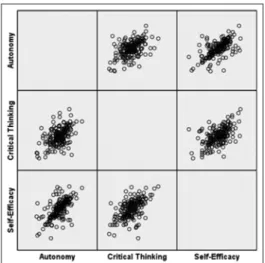
To check the linearity of relations, the researchers visual-ly inspected the data through creating a multiple scatterplot which is presented in Figure 1.
Through inspecting Figure 1, it can be inferred that the relationships among these variables are not fundamentally non-linear. As it can be observed, there is not a U-shaped or curvilinear pattern of distribution. Consequently, the linear-ity of relations can be confirmed. Moreover, the distribution of scores was not funnel shape, i.e. wide at one end and nar-row at the other; therefore, the assumption of homoscedas-ticity was met for these variables.
Normality of the distributions
In order to check the normality of the distributions, the Kolmogorov-Smirnov test was run, results of which are pre-sented in Table 1.
As presented in Table 1, only the Sig. value for the scores of critical thinking is significantly higher than the critical
ue (.05). Therefore, the normality of distribution for autono-my and self-efficacy scores is not supported (Tabachnick & Fidell, 2007). Consequently, the pertinent research questions were answered through employing non-parametric tests.
Answering the Three Initial Research Questions The first research question
In order to answer the first research question, the data were analyzed using the Spearman rank order coefficient of cor-relation which is a non-parametric formula. Table 2 shows the result of this analysis.
According to the results of the analysis reported in Table 2, it was concluded that there was a significant and positive correlation between autonomy and critical thinking,
ρ =.45, n = 196, p <.01, and high levels of autonomy were associated with high levels of critical thinking. According to Cohen (1988), this signified a medium-to-large effect size (99% confidence intervals: 0.28 – 0.58)
The second research question
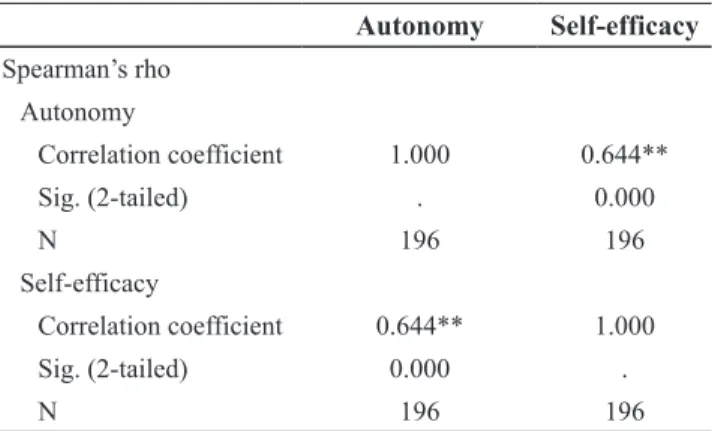
In order to answer the second research question, the data were analyzed using the Spearman rank order coefficient of correlation. Table 3 shows the result of this analysis.
According to the results of the analysis reported in Table 3, it was concluded that there was a significant and positive correlation between autonomy and self-efficac ,
ρ =.64, n = 196, p <.01, and high levels of autonomy were associated with high levels of self-efficac . According to Co-hen (1988), this signified a large effect size (99% confidence intervals: 0.52 – 0.74).
The third research question
In order to answer the third research question, the data were analyzed using the Spearman rank order coefficient of cor-relation, a non-parametric formula. Table 4 shows the result of this analysis.
According to the results of the analysis reported in Table 4, it was concluded that there was a significant and positive correlation between critical thinking and self-ef-ficac , ρ =.53, n = 196, p <.01, and high levels of critical thinking were associated with high levels of self-efficac . According to Cohen (1988), this signified a large effect size (99% confidence intervals: 0.39 – 0.65)
Based on the findings of the three initial research ques-tions, both critical thinking and self-efficacy were signifi -cantly related to autonomy. In other words, critical thinking
Table 1. Tests of normality of the scores
Kolmogorov-Smirnova Shapiro-Wilk
Statistic df Sig. Statistic df Sig.
Autonomy 0.072 196 0.014 0.983 196 0.018
Critical thinking 0.042 196 0.200* 0.993 196 0.428
Self-efficac 0.065 196 0.042 0.991 196 0.245
aLilliefors significance correction, *This is a lower bound of the true significance
Table 2. Spearman’s correlation between Autonomy and critical thinking
Autonomy Critical thinking
Spearman’s rho Autonomy
Correlation coefficient 1.000 0.445**
Sig. (2-tailed) . 0.000
N 196 196
Critical thinking
Correlation coefficient 0.445** 1.000
Sig. (2-tailed) 0.000 .
N 196 196
**Correlation is significant at the 0.01 level (2-tailed)
Table 3. Spearman’s correlation between Autonomy and self-efficacy
Autonomy Self-efficacy
Spearman’s rho Autonomy
Correlation coefficient 1.000 0.644**
Sig. (2-tailed) . 0.000
N 196 196
Self-efficacy
Correlation coefficient 0.644** 1.000
Sig. (2-tailed) 0.000 .
N 196 196
**Correlation is significant at the 0.01 level (2-tailed)
Table 4. Spearman’s correlation between critical thinking and self-efficacy
Critical
thinking Self-efficacy
Spearman’s rho Critical thinking
Correlation coefficient 1.000 0.533**
Sig. (2-tailed) . 0.000
N 196 196
Self-Efficacy
Correlation coefficient 0.533** 1.000
Sig. (2-tailed) 0.000 .
N 196 196
and self-efficacy significantly interact with autonomy among EFL learners. As a result, the researchers could opt for an-swering the fourth research question, considering critical thinking and self-efficacy the predictor variables of the pre-dicted variable, autonomy.
Preliminary Analyses Pertinent to the Fourth Research Question
The fourth research question of this study was answered through running a multiple regression analysis. However, there were a number of assumptions which had to be checked before performing the analysis. According to Tabachnick and Fidell (2007), these assumptions are:
1. Sample size 2. Multicollinearity 3. Normality 4. Outliers.
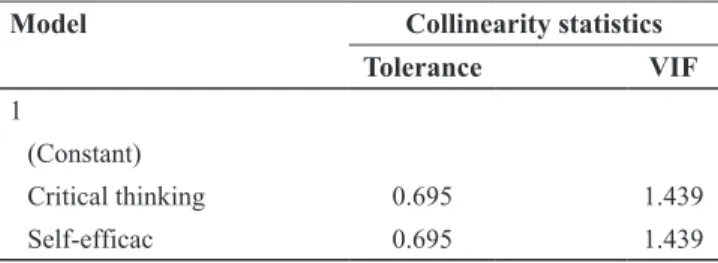
Employing Tabachnick and Fidell’s (2007) formula for calculating sample size (N > 50 + 8m) indicated that this assumption was met as 196 is way above the minimum re-quired number of 66 participants. Furthermore, the research-ers implemented some measures in order to systematically inspect the existence of multicollinearity in the sample, the Tolerance value and VIF value. Table 5 reports the Tolerance and VIF values in this study.
As reported in Table 5, both of the Tolerance values were desirably higher than.1. Moreover, the VIF values were desirably lower than 10. Therefore, it was concluded that, as required, multicollinearity did not exist in this sample. Furthermore, in order to check the normality, the Normal Probability Plot (P-P) was created which suggested no ma-jor deviation from normality. Furthermore, the scatterplot of standardized residuals showed that residuals were rectangu-larly distributed.
Finally, the researchers inspected the Mahalanobis distance value in order to notice and inspect the existence of outliers. The obtained values reported that the highest Mahalanobis value in this sample was 19.36 which is above the critical level (13.28). However, the inspection of the datasheet revealed that there is only one case (case 70) whose Mahalanobis value ex-ceeds the critical value. Consequently, this case was removed from the data (n2 = 195), and this time, the highest Mahalano-bis value is 11.91. As a result, the researchers could argue that the assumption pertinent to the outliers is met.
The Fourth Research Question
In order to answer the fourth research question, a standard multiple regression was run. Table 6 presents the regression model summary including the R and R2.
As reported in Table 6, R came out to be 0.645 and R2
came out to be 0.416. This means that the model explains 41.6 percent of the variance in autonomy (Cohen, Cohen, West, & Aiken, 2003). Moreover, f2 = 0.71 indicated a large
effect size for the regression. Table 7 reports the results of ANOVA (F (2, 192)= 68.362, p = 0.0005), the results of which were considered significant. This means that the mod-el can significantly predict EF learners’ autonomy.
Table 8 demonstrates the Standardized Beta Coefficients which signify the degree to which each predictor variable contributes to the prediction of the predicted variable. The inspection of the Sig. values showed that both critical think-ing and self-efficacy make a statistically significant unique contribution to the equation as their Sig. values are less than.05.
The comparison of β values revealed that self-efficacy has the largest β coefficient (β = 0.519, t = 7.65, p = 0.0005). This means that self-efficacy makes the strongest statistical-ly significant unique contribution to explaining autonomy. Therefore, it was concluded that self-efficacy could more significantly predict autonomy scores of the participants. Critical thinking, turned out to be the second significant pre-dictor of autonomy scores (β = 0.186, t = 2.75, p = 0.007). Fi-nally, the inspection of Part correlation (semipartial correla-tion coefficient) revealed that self-efficacy uniquely explains 17.8 percent of the variance in autonomy (.422 ×.422 =.178).
DISCUSSION
The first research question of the study attempted to system-atically inspect the association between EFL learners’ auton-omy and critical thinking, both considered major learning-af-fecting factors (Lightbown & Spada, 2013). The results of the Spearman rank order coefficient of correlation indicated that there was a significant and positive correlation between autonomy and critical thinking, ρ =.45, n = 196, p <.01. This
Table 5. Tolerance and VIF values
Model Collinearity statistics
Tolerance VIF
1
(Constant)
Critical thinking 0.695 1.439
Self-efficac 0.695 1.439
Table 6. Model summary – R and R square
Model R R square Adjusted
R square error of the Standard estimate
1 0.645a 0.416 0.410 7.455
a. Predictors: (Constant), self-efficacy, critical thinking,
b.Dependent variable: Autonomy
Table 7. Regression output: ANOVA
Model Sum of
squares df squareMean F Sig.
1
Regression 7599.174 2 3799.587 68.362 0.000a
Residual 10671.513 192 55.581
Total 18270.687 194
a. Predictors: (Constant), self-efficacy, critical thinking,
finding provides further support for the existence of a causal relationship between these two factors as many other studies have reported a positive and significant association between autonomy and critical thinking (Fahim & Sheikhy, 2011; Nosratinia & Zaker, 2015; Mahmoudi & Asadi, 2016).
The systematic inspection of the association between autonomy and self-efficacy was the concern of the second research question. The probability of the existence of this relationship was first proposed by Bandura (1997); however, in order to confirm his argument, the researchers ran Spear-man rank order coefficient of correlation test whose results reported a significant and positive correlation between au-tonomy and self-efficac , ρ =.64, n = 196, p <.01. This is in line with the findings of Mahmoudi and Asadi (2016) which reported a significant, yet smaller (r =.62), relationship be-tween these variables. Needless to say, other studies are needed before jumping to the conclusion that the relation-ship between autonomy and self-efficacy is of causal nature (Springer, 2010).
The third research question focused on the association between EFL learners’ critical thinking and self-efficac . Previous research has suggested that these two variables can interact and affect one another, either directly or indirectly (Bandura, 1997; Nosratinia, Zaker, & Saveiy, 2015). In order to conduct a systematic probe, the researchers ran a Spear-man rank order coefficient of correlation test whose results reported a significant and positive correlation between crit-ical thinking and self-efficac , ρ =.53, n = 196, p <.01. This outcome is in line with the findings of Mahmoudi and Asa-di (2016) which reported a significant, yet larger (r =.88), relationship between these variables. Similar to the previ-ous case, other studies are needed before arguing that the relationship between critical thinking and self-efficacy is of causal nature (Springer, 2010). If confirmed, the existence of this causal relationship can have numerous implications for ELT pedagogy which is highly in favor of enhancing learn-ers’ self-efficacy level (O Donnell, Reeve, & Smith, 2012).
Having observed a significant and positive relationship among the three variables of the study, it was legitimate for the researchers to inspect and compare how critical think-ing and self-efficacy predict autonomy among EFL learn-ers. After checking the preliminary assumptions, a standard multiple regression was run whose results indicated that self-efficacy makes the strongest statistically significant unique contribution to explaining autonomy (β = 0.519). This is to say that self-efficacy is the better predictor of au-tonomy, and attempts to enhance the level of self-efficacy have a higher potential to enhance EFL learners’ autonomy.
In other words, the objectives of postmethod methodology (Kumaravadivelu, 2001) and modern ELT pedagogy (Rich-ards & Rodgers, 2001) are easier to meet when self-efficacy is amplified. Needless to say, as the same regression analysis was not conducted in previous research, it was not feasible to compare this finding with those of other studies. The major implications of the findings are discussed in the following section.
CONCLUSION
The role of learners’ internal factors in mastering language skills is no longer unknown to language educators and EFL practitioners (Mitchell & Myles, 2004; Richards & Rodgers, 2001; Zaker, 2016). This awareness has been contemporane-ous with a shift towards highlighting the role of autonomy in ELT pedagogy (Nosratinia & Zaker, 2014, 2017). In this day and age, language learning is occurring in more different cir-cumstances, and for a broader variety of objectives than ever before (Benson & Voller, 1997), and learners are expected to take the responsibility of their own learning (Kumarava-divelu, 2001). Consequently, a great share of ELT studies in recent years has been dedicated to inspecting the interac-tion of learners’ autonomy and other pedagogical and inter-nal factors (Aliweh, 2011; Lightbown & Spada, 2013), also functioning as the driving force of the present study.
Rooted in the penchant for coming up with new peda-gogical solutions for developing autonomous EFL learning, this study intended to systematically inspect the way auton-omy, critical thinking, and self-efficacy interact among EFL learners. Through answering the first research question, it was concluded that there was a significant and positive cor-relation between autonomy and critical thinking. Autonomy and critical thinking, both are considered major factors in language learning (Lightbown & Spada, 2013), and based on the principles of meta-analysis, it seems reasonable to argue that a causal relationship between these two factors exists (Fahim & Sheikhy, 2011; Nosratinia & Zaker, 2015; Mah-moudi & Asadi, 2016). This findings suggests that through developing learners’ critical thinking, they would be able to function more autonomously in learning English as a second language. In other words, developing learners’ metacogni-tive capacities through instructing them on critical thinking has the potential to contribute to learning language based on the new pedagogical concerns.
In addition, observing a positive and significant relation-ship between autonomy and self-efficac , as observed in this study, provides EFL practitioners and syllabus designers with
Table 8. Regression output: Coefficients
Model Unstandardized
coefficients Standardized coefficients T Significance Part correlations
B Standard error β
1
(Constant) 23.484 3.913 6.002 0.000
Critical thinking 0.118 0.043 0.186 2.746 0.007 0.151
further options for developing learners’ autonomy in ELT programs. The next finding of the study was important from two perspectives. First, the significance of the relationship between critical thinking and self-efficacy provides logical support for including them in a regression analysis (Best & Kahn, 2006). Second, it is now more obvious that develop-ing one’s reflective capacities is highly related to their at-titude towards their own abilities, making it important for ELT programs to pay more attention to learners’ attitude and self-evaluation. This argument is further supported by the last finding of the study. Having self-efficacy as a better predictor of autonomy compared to critical thinking makes it essential for ELT programs to include learners’ self-efficacy as a ma-jor factor in learning and develop the pedagogical practice through working on learners’ beliefs about their ability.
The findings of the present study supported the notion that through improving EFL learners’ self-efficac , they can become more autonomous and independent in language learning. Put another way, the findings of the present study provide further justification for EFL teachers to value and appreciate the significance of learners’ beliefs towards their abilities, in line with the humanistic theories of learning (Richards & Rodgers, 2001). EFL teachers are encouraged to endeavor to amplify EFL learners’ self-efficacy if they are going after a heightened level of learning among their stu-dents. There are many tools available for EFL teachers in order to enhance learners’ self-efficac . However, to be more knowledgeable, EFL teachers are recommended to study the features of self-efficacy and the techniques available for pro-moting self-efficac .
According to Bandura (1997), individuals’ self-efficacy is formed by their understanding of information from four different sources. They are:
a) mastery experience, b) vicarious experience, c) social persuasions, d) and physiological states.
Based on these informing sources of self-efficac , EFL teachers are suggested to:
• involve EFL learners in activities which are not signifi -cantly beyond their ability,
• implement formative assessment so that the teaching practice is calibrated to learners’ peculiarities,
• engage learners in meaningful tasks where learners’ are expected to observe the context, communicate, and in-teract with others,
• provide the learners with extrinsic motivation through encouragement,
• pay attention to learners’ affective state,
• create a friendly and supportive learning environment, • involve the learners in course planning and assessment, • familiarize the learners with different aspects of
self-ef-ficac , and
• employ a variety of activities and tasks so that different personalities and learning styles are taken care of. Furthermore, it is now a widely held belief that EFL learn-ers should actively participate in learning activities (Mitchell & Myles, 2004; Nosratinia & Zaker, 2014). They are
expect-ed to use the language for communication in order to master the language (Ashton-Hay, 2006). Consequently, there is no doubt about the significance of learners’ involvement in the learning process. However, such an attempt would be made only if the learners are capable to create the intrinsic motiva-tion needed to take the steps and put in the effort needed for internalizing the L2 features. Furthermore, EFL learners’ are recommended to pay attention to the informing sources of self-efficac , as proposed by Bandura (1997). Based on these sources, EFL learners are recommended to:
• participate in the process of needs analysis so that learn-ing activities are not significant y beyond their abilities, • value meaning over form so that they engage in
mean-ingful tasks,
• develop their intrinsic motivation through reflection • attempt to manage their affective state and develop their
emotional intelligence levels,
• participate in creating a friendly and supportive learning environment, and
• study the different aspects of self-efficac .
Further, syllabus designers and material developers are believed to play an important role in the process of L2 learn-ing through providlearn-ing a great portion of the input, tasks, and activities. Based on the findings of the present study, a statis-tically-supported justification is provided for paying a higher level of attention to learners’ internal factors, especially their self-efficac .
Furthermore, the textbooks should be prepared in a way that EFL learners can voice their opinions at different points in improving their learning activities. Finally, that could be an advantage if the EFL syllabi provide the learn-ers and teachlearn-ers with a clear and comprehensible definition of self-efficac , its categories, and how it can be promoted. Furthermore, EFL syllabi are recommended to pay attention to the informing sources of self-efficac , as proposed by Bandura (1997). Based on these sources, EFL syllabi should: • promote the process of needs analysis so that learning activities are not significantly beyond learners ability, • value meaning over form so that learners engage in
meaningful tasks,
• introduce the different aspects of self-efficac ,
• provide the learners with an objective criterion for eval-uating their own progress, and
• provide a variety of tasks so that EFL learners with dif-ferent learning styles and personality types are given the chance to perform learning tasks properly, and perhaps better than some of their peers, at different points during the language course.
Based on the principles of descriptive research, the focus of the study, the characteristics of the learners, and the pecu-liarities of this study, there are a number of areas which were not touched in this study. Furthermore, other studies are re-quired to inspect relevant concepts and confirm the results of this study. Accordingly, a limited number of recommenda-tions are presented here, hoping that other researchers would find them interesting enough to pursue in the future
b) This research was carried out among EFL learners with-in the age range of 20-30 years old (Mage = 25); the same study could be done among other age groups to see the probable effect of the age range.
c) It is suggested to replicate this study with equal numbers of male and female participants, so that gender might not act as an intervening variable.
d) It is suggested to compare the predictive power of self-efficacy with other internal, personality, cognitive, and metacognitive factors in predicting autonomy. e) It is suggested to replicate this study while including
the language skills, i.e. speaking, listening, writing, and reading.
f) This study can be replicated employing some qualitative instruments to increase the validity and reliability of the results and interpretations.
REFERENCES
Aliweh, A. M. (2011). The Effect of electronic portfolios on promoting Egyptian EFL college students’ writing competence and autonomy. Asian EFL Journal, 13(2), 90-132.
Ashton-Hay, S. (2006) Constructivism and powerful learning environments: Create your own! Paper presented at the 9th International English Language Teaching
Conven-tion: The Fusion of Theory and Practice, Middle Eastern Technical University, Ankara, Turkey. Retrieved May 22, 2015, from http://eprints.qut.edu.au/17285/1/17285. pdf
Bandura, A. (1997). Self-effica y. Harvard Mental Health Letter, 13(9) 4-6.
Benson, P., & Voller, P. (1997). Introduction: Autonomy and independence in language learning. London: Longman. Best, J. W., & Kahn, J. V. (2006). Research in education
(10th ed.). Boston, MA: Pearson Education, Inc.
Chance, P. (1986). Thinking in the classroom: A survey of pro-grams. New York: Teachers College, Columbia University. Cohen, J. W. (1988). Statistical power analysis for the be-havioral sciences (2nd Ed.). Hillsdale, NJ: Lawrence
Er-lbaum Associates.
Cohen, J., Cohen, P., West, S. G., & Aiken, L. S. (2003). Applied multiple regression/correlation analysis for the behavioral sciences (3rd Ed.). NJ: Lawrence Erlbaum Associates.
Cotterall, S. (1995). Readiness for autonomy: Investigating learner beliefs. System, 23(2), 195-205.
Dafei, D. (2007). An exploration of the relationship between learner autonomy and English proficienc . Asian EFL Journal, 4(24), 1-23.
Fahim, M., & Sheikhy B., R. (2011). Critical thinking ability and autonomy of Iranian EFL learners. American
Jour-nal of Scientific Research, Issue 29, 59-72.
Honey, P. (2000). Critical Thinking Questionnaire. Retrieved April 20, 2013, from http://www.peterhoney.com Ku, Y. L. K. (2009). Assessing students’ critical thinking
per-formance: Urging for measurements using multi-response format. Thinking Skills and Creativity, 4(1), 70-76. Kumaravadivelu, B. (2001). Toward a Postmethod
Pedago-gy. TESOL Quarterly, 35(4), 537-560.
Lightbown, P., & Spada, N. (2013). How languages are learned (4th ed.). Oxford: Oxford University Press.
Mahmoudi, H., & Asadi, M. (2016). The relationship among autonomy, self-efficac , and critical thinking of Iranian upper-intermediate EFL learners. Language Education Studies, 2(2),16-25.
Mitchell, R., & Myles, F. (2004). Second language learning theories (2nd ed.). London: Edward Arnold.
Moore, B. M., & Parker, R. (2005). Critical thinking. Bos-ton: McGrow, Hill High Education.
Nosratinia, M., Abbasi, M., & Zaker, A. (2015). Promoting second language learners’ vocabulary learning strate-gies: Can autonomy and critical thinking make a contri-bution? International Journal of Applied Linguistics & English Literature, 4(3), 21-30.
Nosratinia, M., & Zaker, A. (2014). Metacognitive attri-butes and liberated progress: The association among second language learners’ critical thinking, creativ-ity, and autonomy. SAGE Open, 4(3), 1-10. doi: 10.1177/2158244014547178
Nosratinia, M., & Zaker, A. (2015). Boosting autonomous for-eign language learning: Scrutinizing the role of creativ-ity, critical thinking, and vocabulary learning strategies.
International Journal of Applied Linguistics and English Literature, 4(4), 86-97. doi: 10.7575/aiac.ijalel.v.4n.4p.86 Nosratinia, M., & Zaker, A. (2017). Scrutinizing the impact
of teachers’ critical thinking and teaching autonomy on their teaching success and learners’ use of language learning strategies. Journal of Language Teaching and Research, 8(1), 122-132.
Nosratinia, M., Zaker, A. & Saveiy, M. (2015). Higher-or-der thinking and individualized learning: Metacognitive awareness and self-efficacy among EFL learners. The Iranian EFL Journal 11.1, 189-207.
O’ Donnell, A., Reeve, J., & Smith, J. (2012). Educational
psychology: Reflection for action (3rd ed.). Hoboken,
NJ: Wiley.
O’Maley, J., & Chamot, A. (1990). Learning strategies in second language acquisition. Cambridge: Cambridge University Press.
Oxford, R. L. (1990). Language learning strategies: What every teacher should know. Boston: Heinle & Heinle. Pajares, F., & Urdan, T. (2006). Foreword. In F.
Pajar-es & T. Urdan (Eds.), Self-efficacy beliefs of ado -lescents (pp. ix–xii). Greenwich, CT: Information Age Publishing.
Rezaei, F. S., Karbalaei, A., & Afraz, S. (2013). The effect of vocabulary strategy training among autonomous and non-autonomous learners in Iranian EFL context. Eu-ropean Online Journal of Natural and Social Sciences,
2(2s), 35.
Richards, J. C., & Renandya, W. A. (2002). Methodology in language teaching: An anthology of current practice. New York: Cambridge University Press.
Richards, J. C., & Rodgers, T. S. (2001). Approaches and methods in language teaching (2nd ed.).
Scharle, A., & Szabó, A. (2000). Learner autonomy. A guide to developing learner responsibility. Cambridge: Cam-bridge University Press.
Sherer, M., Maddux, J. E., Mercadante, B., Prentice-Dunn, S., Jacobs, B., & Rogers, R. W. (1982). The self-effi -cacy scale: Construction and validation. Psychological Reports, 51, 663-671.
Sprenger, T. M., & Wadt, M. P. S. (2008). Autonomy
de-velopment and the classroom: Reviewing a course syllabus. DELTA, 24, 551-576. doi: 10.1590/S0102-44502008000300009
Springer, K. (2010) Educational research: A contextual ap-proach. Hoboken, NJ: Wiley.
Tabachnick, B. G., & Fidell, L. S. (2007). Using multivariate statistics. Boston, MA: Pearson Education, Inc.
Wenden, A. (1998). Learner strategies for learner autono-my. Great Britain: Prentice Hall.
Zaker, A. (2016). Social constructivism and metacognition in an EFL context: Inspecting the contribution of crit-ical thinking to EFL learners’ social intelligence. Hu-manising Language Teaching 18(6). Retrieved Decem-ber 27, 2016, from www.hltmag.co.uk/dec16/index. htm