www.ijcrm.com Volume 1 Issue 3 ǁ July. 2016 ǁ PP 19-24
Abstract
An accurate impression is one of the prerequisites for a precise and passive fitting prosthesis. This clinical study was carried out to compare the accuracy of fit of metallic superstructures fabricated over multiple implant abutments by using three implant transfer impression techniques. The objective of the study was to determine whether the direct technique with (Group III), or without splinting (Group II), is having any advantage over indirect implant transfer impression technique (Group I), and also if intraoral splinting of the transfer coping have any added advantage over non-splinted method.
The direct splinted method consistently produced the best result with 100% of the impressions producing an accurate fit of the framework followed by direct non-splinted technique, while the indirect technique shows a very low percentage of accuracy. Thus it can be concluded from the study that the indirect technique is best avoided in multiple angulated implant situations.
The accuracy of fit of implant superstructures fabricated using
three different impression techniques for cases with multiple
implant abutments -A clinical evaluation
1,
Pramod Kumar A V,
2,Vinni T K,
3,Aswathi Krishnan,
4,Mehul R Mahesh,
5,
Mohamed Saheer
1,2,3,4,5,
Government Dental College Kozhikode, Kerala, India
I. Introduction:
A precise and passive fit of the framework is an important pre-requisite for the long-term success of implant supported prostheses. Although absolute accuracy of the implant framework does not appear to be attainable, the inaccuracies can be minimized by controlling several steps involved in the construction of implant superstructure, especially the impression technique.Inaccuracies can develop during the removal of impression, repositioning of transfer copings to the impression, during the placement of implant analogues, or during pouring of the impression. Various techniques available for implant impressions are 1) Indirecttransfer technique, 2) Direct unsplinted transfer technique, and3) Direct splinted transfer technique [1,2]. Polyvinyl siloxane and polyether are the materials of choice for implant impressions [3,4]. Various studies have been done to compare the accuracy of indirect, direct and direct splinted implant impression techniques. Some studies reported no difference between the direct and indirect techniques [5,6], whereas others concluded that the direct technique was more accurate [7]. In a systematic review, Heeje Lee et al,concluded that more studies reported greater accuracy with the splinted technique than with the non splinted technique. However, for situations in which there were three or fewer implants, more studies showed no difference between the direct and indirect techniques while the direct technique was more accurate when the number of implants increased to four or more.[8].
Most of the studies reported in literature are in vitro and were done to compare only the linear discrepancy measured in laboratory models[9-11]. Clinical studies comparing various techniques show conflicting results [12, 13]. The vertical and positional discrepanciesof the transfer copings which occur in implant impression techniques make these errors three dimensional in nature.More over the ultimate objective of an implant impression technique is to fabricate a superstructurehaving precise and passive fit, especially in screw retained implants. In vivo studies incorporate various patient related factors in making impressions and therefore are more reliable compared to invitro studies performed on a single master model. This in-vivo study was conducted to compare the accuracy of three different impression techniques for cases with multiple angulated implants.
II. Methodology
problems like uncontrolled diabetes, malignancies, steroid therapy or other debilitating conditionswere excluded. Patients with local contraindications such as untreated periodontal diseases,insufficient bone volume, poor occlusion etc. werealso excluded from selection. Implants (Toureg, Adin, Israel) of varying numbers and sizes were placed under local anesthesia, depending upon the length of edentulous span, the available bone height and width. Healing caps were placed after exposing the implants following an eight to sixteen week interval. Two weeks after placement of healing caps patients wererecalled for implant transfer impressions. Three impressions using three different techniqueswere made for each patient and were divided into Groups I, II and III.
Group 1: The impression transfer copings were secured to the implants and remained attached to
themthroughout the impression procedure. Poly vinyl siloxane (Express Putty and light body, 3M-ESPE,Germany) putty wash impression technique using stock trays was followed. After removal of the impression, the copings were removed from the mouth and connected to the appropriate analog. The coping analog assemblies werethen transferred into the corresponding positions in the impression. A gingivalmask was formed and the master cast was prepared by pouring with Type IV gypsum (Ultrarock, Kalabhai, India).
Group II: Stock trays for direct impression technique wereused. The direct transfer impression copings were
secured to the implants. A PVS putty wash impressionwas thenmade using a stock tray for direct technique. The screws were loosened through the openings in the tray and the impression and the transfer impression copings were removed as a single unit. Implant analogs wereconnected to the embedded transfer copings by fastening the screws. The master cast wasfabricated with Type IV gypsum.
Group III: Transfer copings were secured to the implants. Dental floss was looped around these copings to
form a scaffold on which splinting was done using pattern resin (GC, Japan). Pattern resin was applied to the transfer copings with a fine brush, using incrementalapplication technique. A small gap of 1mm was left at the centre of the scaffold in between successive transfer copings (Fig.). Bridging of this gap was done after complete polymerization of each increment in order to reduce the effects of polymerization shrinkage.Following this, an impression was made in a manner similar to that in group II and a master cast was prepared by pouring with Type IV gypsum.
Three separate master casts were thus prepared from three impressions made for each patient. Transfer copings were then removed from the cast and replaced by abutments. Height of the abutments were adjusted and the abutments milled to 3 degree taper with the help of milling machine. Separate wax patterns were made from each master cast and invested and cast with nickel chromium ceramic bonding alloy in a single ring. Marks were scored onsprue former to identify the specimen. After devesting and finishing, metal superstructure were seated on the corresponding casts. Then the abutments were transferred to the corresponding implants and fit of the superstructure checked with fit checker (GC, Japan) at buccal, lingual, mesial and distal aspects.
Depending upon the fit of the superstructure intraorally, the scoring was given as follows. Score 0 - Unacceptable as gross seating problem present.
Score 1 - Good fit and is same as that on the Master cast.
The comparison between the techniques was done using Chi-square test.
Final prosthesis fabricated from well-fitting superstructure was given for each patient.
III. Results:
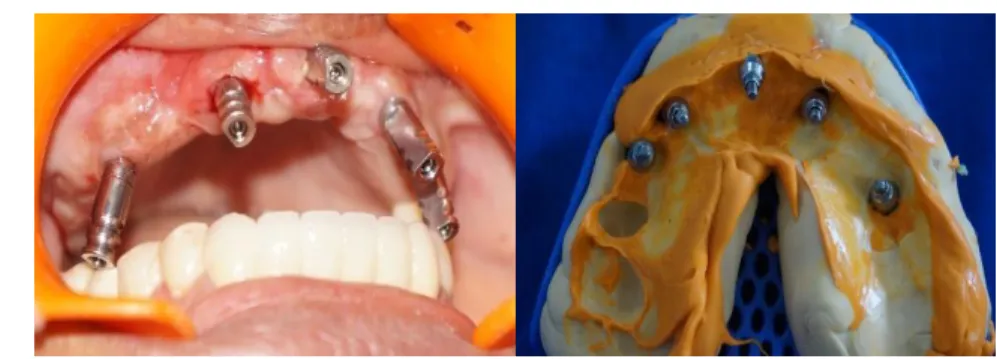
Fig 1 indirect impression
Fig 2 Direct non-splinted impression
Fig 3 Direct splinted impression
Table 1: Fit of the framework
Case No. Group I Group II Group III
1 0 1 1
2 0 1 1
3 1 0 1
4 1 1 1
5 1 1 1
6 0 1 1
7 1 1 1
8 0 1 1
9 0 1 1
10 1 1 1
Table:2 group*fit cross tabulation
Chi-Square Tests
Table:3 group*fit cross tabulation
Chi-Square Tests
Value df Asymp.Sig.
(2-sided)
Pearson Chi-Square 3.810 1 0.051
Continuity correlation 2.143 1 0.143
Table:4 group*fit cross tabulation
Chi-Square Tests
Value df Asymp.Sig.
(2-sided)
Pearson Chi-Square 6.667 1 0.010
Continuity correlation 4.267 1 0.039
Table:5 group*fit cross tabulation Fit
Total
No Yes
Group
1 Count 5 5 10
% within group 50% 50% 100%
2 Count 1 9 10
% within group 10% 90% 100%
3 Count 0 10 10
% within group 0% 100% 100%
Total Count 6 24 30
% within group 20% 80% 100%
Value df Asymp.Sig.
(2-sided)
Pearson Chi-Square 8.750 2 0.013
Fit
Total
No Yes
Group
1 Count 5 5 10
% within group 50% 50% 100%
2 Count 1 9 10
% within group 10% 90% 100%
Total Count 6 14 20
% within group 30% 70% 100%
Fit
Total
No Yes
Group
1 Count 5 5 10
% within group 50% 50% 100%
3 Count 0 10 10
% within group 0% 100% 100%
Total Count 5 15 20
Chi-Square Tests
Value df Asymp.Sig.
(2-sided)
Pearson Chi-Square 1.053 1 0.305
Continuity correlation 0.00 1 1.00
IV. Discussion:
Discrepancies resulting from inaccurate implant impressions are three dimensional in nature. Linear discrepancies such as erroneous duplication of inter implant distances rarely reflect on the implant impression technique. Such discrepancies are more likely to occur due to the properties of the impression material rather than the impression technique. Thus, studying linear discrepancies with respect to implant impression techniques should be regarded with caution. Three dimensional errors in duplicating implant positions and orientations are probably more responsible in causing an inaccurate fit of the superstructures. These errors maybe due to positional changes of transfer copings in a vertical direction, rotational misfits of the copings or both.
In the present study, comparisons were made between three accepted implant impression techniques - the direct, the indirect and the direct splinted techniques. The direct splinted impression technique was shown to produce the most accurately fitting frameworks. The direct un-splinted technique and the indirect technique were less accurate. These results are in accordance with a study performed by Mustafaet al. It is conceivable that the fact that the indirect impression technique causes inaccuracies in more than one dimension leads to them producing more inaccuracies overall.
V. Conclusion:
The present study serves as an in-vivo comparison between the three accepted techniques of impression making in multiple implant situations. The study shows the direct splinted and direct non-splinted techniques to produce the most accurate frameworks while the indirect technique shows a very low percentage of accuracy. Thus, it can be concluded from the study that the indirect technique is best avoided in multiple angulated implant situations.
Acknowledgments
This study was funded by the State Board of Medical Research, Kerala State, India. The funding sources had no role in any part of the research including study design, data collection, data analysis, result interpretation, manuscript writing, and submission for publication.
References
1. Mostafa TM, Elgendy MN, Kashef NA, Halim MM.Evaluation of the precision of three implant transfer impression
techniques using two elastomeric impression materials.Int J Prosthodont. 2010 Nov-Dec;23(6):525-8.
2. Dumbrigue HB, Gurun DC, Javid NS. Prefabricated acrylic resin bars for splinting implant transfer copings.
J Prosthet Dent. 2000 Jul;84(1):108-10.
3. Alvin.G.Wee. Comparison of impression materials for direct multi-implant impressions. J Prosthet Dent
2000;83:323-31.
4. Aguilar M.L,Elias A, Carlos E TorroVizcarrando, Walter .PsoterAnalysis of three-dimensional distortion of two
impression materials in the transfer of dental implants.J Prosthet Dent 2009;101:202-209
5. Wenz H.J, Reuter H.U, Hertrampf KAccuracy of impressions and casts using different implant impression techniques in
a multi-implant system with an internal hex connection.Int.J Oral Maxillofac Implants 2008;23:39-47
6. Conrad H.J, Pesun I.J, Ralph Delong, James.S.HodgesAccuracy of two impression techniques with angulated implants
J Prosthet Dent 2007;97:349-356.
Fit
Total
No Yes
Group
2 Count 1 9 10
% within group 10% 90% 100%
3 Count 0 10 10
% within group 0% 100% 100%
Total Count 1 19 20
7. Mostafa N.T.M, Elgendy M.N.M, Kashef N.A, Halim M.MEvaluation of the precision of three implant transfer impression techniques using two elastomeric impression materials..Int J Prosthodont 2010;23:525-528
8. Lee H, Joseph S, Hochstedler J.L, Ercoli.CThe accuracy of implant impressions:A systematic review
J Prosthet Dent 2008;100:285-291
9. Carr AB. Comparison of impression techniques for a five-implant mandibular model.Int J Oral Maxillofac Implants.
1991 Winter;6(4):448-55
10. Vigolo P, Majzoub Z, Cordioli G. Evaluation of the accuracy of three techniques used for multiple implant abutment
impressions.J Prosthet Dent. 2003 Feb;89(2):186-92.
11. Assuncao WG, Filho HG, Zaniquelli O. Evaluation of transfer impressions for osseointegrated implants at various
angulations.Implant Dent. 2004 Dec;13(4):358-66.
12. Gallucci GO, Papaspyridakos P, Ashy LM, Kim GE, Brady NJ, Weber HPClinical accuracy outcomes of closed-tray
and open-tray implant impression techniques for partially edentulous patients.Int J Prosthodont -24(5); 469-72
13. Stimmelmayr M, Güth JF, Erdelt K, Happe A, Schlee M, Beuer F Clinical study evaluating the discrepancy of two
different impression techniques of four implants in an edentulous jaw.Clin Oral Investig - Nov 2013; 17(8); 1929-35
14. de Faria JC, Silva-Concílio LR, Neves AC, Miranda ME, Teixeira ML. Evaluation of the accuracy of different transfer
impression techniques for multiple implants.Braz Oral Res. 2011 Apr;25(2):163-7.
15. Alikhasi M, Siadat H, Monzavi A, Momen-Heravi F. Three-Dimensional Accuracy of Implant and Abutment Level
Impression Techniques;The Effect on the Marginal Discrepancy.J Oral Implantol. 2010 Jun 16.
16. Assuncao WG, Filho HG, Zaniquelli O. Evaluation of transfer impressions for osseointegrated implants at various