AUSTRALIAN JOURNAL OF BASIC AND
APPLIED SCIENCES
ISSN:1991-8178 EISSN: 2309-8414 Journal home page: www.ajbasweb.com
Open Access Journal
Published BY AENSI Publication
© 2016 AENSI Publisher All rights reserved
This work is licensed under the Creative Commons Attribution International License (CC BY). http://creativecommons.org/licenses/by/4.0/
To Cite This Article: Asmara Alias, Norazah Yusof and Nor bahiah Ahmad., Collaborative Learning with Jigsaw Technique in Online Environment. Aust. J. Basic & Appl. Sci., 10(3): 10-18, 2016
Collaborative Learning with Jigsaw Technique in Online Environment
1Asmara Alias, 2Norazah Yusof and 3Nor bahiah Ahmad
1University Technology Malaysia (UTM), Faculty of Computing, P.O Box 81310, Skudai, Johor Bahru, Johor, Malaysia 2
King Abdul Aziz University Rabigh, Faculty of Computing and information Technology, Kingdom of Saudi Arabia.
3University Technology Malaysia (UTM), Faculty of Computing, P.O Box 81310, Skudai, Johor Bahru, Johor, Malaysia.
Address For Correspondence:
Asmara Alias, 1 University Technology Malaysia (UTM), Faculty of Computing, P.O Box 81310, Skudai, Johor Bahru, Johor, Malaysia
A R T I C L E I N F O A B S T R A C T Article history:
Received 10 December 2015 Accepted 22 January 2016 Available online 30 January 2016
Keywords:
Computer Supported Collaborative Learning (CSCL), Collaborative Learning, Jigsaw Technique
This paper presents a discussion on Jigsaw as the collaborative learning technique in structuring collaboration between students in e-learning environment. The needs of collaboration and interaction between students has created a student centered learning, but in the typical e-learning environments, researchers have found that students learn independently in which without proper learning strategies and techniques, resulting student to do less interaction and collaboration thus decreased student progress and motivation. Computer Supported Collaborative Learning (CSCL) is seen as a potential environment that uses technology to support learning collaboration activities in which the concept of team work is the fundamental. Unfortunately, it has been observed that these collaboration learning strategies in CSCL environment being use and adopt in a bad manner. Therefore, an improved Computer Supported Collaborative Learning framework with appropriate learning strategies needs to be proposed to overcome the raising issues. This research recommends the Jigsaw techniques as the formal collaborative learning strategy embedded in the proposed CSCL framework. This improvement could transform existing CSCL framework into rich computerized capabilities.
INTRODUCTION
The conduct of education in this 21st century has been witnessed with a paradigm shift from traditional
leaning (face-to-face) to a more technology based learning. This is due to the increasingly popularity of internet and its capability to offer transparent communication between the diverse computing platforms which has simplify the processes by providing the learning opportunities to distantly located learners. In teaching and learning environment, interactions between teachers and students can be carried out using communication media such as the computers, internet, e-mails and etc from a wide range of different source through cyber space or virtual space via the internet. The popular term to describe learning through virtual space is e-learning. Nowadays, e-learning environment involved many students engage in the learning process. The e-learning process has involved collaboration between students who are physically far from each other. This collaboration been extended in network environment supported by technology known as Computer Supported Collaborative Learning (CSCL).
However, the nature of e-learning environment in CSCL only concerns towards technologies for learning, without focusing on collaborative technologies and collaborative methods. These typical e-learning environment leads to students learn independently (Chen et al., 2007) without proper less strategies and techniques resulting student to do less interaction and collaboration thus decreased student progress and motivation (Giannoukos et al., 2008).
CSCL refers to learning environment in which ICT plays roles as primary means of interacting such as conversation, collaboration and social exchanges (Cheng et al.,2013) and providing valuable flexibility in the use of time and space (Goodyear et al., 2013). However, the implementations are still teacher centered (Saleh and Aziz, 2012) and does not fully utilize the communications among students and teachers. This has lead students towards passivity and no interactions among others (Duckworth, 2009).
Griggs and Dunn (1999) suggested that a proper selection of teaching and learning methods contributes to educational success of student’s learning with support of computer. Various collaborative techniques are available for CSCL environment in accomplishing task given. However, Pozzi and Sugliano (2006) argue that these collaborative techniques in CSCL environment are adopted in bad manner that leads to unsuccessful learning process. Consequently, CSCL (consists of e-learning environment and collaboration techniques) is seen as a suitable platform to push students to collaborate and by this student will be able to construct their knowledge, learn by expressing questions and lastly achieve goals. Therefore, a framework for CSCL with formal collaborative learning technique needed to be explored and improved.
This paper proposes a CSCL framework that embeds a Jigsaw technique as the formal collaborative strategy. It is organized into nine sections as follows: Section II introduces to the collaborative learning. Section III explains about various collaborative learning models. The Collaborative Learning Strategies is highlighted in Section IV, while the Jigsaw Technique as the formal collaborative learning technique is discussed in Section V. Section VI describes about the Computer Supported Collaborative Learning (CSCL). Then, Section VII presents the proposed CSCL framework that embeds the Jigsaw technique as its collaborative learning techniques. Section VIII reports the implementations of the Jigsaw techniques in the proposed CSCL framework. Finally, Section IX concludes the paper and recommends for future work.
Collaborative Learning:
Collaborative learning is a general term used for the description of educational practices based on simultaneous cognitive and mental effort of multiple students and instructor. It’s involved the mutual engagement of participants in coordinated efforts to solve problems together through learning process. Students’ shares common goals depend on each other and responsible for their success or failure (Andreas et
al., 2010)
In a collaborative learning environment, there were two types of theory adoption on students which are passive and active (Hiltz et al., 2000). Passive environment are assume that students learn by receiving and assimilate knowledge from others. In contrast, active environment present learning as social interaction and process taken place through communication with members such as constructing knowledge, formulate ideas and actively responds and give feedback to the learning process. Lai (2011) had stated that collaborative interactions are focus in shared goal, high degree of negotiation, interactivity and also independent.
Collaborative learning process occurs when the group of students encounters a problem given by the instructors or faced authentically in real situation. Students do the initial discussion in order to agree on actual problem identification. In this phase, it helps to cultivate a sense of ownership to the problem among group of students. This is also the point where students establish the joint activity. Students forward the discussion for improvement of ideas and construct the knowledge. Ideas generated by the students may differ with other students. Students also can improve learning process by elaborate and explanation the learning context.
Gokale (1995) also agreed on collaborative situation which it requires students more active rather than passively listening, active on cooperating, share ideas, communicating, discussing, thinking and more dynamic interaction. The active learning offered by collaborative learning also emphasizes the desirable qualities of interaction.
Collaborative process involves three main mechanisms that affect learning process; conflict or disagreement, internalization and also self explanation (Hiltz et al, 2000). The process can be applied in all collaborative learning activities. There are some practices that are found significant in enhancing a collaborative process. The practices are listed below:
i. Knowing names of students
ii. Balancing talking and listening
iii. Building trust
iv. Create comfortable learning zone
v. Do discussion with students about instructor role
vi. More facilitating
vii. Active exchange of ideas and information between student-student and student-instructor
viii.Involve student in making decision
ix. Provides continues feedback
Collaborative Learning Model:
Collaborative learning model is developed based on learning activity model (Meta et al., 2011; Valentine
et al, 2008). Learning activity is a specific interaction of students with other by using specific tools and
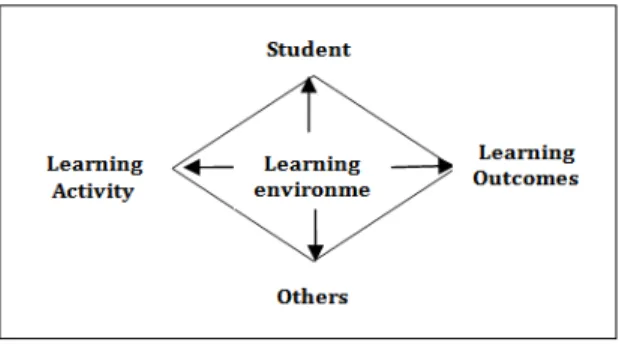
resource towards specific outcomes or learning objectives. Generally learning activity is based on three elements; human (individual, student(s), teacher(s), tools (documents, application, technology) and scenario (objective, learning outcome (LO), product).
Meta et al. (2011) in their research paper also have defined each component in the model (refer Figure 3).
Student must equip with three main components; identities (preferences, needs, and motivations), competences
(skills, knowledge, abilities) and also roles (mode of participation). Learning environment is focusing on the tools, services and also resources. The platform that popular nowadays is virtual learning or e-learning. In addition, Learning Outcomes is based on the knowledge gained, academic results, social skills of interaction and also other abilities. While other components is the other people who directly and indirectly involved in learning activities. They play the specific role such as supporter, mediator, challenger and also guider. Other component that categorized as Other are instructors, motivators and also teachers.
Fig. 1: Collaborative Learning Model (Meta et al., 2011).
Other researcher, Valentin et al., 2008 also have mentioned that collaborative learning model is formed from four components; student, activity flow (learning process), peer review and also working group (learning environment). However, most of task required for a collaborative learning and experiences need the support of one or several particular computing tools which is not necessary provided by the system, such as LMS.
Another model of collaborative learning model presented is from Wang and Wang (2010) (Figure 4). They studied the collaborative learning model on the internet in order to encourage students collaborate more by using virtual learning system. Community element in collaborative learning model by Wang and Wang (2010) is based on knowledge community such as educators, learners and also collaborators. Other than that is learning environment. Learning environment such as face-to-face learning style and traditional classroom is applicable. The model is used to avoid the ‘a giving a ride’ phenomena and also to minimize the spoon fed community. Wang and Wang also describe Goal as a learning objective to reach in learning process. The goal setting must be specific and direct such to achieve learning course and mastering certain skills.
Fig. 2: Collaborative Learning Model (Wang and Wang, 2010).
The model presented by Yu and Liu (2009) in collaborative learning is created for task oriented. Yu and Liu used virtual learning environment for collaborating learning. They were agreed that collaborative learning teaching method in internet/virtual environment able to help the development of students’ ability of collaboration, cooperation, inquiry and innovation. Figure 5 show the model.
processes assist students to develop higher order thinking skills and achieve richer knowledge generation through shared exploration and a process of meaning making.
Fig. 3: Task Oriented Collaborative Learning Model (Yu and Liu, 2009).
Collaborative Learning Strategies:
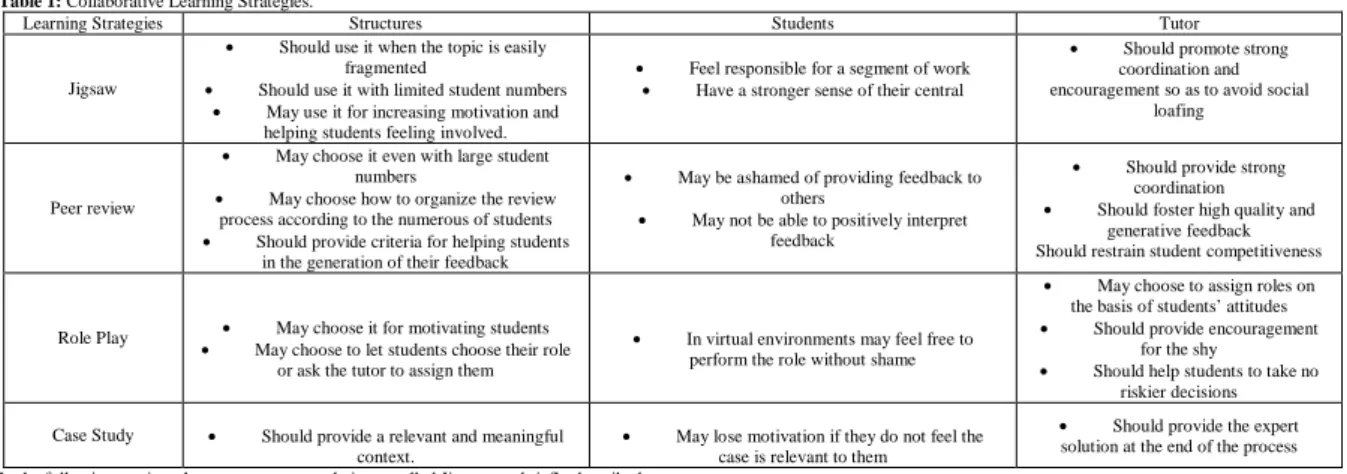
Jara et. al (2009) in Andreas (2010) stated the techniques or activities used in collaborative learning can encourage construction of the student’s knowledge and skill by engaging student’s attention in the learning process. Examples of collaborative techniques are: jigsaw, numbered head together, brainstorming, case study, debate, role play, etc. Such techniques are not strictly native to the e-learning sector in which they often have their origins in face-to-face educational field and have been borrowed and successfully applied in CSCL environment. Based on Pozzi and Sugliano (2006), collaborative learning strategies in online environment can be divided into several structures as in Table 1. The lack of social skills may also help students feel free to perform the assigned roles during the learning in which group members may be less inhibited and this should result in a better performance, thus making the learning process more effective.
Table 1: Collaborative Learning Strategies.
Learning Strategies Structures Students Tutor
Jigsaw
• Should use it when the topic is easily fragmented
• Should use it with limited student numbers • May use it for increasing motivation and
helping students feeling involved.
• Feel responsible for a segment of work • Have a stronger sense of their central
• Should promote strong coordination and encouragement so as to avoid social
loafing
Peer review
• May choose it even with large student numbers
• May choose how to organize the review process according to the numerous of students • Should provide criteria for helping students
in the generation of their feedback
• May be ashamed of providing feedback to others
• May not be able to positively interpret feedback
• Should provide strong coordination • Should foster high quality and
generative feedback Should restrain student competitiveness
Role Play • May choose it for motivating students • May choose to let students choose their role
or ask the tutor to assign them
• In virtual environments may feel free to perform the role without shame
• May choose to assign roles on the basis of students’ attitudes • Should provide encouragement
for the shy
• Should help students to take no riskier decisions
Case Study • Should provide a relevant and meaningful context.
• May lose motivation if they do not feel the case is relevant to them
• Should provide the expert solution at the end of the process In the following section, the most common techniques called Jigsaw are briefly described.
Jigsaw Technique:
According to Hewitt (2005), Bell (2004) and Liu & Tsai (2008) cited in Demetriadis et al.,(2009) has claims that free collaboration may fail to engage all team members in productive interaction. However, this is not agreed by Dillenbourg (2002), which stated that too much guidance or structured activity may hinder
learners’ creativity and freedom and causing a loss of flexibility. Thus, in order to addressing the
matters, Pozzi et al (2011) suggested the level of structuredness of a collaborative can be considered ranging from unstructured or moderately structured activities to highly structured. The structuring can be done from collaborative techniques. Highly structured techniques such as Jigsaw are enables to structure groups, task and activity time.
However, in order to investigate the learning process resulting from the activity, it is necessary to analyze and evaluate the interactions occurred within groups.
A technique for fostering the collaborative learning process is usually described in terms of prescribed procedures and behaviors to be enacted by students (Kanuka and Anderson, 1999). The instructor who often responsible to design the learning environment has to devote special attention to factors and constraints such as students’ characteristics and the context where the activity is to take place that may affect the activity (Pozzi and Sugliano, 2006).
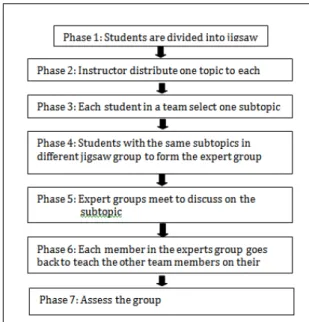
Figure 6 illustrate the phases in the implementation of the Jigsaw technique. Although, this technique has been widely practiced in all disciplines and produce higher achievement than competitive and individualistic learning, a more conceptual approaches on the attitude, cultures differences and learning styles of the students needed to be addresses (Husain et al., 2010).
This is also claimed by Hafizah et al (2013) in which some students did not take the learning strategy seriously and did not take the effort to prepare their part sufficiently to accomplish the given task. Moreover, the implementation of jigsaw technique by instructor requires proper planning and management to obtain excellent results. This initially required tedious and demanding preparation from the instructor.
Fig. 4: Phases of the Jigsaw technique.
The growing popularity of online courses in higher education often involves the transformation of face-to face courses to the online environment, with all its attendant opportunities and challenges. This has leads to many researchers (Amdor & Mederer, 2013; Kordaki & Siempos, 2011; Weidman &Bishop, 2009; Pozzi, 2009) to integrating Jigsaw technique on online teaching and learning. However, the transformation comes with the challenges. The challenges in translating the jigsaw technique to an online format was to retain the ultimate course goal of creating sociologically informed citizens but in more isolated learning environment (Amdor & Mederer, 2013).
Computer Supported Collaborative Learning (Cscl):
In the design of CSCL, the main approach of CSCL is to organize students into various small groups five pillars are listed in order to develop a successful collaboration (Stahl, 2010; Slavin , 2009; Zhao Jianhua & Kanji Akahori, 2001). The five pillars are: positive interdependence, individual accountability, face-to-face interaction, interpersonal and small group social skills and group processing (Kirschner et al, 2015; Rohani , 2014; Hennessey and Dionigi, 2013; Woods and Chen, 2010). A diagram in Figure 7 by Zhao Jianhua and Kanji Akahori (2001) visualize the collaborative learning being carried in the classroom based learning which contains tutor, peers, learning group, communication and traditional classroom learning environment.
the performance of group will increase the quality of the collaborative learning because the students are able to give their constructive feedback on their learning experiences (Jones, 2008; Gillies, 2008) while teacher will guided the responses to the meaningful learning outcome.
Fig. 5: Diagram of Classroom Based Collaborative learning (Zhao Jianhua and Kanji Akahori, 2001).
Since CSCL used tools to support the learning, the model of classroom based collaborative learning by Zhao Jianhua and Kanji Akahori (2001) as in Figure 7 is improved by inserted the system as the domain platform for the interaction . The tutor places on the center of virtual classroom, monitors the interaction among students and generates advices if necessary according to the learning situation. This interaction is supported on the conversation means through the public communication line. The learner can communicate with other learners directly through the private talking line in order to exchange their personal learning histories. The tutor managing the learning situation globally; the tutor takes a place of teacher in classroom activity. If the tutor grasps the learning situation appropriately, the advices which were generated from it may give appropriate hints in order for the learning group to proceed to the nest of learning process. By monitoring the learning situation under these environments, the tutor is able to grasp the learning situation easier and generate advices timely.
The Proposed Cscl Framework with Jigsaw Technique:
Jigsaw has been seen as a method that can support both cooperative learning (Johnson & Johnson, 1992) and collaborative situations (Silverman, 1995). Gallardo (2003) also thought that this technique could be well situated within the constructivist framework of learning. In addition, many researchers have proposed the implementation of this technique within the online context (Gallardo et al., 2003; Kordaki, Siempos and Daradoumis, 2009), despite the fact that Jigsaw was originally proposed for face-to-face education (Aronson and Patnoe, 1997).
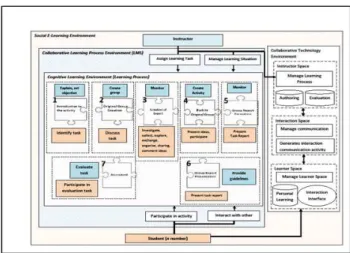
Fig. 6: Proposed CSCL Framework.
The proposed framework as in Figure 6 consists of three main environments which are Social e-learning environment, Collaborative Learning Process Environment (LMS), Cognitive Learning Environment.
The interaction of people is vital in Social E-learning Environment in which social learning can improve
the second environment which labeled as Collaborative Learning Process Environment (LMS). The instructor is the person who responsible to delegate and assign the task to the students. The instructor also manages the learning process and evaluates students’ works at the end of the process which are students’ participation and also a product of the task given. Meanwhile, students are the person who does the task given by the instructor by participates in the activity. They have to work collaboratively (in a group) with others based on a task given. On social learning environment, many researchers agreed that environment in a virtual process is technology which is based on web based education. One of the platforms widely used in web based education is Learning Management System (LMS). Instructor and students are linked to collaborative technology environment as this environment is to support the learning. In this environment, three separate spaces are provided to clearly manage the interaction by instructor and students.
In this paper, we focus on the Cognitive Learning Environment. In this environment, identified actions by students and actor are group with each phase in Jigsaw technique. These actions are explained in the next section under each phases of Jigsaw.
Specifically, the Jigsaw technique proposed in the Cognitive Learning Environment of this framework is expected to enhance the process of listening, commitment to the team, interdependence and team work. Each member of the team has to excel in a well defined subpart of the educational material, undertaking the role of expert. The experts from a different group to discuss the nuances of the subject and later return to their teams to teach their colleagues. The ideal size of teams is 4 to 6 members.
The implementation of the Jigsaw technique could be realized through the following process. 1) Divide the problem into sub problems, 2) Create the heterogeneous groups, 3) Assign roles and material to each student, 4) Form group of experts, 5) Let experts study the material and plan how to teach their colleagues, 6) Let experts teach in their groups and 7) Assess students.
In the next section of this paper, the set collaborative learning activities for the learning of in Computer Science using the Jigsaw technique within computer supported collaborative learning environment is reported.
RESULT AND DISCUSSION
The proposed Jigsaw in the CSCL environment consists seven phases; 1)Introduction to the activity;2) Original group creation; 3)Creation of expert groups; 4)Back to the original groups; 5)Group Report formation; 6)Group report presentation and 7) Assessment
The implementation of these phases within the context of online is diagrammatically represented as a design pastern in Figure 8. The description of the phases is reported in the following section.
Phase 1: Introduction to the activity:
The main goal of this learning activity is to encourage students to learn through performing specific investigations of the following essential issues in Computer Science subject: a) the wide range of computer technology used in daily life and the consequences of such utilization, b) the variety of computer systems serving different tasks, c) the dynamic evolution of information technology in out times. Additionally, this learning activity aims to highlight the value of collaborative learning as a modern technique of teaching.
In the context of these learning aims, students have to investigate essential issues in computer technology such as; the diversity of existing hardware and software, the kinds of computer networks available, the Internet, the social impact of computers as well as their impact on commerce and businesses. To perform these investigations, students should be separated into expert groups according to the aforementioned issues.
Phase 2: Original group creation:
The students are assigned randomly, using the Grouping tool to 4 groups of 6 students. Initially each group discuses using group chat or group forum. The issues presented in the introduction striving to form a commonly acceptable framework of ideas. Each member of each group should also decide which essential issues of computer technology.
Phase 3: Creation of expert groups:
their base groups. Sharing ideas about the appropriate teaching process could be implemented through a chat-room or forum for each expert group.
Phase 4: Back to the original group:
Each expert, on returning to the original group, should propose alternative ways to present the knowledge she/he acquired during her/his participation in the experimentation performed within a specific expert group. Here, the members of the original groups could be provided with some essential activities, so that every student can participate actively in the learning experience. Each expert should also encourage her/his colleagues to better comprehend the knowledge provided. Chat-rooms or forums could be used by each expert to teach their original groups.
Phase 5: Group report formation:
Each group has to prepare a presentation about the total knowledge acquired during their learning process. To form this report, the use of a wiki will be useful. The use of the ‘Submit Files’ activity could be used to send the reports to the teachers.
Phase 6: Group report presentation:
Here, it would be useful to provide students with some recommendations as to how to prepare and deliver
a good presentation. Some useful guidelines for the former are: (a) The presentation must begin with the main idea of the subject, (b) only the key points of the subject have to be presented, (c) On every slide, only 4-5 key points should be presented, (d) A uniform style of presentation must be followed (unnecessary effects must be avoided since these distract the learner from the key concepts), (e) The duration of each presentation should be around 10 minutes (for synchronous presentation using a chat-room) since there is always the danger the students may get bored. There will be additional time to further discuss the learning material.
Phase 7: Assessment:
Each student should be set a quiz after the end of the learning activity, for purposes of assessment. The students cannot help each other during the testing process.
Conclusion And Future Work:
The design of this collaborative learning activity was based on the use of the Jigsaw collaborative method in an innovative way, based on the fact that (a) the tasks assigned to the expert groups consisted of various investigating activities within the real world - where computers are actually used - rather than the study of various online learning materials as is still proposed (b) for the design of the whole collaborative activity, intuitive ‘learning design’-based online tools provided by online environment were used. Some of the advantages of supporting Jigsaw with technology are timesaving, better organization, access to results as they being produced, easy maintenance of a materials repository and incentives to students by technology usage. However, it has been observed that these collaboration learning techniques in CSCL environment being use and adopt in a bad manner (Pozzi and Sugliano, 2006). These situations could made interactions to be not proper implemented. Therefore, agent technologies are seen as most promising technologies for dealing with distributed collaborative environment and social interaction (Miguel et al, 2010). To investigate the effect of this collaboration activity, specific field research is needed using an agent in a real online classroom.
REFERENCES
Amador, J.A., H. Mederer, 2013. Migrating Successful Student Engagement Strategies Online: Opportunities and Challenges Using Jigsaw Groups and Problem-Based Learning. Journal of Online Learning
and Teaching, 9(1): 89. Retrieved from http://search.proquest.com/docview/1500386307?accountid=14645
Andreas, K., T. Tsiatsos, T. Terzidou, A. Pomportsis, 2010. Fostering collaborative learning in Second
Life: Metaphors and affordances. Computers and Education, 55(2): 603-615.
http://doi.org/10.1016/j.compedu.2010.02.021
Aronson, E., N. Blaney, C. Stephin, J. Sikes, M. Snapp, 1978. The Jigsaw Classroom, Beverly Hills, CA: Sage Publishing Company.
Aronson, E., S. Patnoe, 1997. The Jigsaw classroom: Building cooperation in the classroom (2nd ed.). Longman, ISBN 978-0673993830.
Chen, G., R. Shen, J. Wang, Z. Chen, 2007. Collaborative Education Model and Its Application in
E-Learning. In Computer and Information Science. ICIS 2007. 6th IEEE/ACIS International Conference on
(11-13): 856 –860.h ttp://doi.org/10.1109/ICIS.2007.78
Giannoukos, I., V. Loumos, 2008. Collaborative e-learning environments enhanced by wiki technologies
Collaborative e-learning environments enhanced by wiki technologies,
http://doi.org/10.1145/1389586.1389657
Gokhale, A., 1995. Collaborative learning enhances critical thinking. Journal of Technology Education, 7(1). http://scholar.lib.vt.edu/ejournals/JTE/jtev7n1/gokhale.jte-v7n1.html
Hennessey, A., R.A. Dionigi, 2013. Implementing cooperative learning in Australian primary schools:
Generalist teachers' perspectives. Issues in Educational Research, 23(1), 52-68.
http://www.iier.org.au/iier23/hennessey.html
Hewitt, J., 2005. Toward an understanding of how threads die in asynchronous computer conferences.
Journal of the Learning Sciences, 7(4): 567-589. http://doi.org/10.1207/s15327809jls1404_4.
Hiltz, S.R., N. Coppola, N. Rotter, M. Turoff, R. Benbunan-fich, 2000. Measuring the Importance of
Collaborative Learning for the Effectiveness of ALN : A Multi-Measure , Multi-Method Approach, 103–125.
Jara, C.A., F.A. Candelas, F. Torres, S. Dormido, F. Esquembre, O. Reinoso, 2009. Real-time collaboration of virtual laboratories through the Internet. Computers & Education, 52: 126e140.
Kaffash, H.R., Z.A. Kargiban, S.A. Kargiban, M.T. Ramezani, U. Information, & C. Technology, 2010. International Journal of Instruction, 3(2).
Kanuka, H., T. Anderson, 1999. Using constructivism in technology-mediated learning: Constructing
order out of the chaos in the literature. Radical Pedagogy, 1(2). Retrieved from
http://radicalpedagogy.icaap.org/content/issue1_2/02kanuka1_2.html.
Kirschner, P.A., K. Kreijns, C. Phielix, J. Fransen, 2015. Awareness of cognitive and social behaviour in a CSCL environment. Journal of Computer Assisted Learning, 31(1): 59–77. http://doi.org/10.1111/jcal.12084
Kordaki, M., H. Siempos, 2011. A collaborative and adaptive design pattern of the jigsaw method within learning design-based e-learning systems. Studies in Computational Intelligence, 350: 239–255. http://doi.org/10.1007/978-3-642-19814-4_11.
Lai, E.R., 2011. Critical Thinking : A Literature Review Research Report, (June).
Liu, C., C. Tsai, 2008. An Analysis of peer interaction patterns as discoursed by on-line small group
problem solving activity. Computers & Education, 50(3): 627-639.
http://doi.org/10.1016/jcompedu.2006.07.002.
Pozzi, F., 2009. Using Collaborative techniques in Virtual Learning Communities, 670–675.
Pozzi, F., A.M. Sugliano, 2006. Using collaborative strategies and techniques in CSCL environments.
Education, 703–709.
Pozzi, F., L. Hofmann, D. Persico, K. Stegmann, F. Fischer, 2011. Structuring CSCL through Collaborative Techniques and Scripts. International Journal of Online Pedagogy and Course Design, 1(4): 39– 49. http://doi.org/10.4018/ijopcd.2011100103
Saleh, S., A. Aziz, 2012. Teaching Practices Among Secondary School Teachers in Malaysia, 1997, 63– 67. http://doi.org/10.7763/IPEDR.
Slavin, R.E., 2009. Chapter Seven Co-Operative Learning: What Makes Groupwork Work?, 1–16.
Stahl, G., 2010. Guiding group cognition in CSCL. International Journal of Computer-Supported
Collaborative Learning, 5(3): 255–258. http://doi.org/10.1007/s11412-010-9091-7
Valentín, F., De, L., Pardo, A., Asensio-pérez, J. I., & Dimitriadis, Y. A. (2008). Collaborative Learning
Models on Distance Scenarios with Learning Design : A Case Study, 278–282.
http://doi.org/10.1109/ICALT.2008.238.
Weidman, R., M.J. Bishop, 2009. Using the Jigsaw Model To Facilitate Cooperative Learning in an Online Course. Quarterly Review of Distance Education, 10(1): 51–64-89-91. Retrieved from http://search.proquest.com/docview/231068932?accountid=14645