International Journal of Applied Linguistics & English Literature ISSN 2200-3592 (Print), ISSN 2200-3452 (Online) Vol. 6 No. 3; May 2017
Australian International Academic Centre, Australia
Individual Differences and L2 Motivation:
The case of EFL Learners
Azam Badrkoohi (Corresponding author) Islamic Azad University, Science and Research Branch, Iran
E-mail: [email protected]
Parviz Maftoon
Islamic Azad University, Science and Research Branch, Iran E-mail: [email protected]
Received: 14-11-2016 Accepted: 22-01-2017 Advance Access Published: March 2017 Published: 01-05-2017 doi:10.7575/aiac.ijalel.v.6n.3p.199 URL: http://dx.doi.org/10.7575/aiac.ijalel.v.6n.3p.199
Abstract
With the growing understanding of the process of Second Language Acquisition (SLA), more and more emphasis has been put on the learner factors that affect the success or otherwise of SLA. These factors have come to be studied under the general title of “Individual Differences” (ID) (Dörnyei & Ryan, 2015). These factors determine not only the success of an individual second language learner but also the inter-individual variation in second language acquisition. This study is an attempt to shed more light on the relationships among L2 motivation, visual learning style, mental imagery, ideal L2 self, and L2 learning experience in the Iranian context. Exploratory factor analysis was run to ascertain the validity of the questionnaire which was used for data collection. The results revealed that visual learning had its highest correlation with L2 motivation. On the other hand, it had only small to moderate correlations with ideal L2 self, mental imagery, and L2 learning experience. In addition, from among the variables investigated in this study, L2 motivation had the largest correlation with L2 learning experience. Furthermore, the ideal L2 self had the second highest positive correlation with L2 motivation. Finally, mental imagery had the lowest correlation with L2 motivation. The implications of the findings for theory and practice are discussed accordingly.
Keywords: individual differences, L2 motivation, English as a foreign language
1. Introducation
With the growing understanding of the process of Second Language Acquisition (SLA), more and more emphasis has been put on the learner factors that affect the success or otherwise of SLA. These factors have come to be studied under the general title of “Individual Differences” (ID) (Dörnyei & Ryan, 2015). These factors determine not only the success of an individual second language learner but also the inter-individual variation in second language acquisition.
It has been argued that language teaching should take into account individual differences and that language teachers must tailor their teaching to the particular needs and characteristics of his/her students (Lightbown, & Spada, 2013). Hence, it seems that rigorous research should be conducted into these factors and how they affect language learning. This study was conducted to examine the relationship among a number of ID factors. In the next section, some background is provided for the various factors examined in this study. Then, the main problems addressed in the study and its significance will be explained in detail.
2. Review of the related literature
A plethora of factors have been identified as having an influence on learning a second language. Undoubtedly, motivation can be considered as one of the critical elements of successful second language learning. Thus, the concept of motivation and what would influence the students' motivation has received much attention in the area of second language learning.
Although different theories have been tried to explain motivation, only some aspects of motivation have been fully investigated and there are a lot of untapped aspects. In fact, no single theory can explain all human motivation because human beings are very complex creatures with various and complex desires and needs. With respect to students, no learning or even little learning can take place without motivation. In the same line of argumentation Dornyei (1998) “Motivation provides the primary impetus to initiate learning foreign language and later the driving force to sustain the long and often tedious learning process” (p.117). In fact, no long term purposes and sustainable learning and teaching can occur. On the other hand, high motivation can make up for deficiencies and limitations in one's language aptitude and learning conditions.
As Dörney and Chan (2013) argue, recent theories in the realm of second language motivation postulate “viewing motivation as a function of the language learners’ vision of their desired future language selves. This would suggest that the intensity of motivation is partly dependent on the learners’ capability to generate mental imagery” (p.437). In the same line of argumentation, Muir and Dörney (2013) assert that “vision has not only been successfully introduced into the landscape of L2 motivation theory, but has become instrumental to our understanding of how to inspire motivated action in the language classroom” (p.358). To put it in another way, Dörney and Kubanyiova (2014) consider vision as one of the most powerful motivational sources.
2.1 The L2 motivational Self-system
With the growing dissatisfaction about the integrative and instrumental motivation, the theoretical construct of ‘The L2 Motivational Self System’ was proposed by Dörnyei (2005). Through the lens of the L2 Motivational Self System, learners are seen to have a respect for the L2 speaking community rather than integrative orientation. Another reason for proposing this framework is the theory of possible selves which opens up new possibilities. The L2 Motivational Self System involves three dimensions, namely Ideal L2 self, the Ought-to self, and L2 Learning experience (Dörnyei, 2009).
The ‘Ideal L2 self’ refers to“L2-specific facet of one’s ‘ideal self’” (Dörnyei, 2009, p. 29). It demonstrates the ideal
image a learner prefers to have in the future.
The ‘Ought-to L2 self’ deals with “the attributes that one believes one ought to possess to meet expectations and to
avoid possible negative outcomes” (Dörnyei, 2009, 29).
Finally, the ‘L2 Learning experience’ refers to the “situated, executive motives related to the immediate learning
environment and experience” (Dörnyei, 2009, 29). Papi (2010) states that situation-specific motives such as the L2 teacher, the curriculum, the teaching materials, and the peer group can have a remarkable and strong effect on motivated behavior. L2 Learning experience is not related to self-image but it is related to the situation in which the learning process occurs.
On the other hand, Gardner (2001) believes that ‘integrativeness’ refers to the desire to learn an L2 of a valued
community, so that one can communicate with members of the community and sometimes even become like them (Dörnyei & Ushidoa, 2009). Gardner (2001, p. 5) further argues that:
Integrativeness reflects a genuine interest in learning the second language in order to come closer to the other language community. At one level, this implies an openness to, and respect for other cultural groups and ways of life. In the extreme, this might involve complete identification with the community (and possibly even withdrawal from one’s original group), but more commonly it might well involve integration within both communities.
Integrative motivation is considered as a more complex, multi-componential construct, and includes three main constituents: ‘integrativeness’, ‘attitudes towards the learning situation’, and ‘motivation’. The last one is seen as strong force of motivated behavior, continuous effort, desire and affect (Gardner, 2001).
Worldwide globalization process and the growing dominance of global or world English as an international language is
another problematic area toward integrativness (Dörnyei, Csizér, & Nemeth, 2006). It is argued that in the new
globalized word order, most people tend to develop a bicultural identity, in which part of their identity is rooted in their local culture and another part is associated with a global identity that connects them with international contexts. The language of this global identity is English, and from this view it is not obvious who EFL (English as a foreign language) learners believe the ‘owner’ of their L2 is. Gardner’s theoretical concept of integrativeness would be underestimated due to the lack of a specific target L2 community (Dörnyie, 2009).
The L2 motivation has been investigated in relation to different factors. In this study the relationship between L2 motivation and ideal L2 selves, visual learning style, mental imagery, and L2 learning experience. Hence, each of these concepts is explained in detail in the following sections.
2.2 Visual Learning Style
• They relate to words such as see, look, pictures, observe, show, imagine.
• They understand better and retain information most efficiently by looking at visually stimulating objects such
as pictures, diagrams, and charts
• They prefer modeling and observation to verbal explanation
• They enjoy a powerful visual memory and can remember, for examples, faces, locations, signs. (p.165)
It is also worth mentioning that there is a direct relationship between vision and visual imagination of visual learning style because as Modell (2003) states vision and visual imagination use the same neural circuitry. So, some relationship can be detected between visual learning style, imagination, and imagination capacity.
You, Dörney, and Csizér (2016, p. 116) state that “of the sensory styles, Visual Style in particular had a strong influence on Vividness of Imagery”. Besides they assert that vividness of imagery have remarkable and tremendous impacts on two future self-guide and Ideal L2 Self which are referred to as one's vision. They also state that although the Ought-to L2 Self is also strongly affected by vivid imagery, the effect of vivid imagery on the Ideal L2 Self is almost twice as strong. It implies that “ought-to language selves—are often less internalized and visualized than one's own ideal language selves” (p. 118). They also stated that female learners have a more positive attitude towards L2 and are more motivated compared to male learners because they are high-visualizers and vision has a clear bearing on students’ commitments to acquiring a second language.
Tai (2013) investigated the relationship between students’ preferred learning style and their motivation. He discovered of the seven styles, computer-assisted style was the most preferred, while individual and visual styles were the least preferred. Furthermore, he found that there were significant relationships between auditory, tactile, kinesthetic, and computer-assisted learning style and motivation in learning English while no relationship was established between visual learning style and motivation.
Ghaedi and Jam (2014) set out to investigate the relationship between learning style and motivation. They discovered that there was a significant relationship between motivation and learning styles. Besides the results demonstrate that the highest correlation belong to visual learning styles that is, visual learners have more motivation for higher education. A different result was reported by Dai, Wu, and Dai (2015). They surveyed the relationship among motivation, language proficiency, and learning style. The results of their study indicated that motivation and English proficiency was moderately correlated and the visual learning style was negatively correlated with motivation. In other words, the less motivated learners tend to employ visual learning style.
2.3 Mental Imagery
Weinberg (2008) defines mental imagery as the “creation of mental images with the use of various sensory modalities including visual, auditory, olfactory and tactile” (p. 2). From a practical perspective, the main question is how language educators can use mental imagery and possible self in EFL classroom. It is suggested that possible selves may create different feelings such as efficacy, competence, control, and optimism and all these feelings affect learners’ behavior. However, the learners’ ideal selves could not be developed from scratch. In fact, it is essential to raise learners’ awareness about their accomplishments, their strengths and weaknesses while picturing future goals (Dörnyei, 2009). Arnold, Puchta, and Rinvolucri (2007) state that mental imagery can strengthen self-concept and enhance language learners’ motivation and learners’ motivation plays an important role in measuring the effectiveness of instruction in any academic context. As it is said, the importance of self-concept should not be ignored in language learning. Some learners have a low self-concept and negative idea about learning L2 which limits their real ability. Teachers should assist them to strengthen their self-concept and break that negative idea through visualization.
Guided mental imagery exerts considerable influence on learners to see and feel themselves speaking English well and managing learning problems. It is suggested that learners try to play the visualization game repeatedly in which they visualize themselves speaking the language fluently and interacting with people. So, when they are in a real situation, they feel that they have been there before. In a similar way, the ideal L2 self can act as a strong motivational force. If L2 learners have a vivid ideal vision of themselves, they will be more motivated to learn the language.
In the EFL classrooms, using mental images can help learners to increase their interests about language learning and make them more active and participatory in the learning process. In addition, personal meaning has been considered as an important component of motivation. This means that if one has to learn something that has no relevance to their lives, they may lose their motivation. In EFL classrooms, teachers can strengthen their students’ mental imagery through visualization training, language learning in mind, storytelling forming imagery of time and place, forming personal pictures in mind.
Although past research has confirmed the links between visual learning style, mental imagery, L2 ideal self, and L2 motivation, the current study is unique in that it further examines the possible relations among L2 learning experience and other four variables. The present study aims to replicate Al-Shehri’s finding by exploring the role of L2 learning experience in our social context of Iran. On the other hand, although the role of visual learning style on L2 motivation has increasingly been gaining importance in the literature, this has not been taken into consideration in Iranian EFL learning context. Specifically, the following research questions were posed in this study:
1. Is there any statistically significant relationship between L2 motivation of Iranian EFL learners and their visual
2. Is there any statistically significant relationship between visual learning style of Iranian EFL learners and their mental imagery?
3. Is there any statistically significant relationship between visual learning style of Iranian EFL learners and their
ideal L2 Self?
4. Is there any statistically significant relationship between visual learning style of Iranian EFL learners and their
L2 learning experience?
In the next section, the methodology adopted in the paper, including the participants, the design, and the data analysis, are explained.
3. Method 3.1 Participants
The participants of the study were 100 senior BA students (both male and female) majoring in English Translation or TEFL at Islamic Azad University, Central Branch, Tehran, Iran. As these students had studied English as their major for almost four years it was assumed that in terms of their English knowledge and learning experiences they were experienced enough to take part in the study.
Though the proficiency level of the learners was not taken as a significant factor in the present study, it was assumed that they were all above the intermediate level considering the fact that they were senior learners and the age range of the participants was 22 to 25.
3.2 Instrumentation
The data for the present study was collected by means of a validated questionnaire (see Appendix I): This instrument was employed in the current study to collect the data about the participants’ L2 motivation, mental imagery, visual learning style, the Ideal L2 self and L2 learning experience. In fact, the main body of the questionnaire was adopted from Al-shehri (2009) to which a new component of L2 learning experience was added. The new component consisted of six items which were adapted from Papi and Abdollahzadeh (2012). Some items about Ideal self were also adapted from the same paper. The questionnaire was in the likert format with the item responses ranging from strongly agree (1) to strongly disagree (6).
To ensure the reliability and the validity of the collected data in this study, the new questionnaire which was the main instrument of the current study underwent piloting and validation. Hence, the questionnaire was piloted among 40 students similar to the target group. Results of the pilot study represented that the scale enjoyed high reliability of 0.83 based on Cronbach alpha coefficients.
The content validity of the questionnaire was also checked by two experts who were university professors in TEFL. In so doing, they essentially checked the wording and content of the instrument. Then according to their comments, the necessary modifications were made. The face validity of the instrument was improved by considering some aspects such as good layout, font type, margin, and color and also checking them with the previously validated questionnaires in the literature.
The main constructs in the questionnaire were as follows:
· Mental imagery: The ability to create visual imagery in one’s mind in English (five items).
· Visual learning style: A way of learning in which information is associated with images (ten items).
· Ideal L2 self: The representation of the L2 attributes that one wishes to possess if one is able to master one's L2
(eight items).
· L2 motivation: This factor measures the amount of motivation learners have to learn English (eleven items)
· English learning experience: This notion assesses the situation-specific motives related to English learning
immediate environment and experience (Six items)
3.3 Procedure
After piloting the questionnaire, it was administered to 100 EFL students in Islamic Azad University, Central Tehran Branch. In fact, 130 questionnaires were distributed manually among EFL students and they were informed about the study and the purposes before completing the questionnaire. They were also briefed that they had complete freedom and choice in participating in the study and their performance would not affect their grades. It approximately took fifteen to twenty minutes for the participants to fill out the questionnaires. Out of 130 questionnaires distributed 25 ones were either incomplete or mutilated, hence they were discarded. Five questionnaires were not returned back, hence the total number of 100 completed questionnaires were the basis of the data collected for the present study.
3.4 Data Analysis
4. Results
Exploratory Factor Analysis (EFA) was exploited to examine the validity of the Questionnaire. Prior to factor analysis, the factorability of the correlation matrix was scrutinized. It was found that there were a lot of high correlations in the matrix supporting the hypothesis that the factors are highly correlated. In addition, the Kaiser-Meyer-Olkin Measure of Sampling Adequacy turned out to be 0.72 which is clearly above the minimum required level of 0.60 (Pallant, 2007).
Furthermore, Bartlett's Test of Sphericity was also significant at p<.001 level. Hence, the results support the
factorability of the initial correlation matrix.
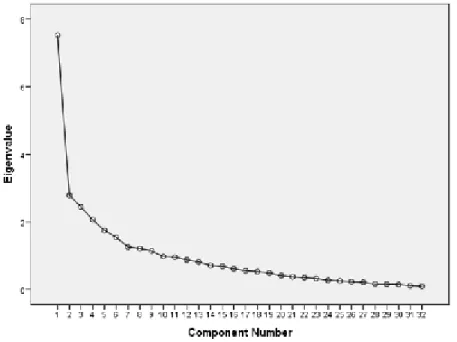
Figure 1. The scree Plot
After making sure that factors can be extracted from the correlation matrix, several Principal Components Analyses (PCA) were performed. The extracted factors were rotated using the Varimax rotation technique. The decision as to number of factors to be extracted was made on the basis of prior theory, an inspection of the scree plot, and the meaningfulness of the pattern of factor loadings.
The results of the factor analysis revealed that 8 items out of the initial pool of items must be deleted in order to achieve simple structure. Hence, 32 items were retained. The scree plot for the final pool of items is presented in Figure 1. Note that the interpretation of the scree plots is not always clear. This seems to be the case with the current data. In such cases, this is usually suggested that a Parallel Analysis (PA) be done.
The results revealed that five factors can be extracted from the data. This is because the amount of variance by the fifth factor extracted from the current data was higher than the variance explained by the fifth factor extracted from random data. This finding was in keeping with prior theory. Hence, it was decided that five factors should be extracted. The five factors explained about 52 percent of the total variance which is considered acceptable.
The factor loadings are displayed in Table 1.
Table 1. Factor loadings Component
1 2 3 4 5
Item 30 .732
Item 29 .691
Item 34 .674
Item 33 .636
Item 26 .575
Item 24 .566
Item 25 .559
Item 32 .549
Item 20 .858
Item 19 .783
Item 17 .728
Item 21 .616
Item 23 .523
Item 16 .507
Item 37 .769
Item 36 .673
Item 39 .629
Item 38 .439
Item 40 .360
Item 1 .814
Item 3 .635
Item 4 .573
Item 5 .543
Item 2 .422
Item 10 .661
Item 14 .521
Item 11 .492
Item 7 .468
Item 6 .447
Item 13 .423
Item 9 .417
It appears from Table 1 that all factor loadings are above 0.40. In addition, there are no cross loadings above 0.40. Overall, the results of the factor analysis and the pattern of the factor loadings support the factorial structure of the questionnaire.
Table 2. Item statistics
Mean Std. Deviation
Corrected Item-Total Correlation
Squared Multiple Correlation
Cronbach's Alpha if Item Deleted
Item 1 1.790 .820 .383 .678 .868
Item 2 2.020 1.015 .463 .647 .866
Item 3 2.180 1.132 .349 .615 .868
Item 4 2.170 .985 .515 .690 .865
Item 5 2.320 1.205 .138 .534 .874
Item 7 2.180 1.067 .160 .403 .873
Item 6 2.030 .948 .229 .482 .871
Item 9 2.070 1.066 .431 .554 .866
Item 10 2.290 1.140 .174 .618 .873
Item 11 2.190 1.051 .255 .383 .870
Item 13 2.160 .896 .175 .460 .872
Item 14 2.540 1.251 .343 .466 .869
Item 16 2.410 1.198 .391 .541 .867
Item 17 2.240 1.006 .469 .621 .866
Item 19 2.190 1.061 .540 .771 .864
Item 20 2.280 1.181 .505 .830 .864
Item 21 2.310 1.051 .531 .698 .864
Item 22 2.180 .978 .536 .712 .864
Item 23 2.440 1.018 .269 .499 .870
Item 24 1.940 .930 .486 .648 .865
Item 25 1.960 .994 .597 .691 .863
Item 26 1.850 .936 .672 .704 .861
Item 29 1.940 .962 .541 .611 .864
Item 30 1.920 .981 .525 .669 .864
Item 32 2.240 1.006 .500 .538 .865
Item 33 2.020 .943 .479 .546 .865
Item 34 1.940 .962 .552 .605 .864
Item 36 2.500 1.040 .506 .771 .865
Item 37 2.550 1.226 .336 .686 .869
Item 38 2.580 .901 .196 .435 .873
Item 39 2.410 1.006 .493 .666 .865
The Cronbach’s Alpha reliability of the questionnaire turned out to be 0.871. Considering the number of items included in the questionnaire, it seems that the scale is enjoying a high degree of reliability.
The items statistics for the questionnaire items are displayed in Table 2. The item means are included in the second column. Note that there is a wide variation among the item means. It shows that the participants do not have the same amount of the constructs tested by various items. The standard deviations of the item scores are displayed in Column 3. These show the differential performance of the participants on each item.
Column 4 includes the item-total correlations. These are actually the correlations among items scores and total scores. The higher the correlation, the more similar the performance on the test and the item. The squared multiple correlations in Column 5 show if performance on the given item can be predicted from all other items in the scale. These should be neither too high nor too low. Too high a correlation would indicate that the item does not make any unique contribution to the construct. On the other hand, too low a correlation would mean that the item may be testing a different construct. Here, all multiple correlations seem to be acceptable.
The last column shows what the reliability of the scale will be if the specific items is deleted. A remarkable increase in reliability if the item is deleted would indicate that the item may not be functioning properly. No noticeable is the reliability indices are observed in Table 2. Hence, the items are functioning as intended.
After ascertaining the validity of the questionnaire and making sure that the items are functioning in the intended way, analyses were conducted to answer the research questions posited in the study. The descriptive statistics for the five constructs are presented in Table 3. Note that the number of items in each subscale was different. Hence, the subscales were rescaled so that the scores in all subscales are from 1 to 5. This is the reason for the decimals in the maximum scores in Column 3.
Table 3. Descriptive statistics
Minimum Maximum Mean Std. Deviation Variance
Mental Imagery 1.00 4.20 2.096 .690 .476
Visual Learning Style 1.00 3.43 2.209 .600 .360
Ideal L2 Self 1.00 4.43 2.293 .756 .572
L2 Motivation 1.00 3.50 1.976 .682 .465
L2 Learning Experience 1.20 4.40 2.582 .649 .421
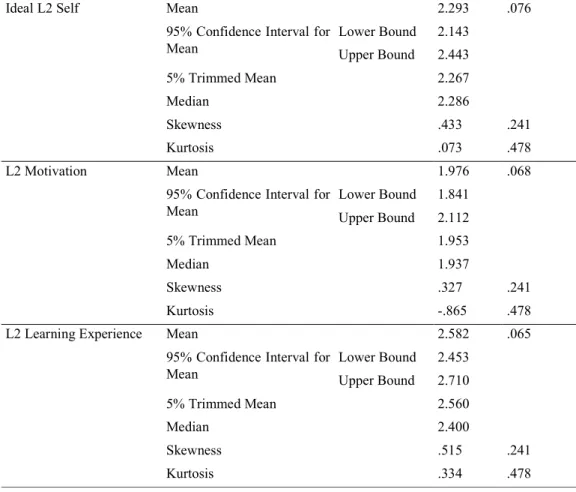
Note that the mean scores are not the same. However, all standard deviations are fairly similar except for Ideal L2 Self which shows more variation. It means that the participants were more different when it comes to their Ideal L2 Self. Before checking the relationships among the relevant subscales, the normality of the data must be checked. The relevant statistics are presented in Table 4. In order for the variables to be normally distributed, the mean and the trimmed mean should not be noticeably different. This would indicate that there are outliers. In addition, the skewness and kurtosis indices should not be significantly different from zero.
Table 4. Normality indices for the five subscales
Statistic Std. Error
Mental Imagery Mean 2.096 .069
95% Confidence Interval for Mean
Lower Bound 1.959
Upper Bound 2.233
5% Trimmed Mean 2.062
Median 2.000
Skewness .696 .241
Kurtosis .292 .478
Visual Learning Style Mean 2.209 .060
95% Confidence Interval for Mean
Lower Bound 2.090
Upper Bound 2.328
5% Trimmed Mean 2.211
Median 2.286
Skewness -.122 .241
Ideal L2 Self Mean 2.293 .076 95% Confidence Interval for
Mean
Lower Bound 2.143
Upper Bound 2.443
5% Trimmed Mean 2.267
Median 2.286
Skewness .433 .241
Kurtosis .073 .478
L2 Motivation Mean 1.976 .068
95% Confidence Interval for Mean
Lower Bound 1.841
Upper Bound 2.112
5% Trimmed Mean 1.953
Median 1.937
Skewness .327 .241
Kurtosis -.865 .478
L2 Learning Experience Mean 2.582 .065
95% Confidence Interval for Mean
Lower Bound 2.453
Upper Bound 2.710
5% Trimmed Mean 2.560
Median 2.400
Skewness .515 .241
Kurtosis .334 .478
A look at the indices included in Table 4 reveals that the means and the related trimmed means are very similar. Also, none of the kurtosis and skewness indices are noticeably different from zero. Therefore, it may be concluded that all variables (i.e., subscales) are adequately normally distributed.
Table 5. Correlation indices
The various correlation indices needed in order to answer the research questions are displayed in Table 5. Note that all correlation coefficients are statistically significant. However, the absolute values of the correlations seem to show a large variation. The smallest correlation is between L2 Motivation and Mental Imagery while the largest correlation happens between L2 Learning and L2 Learning Experience.
5. Discussion
One of the findings is that the visual learning style had the highest correlation with L2 motivation. This would in effect mean that L2 learners who have a preference for the visual style are generally more motivated. Al-Shehri (2009) has argued that learners with visual learning style have strong imagination and these kinds of learners are capable of developing more potent ideal language self. This may partly account for our finding a higher positive correlation between L2 motivation and the visual learning style.
This confirms the findings of some of the previous studies who have focused on the relationship between visual learning style and motivation. Al-Shehri (2009), for instance, found a large positive correlation between L2 motivation and visual style. In fact, the correlation between these two variables was almost as high as the correlation between Ideal L2 Self and L2 motivation.
Mental Imagery
Visual Learning Style
Ideal L2
Self
L2 Motivation
L2 Learning Experience Visual Learning
Style
Pearson Correlation .225 1 .227 .402 .264
Sig. (2-tailed) .024 .023 .000 .008
L2 Motivation Pearson Correlation .221 .402 .632 1 .677
This is interesting considering the characteristics of visual learners. These learners learn best when they actually ‘see’ the objects. In fact, these learners have good visual memory and imagery skill and they often remember what is observed and retrieve events and details by focusing on them (Dunn, 1988).
The implication of such a finding for the classroom practice is also very important. With visual learners in the classroom, language teachers should make use of “pictures, filmstrips, computers, films, videos, graphs, charts, transparencies, diagrams, drawings, books, and magazines (provide resources that require reading), and written assignments and evaluations” (Tai, 2013, p.163). The higher the availability of such objects in the classroom, the higher the chances of learning on the part of visual learners.
Not all studies in the literature have reported a positive correlation between visual learning and L2 motivation. Tai (2013), for instance, reported that, compared to other styles such as auditory and tactile, visual learning did not have any predictive power for L2 motivation. This finding notwithstanding, the majority of the studies conducted in the literature have reported a high positive correlation between L2 motivation and visual learning.
Another finding of the present study is the fact that mental imagery, ideal L2 self, and L2 learning experience all had similar moderate correlations with visual learning. Although all the correlations are statistically significant, they are not as high as the correlation between visual learning and L2 motivation.
It was interesting to find that L2 motivation had the highest correlation with L2 learning experience. Dornyei (2005) defines L2 learning experience as being concerned with “situated, executive motives related to the immediate learning environment and experience (e.g., the impact of the teacher, the curriculum, the peer group, the experience of success)” (p.29). This clearly shows the significant role played by the learning environment (including all objects and people involved) in the learning process.
This finding supports also the claim by some scholars such as Papi (2010) who argue that situation-specific motives such as the L2 teacher, the curriculum, the teaching materials, and the peer group can have a remarkable and strong effect on motivated behavior
The ideal L2 self had the second highest correlation with L2 motivation. This finding is in keeping with a large body of literature which has reported a large positive correlation between ideal L2 self and L2 motivation (e.g., Al-shehri, 2009; Dörnyei & Chan, 2013; Taghuchi, Magid, & Papi, 2009; You & Chan, 2015).
In fact, Higgins (1987, p. 320) defines the ideal self as “the representation of attributes that someone would ideally like to possess (a representation of hopes, aspirations, or wishes)”. In addition, Dörnyei (2009, p. 29) applied the ideal self to the L2 context and defines the ideal L2 self as “the L2-specific facet of one’s ideal self”. From this definition, it is clear that the higher a particular learner’s standards about his ideal self, the higher his/her motivation to move towards that ideal. Of course, the limits of this argument should also be recognized as being too much of a perfectionist about one’s ideals may result in demotivation.
Finally, mental imagery had the lowest correlation with L2 motivation though the correlation was statistically significant. Taking into account the absolute value of the correlation coefficient obtained in this study (i.e., 0.22), it may be argued that mental imagery and L2 motivation are only mildly correlated. This may put under question the claims of some scholars such as Arnold, Puchta, and Rinvolucri (2007) who have argued that mental imagery can enhance L2 learners’ motivation and strengthen their self-concepts.
6. Conclusion
Before embarking on the implications of the findings of the study, a word of caution is in order. It is now well-known that a correlation coefficient does not give us the grounds for making causal inferences. Hence, a high positive correlation between, say variables X and Y, does not necessarily mean either X causes Y, or Y causes X. The findings reported here must be interpreted with this caution in mind.
As stated earlier, visual learning style had its highest correlation with L2 motivation. The implication of such a finding for language teachers is clear. Remember that visual learning style refers to learning and teaching in which concepts, ideas, information, and data are associated with visual techniques and images. In order for teaching to be beneficial to the visual learners, it must provide lots of opportunities where visual objects aid learning. As Tai (2013, p.163) argues, language teachers should make use of “pictures, filmstrips, computers, films, videos, graphs, charts, transparencies, diagrams, drawings, books, and magazines (provide resources that require reading), and written assignments and evaluations”.
Another implication of the findings pertained to the high positive correlation between L2 motivation and L2 learning experience. In fact, this was the highest correlation for L2 motivation. We earlier gave the definition of L2 learning experience offered by Dornyei (2005, p.29) who explains it as “situated, executive motives related to the immediate learning environment and experience (e.g., the impact of the teacher, the curriculum, the peer group, the experience of success)”. In fact, our findings revealed how important the learning environment can become in affecting the learners’ motivation.
therefore, teachers should focus on the learning styles of individual learners. In other words, this is another piece of evidence in support of the idea that one size may not fit all.
The final implication of the study follows from the fact that the ideal L2 self had the second highest correlation with L2 motivation. Ironically, the L2 learning experience was more correlated with L2 motivation than the ideal L2 self did. This is similar to what Csizèr and Kormos (2009) reported. Based on the findings, it seems that the L2 learning experience is much important than any other variable examined in this study. Of course, further research is clearly needed before such conclusions can be generalized to other contexts.
References
Al-Shehri, A. S. (2009). Motivation and vision: The relation between the ideal L2 self, imagination and visual style. In
Z. Dörnyei & E. Ushioda. (Eds.), Motivation, language identity and the L2 self (pp.164-171). Bristol, UK: Multilingual
Matters.
Arnold, J., Puchta, H., & Rinvolucri, M. (2007). Imagine that! with CD-ROM/audio CD: Mental imagery in the EFL
classroom. Cambridge: Cambridge University Press.
Ary, D., Jacobs, L. C., Sorensen, C., & Razavieh, A. (2011). Introduction to research in education. Canada:
Wadsworth.
Brown, H. D. (2000). Principles of language teaching and learning (4th ed.). White Plains, NY: Longman.
Celcia-Murcia, M. (2001). Teaching English as a second or foreign language (3rd ed.). NY: Dewey Publishing
Services.
Dai, Y., Wu, Z., & Dai, L. (2015). The relationships among motivation, learning styles and english proficiency in EFL
music students. International Journal of English Linguistics, 5(6), 75-83.
Dornyei, Z. (1998). Motivation in Second and Foreign Language Learning, Language Teaching, 31,117-135.
Dörnyei, Z. (2005). The psychology of the language learner: Individual differences in second language acquisition.
Mahwah, NJ: Lawrence Erlbaum.
Dörnyei, Z. (2009).The L2 motivational self-system. In Z. Dörnyei & E. Ushioda (Eds.), Motivation, language identity
and the L2 self (pp. 9-42). Bristol: Multilingual Matters.
Dörnyei, Z., & Chan, L. (2013). Motivation and vision: An analysis of future L2 self-images, sensory styles, and
imagery capacity across two target languages. Language Learning, 63(3), 437-462.
Dörnyei, Z., Csizér, K., & Németh, N. (2006). Motivation, language attitudes and globalization: A Hungarian
perspective. Clevedon, England: Multilingual Matters.
Dörnyei, Z., & Kubanyiova, M. (2014). Motivating learners, motivating teachers: Building vision in the language
classroom. Cambridge: Cambridge University Press.
Dörnyei, Z., & Ryan, S. (2015). The psychology of the language learner revisited. London: Routledge.
Dörnyei, Z., & Ushioda, E. (2009). Motivation, language identities and the L2 self: future research direction. In Z.
Dörnyei & E. Ushioda (Eds.), Motivation, language identity and the L2 self (pp. 350-356). Bristol: Multilingual
Matters.
Gardner, R.C. (2001). Integrative motivation and second language acquisition. In Z. Dörnyei & R. Schmidt (Eds.),
Motivation and second language acquisition (pp. 1-20). Honolulu, HI: University of Hawaii Press.
Ghaedi, Z., & Jam, B. (2014). Relationship between learning styles and motivation for higher education in EFL
Students. Theory and Practice in Language Studies, 4(6), 1232-1243.
Higgins, E.T. (1987). Self-discrepancy: A theory relating self and affect. Psychological Review, 94, 319-340.
Ifenthaler, D., & Lehmann, T. (2012). Preactional Self-Regulation as a Tool for Successful Problem Solving and
Learning. Technology, Instruction, Cognition & Learning, 9.108-118.
Lightbown, P.M. & Spada, N. (2013) How Languages are Learned (4th edition). Oxford: Oxford University Press.
Modell, A.H. (2003). Imagination and the meaningful brain. Cambridge, MA: MIT Press.
Muir, C., & Dörnyei, Z. (2013). Directed motivational currents: Using vision to create effective motivational pathways.
Studies in Second Language Learning and Teaching, 3(3), 357-375.
Pallant, J. (2007). SPSS survival manual: a step by step guide to data analysis using SPSS. Maidenhead: Open
University Press.
Papi, M. (2010). The L2 motivational self system, L2 anxiety, and motivated behavior: A structural equation modeling
approach. System, 38, 467-479.
Papi, M., & Abdollahzadeh, E. (2012). Teacher motivational practice, student motivation, and possible L2 selves: An
Taghuchi, T., Magid, M., & Papi, M. (2009). The L2 motivational self-system amongst Chinese and Japanese learners
of English: A comparative study. In Z. Dörnyei & E. Ushioda (Eds.), Motivation, language identity and the L2 self (pp.
66-97). Bristol: Multilingual Matters.
Tai, F. M. (2013). Adult EFL students' preferred learning styles and motivation. The Journal of Human Resource and
Adult Learning, 9(2), 161-172.
Weinberg, R. (2008). Does imagery work? Effects on performance and mental skills. Journal of Imagery Research in
Sport and Physical Activity, 3(1), 1-21.
You, C., & Chan, L. (2015). The dynamics of l2 imagery in future motivational self-guides. In Z. Dörnyei, P.
MacIntyre, & A. Henry (Eds.), Motivational dynamics in language learning (pp.213-230). Bristol: Multilingual
Matters.
You, C. J., Dörnyei, Z., & Csizér, K. (2016). Motivation, vision, and gender: A survey of learners of English in